so in London listening to the Songlines CD there’s a track we love by Mexican Institute of Sound, a track called México, kind of politico-funk mariachi. In Mexico I see, along with an actually infinite number of other wonderful things, several references to a book called Pedro Páramo, and I also happen to watch a documentary about Mexican music called Hecho en México which features a mix of famous and well-known names. There’s a kind of bedroom DJ with this kind of absurdist electro track about how it’s really hard for him to get any action in DF because he’s just too weird. I look him up and it turns out that his name is Camilo Lara and he’s also the guy behind Mexican Insitute of Sound, which is actually called, for fairly self-evident reasons, Instituto Mexicano del Sonido, and he uses a lot of spoken samples in his work from a guy called Juan Rulfo, who I’ve never heard of, but it turns out he’s the guy who wrote Pedro Páramo, which I now realise is the book that Hussain told me that I must read, and which I will now actually read, once I’ve finished reading this book in which I now remember I more recently came across a reference to Pedro Páramo (and I also must get round to reading El Laberinto de la Soledad, because it crops up everywhere), and I now also want to listen to everything by Insituto Mexicano del Sonido, and other similar bands and singers, such as Natalia Lafourcade, who, in 2012
Author: Rich Will
Mexico City and London: Striving to Survive

A neoliberal writes
You don’t come across many shirkers in Mexico City. Not even that many beggars. People work, and when there isn’t any work, they work. Six in 10 Mexican workers, or 30 million people, work in the informal economy — take the metro and at every stop there is someone who has got hold of some cough sweets, a few soft drinks or a box of cooking magazines and who is working as hard (and as loudly) as they can to convince people that they want them. As I sit and write this I lose count of the number who have passed my window selling food, collecting broken appliances, gathering garbage in that particular local combination of recycling and scavenging… . Mexico is a country of strivers and entrepreneurs.
*****
What can we make of this? It’s true that in DF that you don’t come across many people simply begging — not, at least, in relation to the amount of poverty that undoubtedly exists. It’s also true that there are people selling things everywhere — the area around the Zócalo (the enormous central square) has more face-to-face economic exchange taking place than anywhere I’ve ever seen. It’s a kind of economic activity similar to that which in Brazil is called biscate — hand to mouth existence sustained by small-scale informal activity on a massive scale, without any of the protections we are (quite reasonably) so very accustomed to and dependent on in most of Europe and/or the UK. People may be striving, but it’s not to succeed — it’s to survive in the absence of any kind of welfare state.
What doesn’t announce itself quite so visibly or so loudly are the immense difficulties which underpin this unprotected way of life. The consequences of failure in this intensely fragile and fraught fight for sustenance are immense. Not selling a sufficient amount of merchandise on any given day means hunger on a level that I for one am unable to imagine without great effort (although it is imperative that I try). Healthcare, for the poorest, is simply not an option. And as for housing, it turns out that most people working informally in DF do not live in large rented flats in the middle of Condesa… . Also less immediately noticeable is all the activity that goes on behind the scenes: the violence which so often mediates all kinds of informal transactions, the extortion, the drug gangs, the prostitution and trafficking in women, and so on. Not to mention, of course, that there are very many people who beg on the streets of DF, who live an even more precarious existence — the people from indigenous backgrounds, those right down at the bottom of society. Plus there’s also the fact that Mexico is a primate city, meaning that it concentrates huge amounts of economic activity which the rest of the country doesn’t get to enjoy. People in Oaxaca, Guerrero and Michoacán live an even more radically unprotected existence — there, any contact with the forces of public security is to be avoided at all costs. The Afonso Cuarón film Y Tu Mamá También (2001)is a subtle but forceful exploration and indictment of these contractions.
How does this relate to the UK? One interesting thing about the coverage of the 2011 riots, particularly in relation to the abolition of ESA , was learning just how much the economic lives of teenagers in some parts of London revolves around the circulation of small amounts of money for and from dealing in hash and weed. On the whole though, the culture that I’ve been trying to describe hasn’t really existed in the UK in my lifetime. Firstly, nowadays there simply isn’t the space to sell things informally. Service and retail industries are very tightly controlled, with supermarkets and aspirational malls having taken the place of (in the words of the 6-year-old daughter of Newham Mayor Robin Wales) ‘dirty’, ‘smelly’ street markets and carboot sales. Public space is also very restricted and controlled — anyone setting up a tamarind stand in Paternoster Square would be given very short shrift, and it’s hard to imagine what kind of response someone would provoke if they took to the tube in an attempt to knock out cut-price Juan Gabriel DVDs at very full volume.
Of course, if you want to sell goods or services, there is also the internet. Nowadays, while there is a distinct, but suspicious, lack of people who say they’re unemployed, there is an abundance of individual freelancers, hustling their products and skillsets online, always on the lookout for a creative opportunity in the brutal new world of the knowledge-based economy. Nowadays in the UK being an ‘entrepreneur’ is increasingly the only available or permitted mode of economic survival — just count the amount of times today you see the term ‘your business’. But this sexy fantasy hides the reality of people scrambling around doing odd jobs in a heart-racing struggle to be able to pay the rent. It is a term desperately in need of détournement — someone depending on Taskrabbit to survive enjoys fewer rights than a medieval serf, and to think of them in the same terms as Alan Sugar is something of a category error.
In Mexico this struggle for day-to-day existence is visible, on the surface. In the UK, it is less so. So much of the postmodern biscate economy takes place behind a screen, on smartphones whose expensive monthly tariff is even more important than rent for people whose basic survival depends on an occasional email or text message. For neoliberals, the internet appears to be a free market utopia: no taxes, no minimum wage, no contracts, no state regulation, just infinite human labour deprived of all social protection and begging to be exploited. For people who need to work to obtain food, shelter and healthcare (and, nowadays, communication), it is in many ways a nightmare come true.
*****
In the UK and elsewhere, the state than has sustained our lives, administered our births, fed, guarded and healed us is on the retreat, falling to its feet and discarding unused ammunition as it flees. In its absence, without the manifold protections it has afforded us, where do we find ourselves? It increasingly seems that in the imagination of many, we no longer live in what we’re now forced to call the ‘real’ world, amongst buildings and people and shouts and smells and incessant hunger and ugly human need. We are in the process of migrating instead to another realm, one safer, cleaner and easier to control (albeit almost impossible to switch off). But how will these screens we have erected around ourselves give us shelter from the gathering storms? How will these infinitely precious and meaningful religious icons, these handheld shrines, that we cling to for dear life redeem us from our all-too-earthy earthbound physical existence, our dependence on air, on water, on food, on the human touch? Increasingly, it seems, we live in gnostic times. The Gnostics believed that all matter is evil and the body is a prison to escape from. Perhaps, then, the essence of neoliberal faith and practice is not bare, brutal, atheistic social Darwinism, an animalistic fight of all against all unto death, but a belief in a higher realm, in an infinitely cruel deity which hovers over the furnace into which our physical environment and all our infinite hours, years and lifetimes of human toil and endeavour are currently being sacrificed. A Taskrabbit economy (final-stage turbocapitalism as a cupcake-cute bunny apocalypse) is a façade covering a fullscale hollowing out of social protection, increasingly desperate poverty and an economic existence just as vulnerable as that which I see around me every day on the streets of Mexico. And when George Osborne warns us of the need to strive, it’s not our aspiration to wealth and success that he has in mind, but the battle for survival.
Locked Out in La Condesa
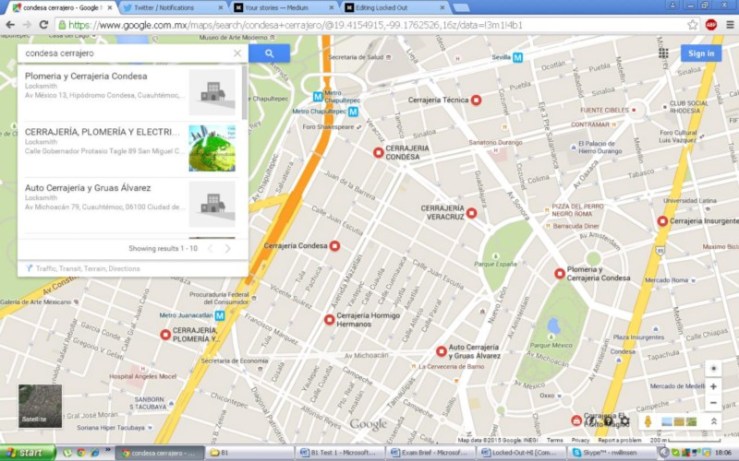
I once heard it said that when you move into a new home, one of the first things you should do is get yourself locked out, so as to try to work out how, if you were a burglar dead set on robbing your house, you might go about doing so, all in order to work out how to best protect your property and shore up your possessions. Another game I recently invented, quite inadvertently, is to get yourself locked out not in order to find your way in, but to find your way, as it were, out. After all, in almost all certainty, very, very few of your immediate neighbours are right now planning to rob your house. And getting yourself locked out is a wonderful way to meet your neighbours and find out a little bit about how the society (or, ideally, community) around you works.
It turns out that, at least in Mexico City, contrary to what you might, quite reasonably, have expected of the place, not everyone needs, or even uses, locks on their doors. Paradoxically, the local locksmith, to whom I swiftly turned in my actually really rather relatively desperate plight, given that I, on the way to the gym, had got myself locked out with no money or phone (and, even more significantly, no keys), two days after my wife, who for comedy reasons also likes to refer to herself as my ‘flatmate’, had flown off to the most racist country on earth for two whole weeks, and given that my landlady, who I managed to contact via Skype having begged my way onto a computer in an extremely obliging local internet café just down the road, didn’t, it transpired, have any keys herself, the locksmith, that one to whom I referred at the start of the sentence, wasn’t actually there, and had left his shop (which doesn’t have a door, let alone a lock) completely unguarded while he went out on a job, but then when he did return, he promised to be round to the flat ‘ahorita’, a word guaranteed to send a chill down the spine of any recently arrived foreigner who tries really hard not to base their knowledge of Mexico on what they’ve read on the internet, but can’t help wondering if that means today, next week, or never, and then (the locksmith) came round five minutes later and, using an instrument the usefulness of which certainly gives one pause for thought (that thought being, my god, it’s really easy to break into houses) he opened the seemingly impregnable door in less time than it takes to put a much-needed full stop at the end of this sentence.
So it turns out that we are lucky to live in a medium-sized village in the centre of what is very probably the largest city on earth. One which, it turns out, unusually for a village, has so many nice places to eat which subsequently turn out to be chain restaurants that you’d start to wonder if when Karl Marx came up with that natty line about the whole world being in chains he might actually have just spent a couple of weeks in Condesa, but one which clearly benefits from a strong sense of, if I can’t quite bring myself to call it social solidarity, certainly abounds in helpfulness and basic good-hearted neighbourliness. Which I must say, and here I risk revealing myself as someone who’s deeply immersed in the third stage of culture shock, is quite refreshing after London. One wonders, and I will return to this shortly, how the UK will deal with the next stage of psychopathic structural adjustment, given that, unlike in a society like Italy, where, as this programme details, young unemployed people will stay with their families, and also unlike (according to David Harvey), in China where it is the ancestral village that provides social support when the state is absent — when a Chinese migrant worker gets ill, they go back to their hometown, in the UK (rejoinder: it seems to me that…) the social fabric, the social safety net that lies underneath the formal state safety net, is extremely frayed. What the UK has in abundance is negative solidarity, a spiteful attitude towards those who are suffering, a contempt for anyone might be seen as a loser or victims. That’s not remotely to claim that compassion and solidarity are absent, but is does mean that, unlike in Spain, where extremely well organized movements have managed in numerous cases to prevent people being kicked out of their homes, in the UK such movements have had very little (one of Russell Brand’s favourite new words coming up!) purchase. In some ways, Mexico (and Spain, and Italy) are probably better societies in which to find yourself locked out of your house, or indeed to be without a home at all, than the UK.
Coincidences
…or, to be more precise, two coincidences. Were I a journalist of any kind (which I’m not), I would be looking for a third to corroborate the sense that something is up, that there is something in the air. Actually there is indeed, as it happens, something troubling the atmosphere — it’s called precontingencia, a word I learnt this morning from the newspaper, a word which, by coincidence, is seemingly only used (or useful) to describe the set of unnatural and unhealthy climatic conditions persisting over the last few days in Mexico City.
It just so happened that in the cheerful café where I was having lunch today, probably the only non-Hollywood Mexican actor I’ve heard of was sitting at the next table. To be fair he had to be pointed out to me, but it was none other than Damián Alcázar, star of every one of Luis Estrada’s enormously successful, extremely entertaining and utterly horrifying depictions of Mexican society. Coincidentally, just this very morning, while investigating buying tickets for his new play, which I had, by coincidence, seen advertised, I was surprised to see it had been cancelled. I decided that a pinche gringo molesting him about this while he was enjoying a social lunch would not have been at all welcome.
Subsequently, while strolling through the plaza which is not called Plaza Cibeles, I happened upon a plaque commemorating the life’s work of Carlos Monsivais, someone who I had been unaware of until four days ago, when my Mexican teacher directed me towards the books of this polymath intellectual and theorist of Mexican culture, society and identity, who also happened to be a fellow traveller (or camper) of the ever-more-interesting Zapatista movement, and was the originator of the enticing theory that the Mexican elites who, perhaps more than ever before, have a stifling grip on power, are essentially gringos who just happen to have been born in Mexico.
That’s enough coincidences for the time being. Maybe I should fear a third — it might be less serendipitous. Perhaps there are superstitions pertaining to this. Too many coincidences could be a bad omen, for example of a prolonged period of no rain. As I walked along Calle Ensenada just now there was a young guy watering the flowerbeds outside a restaurant, indifferent to the very rapidly very darkening skies overhead. Another coincidence, then: before coming here I was nervous about the possibility of prolonged drought, like the truly terrifying ones going on in California and São Paulo. Given that it apparently rains around 200 days a year here (and is currently raining torrentially), you wouldn’t expect a lack of water to be a problem. But it is. El DF could run out of water at any moment. At least here in Mexico there are solutions at hand.
Day 11
There any only a finite number of ways to find out what’s going on around you: observe, listen, ask, participate, guess…or read. Me, I like newspapers and detective fiction. Adopting a newspaper is my standard operating procedure when trying to get to grips with a language and a culture. Except when I lived in China, where, exiled from the written word in terms of my interaction with the society around me, I mostly used guessing to work out what was going on — not a foolproof procedure when dealing with a culture and society as complex as China’s. I did ask questions, but with hindsight they weren’t very good questions. Not that I knew that at the time. While in China, knowing that for me it was a stopping-off point on the way to Spain, I fought my way through an original language copy of Cien Años de Soledad, not so much a whodunnit as a whatthefuckisgoingon, especially given my copy had no árbol genealógico. Since I was already trying to cram my head with Chinese and rescue a clearly doomed relationship I needed to read something simpler which did not feature literally hundreds of characters who were seemingly all called Aurelio or Rebeca Buendía.
Around that time I discovered that Subcomandente Marcos, the (ahem) Leader of the Zapatista army, had written a crime novel with another writer and it was being serialized in what was evidently Mexico’s primary daily left-wing newspaper, La Jornada (the newspaper I’ve now been reading assiduously since we arrived in DF). From that experience came the few bits of Mexican Spanish which don’t basically mean f*ck yer mum. I can’t claim to have finished the novel because it was a written in dense literary Mexican Spanish, so I interspersed my adventures with Melquíades and the gang by reading a tacky French crime novel from an American crime series presented by someone who turned out to be some sort of a catholic fascist. I didn’t really mind at the time because, what with my French being essentially shit, all I was trying to understand at the end of each chapter was who’s dead? Who killed them? Who’s going to die next? By the time I got to the end I had a lot of passive vocabulary for describing various sorts of murders, which I would say made my French about 2% better, but given that in China I didn’t know anyone else who spoke rudimentary French, and certainly not anyone I wanted to murder (in French), it was all a little bit whatever-the-French-word-for-moot-is.
Crime fiction is a great way of learning about a city, about the urban texture but also what might be going on beneath its surface. If I was going to live in Edinburgh I’d be sure to gem up on the work of fellow Thomas Pynchon enthusiast Ian Rankin. Yesterday, looking for Mexico City policiacas, the name Paco Ignacio Taibo II came up and, recognising him as the co-author of the novel by El Sup I’d struggled with ten years ago, I immediately identified with his particular absurdist take on crime fiction, particularly given his politics and his comments on living in Mexico City:
“In DF (everyday you’re) forced to deal with complexity, economic inequality, corruption, environmental destruction and pollution. The only way to survive (is) to accept the chaos and become one with it.”
“Mexico City is the safest city in Mexico. Everybody says that. I even believe it. And it’s true. Why? The narcos have created paradise here…they can live here but [they don’t] work here. It’s the resting city of the narcos. What is this? Very complex city, I love it.”
From his twitter account I learnt that, somewhat serendipitously, he was giving a talk round the corner yesterday connected with the election. We went along, or at least we tried to, as we ended up getting horribly lost somewhere en route, and given that the event had already started, it was taking place in a park, and the Aztec gods had just unleashed yet another mind-bendingly intense thunderstorm, we were forced to give up and go home. This felt appropriate as I’m sure that even had we managed to find the place we would have ended up even more lost in the infinitely complex thoroughfares of Mexican politics and history. It’s the names which cause most problems, whether I’m reading the paper or trying to find a particular place — names of places and people, plazas and politicians — not by coincidence, as a cursory knowledge of Mexican history confirms that most streets take their names from past presidents or revolutionary adventurers.
Getting lost in a city is like getting lost on the page. It hurts nicely in the head and even though you may not get where you originally wanted to go, you end up discovering things that, to mildly paraphrase Donald Rumsfeld, you didn’t even know that you didn’t know. The first thing to do in a new city is get lost, and use the few clues you have to help you identify where you might be. On the first page of Taibo’s first novel his Detective Belascoarán sits in his office staring at newspaper pages spread out on the floor, looking for clues to no crime in particular. Anything at all could come in handy one day. Nunca se sabe.
Day 1
Strolling down the monumental leafy boulevard that is Paseo de la Reforma I come across an Occupy-style camp dedicated to the 43 students who were presumably murdered by people connected to state power last September. Among the photos of the missing students there are exhortations not to vote in the upcoming elections as a protest against corruption and abuses of power, and as I stand there looking in vain for someone from the camp to talk to a cyclist goes blasting out mariachi music in support of one of the candidates. The question of whether or not to vote inevitably brings to mind Russell Brand’s about-turn in the recent UK elections. Back in London there is no equivalent of Ayotzinapa (a word it took me a few days to learn), no mass graves of missing students, and therefore, in a way, less at stake, although admittedly Ian Duncan Smith is doing his little bald best to boost, and cover up, the tally of state-sponsored deaths.
Two minutes further down the road two blue buses suddenly pull out, packed with heavily armed police on their way somewhere, while other police stand at the side of the buses bossing people around. It’s hard to tell whether the people around me are nonplussed, cowed or resigned. There are a lot of guns around in Mexico — yesterday’s edition of La Jornada reported the deaths of ten people in two days in Acapulco, and not to be outdone, in today’s paper you can read about the 30 who have been killed in five days in Chilapa, Guerrero State, the same state as Ayotzinapa. FARC rebels from Colombia are reported to be training narcotrafico gangs in the north of Mexico. Adding all this up, a new report from the International Institute for Strategic Studies puts Mexico in third place for violent deaths, behind only Syria and Iraq. If there is a Mexican equivalent of Russell Brand out there he or she is risking somewhat more than mere credibility.
As I walk on down the avenue a small procession passes by, people carrying placards for PAN, the party that governed Mexico between 2000–2012 before being replaced by the Instutional Party of the Revolution, PRI. The PRI has often been compared to the Irish political party Fianna Fail in that it is the official party of the revolution and has been the main font of corruption for almost 100 years. People still seem to be in shock that it could ever return to power. The precise details of the political panorama of this country defy my understanding but I have heard that the current president, Enrique Peña Nieto, is, in addition to allegedly being enormously corrupt, a profound idiot — there is even a website dedicated to his pendejadas.
This is a complex, beautiful, and dangerous place. Not so dangerous for me, of course — I’m trying to make sense of these things from an extremely privileged and partial position. Where to begin? Who can tell me what’s going on? I have my guide book and the odd bits of information I’ve picked up here and there from conversations and newspaper articles. I’ll always be little more than a tourist here, and I’m aware of my tendency to make snap judgments and facile connections about and between things I have no or next to no understanding of. My duty is to be polite, to recognise when it’s a good idea when to get involved and when to stay out of the way and to try, humbly, to learn.
This reality is new to me but it’s also ancient, and I have to keep reminding myself not to make assumptions. Even in the UK, a country I grew up in and have been living in for the last ten years, I fail to understand the dynamics of the society in which I’m living. So this blog is not an attempt to explain what is going on in Mexico but a series of hopefully interesting reflections and not completely inaccurate observations by someone with a very limited and privileged perspective and a tendency to make unsubstantiated judgments. It will hopefully make connections between what is happening here and the gathering shitstorm elsewhere. And it will also attempt to explain the experience of being here in this seemingly infinite, and infinitely delightful, city, with its tamarind juice and Iron Maiden t-shirts , its cordiality and variety. In addition to being mostly inaccurate, it will contain far too many links, be clumsily written, insifficeienly prrofread, peripatetic and, in many ways, like all blogs, including the one I did when I was in China, almost entirely irrelevant. In any case, aquí lo tienes.
On Framing Austerity
Popular support for austerity as a response to economic crisis remains very high in the UK. Statistics on unemployment, child poverty, homelessness seem to fall on deaf ears. So far none of the campaigns which have been launched to challenge the austerity agenda appear to have had the slightest impact. Why is this?
One very convincing explanation lies in idea of framing. According to the work of George Lakoff and others, people do not simply evaluate the available evidence and form their opinions on this basis. Rather, they tend to accept facts which fit into their picture of the world, and reject those that don’t fit. A great deal of research into the way that people perceive events, think and form opinions supports this.
And it is not just a conscious thing – research into the brain shows that we take metaphors much more seriously than was previously assumed. When we hear it repeated endlessly and everywhere that the national credit card has been maxed out and that we urgently need to cut back on spending, we tend to believe it, whether we want to do so or not.
A recent report <http://www.neweconomics.org/publications/entry/framing-the-economy-the-austerity-story>from the New Economic Foundation addresses this problem head on. Over the last few years a very effective story has been told, which barely bears repeating here: The country is broke, austerity is a necessary evil; government spending has grown out of control; many are addicted to welfare and have no incentive to work; many are simply lazy and their outright refusal to work conflicts with the hard-working efforts of the rest of us; the national debt is a ticking time bomb which simply must be addressed.
This story has been effective because it contains key elements: it relates powerfully to people’s own experience of the world; it contains vivid and memorable metaphors; it consists of a simple message repeated endlessly and consistently.
If we want to challenge this agenda, we need to change the terms of the debate. It is clearly not enough to claim, as Labour has done, that austerity is too fast or the cuts too deep. Those of us who oppose austerity have to develop alternative frames which make sense to people and have an emotional appeal.
To this end the NEF report makes a series of suggestions. They suggest the following would be effective messages that the left should try to communicate as much as possible:
*1. **Casino economy – our economy is like a casino, it is in need of reform so that **it can be stable and useful.*
*2. Treading water – we are not making any progress as a nation; we are running **to stand still, struggling but not moving forward.*
*3. Big bad banks – our current problems are the result of a financial crisis that we, **and not the banks that caused it, paid for.*
*4. Big guys and little guys – there are two types of people in Britain, the little guys **who work hard and don’t get a fair deal, and the big guys who have money and **power and play by their own set of rules.*
*5. Jobs Gap – the biggest issue facing our country is the jobs gap: people who **want to work but can’t, people who work hard but don’t take home a decent **wage and young people who cannot be sure of a good job.*
*6. Time for renewal – we need to rebuild and renew what made Britain great– **from the railways to our education system. We need to invest.*
*7. Austerity is a smokescreen – The Coalition uses the deficit as an excuse to do **what they have always wanted to do like shrink the state and privatise the NHS. **We cannot trust them; they aren’t out to help ordinary people.*
We can, indeed should, debate which of these messages may resonate more powerfully with the public. Some would clearly be much more effective than others. We also need to use whatever resources we can to find out which ones work best. They all potentially present alternatives messages which exploit certain sentiments which are widely held and deeply felt. Whichever messages we choose will need to be repeated as consistently, as clearly and as widely as possible.
One hopeful sign that Miliband and co may be aware of the potential of such an approach was his recent instruction to MPs and ministers to refer to ‘social security’ rather than ‘welfare’. But if Left Unity is serious about having any sort of impact on public debate in this country it will have to take up this challenge and go much further.
I’m sure that these ideas will provoke a furious reaction from some on the left who are allergic to any attempt to rethink the way we use language to formulate and communicate our ideas. For me such a debate will be very welcome. We cannot just keep trying, and failing, to appeal to people’s rationality.
The same goes for climate change. No amount of appeals to people’s rational sense of self-interest has worked in trying to raise awareness of the coming catastrophe. The need to behave sustainably does not fit into people’s framework for understanding reality, which is based on infinite economic expansion and ever-increasing consumption. We have to develop frames which are based clearly on the notion that we cannot separate economic and social development and environmental impact, that the economy and the environment are not two separate entities but one. Thinking in new ways, seeking to reframe debates about all aspects of how we perceive and organise our social reality has to be an integral part of the project to build an effective left movement in this country and elsewhere.
Left Unity: The Importance of a Green Agenda
The last couple of weeks have seen the publication of two articles in the mainstream media whose implications could not be any more explicit or terrifying. According to last week’s Guardian we face a(nother) global economic crisis as a result of the imminent bursting of the ‘carbon bubble’: http://www.guardian.co.uk/environment/2013/apr/19/carbon-bubble-financial-crash-crisis. What this means is that the energy markets have not yet priced into their models the fact that most of the world’s fossil fuel resources will have to stay in the ground if the world is to make any serious attempt to tackle climate change. The energy industry’s concerted efforts to sponsor inaction on climate change have, therefore, been an ongoing and desperate attempt to stave off the inevitable moment when their share prices take into account either the fact that their well will very soon run dry or that the global ecosystem which sustains all human activity will soon collapse.
Another article published today on the BBC News website (http://www.bbc.co.uk/news/business-22002530) goes by the title ‘How is the world going to become extinct?’, and reports that a group of Oxford scientists are addressing this question very seriously indeed, speculating about what will (not might) deal the killer blow to the human race: an unpredictable and uncontrolled acceleration in computer technology is a contender, the unforeseen ecological side-effects of new synthetic organisms another. As this is the BBC, the article makes no specific reference to climate change, but it is unlikely that the scientists themselves are quite so complacent. In the words of Dr Nick Bostrom, “There is a bottleneck in human history. The human condition is going to change. It could be that we end in a catastrophe or that we are transformed by taking much greater control over our biology…this could be humanity’s final century.”
So, to recap: either we fundamentally and immediately transform our economic way of life and our relationships with technology and our environment, or we face not just social collapse but planetary annihilation. Could the need for a workable alternative to the insanely destructive logic of neoliberal turbocapitalism be any starker?
It is therefore critical that Left Unity have at its base a radical green agenda. It is not enough to pay lip service to the need to ‘protect the environment’. Every aspect of our opposition to austerity and our revisioning of society, each one of our policies and initiatives must be conditioned by the need to dramatically reduce our dependence on fossil fuels and develop sustainable alternatives. The concept of climate justice must also be a founding tenet of our organisation, especially given that climate change is already having a devastating impact on the lives of millions of people around the world, especially the very poorest. Above all, the question of who pays for climate change is a profoundly political one; thanks to another recent Guardian report (http://www.guardian.co.uk/business/2012/jul/21/global-elite-tax-offshore-economy) we know that no less than $21 trillion is currently hidden in offshore accounts by the world’s rich. The resources we need in order to begin to reconstruct society on a fairer and more sustainable basis are there. If we are to survive for more than a few short and painful decades we simply have no alternative but to join together and seize them.
Review: Iron Lady – hagiography of an evil woman
 It seemed oddly appropriate to be watching a film about Thatcher in my local cinema in Wood Green, North London. Not only was the area (branded as ‘Shopping City’) recently the scene of extensive looting by youth driven mad with frustration at their failure to take part in the great consumer society; it was also the setting for the recent film ‘Dreams of a Life’, which told the true story of a woman (a former ’80s socialite) who was found dead in 2006 in an apartment in the same complex as Wood Green’s mall. Her body had lain undiscovered for three years, and the film traces how a vibrant young woman could slowly and sadly drift away from all contact with friends and family in a city where shopping is the only means of acquiring any sense of identity and belonging.
If there is one individual who can more than any other be held responsible for the collapse of communities and social solidarity in the UK it is Margaret Thatcher.
Odd, then, that a group of filmmakers who were avowedly no fans of her politics (director Phyllida Lloyd and screenwriter Abi Morgan) should choose, and choose this moment, to present a film which encourages us to sympathise with the former Prime Minister on a personal level.
It is not remotely a bad film: the acting is superb, the script is tight and, one presumes, the on-set catering was almost certainly top-notch. And there are some pointed digs at her politics, particularly in relation to the wider effects of the cuts that Thatcher imposed; also, the opening scene, in which a visibly confused and physically decrepit Thatcher pops out for some milk and experiences first-hand the rude and uncaring society that she did so much to create, can be read as a criticism. But on the whole there is very little that even the most fundamentalist Thatcherite would have a problem with. The intention is clearly to make us sympathise with her as an increasingly helpless individual.
At least when US filmmaking Oliver Stone depicted Richard Nixon as a widely misunderstood hippy, his subject’s political legacy was dead and buried and his reputation in tatters, whereas this same is not even remotely true for Thatcher. Perhaps the filmmakers wanted to challenge themselves, and us, to think more carefully about someone not usually seen as entirely human. By contrast, the recent TV biopic of Fred West did not attempt the same treatment of its subject, although it must be acknowledged that he was responsible for the murders of considerably fewer Argentinians than Thatcher.
And so the woman who declared there was no such thing as society, and then tried to prove her point by smashing it to pieces, is portrayed as well-meaning and genteel. Sadly we do not get to see her in her addled dotage pissing in her cornflakes and pouring milk down the toilet as the inevitable hysterical hype in the Mail and Telegraph suggested we would. one can only conclude that the filmmakers are devoid of any political intelligence whatsoever in releasing such a film right now in the current climate of pure Thatcherism. Mind you I have to admit that I can’t wait for the sequel, in which she actually dies. Go and see ‘Dreams of a Life’ (or the equally wonderful ‘The Artist’, for that matter) instead and give this utterly misguided hagiography of an evil, evil woman a very wide berth.
It is becoming fashionable to talk about politics
It is becoming fashionable to talk about politics, which means that for the first time in my life on this planet ordinary people are talking openly and angrily about inequality, injustice, poverty and the urgent need for new ways to organise society. They are talking about these things at work, in the pub, over meals, on the train – wherever there is more than one person capable of speech, people are talking about politics – talking about politics in terms of ‘them’ and ‘us’.
Those who criticise the occupiers at St. Paul’s Cathedral and elsewhere for not having a clearly defined political agenda are entirely missing the point.
The shit is about to break loose. The associations and the ideas that are being formed now and the intellectual muscles that are now being exercised for the first time in generations will stand us in very good stead in facing up to what comes next – in deciding, organising and shaping what comes next.
The hegemonic dam of neoliberalism has been breached. It is becoming fashionable to talk about politics.
(Source: https://www.youtube.com/)
 Infinite Coincidence