After an almost impossible first night in a hotel with our three-month-old daughter I reassure my wife ‘we’ll get through this. We’re a team’. This analogy only goes so far, however, as one of the team members has no idea she’s part of a squad of players sharing a common objective. For one thing, she doesn’t respond to hand signals and whistles from the touchline and doesn’t even seem able to identify or even see the other players. She also, rather like certain actual footballers, responds to any potential slight, no matter how minor, as though she’s being tortured, and is in the unfortunate habit of screaming to the point of losing her voice when decisions don’t go her way. Also, unlike most professional sports people with a couple of unfortunate exceptions, she appears to exercise no control whatsoever over her bowel functions and will quite happily play on as though she did not have excrement visibly trickling down her legs. Then there’s the fact that at the end of the match she simply refuses to leave the pitch, insisting on staying in the centre circle proudly surveying the increasingly frustrated crowd despite how appallingly she’s perfomed. When she is finally persuaded to go to the changing room she embarrasses herself even more with her appetite for endless amounts of seemingly intoxicating liquid. She also has her equivalents of Jimmy ‘Five Bellies’ Gardner, although in her case the badboy mates who egg her on to even greater heights of excitability and subsequent disgrace go by the names of Mr Gweenewy and Comfy Wabbit. If you add in the fact that, as we’ve now discovered, her behaviour in hotels would shame even a Sheffield United striker, it’s pretty clear that although she may in some ways always be a valuable member of the squad, it’s certainly not her team-playing abilities that make her so. The whole thing makes me feel the deepest sympathy for David Moyes. At least given that she lives in Rome and has a British passport, we might be able to get a few quid for her out of Lazio. She could yet turn out to be the female equivalent of Ravel Morrison.
Category: .
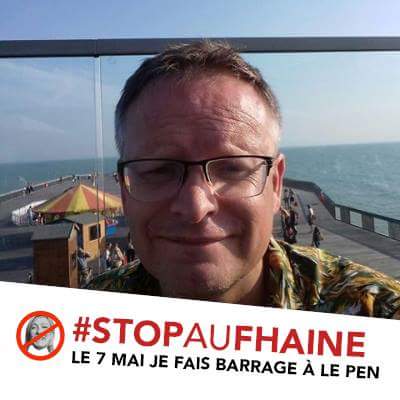
You can do something to stop Le Pen: Change your profile photo
Probably the smallest gesture you can make in the attempt to change the world for the better (or stop it getting worse) is to change your profile picture on social media to reflect your concern about an issue. In the last couple of years people have most commonly altered their photos using a twibbon to commemorate or express solidarity with the victims of terrorist attacks such as the ones in Paris and Brussels.
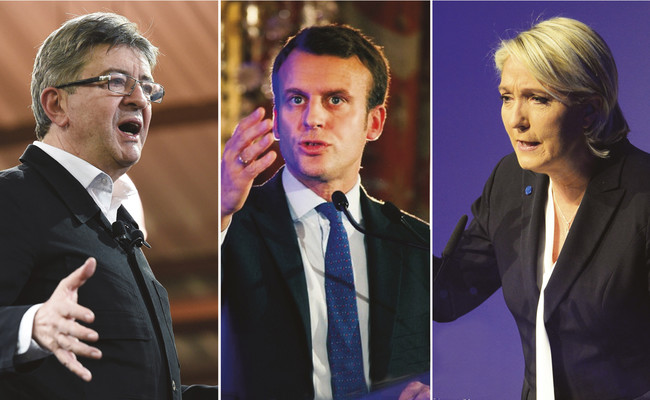
Right now, all of the values that enlightened users of Facebook, Twitter and Instagram are under grave threat. This time it’s not a single unpredictable act of political violence which threatens to turn our continent into a more dangerous, repressive and mistrustful place to live, but the victory of a national socialist candidate in the second round of the French elections.
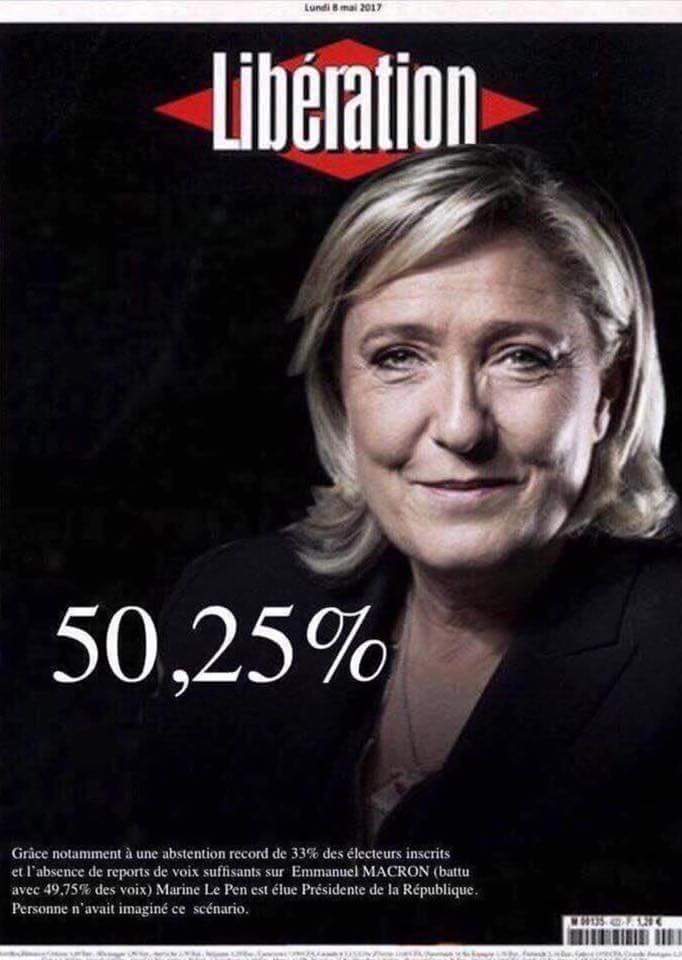
For most of my own life the notion that fascism could make a comeback in Europe was unthinkable. A charismatic leader manipulating the masses into hating their neighbours so that they could gain political power and eradicate democracy? Surely people would recognise the danger and unite to ostracise such a figure. But now Marine Le Pen, the proud daughter of a man who repeatedly insisted that the Nazi Holocaust a ‘mere footnote of history’, stands a very real chance of winning the Presidency. The response of a lot of those who should be in the forefront of the fight against her has been to shrug their shoulders and talk sulkily about abstaining. Some have complained bitterly that there was no point voting against Jean-Marie Le Pen in 2002 only to see his daughter become even more popular, as though fifteen years of no death camps had not been worth getting out of bed and voting for.
This is not about telling French people how to vote. Or maybe it is. It doesn’t matter. Fascism is too grave a threat to pretend that borders matter. People like Le Pen have an international vision of how they want the world to be. She welcomed Brexit and the election of Trump and openly associates with (and is funded by) Vladimir Putin.
It is not about persuading hardcore FN supporters not to vote for her. Such people are, for the moment, lost to humanity. This is about expressing publicly the very simple and ideally universally-shared belief that fascism is evil and must be opposed by any means necessary, even if that means putting a cross next to the name of a person who would not be your ideal first choice to lead your country. Over the next ten days, whenever French people who are at all inclined to abstain on May 7th go onto social media, they need to see that their foreign friends want them to go and vote against Le Pen.
You would make this simple, tiny gesture for victims of terrorism; do it now to help prevent all of us falling victim to fascism. If you need any more persuading that it is a worthwhile thing to do, google ‘Marine Le Pen twibbon’. There are lots and lots, and they are being used and seen, including in groups that are supposedly left-wing and anti-fascist, where, as I presume elsewhere, her attacks on Macron from the left are going down very well. Unless we help to oppose Le Pen, in whatever ways we can, she will win.
I’m starting to despair of ‘the Left’
I have a very bad habit: signing up to and spending time in Facebook groups. Around Brexit it was the various Remain groups, during the US election the anti-Trump ones and over the last couple of weeks I’ve been hanging out with the French Left.
When I say ‘Left’, it’s an odd melange, in that there aren’t at present many contributors who define themselves in opposition to the right. In such groups supporters of the growing movement for abstention increasingly rubs shoulders with open supporters of the Nazi candidate Le Pen.
I saw something similar late last year with so-called ‘Bernie’ supporters who were far too busy propagandising against Hillary to even mention Trump. It has recently turned out that some of the groups are actually orchestrated by the far-right, which partly explains why they are happy to host posts in favour of far-right causes, including Le Pen. Although I’ve always found the cliché that the two ends of the political spectrum meet up contemptible, on social media it is often very difficult to tell who is what.
As someone whose knowledge of French politics is limited (I’ve never lived in France), I respect the opinions of friends who insist that some of the anti-Macron stuff being shared is a healthy letting-off of steam and that most of those disappointed with Méchelon’s failure to get through to the second round will do the sensible thing in ten days’ time. It’s also possible that the Facebook groups of France Insoumise Ici, the inappropriately-named 100% Anti-Facho and others are not representative of the debate in society at large. Espérons-le. It’s worth acknowledging are also sections of the Left (notably Ensemble) who have actually taken an anti-fascist position on the election – shamefully, that doesn’t include the once-prominent Nouveau Parti Anticapitaliste (NPA).
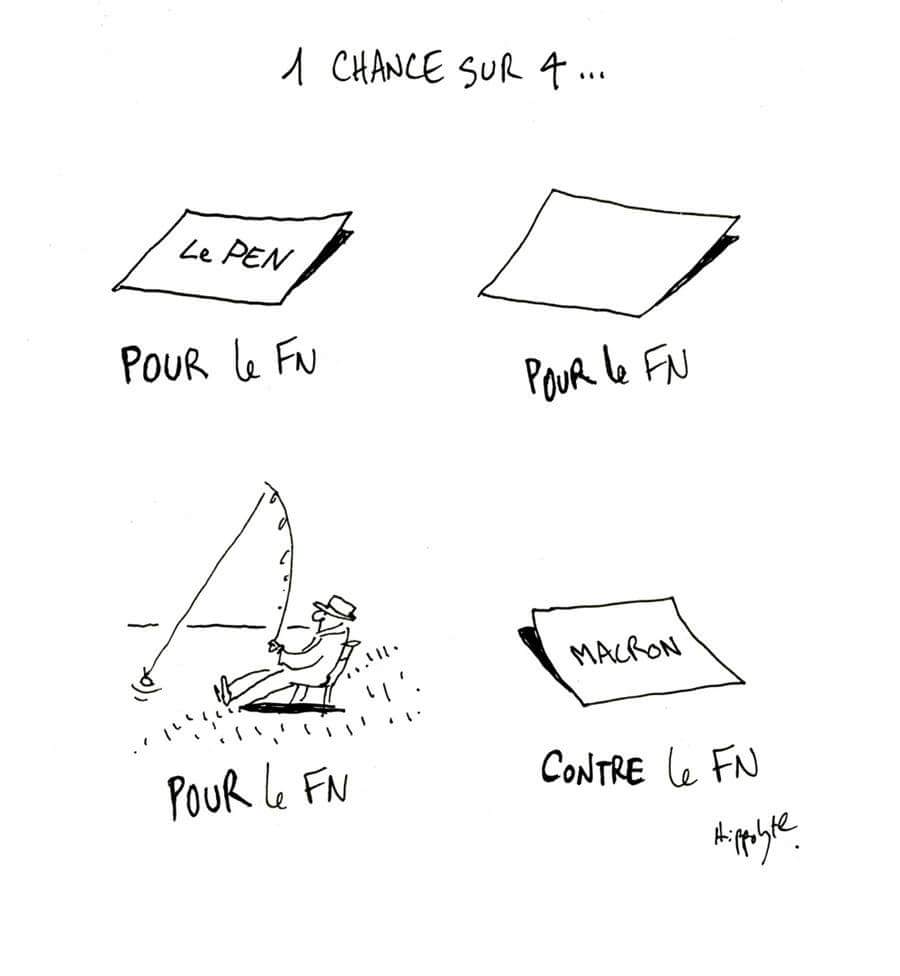
However, what I’m seeing repeated exponentially more often is the argument ‘there’s no difference between Macron’s neoliberalism and Le Pen’s fascism’. The hashtag #sansmoi is being used by those who will proudly refuse to exercise their democratic responsibilities on May 7th and will presumably wash their hands of the consequences of the result.
That’s what a lot of ‘Bernie supporters’ did. They campaigned against Clinton to the point where millions who clearly should have voted for her were unmotivated to do so, and now they happily blame others for the outcome. The far-right is now tearing up the rights and protections of ordinary citizens at a ferocious rate, held back only by the courts. Trump is trying to bomb his way to popularity but the consciences of those who helped him into power are clear. It’s apparently all the fault of the Democrats who treated Bernie unfairly, the diddums.
It’s distinctly possible that the memes and tropes being shared against Macron right now on the ‘Left’ will help to elect Le Pen. They will depress Macron’s vote, increase abstention, put his campaign on the back foot and let a Holocaust revisionist and open racist into power in one of the world’s most emblematic democratic and powerful countries. In the process they will jeopardise the future of Europe and encourage the exponential growth of the far-right across the world. There may well be death camps; no one can pretend they don’t know what Le Pen stands for.
But what will the consequences be for those who let it happen? As so often on the ‘Left’, the ultimate prize is a pure, unsullied pair of hands and a smug sense that although there may be massive injustice in the world, I have played no part in its perpetuation. In the justifications of anti-Clinton leftists, pro-‘Lexit’ voters and French abstentionists, the key words are me and my: my beliefs, ma conscience… I know this because for years I was involved in leftwing organisations (although presently unaffiliated, I still hold basically socialist values and principles) and with some honourable exceptions those who were or aspired to be at the top of such groupuscules were far more concerned with promoting their egos and the name of their parties than with actually achieving meaningful change, except in some never-to-be-achieved wonderland.
I don’t know if Jean-Luc Mélenchon falls into that category. I’m reliably assured that he has in the past shown himself to be an admirable and consistent anti-fascist. It may be that his ego was damaged by his failure to get into the second round; he may just be sulking. He may, like Jeremy Corbyn, be tragically incompetent when it comes to strategy and leadership. Of course I would rather have seen him in the second round against Macron or Fillon. The support he built up in a few short weeks before the election is an encouraging sign that there is a huge appetite for a radical egalitarian alternative to neoliberalism. But there is no way that he is unaware that Le Pen is harvesting similar sentiments, that a key part of her strategy is to position herself right where he stood. For his supporters to be repeating this arrant nonsense that there is no difference between a banker and a Nazi AND NOT BE CONTRADICTED indicates an absolute abdication of moral and political leadership at the most critical point in the history of post-war Europe.
This is what I feel like screaming in the street right now (instead, I’m writing it on my website, which is sort of similar): IF LE PEN WINS, IT WILL BE THANKS TO THE CONNIVANCE OF THE ‘LEFT’. Any and all anti-fascists worthy of the name need to learn a very important lesson from the US and and STOP telling the world that Macron and Le Pen are indistiguishable. Doing so may involve a self-sacrifice of one’s impeccable anti-neoliberal credentials and necessitates a measure of humility. For me it’s another test of whether or not today’s ‘Left’ is anything other than a long-running vanity project, a puerile or senile delusion, a shiny accoutrement which looks nice but refers to nothing but itself. The dominance of the notion that the market and finance should control every aspect of our lives is a catastrophe for the human species, but if you think it’s as bad as what Le Pen stands for, you’re a cretin and a connard. Grow up, vote Macron. C’est tout.
PS: Bonus quiz question: does the follow clip depict fascism or neoliberalism?
Rome: The Coming Community
In ‘The Coming Community’ the Italian political philosopher Giorgio Agamben argues that community nowadays is less about shared identities and more about contingent experience. Or at least I think he does, I’ve only really read the title and a couple of synopses which made my head hurt slightly. I’m not going to read any more about it this morning as I’m feeling a little tired, the result of a poor night’s sleep.
The area where we live could be classified as quiet, and has even been described as anonymous. There are cafés and shops we all occasionally frequent but my wife and I don’t know or recognise many of the neighbours who share our street. There are a couple of local characters: the guy who drinks Peroni on a bench and snarls at anyone else who tries to sit there, the ebullient beauticians downstairs who always say hello and coo over the baby, the reliably cheerful Bangladeshi guy who runs the local grocer’s. In the cafés (of which there are three or four) people nod at acquaintances, gulp down their cappuccini and scoff their cornetti standing at the bar in that Italian way, but don’t stick around to chat. It’s by no means a hostile area but most interactions seem to be largely transactional in nature.
Sometimes it takes a single visionary human being to create a sense of shared experience out of seemingly unpromising material, to produce a spirit of communality by connecting elements of otherwise atomised lives, like all religion, art and politics aspires to do. Last night one man took it upon himself to unite people on our street. It’s not even clear whether he himself lives locally. Maybe it was the selfless gesture of a Christ-like outsider figure offering himself up for society’s approbation or crucifixion: a wandering prophet, a drifting shaman, a perambulating teller of universal truths unpalatable in the light of day. It’s not clear what the content of his speech was. The language that he’d chosen for his testimony was one unknown by the overwhelming majority of his audience. (It may even have been Aramaic.) It was the force of his sermon which was so compelling, the relentlessness and particularly the volume of whatever it was he was he was bellowing over the course of at least an hour.
In response, a community emerged from nothing, an implicit understanding of our commonality spread through the souls of those anonymous men and women in the surrounding buildings. Hundreds of rudely-awoken residents who had previously shared little more than the occasional pavement glance were united in what was at first mild annoyance and then, as the minutes wore on, under-the-breath curses, muffled complaints about punishing work schedules, he’ll-wake-the-bloody-baby and some-people-have-NO-consideration, developing gradually into fantasies of picking up non-existent airguns, marching purposefully to the window, taking aim and, to the silent cheers of the entire neighbourhood (one which until that moment had never thought of itself as such), as the local birds just started to chirp in the local trees, neutralising the irksome threat to our peaceful coexistence.
Mélenchon could be the French Bernie Sanders, and that’s not a good thing
Originally published at katoikos.eu.
I saw some startling examples of puerile posturing in my years of left-wing activism. They mostly involved people more concerned with (and competitive about) the purity of their (self-)image as anti-capitalists par excellence than with actual injustice, poverty and inequality.
Is Alex Jones a good dad? As a parent myself I’d say it’s pretty unlikely
I’ve been a father now for all of three months, and like all parents have found it both absolutely exhilarating and hugely demanding in terms of tolerance and patience. My love for my daughter grows exponentially every day and if anyone deliberately hurt her I’d probably try to kill them, although obviously I don’t think that such personal vengeance should be the basis of a legal system. I’m not a prick.
Someone who clearly is a prick, and an asshole, and a c*nt, is the US radio hate preacher Alex Jones. How do I know this? Well, I’m judging him on his words and actions, and as a parent I’m now in a position to see how damaging they must be. In Sandy Hook Elementary School in Connecticut in 2012 a 20-year-old man murdered twenty children and then shot himself in the head. This led to renewed calls for gun control, which provoked a malicious internet conspiracy theory among those who don’t mind the odd school shooting (shucks, they might even do one themselves one day!) that the massacre was a ‘false flag’. Jones picked up on this and told his gullible and resentful disciples, primed as they are on a heady cocktail of skunk and misinformation, that not just the terrorist attack but also the children themselves were fake, (‘child actors’) and directed them to harrass the families of the dead children (because they’re ‘actors’ too, right?).
Is someone who thinks other people’s kids don’t exist a fit person to have custody over their own? (Presuming his own kids aren’t themselves ‘child actors’, of course.) A court is currently (and hilariously) trying to decide. Of course, it’s possible that Jones is the best parent in the world, but given the evidence so far permitted in court and that excluded by the judge, it’s pretty unlikely. His life story is a litany of drink, drugs, and megalomaniac narcissism, to the extent where he can’t remember basic information about his kids and also fills their heads with hateful internet nonsense. Jones is now married to a former prostitute. He denies her past (whereas she, notably, doesn’t), just like he and his naive followers deny climate change, 9/11 and the Holocaust.
Regardless of the custody battle, it’s very clear that such a person should be nowhere near political power. Yet Trump praises him and has repeated his syphillitic screeds word for word. They thus have an impact in the real world, giving the lie to his claim inside court that he’s merely a performance artist – he made a video on the way to court in which he himself made clear that it’s not true. His success, after all, depends on his audience believing he’s more than just a clown.
Over the years celebrity refuseniks like Russell Brand have appeared on his Infowars show, granting him radical credibility despite his affiliations with white supremacists and antisemites. He’s also been defended by the British investigative journalist and author Jon Ronson. Ronson’s schtik, which can be charactersised as fey muscular liberalism, can be very effective and great fun. His modus operandi, like that of Louis Theroux, uses a very softly-spoken gonzo approach of befriending people who provoke the ire of liberals: Katie Hopkins, that God Hates Fags family, Islamic terrorists. He has been described as a ‘semi-friend’ of Jones. But humanising those who dedicate their lives to dehumanising others is risky and morally questionable. What about the effects of what they do, and what they represent, notwithstanding their inner psychological battles? As Žižek points out in ‘Violence’, no one is consciously evil. We all have private narratives which explain our behaviour towards others. But the truth of a human being lies not in what they think, but what they say and do.
I don’t know Jones personally. I only know what he does and what he proudly represents. I also know the effect that people like him and his aspiring UK counterpart Katie Hopkins had in Rwanda. Now he’s asked for respect and responsibility in reports of his case. Fine. If he apologises to the people whose lives he’s ruined with his (ahem) ‘performance art’ and tries to make amends, then he’ll be deserving of respect. While he continues to propagate dangerous lies in a way which is absolutely irresponsible and disrespectful, anyone who’s not a complete prick will continue to see him as someone who should be kept securely away from contact with human beings in general and children in particular.
Is voting for the far-right a form of gambling?

On the 31st of December 1998 I walked, drunk, into a betting shop in Central London to enquire about the odds of global economic meltdown as a result of the Millennium Bug. They demurred and directed me to head office.
That addled prank remains my only visit to a betting shop. I’ve never been desperate enough. Living in London for a decade or so I saw them spread like cancer cells across the less salubrious parts of the city. I found it useful to point out to my international students that you can tell how poor an area is by the number of betting shops and fried chicken outlets. They usually spread in malignant clusters, often three or four gathered on the same street corner, particularly in areas like Stratford and Haringey where I lived for several years.
Anyone who, like me, doesn’t frequent such places may be puzzled about their prevalence until they learn about the phenomenon of Fixed Odds Betting Terminals (FOBTs). These have long been known as the crack cocaine of gambling, and in several countries (for example in Ireland) they are banned. FOBTs allow users to stake £100 every 20 seconds, and are largely responsible for bizarre but by no means anomalous statistics: Rochdale, a town in Greater Manchester, staked £72m on gambling machines in 2012; this figure equates to every man, woman and child staking £340 each. There have been campaigns to prohibit FOBTs in the UK, culminating in a parliamentary policy review in 2016, in the run-up to which gambling companies quadrupled the amounts of money and gifts they gave to MPs (including ministers).
I suspect that for some people firms like Ladbrokes play much the same role in their economic life as loan sharks. Given the considerable odds of getting into serious trouble if you borrow money from companies like Wonga, why not combine such risk-taking with a bit of ‘fun’ in a place where they at least give you a free cup of tea?
That’s why I was heartened in 2011 to see the footage above. Although the riots that summer were inchoate, incoherent and altogether regrettable, I can’t avoid the feeling that that particular target got what was coming to it. Just as it’s hard to argue against vigilantes in economically devastated areas who physically attack crack dens and dealers, it cheers me up to see a Paddy Power’s or Ladbrokes with its windows cracked or smashed. At least someone is putting up some resistance.
Anyone spending more than a couple of days in Italy nowadays would start wondering what the ubiquitous phrase scomesse sportive means. Over the last five years of visiting regularly and now living here I’ve seen the number of betting places surge. Here they either take the form of ordinary cafes with a couple of terminals (as on my street corner) or dedicated negozi with blacked out windows. The cafes are generally locally and independently owned places so sports gambling seems more integrated into the social fabric.
As in the UK, it seems that thanks to relentless marketing and team sponsorship being a football fan has become linked with betting on your club’s fortunes. I don’t think that the Fixed Odds machines have been legalised yet but clearly these mini-casinos are sucking up a great deal of very hard-earned cash from a lot of extremely desperate people who have little to lose.
Risk plays an increasing role in our daily lives and we are encouraged to blame ourselves for failure rather than to share that responsibility with the society and its politico-economic order.
If we draw back and think about Europe as a whole, it’s apparent that this form of parasitism has an effect on the general mood. In societies where risk plays an increasing role in our daily lives and we are encouraged to blame ourselves for failure rather than to share that responsibility with the society and its politico-economic order, gambling has become one of the key metaphors for how we conduct our lives. The advertising of gambling companies plays on this very cleverly, and the growth of online gambling means that when we play games like Candy Crush Saga we are betting (or being primed to bet), without being aware of it, often from a very early age.
What results is unmanageable levels of spiralling debt with no way to pay it off but taking more risks. If we’re looking for a reason for the stupid actions of young people in Croydon and Tottenham in August 2011 seeing their behaviour as a form of gambling helps. The social sanctioning of absolutely irresponsible activity led huge numbers of young people to gamble that taking a TV from a looted shop would have no consequences other than better quality film nights. The debt they paid as a result was very punitive custodial sentences and ruined life chances. Crime is, after all, a form of gambling.
The terrible odds of ‘taking back control’
No wonder people want to ‘take back control’. The chance that the Brexiteers’ promises and threats (£350,000,000 on the NHS, millions of marauding Turks) would turn out to be true were clearly minimal, but for many people it was better to bet on that than to continue in the certainty of ongoing economic annihilation. Humans take terrible odds when they’re desperate. As Daniel Kahneman points out, that’s what we do in relation to the climate: the odds of catastrophe are so overwhelming that we gamble that that mythical 3% of scientists are right, and we ignore scientific fact and the evidence of our own senses. The possibility of finding meaning through dedication to jihadism is pretty small, but nihilistic young men take that chance rather than betting on continuing monotony and irrelevance. When buying food we gamble that one more kebab or piece of fried chicken will give us the energy we crave without damaging our physical selves beyond repair. Gambling may well be written into the way social media works – as this terrifying article explains in depth, liking a post or retweeting quite possibly triggers the same emotions as sticking more coins in a slot machine.
Then, of course, there’s voting. The odds that Donald Trump, Marine le Pen or Beppe Grillo will be able to resolve the multiple crises that engulf us are practically zero. The same goes for Jeremy Corbyn and Jean-Luc Mélenchon. However, given that so many are locked into spiralling debt and staring social and economic oblivion in the face, betting on the chances of political change, not matter how remote, must feel like one more desperate jerk of the lever – or least a way to give the machine a big hefty kick, just in case it pays out when you’re standing nearby. Modern gambling mechanisms work entirely on that emotional tug, the rush of endorphins that comes from taking a heart-stopping risk.
Let’s hope that when French voters step into the booth this week and next month they’re able to exercise rational control over their actions rather than acting upon the impulses that cause so many to gamble their futures away online
Is voting for the far-right a form of gambling?
On the 31st of December 1998 I walked, drunk, into a betting shop in Central London to enquire about the odds of global economic meltdown as a result of the Millennium Bug. They demurred and directed me to head office…
(On katoikos.eu.)
This is what I hope happens when Trump meets the Pope

I like this Pope. Okay, he may not smoke dope and he’s got some pretty obnoxious views on what women should and shouldn’t do with their own bodies, but he’s also genuinely and deeply concerned about poverty, inequality, racism and climate change and has spoken out forcefully against those who perpetuate injustice in those areas. Now it’s been reported that he is to meet with Donald Trump, aka the worst person in the world, a human shaped-turd in an ill-fitting million-dollar suit with a badge on it that reads (tragically for us) ‘I AM THE MOST POWERFUL PERSON ON THE PLANET’.
The following is the scenario which I hope will play out when they meet up.
Setting: A room in the Vatican, sparsely furnished with just the odd bit of velvet on the chairs, nice plush drapes and a couple of crucifixes and the like on the walls. On the left there is a line of seven people wearing suits, some of whom have bulges in their jacket pockets and three of whom are known members of neonazi organisations. To the right there stand three monks, two archbishops, a couple of swiss guards, a cardinal and one or two deacons. Pope Francesco and Donald Trump are sitting next to each other on two of the velvet-backed chairs.
THE POPE (addressing the hangers-on): EXEUNT!
(they all leave, except one)
THE POPE (looking slightly irritated): EXIT!
(the last one leaves)
TRUMP: I…
The Pope reaches over and with a surprisingly swift jab breaks Donald Trump’s nose. The Commander-in-Chief gasps and puts his tiny hands over his face. The Supreme and Sovereign Pontiff stands up and, demonstrating astonishing agility for an eighty-year-old man, pulls his left leg full back and kicks over the tycoon’s chair. The 80’s playboy’s huge bulk goes crashing backwards and his head lands with a sickening thump. He’s making a curious keening sound, like a man very unused to being subjected to physical violence. The Bishop of Rome as head of the Roman Catholic Church turns to face the wall, takes two steps towards it and then swiftly turns and executes a full body slam on the alleged child rapist’s torso. From the look on the robber baron’s face, which is rapidly turning purple and emitting wheezing noises, there seems to be some damage to his internal organs. When the heel of the His Holiness’s right boot makes contact with the tax avoider’s chin, there’s a snapping sound. The real estate mogul is really suffering now – it’s not even clear that the reality TV show star is conscious. The climate liar has blood pouring out of what is left of his nose and his jaw is at an unnatural angle to the rest of his face. The Holy Father stands over the pretend billionaire’s bloated and beaten face breathing evenly, then reaches down, rips off the mendacious mafia frontman’s wig, then steps to the window and hurls it down to the cheering crowd watching the battle unfold on huge screens down in Saint Peter’s Square. As the tinpot tyrant lies whimpering on the floor, the religious leader formerly known as Jorge Mario Bergoglio strides over to the immense oak door and raps on it sharply, crying ‘DA MIHI IPHONE!’. He grabs the smartphone with pontifical impatience and shoots a smily selfie with the rapidly soon-to-be-former autocrat expiring in the background, then tweets it to his 10.6 million followers. Within ten minutes it has received many more likes than any other tweet in human history and the Combover Con Artist, aka the Orange Hitler, aka the Cheeto Benito, aka King Leer, aka the Last of the Mango Mohawkans, aka Fuckface von Clownstick, is no more.
FIN
I was a teenage Lib Dem

It was my (German) grandmother who first introduced me to acid house. She’d just got back from a all-nighter in a field off the M1 and with shaking hands and gleaming eyes she pressed a Todd Terry mixtape into my hands with the words ‘Dies musst du einfach nur hören!’. In suburban Sheffield in mid-1988, a period soon to be known as the second summer of love, there was a huge opening of like minds, a spiritual confluence of tribes and generations united around bleeps, beats and togetherness.
Actually none of that is quite true. There may have been people nearby getting into raving and revelling in e-fuelled dionsyan madness but I’d just finished my GCSEs and was working in a supermarket stacking shelves as slowly as I could. When my dad offered me the chance to deliver Liberal Democrat Focus leaflets I must have leapt at the opportunity for some excitement. To my eternal shame my attachment to the Lib Dems continued on to University. I think I must have quite fancied one of the people on the stall on Fresher’s Day and so spent several weeks trudging around Norwich in the runup to the local elections trying to get people to vote yellow (I don’t think I actually voted for them myself). I vaguely remember a couple of barbecues at which I met well-meaning and very polite local people who cared very much about their streets (for them the Lib Dems were essentially a national version of Neighbourhood Watch) but were either clueless about the world beyond or sounded to my ears distinctly like Tories.
Thankfully for my dignity and campus credibility my political trajectory swept me away from Paddy Ashdown and co. When the exchange rate mechanism crashed down in early 1992 and it became clear that no one up there in or near power had a clue what they were doing I decided to abandon my weird form of political contrarianism and go back to being a Marxist. In the meantime, sadly, my adolescent street-pounding in Sheffield Hallam would eventually pay off, and those seeds I’d planted (in the form of leaflets focussed almost exclusively on street lights and traffic containment measures) would flourish to the point where a fresh-faced chap called Nick Clegg was elected local MP. His trajectory surpassed mine, because while I continued on through various trotty groups towards inevitable disillusionment, his star rose to the point where he came to stand on a sunny morning in spring 2010 in the garden of 10 Downing Street and, beaming like a new parent, boast that he and his new friend David were going to “take Britain in a historic new direction” and create a “stronger society” by, er, allowing Trident to go ahead, capping immigration and introducing some spectacular and ‘savage’ cuts.
The rest is history, although not of the sort that should make anyone feel proud. Within a few short months students were rioting in Central London in fury at Clegg’s decision to betray them over skyrocketting tuition fees. By spring 2011 ordinary voters were so sick of the Government’s coalition of sickening cruelty and staggering hypocrisy they rejected Clegg’s prized referendum over the Alternative Vote. In mid-2011 there were (as had been predicted a few weeks earlier by local youth groups struggling to survive those ‘savage’ cuts) riots which quickly spread from Tottenham to cities across the country (and which were sternly condemned by Clegg as ‘completely unacceptable’). Since then things have only got worse, as Gary Younge details in The Guardian this week:
Since 2010 there has been a £387m cut in youth services, and between 2012 and 2016 603 youth clubs were closed. In London, £28m has been slashed from youth services budgets in the last five years, leading to 36 youth centres in the capital closing. A starved NHS is unable to adequately provide mental health assistance to the young. The government now plans to cut funding to schools in urban areas.
Cuts have consequences. They leave wounds and create resentment in those whose lives have been scarred. It’s more than poetic coincidence that Younge’s article also talks about a rise in knife crime and relates it to austerity. The A-word is one that, in the Lib Dem-crowded anti-Brexit Facebook groups I signed up to in the wake of the Brexit vote last summer, I quickly found to be taboo. People were (rightly) horrified and outraged by what had taken place but (as had been the case after the 2011 riots) they weren’t very interested in finding out why it had happened.
At the same time there were a number of well-informed explanations of what lay behind the vote, especially how those who had most to lose (in working class areas which depend on EU funding) had almost uniformly voted to leave. One particularly cogent account by someone who spent weeks talking to people in what became ‘leave’ areas is the Guardian reporter John Harris, who argues trenchantly that decades of economic neglect lie behind the Brexit vote, and that the level of dillusionment is such that it would be a grave mistake for those of us who campaigned to stay in the EU to try to reverse the vote. Instead left-liberals have a duty to make political connections with the areas left out of globalisation, to create dialogue and common causes which aim to draw millions of disaffected people away from the influence of the far-right.
I’m lucky: I haven’t been directly affected by austerity. I’m also one of those who has (on an individual level) done quite well out of neoliberal globalisation and who appreciates the chance to live in other countries and have other people come to live in mine. At the same time, I oppose the austerity agenda of the last few years, which I can see is having a devastating impact on the social fabric of cities like Sheffield and creating unprecedented levels of social resentment and mistrust throughout the country. That resentment and mistrust fuelled the Brexit vote. Nevertheless, in my occasional visits to those Facebook groups I regularly encounter people who like to pretend that everything was perfect until June 23rd last year, that Brexit is an inexplicable stain on reality’s otherwise pristine sofa. In fact, it is partly an incoherent and (deliberately) misguided response to those ‘savage’ cuts Nick Clegg boasted of and then presided over. I know that Tim Farron is not an Orange Book neoliberal like Clegg, but I’m also aware that (as Owen Jones points out in today’s Guardian) he is on record as saying he would enter another coalition with the Tories. Whether he’s being cynical or naive, his party is no alternative to and no defence against the most right-wing government that the UK will have ever seen. Another loved-up springtime morning in the Downing Street garden would be, to paraphrase one of my grandmother’s most illustrious compatriots, a farcical tragedy repeating itself as a particularly tragic kind of farce. If Tim Farron wants his party to be part of an anti-Tory alliance, he needs to make it absolutely clear that they have no intention of entering