Who can mark themselves safe from the changing climate?

It would be beyond absurd to vaingloriously demand that the alacrity and visceral passion with which people repond to random violent attacks on cities they live in or regularly visit were extended to every single news report involving human suffering. I myself, although I don’t live in London at present, pass through Westminster regularly and I also have dozens of friends and former colleagues who could easily have been amongst those murdered. But.

The near-total indifference on social media to stories like this never ceases to be maddening and dispiriting. Social media has, as so many have eloquently explored of late, a collective mechanism for hiding from that which makes us most uncomfortable and constructing an alternative, simpler reality.

I understand why people mark themselves safe, and am glad to see friends and acquaintances do so. But who can mark themselves safe from the climate? Maybe by avoiding sharing, liking and commenting upon such stories we believe at some level that we are making ourselves immune. What we haven’t seen can’t affect us. It’s not part of our world. And how could we not be immune, given that we don’t regard ourselves as responsible?

As for the number 1 Twitter hashtag (#prayforlondon), if only we could ‘pray’ for the stability of our climate, or at least for the courage to try to preserve that stability. To quote Soren Kierkegaard, “the function of prayer is not to influence God, but rather to change the nature of the one who prays”. If only we would bring ourselves to at least reflect on the facts presented to us by (in this case) reponsible journalists and eminently trustworthy scientists, we might start to understand the connection between the prevalence of infinitely more deadly (if not so telegenic and instantaneous) climate disasters and our own (abdicated and disavowed) responsibility to make lifestyle choices and political commitments which ensured that humanity as a whole could be marked safe.

Terrorism is the evocation of fear for political purposes. My terror is that we are as a species incapable of responding to knowledge of our impending self-annihilation. The political and social consequences of such awareness appear to be too serious and too massive for us to accept. In the words of Philip Larkin, this is a special way of being afraid.

Thus: what is indifference to climate change (mine, yours, all of ours) but another form of terrorism? One which becomes no less frightening or threatening by virtue of our incessant muting and unfollowing of our knowledge of it? The fear just expresses itself in other ways. That, to me, is the main reason we are nowadays so given over to anger at others. It is an expression of frustration at our collective impotence, and as such it is the perfect fuel for fascism.

What’s the alternative? Start by reading this, and then post it all over your social media outlets.

Immediate consequences of the attack in London

​Marine Le Pen, bubbling with ebullience after talking to France 24 in appropiately forthright tones about the French students injured in the attack, has sent a triumphant text to her beloved papa and cracked open some decent champagne she was saving for just such a special occasion, while Nigel Farage, who was about to head home to whoever he’s using as a wife this month, has instead ordered another pint of IPA and starting to feel nicely settled in. Donald Trump is sitting on the Oval Office toilet with his iphone in his other hand, wondering what he can say to the cameras that will make him sound important, as if he really was President of the United States, and also hoping that whatever has happened won’t interfere with his golfing plans. Meanwhile, Theresa May is asking herself if this will mean she gets to go on playing at being Prime Minister for the time being, and also feeling a bit guilty whenever she hears the Houses of Parliament described in the news reports as the ‘home of democracy’, as she knows very well that what she’s planning to do next Wednesday will make (yet another) hollow mockery of such a claim. Throughout the United Kingdom friends and families are starting to receive messages and phone calls from which they will never quite recover, while all over the world middle managers of airline companies which fly in and out of the Middle East are wondering if they’re ever going to get to go home, kiss their kids goodnight and lie down to sleep off their nagging headaches.

That time I worked for a religious sect

download

Of all the language schools I’ve worked for over the last 18 years, only one has gone on to help organise a military coup. So far. The school in question (in North London) was part of a global network belonging to Fetullah Gülen, the Muslim sect leader accused of orchestrating the anti-Erdogan coup attempt in Turkey in July 2016.

I started working at the school in late 2007 and stayed for about nine months. At first I thought it was a normal school that just happened to be owned by Turks, but was intrigued when, upon learning who I was working for, several politically-minded Turkish people I met around that time reacted with outright revulsion. I also found out from a former student from Uzbekistan, who had been part of the group while studying in Ankara, that they had some connection with a group of terrorist fascists from the 1970s called the Grey Wolves. Turkish leftists told me that where Gülen’s movement had taken power in more remote areas they had imposed quite a strict version of Islam, and that then Mayor of Istanbul (a Gülen supporter) had recently banned beer-drinking in the street. Given that the job apparently involved potential for travel, I was quick to picture myself running round Chechnya with an AK47. It would make a refreshing change from teaching Korean design students and unemployed Italian graduates the language for sucking up to their bosses on their unpaid internships. In any case, I knew a little bit about the murkiness of Turkish politics (the Deep State, the Susurluk affair, the succession of military interventions to prevent a non-secular government being elected) and (especilaly since I’d never been to Turkey) I thought it would be a good way to learn more.

Nevertheless, rumours aside, the people I worked for all seemed very nice. They were good-natured and courteous and they plied me between classes with strong tea, sujuk, olives and overflowing fruits platters. The students (mostly men in their 40s) were also polite, attentive and motivated. They were also respectful of my role as a teacher, almost excessively so. They taught me a slightly mad Turkish proverb: ‘if you a teach me one thing, I will be your slave forever’.

As for politics, although I was on the lookout for any furtive radical inclinations, I didn’t detect any secret jihadi fervour. Their views seemed occasionally naive but certainly well-meaning. They were very excited about a conference which had just taken place in UCL on their work of their founder, with several leading academics and a number of UK parliamentarians. They talked a great deal about education, quoting Gülen himself on the need to open the minds of the young and to educate women. My boss told me that their organisation had recently been kicked out of Uzbekistan, with all the school closed down at a whim of the regime. We talked about the prospects for meaningful democracy in Central Asia (he had spent several years in Tashkent and I’d recently read Craig Murray’s book), and he said things would change once ‘our people’ were in charge. This set off a muted alarm bell, but he said it in an almost reassuring way, or at least as if he was a loyal employee of a corporation looking to expand its commercial domain.

My students (mostly from the organisation or there under its auspices) taught me a huge amount about 20th Century Turkish history. When it came to the Kurdish question they were sentimental and a little patronising, saying that the Kurds didn’t seem to understand what the Turkish State was trying to achieve, but they never seemed aggressive in their attitudes. At the same time, all of them were very enthusiastic about a  TV crime series called ‘Tek Türkiye’, which seemed to promote a quite brutal model of policing. I did recognise a strain of nationalism but it didn’t strike me as untypical or remotely fanatical.  

Where differences in our worldviews emerged, they were always conciliatory. They were sympathetic to the new Government (Erdogan’s party was then called the APK) and their apparent progressivism seemed to reflect what I was reading in the press about his more enlightened form of Sunni Islam. An article appeared in the Guardian which reported on Erdogan’s relationship with the then Spanish Prime Minister Jos’e Luis Zapatero and the Turkish PM’s mission to create “a 21st century form of Islam, fusing Muslim beliefs and tradition with European and western philosophical methods and principles”.

When it came to the classes, there was a slight clash between my expectations and those of my Academic Director, as his formal approach conflicted with my then teaching ‘style’. This involved my being attentive to whatever came up and exploiting learning affordances, or, if I was hungover, then same thing in far less high-falutin words. He asked me more than once for a complete booklet of the week’s activities in advance, which at that time was a bit like asking me to conduct the course in 13th Century Japanese. Luckily he didn’t insist.

I also taught a group of teachers from Turkey, who were among the smartest and wittiest students I’ve yet had the pleasure to teach. Another memorable student was a 14-year-old from Rotterdam. He had clearly grown up deep within a conservative Turkish immigrant milieu and, horrified at my suggestion that Turkey, like anywhere else,  had a fair share of gay people, argued back that not only did Turkey have no gay people, his adopted homeland (The Netherlands, lest we forget) didn’t have any either.

While few of them did or said anything to shock and offend me, I can’t say I was always as well-behaved. Once, given widespread confusion over the meaning of the word ‘speech’, despite my miming and trying to get them to name any famous speeches that Atatürk had made, I decided to draw upon my, well, drawing skills (which are non-existent but come in handy sometimes for comedy purposes). I drew a picture of someone who looked a bit like Mussolini (I couldn’t remember what the Father of Modern Turkey looked like), stuck a fez on his head (er…), and gave him a speech bubble reading ‘blah, blah, blah’ with a couple of umlauts and cedillas floating around in it. I thought it was an efficient means of communicating my point, and it certainly got their attention. In the mid-morning break students from other classes crowded into the room to admire my artwork. One of them, clearly awestruck at my mastery of desin, remarked with not atypical Turkish gravity, ‘In Turkey…you die’. My elevated position of Respected Knower Of All Things seemed to have stood me in good stead and my life was spared.

The bigoted Dutch/Turkish teenager wasn’t typical of the 2nd-generation immigrants I met. I also taught a pair of 13-year-old German/Turkish brothers who I would happily place in my personal top 10 of funniest-and-most-charming-people-I’ve-ever-taught. Their mother would send me daily meals of ichli kurfter and other treats. The brothers were part of a group mostly made up of 15 or so very sweet kids from Turkmenistan. I suspect that in their three weeks in the UK me and my fellow teachers were the only locals they spoke to, such were they shepherded around. They left me with enough CDs and postcards of their country to suggest they’d brought enough to go round everyone in London.

When those groups weren’t around I was just left with the local staff of the Gülen organisation. Occasionally someone who I’d been teaching for several months would disappear, and upon probing I would learn that he had been relocated overnight to Nigeria or Russia. What they were doing in London apart from gamely fielding my inquiries about Turkish politics and struggling with the present perfect continuous was a bit of a mystery. I knew that there was some sort of fundraising which involved Turkish businesses, but I let myself believe that the invitations they were making to local kebab shops to contribute to the cause weren’t too forceful. They also had some vague relationship to the movement’s (leading national) newspaper ‘Zaman’ (Time).

As it happened, my Uzbek friend had come back into contact with members of the Movement, and, down on his luck, gone to stay in one of their houses for a few weeks. This involved getting up to pray at 5am and having very lengthy debates about which food products from Lidl could be considered Halal, but no apparent talk to the need to violently overthrow the state.

The managers of the school were ambitious. They wanted me to get them up to British Council inspection standard in a few months, but with only the occasional proper class it was a forlorn hope. By the autumn of 2008 it was clear it wasn’t going to happen, at least not for the time being. Even sending people down to Oxford Street to hand out leaflets for free classes wasn’t working. The school closed soon after and the premises were given over to a company promoting educational tourism.

I’ve vaguely followed developments since then. At some point Gülen broke away from Erdogan to the point where he and his group became public enemy number 1. The coup last summer shocked me and others I know who have had contact with them in the past, but it did put me in mind of that comment made by my boss about Uzbekistan. I don’t know if Hizmet (the more recent name for the movement, meaning ‘the Service’) shares Erdogan’s evident leanings towards Isis, or at least his willingness to use them to suit his strategic ends with regard to the Kurds. I suspect not, and the circumstances of the split suggest (without wanting to be either naive or cynical) that some principles were at stake. If those pleasant, courteous and seemingly very sweet people I taught over the course of those few months are also supporters of the most brutal forms of political violence (as the Turkish state alleges), there’s clearly something about life, people and the world which I haven’t understood.

EFL worksheet: Russell Brand’s new podcast

listen-to-russell-brands-new-pod

The British standup comedian and political gobbermouth Russell Brand has gone back to school (well, university) (well, SOAS) to learn more about politics, and he’s sharing his new knowledge in the form of an excellent new podcast in which he (making the most of his celebrity connections) interviews leading figures from areas related to religion and global politics. This lesson uses the first episode, which is an interview with the political philosopher Brad Evans called ‘Can we really stop terror?’. It will work well with upper-int(+)/advanced EFL/ESOL students with an interest in  global issues and also with EAP/IELTS classes.

Worksheet

  1. Preparing to listen

On your phone or tablet, google the following to find out who or what they are and then compare notes with a partner:

Russell Brand                      Ed Miliband             Brad Evans               SOAS

Now see if you can find anything they have in common.

  1. Podcast – gapfill

Try to identify the missing words. Remember that a) you won’t be able to understand every word and b) you don’t need to!

Part 1 (0.50 – 8.43)

  1. I’m doing a three-year __________ in Religion and Global Politics.
  2. His work introduced me to the relationship between governments and _________.
  3. …the sudden lurch to the __________ as demonstrated by Brexit and the rise of Trump.
  4. I realized this was a very complex world and I realized I didn’t have the artillery to engage in this __________.
  5. What do you say to someone like me who feels __________ with politics but doesn’t know quite where to begin?
  6. Our power to change the world is still __________ to these nationalistic models.
  7. We feel __________ because we know change is not going to happen through those kinds of mechanisms.
  8. One of the purposes of an academic is to ask how we can __________ the right types of questions.
  9. What is the historical __________? What makes this moment this moment?
  10. Why is it that we often put the blame on the __________ of the most vulnerable?

Now check your answers with your partner.

Part 2 (8.43 – 17.57)

  1. There is no such thing as Muslim __________ separate from US imperialism.
  2. The term terror has a much broader historical __________.
  3. If you look at the old colonial seafaring powers, they had the __________.
  4. On the one hand you had powers trying to establish __________.
  5. The best way to understand any political regime is to understand the relationships of __________ that it’s engaged in.
  6. Liberalism says it has a __________ over these terms – universality, rights, security, justice – but it doesn’t.
  7. He doesn’t stipulate one precise point about what this shared universal __________ system actually looks like.
  8. The idea that liberalism can transform the world for the better is __________.
  9. People are denied the most fundamental political right, which is the right to __________.
  10. You have these impoverished communities who are taught by the media and people like __________ to fear these people who are deeply vulnerable.

Now check your answers with your partner.

Part 3 (17.57 – 26.07)

  1. Whose story is the __________ story, and how do they get to maintain it?
  2. You get people to __________ the conditions they should find intolerable.
  3. Global capitalism today doesn’t require __________ of the world’s population.
  4. Why doesn’t that idea get __________ more?
  5. People are working in such __________ environments today, they can just turn on the TV and be filtered a message which is comforting to them.
  6. It’s what the late Zygmunt Bauman called ‘__________’.
  7. We live in an age of what I’ve called ‘__________’.
  8. You have to __________ them from trying to achieve the kind of lifestyles that we’ve been selling to them.
  9. The ways in which certain elites are operating is having __________ consequences for people on the planet.
  10. One of the questions we need to ask is ‘where is the __________?’.

Now check your answers with your partner.

  1. Discussion

Now you’re going to have a conversation about what you’ve heard. Think on your own for two minutes about the following question:

How does the conversation relate to a) your life b) your country c) your view of the world?

You can take some notes if you wish. Look up or ask your teacher for any vocabulary you might need.

Now get into a group of three or four and compare your reactions to the podcasts for ten minutes. One person in the group will need to report back to the whole class on what is said so they need to write down any interesting points. Remember that you don’t have to agree with each other – if you have different points of, explore them, but remember that this isn’t Facebook – be respectful!

Homework

Using your phone, either with a classmate or on your own, make a 5-minute podcast in which (similarly to what you just did in class) you talk about your reaction(s) to the podcast. You might want to listen to the rest of the podcast before you start, but you don’t have to.

HEALTH WARNING: You might find the ambivalence of your students upon hearing that 60-70% of the world’s population is surplus to the requirements of global capitalism somewhat dispiriting.

What’s wrong with the word ‘expat’

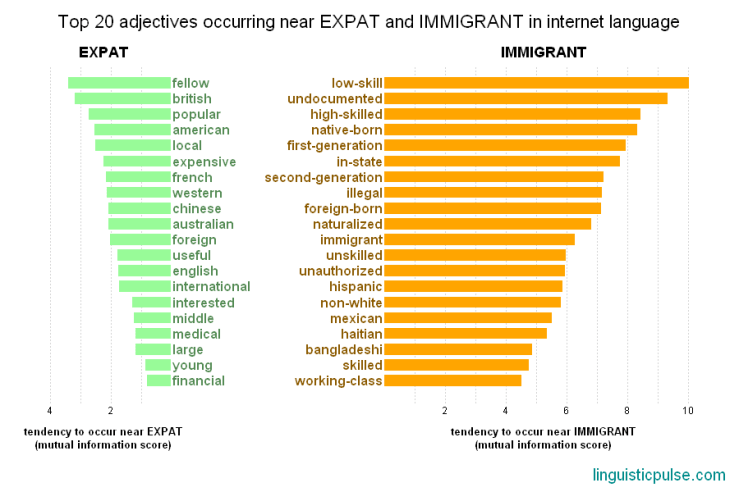
expat_immigrant_linguisticpulse1The piece I wrote two days ago (‘A warning to all expats in Rome!!!’was mischievous and frivolous but was also intended to make a serious point. It sought to draw attention to the fact that people who call themselves expats are also immigrants, just ones who enjoy – and, crucially, don’t tend to question – certain privileges. It therefore provoked a furious reaction from people whose status as ‘expat’ is one of the most important aspects of their self-identification.

The post was partly motivated by my genuine surprise at how many people here in Rome wear this badge with pride. I guess (and I’m aware that I am generalising enormously) that Rome has something in common with Paris, in that both cities tend to attract the kind of people depicted in later Woody Allen films: urbane, mobile and well-heeled North Americans and middle class ‘Brits’ attracted by the postcard romance of the place but with little actual commitment to or knowledge of the society they’ve chosen to make home. The prevalence of self-declared expats here contrasts with previous places I’ve lived in. In Portugal the only people who were happy to be called expats lived on the Algarve and played golf or lived in Lisbon and were part of rugby clubs. In a Spanish context I immediately think of monolingual retirees on the Costa del Sol. In Mexico I only heard the word in relation to places like Puerto Vallarta and San Miguel de Allende. Most people I’ve known there and elsewhere wouldn’t call themselves expats. It’s not cool to be an expat and I think there are good reasons why this is the case.

I want to make clear that I know and respect some lovely people who may call choose to label themselves expats. I also enjoy the work of the Canadian graphic novelist Guy Delisle, who depicts beautifully the tribulations and contradictions involved in moving to distant countries with his wife every couple of years. It’s also true that those who try too hard to fit in, disavowing entirely their own background, can be deeply annoying.  While I have little problem with individuals who call themselves expats, when it’s manifested in a cluster, the expat mentality starts to look ugly and sound really quite whiny and arrogant. Facebook groups are rarely nice places to hang out, but anyone interested in how unpleasant the expat worldview can get is well-advised to temporarily sign up to one called ‘Expat Moans’. It’s hard to read more than three posts in such a group without getting a distinct whiff of actual racism.

Does that mean I’m calling all those who describe themselves as ‘expats’ racist? No, of course not. But with the help of this Guardian article, I want to enumerate those things about the category ‘expat’ which make me feel uncomfortable. I must also say that a) I’ve been guilty of several of these things in the past and b) that I’m trying to characterise a way of thinking and behaving. This is not written as an attack on a particular group of individuals. I’m also conscious that some of these criticisms are made of immigrants in general; I hope it’s clear that I am not presenting them here in such a way.

These are the features of the ‘expat’ attitude that I find distasteful:

1. A belief that whiteness and westernness makes one exempt from social responsibilities. Some expats engage very little with what’s going on around them in their host society -paying no attention to local and national news, for example.

2. A failure or refusal to recognise one’s privileged position and its historical roots.

3. A disavowal of one’s status as immigrant, to the point of failing to express solidarity with less privileged foreigners. A lot of so-called expats would not be inclined to express solidarity with the plight of immigrants if they had stayed in their own country.

4. A political identification with local elites, including the taking-on-board of class-based and racist prejudices.

5. A failure and/or refusal to integrate and learn the language. This is particularly prevalent among English-speaking expats. It’s both fortuitous (in terms of finding work) and unfortunate (in terms of encouraging our sense of superiority) that our belief in the primacy of our language is shared by people all over the world.

6. An attitude of being a permanent tourist, continuing to treat the host society as little more than a source of photo opportunities: charming but without substance.

7. Some expats have a tendency to complain about what surrounds them – particularly service and services – but without seeking to understand the social, political and economic context.

8. In a lot of cases, expats live at a distance in economic terms, only frequenting ‘international’ establishments. It is also common for self-declared expats to inhabit a cultural and social bubble in which they only mix with others of their kind. I’m not just talking here about corporate immigrants – the same is definitely true for many who work for international NGOs and the UN. The Green Zone extends far beyond Baghdad.

9. An uncritical attitude towards one’s own country. Expats often think of themselves as enjoying a temporary absence from an unchanging homeland which will always welcome them back. In the case of both Brexit and Trump, this complacency has been cruelly exposed. The post-1992 tide of open European borders is retreating, and it may well leave some long-standing emigrants in EU countries stranded.

This is by no means an exhaustive list and I’m aware that in relation to any given individual’s set of circumstances some of it may be unfair. For example, having lived in China and spent time in Thailand, I understand that there are some countries in which immersion in the host society is infinitely more demanding in terms of time and effort. The language is much harder to learn and the culture much more difficult to get to grips with, making it so much more difficult to participate in social life unless one has sent a substantial portion of one’s life there. In other countries such as Saudi Arabia and the UAE, expats are servants of the elite, little more than a caste of privileged servants, and as such are more socially dependent on their English-speaking patrons. Increasingly, many countries have a preexisting infrastructure to facilitate the expat lifestyle. Mike Davis’ book ‘Evil Paradises: Dreamworlds of Neoliberalism’ reports on the iconic example of modern Managua, where a high-speed road network whizzes elite citizens and visitors between the business district, the gated communities and the airport, leaving poorer parts of the city untouched and deteriorating. The annual Mercer Survey of the world’s ‘most expensive cities’ is a regularly bizarre read, featuring locations such as Luanda and Kinshasa in the top 10. While life for most people in those cities is certainly a struggle, the survey isn’t about them, but the Randian superheroes who (or whose companies) think nothing of spending $100,000 on a prime apartment in the most desirable areas.

Are people from the Philippines expats? Or from Bangladesh? What about Senegal? In a way, given that so many people from those countries work abroad out of necessity, it would be nice to think they were part of the club. However, it’s hard to imagine the average British financial services worker in Dubai regarding her pool cleaner as part of the same social class. In the case of the Italian expat Facebook groups, the members are almost exclusively white Americans and ‘Brits’. There’s little direct racism but a lot of griping about Italy and the Italians, and little solidarity with African or Arab victims of Italian racism. As for the Expat Moans group, it’s a bit like a vision of what Facebook would have been like in the middle of the 19th century. I know that similar dynamics operate in the French and Portuguese-speaking worlds, and similar attitudes are probably expressed among highly-paid Chinese workers in African countries.

I earlier mentioned the historical roots of expat privilege. If we want to (as we must) make an effort to understand where those roots lie, we have to talk about colonialism and imperialism, that ‘corner of a foreign field’ that is to be regarded as part of the metropole. This is our history as westerners. It’s helpful – indeed, as a white Westerner living abroad, essential – to be aware of the critiques of writers such as Camus, Fanon, and Orwell if we want to be aware of our implicit modes of thinking and behaving in relation to the world around us. We are hardwired to regard poorer societies in a condescending and/or hostile way and to expect that the locals defer to our needs, our values and our lifestyles. For centuries we have been taught to believe that we have an automatic right to be spoilt. As I mentioned earlier, the English language in particular encourages this mentality. It’s common now to hear references to ‘international’ food as opposed to national cuisine, and it’s not implausible that this way of thinking extends to people. Those who call themselves expats aspire to belong to a global elite in a world increasingly divided along lines of mobility, between those who can live and work wherever they want and those whose movement is, by dint of class or birth, infinitely more restricted.

Calling oneself an ‘expat’ encourages a certain mentality and way of behaving, a sense of superiority and entitlement which we have to be vigilant of and challenge in ourselves and others. At a time when immigrants are being scapegoated, locked up and deported around the world, from LA to Rome to London, all migrants – regardless of the colour of our passports – have an absolute moral duty to stand up for one another.

(P.s. Anyone still inclined to think that there is no difference between how the words ‘expats’ and immigrants’ are used is well-advised to do a google image search for both terms.)

A warning to all expats in Rome!!!

fotocastroni6

I want to share this experience because I think it should serve as a warning to anyone who’s tempted to be off their guard here in Rome. The whole thing has left me feeling more than a little shaken and disappointed. Please take what I’m about to tell you very seriously indeed and if you recognise similar situations DON’T DO what I did – just walk away instead. This could happen to ANY of you.

I was walking along Viale Marconi, just down from Piazzale dalla Radio and round the corner from our apartment. I came up to the Feltrinelli bookshop, outside which I saw a guy I’ve seen a few times before, in pretty much the same spot. His name is Mamadou and he comes from Senegal. We’ve always spoken in a comedy mix of French and Italian, although he’s been here for a few years and speaks the language excellently (much better than me). I’ve also seen him up on Via Nazionale, outside the IBS bookshop next to Repubblica, and he always remembers and greets me. He makes a living (more or less) from selling books, mostly about Africa, and over the last six months I’ve bought a few of them, some poetry and kid’s stuff which is actually quite good. I’d last seen him a few weeks ago so he knows I have a child now, so we chatted about sleepless nights (he’s told me before he has three sons and a daughter back home) and he was showing me a brand-new book of children’s stories. I demurred, saying we’d got lots of new books at home, forse la prochaine foi, etc. He pressured me a bit but it all seemed very good-natured. We said goodbye and I walked on.

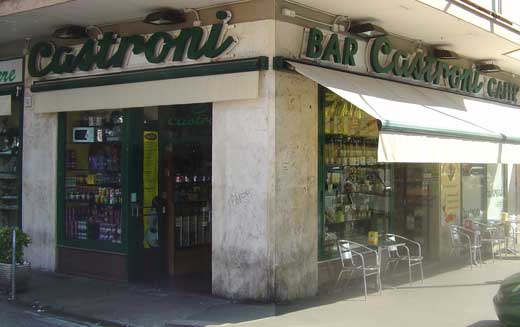
Now, this is the important part. The conversation with Mamadou was OVER. I’d very clearly said NO to buying his books. I carried on up the street a couple of hundred yards to Castroni. Now, they sort of know me as I’m often in there buying Calabrian chillis and the like. I stepped through the door and went up to the shelf where the Middle Eastern products are displayed. There was a new kind of hummus I hadn’t seen before in an attractively-presented tin can. The packaging is green and the company (Lebanese) is called AL-RABIH. The name of the product is spelt (bizarrely) HUMMOS.

Whatever you do, do NOT buy that huomus. It is absolutely shit. You have to add about six tablespoons of decent olive oil to make it even remotely palatable. The consistency is like dust. And it’s massive! It’s like the fucking humus tardis in there! I’s going to take me about six weeks to get through the stuff (I hate wasting food) and I don’t even like it. In any case my wife refuses to countenance the buying of any more hommus until it’s finished :-(.

Please pass this on to your friends and colleagues. People keep saying that Rome is a ‘safe place’ for expats. They have NO IDEA of the dangers that lie out there.

Lesson Plan: Procedure for writing a story

This is a very simple procedure for writing a story in the first person about a personal experience. It’s in the form of a Powerpoint presentation so you can just show it to your students and put your feet up. At the end of the lesson get your students to stick up their stories on the walls, walk round reading them and choose their favourite. For homework they can either do a second draft with more details (which don’t by any means have to be true) or write another story. 매우 쉬운!


I love Cuba

DSC_0421

Of all the abuse that the term ‘authentic’ has come in for over the years, nothing can have prepared it for the outright torture it is subjected to in an advert currently showing on the metro in Rome for authenticcuba.com. Ordinary life for the average Cuban apparently revolves around a succession of five-star hotel lobbies, exclusive spa treatments and gourmet meals of the very highest international standards.
DSC_0453

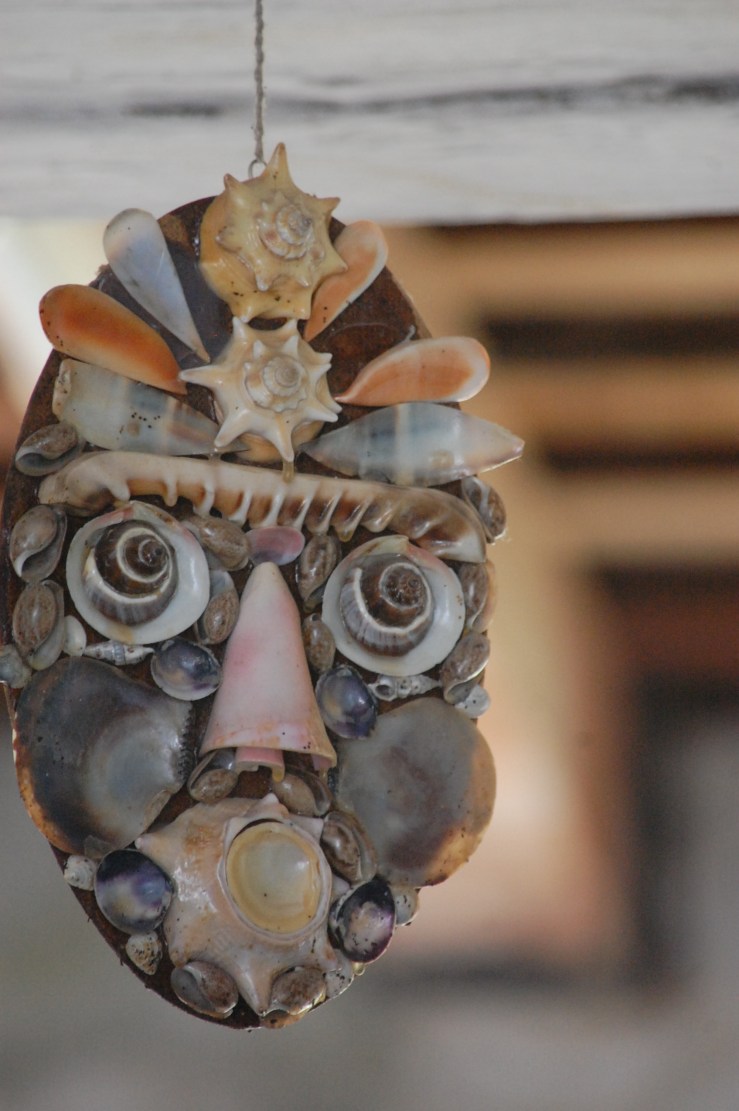
Although Cuban society is changing, it hasn’t quite yet reached that point of being synonymous with luxury and exclusivity. Maybe the people who made the ad got it confused with Dubai. As an erstwhile/occasional radical Marxist communist revolutionary type who also happens to speak Spanish, I’d always felt slightly ashamed of never having been there when it was more authentically egalitarian. My wife hadn’t either, because early until last year she worked for a (large human rights organisation which isn’t recognised there) defending Caribbean human rights and thus always assumed that she wouldn’t be allowed in. But given that (as of May 2016) we were living not very far away (in Mexico) and that she was leaving her job after seven years, it seemed not to foolish not to give it a whirl. As it happened, the day we arrived was the day after she’d left that job, and it only occurred to us as we approached immigration that if her name was on some sort of list it wasn’t like the hyperefficient Cuban bureaucracy would have removed it in the preceding 24 hours. It’ll be fine, I blithely reassured her, just as a uniformed official stepped in front of us and asked us where we were from and what we did for a living. ¡Ih!

DSC_0808

After 15 or so minutes of slightly evasive light interrogation we were free to enjoy Cuba’s manifold splendors and contradictions, the most prominent of which was occasioned by our very presence there. While in Cuba we we spent about $100 a day (in CUC, the convertible dollar equivalent as opposed to the peso nacional, which is worth 25 times less), five times what very many Cubans working full-time in professional jobs earn in a month. Now, let’s imagine that where you live there was a huge numbers of visitors to whom $3,000 dollars had the same value as $20 has for you. You’d probably badger them, a bit. You’d might even learn to play the guitar, just in case they liked that sort of thing. You’d try to provide whatever services might be to their liking. So it’s easy to see why so many doctors, university professors, teachers and so on are driving taxis, renting out their flats or offering up the odd autentico sex act.
DSC_0805

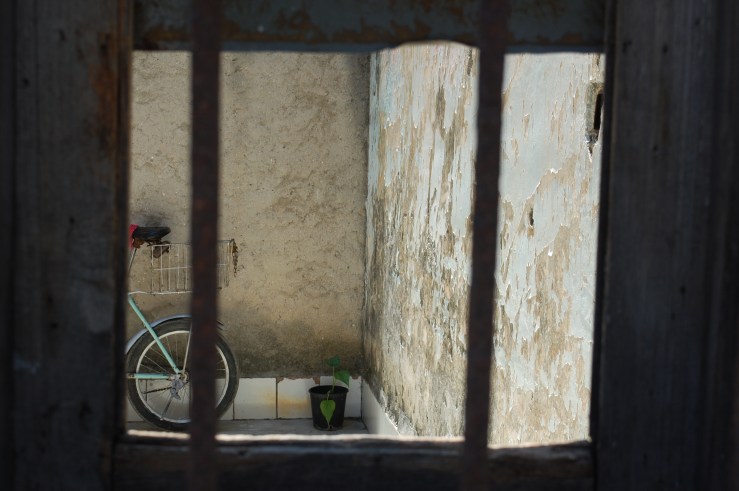
For various reasons (some frankly superstitious and some eminently sensible, given the embargo and the dangers of suddenly spiralling inequality), there are stringent restrictions on private commerce. Some forms of economic activity are allowed, others prohibited. The fact that food is not on the list makes for a startling contrast with Mexico. If you accepted all the offers you receive for cheap and tasty food in Mexico City you’d be dead within 15 minutes; in Cuba, even with (by local standards) an infinite amount of cash to spend, you can still find yourself if not hungry then certainly a bit frustrated.

DSC_0776

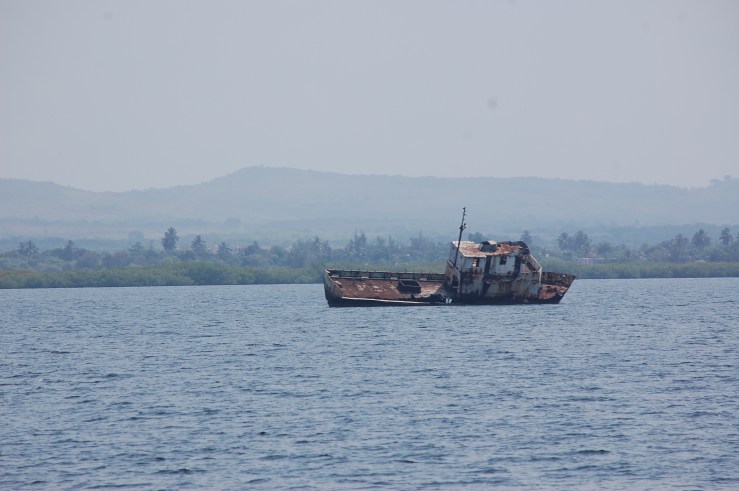
Access to a small quantity of some daily essentials is guaranteed via a system of rationing. Every family receives a small amount of rice, sugar, matches, and oil every month. It’s not enough, but it is essential. Petrol is also cheap thanks to an ongoing (although maybe not for much longer) agreement with Venezuela, and public transport costs next to nothing. Healthcare and education are famously provided by the state. Both housing and private cars seem to be passed down and carefully maintained on a minimum of resources. People get by, some barely. A successfully waylaid tourist late in the month can mean the difference between eating and going hungry.
DSC_0298

The dual currency policy is a useful educational tool for tourists. In other countries, the existence of a single currency disguises the fact that there are different economies in society, some in direct conflict with others. The London housing market is a good examples of this, and the imbalances in Mexican society, between those (like us) who can happily throw around 70 pesos on a cup of coffee and those for whom that sum represents 16 hours’ hard work, would be less avoidable if the poorest and the richest didn’t share the same currency.
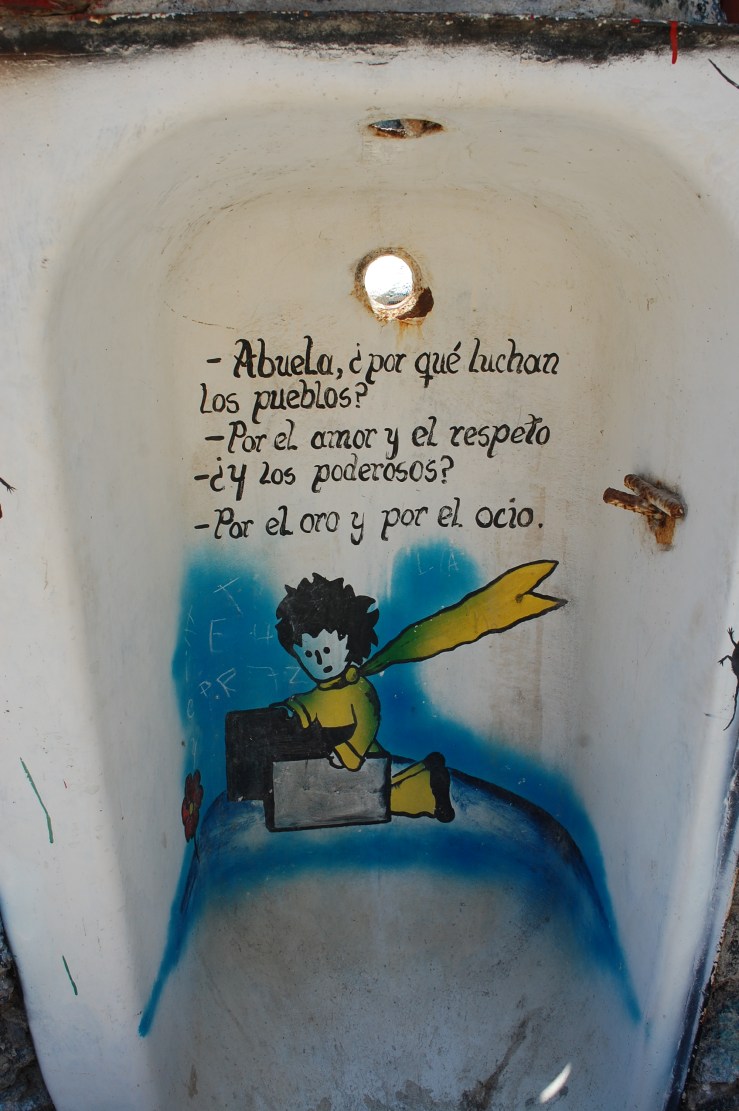
DSC_0798

One thing that actually shocked me about Cuba was the (lack of) printed media. There is essentially one national newspaper (‘Granma’) and it is absolutely dire, like a monochrome and cheaply-printed edition of Worker’s Power from 1985. Even that is not very easy to track down. Given that we unfortunately didn’t have access to TV in any of the places we’re staying, it was hard to figure out how state propaganda operates. One taxi driver was kind enough to explain it to me. According to him, political control is partly exercised through the (very) locally-based Committees for the Defense of the Revolution. The soldiers we saw knocking on doors around the country may be connected to this system. It apparently involves a lot of gossip and neighbourhood spying, like what Jane Jacobs called ‘eyes on the street’ but with a more sinister edge. Careless talk could mean an uncomfortable visit to or from the police. In the last few years Raúl Castro has unleashed crackdowns on dissent, especially in 2009 when he took power. There are numerous reports of arbitrary detentions and of those who fall out of favour losing their livelihoods.
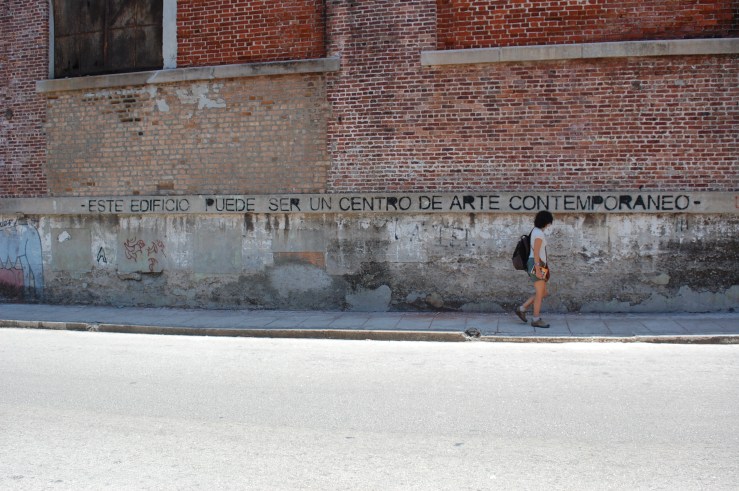
DSC_0803

Although Mexico and Cuba are obviously very different societies, visiting the latter while living in the former made for some inevitable but hopefully not too misleading comparisons. In Mexico everyone complains, all the time, and quite rightly, about everything connected to the Government and the rateros who run things. There’s an extensive privately-owned media, subject to more brutal forms of censorship. In Cuba I heard no one talk about corruption. That doesn’t mean there is none; in a way Cubans are both better-placed to know what goes on behind the scenes and also less likely to be able to find out. The Internet suggests that there is a lot of bribery and theft (there are lots of references to informal ‘sociolismo’ and ‘amiguismo’), and the fact that the Government has publicly cracked down on it suggests it is an issue, but for all that people we met complained about the difficulties of their daily lives, it wasn’t mentioned.

DSC_0910

I did get the sense that inequality is a growing problem. Most taxi drivers were chatty and open. They are among those to have gained most from the opening up, making up, along with waiters and (apparently, inevitably, depressingly) prostitutes, a brand-new middle class. Both they and the owners of the casas particulares (licensed private guesthouses) we stayed in seemed pleased and grateful for the opportunities they’ve been given. Of course, by definition we had limited chances to talk to people who’ve been left out of the tourist boom. It is also worth mentioning that almost everyone we came into contact with through the tourist industry was white.

DSC_0329

The lack of Internet was something I at first found frustrating and then refreshing. Going online in any form involves buying a card for a certain number of minutes, or at least joining a queue and then doing so. Then there are only certain places where wifi can be accessed. As a result, such places are social spaces where people hang out, talk to friends abroad and use the internet as a public good. The restrictions may be motivated by political control and austerity, but for ten days I enjoyed the novelty of my enforced exile from the online world, obviously another privilege that very few Cubans share. It felt a bit like those resorts where you eat not what you want but what’s good for you, like holidaying in a high-end monastery. The temporary absence of traffic, internet, mass media, and the pressure of advertising felt like a breath of fresh air to me, but I know that for locals it is stifling, a source of immense frustration that in many cases can’t be contained, leading them to try their luck on rickety boats. The numbers leaving the island have increased since early 2013, when exit visas were automatically granted for the first time.
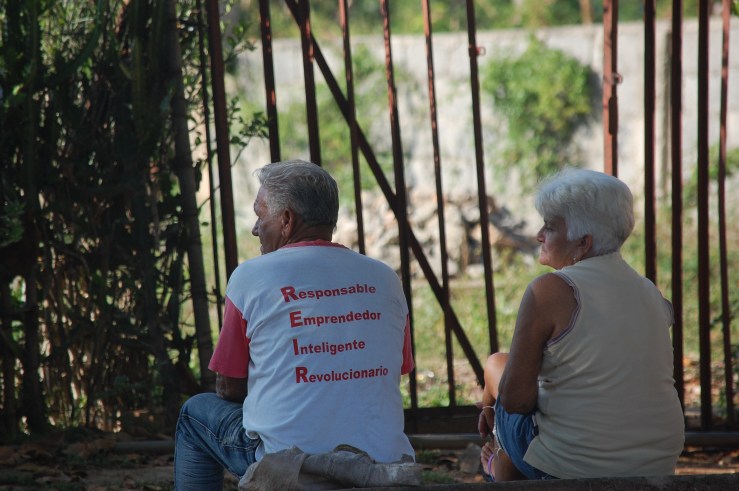
DSC_0251

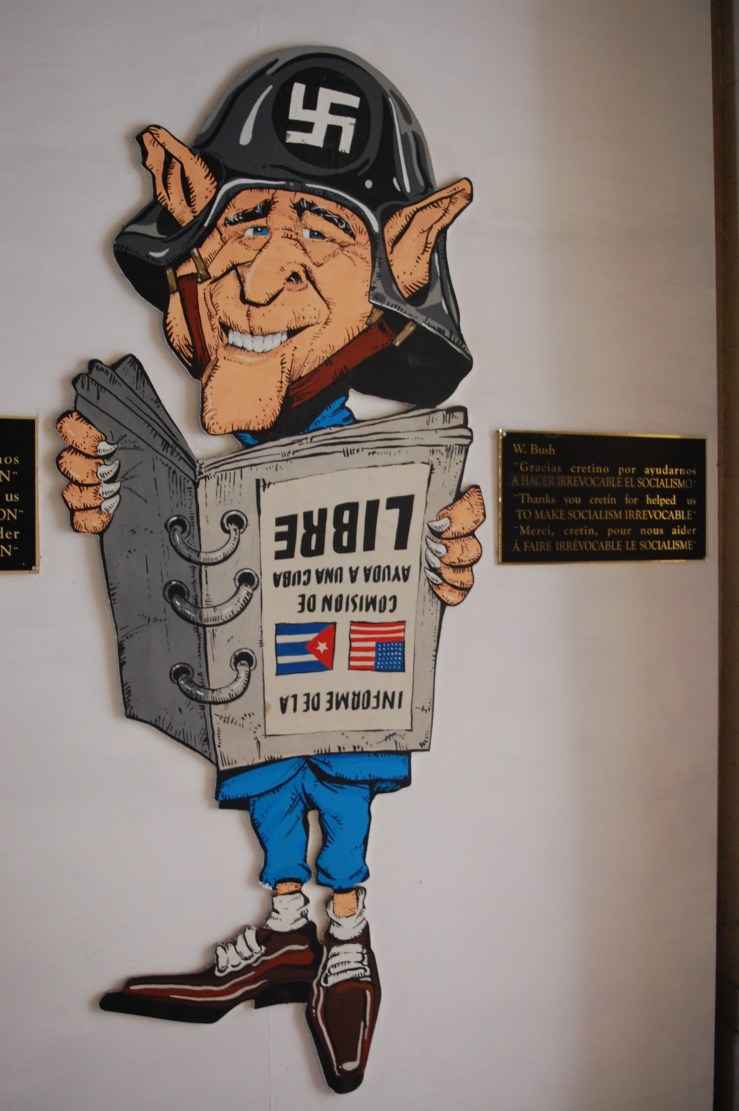
I did pick up the sense, however, that people in Cuba do still share an ethos. This is not the same as subscribing to a political ideology. The only times I heard socialism mentioned was in museums, on street murals and the couple of times I read the newspaper, and in publicly-broadcast announcements. There does seem to be a patriotic spirit which takes some pride in the achievements of the Revolution. How young people relate to that I have no idea. Graffiti artists and bloggers are among those who have been swept up in Raúl’s crackdowns on dissent. Cubans also face restrictions on movement around the island, a reality probably lost of most of those who, like us, sail round for the sake of air-con, speed and convenience on buses lines which are only available to tourists.
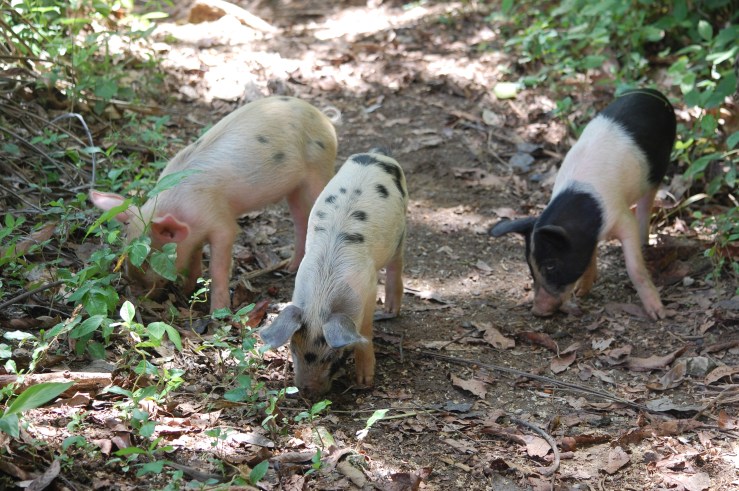
DSC_0144

Not spending all our time looking at our phones means we get talking to other tourists. Some English people we make friends with on the beach are kind enough to pass on a recentish (sympathetic, but not uncritical) biography of Fidel Castro written by a German journalist in 2007. For all the drama of the Revolution itself and the immense sacrifices made to keep it going, with Cuban citizens occasionally removed to an age before the invention of the combustion engine and tales of Havana residents (illegally) farming pigs on their balconies, you’d have to admit that ideological madness was a factor in its survival. At one point in the 1960 Castro declared himself to be against all forms of private trade, right down to the ownership and exploitation of fruit trees. Even the most rabidly pro-Castro leftist would have to wince at some points in the story.

DSC_0970

At the time the book was written the rising star of Cuban politics was Ricardo Alarcón. He was central to the policy of opening up some areas of private trade in the face of absolute economic oblivion. I asked a taxi driver what had become of him since. He’s off the scene, was the reply. Later I learned that he fell out of favour with Raúl and now works is an administrator in a hospital somewhere to the West of Havana, presumably earning the standard $20 a month.
DSC_0849

Not that there’s anything ignoble about working in a hospital, of course. Cuban has some excellent medical services (I didn’t get the chance to find out how the glowing tales we hear abroad are reflect reality). But if those doctors had the chance to go and work abroad, would the system survive? This is just one of very many conundrums which a visit to Cuba opens up. I spent a great deal of my time trying to work out the relationships between embargos, imports and exports, balance of payments, foreign currency, emigration, remittances…as for whether or not tourism is a basis for development, other Caribbean countries such as Jamaica and the Dominican Republic are not inspiring examples of sustainability or stability. Decent education, and health systems, a lack of widespread violence and corruption all seem unambiguously laudable. The post-Soviet Special Period (or at least the way it’s represented in this excellent-if-a-little-too-effusive documentary) is a genuinely heroic example of popular austerity and enforced environmental sustainability, one which I’ve sometimes thought that (as I’ve argued before) Greece could have learned some lessons from had it not opted to stay inside the EU.

DSC_0266

Given the particular historical moment at which our visit took place, pretty much everyone we talked to told us it might be the last chance to see the country before it ‘changed’. I was and am sceptical of such predictions. The Government is keeping economic and political activity tightly controlled and I didn’t detect any signs of insurrectionary sentiment. Nevertheless, Obama in his last lame duck year did make some very significant changes in the relationship between the countries, and the pressure of big money will probably mean that even the most reactionary government in US history may not be able to reverse the momentum. Maybe they don’t feel the need. After all, Cuban Americans are neither as powerful nor as useful as they were in the 1960s.
DSC_0166

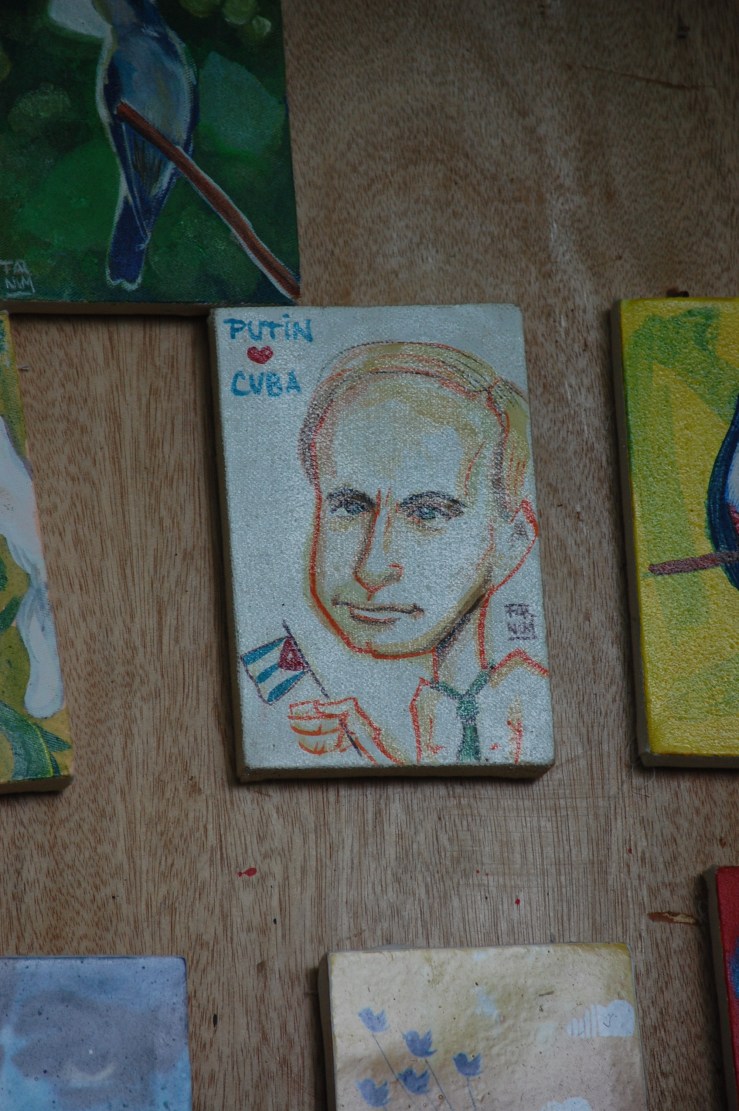
Visiting Cuba taught me a lot. Since it’s one of the those places where it’s hard to relax and play the role of the tourist it problematised my view of the world in a useful way. Emotionally I still feel that the Revolution was worthwhile, and am inclined to believe the sacrifices since then are to some extent justified. It’s easy to forget that in the case of East Germany the Communist regime was partly fueled by revulsion and horror at what had preceded it, and in a similar way I don’t think anyone beyond far-right Republicans is keen to return to the brutal repression of the Machado and Batista years. But then, while browsing in a tourist shop I picked up a book of photographs taken by one of Fidel’s sons of those who visited him over the last few years. There  was El Jefe Maximo with Lula, Chávez and Morales, but also with Assad, Peña Nieto, Mugabe, and Putin. Cuba’s spiritual leader was allowing his country’s legacy of radical self-sacrifice and principled international solidarity to be used as a cheap photo op by any passing tyrant. Irrespective of Cuba’s problematic-but-inevitable past dependence on Stalinist regimes, seeing Castro with Putin and Assad is particularly galling in the context of the current worldwide reactionary resurgence. Today I came across a truly bizarre pro-Assad Facebook group called ‘Love for Syria, Iran, Russia and Cuba’. Is support for Cuba now somehow part of the cause of global neofascism? Such geopolitical shifts require acts of mental contortion that it usually takes a lifetime to master. Perhaps, to paraphrase the documentary-maker Adam Curtis, given the current global political context, relations between the rest of the world and Cuba could not and will not be normalised, but rather hypernormalised. Cuba is not going to become ‘just another’ capitalist country – in a post-Trump world, such a thing no longer exists.

DSC_1038


I love Russia

Russia-Flag-14

Apparently there’s recently been a worldwide explosion of ‘Russophobia’. According to Alex Jones of infowars.com, hundreds of thousands of expats in Europe and elsewhere have decided to return home in the last couple of years because of anti-Russian sentiment.

Shamefully, I myself have never actually been to Russia, although I’ve nearly made it a couple of times. In winter 2007 I was offered a month-long job in a (presumably frozen) forest near St Petersburg teaching kids ‘on a campsite’. Since I was suffering at the time from what Russians call toska it sounded ideal. I’ll be able to see St.Petersburg, I mentioned to the interviewer. Hmm, maybe with…a chaperon, was her response. And when I asked who was organising the whole shebang, she sort-of-smiled and referred vaguely to ‘some…businessmen’. In the end I got a job working for Fetullah Gülen so it didn’t happen.

Russian stereotypes for my generation weren’t of heroic workers or freezing gulags but of the catastrophic consequences of economic collapse. In the 1990s Russian society was depicted as a hellish environment to survive in, one of ragged post-Soviet citizens gathered round salvaged oil drums for warmth, drinking bootleg vodka out of shoes whose laces their beleaguered grandmothers were out trying to sell on the streets whenever they weren’t in their furniture-stripped apartments making webcam porn for foreign cents. The country was synonymous with dodginess in the form of a resurgent mafia taking the place of broken state institutions. If it wasn’t dog-eat-dog then it certainly involved people doing just that. I once had a delicately-featured 17-year-old student from Siberia who, in a class discussion on weird things we’d eaten, told a mesmerising tale of the time she and her friends drunkenly killed and ate a dog. She may have just said it to have a laugh. I’ve found that Russians have a mordant sense of humour and a very strong sense of the absurd.

For years I told that story, vaguely aware that in doing so I was perpetuating a lazy stereotype of scary Russians. In reality I always enjoyed hanging out with them. At about the same time as the abortive St Petersburg trip I was teaching what is still one of my favourite ever classes. It was huge fun largely thanks for the presence of two Russian women: Tamara/Toma, a budding fashion designer bursting with wit and ebullience, and Natasha/Natalya, who on first meeting I was inclined to dismiss as a sloane but who turned out to be one of the most emotionally intelligent people I’ve ever met. I also spent about 18 months teaching private classes to a student called Vlad, an aging computer whizzkid as laconic as he was wise. Toma and Natasha helped me through a difficult break-up, while Vlad and I mostly ended up talking about the works of José Saramago, on the subject of which I was writing a dissertation at the time. I’m enormously grateful to all three of them.

Perhaps I’ve just been lucky, but the Russians I’ve known have almost all had an in-depth knowledge of and an appreciation for the wealth of culture that their country has given the world in the form of literature, painting, theatre and music. Most have been happy to discuss and draw lessons from Dostoevsky, Chekov, Eisenstein, Tarkovsky and many more. At the level of fiction and cinema in particular Russia seems to be one of those cultures (akin to the Spanish-speaking world) which is so vast and dense you’d never really need to leave. Two more recent novelists who have influenced my understanding of not just Russia but also life and the world are Victor Pelevin and Vladimir Sorokin. The former is like a cross between Irvine Welsh and Thomas Pynchon, and the latter’s novel ‘The Day of the Oprichnik’ is a futuristic dystopian fable as troubling as it is entertaining. As for film, the 2014 movie ‘Leviathan’ depicted the dismal reality of daily struggles for human dignity in the face of powerful and evil forces, in the form of an epic biblical parable. The film faced a campaign of vilification in the Russian press as a result. Similarly scripture-heavy is the brand-new release ‘The Student’ which I will, baby daughter permitting, endeavour to see as soon as possible, which may well not be til at least 2035, but still. There’s a moral seriousness to a lot of contemporary Russian cinema which I for one find extremely beguiling but would be deeply inappropriate for a newborn child who doesn’t even recognise Peppa Pig yet.

I was also lucky a few years ago to spend time in London with members of Chto Delat, a (genuinely) radical art/activist collective from St Petersburg. Their elaborate dialectical critiques (most often presented in the form of newspapers and films on themes such as Brecht, the political role of the Avant Garde, the Right to the City) I find both profoundly disorientating and deeply enlightening. The risks they take to produce and present their art surpass by far any challenges faced by artists in the UK or the US, with their publications seized by the State and members harassed and arrested. Together we organised a protest outside the Russian embassy in support of two antifascists arrested on an environmental protest. I hope that if I ever do make it to Russia this won’t turn out to be a problem and I don’t have to remotely post a series of gulag diaries. In fact, that’s quite a good point. Let’s just pretend I never mentioned it.

Those who do dare to oppose the abuse of the powerful in Russia exhibit enormous courage. The suffering and fortitude described by Alexander Solzhenitsyn is almost beyond compare. Some of that bravery lives on in Pussy Riot, who in return for standing up against the Church and the State were sentenced to endure similar conditions in an actual full-on Siberian penal colony.

Their crime was to stand up to the patriarchal arrogance of a president who seems to take pride in the very worst aspects of Russian history: Tsarism, pogroms, showtrials and the gulags themselves. Those Russian individuals and institutions who exhibit the enormous courage required to resist his autocratic rule, who publicly object to the corruption, racism, homophobia, misogyny and state terrorism he promotes are labelled ‘anti-Russian’ and ‘foreign agents’ and driven out of their homeland – or, even worse, forced to stay. Now, through the Kremlin’s media outlet Russia Today and its useful bigots overseas such as Alex Jones, this bullying of anyone who opposes Putin has taken on international proportions. The Russian President may not be the megalomaniac psychopath that some of his detractors like to make out, but that his rule is brutally repressive and that he has plans to expand it overseas is beyond any doubt.

In the meantime, if US Republicans and neofascists want to go looking for anti-Russian prejudice, they need to look at the history of their own families and their own political traditions. For decades US mainstream culture portrayed Russians as less than human. A far-right xenophobic hate merchant like Alex Jones has no concern for the people of Russia. And anyone who, like him, implies that criticisms of Putin or attempts to investigate his seedy connections with Trump and Exxon is a manifestation of ‘Russophobia’ is, like the Russians say, “полон дерьма” – full of shit.

I’ve thought of a great way of dealing with the “alt-right”. It’s called “shush-pat”.

altright-you-say

Jacques Lacan said of the student revolutionaries of 1968 they were looking for a new father. By contrast, the so-called alt-right appear to be seeking someone to breastfeed them. In this excellent lengthy article about hanging around with fanboys of that pro-pedophile sociopathic freak Milo, Laurie Penny writes:

I enjoy most respectful conversation, and these boys are scrupulously polite to me. They were polite to me a month earlier when I slept on their tour bus — right until a door closed between me and them, and they immediately started talking loudly, to each other, about the crass and anatomically implausible things they wanted to do to me. Intellectually, they must have known that I could hear them, but these kids grew up on the Internet, the world’s locker room, where if you can’t see a woman, she doesn’t really exist. The one grown man on the bus started yelling at them to go the hell to sleep — “there’s a girl back there!”—and they yelled back that they’d let me sleep if I let them “suck my titties.” It’s no surprise to hear that they’re still yearning for the teat, but these babies had best be careful where they go slobbering for the milk of human kindness. I’m just about dried up.

Now it turns out she was spot on: milk is indeed a Thing among alt-righters. Nazis have been using it as an emblem, because it’s ‘pure’ and, er, Asian people don’t drink much of it. They have apparently been pouring it over each other in celebration of its and their ‘whiteness’. This taste for moomoojuice seems to have inspired this remarkable work of art. Where Hitler called for Lebensraum, his latest disciples are after milky-wilky.

It eloquently demonstrates the infantile nature of the whole project. They want someone to mother them. Perhaps Le Pen fits the bill, or maybe Trump himself, given the famously female cadences and rhythms of his speech. It also explains why they have a thing about cartoons. Their undeveloped brains and nascent eyesight are unable to deal with anything more cognitively demanding, hence their emotional attachment to a white supremacist equivalent of Peppa Pig and Teletubbies (one which happens to be green, but still). There’s also something distinctly ‘Lord of the Flies’ about their inhouse media outlet, Breitbart. And as Laurie Penny points out they, like punks, have no actual understanding of what Nazism is, they’re just trying to annoy adults by any means necessary.

As it happens I am currently undergoing a crash course in dealing with infant hysteria. I am developing my skills in calming down my six-week-old daughter and sending her to sleep. Her screaming has been honed by evolution to be as distressing as can be, as she alone has no means of dealing with hunger, tiredness or discomfort. Her screeching, like that of the überbrats of the new far-right, has no actual meaning beyond that.

Luckily there’s a solution (beside feeding her, naturally): shush-pat. This technique, invented by the currently ubiquitous childcare guru Tracy Hogg, consists of tapping her firmly on the back while saying ‘shush’. It’s simple and it works. With (sometimes immense) repetition it soothes and comforts her. Eventually her eyes close and her breathing slows. She’s totally relaxed which means we can be too (actually we lie awake for hours worrying that she might explode into fury at any moment, but you get the point).

How would this work with the alt-right? It’s hard to say. I personally have no inclination whatsoever to cuddle Steve Bannon, and although Trump himself appears desperately in need of a breastfeed I’m not about to lift him out of his cot and hand him to my wife. In any case the most outspoken Trump supporters (of whom the angry young men of the alt-right are a self-styled postmodern Hitler Youth) only exist online, where they trade in a currency of memes, mostly originating on 4chan (“the internet’s hate speech hit factory”). Most can only communicate in bright, colourful images with slogans written in big letters. Shush-pat could be an effective antidote to their unsolicited and unwarranted venom and denial, whether they happen at that particular moment to be be sticking up for rape or torture or murder or pedophilia. These are, after all, not rational adults. They are no more open to reasoned arguments and the sober presentation of factual evidence than a hungry newborn baby is. They are, in fact, not post-factual but pre-conceptual. They are screaming for attention and consolation and they need to be told, patiently but firmly, to shut up. I offer the above hastily-assembled collage as a contribution to the cause.