Once, in the driving rain in Rossio Square in the centre of Lisbon, I saw someone who looked like a caveman devouring a pineapple in the driving rain. It was May Day, mid-afternoon, and the annual demonstration was dispersing. Through the deluge, from fifty metres away, I could just see masses of unkempt bedraggled hair and the manic gleam in his eyes as he hacked into the flesh of the fruit, like a primitive sculptor trying to destroy his artwork with his incisors, or as if the pineapple were freshly-killed red meat and fire had yet to be discovered.
On another occasion, cutting across London from Marylebone towards UCL one drizzly Monday lunchtime, I happened to notice three separate individuals standing in the rain, without umbrellas, eating sandwiches they’d bought from the supermarket. I’ve sometimes mentioned this in class when a student was struggling with the distinction between ‘standard of living’ and ‘quality of life’.
It’s 2012 or 2013. I’m in the octagonal café outside Turnpike Lane Station. Outside the rain is pelting down. Someone has ordered a pizza, maybe one of the taxi-drivers on the other side of the busy road. I watch the waiter carry it on a plate across the pavement and hold it up while he waits for the traffic to stop. The boss or whoever is in charge really should have told him to put it in a box first.
Late capitalism is a pyramid racket on a global scale, the kind of pyramid you do human sacrifices up on top of.
Reading Thomas Pynchon’s novels is hugely entertaining. It enables you to see the world in new and unexpected ways, to entertain new possibilities about reality. While poets often do this in an oblique way, Pynchon does it in a manner which teases the brain but is also relatively easy to make sense of. To get to grips with his novels nevertheless takes effort, but it’s one which is hugely pleasurable and deeply rewarding. That first quote was from his latest (and possibly last) novel, ‘Bleeding Edge’ (2013). This is from his first, ‘V’ (1963):
The only consolation he drew from the present chaos was that his theory managed to explain it.
And this from ‘Mason & Dixon’ (1997), from the mouth of a talking dog:
“Once, the only reason Men kept Dogs was for food. Noting that among Men no crime was quite so abhorr’d as eating the flesh of another human, Dog quickly learn’d to act as human as possible,— and to pass this Ability on from Parents to Pups. So we know how to evoke from you, Man, one day at a time, at least enough Mercy for one day more of Life. Nonetheless, however accomplish’d, our Lives are never settled,— we go on as tail-wagging Scheherazades, (…) nightly delaying the Blades of our Masters by telling back to them tales of their humanity. I am but an extreme Expression of this Process.”
Seeing as I am currently, while waiting for my wife to give birth to our first child, enjoying “that mysterious exemption from time that produces most internet content” (‘Bleeding Edge’, p428)*, I wanted to share with ‘the world’ just what a joyous experience it can be to read Pynchon’s work. Once again, that doesn’t mean it’s easy. It took me, I would say, seven attempts over twenty-five years to get past the first few pages of ‘Gravity’s Rainbow’ (set during the Second World War, published in 1973). I’m very glad I did, because once you accept that those first couple of pages are almost certainly a dream sequence, on page 9 you get this:
With a clattering of chairs, upended shell cases, benches, and ottomans, Pirate’s mob gather at the shores of the great refectory table, (…) crowded now over the swirling dark grain of its walnut uplands with banana omelets, banana sandwiches, banana casseroles, mashed bananas molded into the shape of a British lion rampant, blended with eggs into batter for French toast, squeezed out a pastry nozzle across the quivering creamy reaches of a banana blancmange to spell out the words C’est magnifique, mais ce n’est pas la guerre (attributed to a French observer during the Charge of the Light Brigade) which Pirate has appropriated as his motto . . . tall cruets of pale banana syrup to pour oozing over banana waffles, a giant glazed crock where diced bananas have been fermenting since the summer with wild honey and muscat raisins, up out of which, this winter morning, one now dips foam mugsfull of banana mead . . . banana croissants and banana kreplach, and banana oatmeal and banana jam and banana bread, and bananas flamed in ancient brandy Pirate brought back last year from a cellar in the Pyrenees also containing a clandestine radio transmitter. . . .
Some internet genius has made a diagram in case you should want to recreate the banana breakfast:
And on the next page of the novel there’s a song about bananas:
There’s a constant strain of wackiness in all Pynchon’s novels. He uses a huge amount of humour and a lot of (often extremely silly) songs. Talking lightbulbs, mechanical ducks and a sentient (and actually very cute) ball of lightning called Skip all feature in his books. His characters often appear to be animated: that talking dog he describes as walking with ‘no more than one wag of the Tail per step’. He’s often using these tropes to talk about science: ‘objects’ that appear to be inert but may be more alive and conscious than we think. The science parts are apparently extremely well-researched or very elaborately made up and also eye-glazingly complex. Some passages test your patience and might make you inclined, on the first reading, to put the book down, walk quietly away and just pretend that you’ve read it. One disturbing secret about Pynchon’s novels is that you have to read them twice: the first time is practice. You also need to concentrate, using what Daniel Kahnemann calls “System 2” thinking: not automatic and emotional but deliberate and attentive.
The stories he tells are open-ended and feature hundreds of characters, many of whom may appear only once or twice. It’s often a challenge to work out who is speaking: is this passage a memory, a fantasy, a dream? Whose it it? What happened to the person we were introduced to two pages ago? It helps that the characters’ names are entertaining. The narrator of ‘Mason & Dixon’ (which is set in the 1760s) is called Reverend Wicks Cherrycoke. There are others called Fender-Belly Bodine, Sauncho Smilax and Mucho Maas. This works to help you remember the characters and also to remember that what you are reading is a work of the imagination. The main character in the book (and now film) ‘Inherent Vice’ (2009) is called Doc Sportello (‘sportello’ in Italian means counter, like in a bank. This may be important; it may not). Paul Anderson’s film is actually a pretty good introduction to Pynchon’s work, in that it’s huge fun to watch but it hurts nicely in the head to make sense of what’s happening. The best book to begin with, however, is ‘The Crying of Lot 49’ (1966, 142 pages), which features the funniest parody of a Jacobean revenge play in mid-1960s postmodern fiction.
For all his zaniness and occasional abstruseness (especially with regard to science), Pynchon’s work is concerned with very pressing themes. Although he may be talking about German colonialism in late 19th century Africa, 18th century myths about the hollow earth or recipes for potato salad, he’s also talking with disguised urgency about the world we live in now. That may be the reason he likes to use anachronisms. Pre-Independence America didn’t feature shopping malls, coffee chains or goth teenagers, but they all appear in ‘Mason & Dixon’. One major theme in all his books is history and remembrance. History is ‘at best a conspiracy, not always among gentlemen, to defraud’ (‘Gravity’s Rainbow’). ‘History is not Chronology, for that is left to lawyers – nor is it Remembrance, for Remembrance belongs to the people’ (‘Mason & Dixon’). ‘Vineland’ (1990) insists on the need to remember. It was widely misunderstood when first published. Pynchon’s unofficial mentee David Foster Wallace hated it. There were complaints that is was superficial, obsessed with obscure details of popular TV shows, and vastly inferior to the immensely complex ‘Gravity’s Rainbow’ seventeen years earlier. But actually it was an elaboration of the prediction in that novel: ‘there’ll be a thousand ways to forget’. One late ’60s hippy character comments:
“They just let us forget. Give us too much to process, fill up every minute, keep us distracted, it’s what the Tube is for, and though it kills me to say it, it’s what rock and roll is becoming — just another way to claim our attention, so that beautiful certainty we had starts to fade, and after a while they have us convinced all over again that we really are going to die. And they’ve got us again.”
Upon which Pynchon wryly editorialises: ‘It was the way people used to talk’.
‘Vineland’ had therefore a deeper message about the history of workers to survive in the face of brutal repression, and the ways in which (pace Gramsci) the dulling effects of TV serve to complement that repression. Pynchon’s novels depict and are in themselves attempts to map networks of power, and thereby to escape the wire mesh power throws over us so it can build upon us, to paraphrase the plutocrat Scarsdale Vibe’s terrifying speech at the end of ‘Against the Day’ (2006).
That novel is set around the turn of the 19th century but Pynchon was keen to stress that it is a book about now and the future**. In his own distinctive way, that is. This is the synopsis he himself appears to have written upon its publication:
With a worldwide disaster looming just a few years ahead, it is a time of unrestrained corporate greed, false religiosity, moronic fecklessness, and evil intent in high places. No reference to the present day is intended or should be inferred.
That worldwide disaster in the context of the novel was of course the First World War and the novels shows the apparently inexorable drift towards it. It contains a warning:
“When peace and plenty are once again taken for granted, at your most languorous moment of maximum surrender, the true state of affairs will be borne in upon you. Swiftly and without mercy.”
Events converge in Pynchon’s work as they do in history and in life, often (to quote ‘V.’) ‘according to an ominous logic’. ‘Bleeding Edge’ is set around the time of both 9/11 and the aftermath of the dotcom crash. If events coincide, there must be some connections, some hidden logics which connect them. You might think that as it’s the only one of his novels to be set in the last 30 years, it would be the only one to address the Internet. You’d be wrong. The following quote comes from ‘Gravity’s Rainbow’, which was mostly written during the 1960s:
Is it any wonder the world’s gone insane, with information come to be the only medium of exchange?
…and this one from ‘Vineland’ (1984):
If patterns of ones and zeroes were “like” patterns of human lives and deaths, if everything about an individual could be represented in a computer record by a long strings of ones and zeroes, then what kind of creature could be represented by a long string of lives and deaths? It would have to be up one level, at least — an angel, a minor god, something in a UFO. It would take eight human lives and deaths just to form one character in this being’s name — its complete dossier might take up a considerable piece of history of the world. We are digits in God’s computer, she not so much thought as hummed to herself to sort of a standard gospel tune, And the only thing we’re good for, to be dead or to be living, is the only thing He sees. What we cry, what we contend for, in our world of toil and blood, it all lies beneath the notice of the hacker we call God.
A character in ‘Bleeding Edge’ elaborates on the remark in ‘Inherent Vice’ (2009, set around 1970) that “everybody’s gonna wake up to find they’re under surveillance they can’t escape”:
“(the) Internet was their invention, this magical convenience that creeps now like a smell through the smallest details of our lives, the shopping, the housework, the homework, the taxes, absorbing our energy, eating up our precious time. And there’s no innocence. Anywhere. Never was. It was conceived in sin, the worst possible. As it kept growing, it never stopped carrying in its heart a bitter-cold death wish for the planet, and don’t think anything has changed, kid.
Call it freedom, it’s based on control. Everybody connected together, impossible anybody should ever get lost, ever again. Take the next step, connect it to these cell phones, you’ve got a total Web of surveillance, inescapable. You remember the comics in the Daily News? Dick Tracy’s wrist radio? It’ll be everywhere, the rubes’ll all be begging to wear one, handcuffs of the future. Terrific. What they dream about at the Pentagon, worldwide martial law.”
The main character’s two children in the same novel are described near its end as:
…standing just like this, folded in just this precarious light, ready to step out into their peaceable city, still safe from the spiders and bots that one day too soon will be coming for it, to claim-jump it in the name of the indexed world.
And although these lines describe the atmosphere in the wake of 9/11, they may also strike a tone when we reflect on the role of hackers in the recent US election:
…the bleak feeling, some mornings, that the country itself may not be there anymore, but being silently replaced screen by screen with something else, some surprise package, by those who’ve kept their wits about them and their clicking thumbs ready.
Pynchon has also been extremely prescient when it comes to environmental questions – “for the living green, against the dead white”. Both that and this come from ‘Gravity’s Rainbow’ again:
Taking and not giving back, demanding that “productivity” and “earnings” keep on increasing with time, the System removing from the rest of the World these vast quantities of energy to keep its own tiny desperate fraction showing a profit: and not only most of humanity—most of the World, animal, vegetable, and mineral, is laid waste in the process. The System may or may not understand that it’s only buying time. And that time is an artificial resource to begin with, of no value to anyone or anything but the System, which must sooner or later crash to its death, when its addiction to energy has become more than the rest of the World can supply, dragging with it innocent souls all along the chain of life. Living inside the System is like riding across the country in a bus driven by a maniac bent on suicide . . . though he’s amiable enough, keeps cracking jokes back through the loudspeaker . . .
There are, even more than is the case with other Pynchon novels, several genres woven together in ‘Against the Day’. One is time-travel science fiction:
“We are here among you as seekers of refuge from our present—your future—a time of worldwide famine, exhausted fuel supplies, terminal poverty—the end of the capitalistic experiment. Once we came to understand the simple thermodynamic truth that Earth’s resources were limited, in fact soon to run out, the whole capitalist illusion fell to pieces. Those of us who spoke this truth aloud were denounced as heretics, as enemies of the prevailing economic faith. Like religious Dissenters of an earlier day, we were forced to migrate, with little choice but to set forth upon that dark fourth-dimensional Atlantic known as Time.”
There’s a hopeful note in ‘Inherent Vice’:
“The good news is that, like any living creature, Earth has an immune system too, and sooner or later she’s going to start rejecting agents of disease like the oil industry.”
..and its hard to argue with the sentiments expressed by March in ‘Bleeding Edge’:
“Maybe it’s unbeatable, maybe there are ways to fight back. What it may require is a dedicated cadre of warriors willing to sacrifice time, income, personal safety, a brother/sisterhood consecrated to an uncertain struggle that may extend over generations and, despite all, end in total defeat.”
In terms of 9/11, you don’t have to be a puerile internet conspiracy theorist to see that the planes did not fly into the World Trade Center by accident:
“The Trade Center towers were religious too. They stood for what this country worships above everything else, the market, always the holy fuckin market”
“A religious beef, you’re saying?”
“It’s not a religion? These are people who believe the Invisible Hand of the Market runs everything. They fight holy wars against competing religions like Marxism. Against all evidence that the world is finite, this blind faith that resources will never run out, profits will go on increasing forever, just like the world’s populations–more cheap labor, more addicted consumers.”
…while, in this mood of paranoia which suffuses Pynchon’s fiction, other characters remark:
How could predicting market behaviour be the same as predicting a natural disaster?
“If the two were different forms of the same thing?”
(…)
“No matter how the official narrative of this turns out,” it seemed to Heidi, “these are the places we should be looking, not in newspapers or television but at the margins, graffiti, uncontrolled utterances, bad dreamers who sleep in public and scream in their sleep.”
Pynchon is mostly renowned as a writer of conspiracy and paranoia, trying to discern those ‘secret lusts that drive the planet’. In his novels paranoia is a tool that helps us interpret reality. His characters (and therefore we readers) struggle to make sense of, to map reality, and the way in which those efforts conflict with ‘control’, the desire of power to index everything, to turn it (and us) into ‘ones and zeros’. Hence there is a libertarian strain to his work. It’s no accident that rumours spread in the 1970s (partly fuelled by his habit of avoiding journalists) to the effect that he might be the Unabomber. It’s even possible that there are some Pynchon fans who voted for Trump. I hope not. It would go against his respect for our human vulnerabilities and his insistence on holding open the possibility of other realities in the past, present and future.
At a certain point reading Pynchon (and similar literature) compelled me to start writing. Doing so is partly a form of reading more deeply, and also a way of finding others who’ve had the same experience and of trying to persuade more people to read (and think) the same things. What is, after all, the point in my having read these books? What do I do with the knowledge I’ve acquired? I’m privileged to have the time and education to read such books. Reading serious fiction is also a way of taking life more seriously; I know I have a culturally-derived tendency not to do so:
“On this island,” says Yashmeen Halfcourt, “as you will have begun to notice, no one ever speaks plainly. Whether it’s Cockney rhyming codes or the crosswords in the newspapers—all English, spoken or written, is looked down on as no more than strings of text cleverly encrypted. Nothing beyond. Any who may come to feel betrayed by them, insulted, even hurt, even grievously, are simply ‘taking it too seriously.’ The English exercise their eyebrows and smile and tell you it’s ‘irony’ or ‘a bit of fun,’ for it’s only combinations of letters after all, isn’t it.” (‘Against the Day’)
In the face of “life’s single lesson: that there is more accident to it than a man can ever admit to in a lifetime and stay sane” (V.), if you want to learn to understand the world in 2017, need to find (as we all do) an antidote to Trump, and would like to have a huge amount of fun and frustration in the process, read Pynchon. Should you need some help from people who know even more about Pynchon than I do about wasting time writing pointless blogs, listen to the podcast. It’s also huge fun.
* I’m also trying hard to avoid thinking about earthquakes.
** ‘Gravity’s Rainbow’ was set during World War 2 but its relevance to the Vietnam era shouldn’t be underestimated.
*** Incidentally, a propos of nothing, occasionally nobody asks me where the quote at the top of each page is from. It’s from ‘Gravity’s Rainbow’.
If you believe this, you’ll believe anything! Notice btw that it comes from a *government* website.
It’s telling that the global warmist lobby, with their constant bombardment of fake news about floods in Thailand and drought in Africa (make your mind up, guys!) go out of their way to cover up the real stories. It turns out that those “doctors” would have you believe that “cells” within your “body” can go bad and ultimately “kill” you were lying. That’s right: “cancer” doesn’t exist. It’s a hoax that’s been played for decades, one perpetrated by the government and the mass media and believed by all those who don’t dare to question what they’re told. These are the same people who tell you that the President of the United States is married to an immigrant or that it’s (as one of these so-called “pediatricians” told me in person last week) “an act of grave irresponsibility” not to get your child vaccinated! Thank god (another fake news story that I bet you fell for!) that we have Facebook and Twitter so we don’t have to believe their bullshit any longer.
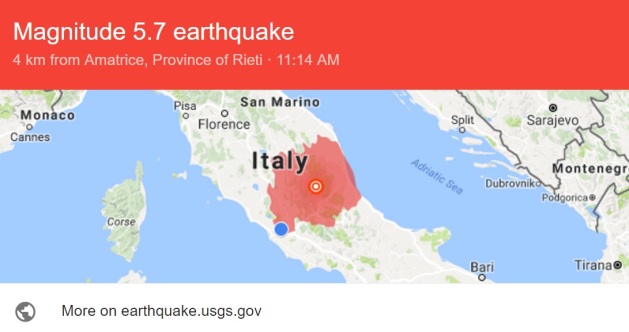
But even worse than so-called “climate” “scientists” and “cancer” “doctors” are this bunch of self-appointed experts who call themselves “seismologists”. This is a fancy name for people who want you to believe that the “earth” (which other “scientists” will tell you is as round as a baseball! – but that’s another story) can tremble and shake like a blancmange! The official story (and I can tell you, I’ve studied this in some detail) is that it’s caused by (try not to laugh) “sudden movements in the Earth’s crust”. Well I’m going to tell you a personal story, something that “happened” to “me” just this “morning”, which will show that this whole “earthquake” racket is no more than yet another official libtard hoax.
We went to our local “hospital” for a checkup with someone who calls himself a “gynecologist”. This shyster is paid thousands of euros of taxpayer’s money to tell us that as a result of a little cuddle time me and my “wife” enjoyed several months ago she is now “pregnant” and is going to have a “baby”. While we were “there” we visited another “couple” who apparently have just “given birth” (there was no actual evidence of this; there was a very small human being in the room and two beaming but exhausted new “parents” but there could be any number of explanations for that). After a few minutes of “conversation” (I noticed that the “baby” was pretending to be asleep the whole time) the “father” character drew our attention to the “fact” that the “water” in a bottle on the “bedside” was “shaking”. Sure enough, it “was”; I then “looked” at the “curtains” and they appeared to be moving – which obviously raised my suspicions! Then I “felt” with my “body” that the whole “building” (we were on the “eighth floor”, in the so-called “maternity department”) seemed (I’m being very careful with my language here!) to be “trembling”. I suddenly felt quite “scared”. Our “friend”, the new “mother”, checked on her “iphone” and said something about “the “epicentre””(it’s depressing to see how all this quakist jargon has wormed its way into the heads of ordinary sheeple) being near a place called “Rieti”, which I knew at once to be a lie, because although I’ve seen the name on a so-called map and noticed it on the front of “buses”, I’ve never actually been “there”.
We made our excuses, and “left”. I dread to think what fairy tales that baby will grow up hearing. They’ll probably tell it all the usual pseudo-scientific nonsense about “water” being “wet” and about how it gets “dark” at “night”. Personally I’m glad that I’ve seen through all that crap. As soon as “my” “child” is “born” I’m going to tell him the truth: that “hospitals” do more harm than good, that “teachers” do nothing but lie, and that so-called “parents” are the least trustworthy people he’ll ever meet. I’m also going to make sure he understands that whatever information he receives through his “eyes”, “ears”, “nose” and “fingers” is almost certainly bullshit, and that the last thing he should ever do in life – even worse than putting any faith in “experts” – is to use his “brain” to interpret the world. And you can stick your Dr Seuss, Alice in Wonderland and Roald Dahl books back where the sun don’t shine. I won’t be reading him any “bedtime stories” (in any case, if you believe that human beings “need” to “sleep”, quite frankly you’ll believe anything -and as for “breast” “milk”, don’t get me started on that junk!). Instead he’ll be staying up all night with me getting the real story from my good friends at Breitbart, Infowars and Wikileaks. I want my “child” to be brought up on a solid diet of the truth.
NB: This is a work of satire. In reality the only thing more dangerous than seismic activity is climate denial. They both serve to destroy the foundations of our existence.
This is a plan for a lesson I taught a couple of times before Christmas on the very timely subject of fake news. I did it with Politics and International Relations students on University courses, but it could be very easily adapted to a more conventional EFL context. The lesson develops their reading, writing and discussion skills and is aimed at upper-int and upwards. It should take about 90 minutes.My students really enjoyed the class and produced some interesting responses and some very imaginative pieces of writing.
Procedure
Write the words ‘fake news’ on the board. Get your students to give you some examples. Have a couple to hand if they can’t (if you’re in Italy, like I am, you could always show them this). (5 mins)
Explain you’re going to give them a presentation in which they will look at how to tell the difference between facts and opinions.
Take them through this presentation, doing the practice exercise in pairs and clearing up any confusion at the end. The final slide directs them to where they can do further practice online. (15-20 mins)
Tell them you’re going to read together an article about a ‘fake news sausage factory’. Elicit ideas about what that might be (Ans: it’s a website which produces and distributes fake news stories – don’t tell them that yet). (5 mins)
(If they have internet access) Direct them to the article online or (if they don’t) hand out paper copies of the article. Instruct them to skim the beginning of the article to check if their guesses were correct. Give them two minutes and then get feedback; clarify if they’re confused. (5 mins)
Put these questions up on the board. Students work through them in pairs. Monitor and give the occasional mild hint to those who are struggling. With weaker upper-int students let them use (but not overuse!) a dictionary. (15 mins)
Go through the factual answers, also eliciting the appropriate part of the text. (5 mins)
Make sure you leave time for discussion of the more subjective questions. (5 mins)
If you have time and the students are willing, you can get the students to do a short writing task. Depending on their level, get them (individually or in pairs) to write the first paragraph or more of a fake news article about someone in the news in their country. (15 mins)
Students stick their articles on the wall, read the others and choose their favourite (5-10 mins).
Homework: Get them to redraft and extend their writing.
Additional reading for very strong students: direct them to this.
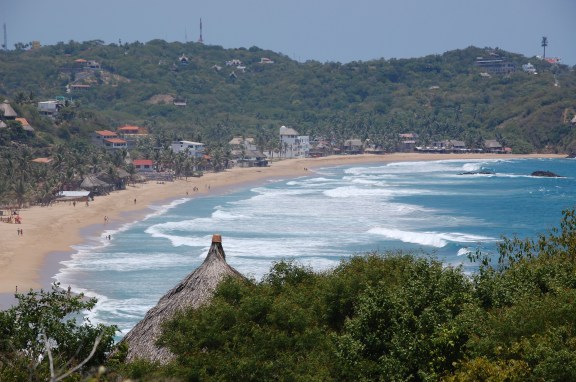
If you ever want to stay in a discreet nudist hotel, look out on Tripadvisor for codewords like ‘broadminded’, ‘especially for adults’ and ‘not child-friendly’. If you choose judiciously you may, upon walking through the door, be delighted – just like we weren’t – to see two French tourists splayed out in all their flaccid glory in the alfresco bar/reception area, umbrellas in their drinks and gallic pudenda making the most of the warm sea breeze*. Conversely, if for some bizarre reason you don’t want to stay in such a place, do not choose places which are described as such. I.e: don’t make the same mistake that we did in Zipolite. Like most tourist hotels and guesthouses we stay at in Mexico, the nudist colony happens to be foreign-owned. In Puerto Escondido itself we stay at a place owned by a Swiss couple, and when we move on to Mazunte the proprietors turn out to be French. The actually quite charming nudist place belongs to an Italian who got halfway to learning Spanish and then got stranded out of his depth. He flounders between the two languages in a way that’s distressing to witness. I would happily dive in and save him, but then he isn’t wearing a swimming costume. Italians love this bit of the Oaxacan coast, because it was the setting (and ‘Puerto Escondido’ was the title) of a 1989 film about a guy from Milan who looks like a young Silvio Berlusconi getting mixed up in drug smuggling, partly because of a series of misunderstandings. It’s therefore possible that the owner of the hotel didn’t know he was starting a naturist colony. It’s also possible I misunderstood the film as I was watching it in Italian and at this point, after three months in Mexico with my Italian wife, Itañol is rapidly becoming my best second language.
It’s certainly warm enough to strip off. We’re at the top of a cliff and the heat and wind are immense. I have to keep covered up, I tell everyone, because I’m scared of getting badly sunburnt. It wouldn’t be the first time. If you really want to know just how painful excessive exposure to the sun can be, go to Tioman Island in Malaysia at the hottest time of the year and spend five straight hours in the sun, dismissing every attempt by your sister to get you to put some suncream on. It hit me three or so days later on the bus from Singapore to Kuala Lumpur: I was seized by an extremely insistent itching deep beneath my skin all over my chest, back and shoulders. Fearing that I might be having a heart attack brought on by excessive exposure to all the spiciest foods that Asia has to offer, I looked up the health bit of the Lonely Planet and learnt it was probably something called ‘prickly heat’, and that I should apply talcum powder asap. When I got to KL I ran like the wind to the nearest pharmacy, where to my relief I saw that they also sold something called ‘tiger balm’. The word ‘balm’ sounded soothing, like ‘calm’. Or ‘balsam’. Or ‘balsamico’. It doesn’t matter. It made it (at a generous estimate) about thirty times worse, and I spent my entire first, last and only evening in the Malaysian capital showering my torso with cold water. Which, in turned out, also made it worse. Over the next three days I became a gibbering monkey, incapable of more than ten seconds of conversation before I would have to go back to grimacing, scratching and at some points actually screeching. I never got to the point of stealing cameras and throwing my excrement at tourists, but I can tell you it was a pretty close shave. It was such a traumatic experience that I’ve never made such mistake again, unless you count once in Spain, the first few days in Thailand and pretty much any time I’ve been anywhere really hot where the prospect of getting a fabulous suntan really quickly was just too good to pass up on. That’s why, on the second beachday in Zipolite, having magically overcome my aversion to exposing myself as soon as we left the hotel complex, upon feeling a familiar deeply-buried itch in my chest I run like the wind to the nearest pharmacy, desperately garbling some nonsense about cream-of-after-the-sunshine**. Luckily they do have some, so I down it in a single gulp, give a satisfying burp of relief and go back to working on that tan.
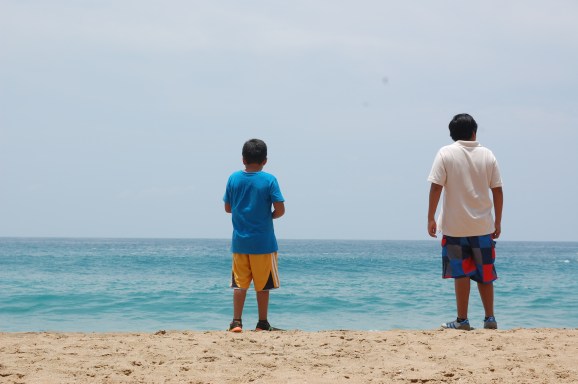
It’s blisteringly hot but we can’t cool down in the sea. It’s just too wild. It was actually on this beach that the wife of the Mexican-American writer Francisco Goldman was killed by a wave about three years ago, an event he describes in the heartbreaking memoir ‘Say Her Name’. We move on to another village in search of calmer waves, less violent winds and the Perfect Beach Hut, and luckily soon come across a collection of round bungalows on stilts with bamboo walls. This is perfect, I murmur as we lay back on the bed. Sorry? mouths Chiara. I say it again, this time MUCH LOUDER, but it’s no good. It sounds like we’re at the top of MountPopocatépetl in a Force 12 gale. Using sign language I manage to communicate that we should go downstairs and change our booking from three nights to one. The Parisean owner is thankfully very obliging once I’ve explained that we have to leave earlier than expected to look for my aunt’s favourite pen, which has got blown away PAR LE VENT. The wind might be annoying to tourists, but it’s being put to good use a little further down the coast. The Isthmus of Tehuantepec (quite a challenging name for a Spanish Spanish speaker to pronounce, I’d imagine) hosts most of the country’s wind farms. Although it obviously sounds laudable (and god knows Mexico desperately needs to move away from its dependence on fossil fuels) it’s more problematic than it might first appear. Objections have come from local indigenous people, who say that the resultant encroachment on their land and fishing resources has been accompanied by threats and attempts at bribery. Although in Europe campaigns against wind power are often fuelled and funded by fossil fuel companies or their self-appointed defenders (asthis clip from the documentary ‘Age of Stupid’ demonstrates), in Mexico mitigating the effects of the changing climate will be, like so much else, riven by conflict between rapacious commercial interests and people whose land is their only livelihood.
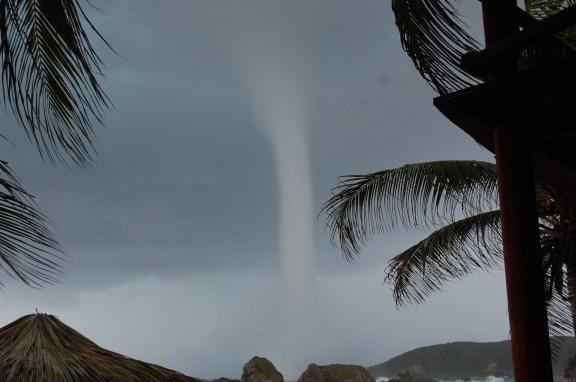
Not that this level of wind is normal, even for the Oaxacan coast. The following day we witness our, and apparently Mazunte’s, first evertornado. It twirls inland a mere 200 metres down the beach and whips off a few roofs, but luckily no-one is hurt. For the second time in two months I narrowly avoid becoming a victim of climate change. Over the next few days no boats can go out to sea. On the last night of our holiday there’s a power cut, but the Italian restaurant next door is on hand with candles, lukewarm white wine and burnt pizza served up to a passionate soundtrack of Neapolitan swearwords. We move on to an open-air bar where they’re playing Electrocumbia (my new favourite kind of music). It takes a while to get going but then some French-Canadian crusties turn up with their dogs and take over the dancefloor. Maybe it’s the music, maybe the mezcal cocktails or maybe just the fact of being so far from home, but the dogs just can’t contain their romantic impulses. It adds another dimension to the phrase c’est une vie de chien, but it’s nice to know that it’s not only we humans who do slightly embarrassing things when we’re on holiday.
* Apparently the French phrase for ‘wedding tackle’ is ‘bijoux de famille’ (lit: family jewels).
** Which I’ve learnt over the years is the product specifically designed for such situations.
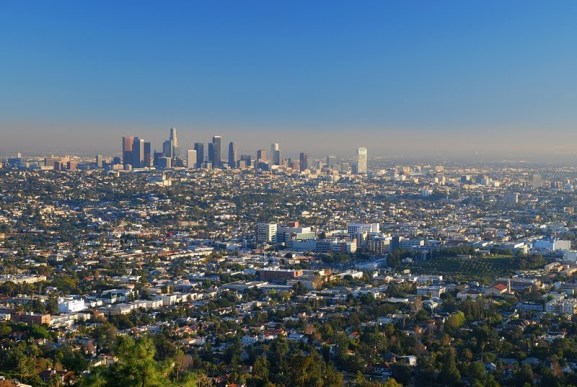
The film that LA reminds me of most is not ‘Chinatown’, ‘The Long Goodbye’ or ‘Mulholland Drive’, but ‘Tron’*. The absence of a specific centre is nicely disorientating, like a dream of a city with no centre, or with dozens of centres spread out across an undulating grid of (in theory) highspeed highways. Thomas Pynchon called LA “less an identifiable city than a grouping of concepts”; as it happens I quite like exploring concepts and I find LA surprisingly pleasant to move around. I am, after all, here on holiday. Those who live with its traffic jams and smog would probably question the impression created by the distortions employedhere.
I’ve been to a number of cities modelled on or heavily reminiscent of the rhizomatic layout of LA (Johannesburg, Singapore and the Santa Fé part of Mexico City spring to mind), which have tended to be alienating and lacking in identity. But the original has a distinct character in that it’s suffused with images of itself, so I do feel that its history is present. It helps that I’ve just read Mike Davis’ incendiary chronicle of LA’s development, ‘City of Quartz: Excavating the Future in Los Angeles’. Davis writes like an Old Testament prophet, a West Coast Marshall Berman. The book was originally published before the riots of 1992, and mostly details the 20th century battles over local political power, water, and land, all conditioned by race and class. The history of LA is one of small-scale wars over land title and water rights, between newly-established communities and goon squads, vigilantes, landlords, lawyers and developers. One of those developers says in Pynchon’s novel (and subsequent film) ‘Inherent Vice’:
“Look around. Real estate, water rights, oil, cheap labor—all of that’s ours, it’s always been ours. And you, at the end of the day what are you? one more unit in this swarm of transients who come and go without pause in the sunny Southland, eager to be bought off with a car of a certain make, model, and year, a blonde in a bikini, thirty seconds on some excuse for a wave—a chili dog, for Christ’s sake.”
The French philosopher Jean Baudrillard saw LA as a mirage, a simulacrum, but if it is true that our mental images of LA screen out the real city at least they’re familiar ones. The city I come from is famous for one film, whereas LA is known for tens of thousands, many of which by no means show the city in its best light. I knew something about the water wars thanks to ‘Chinatown’ and have learnt about LA’s vice, drugs, corruption and racist police brutality from films like ‘The Big Sleep’ and ‘LA Confidential’. Mike Davis writes that the film noirs of the 1930s onwards comprised an ‘ideological assault on the American dream’. Raymond Chandler was certainly not the most radical or critical of noir writers but neither ‘The Long Goodbye’ nor ‘The Big Sleep’ paints an idyllic picture of the city. A lot of the early noirs were written by exiled European writers, like Hans Eisler and Erich Maria Remarque, who hated LA’s lack of a civic centre and thought that the city ‘negated every classical value of European urbanity’. Bertolt Brecht simply called it ‘hell’. Nevertheless Theodor Adorno, someone who you might think, given his active antipathy to the culture industry, would have dedicated LA a particularly scathing Tripadvisor review, instead commented: ‘It is scarcely an exaggeration to say that any contemporary consciousness that has not appropriated the American experience, even if in opposition, has something reactionary about it’. And, in a different mood, Brecht once complained that his cottage was ‘too pleasant to work in’ .
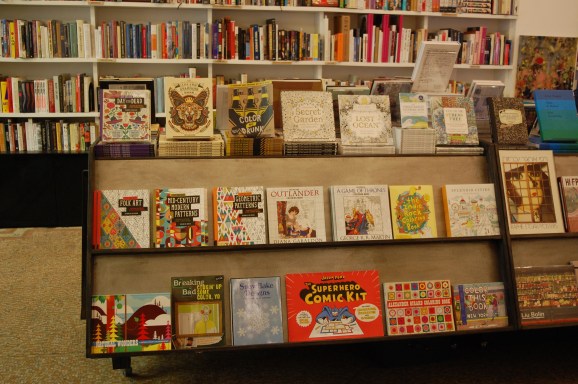
In my case I’m surprised to find that there is, if not a centre, a downtown, and that it’s actually quite likable. The fact that it’s mostly Latino and that casi everyone is speaking Spanish is comforting: given that I’ve just popped up for a week from Mexico City (another city that’s often misrepresented as consisting of nothing but traffic hell but is in reality remarkably walkable), I enjoy the feeling of being doubly foreign. It’s something I regularly experienced going from Portugal to Spain, and also the time when, living in China, I flew to Thailand and bumped into some ‘other’ Chinese people. Downtown LA also has some food markets, tidied-up versions of the ones at home. We visit one of the best bookshops I’ve ever visited (The Last Bookstore), in which I first go a bit mental buying English language novels, and then can’t help but feel a bit disdainful on discovering that they have an entire department dedicated to colouring books for ‘adults’. Out on the streets there are some sights recognisable from Hollywood films depicting a dystopian future. Although we visit on a weekday, most stores are closed and shuttered, there’s evidence of people sleeping in pretty much every doorway and a couple of distressed individuals pushing shopping carts a la ‘The Road’. However, from a Mexico City point of view, it’s all quite familiar – it feels a bit like one of the more abandoned sections of Insurgentes. Down in Chinatown there’s actual streetlife – food stalls, a couple of buskers, and groups of people standing around chatting – and when we pass through the area known as Skid Row people are quite affable, even when they think I’m trying to take photos of them, which I’m not. Much.
The area where my friends live (Mount Washington) is extremely pleasant; it puts me in mind of the more lightly-gentrified parts of Hackney, like Lower Clapton. Some streets are like Dalston without all the ridiculous new apartment buildings. With its lowlit bars, ethnic restaurants, antique shops and hipsters, there’s a strong sense of quality of life. My friends have been here for about three years. When they arrived, she was pregnant and they were panicking about not having health insurance, but it turned out to their immense relief that the State of California has a scheme which meant they avoided having to pay out over one hundred thousand dollars just for giving birth. Even in terms of healthcare, the United States is a more complex society than I had assumed.
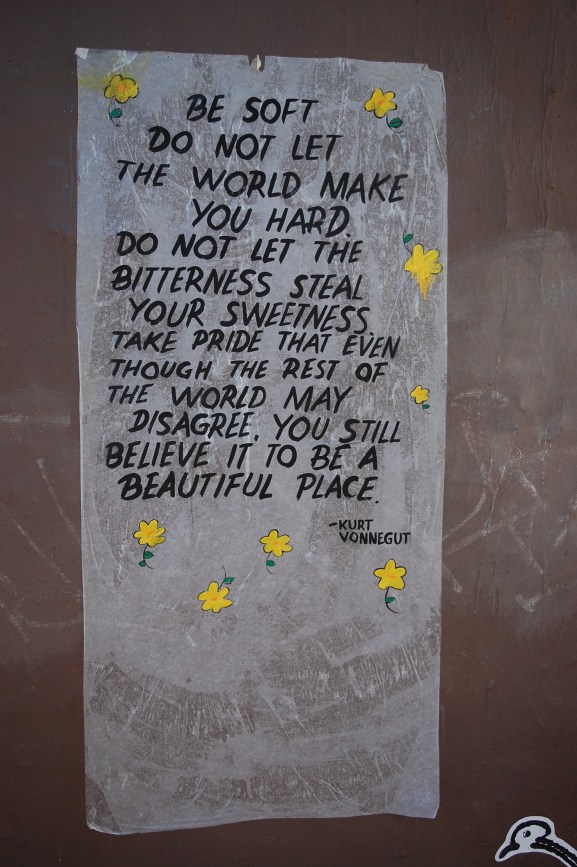
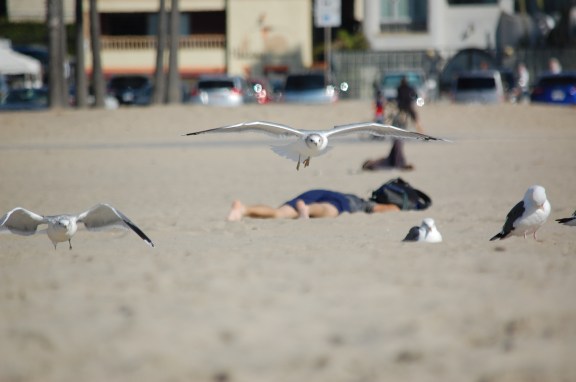
Another day we head down to Manhattan Beach, where I’m sort of hoping I might bump into Thomas Pynchon, even though I nor anyone else have seen any photos taken of him in the last sixty years and he hasn’t lived here since around the late ‘60s. ‘Inherent Vice’ is set here during that time. It’s a hippy noir whose detective is permanently stoned, which doesn’t help the reader or viewer make much sense of the shaggy dog plot with its dozens of characters. Like most good detective fiction it’s less about who did what to whom than a study of the texture of a particular time and place. There are police buying off hippies to protect millionaire property developers and a shady operation called the Golden Fang which appears to be some sort of mafioso cartel crossed with a secretive corporation. But the novel shows that the LA ruled by such forces is not the only one that might exist or come to exist: the epigraph to the book is the situationist slogan ‘Under the pavement, the beach!’. The ‘60s was a time when another LA, another California, another America threatened to burst through the paving stones of mainstream society. In ‘Vineland’, a previous novel set (conversely) fifteen years later, one whose characters are addled and incapacitated not just by weed fumes but also by cathode rays, Pynchon explores a similar history to Mike Davis’ book: union battles in the film studios, McCarthyism, the FBI’s attempts to control and buy off any burgeoning countercultural forces and impose authoritarian rule. ‘The Crying of Lot 49’, from 1966, was written on the cusp of the hippy years, and has a lot in common with the critique of the situationists of the deadening effects of suburbanisation, bourgeois life and consumer spectacle. Pynchon apparently lived right down next to the beach and spent his time when not writing ‘Gravity’s Rainbow’ driving round and discoursing to his hippy companions on LA and its dependence on the war machine. And it’s on the beach that I come across this:
From the beach we drive up to Malibu to a cheap fish and chip restaurant with ocean views and photos of Barbara Streisand, Rod Stewart and Dylan (Bob) on the wall. I pick up a brochure for local property but the prices are even more absurd than the ones in Dalston**. Although they’re very nice I’d actually pay more money not to have to tell people I live in a place which reminds them of one of the world’s most cloying drinks.
The megarich of LA have other concerns, however. Many of them spend their time worrying about the number of thetans they’ve built up, only to find after several years that the secret truth they were striving for involves some total bollocks about “a galactic overlord by the name of Xenu, a volcano, and souls that attach themselves to newborn babies”***. However, contrary to what a lot of people who spend too much online may tell you, Scientology is not the most dangerous and destructive aspect of the LA lifestyle. In the evening we go to a bar which is showing sport. As the commentators discuss the game a huge Volkswagen logo located right between them takes up roughly 80% of the screen.
Much more than Scientology or the dreamlife that LA sells us, the cult of the car is the city’s most pernicious export. One consequence of the failure of our species to reduce our dependence on fossil fuels is that California is suffering from a massive and unprecedented (although not inexplicable) drought. There are notices of water restrictions everywhere. In Beverly Hills the locals have protested, however, explaining that they can’t reduce their water consumption because you know, they just need to consume that much water and anyway they’re rich so fuck off my lawn. You’d have to have the mentality of a cult member to think this kind of attitude has any kind of future.
Some people still see LA as representing the chance of stardom, despite all the cautionary tales told in movies and music from ‘Sunset Boulevard’ to ‘Do you know the way to San José’. In a burger restaurant round the corner from where all the Hollywood Boulevard nonsense is, we meet a young Austrian who’s been here for three years doing an acting course. The fact that she prefers to speak in German with someone (me) who struggles to remember the word for burger suggests the course may not have been all she hoped for, although she puts a brave face on it (or at least I think she does, I can’t remember how you say ‘brave’). Subsequently I see several adverts for such courses; it seems that, like the UK wrt EFL, the US also has a burgeoning ripping-off-foreigners-in-return-for-fuck-all industry disguised as something to do with ‘education’. We also meet a more long-standing immigrant, a Russian taxi-driver who is inspired by our late-night request for somewhere to buy a couple of cans of beer to drive us halfway to Seattle and stock up himself “for the night!”. He buys 16 cans, at 2am.
LA has been called a commodity, a simulation, and a cultural desert, so it’s a pleasant surprise to find (pace Gertrude Stein on Oakland) that there is in fact a ‘there’ there. I can certainly see the appeal of living in LA, particularly up in the hills. Some parts of the city looks curiously like an area of my hometown, Sheffield. The ‘70s-built council housing in Gleadless Valley imitated Californian design to great effect. (If anyone thinks that this is nonsense please read this to verify). The wonderful place where my friends live, on the slopes of Mount Washington with a sweeping view across the train tracks towards downtown, puts me in mind of the 1970s, the LA of Tom Waits and Robert Altman’s version of ‘The Long Goodbye’, which are the sounds and images I most cherish from the city.
Nevertheless, the idealised LA way of life is one that doesn’t export well. Devoid of historical content and bereft of Los Angeles’ rich and complex set of visual associations, it produces bland suburbanisation, something far closer to what Baudrillard was talking about. In a word: Singaporisation. I find it hard to see the appeal of Dubai to anyone who has an alternative****. Such places seem to me to be much better simulations of dystopia, rendered worlds with no civic or public life, no libraries or bookshops or public squares or walkable streets. A bland, privatised architects model, an outdoor shopping mall where the only game to play is pretend-you’re-a-millionaire. At least LA has a history: one of desert, drought, corruption, rats in palm trees, film noir and race wars. It is a gigantic incoherent confluence of human ambition, creativity and destruction. The brightness and the darkness. It’s thanks to the imaginations of filmmakers and writers that Los Angeles exists in a way that many cities that imitate its form don’t.
* The original version, not the remake by Tim Burton or whoever.
** Nobody from London will believe this possible.
*** This is what it says in this South Park episode, accompanied by the words ‘This is what Scientologists actually believe’. I sometimes think of writing something similar on this blog just in case people think I’m doing this for a laugh.
**** Not that Dubai is lacking in intrigue. I think you’d have to be very brave to live there and go looking for it. One of my friends in LA wrote this excellent novel about oil business shenanigans.
I don’t remember using or even writing this but I obviously did at some point because it’s here in my My Documents folder on my computer and it’s exactly what I think about learning languages. Hopefully it will be of use to someone.
Up to a certain point, it’s easy to learn a language. Okay, of course you’re sometimes tongue-tied when you don’t know the word, and it can be very embarrassing when you use the wrong one, or completely miss the point of what someone has just said – plus obviously it’s frustrating when things you read and listen to are simply beyond your current level of understanding. However, in all these situations you can go away and think about what went wrong, and work hard on acquiring the words you need and learning how to put them in the right order when talking to the appropriate people at the appropriate time. Then, hey presto, you’ll be able to understand about 90% of what you read and hear, and people will be able to understand you pretty much all the time.
And then what? Your language skills are now good enough for you to be able to make friends with people, read what you want to read, do a job, study a new subject, and so on. You’ve finished! Except, er, you haven’t. Not even nearly. Slowly you discover that despite all your hard work and dedication, your careful acquisition of skills, knowledge and the confidence to put them to good use, despite all your careful study of grammar and your acquisition of all the vocabulary you could possibly need, there are still occasions on which you think: I don’t get this. Or: I wish I had exactly the right words in order to say what I want to say. You feel frustrated. Is there some secret classroom in which people are learning all this stuff, and if so how where do you sign up for the course?!
So what do you do? Well, if you’re lucky, you might find a job which stretches your skills and challenges you to learn new things. Or you might have a hobby which stimulates you to acquire lots of nuanced vocabulary expressing very specific things which you don’t need even know how to say in your own language, along with the complex grammar which allows you to express all sorts of very particular meanings. Or maybe you’re lucky enough to be living in a country in which the language is widely spoken, in which case you have the opportunity to engage with the local culture: hang out with the locals, follow the local news, become a fully-paid up member of this other society, which will mean learning all sorts of new things, many of which, as I mentioned earlier, you wouldn’t know how to express in your own language. You’ll make lots of friends with whom you never speak your own language, and discover new things with and through them. You’ll be using the language as a medium to explore and engage with the wider world, in addition to just your ‘target’ culture.
Does all of this mean that your language skills will inevitably improve? Well, yes, it does. Your vocabulary will expand immeasurably, meaning that you will be able to understand even more of what you see and hear. Some things may get stuck, of course. Most probably you will have developed your own grammar in the language, finding shortcuts which simply seem to make more sense than all those fiddly structural elements which you can never quite see the purpose of. You might be one of those people who finds it easier to use grammar accurately when you write rather than when you speak. In any case, given that you are using the language in order to carry out increasing number of complex and demanding tasks, whether at work or play, the only criticism that anyone might make of your language is that you ‘have a bit of an accent’, which is what people say when they encounter non-standard syntax and word grammar which, although it expresses things in a slightly different way, does the job pretty well pretty much all the time.
But what about that other accent, all those sounds that never come out quite like when the locals say them? What if people ever find out that you’re (shock horror) a foreigner?! Well, your accent might disappear eventually. It might not. Research has discovered countless times that the key issue here is identification with the target language community. If you happen to be learning English, then problem solved: the English language speaking community is one of which you are already a member. Depending on where you live and who you live with, you might end up speaking standard English with a Scottish accent, a South African one, or even a Brazilian accent. Which would clearly be no bad thing, especially if you yourself happen to be Brazilian. The most important thing is that you sound like yourself – after, wasn’t wanting to express yourself the very reason you started out learning a language in the first place?
So what can you do while you’re waiting for all these things to fall into place? Well, if you’re worried about your grammar, try to pay careful attention to how you speak and how your grammar is different from how other people around you express the same thoughts. The same goes for your vocabulary and pronunciation, obviously. Try to copy those around you, and see what works for you and what doesn’t. Don’t copy everybody, of course, otherwise you might end up sounding like someone three times older and two times posher than you. Identify people who you want to speak more like, and copy them. If you’re mixing with people and using the language in a variety of situations this will happen naturally, of course. But it certainly helps to give it a bit of a push if you’re in a hurry.
You hear it in the music, the films, the novels and the poetry: Portuguese culture is suffused with melancholy. In the early 2000s the most popular foreign groups were those whose music was steeped in the same yearning and languor: Lamb, Tindersticks, Gotan Project, Mogwai. The measured pace and sometimes sombre atmosphere led me to develop a wacky theory according to which there is a global pattern of large, exuberant countries neighboured by smaller ones where life is less frantic and more given over to reflection: Mexico, Portugal, Argentina, New Zealand, Ireland… Although the theory is in many important ways nonsense, the role of rancheras and tango in two of those cultures does lend it some credence. One of Portugal’s most popular songs of 2001 was a version of Erasure’s bouncy/sad disco anthem ‘A Little Respect’ which had been slowed down to bring out the tragic element (and, in the process, make it a lot less fun to listen to). Portuguese music had something of the drowsiness of bossa nova, but I didn’t detect the same sensuality. Fado seemed to encapsulate a mood of being ‘half in love with easeful death’. Lisbon even had its daily ritual of mourning the passing of the day, toasting the lusco fusco at Miradouro Santa Catarina.
To get inside Lisbon it helps to read at least some of Fernando Pessoa’s ‘Book of Disquiet’, a collection of prose texts assembled after his death and all written under the name of Bernardo Soares, whose lifestyle and outlook seems to have matched Pessoa’s almost exactly. In it he writes:
“I love the stillness of early summer evenings downtown, and especially the stillness made more still by contrast, on the streets that seethe with activity by day. Rua do Arsenal, Rua da Alfândega, the sad streets extending eastward from where the Rua da Alfândega ends, the entire stretch along the quiet docks – all of this comforts me with sadness when on these evenings I enter the solitude of their ensemble. I slip into an era prior to the one I’m living in.”
Pessoa spent the ages of seven to seventeen in South Africa but after he came to Lisbon he rarely left. His was an exile of the imagination. He invented heteronyms, characters with fully-developed biographies in whose names he wrote, and some of whom, like Álvaro de Campos, travelled for him. It’s possible that he made a physical visit to Porto, where rumours suggest that he may have been caught on film by the local director Manoel de Oliveira. De Oliveira, who died last year at the age of 106, made his first full-length film in 1942 (‘Aniki Bóbó’); it featured children singing and dancing. His subsequent works slowed down until they became almost inert, like a series of sumptuously detailed paintings. I once fell asleep watching his historical ‘drama’ ‘Palavra e Utopia’ at a point where a shot of an oak tree in a breeze was being accompanied by two voices softly discussing theology. When I woke up sometime later neither the shot nor the topic of conversation had changed. His later films were feted internationally, particularly the comedy ‘I’m Going Home’, which starred John Malkovich, and his very last film, which he made at the age of 104. It was called ‘The Old Man of Restelo’ (that eternal Cassandra of Portuguese imperial expansion, as mentioned in Part 2), and consists mostly of a dialogue between four of the greatest writers in Portuguese and Spanish history (Camões, Castelo Branco, a poet I’d never heard of called Teixeira de Pascoaes and Cervantes) about “the glories of the past and the uncertainty of the future”.
Another idiosyncratic local filmmaker was João César Monteiro, who in his films often went by the name John of God. I myself took part in Portuguese cinema history when I went to ‘see’ his version of ‘Snow White’, which on a visual level consisted almost exclusively of a blank grey screen. In doing so I was one of only seven people who saw it on its opening weekend. More recently the King of Almost-Unwatchable Portuguese Cinema is Pedro Costa, whose visually luscious and very lengthy films typically consist of static shots of Cabo Verdean immigrants standing in empty museums looking extremely sad, interspersed with twenty-minute long takes of heroin addicts coughing in dust-filled rooms in crumbling parts of Lisbon. They are very beautiful to watch and have lots to teach us about post-colonial entropy, but they are nevertheless nearly impossible to stay awake to. They put me in mind of Shashi Tharoor’s comment about India being “a highly developed society in an advanced state of decay”.
The younger people I taught were nevertheless very dynamic: highly-educated, socially liberal and often startlingly witty. They were some of the most intelligent and imaginative teenagers I’ve ever met. In my mind now, fifteen or so years later, I can’t help but compare and contrast their fate with that of those former emigrants I hung out with in Jaana’s café, who had had for the most part a miserable education. As we become older our place in history becomes more clearly defined. In their case that meant being forced to kill and risk their own lives in a war they didn’t believe in, and then driven by a lack of opportunities for mobility in their own country to seek work elsewhere. Then came the Revolution, ascent to the EU, the circenses of the 1998 Expo and the 2004 Euro Cup, followed swiftly by the crisis of the EU and brutal austerity programmes jeopardising the life chances of their children and grandchildren. It’s hard not to see them as victims of history.
As Paul Theroux pointed out in relation to travel writing, it’s never fair to judge another country when you visited it in a bad mood. In my case, I stayed too long in Portugal, started to feel stuck, and blamed my frustration on the world around me. I was irritated by what I saw then as the alternating self-aggrandisement and self-abnegation of the Portuguese, particularly how these feelings were projected onto the national sport. I came to hate both the sound of Portuguese people speaking English and other foreigners speaking Portuguese. I got annoyed when there was a word in the newspaper I hadn’t encountered before, and if anyone local who I didn’t know spoke to me in English I’d cut them dead. But I couldn’t leave, I reasoned, because I had a permanent job, a fridge, and a cat. In any case the rhythms of my life had become like the lulling sounds of a train track: trips to the Algarve and to Spain, drinks every night in the Bela Ipanema café, hearty portions of comfort food and elephantine servings of Amêndoa Amarga, trips to the beach, falling out and patching up with friends, visitors coming and going, relationships starting and ending, new teachers arriving every September… I fantasised about going to Spain or Brazil but knew I never could put myself back on the map of my own accord, despite my vague 5am notions that one day I could do a Master’s and restart my life. And all the time I was trying hard not to spend too much time wondering how my life would have turned out had I stayed in the UK twelve years earlier.
I think I hit a wall around the time a Portuguese friend of mine went on a spectacular late-night rant about “these fucking English teachers with their drinking, their whining about the society they’ve chosen to make home, their sense of entitlement and their shitty lessons which they don’t even prepare for or care about”. Sabia que tinha razão: I knew he had a point . In June 2004 I went into a massive sulk when my “beloved” Spain were defeated by my host country at football. In the end it was one of those new teachers who uprooted me, a violent process which involved moving on from those habits and friends which had sustained my single life.
A couple of years later I came across a song by Transglobal Underground (‘Drinking in Gomorrah’ – see playlist below) which summed up perfectly that particular fate I’d narrowly escaped: being Lost in TEFL. For years I blamed the place but knew deep down the problem was really me in that place. Part of the sadness, frustration and regret I was seeing everywhere around me was my own, and a lot of the arrogance and self-abasement I attributed to the Portuguese was really aspects of my own personality and culture which I was projecting elsewhere. As psychologists like to point out, if you can spot it, you’ve got it. Ainda bem that I left, for me and for Portugal. It really wasn’t working out for us any more, but, as so often – at least in the sometimes melancholy world of Teaching English Abroad – the problem wasn’t them, it was me.


 And on the next page of the novel there’s a song about bananas:








 Stage 1: Get your students to sit down.
 I don’t remember using or even writing this but I obviously did at some point because it’s here in my My Documents folder on my computer and it’s exactly what I think about learning languages. Hopefully it will be of use to someone.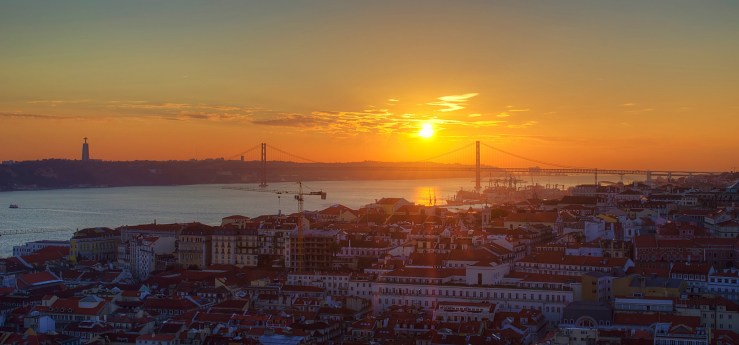
 Infinite Coincidence