Even though the result of the Labour Leadership Election won’t be officially announced until the 12th September, UK betting shops are already paying out to customers who put their money on a Corbyn victory. It’s been a spirited and fractious campaign throughout. Obviously we all knew right from the start (and especially since the unofficial audition for Leader for the Opposition on July 20th — you’re supposed to oppose the Government, guys!)) that Cooper, Burham and the other one never stood a chance of winning (God forbid! They’re unelectable) but it was important to have their names on the ballot paper nonetheless. At the very least no-one can claim it wasn’t a democratic election. A full and frank debate was necessary, and it has certainly been had. Now it’s time to take on the Tories.
Category: .
What is smearing Jeremy Corbyn destined to achieve?
So a social democrat of impeccable integrity enthuses hundreds of thousands of people, particularly the young, about the radical potential of parliamentary politics. In response, the entire British political establishment, both politicians and media, launch an incredibly vindictive campaign to smear him on charges which even they don’t believe — and it works. However ludicrous the accusations, they succeed in associating the Corbyn brand with antisemitism, and he loses the election. Someone very similar to the previous Labour leader takes over, and things continue along their previous dismal and disheartening trajectory, towards a point where it’s hard to find anyone who gives two shits about conventional political parties, in fact the very mention of them makes almost everyone extremely angry. The things that politicians say on TV and the reality of people’s lives under endless grinding austerity just do not correspond, and things get worse, and worse, and worse, until someone, a bit like Nigel Farage, but with more plausability and charm, turns up on TV offering easy solutions that exploit people’s sense of powerlessness and frustration (not against the elites, obviously, there’s nothing anyone can do to challenge them, we’ve learnt that, but against more available targets, like those homeless people on the streets who never seem to go away, and all those migrants on TV clamouring for a new life, and who wouldn’t want one of those, and those people whining about how they can’t feed their kids, well why did you have them in the first place then?!, and yes this guy apparently said some unpleasant things about Muslims and Jews, but they kept saying that the Labour guy, the one who lost, was anti-semitic, and personally I really wasn’t so sure it was really true…), and suddenly there’s a new sense of purpose in the air, let’s clean those streets and tidy away the scum littering them, let’s put young people to work guarding our borders…
Have the people at the top of the Labour Party stopped to think for a moment about the consequences of what their no-holds-barred media assaults on Jeremy Corbyn will ultimately achieve?
The smears against Corbyn are, wittingly or not, an assault on our system of democracy. If they are successful, its reputation (and in particular the reputation of the Labour Party) will not be able to recover.
Corbyn and New Labour: Don’t take the electorate for a hippopotamus
There is no doubt that Yvette Cooper, Andy Burnham and Liz Kendall believe themselves to be in the appropriate political party. They would like to use it to introduce all sorts of radical changes in society. The problem, as they appear to see it, is the voting public. Ordinary people are, to put it bluntly, considerably more stupid and right-wing than they themselves are. They will not vote for progressive social and economic measures. The best that can be hoped for is that they can be nudged, like grumpy cantankerous hippopotamuses, in the right direction. They must be moved gently, without ever appearing to threaten their sense of security and comfort, as the electorate, if riled, will simply lash out, always in the wrong direction. Ordinary people are very susceptible to messages which appeal to their most base instincts, which trigger the sensitive defense mechanisms which surround their senses of identity and security, and appealing to those instincts remains the only proven way to get them to move in the direction you want them to — but only so far, because no matter how gently you try to persuade them, they will never step outside of their comfort zone.
This is New Labour electoral dogma. It is written through the DNA spirals of leadership candidates like a stick of rock. It dictated Harriet Harman’s admonition that Labour must not fall into Osbourne’s trap of being seen to oppose profoundly radical changes to the Welfare State. It is in right there marking the beat of the thoughts of each candidate as they voice their euphemisms about ‘economic credibility’. What has happened over the last few weeks is that it has been shown to be, as it were, hippopotamus shit. Ordinary people are, it transpires, infinitely more politically agile than their aspiring leaders. The effect of this revelation has been deeply traumatic for New Labour. Not only does it fundamentally challenge their view of the electorate and the world in general, it detonates a highly explosive package at the very core of their political identity. And so they are now exploding in all directions, turning in panic to the right-wing media and their emergency weapons of character assasination, trying even to dismantle at whatever cost the electoral apparatus they themselves established in the complacent certainty that voters would never have the courage or the wherewithal to consciously use it to further their own genuine interests.
They must now be aware that even if they managed to successfully rig the election, their shoehorned-in new leader would lack credibility to the extent that Labour would face a historic wipe-out in England similar to the one it has experienced in Scotland, with millions of voters lost to electoral apathy, the far-right and (hopefully) some sort of meaningful left alternative. They must know those things at some level, but the depth of the trauma occasioned by Corbyn’s imminent storming to victory is so great that they appear to have lost all sense of what they are doing and what it is destined to achieve. While the smears against Corbyn are designed to trigger the famous don’t-think-of-an-elephant effect, perhaps a fitting epitaph for New Labour could be: don’t take the electorate for a hippopotamus.
On Laziness — A confession
Someone very close to me recently called me, partly in jest but not without reason, lazy. I don’t have to get up and physically go to work much these days so I can see what this person (in this case, she, or, more specifically, my wife) means. I have all sorts of grandiose plans for the day but not much to show for them at sundown. (I like the word sundown). It helps me remember that tweeting and facebooking (notoriously terrible temptations if you (try to) work from home) are not actual activities at all, but mere simulations thereof. In the fullest of senses, what we are doing (what I am doing) when we (I) are/am staring at a smartphone or shouting at a computer screen is not changing the world but avoiding more meaningful and more truly engaging activities. This might explain the particular relation, which I always have difficulty articulating (or just can’t be bothered to think about properly) between the twin developments of the internet and our ‘knowledge’ of climate change. At the exact moment we need to engage with one another and our physical environment as never before, we hide behind a screen, in the vague lazy hope that the problem will sort itself out, even though nobody we know is even talking about it, let alone trying to prevent or prepare for it. It’s just too much hard work. There is also, I admit, the fact that most people spend far too many hours doing entirely bullshit things for money, looking after children, and being told by The Man that they’re still not doing enough…I should really think about this some more, but it’s the internet, so there’s not really all that much at stake. I readily apologise to anyone I have offended and/or disappointed in this paragraph.
Much-quoted in what I have bothered to read of philosophy over the last few years have been the lines from Nieteschzxe (I’m tragically too lazy to cut and paste the correct spelling) about the ‘last man’, who “is tired of life, takes no risks, and seeks only comfort and security”. Reading the comments from Europeans about the refugees escaping from, let’s face it, hell over the last few weeks has made this phrase resonate. The opposite of cultural decline into the world of the Last Man for Neechy is the Will to Power, and I don’t want to suggest here that the opposite to overusing twitter is to open the windows into the gathering storm, wack on some Wagner and read Ayn ‘Medicare’ Rand out loud to your cat, but I do want to pledge (is that the same as actually pledging?) to be less lazy in the future, whatever that means. At the risk of sounding a little like sub-Ted Talks ‘philosopher’ Alan de Button (anyone who’s actually reading this will be able to spot the names of my very least-favourite-people-whose-names-begin-with-A in these last two sentences), we should all try (actually this really only applies to me, which is why Alan de Bottom is such an unbearably patronizing wanker, a multibillion pound inheritee writes a book explaining what work means?!, no thanks Al) I should try hard to make much better use of my energies and time than I do at present. So if you see me on twitter, feel free to tell me to fuck off, even if you’re not in #Ukip. The End.
Frida y México: Imágen, identidad e ideología

La imágen mejor conocida y mas difundida de México en los últimos uno o dos decénios es la de una mujer colorida, bella y fuerte con trajes y rasgos aparentemente indígenas. Sin embargo, con un poco de reflexión queda claro que esta imágen en nada corresponde a la realidad en la que viven las mujeres y (especialmente) las mujeres indígenas en el México de hoy. Hace mucho que la prensa internaciónal habla de un ‘pandémico’ de violéncia contra las mujeres en México, y no solamente en el ya tristemente celébre caso de Ciudad Juarez. En cuanto a los indígenas, no es por acaso que en la mayoria de los escandalosos masacres de los últimos años las víctimas eran de origen indígena.
Parece entonces que El Comandente Marcos tenía razón cuando dijo que en México lo que se valora de los indígenas no es su realidad, pero sí una foto suya. A fin de cuentas se trata de una imágen, producida por una industria cultural. Nada anormal. Todos los países tienen sus industrias culturales. Pero esta imágen es tan difundida, y los valores que promueve tan ubícuos, que alcance el nivel de una ideologia naciónal. Nos basta un ejemplo: este verano el Museo Franz Mayer luce una exposición especial sobre el esbozo, titulada, reveladoramente en inglés, Made in Mexico. Aprendemos de la información expuesta que este traje, es “una de las prendas femeninas mexicanas por excelencia … tiene (mucho) significado en la creación de la identidad de la mujer y del país”. El texto que introduce la exhibición no habla principalmente del rebozo, pero si de la intentidad naciónal:
‘México es un rico tapiz en el que se entretejen múltiples hilos. Su larga y tumultuosa historia, desde los antíguos pueblos prehispánicos hasta la modernidad de su cultura urbana, ha traído múltiples influencias e ideas al país, adaptándose en un cosmovisión y modo de vida singularmente mexicanos. Las artes decorativas, parte integral de la cultura mexicana, reflejan la intersección de la cultura tradiciónal, el legado colonial y la vida contemporanea y política. El rebozo ha sido — y continúa siendo — un resistente emblema de la identidad mexicana’.
También en la exposición aprendemos que hoy dia hay ‘planes gubernamentales…que se han creado para fomentar la producción de rebozos de alta calidad (y) cooperativos para ayudar a las comunidades a elaborar rebozos y para aconsejarlos sobre la manera de comercializar los textiles y volverse autónomos’. Nos presenta una imágen muy positiva, y no poco consoladora. Deja la impresión que en este pais se valora las tradiciones indígenas y el trabajo de las mujeres indígenas, en la orgullosa tradición de Frida Kahlo (quien de paso no era indígena, pero bueno…). Es una idea que (en principio, dada la caída del peso…) vende muy bien en el exterior (hay que recordar el nombre de la muestra, dirigida a un público o bien gringo o ya sea suficientamente malinchista…). Es una imágen que legitimiza la violencia y la desigualdad, el rebozo transparente de un estado que quiere continuar a ser visto como esencialmente liberal y progresista (y, demás importante, inversionable) al mismo tiempo que brutaliza, ensclaviza su población indígena al punto de encogerse de hombros y lavarse las manos cuando un niño indígena de 12 años que estába nomás comprando pañuelos es asesinado por un soldado que evidentamente no estába disparando “hacía el aire”; enseña la imágen de un estado que se ríe cuando 43 estudiantes indígenas son matados, que es liderado por un presidente responsable de la violación de decenas de mujeres indigenas por sus policías…
Hablar de la industria Kahlo, de su papel cultural, economico e ideológico no implica, evidentamente, echar la culpa a la rica y compleja obra de Frida…aunque cabe recordar que ella tampoco era indígena, pero sí urbana, de clase alta, que en su tiempo, en el acto de hacer valorar las culturas indígenas, tambien les exproprió, mezclando vários elementos de diversas culturas que no tenían ninguna conexión entre sí y “mexicanizándolos”. A fin de cuentas, una nación necesita una cultura. En todo los casos subyace a esa cultura un mundo sordido de contradiciones y contrastes, que apenas vislumbramos, un mundo, además, que puede ser explotado fructíferamente por los artistas – como, por ejemplo, Frida Kahlo. Pero en México estas contradicciones son brutales, y vivas. La mayoria de los turistas que están dispuestos a desembolsar 200 pesos a cambio de una playera con una imágen de Frida Kahlo en la que lleva pusto, junto con sus adornos indígenas, una playera del Daft Punk (indígeneidad y modernidad en perfecta sinfonía!) por cierto desconocen que en el Estado de México diez veces más mujeres han sido asesinadas que en Ciudad Juárez en los últimos 21 años sin que el Estado mexicano ni pestañeara. Pocos fuera del país entiendrían que en el caso Iguala la indiferencia de las autoridades se debe en gran parte al hecho de que eran indígenas los que fueron (presumiblemente) masacrados. Pero en el México de hoy, una mujer indígena es la más vulnerable y menos visible de todos. A no ser que sea colorida, bella, y muerta.
Greece has to go green
(This was written as a comment in response to this typically excellent piece by Alex Andreou (@sturdyalex), I’m not sure if the Byline comments section is working properly so I’m posting it here in any case)
You lay things out very clearly and fairly. This article from a French site published yesterday makes clear just how enormously difficult the position of the Greek negotiators was, so anyone criticising Tsipras and his team has to do so with great circumspection. For me (from my customarily limited perspective) it seems as though Costas Lapavitsas was right all along, that Greece has to leave the euro and strike out on its own, nationalising the banks forthwith. The problem with this in the context of the last two weeks is threefold: problems of liquidity made it unfeasible; Tsipras had just asked for a mandate to stay in the euro; and the process will be a time-consuming one as it will have to be done in an orderly fashion. It’s clear now that Syriza weren’t and aren’t prepared for this at this stage. I do think that in the future one of the Second Division Euro countries will have to make the leap, and when they do it will need to be on the basis of not only a formal process of disengagement and the setting in place of a formal alternative, but also on the basis of a massive campaign of national and international solidarity for a popular austerity programme a la Cuba. It would have to mean taking a path of alternative sustainable development rather than further slavish adherence to the neoliberal model of selling off the country’s assetts, sacrificing its environment and enslaving its people. I don’t say this as a fan of Castro’s Cuba but it does offer a useful point of comparison for what would need to happen. There’s a documentary from the early 90s about Cuba’s special period after the fall of the USSR which I think would be very useful viewing at this time as it details how Cuba was forced to turn to alternative energy in order to survive. Why couldn’t Greece be the world’s first truly sustainable economy? Easier to ask than to achieve but if it is to survive with falling into war, fascism or permanent debt peonage it seems to me that this is the only way for it to develop. So far, as Naomi Klein details in This Changes Everything, Syriza doesn’t seem to have begun to take climate change and other environmental questions seriously but in doing so it may not only be able to find a way out of this morass but also to offer a shining example to the world of how humanity itself can leap off the express train leading it to certain and total destruction and survive its special period.
In Defence of People Smugglers
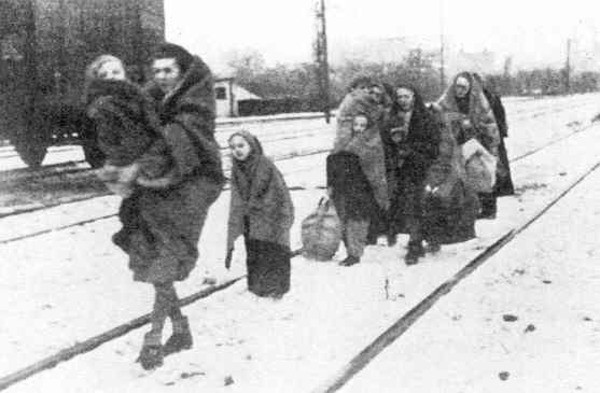 A small group of German women and children arriving in the British sector of Berlin, October 1945 (photo: http://www.kingsacademy.com).
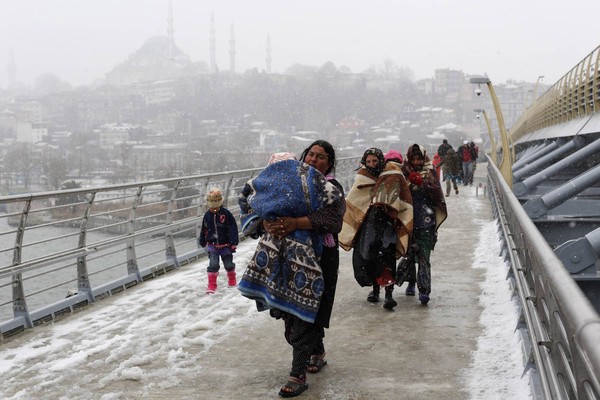 Syrian refugees brave the cold and snow as they walk to a metro station in Istanbul, February 2015 (photo: http://dailyamin.com).
When I was a child I loved reading novels about escape. They were mostly stories of people escaping from areas under Nazi control, being smuggled across borders into neutral countries, or trying to get hold of the right papers, or at least ones convincing enough to allow them to escape from imprisonment, torture and death. Along the way they would meet some people who would help them and some who would betray them — the suspense and drama came from sharing the character’s uncertainty as to whether or not they’d make it, and whether or not the person they’d just met could really be trusted. The escapees, exhibiting bewildering levels of courage and ingenuity, were ocasionally assisted by networks of resistence, anonymous people of staggering bravery who were prepared to face torture and give their lives to save others and to combat injustice. This kind of fiction was everywhere when I was a kid, which was still within the broad cultural aftermath of the excitement and traumas of the war. You could still buy Victor annuals which revelled in imagery of armed conflict — I’m pretty sure the very first phrase I learnt in German was ‘Achtung! Ich bin hit!’. By the time I came into being there had already been a good couple of decades of this stuff. As an adult I read A Night in Lisbon by Erich Maria Remarque, a more complex account of the brutalities of the struggle for escape and survival, and also Austerlitz by WG Sebald, which explores the deeper implications of what it is to be rescued and to start a new life elsewhere. They depicted deep, intense psychological and moral battles, in a way conditioned by a profound sense of empathy at suffering and loss.
Poem for the people of Greece
A stranger steps into your (spacious, sunlit, well-appointed) cell
and asks you, with impeccable politeness,
to chew off your thumb.
Your protest, reasonably. It’s my thumb, you point out.
An essential appendage. You just can’t just…
Your jailor is courteous but firm.
There is no problem whatsoever, he assures you.
Just chew off your thumb and you’re free.
The moment you’ve chewed off your thumb, he promises,
you can walk.
He understands your frustration.
He offers you fruit juice, fresh towels, football on TV.
All the creature comforts, all the consolation, you might require.
Just chew off your thumb, he requests.
I’ll be back in an hour,
To see how you’re getting on. No pressure.
You sit and ponder such things as sinews.
You consider the strength of your teeth,
the softness of your tongue.
Nothing gives.
He returns. His patience, his compassion,
are immense.
It’s a simple thing, he says;
his voice soothes.
We just want you to chew off your thumb.
I have tried, you implore.
He gazes back at you
With inexhaustible sympathy.
His manner is consoling.
He calls you by your first name.
Day 38
so in London listening to the Songlines CD there’s a track we love by Mexican Institute of Sound, a track called México, kind of politico-funk mariachi. In Mexico I see, along with an actually infinite number of other wonderful things, several references to a book called Pedro Páramo, and I also happen to watch a documentary about Mexican music called Hecho en México which features a mix of famous and well-known names. There’s a kind of bedroom DJ with this kind of absurdist electro track about how it’s really hard for him to get any action in DF because he’s just too weird. I look him up and it turns out that his name is Camilo Lara and he’s also the guy behind Mexican Insitute of Sound, which is actually called, for fairly self-evident reasons, Instituto Mexicano del Sonido, and he uses a lot of spoken samples in his work from a guy called Juan Rulfo, who I’ve never heard of, but it turns out he’s the guy who wrote Pedro Páramo, which I now realise is the book that Hussain told me that I must read, and which I will now actually read, once I’ve finished reading this book in which I now remember I more recently came across a reference to Pedro Páramo (and I also must get round to reading El Laberinto de la Soledad, because it crops up everywhere), and I now also want to listen to everything by Insituto Mexicano del Sonido, and other similar bands and singers, such as Natalia Lafourcade, who, in 2012
Mexico City and London: Striving to Survive

A neoliberal writes
You don’t come across many shirkers in Mexico City. Not even that many beggars. People work, and when there isn’t any work, they work. Six in 10 Mexican workers, or 30 million people, work in the informal economy — take the metro and at every stop there is someone who has got hold of some cough sweets, a few soft drinks or a box of cooking magazines and who is working as hard (and as loudly) as they can to convince people that they want them. As I sit and write this I lose count of the number who have passed my window selling food, collecting broken appliances, gathering garbage in that particular local combination of recycling and scavenging… . Mexico is a country of strivers and entrepreneurs.
*****
What can we make of this? It’s true that in DF that you don’t come across many people simply begging — not, at least, in relation to the amount of poverty that undoubtedly exists. It’s also true that there are people selling things everywhere — the area around the Zócalo (the enormous central square) has more face-to-face economic exchange taking place than anywhere I’ve ever seen. It’s a kind of economic activity similar to that which in Brazil is called biscate — hand to mouth existence sustained by small-scale informal activity on a massive scale, without any of the protections we are (quite reasonably) so very accustomed to and dependent on in most of Europe and/or the UK. People may be striving, but it’s not to succeed — it’s to survive in the absence of any kind of welfare state.
What doesn’t announce itself quite so visibly or so loudly are the immense difficulties which underpin this unprotected way of life. The consequences of failure in this intensely fragile and fraught fight for sustenance are immense. Not selling a sufficient amount of merchandise on any given day means hunger on a level that I for one am unable to imagine without great effort (although it is imperative that I try). Healthcare, for the poorest, is simply not an option. And as for housing, it turns out that most people working informally in DF do not live in large rented flats in the middle of Condesa… . Also less immediately noticeable is all the activity that goes on behind the scenes: the violence which so often mediates all kinds of informal transactions, the extortion, the drug gangs, the prostitution and trafficking in women, and so on. Not to mention, of course, that there are very many people who beg on the streets of DF, who live an even more precarious existence — the people from indigenous backgrounds, those right down at the bottom of society. Plus there’s also the fact that Mexico is a primate city, meaning that it concentrates huge amounts of economic activity which the rest of the country doesn’t get to enjoy. People in Oaxaca, Guerrero and Michoacán live an even more radically unprotected existence — there, any contact with the forces of public security is to be avoided at all costs. The Afonso Cuarón film Y Tu Mamá También (2001)is a subtle but forceful exploration and indictment of these contractions.
How does this relate to the UK? One interesting thing about the coverage of the 2011 riots, particularly in relation to the abolition of ESA , was learning just how much the economic lives of teenagers in some parts of London revolves around the circulation of small amounts of money for and from dealing in hash and weed. On the whole though, the culture that I’ve been trying to describe hasn’t really existed in the UK in my lifetime. Firstly, nowadays there simply isn’t the space to sell things informally. Service and retail industries are very tightly controlled, with supermarkets and aspirational malls having taken the place of (in the words of the 6-year-old daughter of Newham Mayor Robin Wales) ‘dirty’, ‘smelly’ street markets and carboot sales. Public space is also very restricted and controlled — anyone setting up a tamarind stand in Paternoster Square would be given very short shrift, and it’s hard to imagine what kind of response someone would provoke if they took to the tube in an attempt to knock out cut-price Juan Gabriel DVDs at very full volume.
Of course, if you want to sell goods or services, there is also the internet. Nowadays, while there is a distinct, but suspicious, lack of people who say they’re unemployed, there is an abundance of individual freelancers, hustling their products and skillsets online, always on the lookout for a creative opportunity in the brutal new world of the knowledge-based economy. Nowadays in the UK being an ‘entrepreneur’ is increasingly the only available or permitted mode of economic survival — just count the amount of times today you see the term ‘your business’. But this sexy fantasy hides the reality of people scrambling around doing odd jobs in a heart-racing struggle to be able to pay the rent. It is a term desperately in need of détournement — someone depending on Taskrabbit to survive enjoys fewer rights than a medieval serf, and to think of them in the same terms as Alan Sugar is something of a category error.
In Mexico this struggle for day-to-day existence is visible, on the surface. In the UK, it is less so. So much of the postmodern biscate economy takes place behind a screen, on smartphones whose expensive monthly tariff is even more important than rent for people whose basic survival depends on an occasional email or text message. For neoliberals, the internet appears to be a free market utopia: no taxes, no minimum wage, no contracts, no state regulation, just infinite human labour deprived of all social protection and begging to be exploited. For people who need to work to obtain food, shelter and healthcare (and, nowadays, communication), it is in many ways a nightmare come true.
*****
In the UK and elsewhere, the state than has sustained our lives, administered our births, fed, guarded and healed us is on the retreat, falling to its feet and discarding unused ammunition as it flees. In its absence, without the manifold protections it has afforded us, where do we find ourselves? It increasingly seems that in the imagination of many, we no longer live in what we’re now forced to call the ‘real’ world, amongst buildings and people and shouts and smells and incessant hunger and ugly human need. We are in the process of migrating instead to another realm, one safer, cleaner and easier to control (albeit almost impossible to switch off). But how will these screens we have erected around ourselves give us shelter from the gathering storms? How will these infinitely precious and meaningful religious icons, these handheld shrines, that we cling to for dear life redeem us from our all-too-earthy earthbound physical existence, our dependence on air, on water, on food, on the human touch? Increasingly, it seems, we live in gnostic times. The Gnostics believed that all matter is evil and the body is a prison to escape from. Perhaps, then, the essence of neoliberal faith and practice is not bare, brutal, atheistic social Darwinism, an animalistic fight of all against all unto death, but a belief in a higher realm, in an infinitely cruel deity which hovers over the furnace into which our physical environment and all our infinite hours, years and lifetimes of human toil and endeavour are currently being sacrificed. A Taskrabbit economy (final-stage turbocapitalism as a cupcake-cute bunny apocalypse) is a façade covering a fullscale hollowing out of social protection, increasingly desperate poverty and an economic existence just as vulnerable as that which I see around me every day on the streets of Mexico. And when George Osborne warns us of the need to strive, it’s not our aspiration to wealth and success that he has in mind, but the battle for survival.
 Infinite Coincidence