Read the above articles and then consider the following question: will there be anybody at all within the next few months who will still be prepared to affirm in all good conscience that the riots in August and those to come in the future were not the result of successive government policies?
No book has ever frightened me as much as ‘A Handmaid’s Tale’; no other novel has presented such a plausible account of how a democratic and civilised society can turn in a terrifyingly short period of time into one based on pure repression, terror and the imposition of silence, and when I read about events such as the rise of the Tea Party or what is taking place in Alabama I find that my mind rushes to those few pages in Margaret Atwood’s novel in which she describes how a few vague rumours of certain reactionary measures happening elsewhere in society very swiftly take on the form of concrete prohibitions which have devastating impact on the everyday lives of the protagonists. For all that I take hope from the movement to ‘occupy everywhere’ and, let us presume, take control of our planet from those forces which remain determined to reduce every aspect of human life to a brutal and cynical war of all against all, with all other values subservient to the need to acquire material and immaterial wealth at all and any cost, with the losers in the battle (ultimately, all of us) condemned to lives of desperation, terror and hatred and suspicion of our neighbours, despite as I say my fervent hope that that part of the 99% which has awoken to the terrifying future that potentially awaits us can somehow prevail against the forces of chaos and destruction that have been unleashed, I do find that the echoes of Atwood’s dire prognosis of the final collapse of a civilisation are becoming deafening. Those who choose to ignore them, and to abjure their ethical responsibility to take a stand, are electing in so doing to remain not just deaf but also, in the terms defined by another well-known novel which illustrates clearly how collective moral cowardice could lead to a swift collapse into barbarism, blind.
When I came across the above sign outside a local branch of Lidl this morning I didn’t know what to make of it at first. Initially I didn’t quite believe my eyes, but then I thought, or rather hoped, that some enterprising bunch of anarchist pranksters had splashed out their entire annual publicity budget on a spectacular piece of morbidly tongue-in-cheek Borgesian street furniture. Only when I googled it did I find out to my considerable distaste that there is an actual health lottery, brainchild of Private Eye’s favourite pornographer/downmarket media mogul Richard Desmond, and the winner is to be announced every week during the X-Factor, whose creator has already hailed it as ‘a great idea’.
I feel the need at this point to emphasise that I am not making this up.
I was surprised and perturbed to find that google did not turn up much of a reaction to the initiative, beyond an article in the Droitwitch Advertiser which details the response of local hospices which are concerned about the effects on their own lottery schemes. Others have accused Desmond of profiteering on the back of charities and undermining more ‘generous’ lotteries. But so far I have not managed to find any blogs dealing with the bigger and more troubling issues raised by the very notion of a ‘health lottery’.
The money raised through the scheme will go to things the NHS does not cover, which, according to this very indepth and deeply harrowing piece in the LRB, will shortly include each and every kind of medical service, given that the NHS increasingly exists in name only.
Clearly in any kind of civiilised sociey the people responsible for conceiving of any sort of health lottery should be securely confined well away from all other members of society, lest their insane sociopathic ideas shoud gain any sort of influence. But I fear that this alone may not be enough, that millions who have already been infected by such catastrophically dangerous thinking, who do not respond to the sight of the words ‘health’ and ‘lottery’ in such close and deadly juxtaposition with the churning visceral mixture of revulsion, terror and rage such an encounter provokes in anyone who truly aspires to the status of human, that such people in all their legions may be harbouring the sentiment that a lottery is an appropriate way to resolve the question of differential life chances of different groups of people in an abysmally unequal society.
How can such a destructive idea be extirpated? Clearly we are in dire need of some sort of system of gulags, internment camps, abandoned mental institutions, where such people can be forcibly gathered and obliged to undergo a process of reeducation, to be adequately instructed in the most fundamental principles of human coexistence.
This may sound like mindlessly extreme invective, but I challenge you: read the LRB article, tune in to X-Factor on Saturday night to watch the live draw, and then see if you still feel like writing to me and telling me I’m wrong.
If only British political life had a political figure with an ounce of the perspicacity, integrity and courage of Rio state deputy Marcelo Freixo.When I was in Rio late last year I enjoyed taking the number 10 bonde into the central district. The bondinho (little tram) as it is affectionately known is the ancient yellow tram which serves as a quaint but very useful means of transport, carrying locals and tourists down from the hills of Santa Teresa in return for what is to the tourists a very small amount of money. It offers along the way some fabulous views, not to mention a slight frisson of danger as it squeaks along the rails in stops and starts and squeals, hisses and wobbles its precarious way over the aqueduct known as the Arcos de Lapa.
Another thing that made quite an impression on me at the time was a massive police invasion of one of the most notorious favelas, which aimed to clear the previously impenetrable area of powerful gangs of drug traffickers. The action on the TV mirrored in many ways a film that was taking the country by storm, and which has just been released in the UK. In Elite Squad 2 the military police take over a favela, kicking out the drug trafficking gangs and establishing new milícias, mafia alliances which control all aspects of favela life. The film depicts the relationships that enable this kind of activity, associations that go right to the top of Rio society, involving prominent media figures and corrupt politicians. To fight this deadly corrupt system an uneasy alliance is formed between a senior investigating police officer, Captain Nascimento, and a leading human rights activist turned state deputy called Manuel Fragas.
Manuel Fragas is a fictionalised version of a real person: Marcelo Freixo, state deputy for the PSOL (Socialism and Freedom Party). The filmmakers are quite open about basing their character on Freixo, and Freixo has said he is honoured. In the book of the film, they even use the deputy’s real name. Freixo is well-known in any case for demanding two critically important public inquiries into the milícias and police corruption, and has faced numerous death threats for his work. Upon returning from Rio I wrote a suitably impressed piece about him and about the film, which you can read here.
So when at the end of August a tragic accident on the bonde led to the deaths of five people and injuries to dozens more, the people of Rio had someone to stand up for them and also to stand up to those responsible and to demand justice. In a similar scene to that which which we see in the film, when Captain Nascimento furiously denounces those behind the milícias in a state tribunal, Freixo last week made a devastating attack on those whose decisions and interests ultimately led to the deaths on the bondinho in Santa Teresa.
Among other things he makes the following points:
* The Secretary of State for Transport for Rio de Janeiro blamed the accident on a ‘lack of investment’ in the bondes. Freixo points out that in 2009 the Rio Government was warned that within the next 120 days they needed to make urgent repairs to the safety of the existing Bonde trains or pay a daily fine of around $30,000. The Government appealed, and lost, and appealed again. The repairs were not carried out. Subsequently in June 2011 a French tourist fell off the tram and off the Arcos de Lapa to his death; this was followed by the tragedy at the end of August.
* Of the $BR14,000,000 which had been budgeted to the upgrade of the bonde system, $BR9,700,000 was destined not for improvements to the existing trams, but to the purchase of new ones, in a deal which was subsequently declared illegal. The World Bank contributed $BR17,000,000 for the improvement of 14 bonde trains, an upgrade which never took place.
* The Secretary of State for Transport Júlio Lopes is a former empresario in the area of education, someone who has little experience of or expertise in the area of public transport, and someone who seems more concerned with defending the interests of private companies which invest in transport than in the people who use them.
* The same Júlio Lopes described the accident in Santa Teresa as ‘a tragedy for tourism in the city’, rather than for the victims themselves and those who depend on the bonde in their daily lives.
* Lopes also went so far as to blame the accident on the driver of the bonde, a man who lost his life in the attempt to save others’; he could have chosen to jump from the out of control tram but instead hung on, attempting to regain control and evade a tragedy. Freixo furious response to this is worth quoting in full:
‘Look, sincerely, the Secretary of State needs to wash his mouth out with soap rather than speak of this man, because this man died trying to save other people’s lives (while) working in such terrible conditions, and this idiot, this incompetent coward, this coward, goes blaming the worker who died…(the motorist’s) family are crying over his death, are furious, while this disrespectful Secretary of State, instead of offering his resignation, instead of apologising, instead of going to hell, tries to put responsibility on the poor man who died…please, Secretary, if you don’t have competence, please have a minimum of respect for his family…it is unacceptable, unacceptable that this incompetent man continues in his position. No way. No way…his incompetence caused the death of these people, and trying to pass the blame onto one of the victims passes all possible limits.’
Freixo makes it abundantly clear that the tragedy is not just the fault of a lack of investment but of a lack of shame among those in power, a lack of character, a lack of decency, dignity, and respect.
* * * * * * * * *
According to the late, great Tony Judt, we are simply losing our historical memory, our ability to relate current events to their possible and actual causes. In this sense it seems appropriate to quote Pierre Bourdieu, in a comment about French society which could also have some bearing on our reaction to recent events in London:
‘It can be shown, for example, that the problems seen in the suburban estates of the cities stem from a neoliberal housing policy, implemented in the 1970s…This social separation was brought about by a political measure. [But] who would link a riot in a suburb of Lyon to a political decision of 1970?’
In much the same way, who now dares (or bothers) to relate a tragic accident, wherever it occurs in the world, to specific decisions taken by specific people at specific times for specific reasons? Or indeed to point to ways in which specific decisions taken today will lead to deeper and wider problems and tragedies in the future? Who has the courage to point the finger at those responsible and to demand justice? In the case of Rio and the accident on the bonde, the victims have someone to stand up for them. Millions of others around the world do their best to stand up for justice, often in situations of great danger. We have to applaud and support their work in every way we can, and try to be more like them in our daily lives and in our confrontations with sudden or ongoing injustice.
However, when we look at those people who wield some measure of political power we see that there are very, very few Marcelo Freixos out there. To take the random example of those (overwhelmingly Labour) Haringey councillors who recently voted through a 75% cut in youth services in the face of repeated and serious warnings about the devastating consequences of doing so, even though they face nothing of the same kind of risk as Freixo does, ie. of being brutally assasinated; none of them appears to have the slightest comparable amount of courage or integrity. So when riots break out again, or another Baby P case occurs, they will shrug their shoulders rather than address questions of responsibility. And on a broader level, when last week British politicians voted to dismantle the National Health Service, nobody stood up in Parliament and talked of shame or disgrace, used words such as unacceptable or spoke of a total lack of respect; no-one openly accused the Conservative ministers and their pathetic acolytes of acting in line with their own narrow self-interest as they sell off the health of millions of people who they will never meet and who have yet to be born in order to enrich themselves and their friends and to serve an utterly bankrupt and destructive ideology.
It is almost certainly too late in the day to expect Labour Party MPs and councillors to show any signs of anything other than cynicism and cowardice. In the words of Captain Nascimento at the end of Elite Squad 2, as the camera pans over the pristine buildings and lawns of Brazil’s political capital, the system is fucked. It is only with an enormous investment of fury and indignation that we will hold on to the little we have and hopefully achieve something better. There are hopeful signs that the movement which begun in Spain, inspired by the Arab Spring, has reached Brazil. It is high time the British woke up to the fact that a monumental tragedy is currently taking place around us and started to direct our fury at those responsible.
I come across a memorial park which is not on my tourist map. It has some gravestones with writing in Russian but my attempts to find out exactly what it is for come to nothing when the gardeners are unable to respond to my questions in English, shit German and non-existent Finnish. My command of Russian is unfortunately no better than my knowledge of basic photography. Behind the memorial, which also features some concrete seats facing one another and a pair of hands carved into the rock, stands a small forest from which there is a windswept chorus of echoing women’s voices, giving the deserted arena a haunted air.
It strikes me that the function of such memorials is precisely to haunt us; a problem in an age that purports to no longer believe that, what with history being done n’ dusted, the dead have any power over us.
The hands are perhaps an echo of the structure over the road what is clearly part of the same memorial, also unmarked on the map. Overhead and all around a number of large black birds fly, land and take off. I do not know their name in Russian, or in English.
A short walk down the road there is the National Museum, housed in a mansion set amidst low chalet buildings where (presumably) the servants of the Russian aristocracy used to live and keep their horses. It strikes me that post-Soviet states may well be reaching out to a more distant aristocratic heritage. In the grounds I come across an abandoned building which I, being British and in former Eastern Europe, immediately assume is some sort of macabre former death factory.
This image is quite close to a bust of Miss Estonia 1931, who was probably not a Communist, unlike the people in the photo.
In 1930s Estonia a tightly guarded and highly privileged elite controlled and hoarded the supplies of top quality sockwear.
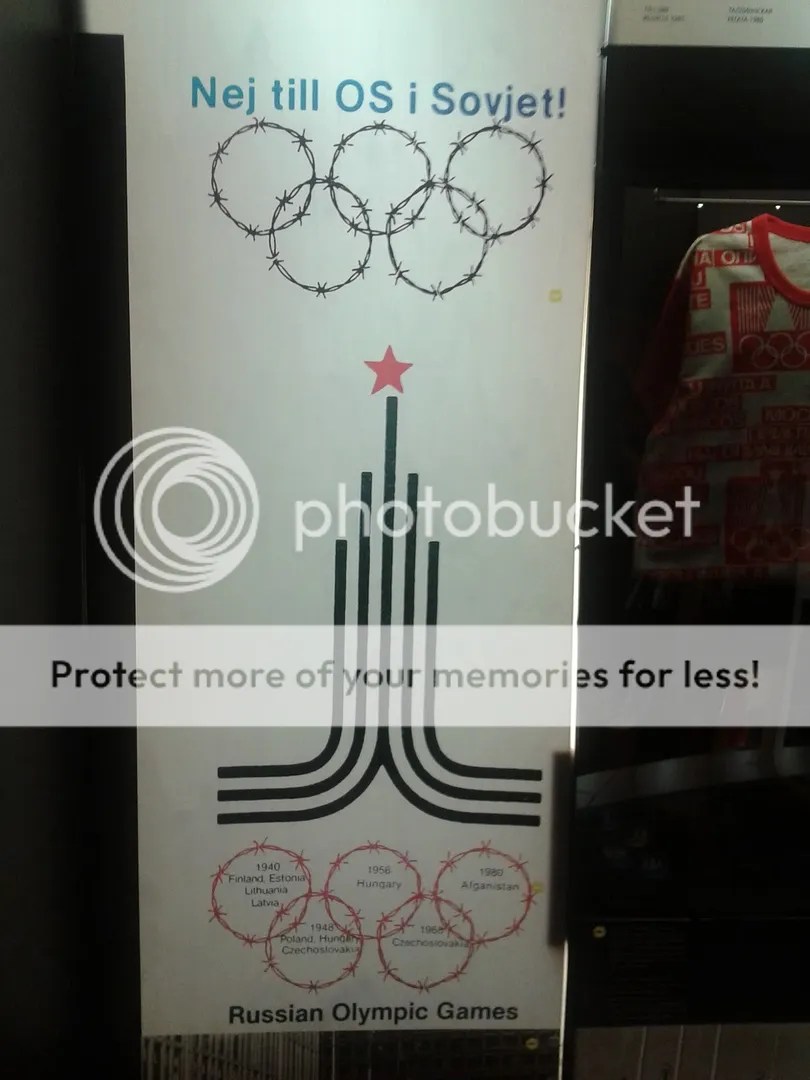
The sailing events for the 1980 Olympics were held in Tallinn, but were apparently not popular with the locals. The hotel in which I am staying was built to accommodate the competitors. It is olympically garguntuan; it takes me seven minutes to walk from reception to my room, not counting getting lost, which I manage to do four times in three days.
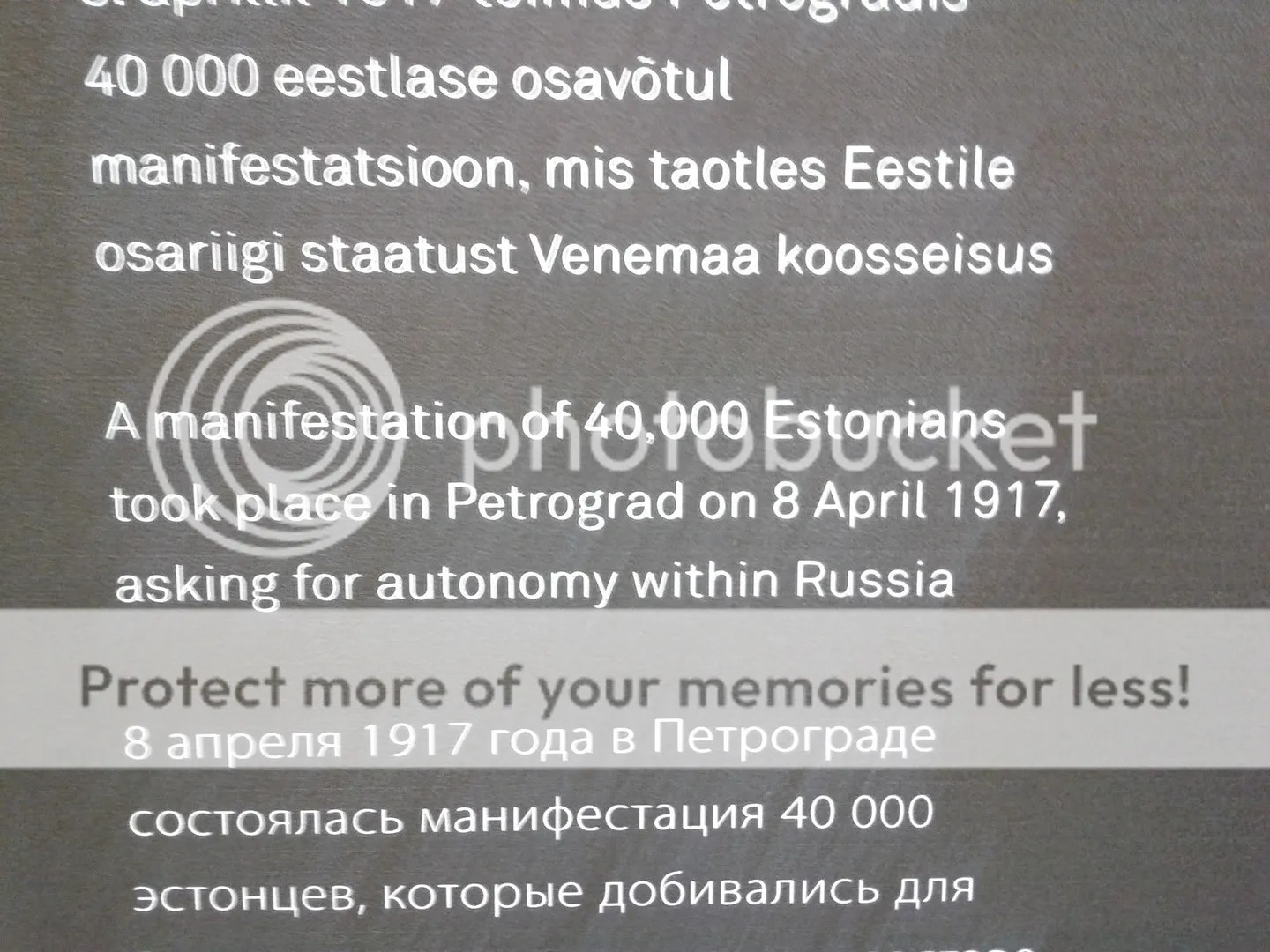
I visit the Museum of Occupations, which being partly German I am unable to think about as anything other than the Museum den Besetzungen. It is mostly concerned with the Soviet years. I have some qualms about the extent to which the attempt to equate Soviet crimes with those of the Nazis is apparently part of a more general attempt to play down the latter. Like about 90% of the things that I know, or nearly know, this suspicion comes courtesy of the Guardian:
The three Baltic states in the late 1990s set up state-sponsored commissions to study Nazi and Soviet crimes, but not in an open and democratic spirit. This was a project of ultra-nationalist revisionism with an active political agenda that meant much more to the politicians than this or that historical volume produced for minute readerships. That political agenda was in short, to rewrite the history of the second world war and the Holocaust by state diktat, into a model of “double genocide”. Holocaust denial was, in fact, never an option in a region with hundreds of mass graves. Instead, a new and more worrying “Holocaust obfuscation” movement took off, with a lot of government support in the region. It tries to reduce all evil to equal evil, in effect to confuse the issue in order to write the inconvenient genocide that is the Holocaust out of history as a distinct category.
The museum is indeed a recent construction, which has very little detail about the Nazi occupation and very many artefacts and films related to the Soviet period, which was, to be scrupulously fair, extremely brutal. In Postwar: A History of Europe Since 1945 Tony Judt writes:
The Baltic States, fully incorporated into the Soviet Union itself, were even worse off than the rest of eastern Europe. In 1949, kolkhozes in northern Estonia were required to begin grain deliveries even before the harvest had begun, in order to keep in line with Latvia, four hundred kilometers to the south. By 1953 rural conditions in hitherto prosperous Estonia had deteriorated to the point where cows blown over by the wind were too weak to get back on their feet unaided.
The first Soviet occupation was quite shortlived, the Russians being replaced by the Germans in 1941. In one night in 1940 Stalin’s forces rounded up and expelled 11,000 people, including several hundred jews, to Siberia; during this period Estonia lost around 10% of its population. According to the above booklet, by the time the Nazis arrived, there were around 1,000 Jews left in the country; by the time they had left, they were twelve. Most of these ended up in a concentration camp in Estonia itself; the exhibition makes no mention of this, however.
Estonia now has a population of around 2,000 Jewish people.
Estonia estonianises many more English words than Finnish finnishises.
This can sometimes seem a bit daft.
It is an issue; a school art project on the boat back to Helsinki features this work, the documentation to which reads:
In my view, we are facing the problem of a diminishing language space, where the foreign expressions used in daily interaction seem endless…people don’t say ‘hello’ in Estonian, but use English words instead.
I can’t say I’ve done much to forward the cause of the Estonian language, (the similarity of which to Finnish seems to be some sort of international secret, incidentally). I have learnt the words for Hello and Thank you, and also taught myself how to say ‘My Estonian is a bit limited’ (in English).
The national religion of Estonia is Hare Krishnaism.
Finally, an idea for how to dismantle the Euro: simply allow this side of the coin to circulate as legal tender in each individual country, and in no other. Problem solved. Nearly.
In a routine about eating tuna Louis CK expresses perfectly the (not particularly complex or original, to be fair) idea that I have been struggling to expound here of late regarding how we today tend to deal with our knowledge of climate change and things like climate change (global inequalities, peak oil, etc): ‘Je sais bien, mais fuck it!’
An ability to say what things are like obviates the need to say what things are; often it brings us closer to the nature of said things. I find it peculiarly frustrating when my students fail to pick up on this – on the way in which the question ‘What is it like?’ forces the speaker to stop and describe something, however difficult to put into words the comparative qualities of said thing, place, person or experience may be. It’s like a game! I point out. ¿Como es? Wie ist es? In Finnish you say ‘Mita lainen’, apparently, which I’m enjoying using, particularly because I don’t speak the language. An inability or what sometimes appears to be a refusal to recognise the centrality of this question in all human language I often interpret as symptomatic of a paucity of poetic sense related to the tragically instrumentalist worldview propagated over 30 years of neoliberalism; I attribute it to the same mode of thought and experience which occasionally produces the execrable statement ‘I don’t like music’. But that is probably, like, unfair of me. Anyway students often come up with the most strikingly economical descriptions: the other day a young guy from Korea described his two years in the army as ‘like hell’. I was genuinely impressed by his effective management of cliche; but when we pressed for a further description it turned out his experience actually *was* hell.
The (very) French philosopher Alain Badiou describes capitalism as a system which is worldless, by which I understand him to mean that it has broken free of all historical and cultural moorings and can shapeshift into any social formation; witness the success of authoritarian China, a society unencumbered with liberal democratic baggage and/but which has forged ahead economically.
Now, a lot of people struggle with Badiou’s ineffably complex ideas, but I have to confess that I do not. I simply treat them as one is supposed to deal with a shark attack – stay completely still and pretend I haven’t seen them, hoping they will go away without causing me any harm. To try to fight back would in either situation be sheer suicide, so I just accept that well over 100% of the time I have not got a clue what he is on about. ‘More than 100%’ may be Bad Maths, I accept, which is another reason for me to swim well clear of Badiou’s work, given that it involves very dense mathematical theory, whereas I failed GCSE Maths twice; I would have taken it a third time but back then I only had a very vague notion of the number 3, a bit like the indigenous Brazilian tribe which Alex Bellos writes about in his book ‘Adventures in Numberland’, which I have read, but only because it was written in words rather than numbers.
Also said to have detached itself from its historical, geographic and cultural roots is the English language, which in global terms is now used regularly by more non-native speakers than by those who speak it as a first language. It has, cliché dictates, become a global language. However, the conversations I have time and time again in a professional capacity with young people certainly suggest to me that although the language may have lost its anchor, it has a very clear sense of direction, navigating us to a future in which the only conceivable priorities are economic ones. I shall explain what I mean.
Among the young people I teach from around the world, it is very rare nowadays to encounter one who is not studying Business in some capacity. I did recently come across someone who said he had been studying Business Administration, but had stopped, which raised my hopes briefly – but then he said that he had transferred to Business Management, but had found it boring, so was planning to move back to Business Administration. I can affirm that this is the singlemost confusing and possibly absolutely meaningless statement I have ever heard anyone make in my presence.
Most of these young people can pretty fairly be called the children of neoliberalism; their parents have invested a great deal of money in them and they are under a lot of pressure to succeed in very competitive environments. In order to help them do so, the kind of English they most want to learn is Business English. This is basically a mixture of English for the workplace and neoliberal Business philosophy taught more slowly. Of course it is not just the children of the global elites who are taught to look at the world through dollargreen tinted spectacles. The mostly young people I examine in my other job are often from much poorer backgrounds, but the worldview tends to be the same: all things, experiences, people and places are increasingly valued in terms of their instrumental contribution to economic growth, whether individual or collective. In an entirely typical (and typically depressing) response, one candidate, when I asked him about the importance of parks, responded that if a city has a lot of parks, then more tourists will visit, and it will be good for the economy…I have heard similar thoughts expressed in relation to flowers, music, cultural traditions and pretty much every aspect of our lives. It seems that everything has to be reduced to its essential economic utility.
This is very obviously not restricted to young people taking English language courses and English language exams. It is simply the way in which we are all encouraged, even compelled, to look at reality these days. It is ideology at work in even the most banal of conversations. The fact that I am paid to pay very close attention to what people are saying means I notice it more in this context. To hear twelve separate individuals in a single afternoon say that the world is now a global village and implying that competition is the ultimate goal of all human activity is a salutary experience. It has nothing to do with the structural properties of the English language but is merely evidence of the extent to which neoliberal discourse has transformed our attitudes to things which were never before valued in this way. It is proof that the age through which I have lived has been subject to profound changes in the way we relate to one another and to the world.
It also suggests to me, however, that these deep changes have most obviously manifested themselves in the way that we speak, and that increasingly the world language is not English, but Business English. To illustrate this I want to use another example from my own personal experience.
I found it frustrating after a few weeks in China that I seemed to be having the same conversations again and again. They would begin with the same questions – which university did I go to, how much did I earn, what kind of car did I drive – and rarely go anywhere interesting. I can hardly entirely absolve myself of blame for this of course, but my attempts to take the conversation elsewhere didn’t usually work, especially given that I wanted to ask about details of everyday life and how it related to the political and social context, which was not a popular area of conversation when I was around. If I had stayed there longer and/or got beyond transactional Chinese, I presumably would have been able to hold deeper conversations, but I didn’t. I’m aware too that this is a common bugbear of foreigners resident in China, one of whom made a list of the top ten questions he was asked, put it on a t-shirt, and was roundly beaten up for his efforts (to be scrupulously fair, he almost certainly deserved it).
I quickly came to the conclusion that this phenomenon was due to the way in which people in China are taught English, which is I think mostly by rote. This explains why completely different people in totally different parts of the country all tended to know the same often quite odd bits of idiomatic vocabulary, none of which I am able to remember now seven years later. I presumed that it was all down to living in a party dictatorship. I recognise looking back that my outlook was largely orientalist in nature.
Perhaps it still is now. Certainly it seems easier to detect ideology in the discourse of someone different from you, especially if they are not in full command of the language they are using. Nevertheless it remains the case that ideology, whether formal or otherwise, determines which kinds of terms we use and which ones we do not, and which questions we ask about the world and which ones we do not. I spend a great deal more time talking to younger people from other parts of the world than I do talking to 18-24 year-olds from the UK, but when I do do so, I tend to find similar attitudes. Economic necessity is to a very large extent the basis of ideology, as someone once pointed out. We live in an age where everything of value must be sacrificed to the great god of competition, and of course this fundamental precept can be identified in the way that we speak of each other and of the world.
I don’t think that what follows is based purely on personal supposition. In the last few months, something has shifted. In the revolts in North Africa and the protest movements in Europe, not to mention in the anti-globalisation movement ten or so years ago, English has played a different role. It is the language of shared experience between movements in different parts of the world, and sometimes, as in London right now, in the same city. It emphatically rejects neoliberal categories and introduces radical new concepts and slogans. It explicitly challenges the neoliberal notion of what ‘democracy’ means, for example.
I am dimly aware that in writing this I am largely repeating certain ideas which have been around for some time, in relation to post-colonial literature, for example. The language of the oppressor can be put to our own uses. Capitalism may be ‘worldless’ (although within the limits of my understanding, I feel some doubt about the validity of such a term), but it certainly behaves like a colonial power, appropriating our intimate moments and common spaces, our bodies, our hopes and fears, and restructuring our perceptions of the world, as manifested in language. But in rejecting categories such as the ‘free market’, ‘competition’, ‘labour flexibility’ and ‘the needs of the economy’, we reclaim our language and escape the colonial net that had been cast over us. The Spanish indignados proclaim that ‘We are not commodities’, and counterpose this to the neoliberal dogma that ‘there is no alternative’. Discussions of words like precarity, austerity and solidarity is beginning in some places to take precedence over attempts to reduce the global debate to terms such as markets, privatisation, and flexibility. Business English is increasingly locked in a struggle against Radical English.
Joycian levels of psycholinguistic literary creativity are now within the fingertips of all. A lapse of attention when texting can result in surreal bloopers such as the one I experienced yesterday when an attempt to offer my services by writing ‘I can do that’ automatically produced ‘I Cannabis Do Thatcher’, which had I been stoned at the time would probably have blown my head clean off. I should mention that my phone language was in German at the time due to my ongoing attempt to pretend to myself that I am too; my phone is clearly not fooled and may even have begun to take the piss slightly.
To sit down for a full nine and a half hour showing of the Holocaust documentary ‘Shoah’ is to embark on a long-haul flight into terrible, dark skies. It may be a little glib to suggest that it would be of an ideal length to show on transcontinental journeys to and from Germany and Poland (and perhaps also Israel, of which more later), but in the face of the testimonies presented in the film, all aspects of life and all commentaries take on shades of glibness. It is oddly salutary to note that the same cinema that presented the film is also currently showing one by the noted Holocaust affirmer Mel Gibson (affirmer in the sense that those who would deny the Nazi genocide took place know full well that it did, they just thought it was a good thing).
The interviews are conducted in German, English, French, Polish, Hebrew and Italian. The consecutive translation from Polish meant that I was always trying to make sense of what could not be understood, which seems apt. Another curious thing is that a lot of the language used can be called Business German, given that people are describing, in the words of one former SS commander, ‘an efficient production line of death’. The talk is of Ware (merchandise), Verschiffungen (shipments), Verarbeite (processing) and technische Änderungen (technical changes). The purpose of the enterprise was partly to appropriate Jewish goods, a wealth accumulated over centuries during which repeated attempts were made throughout Europe to seize it; hence the Nazi’s Endlösung (final solution).
Now as I mentioned it is practically impossible to talk about the events described in the film without sounding trivial or as if one is revelling in the morbidity of it all. If Adorno famously found it impossible to conceive of how poetry could be written and art created after Auschwitz, a blog post written by me is certainly not going to add anything of meaning. The instrumental use of the Holocaust as a moral yardstick with which to draw comparisons is something explicitly rejected by, for example, the director of the film. However; it is hard to watch this scene without hearing future echoes in one’s brain of what happened in and after 1948, indeed is very much still going on, in another part of the world. I do not want to focus on this explosively contentious analogy here, nor is this the place to explore the uncanny resonances when the historian Raul Hilberg talks about what happened when the Greeks were unable to acquire enough Deutschmarks in order to exchange their stolen Jewish drachmas so they could pay for the selfsame Jews’ journey to death: they were forced to default.
One word that crops up repeatedly in Shoah is Gold. The Jews were the victims, Polish villagers tell us, not only because they were rich and lazy and their women were like sirens to the local men, but ‘because they were the richest’ and ‘they controlled the capital’. Primitive accumulation is clearly one of many reasons for the Nazi genocide.
We may be about to enter very deep waters of glibness, to coin a somewhat ungainly phrase. But still. We are in a period in which what is most of value in this society is being converted into money. From the Cash for Gold ads on TV to the impending attempts to sell off our future health to the highest bidder, it is a process which David Harvey has characterised as ’accumulation by dispossession’. Everything must go, we are told: islands in Greece, pensions in Spain, social welfare here in the the UK, the sentimental objects you have accumulated in your attic. There is no alternative; everything, as Mark Fisher has pointed out, must be evaluated in terms of its immediate or potential exchange value, including ourselves. News has become Business News, philosophy has become Business Philosophy, and all this business is conducted in the new global language of Business English.
About this time last year I was at a music festival and I got chatting to a young woman who had just graduated in a health-related discipline. I mentioned that this was possibly not a great time to be doing so what with the impending destruction of the NHS, but she corrected me, saying that in her field of private health consultancy things were about to boom and opportunities abounded.
Now, I think in the broadest possible sense we as humans today tend to avoid reflecting too much on the broader consequences of the things we do all day at work, especially when jobs and careers are very difficult to obtain and easy to lose. Few people would be happy to fully accept that what they do for eight hours or more in their jobs makes the world a worse place. In any case, we are not for the most part the ones pulling the switches and deciding where the particular train on which we are riding is going to go. The same is true in the film; four Nazis are interviewed and they all have excuses and explanations – inevitably they did not know, or ‘they saw’ prisoners being beaten to death, by others doing the same job, and it was terrible, terrible for me…or literally in this case, I was so very busy working I never got round to asking where the trains I was coordinating were going, nor why there so very many of them, over such a long period, and anyway it wasn’t the done thing to ask…
To return for the final time this week to Zizek, he writes in ‘Violence’:
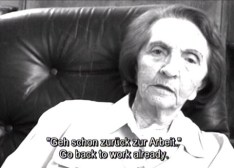
‘Hannah Arendt was right: these figures (the Nazis) were not personifications of sublime Byronesque demonic evil: the gap between their intimate experience and the horror of their acts was immense.’ No-one sees themselves as a personification of evil; we all have interior rationalisations of what we do. The horror of capitalism is not only that in commodifying our time and our mental and physical energies it also forces us to sell off our ethical consciousness; it is that it does the same to those around us, and our sense of what we should do is largely based on copying what others seem to think they should do. Zizek goes on to remind us:
‘The experience that we have of our lives from within, the story we tell ourselves about ourselves in order to account for what we are doing, is fundamentally a lie — the truth lies outside, in what we do.’
Much was written a number of years ago rightfully castigating the Sinead O’Connor line on the Hitlers and Stalins of history, that they were probably abused as children or something. But we were all abused as children. We simply cannot use it as an excuse to abuse others. And if we know that abuses are going on elsewhere in our name or for our cause, or as a result of our daily enterprises, whether for financial gain or out of some vicious inexplicable cruelty, we have an absolute moral imperative tostopthem.

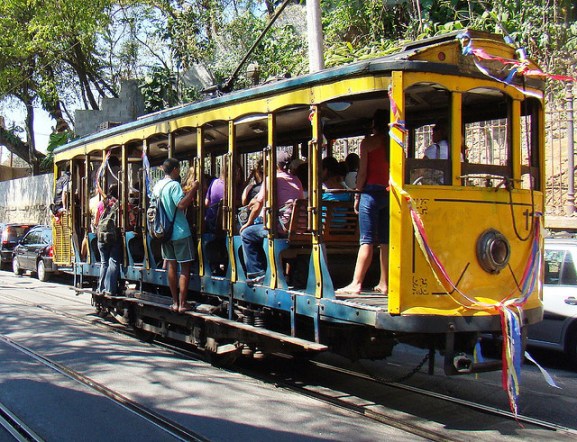 When I was in Rio late last year I enjoyed taking the number 10 bonde into the central district. The bondinho (little tram) as it is affectionately known is the ancient yellow tram which serves as a quaint but very useful means of transport, carrying locals and tourists down from the hills of Santa Teresa in return for what is to the tourists a very small amount of money. It offers along the way some fabulous views, not to mention a slight frisson of danger as it squeaks along the rails in stops and starts and squeals, hisses and wobbles its precarious way over the aqueduct known as the Arcos de Lapa.






 To sit down for a full nine and a half hour showing of the Holocaust documentary ‘Shoah’ is to embark on a long-haul flight into terrible, dark skies. It may be a little
  Now as I mentioned it is practically impossible to talk about the events described in the film without sounding trivial or as if one is revelling in the morbidity of it all. If Adorno famously found it impossible to conceive of how poetry could be written and art created after Auschwitz, a blog post written by me is certainly not going to add anything of meaning. The instrumental use of the Holocaust as a moral yardstick with which to draw comparisons is something explicitly rejected by, for example, the director of the film. However; it is hard to watch
  We are in a period in which what is most of value in this society is being converted into money. From the Cash for Gold ads on TV to the impending attempts to sell off our future health to the highest bidder, it is a process which David Harvey has characterised as ’
 Now, I think in the broadest possible sense we as humans today tend to avoid reflecting too much on the broader consequences of the things we do all day at work, especially when jobs and careers are very difficult to obtain and easy to lose. Few people would be happy to fully accept that what they do for eight hours or more in their jobs makes the world a worse place. In any case, we are not for the most part the ones pulling the switches and deciding where the particular train on which we are riding is going to go. The same is true in the film; four Nazis are interviewed and they all have
  No-one sees themselves as a personification of evil; we all have interior rationalisations of what we do. The horror of capitalism is not only that in commodifying our time and our mental and physical energies it also forces us to sell off our ethical consciousness; it is that it does the same to those around us, and our sense of what we should do is largely based on copying what others seem to think they should do. Zizek goes on to remind us:
 Infinite Coincidence