Me and Billy Bragg, Billy Bragg and me

billy-bragg-p0x2_o_tnOn my bedroom wall I have a signed poster of Billy Bragg. This suggests that I am a Billy Bragg fan, which is something about which I feel a certain awkwardness. To be a Billy Bragg fan is to associate oneself with someone always seen by many as gruff, proletarian, sexless, musically staid, and chippy. But nevertheless it remains a fact that the first single and album I bought were both his, his play ‘Pressure Drop’ was one of my highlights of last year, and I kicked myself recently on learning I’d missed his national tour, which ended last week. I’ve always felt an admiration with his seemingly boundless wit and warmth, and partly thanks to these qualities, and partly due to having, like that other group my fanship of whom has always occasioned a certain embarrassment, the Pet Shop Boys, he has managed to hang around just within public sight for over twenty five years without pissing off everyone too much and has in middle age been achieved the status of avuncular national treasure. Nevertheless like any uncle some of his pronouncements over the last few years have been somewhat dubious and increasingly conservative, especially around the questions of English national identity and tactical voting. There is an unpleasant element of both left-baiting in his relentless scorn for the far-left, and a not unrelated level of anti-intellectualism, both of which were evident in a Guardian interview published yesterday.

It is touching to read about his enthusiasm for the student protests, although predictably he also uses it as an excuse to indulge in some cheap digs at the far-left and anyone who tries to apply the lessons of the past to the present situation. There are signs that Bragg’s long-standing embarrassment with the legacy of socialism and communism colours his view of how things should develop, an awkwardness has always led him to temper his radicalism and try to sell it as instinctive, and organic, rather than intellectual. It seems churlish to point out that Bragg did not go to university and seems to harbour a certain resentment against those whose ideas for changing the world derive from detailed and patient analysis of complex ideas about society and how to change it. He is a proselytiser of what José Saramago used to call ‘hormonal’ socialism, although he now prefers to avoid the word itself if at all possible:

‘The people out protesting now, Bragg says, are the first generation ever to be able to talk about socialism without having the long shadow of Karl Marx hanging over them. If, indeed, they even describe it as such. “To be honest, I don’t care if it’s called socialism,” he says. “Anyway, what is socialism but organised compassion…They (the students) are making their own connections, and at the bottom of them all is an absolute sense of unfairness. That’s what’s politicised them. Not some abstract interest in dialectical materialism…We’ve got a lot to learn from them – their ability to join things up, take the initiative, not hang around and see what Marx would have said.”

He has also engaged in these debates in the last week or so, making very similar points on the already seminal Comment is Free piece by Laurie Penny:

“I now understand that what annoys you about Laurie and her generation is their refusal to be kettled in by either the Metropolitan Police or by the SWP and their ideological bedfellows.

Whether we like it or not, we are currently living in a post-ideological era. The language of Marxism is dead. Don’t mourn, organise! That’s what the students are doing – in a manner that is both different and challenging to those of us whose politics were forged in the 20th century.

We can either carp from the sidelines or join them as they take action.”

And is righteously smacked down:

“Laurie Penny, and in fact everyone ‘resisting’ the coalition’s education reform agenda, frequently draws on Marxism, even if she/they don’t know that that is what they are doing. And I don’t blame them, because if they want to talk about the ‘marketisation’ (i.e. commodification) of higher education, then they are de facto drawing on Marx! So to argue that the langauge of Marxism is dead is just a laughably ill-informed comment to make. It beggars belief.” (oxymoronic)

One wonders if Bragg has also been following that other debate about the meaning of communism and the role of Communist ideas in the struggle for a different world sparked off by Alain Badiou’s article in the New Left Review two years ago. The conference which that article inspired took place in the Logan Hall of the Institute of Education, the same venue as last year’s Compass conference, which Billy was at; but I suspect that the On the Idea of Communism event may have been anathema to him, given that it featured a series of Marxist intellectuals, two words guaranteed to provoke a spluttering splenetic reaction. It would be a shame if he hadn’t at least read Badiou’s article, because his aversion to the very names of Communism and Socialism is not uncommon, but to really think about what we do need to retain from the past, indeed to insist upon, and what we need to jettison, and who is this ‘we’ that needs to find answers to these questions, is an intellectual process, which demands that we analyse in depth revolutionary ideas and practices from the past. It is perhaps too easy to see Bragg’s dismissal of such debates of symptomatic of a British culture of anti-intellectualism, but it is highly likely that the experience of ferocious debates with SWP student firebrands on the Red Wedge tour in the 1980s traumatised the man and provoked this very evident revulsion at the very mention of revolutionary politics.

As I mentioned at the start, I love the wit and warmth at the heart of the best of Bragg’s music. Growing up I even preferred his poetry to that of Morrissey, someone who had a more grandiose emotional range which I as a teenager couldn’t yet aspire to. There was something in the combination of plaintiveness and gruffness in songs like ‘St. Swithin’s Day’ and ‘A Lover Sings’ which echoed my more stoical sense of myself. Morrissey seemed too much at home in his outsiderness, seemed to enjoy his symptoms too much, while Bragg was (for me) comfortingly gauche in his sense of romance and bitter at the world. I recognised myself in his songs, and admired his sense of engagement.

This heightened poetic sense can lead to political confusion, however. In yesterday’s interview he draws an analogy which seems to work beautifully at first, but quickly collapses when subject to further reflection. He rightly condemns the slavish devotion to market ‘dogma’ of all three parties over the last number of years (he clearly prefers this word to its near cousin ‘ideology’, which, given that he insists we live in a ‘post-ideological age’, would complicate things somewaht, but what the hey). But then he produces a metaphor which sounds apt, but isn’t:

“‘The market’s like fire, you know? Constrain it, harness it, and it’ll provide you with warmth and light and heat for your cooking … Let it rip, and it’ll destroy everything you hold dear.”

Now that is a fabulous image, but as I say it doesn’t work. Why not? Well, in a world increasingly subject to the iniquitous dictates of the so-called free market, billions around the world lack precisely that warmth, light and heat for their cooking. And this is not because the market is improperly regulated and managed, but because as reality shows quite clearly it is not an appropriate mechanism for providing the essentials of life. Warmth and heat and fuel for cooking are commodities exchanged for profit, but they are not, as Bill Clinton remarked of food, commodities like any other, or at least, they shouldn’t be. The market may one day have a role of some kind in a world ordered justly and democratically, but the essentials of life – housing, food, energy, transport, health, education – cannot be left to be distributed according to a system in which the winner takes all and the loser freezes or starves.

I very much hope that Billy Bragg continues to play a part in what appears to be a growing movement for radical change. But his aversion to intellectual and ideological debate may be an obstacle to his making a full contribution. The debates of the last week over the role of revolutionary organisations, and what new forms of media imply for how radical activists should and can organise have been very important and useful. The legacy of the reluctance of certain far-left groups to engage in honest and open debate in the past may be something that can be overcome, or it may be something that serves as an obstacle to greater unity, but at the very least people are now trying to have that debate rather than cynically bitching about the irrelevance and inadequacies of the far left, as Bragg has long been prone to do.
Rio: Crime, Corruption and Mega-events

tropa-capa2

‘The system is fucked’. That is the conclusion reached at the end of the film that has become in the last few weeks Brazil’s most succesful production of all time. ‘Tropa da Elite 2’ is the sequel to a film which itself broke box office records in 2007. It is, in the words of the film’s director José Padilha, unusual for such a politically and socially engaged film to meet with such success.

The first film depicted a series of invasions of favelas by the incredibly brutal military police known as BOPE. It was based on real accounts from former BPE agents, and focussed on the attempts to ‘clean up’ the favelas in preparation for the visit of the Pope in 1997. Some people interpreted the film’s tortured protaganist, Captain Nascimento, as an action hero mercilessly blowing away the bandits, which was not precisely the intention of the film makers.

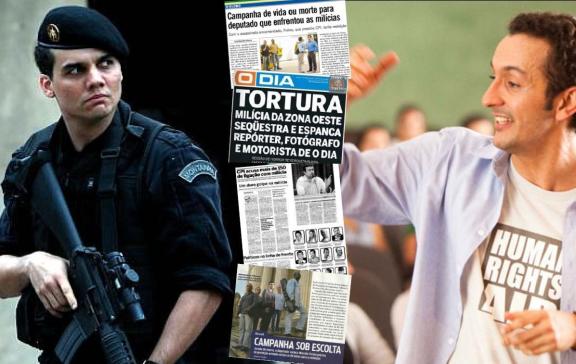
Any kind of gung-ho interpretation of the sequel is not possible. In the new film Captain Nascimento joins forces with a prominent human rights activist to challenge the growing power of the milícias, mafia gangs mostly made up of former (and often serving) police officers who dominate life in many of the favelas, charging extortionate rates for services such as electricity and gas supplies, cable TV and internet, and threatening, beating and murdering those who stand up to them. The film depicts the way in which they have taken over from the drug gangs that used to dominate crime in the favelas, and also highlights the levels of corruption which permit and sustain their activity, reaching up to the highest echelons in the political system: corrupt politicians in the Rio government and in Brasilia itself – hence the stark and bitter conclusion to the film.

After the recent successful operation by the military to expel the drug trafficking gangs from their strongholds in certain favelas, police officers moving into areas previously outside their control were accused by residents of acting ‘just like in the film’ – demanding favours and a share of the income of local businesses. However in recent weeks the focus in the media has not been on the militias themselves, but on the drug gangs.

The drug gangs appear to be on the wane, but the power of the militias is much more deeply entrenched. Through intimidation and bribery they manage to get their own representatives elected to the city council, in order to protect and promote their interests. As for where the proceeds from extortion go, the profits do not all go into the pockets of those further up the scale, but also subsidise the pitifully low salaries of the police, who because they earn only around $800US per month often moonlight as private security guards, either independently or with the mafias. The book of the film even goes as far as to say that in Rio, the problem of violent crime is the police.

In Brazil the police and the military are know as the ‘public security’ forces. However, according to Marcelo Freixo, there is no such thing as public security. He is well placed to judge; for the last number of years he has been a human rights activist fighting against police corruption in the city. It is on Freixo that the character in the film who tries to take on the mafia gangs is based. He has also just begun his second term as a representative on the city council, on behalf of the Socialism and Freedom Party, which split from the ruling Worker’s Party in 2002.

In that capacity has sought to uncover corruption, to expose links between the mafias, the police and politicians, and it was he who instituted a far-reaching public inquiry into these questions. The recommendations that the inquiry produced have still not been implemented. Although the character in the film has a different name, in the book of the film he appears under his own name, and so he has gained a significant profile as someone prepared to challenge power in its most dangerous form. The film and the book both show clearly the terrible dangers that anyone brave enough to stand up to the milícias faces.

It is significant that in the first ‘Tropa da Elite’ film the favela is being cleaned up to ensure security for the visit of an international VIP, the Pope. Ten years later the Pan American Games saw the then governor of Rio reportedly embarking on a campaign to ‘retake the favelas’. The games brought new stadiums and a great deal of investment to some of the wealthier parts of the city, but, in the words of a community activist in one of the favelas, delivered ‘nada para os moradores’ – nothing for the people who actually live in the poorer parts of the city.

More recently the Rio government has launched a campaign to install police posts in some of the areas they were previously afraid to enter. By and large this has been a success in the limited areas where it has been implemented, and the events of the last few weeks, with supposedly impregnable strongholds of the drug gangs invaded and occupied in a very short space of time, have taken everyone by surprise, not least the drug gangs themselves. But as the film shows and as activists such as Marcelo Freixo have tried to make clear, the corruption and violence which blight the lives of hundreds of thousands of people throughout Rio is not at this stage directed or controlled by the drug gangs, but by the militias, whose power is more deeply entrenched.

It is very clear what the impetus for this current campaign to retake certain favelas is about: it is in preparation for the coming of the football World Cup in 2014 and the Olympic Games two years later. As an increasing amount of people around the world are aware, there is a history of the poor being shunted out of town to make way for these mega-events, as we have seen recently in Beijing, where the residents were impolitely requested to stay inside their homes so as not to get in the way of the important foreign guests, and in South Africa, where a movement sprung up fuelled by outrage at the forced evictions of shack dwellers to enable corrupt land deals backed up by the full force of the state.

Remaking the city for such events is not just a cosmetic exercise – it forms part of a strategy to remake the host city more amenable for business interests and tourism. It is also a means of forcing up rents and land and property prices – poverty that can not be physically forced out of sight and out of mind will not be able to withstand the increase in the cost of living as speculators move in – which raises the question of where the poor are to live. In the 1960s and 1970s the answer to the ‘problem’ of the favela was to uproot and force entire communities away from the centre, to the far west of the city. It has been suggested – and evidence shows – that this is what the preparations for the upcoming events will bring about.

Rio is said to be the capital of informality. The favelas are held to be one of its charms, and the views from some of the those located close to the centre are some of the most iconic images of the city. In Rio, the spontaneity and chaos are very much selling points, and the city is sometimes idealised as a space of democracy: rodas de samba, carnival and the beach, spaces which everyone, rich and poor, shares. Reality often and clearly contradicts this picture; the other side of this unboundedness is social exclusion, the threat of violence and the reality of third-world levels of deprivation. Tourists now flock to favelas on organised tours to get a closer look at this curious mix of heaven and hell. But if these spaces of informality are to be formalised, for whose benefit will it be? For the people who live there, or for the rich visitors? And to whom will these spaces belong once the VIPS have left?

Mega-events such as the Olympics and the World Cup seek to submit all local control to commercial interests backed up by the legal and physical might of the state, and to channel and control all surrounding economic activity in such a way as to benefit certain formal interests which operate, as Andrew Jennings has ably demonstrated, in a world of backhanders and sweeteners. The reality behind the airbrushed images is one of extortion and bribery, both formal and informal. Given the obscene corruption of FIFA and the Olympic Committee, amply documented on this site, and given the recent history of the brutal displacements in Beijing and South Africa, it is clear that corruption in Brazil is about to move up to another level. Fortunately there are signs of a growing movement in Rio to begin to expose and challenge the attempt to remake the city in the interests of corrupt international cartels which are much more powerful, but in a way very similar, to the mafia gangs that seek to control and exploit Rio’s favelas. It is, after all, in the words of Captain Nascimento, no accident that favelas exist in the first place.

No More Colosseums!

jesus

The prospect of the failure of the Commonwealth Games in Delhi, with reports of unfinished facilities leading to athletes and even countries threatening to pull out, has led to an outpouring of racism in the British press. India was never fit to host the games, we read. It was a mistake to award such a prestigious event to a third-world country. Officials in India have also been keen to lambast their fellow citizens for their corruption and inefficiency, and a former sports minister publicly hoped the Games would collapse in disarray so India would not be tempted to bid for future events.

Such reports are now par for the course, perhaps even adding to the anticipation itself. Very similar things were written and said in relation to Athens, Portugal, Beijing and South Africa. But some of the commentary around Delhi has sought to look beyond this specific event to look at the whole genre of international sporting mega-events. In an excoriating article in the Guardian Simon Jenkins condemns the whole farrago and its real legacy of corruption and wastage. A separate report told us that holes dug all over Delhi to plant trees to beautify the city have led to an outbreak of Dengue fever. This is a telling image: attempts to makeover the urban environment to satisfy the overweaning demands of superpowerful sporting bodies such as the International Olympic Committee and FIFA are never merely cosmetic, and they always leave scars which may never heal and are increasingly difficult to hide.

Cities spend vast amounts of money to obtain the privilege of hosting such events. In so doing they find themselves trying to satisfy garguntuan appetites. The comi-tragic claim by the British Government that the 2012 Olympic Games will be more sustainable or even an ‘austerity games’ conflicts dramatically with the growing bank of reports highlighting the corruption, overspending and displacements mega-events always occasion. The Brazilian Government also affirmed that the World Cup in 2014 will be an opportunity to showcase and develop parts of the deprived Northeast of the country which do not have such a high level of international recognition. Unfortunately what such optimistic statements fail to acknowledge is that no democratic or national authority makes the decisions about what gets built and where. The terrain of the games is entirely given over to the voracious whims of an international cartel of corrupt megelomaniacs, media executives and giant corporations. The journalist Andrew Jennings has documented the extent to which the histories of the IOC and FIFA show them to be two of the most corrupt institutions on the planet, with the key players and any developers able to scramble onboard pocketing unimaginable quantities of cash, while for very many people the price paid for three weeks of sport is the loss of homes and communities.

Employment is of course one of the most commonly proclaimed benefits of such events. If the prestige were not enough justification for the cost and disruption, the boost to employment and tourism will surely compensate. Here in London over the last few weeks, however, we have seen posters appear on the tube offering opportunities for volunteers to make 2012 happen (a scheme sponsored and coordinated by none other than McDonalds). The roles on offer (staffing the turnstiles and information booths) are of the kind that one might reasonably have assumed to be remunerated. As for the purported benefits of tourism, we now know that not to be the case.

The legacy of all this is supposed to be the acquisition of world-class facilities and infrastructure to attract and dazzle future generations of high-worth visitors. Mega-events have come to play a vital role in the boosting of cities, a central element in the (failed, but nevertheless ongoing) neoliberal model of transformation of the urban environment. The aim is to construct cities of prestige and glamour for the mega-elites, while the poor are increasingly shunted away out of town, hidden behind barriers of billboards advertising the wares and the might of Nike, McDonalds and Coca Cola. But of course what cities such as Delhi, Rio, Beijing and Cape Town, cities home to millions of working and struggling poor, need is not world-class elite infrastructure. There is no urgent requirement for more luxury hotels to accommodate the kind of people who jet around the planet engaged in high-level competition, whether athletes chasing medals or the ubiquitous business traveller seeking deals. In the case of Delhi there is a desperate need for sanitation, electricity, running water, proper public transport, schools and health facilities. London needs to house generations of working class people currently crammed into poor quality and overpriced rented accommodation, rather than sporting superstars. In every city in the world people could be gainfully employed in the provision of all such basic facilities. But instead the cheerleaders of neoliberal globalisation offer the urban poor the once-in-a-lifetime chance to participate in the construction and guarding of new colosseums, built over the ruins of their former homes, while dressed in a uniform generously provided by a fast food company.

After the very public horrors of Beijing 2008 and South Africa 2010, with another of the world’s most unequal societies, Brazil, set to suffer two mega-events in two years, there is now a growing movement against the way in which sporting events are used as a tool to transform and sell off our cities for commercial gain. The left and radical activists everywhere need to engage with these campaigns, wherever attempts are made to sacrifice the urban environment to the lions of international neoliberal capital. No more colosseums!

Review: Žižek is endlessly elliptical and self-reflexive

Slavoj Žižek recently proclaimed that ‘only a strong dose of the left can protect liberal freedoms’. At a moment like this, such a clear statement of the importance of radical left-wing ideas and of activity inspired by the Socialist tradition has of course to be welcomed. Žižek has become a hugely influential figure over the last few years. His work reaches a readership far beyond that usually achieved by often very lengthy books dealing with the ideological form and content of subjectivity, Marxist cultural analysis and the urgent need for radical political transformation. He writes prolifically, speaks to overflowing auditoriums worldwide and is the star of at least two films dedicated to his work. It is clearly a good thing to have left-wing ideas achieving such wide circulation.

His new book ‘Living in the End Times’ deals principally with our collective response to the various forms of armageddon that we are faced with. He applies psychoanalytical concepts and ideas borrowed from thinkers such as Hegel to look at the origins of denial of the consequences of the economic and ecological crises that threaten to assail the globe and the possibility and probability of radical transformation. Along the way he takes in subjects as diverse as the children’s movie Kung Fu Panda, environmentalism as a new opium of the people, the case of Josef Fritzl, and glimpses of a utopian society in the work of Franz Kafka, producing his usual dazzling succession of highly entertaining and inspiring insights, along with a few frustrating and puzzling diversions on the way.

His work can sometimes be very hard to follow, given that in employing concepts from the work of Jacques Lacan it often echoes his endlessly elliptical and self-reflexive style; this is mixed with the eternal negations of Hegelian thought. A complete understanding of Žižek’s work would demand an indepth familiarity not only with those two thinkers, but also Marx, Kant, Heidegger, Lukacs, Adorno, Althusser, Marx, Freud, and many more, not to mention Wagner and the Bible. In the process of using (his often very idiosyncratic version of) those works to identify deadlocks in contemporary ideology, he encounters deadlocks in his own thinking, which he often neatly sidesteps by shifting the focus from political analysis to psychoanalysis to philosophy, using the tools of each to interrogate assumptions in the others. Put simply, he has a habit of changing the subject when it becomes clear that his argument is leading nowhere, but so captivating is his manner of doing so it can easily blind the reader to the inconsistencies of his arguments.

How useful is Žižek’s work to non-academic Marxist revolutionaries? He is keen to stress that he is a Marxist, but caution is called for; after all, Derrida and Baudrillard also allegedly defended the Marxist tradtion of thought, and Žižek himself has made it clear that none of his pronouncements are to be taken at face value. Echoing Alain Badiou’s notion of the messianic revolutionary (but entirely unpredictable) event, he often leans in the direction of Maoism. He also tends towards arguments of an ultraleftist variety; for example it is difficult to tell when he is being serious, joking or merely being provocative when he says that the protests against the Iraq war were counterproductive and served to legitimise it. Outside of an academic context such an argument would immediately be dismissed as ultraleftism, and the consistent tone of pessimism which characterises his work finds an appreciative audience among those keen on radical ideas but unwilling to engage in radical action. It contains a great deal of often vague exhortations to overthrow liberal capitalism but with no suggestion as to the means of doing so. At times he does seem to embrace the ideas of Lenin and Trotsky, and at other times dismisses them out of hand and disparages the notion of building a revolutionary organisation along twentieth century lines. In a similar way he explores the radical core of Christian thought, but is very keen to stress his atheist credentials. As for his occasional embrace of certain aspects of Stalinist terror, he most often seems to be joking, which even the most cursory knowledge of psychoanalysis would recognise as a sign that he has an uncomfortable relation with Stalinism. The same can be said for his talk of the need for revolutionary terror in some form, echoing the Maoist cultural revolution.

Žižek has explained that his notion of the role of the philosopher is not to answer questions but to show that the wrong questions are being asked. Nevertheless, many people look to him for answers. His most consistent answer is: wait, think. His books can therefore be enlightening and inspiring but there is nothing that tells what to do, rather a confusing guide to what *not* to do. Also, as Ian Parker points out in his critical guide to Žižek’s thinking, there are clear limits to the use of the concepts of Lacanian psychoanalysis, concepts intended to be applied in the process of individual analysis, as a strategy for radical political transformation. Žižek’s works provides an invaluable tool in the struggle to interpret the world; in terms of our understanding of the task of how to change it, we need to look elsewhere.

The statistical value of a human life

Another curious snippet from the Wikileaks documents relates to nothing less than the value of a human life. The logs reveal that when Afghan civilians are killed as a result of military clumsiness, American policy is to compensate them to the tune of 100,000 Afghani, which may sound like a lot but actually amounts to the rather less than generous sum of $1,500.

Now in a world which aims to, in the words of Bill Hicks, put a price tag on every goddamn thing of value, it is inevitable that there should be a generally accepted measure of the value of a single life, and given the inequalities which condition every aspect of our lives, it is inevitable that it should differ considerably. According to the Value of Statistical Life (VSL), the measure used by insurance agencies and so on, the estimated value (in terms of foregone earnings and the lost contributions to the economy) of a (US) soldier in the Iraq war was between $6.1 and $7.2 million. So Harmad Karzai appears to have a point when he protests that Afghan lives are regarded by the occupying forces as ‘cheap’.

Another interesting point of comparison comes from Turkey, In 2004, the Turkish Government adopted Law 5233 on “the Compensation of Losses Resulting from Terrorist Acts and the Measures Taken Against Terrorism” in favour of those who had suffered losses or damage as a result of “action by terrorist organisations and measures taken by the government to combat it” since 1987. There was considerable anger at the meagre levels of compensation involved; for example For example in Diyarbakir, the amounts offered were 16,000 YTL (€10,000) for a death, while in other provinces it was offered 15,000 YTL (€9,500).

This case contrasts sharply with the amount of compensation paid to the family of a British tourist, also in Turkey. In this incident, one killed and 5 injured in the same family, victims of a terrorist attack while on a holiday in 2005 were awarded more than £1m by the Turkish government.

A non–monetary echo of this can currently be seen on the Guardian website, where the deaths and displacement of tens of thousands of Pakistanis, a tragedy apparently greater than that of the 2004 tsunami, the Haiti disaster and the 2005 earthquake in Pakistan combined, is relegated halfway down the page, below the huge splash on the tragic resignation of a football manager. Evidence that, in the oft- and fondly-quoted words of Bill Shankly, football is so much more important than either life or death.

Some thoughts on Wikileaks and Climate Change denial

11748cartoon20-20climategate20bearNina Power picked up on one little-noticed aspect of the Wikileaks affair, and I want to pick up on another.

I saw in the Guardian that intelligence analyst Bradley Manning, the source of the leaks, wrote excitedly to his (poorly) chosen contact in the outside world, ‘it’s Climategate with a global scope and breathtaking depth‘.

Climategate: we hoped it had quietly gone away, but this snippet shows it has had a monumental impact on public opinion of climate change. Or at least, it has legitimised a stance of total denial.

Why are so many otherwise entirely rational and intelligent people so prepared to give credence to the denialists? Of course it is partly to do with the media hegemony of corporate power, but not entirely. Personally I comfort myself in the secure knowledge that I myself am prepared to ‘believe’ in the reality of what is happening and what we face, that I ‘know’ that it is happening and will continue to happen; but I’ve come to think that I may be mistaken about my own belief.

There are after all very many things we think we believe, but actually we don’t, and to ‘know’ something is not the same as, in the words of Sven Lvindquist, to have understood what we know and to have drawn conclusions. Despite my firmly held and rationally based opinions, my own actions suggest that I am not a strong believer in the reality of climate change. I do not place much importance in recycling, for example, choosing to regard it as something of a superstitious action akin to shouting at the TV to influence the result of a football match (nobody of course would ‘believe’ for a second that doing so would have any impact, but their (irrational) behaviour might make one think otherwise). My position on recycling could probably be characterised as something of a ‘beautiful soul‘ one: given that other people refuse to change, and given the immense complexities involved, I refuse to act, regarding it (entirely rationally) as both utterly ineffective and beneath me. Nevertheless it’s one that I have until now felt entirely comfortable with.

It’s very difficult, impossible perhaps, to take a realistic and rational view of climate change. There is no level of fear or anger that is proportionate, and none of our individual actions are remotely sufficient. I have come to realise however that gestures are important, contrary to what I’ve always thought and contrary to what Slavoj Zizek so entertainingly argues. My actions suggest that subconsciously, like anyone else, I refuse to accept the reality of climate change. The trauma is too great to integrate into my notion of the world, the future of the world and my place in it, and so I act as if I will never be affected. But changing my habits can force me into believing at a deeper level. In Alcoholic’s Anonymous they call this ‘acting as if’; first you change your behaviour, and then hopefully, gradually, your beliefs, both conscious and unconscious, about your ability to manage your life without a drink in your hand begin to change.

To slip briefly into amateur Lacanese, because the Real of climate change is impossible to apprehend, we have to act within the realm of the symbolic. Symbolic tokens in the form of gestures do have a value; they can be exchanged for genuine belief. Not just recycling but skills shares and community gardens are important, as are all other forms of exchange not based purely on exploitation. Staying out of supermarkets is a good move for all sorts of reasons.

Nowadays, again like anyone else, we consume constantly, indiscriminately, or ironically, consuming our own gestures of consumption. This is the age of Mcdonalds happy meals consumed in a constant low-level muzak hum of cynicism, apathy and despair, flat screen Tvs gorged down in the midst of a recession. We consume because we are; What else are we, what else are we to do?

There is of course no substitute for collective political action, for maximum anger gathered and launched at those in power who notice our failure to genuinely believe and so pretend to act, understanding that for us, for now, pretending to act is enough. But it can serve to help us accept the anger and fear that climate change generates, to live with it and try to live differently.

I think I believe in the reality of climate change. But the fact that I fail for the moment to begin to live differently shows that I do not, yet. I first have to change the way I live my life.

Treasury Bounce 2010


One of the tragedies of the failed New Labour experiment is that it was always based on a repudiation of all historical precedent. Alistair Darling seems to be feeling the pinch of this somewhat. He has attacked the Tories for fiddling the figures to make it appear that government borrowing over the next period will be higher than it actually is, and to pretend that the rate of growth will be lower, all in aid of their plan to slash away at jobs and public services.

I recently came across a very instructive lesson from history, from the notoriously dark decade of the 1970’s, a decade we are repeatedly warned against returning to. As Andy Beckett makes clear in ‘When the lights went out: What really happened in the 1970s’, whenever the seventies are evoked we are shown a certain very partial picture, painted in stark and ominous Thatcherite tones, of what happened. We all know that in 1976 the prospects for the economy were so bad that Britain had to go ‘cap in hand’ to the IMF. But Beckett uncovers a darker and more complex picture of what went on.

Callaghan did indeed enter very lengthy negotiations with the IMF, which had recently shifted from its original remit to adopt what we now know to be a harsh neoliberal line. In return for the loan it demanded huge cuts in public services. The Prime Minister himself, along with his increasingly rightwing Chancellor Dennis Healey had already been implementing a series of cuts to public spending in response to a series of runs on the pound and was not entirely averse to more. But he did manage to bargain the IMF, which initially demanded cuts of 4.5 billion, down to less than half that amount. He had quite a job getting it through cabinet, with Tony Benn in particular resolutely opposed. But the figures seemed to speak for themselves: with a loan due to be paid back to a number of countries by the end of December, the Bank of England would be left with only two billion in the kitty, and in the event of further speculative attacks on the currency, the country would be bankrupt.

The cuts were carried out and the prospect of bankruptcy narrowly avoided; so far, so familiar. However, the story has a sting in its tail. When the Public Sector Borrowing Requirement was announced six months later, it was as if the crisis had never happened. In direct contradiction with what the Treasury had predicted would be the case, the PSBR was not 10 billion, as had been thought, but 5.6. The emergency IMF loan, and the cuts upon which it had been conditional, had been unnecessary.

How had Sir Humphrey and the gang got it so very wrong? The answer is, they hadn’t. Here we learn of a ‘hallowed Whitehall tactic known affectionately to all insiders’ as the ‘Treasury Bounce’, as a Whitehall insider is kind enough to explain:

‘You can’t manage the economy tightly over a long period. You only get a chance once every decade to get the economy under control. What you need is a crisis that frightens ministers into accepting [your ideas]. … It’s what we call the Treasury Bounce.’

Here we find a very resonant echo of what Naomi Klein would write about in ‘The Shock Doctrine’: a crisis designed and manufactured in order to push through changes in public policy which would otherwise be politically unacceptable.

Callaghan’s Government paved the way for Thatcher’s attacks on public services and jobs. In much the same way, in 2009-10 New Labour were already talking of the urgent need for massive cuts, once again serving up a steaming platter of public sector spending reduction for the Tories to feast upon, allowing them to carry out “a fundamental reassessment” of the way government works. The kinds of cuts that are being planned for a huge range of government services are of the kind that never heal. If only Alistair Darling was able to read we might not have found ourselves in this dismal situation.

In which I start blogging again

My perfectionist instinct should inhibit me from thinking; it should inhibit me from even beginning. But I get distracted and start doing something‘. Bernardo Soares, The Book of Disquiet

Eleven years ago I moved from Ireland to Portugal. From time to time people ask me why I chose Portugal of all places.

I’m always a bit flummoxed when I’m asked this. Recently however I worked out the answer. The reason why I went to live in Portugal is that I wanted to go and live in Spain.

I suffer from a certain indecisiveness. Bearing this in mind makes it much easier to decipher my own actions.

Often I do things because I don’t want to, and often I don’t do things because I want to do them.

Sometimes the things I wanted to do resemble the things I end up doing.

Sometimes I end up liking the thing I do, but this is always conditioned by the feeling that there are things which I would rather have done, although I often still don’t know what these things are or were.

Very often I do something because it is the exact opposite of what I actually wanted to do, even when I know very clearly what that thing is. This could be something as simple as not asking for someone’s phone number when I know that I want to do so.

After I left Portugal I wanted to go to Brazil or Spain, or maybe Japan. So I went to live in China.

Adam Phillips poses the question, what would you do if you were cured. This is inevitably a very complicated question.

Sometimes I feel that if I could only look people in the eye when I’m talking to them about things that actually matter, this would be a measure of success.

Acting changes things, radically transforms one’s situation. Hesitating, failing to act, indeciding, to coin a word, does not.

Hesitating is a clear sign that I’m censoring myself.

However when I notice that I’m hesitating it’s too late to act. Sometimes I half-act, I act without fully committing myself to the action. This is not the same as acting. I can’t quite decide whether or not to wait and hold the door open for someone, so I hold the door half-open, and get in their way.

The objective is to act decisively, to overcome the abyss between deciding and acting in one fatal leap. To launch myself over the chasm, and in so doing to make that space of indecision retroactively disappear, not to bridge a gap but to close the breach.

To say something, to declare something to be true is an act. To write is an act.

I enjoy writing. I only bring myself to write rarely. Most of the time I spend suspended in midair somewhere between these two points. I’m scared that I won’t reach the other side, that I’ll plunge into the shameful depths below. In the words of Bernardo Soares again, I plumb myself and drop the plumb; I spend my life wondering if I’m deep or not. I’m terribly scared of exposing my depths of shame and of opening myself up to a toxic mix of indifference and ridicule. My natural style is to demolish what I’m saying in the act of saying it. I almost certainly do this when I speak. It might be something I have to address and to change. It might not.

There is a time and a place for not censoring myself when I speak.

One of the things I most admire about Fernando Pessoa is encapsulated in the quote at the beginning of the article? essay? reflection? I’ll come back to this.

All of the people I most admire are prolific in some way. They trust in what happens when they start to speak and to write.

Many people’s lives are made up of hesitations, pauses.

Others’ lives are made up of one long statement that encompasses many many other statements, some of which interrogate or explain earlier statements, and some of which contradict one another.

Then there is the question of dialogue; if one never speaks, never actually arrives at the point of articulating what appears at that moment to have the status of a truth, then one can never enter into a dialogue. This is self-evident.

Perhaps I have nothing whatsoever of depth or originality to offer, or, more likely, very little. Maybe my insights and reflections merely replicate those of others, but at a much less informed and thought-out level.

There is however a very strong argument for trying to articulate some sort of truth, and it comes from Paulo Freire:

‘Hopelessness and despair are both the consequence and the cause of inertia and immobilism’.

Here is another favourite quote, this time from Franz Kafka:

‘You can hold yourself back from the sufferings of the world; you are free to do so, and it accords with your nature. But perhaps this very holding back is the one suffering you could have avoided.’

I love that dizzying rush of ideas, when I think I’m onto something. My instinct these days is  go online and to track down someone who’s already thought of the same thing, so as to evade my own responsibility to articulate whatever it is that’s occurred to me. This can be a frustrating experience, and it is always self-defeating in the fullest sense.

I used to link a great deal. Blogging taught me how very easy it is in the space of a few short minutes to sound like and expert on things you know very little about. Bombard people with links and their resistance to the sometimes suspect logic of your argument soon breaks down. I know that when I speak I have the bad habit of using too many names.

There’s a particular word I came across a few years ago, a name for a kind of essay that starts off on one topic and ends up via a series of diversions talking about something entirely different. It may be called a vagrant essay, or something like that. It was a popular form in the eighteenth century I believe. Anyway. That’s the kind of thing that I kind of sort of quite like to write. Enough of censoring myself. More soon.

Mandeville & Wenlock

Hey Mandeville!

Hey Wenlock!

So how’s things?

Ah, you know…I’m really not sure this being an Olympic mascot thing was such a good idea

Whyever not! We’ve been all over the media! you can’t buy that sort of publicity!

Yeah, but what kind of publicity?

What do you mean?

Well, someone on twitter said that we looked like ‘tortured tellitubbies’ and that i had a morrisons sign on my head. it’s…hurtful

What’s twitter?

It’s a social networking site where people post messages of less than 140 characters. On the internet.

Hmm. And tellitubbies?

Children’s tv characters

And Morrison’s?

Like tesco’s but smaller, and formerly only in the north

Doesn’t sound so bad to me! Better than costcutters! I don’t see what your problem is. At least we got to meet Sebastian Coe at that launch thing! Wasn’t that fun?! What was it you called him again?

I said he was a ‘tory twat’

yeah, he found that hilarious didn’t he.

certainly did, and he loved it when i said i hoped he’d soon go the same way as his fascist fuhrer saramanch

Hmm yes i suppose things did get a bit overexcited. i do think it wasn’t very polite of you to ask daley thompson if his piss was still sponsored by lucozade. and punching zola budd in the face was a little bit out of order, especially after she appeared to stop breathing. And it was very cruel of you to point out that david beckham’s new tattoo means ‘my wife’s a vapid slag’ in hindi…never mind, look at this letter! next tuesday we get to meet the prime minister!

really?(looks) (sounds disappointed) the *deputy* prime minister

what’s the difference?

Aah…I can’t really tell to be honest. Shame we didn’t get to meet Gordon Brown really, I feel we might have had more in common, what with him only having one eye and everything. It’s just…I don’t know…i just expected more from life. I mean, listen to this: ‘Their job is to make the 2012 games child friendly, and to sell more toys than could ever fit at the foot, let alone the peak, of Mount Olympus itself.’

What’s mount olympus?

It’s a mountain in ancient greece

Where is it now then

(exasperated) What?

Did they move it?

(realises) ohh…yeah. it’s in sweden now. i just…can’t help feeling that there’s something more i, we, should be doing. I don’t even particularly like children. and I fucking hate sport, to be absolutely honest

you’re starting to worry me slightly

Look, I had an idea. Nobody likes us…

Nooo…

It’s true. Someone called anethmalves in minas gerais said she thought we were in ‘tremendo mau gosto’. and she’s got 40 followers! we’re fucked.

what does that mean?

it means we’re in really bad trouble

no the trimindi gau mosto bit

I don’t know, but i don’t think it’s good. but listen, i think i can see a way out. Nobody seems to like us, they’re outraged that we’re getting such an easy ride from the media but they’re stuck with us for the next few years. and there are two of us…

what are you suggesting?

i think we should wait a couple of years until the time is ripe, gather our forces, then instigate a wave of street terror, burn down parliament, take advantage of the confusion to make a grab for power, close down all democratic institutions and declare an end to the sketch!

*brilliant* idea!

Jack Straw, Zizek and UK Border Force

mail
An article in last week’s Guardian made it difficult for me to take Jack Straw’s liberal posturing on Question Time at face value. A ten-year-old girl tried to hang herself after being locked up for the second time and faced with deportation to Nigeria. She had recently been dragged screaming from her home by a team of UK Border authority officials. The ten-year-old’s attempted suicide was also an echo of an incident in 2005, when an Angolan man said goodbye to his son and then hung himself in the stairwell of a detention centre, in order that his son be able to stay in the country as an unaccompanied minor.

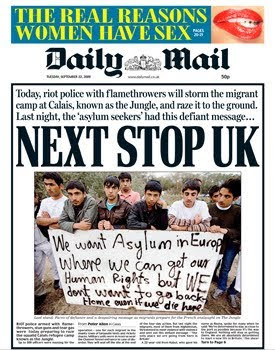
Perhaps when both families were being dragged kicking and screaming from their homes they were being filmed for UK Border Force. This is a Sky One programme, now in its second season, which is presumably made with the full participation and encouragement of the Home Office. It showcases the Government’s policy of sending out teams to hunt down and and round up ‘illegals’ and highlights the ‘tragic stories and challenges’ that they (the immigration officials, not the immigrants) face every day. Raids have recently been staged on a market in East London, dragging off immigrants whose only hope of survival is to work illegally given that the Government not only forbids them from working legally, but is also actively reducing even their most basic means of survival. Presumably in this way New Labour ministers hope to quench the thirst for brutal violence as a solution to the ‘problem’ of ‘illegal immigration’ which is, of course, a mainstay of Jack Straw’s favourite newspaper (see above).

Perhaps the Daily Mail is missing the boat somewhat when it comes to their bitter opposition to further British involvement in and cooperation with the European Union. Slavoj Žižek recounts the case of the Tunisian fishermen who face up to fifteen years of imprisonment for rescuing forty-four immigrants off the coast of Lampedusa. Other fishermen who have beaten off boatloads of people with sticks and left them to drown suffered no punishment. Zizek then quotes what Robert Brasillach, a ‘moderate anti-semite’, wrote in 1938:

‘We grant ourselves permission to applaud Charlie Chaplin, a half Jew, at the movies; to admire Proust, a half Jew; to applaud Yehudi Menuhin, a Jew; and the voice of Hitler is carried over radio waves named after the Jew Hertz . We don’t want to kill anyone, we don’t want to organise any pogroms. But we also think that the best way to hinder the always unpredictable actions of instinctual anti-semitism is to organise a reasonable anti-semitism. ‘

I can only presume that this is what Jack Straw et al are up to with their quasi-fascist hounding of immigrants. They certainly don’t want to organise any pogroms, but they seem to think that TV programmes which present pogroms as entertainment might serve as a means of pacifying violent racists, somehow making them less inclined to get off their sofas and round up ‘illegals’ themselves. Attempts to use similar means to combat racism and fascism in the 1930s met with limited success.