
I think I have actually become quite attached to my ongoing poverty over the last couple of months; there is in the end, as Jesus tried to tell us, and as Mr. Potatohead, with his austere yet exemplary disavowal of everything but a simple nose, and a pair of blue trainers, seems keen for us to understand, something heroic and noble about the prospect of eating nothing but onion pie and potato sandwiches for the next twenty-two days, and I would heartily recommend the large transnational teaching organisation I work for to anyone considering a healthy and holy future as some sort of ascetic hermit.
Category: .
Everything I know

How long would it take you to tell another person everything you know? Assuming, of course, that you, or me, or anyone, could get someone to listen, which is quite unlikely. Also, for me, I suspect that a lot of what I think I know, in reality I probably don’t, for example how to read a French bus timetable (as I recently found to my cost), or basic things about maths, or how to spell the word surrepitiscious. Plus the fact that if you were to start spilling out the entire contents of your brain, new thoughts would constantly occur, and you would quickly find out that you know both a lot more and a lot less than you thought you did.
In 1975 Buckminster Fuller, the inventor of something called the geodesic dome (that thing above that looks suspiciously to me like something he´s nicked from a children´s playground and painted white, but then as I say I know little of science or maths), decided to tell the world everything he knew. It took 42 hours, and I’d imagine that the audience consisted of people familiar with his life’s work, or at least very close friends, or maybe just people who really wanted to shag him, given that the content of the mammoth talk consisted in:
…all of Fuller’s major inventions and discoveries from the 1927 Dymaxion house, car and bathroom, through the Wichita House, geodesic domes, and tensegrity structures, as well as the contents of Synergetics. Autobiographical in parts, Fuller recounts his own personal history in the context of the history of science and industrialization. Permeating the entire series is his unique comprehensive design approach to solving the problems of the world. Some of the topics Fuller covered in this wide ranging discourse include: architecture, design, philosophy, education, mathematics, geometry, cartography, economics, history, structure, industry, housing and engineering.
His speech starts beautifully, if a little bit incoherently; it’s clear that he’s not speaking from a prepared text, which I like:
We try to think about the most primitive information we have regarding our extraordinary experience, is that, I think we choose the fact that, all humanity has always been born naked, absolutely helpless, for months, and though with beautiful equipment, as we learn later on, with no experience, and therefore, absolutely ignorant. That’s where all humanity has always started. And we’ve come to the point where, in our trial and error finding our way, stimulated by a designed-in hunger, designed-in thirst…Man having, then, no rulebook, nothing to tell him about that Universe, has had to really find his way entirely by trial and error.
I should say that he didn’t speak for 42 hours straight, but over a period of two weeks; there were lengthy breaks during which he presumably went about his quotidian erudite existence, without reading too many big mind-expanding books and making absolutely sure he’d be able to get his hands on enough green stuff to plough through ’til the end. You can read, watch or listen non-stop to the entire thing here, although I can’t claim to have done so myself yet. Some of the parts that I have read, though, such as this from Session 11 where he talks about Love and sounds distinctly like an addled and very sentimental hippy, make me dearly want to sit through the whole thing.
And it’s because of my basic inherent laziness, combined with the fact that I myself would never be so presumptuous or ambitious as to think that someone might spend 42 hours staring at my blog, that, inspired by Mr Fuller, I have decided to do something similar here, but much more manageable: I have come up with the simple idea of recording a Daily Thought, just a single sentence which contains whatever piece of original thinking has entered my head that day. Hopefully it won’t just come across as a pithy soundbite or a facetious one-liner, although I think realistically that’s probably the best that can be hoped for most days.
I’ll keep it on the top of the page for the time being, and obviously I reserve the right to develop whatever silly notions occur to me into full-fledged misdirected rants whenever it takes my fancy. In an ideal world people would feel free to respond with considered responses or virulent abuse, but then in an ideal world there wouldn’t be any traffic problems in Madrid and nobody would ever have had any right-wing ideas, so take your pick.
Right, having said all that, my first piece of genuinely original thinking is…:
Err…
On Serendipity

Although my life has of late been blessed in some ways by a certain amount of serendipity, that has certainly not been the case in financial terms. You get paid less money for teaching English in Spain than the average monkey in a Chinese zoo, which is causing me to seriously reconsider my options ie. you might find me working in Starbucks in London before too long.
In fact it was the realisation that one of my best options for avoiding a life of monkey wages or the need to become a barista and learn how to bombard stoopid people with a seemingly endless succession of daft questions about loyalty cards and biscuits entailed taking an exam which I failed twice half a lifetime ago, and which there is no guarantee whatsoever of me passing this time (I still haven’t figured out what the numerical value of X is supposed to be. I mean, to me, it’s always been more of a letter than a number. I’m quite happy to admit that my mathematical genius is not of Noble Prize-winning standard, I mean I can count to twelve but it takes a fucking long time) that brought me to a level of deep deep despondency on the way back from my insufficiently-rewarded job on Friday afternoon, when I received a rare stroke of financial good fortune – I got a message from my mobile ‘service provider’ (am I the only person who finds that phrase sickening, and its ubiquity quite so depressing?) saying that, for no reason whatsoever, they were going to give me €65 of free credit.
Woo-hoo! You might say. I skipped into the Chinese shop, splashed out on some butter (not literally I should stress) and had a cheery conversation with the less reticent of the two weirdos who work there about different words for broccoli, and positively beamed my way up to the door to my building, where I.
dropped.
my.
phone.
Which started to beep wildly and say something about a ‘error de tarjeta’.
Now I am not in any way a god-fearing person, but I did for an instant get a clear image of a vindictive and scornful bearded face cackling at me from between the darkening clouds overhead. The bastard, or in all sobriety probably just the bastards, had given to me with one hand and then gleefully swept my fortune from me with the other, er, claw. I shook, rattled, swore beautifully at, and eventually fixed! my phone.
Which was a relief.
My confidence boosted, I decided to take my mobile ‘service provider’ (AAARRRRRGGGHHH!) up on one of the promotional offers they have been, despite my very best and at one point even temporarily successful attempts to get them to stop, deluging me with over my last two penurious months. One of those things where they let you phone five numbers for a slightly less outrageous price. This required, along with three spare euros of credit, huge reserves of patience and moral courage, given that to get through to actually speak to someone at Movistar is about as easy as finding your way out of a maze the size of the world, or passing a GCSE Maths exam, if you’re me, except that it takes a lot longer than the seventeen years it’s taken me so far.
I digress. Over 30 separate calls later, and after one mind-bendingly long wait, I got to actually speak to someone. After a brief contest about who could speak Spanish faster, in which after a few minutes I was forced to admit defeat, I asked to speak to someone in English.
When I’d waited quite a bit longer and explained to an extremely German-sounding person what I was after, she asked me to hold on while she got the details, and she seemed to be taking a fairly long time. And when she finally came back on the line she sounded a bit surprised, in that slighty shrill German way, and asked me when was the last time I’d put money on my phone.
I can’t quite describe the level of angst and regret that took hold of my entire head at hearing this question. Evidently by making this torturous phone call, which had by this point drained me of such reserves of time and energy that I would have been pathetically grateful just to be told that the promotion was no longer valid, or just have someone blow a whistle down the phone and hang up, I had drawn the attention of the empresa to the fact that they had inadvertently granted a misplaced windfall to one of their least lucrative clients, and they were about to take my now cherished sixty five euros of credit away from me. For the second time in a handful of hours I, rather than fate, had seemingly just, as they say, totally pissed on my own chips.
I mumbled something as unspecific and incoherent as possible, and she buggered off once again to ‘check out some details’, while I waited, feeling as distraught as someone lost and parched in the desert who has just absent-mindedly upended his water bottle in an misguided attempt to pass his Maths GCSE.
And so to the end of the story, which is … nothing. No more mention of the free credit; I gave her four phone numbers, because it turns out that I don’t know five people in Spain with Movistar phones, which is a bit dismal when you consider that it’s by far the biggest network, and that like in most European countries a population of forty million people somehow shares about 137 million mobile phones between them. And no less than two days later I now have, let’s see, €42 of credit left, because our perceived need to be in constant and immediate contact with other people, and to be seen to be so, blinds us to the fact that we are paying ferocious amounts of money that we simply don’t have for something that, at the level of landlines, is basically free, just like people who live in countries with clean drinking water who ‘only ever drink bottled water’, and whose boundless idiocy is a constant source of awe to me. But, you know, Richard, why don’t you tell us what you really think for a change.
Ho hum. The moral to the tale, then, is don’t look a €65 gift horse in the mouth, or don’t tempt fate when it comes in the form of an serendipitous SMS. And speaking of free gifts, if anyone out there has it within their power to gift me a Maths GCSE, I would be humbly and profoundly grateful. Now how do I set up one of those wishlist things that girls have…
Getting your class to steal things from shops

For anyone who thinks that this blog should probably have something to do with teaching, like I do, here is a lesson plan I made up in my head while I was ‘Just Sitting There’ thinking hard about shoplifting and what the hell I’m gonna do tomorrow in class…
Shoplifting Lesson
Show students something you can claim to have stolen – bananas or Ipods work wonders. Ask them how much they think it cost. Tell them you it didn’t cost you anything, and try to convince them that you nicked it.
Say ‘No, haha, of course it’s not stolen’ and show them the receipt (‘ask for ‘un recibo, por favor” (Time Out Madrid, 2002)) (unless of course you did steal it, that is, in which case Hey hey!, well done, I’m jealous).
See if they know any other words for ‘steal’ – teach them nick, swipe and ‘five-fingered discount’. Elicit Shoplifting.
Ask them if they’ve ever taken anything from a shop without paying. If no, tell them you understand they might be shy, and put them in groups to ‘share their secrets’.
In pairs or threes or whatever, give them the following questions to discuss:
Have you ever stolen anything from a shop?
Do you know anybody else who shoplifts regularly?
Would you ever nick anything from a shop? If so, under what circumstances?
Get feedback on questions – get one in each group to ‘report’ back and try to find some way of getting the others to contribute instead of just staring at you when you’re not the one talking.
Have a quick vote on who thinks it’s right or wrong to shoplift. If you have someone who is opposed to it under any circumstances whatsoever, try not to spit on them as you put them in the same group with the one who you most suspect of having a criminal record. Or alternatively, stick them in a pair with the one who hardly ever….says…………..any……………………
thing.
Give them the following questions:
Do you think it’s right or wrong to shoplift? Why/why not?
Is stealing from local shops the same as stealing from supermarkets? Why/why not?
Do you know anyone who’s ever get caught shoplifting? Did you feel sorry for them?
See if anyone knows about the €350 thing. Briefly ask them what they could steal ‘for’ €350. Tell them that all the things they’ve mentioned are basically free if you’re prepared to maybe lose face a little in your local community.
Tell them they’re going to practice their shoplifting skills. Because they’re just practising, they will have to take it in turns to be the thief and the shop assistant, or if you have or prefer threes, the third one can be the manager.
EITHER tell them you didn’t have time to prepare properly, and hand them some post-it notes so they can write role-cards for the other pairs. Remind them that you want to practice as realistically as possible, so they should think of a variety of people in different shopping places – supermarkets, chinese shops, newspaper & porn kiosks, off-licenses, the fucking Body Shop, and so on.
Get down into your Tefl Crouch and help them write their role-cards.
OR alternatively you could use these ones I made earlier.
Swap round the role-cards and tell them to get practicing…
..and then all you have to do is wander round giggling and waiting for the bell to ring, which, what with my appalling sense of …. timing, should have been about 35-40 minutes ago.
I have a shameful confession to make

Any readers concerned that my ongoing fascination with China is turning into an unhealthy and vindictive obsession might be relieved to hear that I’ve developed a new interest, and potentially a whole new hobby: Shoplifting. It came about because I have a student who works for a company which sells supposedly theft-proof security products to supermarkets – coded labels, advanced bar code technology, those almost totally irritating roundy plastic things they stick on bottles of spirits and the like – and who, in the course of a discussion of which Spanish supermarkets are easiest to nick things from (clue: it’s not El Corte Ingles), revealed himself to be something of an unreformed pilferer himself, claiming to have surrepticiously slipped thousands of products out of hundreds of supermarkets over the years.
It’s an aspect of life that I’ve never really considered, apart from a vaguely rebellious notion that there is absolutely nothing wrong with swiping whatever takes your fancy from the shelves of Tescos or Sainsbury’s or wherever. I’m even quite shocked when I leave a shop with someone who turns out to have helped themselves to a five-fingered discount. And the shocking and shameful truth, which it took quite a lot of courage and soul-searching to even admit to myself, is that I don’t think I have ever stolen anything from a shop in my life.
It’s certainly not been through a lack of necessity. I don’t have any problem with pathetically informing the person at the checkout that I’ll have to leave three of those eleven bananas and that 99 cents Neal Diamond – Live! cd behind. And in my mind I’ve always known that the risks of being challenged, let alone taken away and fed to the crocodiles, are almost non-existent – according to my Shoplifting Guru, the police never even bother going to the store if the value of what you’ve stuffed down your pants/hidden behind your earlobe/stashed inside the baby is less than €350. This article talks in some detail about quite how much fun and how widespread it is: I’ve obviously been missing out bigtime. Maybe I am all the same just a coward, but I can honestly say that when I’m counting my farthings in Dia or Lidl (of course, it’s not great for your social standing to be caught in the act in those 12p-for-a-can-of-beans supermakets, no matter how famous you might be), the thought of shoplifting never ever occurs to me. The only conclusion is that I forget to steal things.
So I decided to turn over a new leaf, and start helping myself to at least one item per visit to the Super. If I get good enough at it in my usual discount haunts, I thought, I reckon in a year or so I’ll have saved enough to upgrade to a weekly visit to El Cortin. Not that I’d be paying for it, of course. But then I reconsidered – I have, I realised, much nearer to my house, my own ready made Shoplifting Academy.
Just next to my building, right at the entrance to the local metro station is one of Madrid’s 400,000 Chinese shops, and the two kids who staff it are by far and away the doziest people I’ve ever encountered in my life. They speak notverymuch Spanish, don’t despite my very best vocal contortions appear to understand a word of Chinese, and my attempts to communicate with them in English were greeted with stares as blank as something totally, like totally, like one hundred percent blank. Plus, they seem to spend their non-serving moments hidden away somewhere beneath the counter. I think maybe it’s a better choice if I want a not-too-challenging initiation into the montaña rusa world of the habitual shoplifter.
So that’s where I’ll be starting off my criminal career. I know it’s not the most ethical option to start by picking on low-down neighbourhood establishments owned and staffed by recent immigrants, not to mention ones that are quite so badly-stocked and lacking in pesto. But bear with me, it is only a beginning, and before too long I’ll be setting my sights on the true temples of modern consumer capitalism and rampantly stuffing my pockets in an adrenaline-fuelled frenzy of premium product theft. That is, of course, if I’m not making a shame-faced extended detour to a different metro station every day for the next two years…
NEWSFLASH
I have written something potentially funny and/or interesting enough for other people to read, and it has been submitted to Lauren for approval.
This blog is worth 104,890.74 Kwai

My blog is worth $12,984.42.
How much is your blog worth?

Who’da thunk it?
On ¿Qué?

If, as James Joyce said, the useful lifespan of a newspaper is one day, how long does a free newspaper last for? In Madrid, one of the many, many free papers that are scattered throughout the Metro network every day is called 20 Minutos, which seems a fair estimate. As you might expect, you don’t get a very high standard of news journalism from the free press – Metro, Qué!, 20 Minutos and the other ones whose names I forget just tend to feature the exact same news stories written in a fairly clumsy and sensationalist style. But what can you expect – they are free after all. And because of this, it’s not unusual to see people carrying two or three of them to skim through as they move around the city.
As a result, it’s actually quite unusual to see people reading ‘proper’ newspapers, by which I include the generally ubiquitous football papers Marca and As. Which is a shame, because in my opinion Spain has some excellent newspapers. What’s wrong, then, with the free ones? Well, it’s not too outrageous to suggest that when something is free, it’s often because it has no or next to no actual value. Inevitably Qué! (admittedly much better than the others, being a fairly convincing tabloid newspaper with a fair amount of seemingly genuine interest in what the readers think, and which has recently started an aggressive advertising campaign, which is a bit odd considering it’s free) and all the others just exist to sell adverts. At least with what used to be called a ‘journal of record’, you pay your money in return for a certain level of professionalism in terms of how they gather and present information, and you pay to read the considered opinions of experienced people whose opinions actually count for something. With the free ones, it’s pot luck whether or not you get as much as you pay for, so to speak.
I’d hazard a guess and suggest that this relatively new and rapidly expanding phenomen is due to the very low value that we place on news information and commentary these days. There is just so much newsprint out there, any number of TV channels trying to fill up airtime without upsetting anyone important, and besides all that there is the internet, teeming with unsolicited and ill-considered rants like, erm, this one.
Obviously free newspapers and magazines are nothing new in most cities, although I suspect that they are expanding elsewhere at much the same rate. Newspapers and magazines, in fact, of often the most surprising kind. In the National Express ticket office in Sheffield in the summer there was a huge pile of Chinese-language copies of the Epoch Times, and although I wasn’t able to read it much I did pick up an English language edition a few days later in a Portuguese cafe in London. If you’re not familiar with the paper, it’s Taiwan-based and has some connection to the outlawed Falun Gong religious cult, which is why it publishes a great deal of very anti-CCP articles, which although not always very persuasively written, are always good fun to read – some people seem to have a huge problem with the FG, and I don’t know a huge amount about them, but to be honest if anyone dedicates their time to the destruction of the Chinese Communist Party, whether or not they decide to go to the somewhat puzzling extent of setting themselves on fire, they have my wholehearted support, and are welcome to borrow my lighter anytime.
As I say, their newspaper reads like it’s written by someone with a very definite purpose and agenda – but as I said earlier, what the hell, it’s free. If someone picks it up, which is quite possible given the kind of random places where it’s distributed, under the mistaken apprehension that it’s just some normal expat newspaper for overseas Chinese, it will just get jumbled up and/or discarded along with all the other free and mostly useless information they’ve gathered recently. Unlike when we’ve invested money in a publication which we have some reason to trust, with the free press we’re generally I think disinclined to question the sources or the veracity of the information presented, or the motivations of those who are responsible for it.
Speaking, then, of publications for overseas Chinese and for people interested in China, on the bus yesterday I came across yet another free paper, printed in Spanish, with the title of The Mandarin. It is a weekly publication which, surprise surprise, features story after story of very, very good news about the Chinese economy (‘President Of World Bank Praises Social And Economic Progress Of China’, ‘Chinese Outbound Investment To Continue Growing Rapidly This Year’, ‘Chinese Economy In For A Smooth Landing’), along with articles about the mystery of Guilin and Tibet, the exotic and colourful traditions of the ethnic minorities that China is a proud host to, a page dedicated to preparations for 2008, a story about those (trojan) pandas and their long-delayed journey to Taiwan Province, and a special page for people starting to learn Mandarin.
For someone with a mild interest in Chinese culture, it might all seem perfectly innocuous. As I said, when we sit, or more often stand, and read a free newspaper, we don’t usually think in detail about the credentials or the motivations of those who’ve written it. Glossy magazines about China on sale at kiosks or in newsagents around the world contain pretty much the same information, after all.
However, there is for me something about finding publications like this freely distributed in relatively free countries which I find disturbing, and I think it’s the following: in Wild Swans, Jung Chang talks about how the only western publication they could get hold of during the Cultural Revolution was the newspaper of a tiny group of Maoist sympathisers who were ignored or laughed at in the West. Now it seems that the inheritors of that insane tradition are exploiting our carelessness about what information about the world we allow to enter our heads.
Is the value that we place on news information now so low that we will allow the Chinese Communist Party to distribute state propaganda as though it were just another innocent random source of information about the world?
If that’s the inevitable consequence of this explosion of ‘free’ newspapers, I’d prefer to stick with the Guardian or El País – or maybe even Marca or As.
The Beating of Lu Banglie
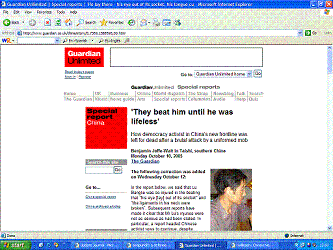
I haven’t got anything useful to add to the debate about the attack on the democracy activist Lu Banglie, and I am not one to blow my own trumpet, but reading this article from Running Dog put me in mind of what I said a few months ago about attempts to ‘reform’ the CCP:
“Throughout the country party officials and to a certain extent ordinary Party members are allowed to run amok: charging peasants illegal taxes, running up restaurant bills for thousands of dollars, stuffing their pockets with public cash, paying thugs to beat villagers off their own land, building up huge unpayable debts with banks, everywhere doing favours for people they like and making life difficult or impossible for those who they don’t. And doing all this with relative impunity – who is going to stand in their way? Other Party members?
It is only a tiny amount of cases of corruption that we ever get to hear about. As far as I can see, corruption and abuse is the rule and not the exception. My second analogy, then, is the Mafia.
In the Godfather Part 2 Michael Corleone is young, idealistic and determined not to follow the example of his father. He is going to clean up his family businesses and make them respectable. So what happens? I don’t want to spoil it for anyone, but it is the Mafia we are talking about here after all. How can you reform an organisation that is based on criminal corruption, on the systematic hoarding and abuse of power? Maybe we can conclude that what Michael wants doesn’t really change, but as a leading member of the organisation he has a crucial job to do: Protect the Family.”
As well as Asiapundit’s post, I though that Rebecca MacKinnon’s challenge to Chinese bloggers was right on the money:
“At the same time, I hope this question of a foreign correspondent’s responsibility will not become a convenient way of distracting people from the core issue: one of human rights and the suppression of a democracy movement in Taishi.
Will Chinese netizens be successfully manipulated into foreigner-bashing as an acceptable alternative to communist party-bashing?”
Vive la Chine!

En honneur du pays où je me trouve actuellement (à Bretagne), j’ai fait un effort de traduire un article…ah whatever, here’s an article from Libération about the recent climax of the ‘France in China’ year. I think the conclusions of the article are quite interesting, in terms of what it says about ‘exchanges culturelles’ between China and the rest of the world.
Apologies in advance for the inevitable mistakes in the translation. Anyone who, unlike me, actually speaks French can read the original article here.
L’Année de la France en Chine, a damp squib
It was supposed to be ‘the incredible adventure’, an event on the scale of the parade down the Champs-Elysées celebrating this year’s Chinese New Year. In the end, after one year of work, €1,500,000 and two hundred special guests flown in from France, it was no more than a simple country fair at the foot of the Great Wall near Beijing, with snacks and white wine for several thousand officials. Somewhere between Chinese authoritarianism and the great follies of the French, the dream had cruelly turned sour.
They’re just peasants!
This, then, marked the end of L’Année de la France en Chine, with a final note of bitterness and an immense sense of waste: Gad Weil, the organiser of the ‘giant picnic’, the idea for which came from the French Government, could not hide his anger on Saturday upon seeing the efforts of his team reduced to almost nothing by the presence of delegations of officials. The initial project, which was to bring together 120,000 people over two days along the length of a wall peopled by representatives of different French provinces promoting their traditional products and traditions, had been rendered more or less unrealisable by the obstacles put in place by the local authorities. The final straw came on Saturday, when the police kept the non-invited public away behind safety barriers, a distinctly colonial scene in which hundreds of Chinese watched at a distance as the French and their important guests enjoyed themselves. When Gad Weil complained, the response was: ‘But they are peasants, they are of no importance to you, they will never go to France!’ ‘I am an acrobat’, explained in vain the organiser of the Chinese New Year parade in Paris, ‘what I do is organise spectacular events for the general public’. His anger was assuaged by the greater access granted to the general public yesterday, but there were very few who turned up owing to the Chinese Mid-Autumn festivities.
L’Année de la France en Chine had begun a year ago with a similar misunderstanding about the ‘popular’ nature of events, with the concert given by Jean-Michel Jarre inside the Forbidden City. The public on that occasion was hand-picked: no spectators without badges, invitations, verification…That concert was among the most expensive events of the year, only available to ordinary Chinese via television. Now, a year later, not much had changed.
Forty million euros
Obviously L’Année de la France en Chine cannot simply be reduced to these two expensive large-scale flops. With over 200 exhibitions, concerts and festivals, there have been many popular successes, such as the travelling Impressionist exhibition or the Transmusicales of Rennes transplanted to Beijing, despite, once again, an overbearing level of security. But the balance cannot be complete without taking into account the financial cost: 40 million euros, a record for a marketing operation. The financing was mixed, involving for the first time private Chinese interests who contributed six million euros, the rest being shared between the State and French companies. ‘Nothing on this scale has been done before’, underlines proudly a French official. A lot has also been wasted on an inumerable number of visits by delegations to China (it’s the fashion), wining and dining, and vague and botched operations.
The rewards of such ‘investment’ are impossible to quantify, and the promoters of the campaign take comfort from the fact that other countries, beginning with Italy, plan to carry out their own ‘exchange years’ following the French model. But this campaign, more diplomatic than cultural, presented initially as an attempt to modernise the image of France, which is traditionally seen as ‘romantic’ in the eyes of the Chinese, will not serve for much more than confirming that the French are friendly and rich…culturally. It will be difficult to break down those barriers.
The lesson
The Chinese are happy to welcome such initiatives: they reap the benefits of this courting by Western countries in search of market share. And they do it on their terms. Intractable on Saturday with regard to the Wall, they were very generous with the Summer Palace, where, on the occasion of a reception given by the city of Beijing to France, the magnificant site, long ago pillaged and destroyed by the French army in 1860, was superbly decorated in the colours of France. But no question of it being a popular fête: the invitees were all wearing badges. In China, cultural exchanges are something too important to be left to the people. France has learnt that lesson at it’s own expense.

 Infinite Coincidence