Isn’t Taipei the capital of Thailand?!

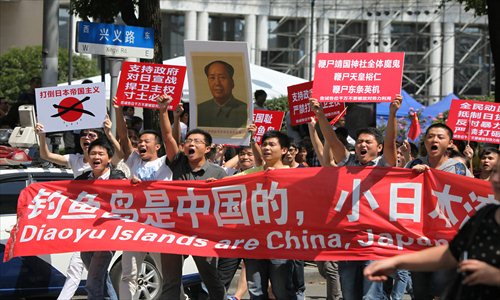
d25146ba-ded2-4854-bc2a-f2bcec8c265eThere are rumours of a large demonstration in Beijing this Sunday against all things Nipponese. I think that having marched everybody up and down the hill so many times over invading Taiwan, the authorities are now in a difficult position with regards to anti-Japanese feeling. They have to be seen internationally to calm things down, but this leads to anger in China as people perceive that they aren’t doing enough. And the internet and text messaging, which seems to be where this movement is being organised, are something that’s very difficult for them to monitor, try as they might.

For people who aren’t living here it’s probably difficult to get a sense of how strongly people feel about Japan. Or at least how they say they feel. Time and time again even the seemingly more clued-up students will volunteer that they ‘hate Japanese people’. It’s amazing how quickly a short statement of opinion can ruin your opinion of someone. ‘Congratulations!’ I think, ‘now I hate you!’

It also opens up an interesting dilemma. Now I’m aware that in the class I can’t make any reference to the three Ts. I think that even if I did, it would be greeted with silence. Actually the students are always keen to talk about Taiwan, but nevertheless I never respond when it’s referred to in class because I can’t honestly tell them how I or most of the rest of the world see it. A fellow teacher was just yesterday upbraided by the Communist Party stooge in the Foreign Affairs Office for pointing out at an English Corner (this is one reason I steer clear of the things) that Taiwan has in effect been independent for a very long time – something that is, for most of the world, a geographical question. Also yesterday when we were practising correcting false statements I mischievously wrote on the board ‘Taipei is the capital of Thailand’, which seemed to upset some of them – the idea of Taipei being a capital disturbs them, and as they’re taught never to say Taiwan, but Taiwan Province, whenever I make any mention of the place they make a big point of it.

However, Japan is a different matter. They don’t seem to consider it to be a controversial topic as far as talking to foreigners is concerned. So am I right in thinking that I can openly tell them that they are wrong and that their government is lying to them about it?

It will be interesting to see, now that the Government is clamping down on all references to the protests in the press, if foreign teachers are somehow made to feel they shouldn’t talk about it. In the meantime, I have no compunction about making someone who claims to ‘hate Japan’ lose face in class!

What are we all doing here?


The Chinese authorities keep a very close eye on the internet. Their objective is to prevent Chinese people coming into contact with information that shows their Government in a negative light. Just recently they have been trying to delete all references to the sometimes violent anti-Japanese protests. In this context, then, just why is it that an estimated 150,000 foreign teachers, most of whom are in their twenties or thirties and share a relatively informed view of the world, are allowed, mostly unsupervised, into classrooms to tell the new generation about how free and prosperous the outside world is?

In fact, I don’t think we’re here to present a positive image of the West. Actually I think we’re here to present a positive image of China.

Let me explain. The best selling book at the moment in China is a biography of Jiang Zemin, the former leader. Why is it so popular? According to the Washington Post:

The biography, “The Man Who Changed China: The Life and Legacy of Jiang Zemin,” by Robert Lawrence Kuhn, argues that the party has brought unprecedented stability, prosperity, global prestige and personal freedom to the Chinese people in the years since Mao Zedong died in 1976.

Who is Robert Lawrence Kuhn? Well, apparently he’s a managing director at Smith Barney Citigroup and an unpaid economic adviser to Chinese officials, ie a businessman. The Times also says that he speaks little Chinese and is not a China specialist.

And what about his book?

The book presents some new material about Jiang’s life, but most reviews of the English edition have panned it as a fawning work that exaggerates Jiang’s impact and seeks to defend him against almost any criticism.

The Chinese edition is even less revealing, with references to the internal political battles that Jiang fought to stay in power and other sensitive material deleted by censors. Kuhn said he was disappointed that portions of his book had been cut and said the work represented his own best effort to write a “personal story as told by Jiang’s family, friends and colleagues” that conveys Jiang’s “way of thinking” in the context of Chinese history and culture.

Now this is the interesting bit of the article, and I think it says a lot about why we were invited here:

Public reaction in China has been mixed. Some readers have praised the book for breaking a taboo against discussing the personal lives of high officials and for presenting details of Jiang’s life that were new to them. Others refused to buy it, dismissing it as propaganda.

“Kuhn is like a fan worshiping a celebrity. There’s no distance, no objectivity,” a Chinese editor who has read (the) book said on condition of anonymity. “It’s strange to us that a Westerner would write something like this.”

The editor said the fact that Kuhn is a foreigner is a selling point because many readers believe that any book written about the country’s leaders by a Chinese author must be propaganda — unless it has been banned.

In fact, a prominent Shanghai writer, Ye Yonglie, has alleged that the biography was sanctioned by the party and that officials quashed an early plan for Kuhn and Ye to write it together, perhaps because they wanted a foreigner’s name alone on the cover.

Now Chinese people, left to their own devices, might start to become suspicious of what the Government and the press in China tells them about China’s up and coming position in the world, given the corruption and mass unemployment they see around them. The Government here desperately wants people to believe that China is just another capitalist country, albeit one with massive growth. And who better to convey this message than foreigners?

Think about it. We are foreigners who live here, apparently comfortably. We are surrounded by McDonalds, KFC, shopping malls, English language media and all the trappings of Western life – remember, of course, that the overwhelming majority of our students have never actually been outside China, and don’t know what these things mean in a Western context.

When we talk to our students we talk most of the time about things we have in common – sports, DVDs, families, traffic jams. And contrary to what our students may have heard in the past about what foreigners think of China, we don’t seem to have any particular problems with life in China. We never mention Tibet, Taiwan or Tiananmen Square. We never talk about democracy or Human Rights and we never question the rule of the Communist Party. Instead, we talk about the massive changes that have taken place in China – the “unprecedented stability, prosperity, global prestige and personal freedom” – implicitly endorsing a crucial point of Communist party ideology, that it is only a matter of time until China achieves parity with the West and can be regarded as just another capitalist country.

The conclusion I draw from all this is that our presence here has very little to do with presenting the outside world to the Chinese – and, as we all know, very little to do with teaching English. It does have a lot to do with normalising China as just another capitalist country with which the West has no major issues.

The Da Shan Dynasty part 7: Down With The Da Shan Dynasty!


Several of my students don’t know or have already forgotten who Zhao Ziyang was. But they have all heard of Da Shan. Da Shan is ‘China’s favourite foreigner’, renowned in every corner of the Middle Kingdom for his dashing good looks and his complete mastery of the Mandarin Chinese of Beijing. He arrived here from Canada in 1988, and since then, according to his very informative webs…excuse me just a moment, one of the students has a question.

Yes, you there, you had a question?

“Yes, sir.”

Don’t call me sir. My name’s Richard. What’s your name again?

“Jamily, sir. Er, Mr. Richard.”

Jamily? Your name is Jamily?!? What’s your question, Jamily?

“Well, sir, it’s just that…I was thinking about that story you made us read, sir, Mr. Richard. The one about the picture. By that guy, er, Oswald Wo-‘

Oscar Wilde, Jamily. What about it?

“What, sir?”

Don’t say ‘what, sir?’ It’s … oh it doesn’t matter. What’s your point, Jamily?

“Well, I was thinking, because, you know, Da Shan came to China in 1988, sir, and that other guy, the one you asked about yesterday? I did some research, and I found out that he was locked up under house arrest, sir, Mr.Richard, in 1989, so I thought-”

Are you suggesting that Zhao Ziyang was like the picture in the attic, while Da Shan is like the-

“Yes, sir, exactly, Mr. Richard, sir! And Da Shan is like the guy who couldn’t, I mean doesn’t, get any uglier!”

That’s bollocks, Jamily.

“Thank you, sir”

No, I mean it’s preposterous. It’s one of the stupidest things I’ve ever heard in my life.

“But sir, just think how much better things would have been! And just imagine all the wonderful things he could have done on behalf of other gay people in Ch-”

Jamily, I never said that Zhao Ziyang was gay!

“Well, sir, maybe just a little bit bi-”

Jamily! This is just too silly for words. Sit Down! Stop calling me Sir!

And change your name!

“Sorry, Mr. Richard, sir.”

Right, sorry about that, now where were we? Ah yes, the blog. According to Da Shan’s very informative website…

Just a moment. I need to think.

You know, maybe that kid Jamily – Jamily! – has a point.

It does kind of all make sense.

In fact the more I think about it…

Right! I’ve thought about it.

It’s time for the Chinese people to stand up once again!

Down With The Da Shan Dynasty!!!

It’s time to establish a People’s Republic of China!

Adopt a Chinese Blog Campaign

As you probably already know, the Chinese Government is currently engaged in a crackdown on blogging websites, via new regulations obliging bloggers to register with the authorities. There is more on this podcast, from Global Voices. It has a frightening moment at about 15 minutes in, when the interviewee explains what happened when an independent blogger called the Ministry for information on how to register. And if you are outside China and have a web server, you may well be able to help.

China’s Division of Labour

How many Chinese people does it take to change a lightbulb? Well, if their Government has anything to do with it, it could be quite a few. The other day in the small supermarket in Dalian’s state-run Friendship Store, I counted 50 uniformed staff. If I look out of my window I can see two elderly men sweeping the dust up and down the same bit of the same road. And it’s also not unusual to find three people staffing a small public bathroom in a public park.

It’s not just public places, though. An average large-sized restaurant typically has up to four women stationed permanently at the door to squawk welcomes and goodbyes at the diners. Big hotels have, in addition to a couple of porters and bell-boys, someone whose job seems to be to ‘help’ people use the revolving doors, which creates obvious difficulties for anyone wanting to get in or out.

Neither is it just Chinese-run businesses. The German-owned wholesaler Metro has literally dozens and dozens of floor staff standing around looking very very bored, while the lucky ones get to whizz around in forklift trucks. They also employ one poor guy to stamp your recept immediately after the checkout staff have given it to you.

I don’t know how the system works. Maybe businesses of a certain size are obliged to employ a certain ratio of people. But the smell from the average Chinese public toilet is enough to tell you that employing all these staff does not result in higher efficiency and a better service – quite the opposite, in fact.

In the supermarket, for example, there are often three or four people in the aisle pointing things out to you and encouraging you to buy them instead of whatever you’ve chosen. However, if you try to find out what the difference is, they can only claim that it is ‘better’. They don’t know why. It’s the same if you try and buy a DVD player, or anything related to your computer. I find that I know more about it than they do. And I’ve been convinced many times that I would do a better job of driving a taxi or a bus than the person employed to do so, despite the fact that I’ve only ever had one driving lesson in my life, and that was a disaster. Even more worrying is coming across articles like this. There is a strong sense that any given person doing any given job in China only has a limited understanding of what they’re supposed to be doing.

Why is this so? I don’t believe any racist nonsense about how the Chinese are any more or less inventive or incompetent than anyone else. My own pet theory is this: After Mao and his henchmen and women had driven anyone with any expertise to madness or suicide, or just plain beaten them to death, there wasn’t that much know-how and learning to go around amongst such a rapidly growing population – and the tradition of passing expertise and wisdom on to future generations had itself received quite a beating.

You can see this clearly in the realms of cultural ‘products’ – although China is the ‘factory of the world’, what cultural exports has it produced in the last few years, apart from those tourist-friendly films celebrating China’s glorious past?

Another enduring legacy of that time is that people don’t seem inclined to challenge anyone in a position of responsibility, even if it’s obvious that they don’t know what they’re doing. Maybe this is an ongoing reaction to a time when nobody’s position was secure, apart obviously from that of the Great Helmsman. The Government soon recovered its authority, and people nowadays tend to regard any form of authority with craven face-saving respect.

So, the Government is desperate to keep people busy, to give them a stake in China’s future and make them believe in the Chinese dream. At least, that’s the charitable point of view. However, in China today those who aren’t lucky enough to find jobs in foreign-owned factories producing inferior-quality goods for export, or unfortunate enough to labour day and night building the unaffordable apartment blocks and hotels that crowd out the skyline of China’s cities, are paid subsistence wages to perform utterly meaningless tasks.

Whatever about Socialism with Chinese Characteristics, I’m sure this wasn’t what Marx and Engels had in mind. And Margaret Thatcher would sleep even less at night at the thought of a public toilet staffed by three salaried employees!

As we all know, low wages are the reason for China’s economic ‘miracle’. And those low wages are the subject of a very interesting article by Andy Xie (it’s the second article on the page), in which he points out that in other fast-developing economies in the past (he talks mostly about South Korea) there was a point at which a labour shortage developed, and wages had to rise.

The crucial point about China, though, is its size. China is starting to run out of land and natural resources – hence the drive to send migrant labourers to Africa to work in Chinese-owned factories. But it will be a very long time before it runs out of peasants prepared to work for very low wages in unskilled jobs. This means that wages will not rise in a country where the supply of labour is basically unlimited and workers are prevented from making demands.

What this means for China, I think, is two things. One is that those new apartment blocks will not rise in price as expected, and there will be some sort of crisis when speculators realise this and stop investing. I think this will lead to big problems for Chinese banks. Andy Xie puts it better than I can:

The fact that Chinese workers benefit little from their productivity gains has profound implications for China’s property market and commodity prices. Property values tend to rise in line with labor income in the long term. Property speculators assume that China’s economic growth will deliver rapid wage growth, and, hence, that they are just front-running Chinese workers in pushing up the prices first, i.e., Chinese workers will buy from them at higher prices with their higher wages in the future. I believe this is an illusion.

The second thing is at some point there will be social unrest related to the failure of wages to keep up with commodity prices. Andy Xie again:

The prices that China can afford depend on wage levels more than the overall size of the economy. The Chinese economy has been expanding rapidly on employment rather than wage growth. In the end, the burden for bearing the costs of raw materials comes down to the income of each consumer. Chinese consumers are just not becoming rich fast enough to catch up with the rapid increase in commodity prices.

But I also believe that all of this has dramatic implications not just for China. China is the ‘factory of the world’ – as we can see right now with the worldwide crisis in the textile industry, companies from other countries will continue to face stiffer and stiffer competition from Chinese exports. And who is going to pay? I think Andy Xie may have just hit the nail on the head with his final point:

In summary, the global financial markets are speculating in China-related assets, in the belief that Chinese prices will rise to OECD levels. I believe that OECD prices are more likely to fall towards Chinese levels.

My own point is this: I don’t think that it’s just commodity prices that are going to fall across the world. Chinese wages are not going to rise to OECD levels. I believe that OECD wages are going to fall torwards Chinese levels.

You know, from a certain perspective, I think that might just be what Globalisation is all about.