Numerous Conservative MPs have rallied round their colleague, Anne Marie Morris, who is reported to have uttered the highly offensive phrase ‘n***** in the woodpile’ in a speech at a public event about Brexit.
The first to rush to her defence was recently reelected Richmond MP Zac Goldsmith, who commented: “It’s quite simply a word I use all the time. We have an open fire in the main living room, and round the back of my mansion there’s a pile of firewood. When it’s cold, I have some of the servants fetch some wood and build a fire. It’s not an offensive term”.
When pressed as to whether he thought it was appropriate for politicians to use the other word in the phrase, commonly referred to as the N-word to avoid offence, Mr Goldsmith was nonplussed.
“I don’t even see why it’s called the N-word”, he responded. “It begins with ‘i’, for a start. It’s merely a prepo…”
At this point our reporter was obliged to clarify. When the nature of the word was explained to Mr Goldsmith, he was silent for almost two minutes. Eventually an aide (subsequently identified as his brother Ben) intervened and whispered something in his ear. Mr Goldsmith looked perplexed. A hushed conversation then took place, during which the MP seemed to grow agitated. He appeared to be seeking some sort of clarification from the aide, but further explanations only seemed to puzzle him even more. Upon moving closer to the conversation, our reporter was able to distinguish words such as ‘darkies’ and ‘coloureds’. After several minutes one of Mr Goldsmith’s butlers politely asked us to depart the premises. He explained that Mr Goldsmith was suddenly indisposed as he had been “working like a n*****” all week” and had to urgently prepare a speech for a Bring Back Slavery event at the Commonwealth Club the following Thursday.
In a subsequent email the MP for Richmond apologised for having cut short his interview. In relation to the question of his colleague’s remarks, he stressed that he saw “nothing racialist about the word ‘the'”, and said he hoped the whole issue would soon disappear, “like a n….. in a blackout”.
When asked for a response to Goldsmith’s own potentially inflammatory use of language, Prime Minister Theresa May said it would not derail her plans to appoint him Secretary of State for Race Relations in The Colonies in the upcoming reshuffle. As for Mrs Morris, she said, the prime minister herself would, in her capacity as leader of the Conservative, Unionist and Obviously Racist Party, soon be making a formal apology on the MP’s behalf to any woodpiles who “may have taken offence” at the use of the term.
I’ve always rejected out of hand the notion that the political spectrum is a horseshoe, that the far-right and far-left are close to one another in various ways. However, what I’ve seen in Facebook groups on both sides of the Atlantic is that the far-right is stealthily digging a tunnel in order to insinuate its ideas into the far-left and beyond.
This mostly takes the form of memes promoting conspiracy theories which target ‘privileged elites’. Superficially persuasive videos blame (most commonly) the Rothschild family (a long-standing anti-semitic canard) and The Vatican for the world’s chaos and corruption. Such videos are distributed by sites which a moment’s investigation reveals to be teeming in pro-Putin/Trump and climate denial material. However, the conspiratorial tone in which they are presented is like catnip to online audiences desperate for easy explanations of troubling but confusing events.
Conspiracy thinking has often been called ‘the poor man’s ideology‘. It’s easier to understand the notion that a secretive group of powerful people controls the world than it is to pick apart the myriad ways in which capitalism preserves itself as a chaotic but impersonal system, in terms of both interacting repressive institutions and also via conservative ideas which circulate at every level – including the ideas that we ourselves hold.
It’s also deeply comforting to think that someone, somewhere is in charge, partly because it lets our own roles in preserving that system off the hook. The problem is always other people’s corruption and venality, none of which can even be addressed directly because They Control Everything. This enables the consumer of conspiracy theories to do nothing but read, watch and share the hidden truth, and to remain in every other way politically passive. Like the ultimate function of a dream, conspiracy theorising works to keep you asleep.
The conspiracist worldview also, ironically, makes those who subscribe to it easy manipulable. Trump’s anti-‘MSM’ tweets are a very clear sign that widespread hostility towards all mass media suits the needs of those who hold formal office. It means what they do and their reasons for doing it face no scrutiny. The fact that he calls all media which questions his power ‘fake’ and instructs his supporters to ignore whatever it says should remind us how essential a free media is to democracy.
What Trump is doing in his blundering way has already been done in a much more sophisticated manner by the Kremlin, with Russia Today. With its line-up of charismatic rebels such as Max Keiser, RT is consistently entertaining. Like all such media, it provides simple but compelling explanations of complex events. Much of its coverage is relatively innocuous, following the same line as other channels. But there is a clear and very clever conspiratorial line in its reporting which dovetails with the content of explicitly right-wing outlets like Infowars and Breitbart, with their pseudo-radical insinuations of a secret Jewish liberal agenda known as the New World Order. That narrative is not coherent, because it doesn’t need to be: it just needs to titillate to the point of being shareable. It is a very short succession of clicks from RT videos showing the ‘truth’ about Russia’s involvement in Syria to ones promoting the idea of a jew-run plot to dominate humanity or denying climate change. It and the videos which (not by coincidence) exist in its orbit are a gateway drug to the far-right.
A key element of media literacy is knowledge of who owns a particular outlet. We need to know who is telling us a given story. Those of us on the Left know to steer clear of Fox News, The Sun, etc. People are also right to be suspicious of the BBC’s coverage of UK politics, given the compromises and connections at the level of personnel. Westminster journalists are often too close to their subjects to have a wider perspective, and they often come to identify with the worldview of those they cover. But the question of whose media we are consuming is even more important on the Internet, because there we are exposed to much more and much more sophisticated means of manipulation.
We need to know which sites to avoid. In particular, those who moderate left-wing forums need to know which sites to automatically block. A good rule of thumb is that if something mentions the Rothschilds or talks about the NWO, it comes from a far-right source and has no place in a left-wing group. However, given the sophistication of attempts to insinuate reactionary ideas into radical circles, we need to be more precise. That’s why this list (helpfully posted by a friend on a pro-Corbyn forum) is so very useful. It consists of a checklist of sites, identifying which are legitimate and which are known to be pushing an insidious agenda. It flags up, for example, the sites yournewswire.com and anonews, both of which I have seen linked to several times in nominally left-wing Facebook groups over the last few days. On each occasion dozens of people who see themselves as progressive have been taken in, liking and sharing material which a moment’s inspection reveals to be far-right propaganda. The Left needs to be much more vigilant about the danger such videos represent. Jeremy Corbyn may represent many things to many people; those who see him as the new David Icke need to be made actively unwelcome in left-wing circles.
Brexit dynamited the edifice of British political life, and as a result some parts of the building are still unsafe to enter. For that reason, Jeremy Corbyn is wise (as Tae Hoon Kim argued) to steer clear of the issue for the time being and to allow the monster that the Tories created to tear them apart.
Does that mean we as a nation should ignore the whole thing, pretend it never happened? While it’s hard to see how John Harris’ laudable call for open and honest dialogue with those who voted to leave can take place within the walls of conventional political debate, there are other fora which enable us to try to understand what circumstances lay behind the explosion. One such forum is art, ‘the lie that tells the truth’, and specifically drama.
We should be grateful to The Guardian for providing us (in the form of ‘Brexit Shorts‘) with nine eloquent if sometimes excoriating explanations of the causes of the vote. They remind us that few of those who voted Leave did so out of myopic xenophobia. Many did so because they were living in a different country to the rest of us. To dismiss them as reactionary dullards is to refuse to acknowledge that the prosperous Britain we felt we lived in, a place where most people enjoy a reasonable standard of living and the prospect of a bright future, was not by any means the universal experience.
Significantly for my own position on all this, I was not in the UK at the time of the vote, but in Thailand, enjoying a very relaxing couple of months while my wife did a course at the university. Previously we’d spent a fabulous year in Mexico City, living in a very pleasant part of town taking full advantage of all the opportunites that our suddenly enhanced economic status afforded us. My working life consisted of flying to other cities, staying in nice hotels, interviewing a handful of local people and then going to nice restaurants. After a while, such experience of unwarranted privilege gets under your skin, begins to seem natural. If you think of the effect of several centuries of automatic entitlement, the arrogance of people like Boris Johnson and Nigel Farage, who were secure in the knowledge that whatever happened to the UK economy as a result of the vote, their privileges were guaranteed, becomes more understandable. Although I would never have admitted it to myself a year or so ago, my fear about the possible loss of the fruits of my own good fortune partly fuelled my fury at the result.
Watching the videos I was reminded of the days of the London riots of 2011. I had a colleague who, sneering at the young people on the streets, rhetorically demanded to know why they couldn’t just follow his example. When I pointed out that his example consisted of going to a good school in a well-off area followed by a publicly-funded university which he had paid nothing in fees, he responded as though, well, as though I’d challenged his automatic sense of entitlement. More recently, a discussion with Nick Currie aka Momus about the motivations of Brexit voters ended up in Norman Tebbit territory: if there are no opportunities where they are, they should all just move. Although I feel distinctly chippy pointing it out, it’s not quite irrelevant that Momus went to a private school and then a public university on a full grant. It’s not possible to talk about such things as Brexit without reference to class, that great taboo in British life, and that does mean being honest about our own privileges.
The dramas presented in the Brexit Shorts series all, thankfully, take a more considered and searching approach than just dismissing Brexit voters as lacking in ambition, empathy and geographical imagination. It also explains to those who voted for Brexit the grief and fear that the decision engendered in other people whose lives could in no terms be described as privileged. I found watching them both enlightening and therepeutic. Anyone who is even remotely interested in how the Brexit vote happened and what sort of country Britain is as a result should watch them all and encourage their friends and families to do so. If we are to build a progressive movement in the UK against austerity, xenophobia and in favour of equality and urgent action on the climate, it will have to be alliance between those of us who voted to remain and those who voted to leave.
There’s a wave of extreme heat assailing the planet. In several US states its caused road signs to melt, and in some the roads are too. There are forest fires across swathes of a number of European countries: last month over 60 people were burned alive in their vehicles in Portugal. In Italy (where I live) we are experiencing several days of a red heat alert with record-high temperatures, and a drought which has lasted several months with no end in sight.
If we don’t act now to prevent the planet from heating up like this, we will all be (quite literally) toast. And yet world leaders in Hamburg have just agreed to quadruple subsidies to fossil fuel companies. Although politicians like Merkel and Macron understand the climate is changing, they also believe that there’s a lack of political will for tackling the problem, and so and very many more roads will melt and very many more cars will burn ; none of them at the hands of the fabled ‘Black Bloc’.
The other main story on our local news bulletins is about Italy’s attempts to persuade other European countries to share reponsibilities for the refugee crisis by opening up their ports and agreeing to distribute new arrivals around Europe. Even though in the past Merkel have shown some courage and principles in arguing in favour of Europe’s duty to shelter those fleeing war and economic collapse, now there’s a ‘lack of political will’, even though hundreds of desperate people are drowning and risking death to reach our shores, many of them having experienced brutal treatment in Isis-run camps in the Libyan desert. In Italy itself bigoted parties and stirring up hatred against the very notion of a refugee, and the Left, currently in Government, is capitulating to xenophobic sentiment.
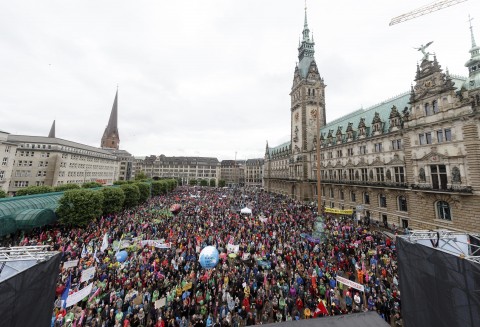
The spectacular images of cars burning in Hamburg have been accompanied by very little reporting of the concerns of the (overwhelmingly peaceful) demonstrators. A glance at their banners reveals what their ambitions are: human rights for all, urgent action on the climate and an end to austerity. They are expressing political will.
The great lie of the last forty years is that this is the only possible world. If people and the planet must suffer and die in order that some might profit, then so be it. But it’s demonstrably not true. Last month, against all predictions, people in the UK expressed political will. Jeremy Corbyn’s astonishing transformation of the British political landscape proved that where politicians provide principled leadership, they can persuade whole populations to change their minds, even on unpopular issues such as austerity, climate change and our response to the refugee crisis.
Naomi Klein’s new book ‘No is not enough’ argues that we (all those who share progressive values, including the notions that human life itself has value and that our species should survive) need to do two things: to understand the ways in which shocking events are exploited by those with the means to do so and used against our interests, and to articulate a positive vision of how we want the world to be. Those who are demonstrating in Hamburg are doing exactly that, and Labour’s near-victory in the UK proves conclusively that there is massive popular appetite for such a vision. An instinctively conservative mass media automatically pushes back against such a movement, seeking to discredit it with images of violent destruction outside the heavily-fortified compounds where our future is being decided; we know that what is being prepared will be infinitely more violent and destructive unless we decide to take on the task of determining our own futures. That will demand a massive exertion of political will on the part of all of us.
Who is responsible for all the world’s spiralling problems? A video posted on the ‘AnoNews’ Facebook page claims that two powerful individuals are to blame: Jacob Rothschild and George Soros. Those two leading, er, financers conspire together wih others of their ilk to cause wars, famines, false flag attacks and (I haven’t watched the video in question, so I’m surmising) the mass eating of Christian babies.
The video is going down a sturm online. It was posted in a group I follow called Jeremy Corbyn – True Socialism and is still there right now, despite repeated requests to the moderators to remove it*. But why on earth would you want to do so, say some unaccountably naive individuals? Aren’t we allowed to talk about the control that all-powerful je…sorry, I meant to say ‘zionists’**, exert over our lives?
The Rational Wiki website, a reliable source for information about climate and holocaust deniers and those who carpool with them, points out that invocations of theories involving the Rothschilds “is a good sign you’re in the more conspiratorial and anti-Semitic neighborhood of the Internet”. As for Soros, it points to a couple of instructiveexamples of sites which reveal the ‘truth’ about his ‘agenda’. They are, as you may have already gathered, explicitly anti-semitic ones, and inevitably they also make a big thing of his, erm, connection to ‘the Rothschilds’.
Does this mean I automatically defend what politically significant billionaires get up to, or that I’m a supporter of the Israeli State’s quasi-genocidal treatment of the Palestinians? Of course not. But it should be absolutely clear to anyone who regards themselves as progressive that when online memes target those particular individuals and not the Koch Brothers and Rupert Murdoch (etc), they are deliberately evoking anti-semitism. The sharing and liking of the Anonymous video confirms that while the campaign to smear Corbyn himself as anti-semitic was utterly dishonest and quite disgraceful***, among his supporters there are people who are not in the least bit inoculated against insidious anti-Jewish sentiment.
Certain kinds of populist political discourse serve the interests of the far-right, and such language and the ways of thinking that it encodes are prevalent on the Left nowadays. The University of Sheffield politics blog (written by department academics rather than lizards) recently argued that one of the main weaknesses of the pro-Corbyn movement is a tendency to think in terms of conspiracies rather than capitalism, to talk about secretive and malevolent elites rather than the workings of an impersonal and chaotic system which produces inequality, exploitation and injustice. This bad habit – based partly on a desire for a comforting narrative that pretends that someone, somewhere is in control – leaves the Left wide open to far-right manipulation. There is a fetid, bubbling swamp which now covers a great deal of territory thought of as ‘radical’ (including Infowars, various sites claiming to be ‘Anonymous’ and (increasingly) Wikileaks), and the gases it belches out stink of antisemitism and other far-right tropes. The Left has to learn to steer as far away from it as possible if it is not to be tainted by the same toxic associations, or, even worse, sucked in altogether.
*Whenever I’ve seen similar material in other such groups it has been removed with alacrity.
**Various people tried to defend the video in these terms. In fact, the only people who describe Soros as a zionist are anti-semites. Don’t believe me? Google the words Soros zionist. Fanatical defenders of Israel hate him, partly because he (laudably) funds Palestinian and Israeli human rights organisations. Here’s an article from the Jerusalem Post on the matter, and here’s one from a pro-Israel US Jewish newspaper. As for the living members of the Rothschild family, if you care to do a quick internet search you’ll see that their relationship with Israel is by no means straightforward. Ergo, when anyone uses the term zionist to describe either man, they mean jew. Btw, if you still have doubts about the whole premise of this piece, viz you think the video may be harmless, simply google Soros Rothschild and have a look at what sorts of site appear. If you’re still not sure which side you should line up to bat for (cricket metaphor!), here’s a quick quiz.
***Anyone tempted to picture me as a lizard would do well to reread that sentence.
P.s. The argument that any amount of anti-semitism is acceptable because: Israel is unerringly close to that made by the far-right a couple of weeks ago in relation to the attack in Finsbury Park. The victims do and did not bring it on themselves.
P.p.s.: The original title of this piece (‘There *is* anti-semitism on the far-left’) was chosen in a bad mood and didn’t reflect the content. The new title is an adaptation of a famous phrase from the German politician August Bebel.
P.p.p.s. As a means of apologising for all the footnotes and p.s.s, here is a cartoon:
The news that Spandau Ballet (who I hadn’t realised were back together) have split up again reminded me of a photo from Q magazine in c. 1990 of bandleader Tony Hadley in the company of two female fans. It accompanied one of those deeply sardonic interviews conducted by Tom Hibbert, erstwhile Smash Hits snarkist extraordinaire. Hadley was flanked by two middle-aged women for whom the encounter clearly represented the highlight of their lives, the realisation of a decade-long dream, because the expressions on their faces were flushed with unadulterated joy. It was, however, not a flattering photo of any of the three subjects. Hadley’s face didn’t express any enjoyment whatsoever but was that of a man imprisoned in anguish. In front of him stood a pint glass which was distinctly half-empty; he looked like a man who’d just had explained to him that he was Tony Hadley and that the year was 1990.
Thinking of that photo put me in mind of a story about a young girl from Glasgow who was obsessed with Abba. As far back as anyone could remember (this was the late 1970s), her bedroom walls had been festooned with images of Anni-Frid, Benny, Bjorn, and Agnetha (her favourite). When the news broke in mid-1979 that her idols would be visiting her hometown, her screaming was so loud it brought people running in from the neighbouring close to find out what was wrong. In the weeks leading up to the concert she was uncontrollable, talking nonstop about which songs they would play (her favourite was, naturally, ‘Dancing Queen’) and what the girls would be wearing. She didn’t sleep for a full week before the day of the gig.
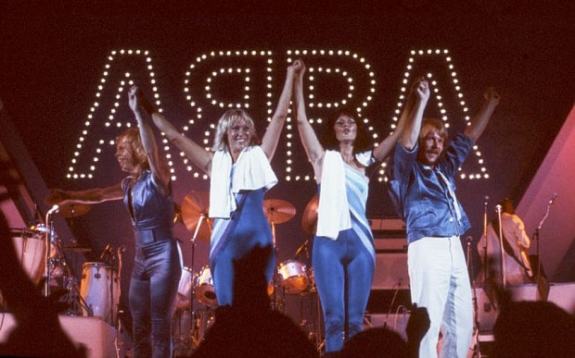
It finally came: November 13th 1979. The concert was everything that she had dreamed of. It wasn’t just Agnetha’s outfit that sparkled: the whole night, inside and outside the Apollo Theatre, was filled with glitter. They started with Voulez Vous (the title track of their latest album, which she’d loved so much she’d almost worn through) and included so many of her favourite songs she felt like she would burst with joy: I Have A Dream, S.O.S., Take A Chance On Me…. Between tracks she and her friends tried hard to catch their breath and remind each other what songs they’d already done so that they could capture every moment to relive later, but then the opening bars of the next song would sweep in and they’d be off, dancing and bawling their hearts out. Summer Nights City, Does Your Mother Know, and then, just when she was starting to feel scared that they’d miss it out for some reason and that The Way That Old Friends Do would be their very last song, that ecstatic piano riff that sent her soaring above the crowd like an angel, so high up in the rafters, having the time of her fucking life, that she then spent the whole of the final number (Waterloo) in floods of tears, her mates trying to console her at the same time as dancing for all they were worth…the last words Benny said from the stage were “We love you, Glasgow!”.
Abba, man. We love you. Unforgettable. They floated home, singing and screaming and bawling all the way.
She read all the reviews she could find in the local papers and added them to her collection. In the new year she was suddenly seventeen, just like in the song. Every time she and her friends met they couldn’t stop talking about the concert. Then, in summer, they heard that Abba had a new album coming out, in November, with a single due in July! She counted down the days again, imagining the lyrics and the songs and the photo on the sleeve. She had to wait to get the single as they were away with her gran in bloody Greenock, where there wasn’t even a record shop, but when she managed to get her hands on ‘The Winner Takes It All’ it broke her heart in the sweetest possible way, it made her suddenly feel like an adult. She loved the sorrowful tone, and the fact that at the most intensely tragic moment of the song the backing singers seemed to be singing (she argued about this with her friends) the refrain ‘BIG ONES, SMALL ONES’ felt like the funniest joke she’d ever been told.
She was ill in bed the day the album (‘Super Trouper’) was released. Bloody mumps. Nae bother, because as soon as school was finished for the day her best friend rushed into town, bought the LP and then got the bus to hers, fizzing with excitement. She ran up the stairs and, giggling and shaking like loons, they put the record on the turntable, sat back on her bed and awaited the worst horror of all.
Supporters of the ‘Lexit’ faction in last June’s EU referendum have proclaimed themselves “satisfied” with Chancellor Philip Hammond’s explanation that Brexit will necessitate a new round of austerity for the public sector.
Jane Blobb, from Sheffield, said she was “not in the least bit surprised” that Britain’s leaving the EU will now serve as a pretext for even more cuts to services essential to the running of society. “It’s just what I expected”, she said. “I mean, Remain voters did warn me that this is exactly what would happen, that they would use it as an excuse, another ‘shock doctrine’ if you will, but I’m not in the least bit bothered that they are indeed doing so, because…er…the EU is a…capitalist club. For…neoliberals”.
Fellow Lexit enthusiast, SWP member John “Johnny” Johnson of Hemel Hempstead, agreed. “It’s a price worth paying”, he said. “We’ll almost certainly see the end of the NHS now, and I helped make that happen. As a lifelong socialist, I’m proud of the decision I made. The EU is a bosses’ club. A neoliberal one.”
Hammond also warned that their calls for wage hikes for teachers, nurses and others may have to mean tax rises for millions and further ‘savage’ cuts to social welfare benefits.
“Well that’s fine,” said Billy Bonehead as he folded and unfolded a three-day-old edition of the Morning Star while waiting for the off-license to open. “I haven’t worked since 2013, and I’ve been sanctioned six times for the pettiest reasons you can imagine. I’ve been staying on a friend’s sofa for the last three months and it’s getting to be a real strain. But if Mr Hammond says that we need to tighten our belts even further, I can respect that. People like him have got a difficult job on their hands managing public finances, and at least it’s not the EU calling the shots this time. They’re neoliberals, you know.”
Hammond, one of the ministers battling for a “soft” UK exit from the EU, defended the 1% pay cap for public sector workers, declaring the Government “must hold our nerve”. He also said that any attempts to address the climate crisis would now have to “take a back seat” to efforts to promote economic growth at any cost, and that any responsibility the UK has to help tackle the global refugee crisis were “not now a priority”. He added that the Government is looking seriously at abolishing corporation tax, bringing in a ‘fasttrack’ fracking compulsory purchase order system, erasing all health and safety legislation from the statute books, tripling VAT and replacing the progressive tax regime with a flat tax, in addition to reintroducing conscription, setting up a network of Victorian-style workhouses, decriminalising child labour and introducing on-the-spot execution of dissidents. This was all necessary because of Brexit, or “whatever you choose to call it”, he added.
“Fair enough,” said another Lexit supporter, Sadiq Eejit of Birmingham. “That’s more or less what I voted for. As long as it doesn’t affect my political principles, I’ll put up with it. God knows what sort of world my kids will live in. It defies thinking about. But as long as we do whatever Mr Hammond and Mrs May think is necessary, we’ll get through this. We’re all British, after all. I’m sure after a few more decades or possibly centuries of entirely necessary austerity and corporate looting, we’ll be back on our feet again, and then there’ll probably be a revolution, or something. Did you know that the EU is run by neoliberals? It said so on The Canary.”
In Thomas Pynchon’s ‘The Crying of Lot 49’ the character Oedipa Maas seems to discover an underground postal network known as W.A.S.T.E. and connected to a shadowy organisation with medieval roots called the Trystero. Or maybe it’s merely a conspiracy to make her believe that there is such a network. This is Pynchon, after all, and it is 1966, on the West Coast, where LSD was beginning to reveal hidden patterns and correspondences beneath the bland surface, “other modes of meaning beyond the obvious…like the matrices of a great digital computer”, another “separate, silent, unsuspected” America. Oedipa suspects she has stumbled upon:
a secret richness and concealed density of dream…a network by which X number of Americans are truly communicating whilst reserving their lies, recitations of routine, arid betrayals of spiritual poverty, for the official government delivery system.
(…)
For here were God knew how many citizens, deliberately choosing not to communicate by US Mail. It was not an act of treason, nor possibly even of defiance. But it was a calculated withdrawal, from the life of the Republic, from its machinery. Whatever else was being denied them out of hate, indifference to the power of their vote, loopholes, simple ignorance, this withdrawal was their own, unpublicized, private.
So far, so libertarian. The novel involves a complex metaphor which can be and has been picked apart in various ways*. Here I want to focus on communication in relation to the private and the State. As the reference to a computer suggests, Neoliberalism has realised Oedipa’s dream, in the form of the internet, also a long-term concern of Pynchon. Is it free or controlled, radical or repressive? Is Tristero the heterotopian deep, dark web, as explored in ‘Bleeding Edge’ (2013), or is it Google, Facebook and Whatsapp? At a certain point it contained the potential to be both, and Pynchon explores those historical moments, unearthing the buried wires that could have gone in all sorts of directions.
While it’s hard to imagine a centrally-managed and state-owned internet, it’s not hard to remember when the postal service was run in such a way. When I was growing up there was a single state-owned postal network in the UK. If you wanted to post a letter or parcel, you went to the post office, and receiving post was a matter of waiting until a postman or woman, employed by the same organisation, turned up in the morning. It wasn’t perfect: sometimes he or she would be late, very occasionally missives wold go missing, there was no internet so you couldn’t ‘track’ what you’d sent, and often – horror of horrors – you had to stand in a queue at the post office itself, but on the whole the system functioned well. I never remember any of my friends or family suggested we scrap the whole thing and replace it with chaos.
With the ‘liberalisation’ of postal services around Europe and some other parts of the world, the sending and receiving of physical objects has, rather than being ‘liberated’, become immensely more inefficient and time-consuming. The fact that certain neoliberals love to boast about ‘disrupting‘ settled industries is exemplified in the amount of hassle involved in identifying which kinds of stamps can go in which kinds of post boxes, staying at home all day in the vain hope that whichever bunch of shysters has been entrusted with your package might deign to turn up at whatever time best suits their employers, calling round two or three mobile phone numbers in the hope that whichever subcontracted individual (working for a subcontracted subunit of a global cartel) has your parcel is still awake and hasn’t flown away to Ibiza for two weeks. By contrast, Oedipa’s system of wandering round the Bay Area all night on the lookout for tramps dumping handfuls of letters into posthorn-marked dustbins starts to look like a far more efficient and reliable system.
Still, onwards and upwards. Far more important than the need of ordinary people to dispatch and obtain goods and gifts is the sacrosanct desire of ‘entrepreneurs‘, those modern-day counterparts of Jay Gould, to profit by acting as entirely unnecessary middlemen (or perhaps that should be highwaymen) in any inter-human transaction. Following on from EU-wide deregulation, both Royal Mail and Poste Italiane are currently being privatised, after years of having been, in accordance with Noam Chomsky’s prognosis, run into the ground. For someone who comes from the UK and now lives in Italy, questa non è una buona notizia.
At a generous estimate, 30% of things that have been dispatched to us in Rome over the last few months of friends and family generously dispatching gifts for our new baby simply haven’t arrived. Others have taken months to turn up. On occasion, tracked packages have apparently arrived at the nearest delivery centre and sat there forlornly for several weeks despite my increasingly bad-tempered exhortations to the people personning the Poste Italiane Facebook page to ask someone to pick them up and bring them to the address written on the cazzo label. At one point I posted them a link to the Italian Wikipedia page about the film ‘Il Postino’, so at least they might understand what the purported function of their organisation was. A volta la ironia si perde nella traduzione.
Last month, the pursuit of a tardy passport delivery occasioned a visit to the local sorting office. Having negotiated the security system (bloke enjoying a ciggy, listens to my garbled explanation and nods me through) I made my way upstairs into a huge room contained what looked like avenues of undelivered parcels. It seemed to be a mausoleum of things that could be delivered, but probably won’t be. Like with gravestones, the names chiseled, printed or handwritten with misplaced optimism on the envelopes marked only a permanent resting place. Excitingly, on the other hand, it appeared that I could wander round and pick things up – I might even happen upon the parcel of baby clothes my sister sent over a month ago! Perhaps I would come across that book of poetry I’d ordered from a US website three months ago, or the TRUCK FUMP! t-shirt my wife had bought as a Christmas present! Sadly, given the enormous piles of pacchi in ritardo mounted up around the warehouse, untroubled by the attentions of the few yellow-tabarded staff standing around in a desultory fashion waiting for lunchtime, it seemed unlikely. It would have been like looking for a needle in a deregulated haystack.
Maybe I should have just asked them to send the parcels via W.A.S.T.E.
*Pynchon later expressed dissatisfaction with the novel: “I seem to have forgotten most of what I thought I’d learned up until then”.
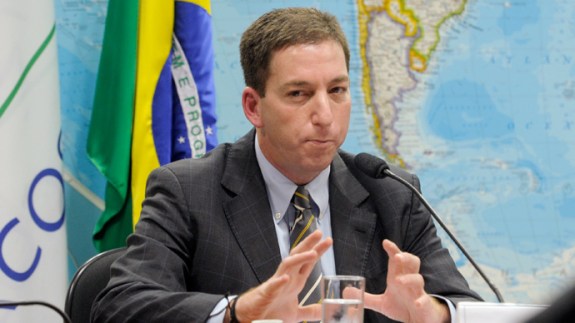
In the documentary ‘Citizenfour‘ (2014) we see the campaigning journalist Glenn Greenwald speak at a senate hearing in Brasília to draw attention to the British authorities’ treatment of his partner, David Miranda, who had been detained for nine hours upon arrival in the UK on jumped-up counterterrorism charges. (The hearing starts at 1h26m.) Having made his home in Brazil, Greenwald made his statement and responded to questions in Portuguese. Although the theme of the hearing was deadly serious, I found it hard to hold back my laughter and difficult to imagine that the assembled journalists were not doing the same. Glenn Greenwald is an extremely brave and principled journalist and the way his partner was treated was outrageous, but his Portuguese was (at least at the time) a bit shit.
Mas quem sou eu para rir? – But who am I to laugh? Well, I lived in Portugal for several years and take an interest in other people’s (particularly English speakers’) command of the language. It’s not entirely a healthy interest, containing elements of snobbery and jealousy, but it is hard not to be competitive, and to try to resolve anxieties about one’s own abilities by means of judging others’ over-harshly. One of the first proper sentences I taught myself to say was ‘My ultimate ambition is to speak better Portuguese than Bobby Robson’, the football manager whose struggles with the language were the source of much mirth and affection:
It became a running joke with friends to take the piss out of British people who spoke Portuguese with no attempt whatsoever to mimic the way local people spoke. Although (adopts very strong English accent) EU NÃO CONSIGO ENCONTRAR BONS EXEMPLOS DISSO ONLINE, anyone who is able to distinguish Portuguese from Spanish will find this clip of the Portuguese writer José Saramago (who exiled himself in Lanzarote and married a Spanish woman) speaking the latter similarly amusing. He simply never made the slightest effort to modify his voice to the sounds of the neighbouring language. I met countless compatriots whose attempts to speak with Portuguese grammar and words but with the sounds of Hemel Hempstead were probably endearing to someone but grated on my ear.
Ridiculing others was one way of addressing my own anxieties about my pronunciation, and thus about my own legitimacy as a Portuguese speaker – of course, my own command of the language was never by any means perfect, despite my very best attempts to delude myself otherwise. When it came to visiting Brazil, I felt a large chip missing from my shoulder, given that it took a conscious and constant effort for me to speak the jollier version of the language rather than the more slavic-sounding European variety. I envied those foreigners who had learned the more gregarious Brazilian language first, accompanied by that physical volubility natural to Brazilians. As it happened, most other gringo tourists I met there spoke portuñol, but when I was hanging out with Brazilians for prolonged periods and my energy (not, like theirs, inexaustible) started to run down I eventually reverted to my most relaxed version, which is strongly luso-accented and, to Brazilian ears, sounds sometimes cute but mostly sort of backward.
The resulting resentment is probably an ingredient in my wanting to find fault with the esforços of someone like Greenwald, who, after all, succeeded where I failed. Of course, it’s only fair to acknowledge that in the hearing he was under immense pressure. Even Manu Chao, interviewed here before a live audience in Goiás, gets visibly and audibly nervous when obliged to address a roomfull of highly attentive native speakers. I’ve never had to do anything similar, and if I did the results would be atrocious. As the New York Times reported, in his interview with the then-Brazilian President, Greenwald performed extremely well, and he has given numerous interviews and reports which demonstrate that he was having a bad day. Perhaps the fact that his partner had been arrested for terrorism put him off his concordâncias nominais and made him keep forgetting to roll his erres appropriately.
Comedy aside, I’m opposed to language shaming per se. It’s particularly unpleasant and unfair (although very prevalent, particularly when it comes to public figures) in the case of foreigners speaking English, a language few truly choose to learn. There should be a camaraderie among foreign speakers of a language. It takes courage to put one’s aspirations and identity on the line in such a way, and being mocked for doing so is often traumatic.
My Portuguese is now officially enferrujado – rusty, at least when speaking. Fortunately Brazilian music is so rich and enjoyable that I am regularly exposed to new and old vocabulary. In the last couple of years in Mexico and Italy I’ve managed to overcome some of my preciousness about Getting It Right when speaking other languages. I’m not from either place, but I get by, in the sense that I can do what I need to do and I don’t get nervous when interacting with strangers. I think that a lot of my prior anxiety came from trying too hard to fit in, to step outside my own skin and discard my own identity. In such a situation it’s inevitable that you will feel like you’re in a No Man’s Land when trying to reach the other bank of the linguistic shore. As you can see from that poorly-assembled sentence, even my own command of my ‘own’ language isn’t always up to scratch. As for Glenn Greenwald, he’s a Pulitzer Prize-winning journalist rather than an academic linguist or a language freak, and he uses his experience and skills in both English and Portuguese to expose injustice and hold power accountable at every turn*. If he were ever to see this website, he’d probably partir-se a rir: piss himself laughing. And if he heard me speaking Portuguese, he’d likely switch to English quicker than you could say “cê é gringo, né?!”.
*This was written before Greenwald started publicly and repeatedly declaring that he is The Only Person In The World Who Is Aware That There Are Bad People In The World Besides Donald Trump, going to the extent of joining forces with Fox Fucking News in order to make this point as widely and stupidly as possible. I actually used to feel a bit guilty about having taken the piss out of his Portuguese; I don’t now. The man’s an asshole.
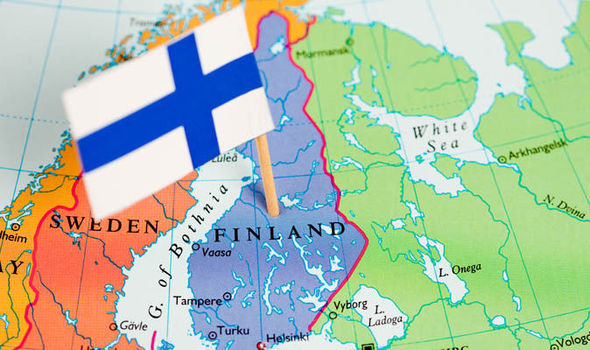
It’s refreshing right now, in the sweltering midday heat of Rome in early July, to remember that there are places on this planet which were once cold. If only we’d all done more to prevent the planet overheating in the first place. I did try, a bit. In early December 2009 I had two trips planned to Nordic Europe* within the course of ten days. My plan was that I would visit my friends in Tampere (in Finland), fly back to London and then, the following day, take another plane to Copenhagen to join the protest at the Climate Conference. As it happened, on the morning after returning from Finland I was too skint, exhausted and hungover to travel to Denmark. At least I avoided any awkward questions about my dependence on unsustainable modes of transport.
Not that I regretted going to Finland: I subsequently went back twice in the space of three years. It was somewhere I felt an immediate affinity with. On my first visit I took immense pleasure in the complicatedness of the language. It was about three degrees and falling quickly in the early December Helsinki midafternoon, as I wandered round in circles both concentric and eccentric and asked passers-by one of the two or three phrases I knew: ‘Missä on… Ekaterinaburgkatu?’ – Where is Ekaterinaburg Street? I had no idea what the answers meant but, having long held the opinion that the best way to discover a new city is to get lost in it, didn’t mind zigzagging around for a couple of hours. Paying careful attention to where people were pointing eventually helped narrow it down when the winter wind became too much to bear.
The people I was staying with in Helsinki were from Russia but had made their home in Finland. Ironically, it was partly through them that I began to get a sense of the unfussy hospitality which characterises Finland, which is, after all, not Brazil: it’s not a culture which goes out of its way to impress or charm visitors. People instead exhibit a quiet, uneffusive generosity. Some of that stoicism must be to do with the climate. In the Kiasma gallery I came across a remarkable artwork consisting of a wood cabin, starkly furnished, complemented by a toy train set which gave off an occasional melancholy wail. Inside the cabin TV screens showed blurred images of snowstormed forests soundtracked by heartbreaking stories of people going missing in month-long blizzards.
Subsequently learning something about history introduced me to the concept of sisu, a kind of hardiness particular to Finnish culture and strongly associated with the staggering sacrifices of the Winter War with Russia. On the subject of suffering, getting deeper into Finnish culture would would mean dealing with the terrifying range of cases central to its famously impenetrable language (essive, inessive, ablative, illative…), which despite my attempts to rationalise them away as sort-of-like-prepositions-but-just-tagged-on-as-suffixes defy normal human understanding.
Heading north on the train I appreciated the silence and space. Outside the main cities Finland often feels barely inhabited. People told me that you can travel for days through the forest and not see a helvetin soul. This sparseness seemed to extend to the consumer economy. I enjoyed the fact that on the train there was a drink you could buy called ‘coffee’, as opposed to the skinny-grande-double-pump-caramel-gingerbread-latte-nonsense on offer in more crowded parts of Europe.
Tampere felt familiar, unsurprisingly so as it’s known as the Manchester of Finland. It has lots of remnants of its industrial past and maintains a similar deadpan sensibility: not so much dry as frozen wit. Among most Finnish people generally I’ve noticed (and admired) a certain earthiness which connects to my own northern roots, particularly when it comes to swearing. I am (courtesy of my friend Steve) the proud possessor of two of the most uproariously graphic insults in any human language, and although posting them here might result in my getting banned from WordPress for life I’m happy to email them to anyone who requests them.
Although it doesn’t reveal anything particularly edifying about my lifestyle at the time, I liked the Finnish relationship with drink. It felt that you could (if you had the money) sit in a bar in your trusty old pullover and three pairs of pyjama trousers and continue drinking until you passed out gracefully onto the sawdust floor to the sound of muttered voices and plaintive blues music. The limited variety of menu options and the narrow range of eating establishments suggested a disinterest in food which I, living in food outlet-saturated London at the time, found refreshing. There was also a carefreeness in the way that people left you alone. Nobody started talking to me just because I was from elsewhere. The society didn’t need my presence, and I appreciated its cool (because uncool) indifference. My memories of my first visit are suffused in a bluey-white blur of very strong alcohol and the weave of extremely thick socks.
Out on the streets I found more signs of that unfussiness and lack of pretension. I was amused by the surreality of Tampere’s musty Lenin Museum and the existence of a strip bar simply called ‘Big Tits’ (I didn’t go inside to find out how big). Finland’s neuroses (about drink, sex, other people) seemed to be on the surface. Maybe that’s what it (famously) has in common with Japan, a place I’ve still never been to but have heard described as having no subconscious. It’s easy to diagnose what’s wrong with Finland: it’s cold most of the year, people drink too much, nobody says please or thank you and everyone commits suicide regularly. As it happens, in ‘The Spirit Level’, published earlier that year, I’d read that in happier countries people kill themselves more. Lots of people doing themselves in is a better indication of social bonhomie than everybody killing everyone else.
I took a trip to my friends’ country home in a tiny village called Auttoinen. Their house was a sprawling place of immense human warmth reinforced by the (exotic by comparison with private rented apartments back home) decent insulation and central heating. The energy-saving ethos extended to the local bar, where words were employed sparingly by the local ‘juntti’ (yokels). You couldn’t call it entertaining but it was, also, exotic. I recognised the mood from any number of films by Aki Kaurismaki, Finland’s leading exponent abroad. This clip succinctly captures the dark, dour wit of many of his works, and if you’re intrigued and have got ten minutes to spare, there’s another short film here (the subtitles are in Spanish, but don’t let that you put you off) (unless you don’t understand Spanish, obviously**).
My second visit took place during the summer solstice in 2011. Between June and August all of Finland heads for the countryside, particularly the lakes, of which there are apparently well over 100,000. If you can avoid the enormous local horseflies known as paarma – not quite as big as your average baby shark, but six times as vicious – it feels like paradise. At a midsummer party in Auttoinen I made friends with increasingly cheerful locals and some expat Africans who told me some hilarious stories about their interactions with more taciturn Finns. A Tanzanian told me about the marked difference between taking a seat on a nearly empty bus back home (sit down next to new friend, shake hands, pass time of day) and doing so in Finland (see other passenger, leave bus, go home, shoot oneself in head). It was difficult for them to adjust to the less convivial culture, and they were working as cleaners or musicians while trying to establish themselves. They seemed frustrated with the lack of opportunities for advancement open to them, but not about to give up on the country having invested so much time and energy into it. They were true Finns now, after all.
The next day on the train to Helsinki I picked up a leaflet aimed at newcomers wanting to learn Finnish. It was written in (excellent) English and was entirely positive in tone, rather than admonishing as would be the case in the rather-more-grudging UK. Back in the Kiasma I bought a book published by Sternberg (in the same series and spirit as the same publisher’s duo of Momus novels ‘The Book of Japans’ and ‘The Book of Scotlands’) which posits alternative future Finlands to replace the inevitably collapsing Welfare State, including a Finland which is repurposed as a nuclear waste storage facility. Another thing it imagines is a road bridge between Helsinki and Tallin, and as it happens I spent my 37th birthday travelling by ferry between Finland and Estonia, where I’m surprised to find that, contrary to everything I’ve ever been told about the Finnish language being totally unique but for a deeply buried lexical connection to Hungarian, Estonian looks and sounds almost identical. There is a short but silly photographic account of my adventures in Tallin here.
If lakes are important to the Finnish summer experience, having access to an island multiplies the fun. A friend of a friend had borrowed half of a small one for the season, and we spent an endless night with his friends from the other side of the island drinking something that tasted like licorice but had a strong aftertaste of something like ayahuasca. You couldn’t really call it a late night because night didn’t arrive, dusk turning straight into dawn. Waking up in the cabin it no longer felt like there was any limit between myself and other objects. Perkele. From downstairs I could smell my friend (who had been in Finland for more than ten years and so had acquired a measure of sisu) frying up some bacon. When I showed my face, which evidently looked like it’d just been through the winter wars, he politely invited me to go and jump in the lake. Having taken his sterling advice and chilled my bones to the marrow, I then went straight onto the small sauna he’d prepared and stayed there til it felt like all the alcohol I’d ever consumed was washed out of my skin, then took another dive into the lake, went back in the sauna, repeated the whole rinse cycle two or three times, and then began replenishing the lost salt and alcohol with a bacon sandwich and a beer.
One my third visit, in June 2012, I was accompanied by my then-girlfriend-now-wife. Being from Italy, she had been reliably informed by older, wiser generations of compatrioti that Finland is freezing cold all year round and that she would almost certainly get eaten by a polar bear. In reality it was 30 degrees. After a few days in Auttoinen introducing her to my friends and soaking up the rays (and the rain), we headed for the Turku archipeleago, where, driving round the labyrinth of tiny islands along tiny twisting roads and on and off, it felt like I was finally unravelling the tangled mess I’d made of my life. In Turku itself we stayed on a large boat in a cabin the size of a small mosquito, and by day walked around the town cooing at all the wonders of the nordic model of social democracy, with its large well-illuminated library reminding us that shopping need not be the be and end-all of a city. We visited the castle, and admired the fact that it wasn’t suffused in marketing overexcitability, that it wasn’t trying too hard to sell itself to us as ‘the authentic Finnish experience of medieval Suomiland’ or whatever nonsense some marketing genius in London would have been inspired to think up.
I’ve never lived in Finland and probably never will. I’m aware that many do and find it frustrating and unwelcoming. Personally, I find its existence a comfort. If, in the thankfully unlikely event I ever found myself existentially alone and listless, I would take a plane to Tampere, don my favourite pullover and at least three pairs of pyjama trousers, and head for a downtown bar to partake in a delicious, revolting glass of some sort of weird licorice drink, and after two or three sips lower myself gently to the sawdust-strewn floor. In the meantime, in summer 2018 to be precise, I will be back there, now-wife and new-baby in tow, for a hopefully paarma and polar bear-free midsummer holiday. Nähdään pian!**
*This used to say Scandanavia but I was swiftly put right, kiitos Richard Millar.
**This now links to a version with subtitles in English, but I thought this was quite a good joke so I’m leaving it as it is, thanks anyway to Sandrita Toledo.
***I told you the language was tricky, it took me about ten minutes to type that phrase.
P.s. Anyone worried that nordic countries are being invaded by legions of hate-filled new arrivals who don’t respect basic values of tolerance and peaceful coexistence will find supportive evidence for such a view in a Facebook group called Foreigners in Finland, where immigrants from Italy, Bulgaria and the UK (the sort of people who are so patriotic they couldn’t stand to live in their ‘own’ countries) spend their time in Finland bitching about other, less privileged, newcomers. I believe the local phrase to describe such people is ‘vitun urpo’ (not that they’ll have bothered to learn the language, but still :-)). This one’s for them






 Infinite Coincidence
