I don’t understand cricket, and that’s become a problem

prv_1497054700

The Bangladeshi guy in the shop under our apartment in Rome is puzzled. He doesn’t understand why I keep pretending that I don’t understand the rules of cricket. My pretence has been going on for months and it’s starting to grate on him. I’ll pop in for another bottle of Bucanero and he’ll joyously proclaim, England are all out and Pakistan are 117 for 2!, to which my only response is, er, so who’s winning?

I’ve explained the social context for my genuine ignorance numerous times to no avail. I think he sees it as something shameful. Maybe it is. I certainly find it a bit embarrassing. As far as he’s concerned, I’m an educated person from the country that invented the sport, so even if I didn’t understand, I surely wouldn’t want to lose face by feigning a lack of knowledge (my evident lack of patriotism is also a source of some bemusement). One issue is that he prefers to speak about cricket in English rather than Italian, and while his command of my language is considerably better than my mastery of his (restricted as it is to a handful of food words that on reflection are probably Hindi anyway), his lack of basic grammar combined with the fact that his cricket vocabulary supercedes mine in any language gets in the way of effective communication.

So I explain again that in the UK only rich people play cricket (‘posh’ is a bugger of a word to explain), that I didn’t go to the kind of school that taught and encouraged an interest in the sport. Cricket isn’t the most popular game in Britain, football is. It’s a political thing. He’s not listening. After all, he spends all day every day around Italians, and he’s not a big fan of Italy. The Italians don’t even play, let alone appreciate, cricket! Whereas in me he has a full-blown, native-born cricket enthusiast to marvel at the game with. He loves talking about cricket with me, even though the only players I can think of are Geoffrey Boycott and Johnny Wilkinson, and I can tell you even that took quite a lot of effort.

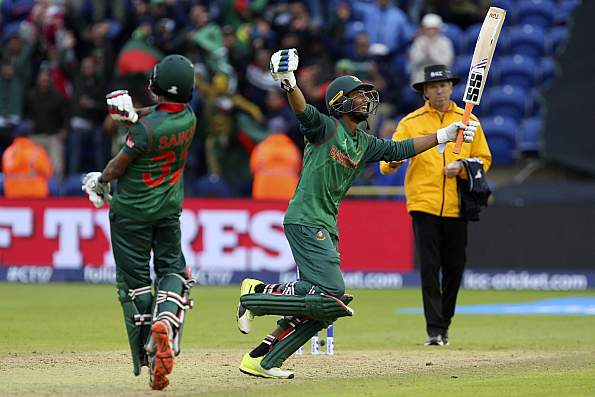
Right now there’s a tournament taking place, which as I write has reached the semi-final stage. Pakistan are beating England (I think) and tomorrow India take on Bangladesh. He’s going to close the shop for half a day to follow the game. I’m genuinely excited to see his excitement – I’ve interviewed so many IELTS candidates from India, Bangladesh, Pakistan and Sri Lanka for whom cricket is the driving force in their lives. But half an hour ago, having endured another failed attempt to explain the contorted relationship between class and sport in British society, I promised to him and to myself that I would go and study the rules. It is, in several senses, absurd that I don’t understand what the numbers mean, how wickets relates to overs and overs to whatever the other one’s called. If there even is another one.

The problem is that I came back up here, cracked open the beer and started writing this. Ever time I think about googling the rules of cricket or opening onto one of the few parts of the Guardian website I’ve never ventured onto before (although shouldn’t I really go for The Telegraph?), I start to feel slightly dozy and more than a little bit chippy. I could not give a flying fuck about cricket. I hope Bangladesh win. I hope they crush England 7,000 runs to love. Christ, imagine what a boost it would give Boris Johnson and Michael ‘fucking’ Gove if the English cricket team were to win the Cricket World whatever-it-is right now. The bloody Daily Mail would probably photoshop a picture of a triumphant-but-dour Theresa May with Will Carling (or whoever) and call her QUEEN OF THE ASHES. So here’s to Shakib Al-Hasan, Mashrafe Mortaza, Tamim Iqbal and even (if it’s not too late) Virat Kohli. Anyone but England. Forza! everyone else.

Ps. According to the Daily Telegraph website my beloved Pakistan have apparently beaten England, I’m off to buy some Pimms :-).

Three people I met in Brazil

Although Brazil is officially my favourite country in the world, I’ve only ever actually spent about three weeks there, which kinda puts me in the same category as that fabled tourist who ‘loves Brazil, but has only seen four square miles of it’. In my defence, I do have a Master’s degree in Brazilian and Portuguese Studies, which she almost certainly doesn’t, but then again, to be scrupulously fair, she does have the unfair advantage of never having existed, so she sort-of wins.

I existed in Brazil in November 2010, but apart from this, and this (and, er, this), I’ve never got round to writing about the country, partly because it’s such a vast, complex and dynamic place that it’s hard to know where to begin. So I’m starting at a fairly random point by writing about three people I happened to meet on my holiday, all of whom just so happen to be men and all of whom taught me something remarkable that has stayed with me. That doesn’t mean that these are the only or most extraordinary people I met, but as they almost say in Portuguese, when it comes to both writing and scratching your arse, the difficult thing is getting started.

The first was a middle-aged German who had set down his roots there and who was therefore, annoyingly for me as a self-appointed expert on Brazil, a self-appointed expert on Brazil who actually lived in Brazil. I got talking to him in a tiny bar in the Pelourinho in Salvador de Bahia, where travellers stroll around to the sound of practising Oludum drummers and small children plaintively asking for milk powder which they can then sell to buy crack. In the course of our short conversation the German kept reaching out to touch my arm, just above the elbow, almost falling off his barstool to do so. It suddenly struck me that I’d witnessed Brazilians performing the same gesture thousands of times, to the point where, without realising it, I’d started doing it myself. The fact that he made the gesture in a way which drew attention to it, whereas when I did it I did so without even noticing, gave me some hope that I was managing to fit in (it is my lifelong ambition, along with fathering a child with a perfectly round head (tick!) and winning the Nobel Prize for Blogging, to be mistaken, just once, for a Brazilian). I found it curious that it had taken another foreigner to teach me something so basic. Touch is very important in Braxil – it can be intrusive or seductive, and sometimes both. It’s part of that willingness to connect which I personally find extremely endearing. I once read about a study of how many times friends make physical contact over a coffee in different countries. The statistics were remarkable: for Brazilians it was roughly 100, in the UK about ten, and in Japan (a culture ostensibly very different from Brazil, although I tend to think there are certain unacknowleged points of comparison) zero.

On a beach somewhere to the north of Salvador I met a guy who lived in a house made of plastic bottles. I don’t remember how we got got talking; maybe he asked me for the empty bottle I was holding so he could start to build an extension. He made a living-of-sorts selling handicraft to tourists, of whom on that undeveloped stretch of coast there were few, although there were a couple of fledgling resorts. (Also, in an encouraging sign of an upturn in economic activity, two suspected drug dealers had been shot dead the previous week just next to where the bus stopped on the coast road (or so I was told by the taxi driver who kindly advised me not to walk up to the village but to allow him to let me pay him to transport me instead)). My new friend had taken full advantage of the subsidies that various PT governments had provided. He was extremely enthusiastic about the changes that Lula had wrought in his life and vehemently insisted on taking me to see where he lived. Sadly, partly because it was getting dark and partly due to a near-death experience I’d had in Salvador a few days previously (nothing to do with the German), I declined, although we did drink a bottle of cachaça and I did pay him over the odds for a couple of carancas and various other nicknacks, so we both stumbled away materially replenished and very, very drunk.

In Rio, within a couple of hours of my arrival in the country, overlooking Lapa with a jetlag-relieving drink in my hand, I fell into conversation with the young guy manning the hostel bar. He must have noticed my Portuguese accent, one which to Brazilians sounds distinctly yokelish. Moving on from the icebreaking topic of how unwittingly hilarious Portuguese people are, we got onto the related subject of colonialism. It turned out that one of my favourite Brazilian films (‘Central do Brasil‘) had been the subject of a thesis he had written. It’s the story of an older woman (whose surname is Guimarães, which is significant, as that’s the city where Portugal was ‘born’) living in Rio, where she witnesses the accidental death of the mother of a young boy from the Northeast. She takes it upon herself to rescue the young boy from the dangers of the streets and takes him to track down his father up north. It’s therefore mostly a roadtrip and (my new best friend explained) an exploration of the tangled relationship between the spinsterish colonial power and the orphaned colony, and thus about identity, my very favourite subject. It was a joyous hour or so of intense conversation, a meeting of rapidly addled minds as the Brahma bottles clinked and the maconha fumes fumed. I didn’t know at that point that my nbf was to lose his job the very next day, sacked by the expat owner for spending too much time, er, fraternising with the clientele. At the time, gazing over the undulating contours of what was clearly the friendliest and most picturesque city on earth, I found myself thinking, this is going to be the greatest holiday of my life. It wasn’t, for various reasons, but still.

“Austerity is over” – so what exactly did Daniel Blake die for?

the-conservative-partys-n-009
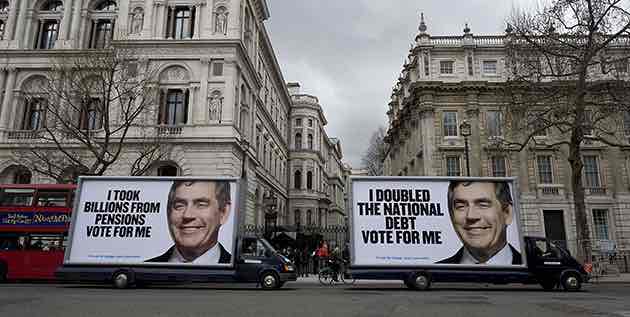
Conservative Party billboards, 2010

Theresa May has said that austerity is finished. What she didn’t mention – but knows full well – is that it was never necessary in the first place.

After the financial crisis of 2007-8, which was largely caused by deregulation of the financial system on the ideological basis that the market always knows best, the Conservative press started telling a story which wasn’t true. The narrative they came up with was that Labour overspending had caused the country to become mired in unsustainable levels of public debt. The solution was to do what they had always wanted: shrink the British state, selling off the profitable parts of the NHS and reducing the post-war Welfare State to a bare mimimum. It was a clear case of what Naomi Klein had described the previous year as the shock doctrine: the taking advantage of a crisis in order to implement an extreme ideological agenda which in normal circumstances would be roundly rejected. As the neoliberal guru Milton Friedman had said:

Only a crisis – actual or perceived – produces real change. When that crisis occurs, the actions that are taken depend on the ideas that are lying around. That, I believe, is our basic function: to develop alternatives to existing policies, to keep them alive and available until the politically impossible becomes the politically inevitable.

On the basis of the story the Conservatives won two general elections. As a direct result of the ‘savage’ cuts (to quote Nick Clegg’s ill-advised boasts) millions turned to food banks and thousands were killed by benefit sanctions and the removal of their disability benefits. The NHS is now on its last legs, both of which are due to be ripped off at any moment and sold off to speculators, as detailed in the Naylor Review.

How were they able to get away with it? Because the Labour Party never challenged the narrative. They never pointed out with sufficient conviction that it wasn’t government overspending that had caused the crisis. Whenever they tried to articulate their own version of events it was done so unconvincingly that the right-wing press shouted them down and they were cowed.

Now the Labour Party is telling its own story and it happens to be one that coincides with the truth. Austerity was a con, a scam, and a coup and the damage that’s been done to public services and to social cohesion was a result of maliciousness and greed. Now, at long last, after seven bitter and frustrating years, it is finally arguing its case with such conviction that the whole tenor of debates about society and the economy have changed more or less overnight.

The Tories think they can get away with pretending to drop austerity and moving swiftly on. They must not be allowed to do so. The cuts agenda has been the entire basis of government policy at every moment of the last seven years and they knew that it was based on lies. They knew that the economic crisis was nothing to do with government overspending. The scale of the scam that has been pulled is so great that it would take a truth and reconciliation commission to get at the truth. It was not based on a regrettable misunderstanding that has now been resolved. It was based on an immense campaign of lies so that public wealth in all its different forms, both tangible and intangible but all absolutely invaluable, could be monetised, financialised and ultimately stolen. It hasn’t been a marginal aspect of the last two governments’ political programmes but their absolute centrepiece. We have been ruled by a regime of austerity and in order to move on from it in any meaningful way HEADS MUST FUCKING ROLL starting with that of Theresa May, who just a few weeks ago thought she could crush all political opposition for good. If austerity is dead, then so are the careers of all those who, with staggering dishonesty and massive corruption, supported it in the first place. They have ruined millions of lives – and, given that without austerity, Brexit would be inconceivable, set in chain a series of consequences which may end up destroying peace between European nations – on the basis of an absolute lie.

What Donald Trump doesn’t understand about regulation

The above video is simply called ‘Indian traffic’, and was presumably filmed by a tourist from a hotel window. It has ten million views. In it we see rickshaws, trucks, cars, buses, cyclists, motorbikes with up to three passengers, and pedestrians all engaged in a seemingly hazardous but actually innocuous dance. Pretty much everyone at some point looks as though they’re about to crash into another vehicle. It looks like total chaos but, despite the apparent absence of traffic signals, actually runs smoothly. The traffic seems to self-regulate; the experience of watching it has a nicely zen-like quality.

To be fair, it is only two minutes. I’m sure whichever city it is has its fair share of traffic accidents*. I mentioned the video the other day in a conversation with a Dutch friend visiting Rome. At a slightly similar intersection we were traversing he said that he tells his kids (of whom he has several) always to look into the eyes of drivers when crossing the road, to create that human connection. I responded that I often do the same.

Perhaps its by studying how traffic interacts in less ‘developed’ countries that has led some European cities to experiment with reducing the amount of traffic signage. Doing so seems to force people to engage with one another in a less abstracted and therefore more humane manner. It was actually a Dutch engineerHans Monderman, who developed the notion of  “naked streets”. He argued that “traffic was safest when road users were “self-policing” and streets were cleared of controlling clutter. His innovations, now adopted in some 400 towns across Europe, have led to dramatic falls in accidents”. So said Simon Jenkins when writing about the topic in The Guardian. Jenkins, who has long played the role of the newspaper’s neoliberal provocateur, went on to argue (with typical sarcasm) that:

The white line down the middle of the road is a metaphor of the age. It is the guiding hand of a benign government. Its abolition hints at a loss of control, a lurch from authority towards personal responsibility, even towards anarchy. Mankind cannot tolerate too much naked tarmac. No sensible person could want more confusion and uncertainty in life. We need the firm paintbrush of a caring minister.

I don’t know if I’d read Jenkins’ article at the time, but the conversation with my Dutch friend also seemed to lead naturally on to talk of other forms of regulation. If traffic (a word we also use for trade in all its forms) is best left unregulated, what about other forms of social and economic interaction? Does the video of traffic in India support a laissez-faire view of the world?

Well, while of course there are no actual car crashes in the youtube clip, there are less visible hazards. The fact that traffic accidents have an immediate and visible impact makes them dissimilar from other consequences of other forms of human interaction which may be less remote in time and space and thus much more difficult to disentangle, or even (often consciously) hidden, but not for that any less real or damaging. However, it does make it much more difficult to apportion responsibility. An obvious example is Climate Change (how many of those Indian drivers are now proud possessors of “carbon neutral” Volkswagens?), but its by no means the only one. To quote the sociologist Pierre Bourdieu:

It can be shown, for example, that problems seen in the suburban estates of the cities stem from a neoliberal housing policy, implemented in the 1970s…This social separation was brought about by a political measure. [But] who would link a riot in a suburb of Lyon to a political decision of 1970?

If we’re looking for the causes of the current rise of far-right parties around the world, ignoring the financial crisis of 2008 would be like tying to enjoy a pleasant hotel breakfast while a woolly mammoth careens around the room shitting all over the toast racks and trays of scrambled eggs. It’s unlikely that Donald Trump has seen ‘Inside Job‘, the excellent documentary which explains succinctly how financial deregulation, and particularly its impact on the housing market, created the catastrophe which has in turn, like a multiple pile-up seen in horrifying slow-motion, done possibly fatal damage to our economies, societies and democratic institutions. As it happens, the President* apparently prefers to watch movies like ‘The Fast and the Furious’ by fast-forwarding to the…car crash scenes.

His total and blissful ignorance of the subject, combined with his evident wish to destroy all traces of the Obama years, is leading him to try to overturn the regulatory legislation put in place in 2010 (too little and too late, but still) to try to clear up the worst of the mess and stop such a disaster taking place again. Now, Trump is unaware that such things as consequences exist, partly because, for him, they don’t and never have. For me, that raises a very interesting question. There’s been lots of speculation as to whether or not the Mango Mussolini knows how to read, or use a computer, or speak English, but I’m starting to wonder, given that he’s been chauffeur-driven since the moment he was born: does Donald Trump even know how to drive? I mean, I don’t, but then a) I live in Rome, so even if I learnt I’d be dead within ten minutes and b) I’m not the one pretending to be US President.

*Apparently it’s New Delhi, where there are loads of accidents. Still, on with the argument.

People Theresa May is now in hock to

Things haven’t gone to plan for the PM. According to the script drawn up by her rather hapless advisors back in April, by this point any remaining dissidents were supposed to have been lying at the bottom of the Irish Sea and she herself was due to be anointed with the Royal Wax of the Imperial Beehive. Instead she’s spending 24 hours a day on the phone to crackpot Ulsterfolk with accents so densely-packed you could use them to blow up a betting shop, while any courtiers who haven’t had their heads chopped off were last heard of making up some absolute f*cking nonsense about goat’s skin. Plus Mr Murdoch’s not at all happy, and he’s not the only one. Here’s a short list of the people she has to appease if she wants to stay in power beyond Tuesday teatime.

1. Rupert Murdoch

When Murdoch summoned May immediately after the election announcement in order to hand her her instructions, he told her in a very loud, grouchy, sort-how-you’d-imagine-an-aging-pedo-to-sound voice GET MICHAEL BLOODY GOVE IN THE BLOODY CABINET. Luckily for her she then screwed up the election, so at this point she can appoint whoever she wants. She might as well make Gerry Adams Minister for Sport or dig up Jimmy Savile and make him Secretary of State for Media and Children’s Hospitals. Whatever she does, she no longer risks attracting opprobrium, simply because there is simply no more opprobrium to be had in the entire country. In fact, given the levels of opprobrium that the British Government is currently attracting from Europe and around the world, global supplies look like running out. Luckily they can be enhanced by another mineral resource, which appears to be infinite: ridicule.

2. Paul Dacre

Imagine the scene. Theresa May, with all her liberal values arraigned alongside her, visits the Labour stronghold of Kensington. She insists that the UK must remain in Single Market and that there must be some measure of free movement, especially for those EU citizens who are settled in the UK. Well, she says that to herself, silently, while nervously sipping her coffee from King Edward VIII chinztware cups. Then the Editor of the Daily Mail turns up, calls her a stupid f*cking c*nt eight times in the first two minutes and orders her to go back to Number 10 and wait for a f*cking email with her f*cking instructions in it.

3. The Saudis

She can’t afford to offend the Saudis, even if they will keep sending their suicide bombers to blow up London. That’s why she continues to (literally) sit on a report which details their plans to do basically just that. In the meantime, as Amber Rudd argues, selling death equipment into the Middle East remains the best guarantee of prosperity and stability for the post-Brexit UK*. Or, you know, not. At least on the next trade mission they’ll be able to send over the DUP as official representatives, and they’re sure to have a huge amount in common with their hosts.

4. The DUP

A lot of commentary on the DUP over the last few days has focussed on how bigoted they are, which is actually in a way unfortunate, because they’re actually more corrupt than they are bigoted. Although, to be fair, they’re also more bigoted than they are corrupt. And vice versa. The initial negotiations over the not-allowed-to-call-it-a-coalition-because-of-the-stupid-bloody-peace-process took precisely as long as it took to say we’llgiveyouwhateveryouwant. There was then a slight delay as everything Arlene Foster said had to be translated from pure hatespeak into something resembling BBC Tory English so that Laura Kuenssberg could try to sell the whole thing to the British public while besmirching, defaming and maligning the opposition, as her contract clearly specifies. They’ve now got as far as establishing that the DUP wants to ban Catholics from public and private office (and transport), hold Orange Marches on Downing Street every Thursday and burn down St. Paul’s Cathedral, which is obviously all fine and dandy. Did you know that Jeremy Corbyn once went to a pub in Belfast where members of Sinn Fein had played darts just three weeks earlier? Oh, you did.

5. The Brexit negotiating teams

“The…what?! Oh, f*ck, I’d forgotten all about that…”

*It’s even more lucrative when you factor in the, er, training that goes into these ‘defence contracts’.

Who did you vote for?

35064937971_be5652079f_k-1160x773Originally published on katoikos.eu.

We asked a number of voters to explain the political earthquake that shook the UK last week and to say what the opposition parties should do next.

In an election, unlike in an opinion piece, everybody (well, almost everybody) gets a say. For that reason, instead of using this space to express my own opinions about the last week’s remarkable general election, I draw on the expertise of several thoughtful friends. With them being my friends, there isn’t a single Tory voter amongst them (nor do I tend to hang out with many supporters of the DUP), but there is a healthy range of views, some useful insights into the circumstances that produced the unexpected outcome and a few very good ideas as to how progressive political forces might try to move things on.

Who did you vote for?

Joanne: Labour. We had a great Labour MP till 2010 and have been suffering under a conservative one ever since. I couldn’t bring myself to vote Liberal Democrats tactically.
Ralph: I didn’t because I can’t. But I would have voted for Labour because the Tory manifesto was borderline fascist.
Akin: I voted Labour as I can’t imagine voting Conservative. Labour doesn’t seem to be about the preservation of privilege unlike the Tories.
Richard: I voted Lib Dem with no great enthusiasm; I might well have abstained. It’s the first time I’ve not voted Labour at a GE. Jeremy Corbyn fought an excellent campaign and obviously enthused people. In spite of this I found it hard to contemplate voting for the party while he is leader. Mainly, that’s because I thought the leadership team in the front bench was 1) incompetent and 2) has an over-simplistic view of the world, in which ‘US imperialism’ is the principal obstacle to all progressive change.
Laura: Lib Dem. Voting for them was, in my seat, the only realistic prospect of ousting the Tory MP. Also, they are the only party remotely reflecting my position on Brexit, the most urgent issue facing the UK, although perhaps not on every other issue. Also, the candidate was Vince Cable, who I think is a useful presence in any Parliament.
John: Labour. The Conservatives had already proven themselves to be unusually cruel and glib about the conditions of Britain’s poorest and most marginalised and had to be stopped. Meanwhile Labour had a left-wing, progressive, class-conscious leader and a manifesto that dared to make the case for public spending rather than more cuts.
Rich: I voted for Labour because as a socialist it is the first (and hopefully not last) chance I have had to vote for a mainstream socialist party.
Andrew: I voted Labour, because Labour had an actual mildly Keynesian anti-austerity programme, and to support Corbyn.
Dan: I voted Liberal Democrats because traditionally in my constituency Labour can’t win. At the time I still hoped for a kind of progressive alliance as the best hope to beat the Tories. As it happened Labour and Lib Dem were quite close, so I’ll just get on the Jeremy bandwagon next time.

Are you surprised at the result?

Joanne: Yes, I am. The rise in Labour votes was reflected in many areas, although not enough to oust the Conservatives. Plus, it was a real change to the local elections where Labour came 3rd behind the Lib Dems.
Ralph: No.
Akin: I’m not too surprised because I didn’t expect Corbyn to win.
Richard: A little bit. Although I think in retrospect it’s perfectly explicable.
Laura: Yes. Huge understatement. I’d done my reading, and I have a friend who’s a polling statistician in Ipsos Mori who carefully explained to me before the election why the YouGov poll predicting a hung Parliament was utterly misleading! Neither of us have ever been so happy to be proved wrong.

Trump’s election had taught us never to hope again. Then the exit poll came…

John: Yes. Unless you seriously believed Labour were going to win, this was a much better result than we could have hoped for. The polls pointed to a defeat, the media coverage was relentlessly hostile; Trump’s election had taught us never to hope again; then the exit poll came…
Rich: Are you shitting me?! If I’d bet on a Tory-DUP coalition at the bookies, I’d now have so much money that I’d never have to pay tax again!
Andrew: I am surprised at the result. Part of me hoped there would be a hung parliament. But hope can be cruel, so I reduced my expectation to Labour getting 35 % of the vote, better than Miliband. None of the other canvassers on Thursday had a real clue what would happen. The only hopeful thing we knew was that the turnout was up in various parts of the country, including London, and there were queues to vote in university towns.
Dan: I am surprised by how volatile the electorate is. Given how reactionary the last two years have been, I thought this trend would continue. I guess the same detachment from establishment norms that fuelled Trump and Brexit can also be exploited by the left.

How do you explain the result?

Joanne: May’s obvious lack of humanity becoming more apparent by the day. The defensiveness of her campaign, the initial focus on Brexit, then random placing of other policies that were then fudged. Turtle and the Hare. Labour seemed to plug a way with a variety of policies and actually talked on the same level to the public. May always has a plinth between her and the public.
Ralph: The polls had forecast growth for Labour shortly before the election with 6% margin of error and the result was within that range.
Akin: I had a feeling that sufficient numbers of people were put off the more they got to really know Theresa May and keener on Corbyn the more they were exposed to him.
Richard: Austerity fatigue is an obvious factor. There are signs that it’s popping up all over the place, witness the way police cuts have become an issue in the wake of the London atrocities. More importantly, it’s obvious that younger people – 18-24s above all – have been won over by the student finance commitments. In addition, the Tories managed to alienate their core constituency – older folk – in the most incompetent and ill-thought out campaign I’ve ever witnessed. May was an utter disaster.
Laura: All I can do here is repeat what I’ve read: the youth vote is coming out for Corbyn after a great campaign. A terrible, arrogant campaign by May offering nothing to the young and alienating even her core support among the elderly. Rejection of hard Brexit. Rejection of a second independence referendum in Scotland.

Young people have been told that free education, affordable housing, stable jobs and public services – all a given for their parents’ generation – are now ‘unrealistic’. Corbyn gave them hope.

John: May’s abject campaign partially explains why this wasn’t the mauling some of us feared, but the big story is the gains that Labour made. People warmed to Corbyn as they saw more of him. Including many who couldn’t even articulate what he stood for – a theme that kept cropping was how he ‘wasn’t a typical politician’. In these discontented times, looking like a political insider puts voters off, that clearly mattered, especially among young people, who have effectively been told that free education, affordable housing, stable jobs and public services – all a given for their parents’ generation – are now ‘unrealistic’. Corbyn gave them hope.
Rich: JC’s campaign was, in the end, fabulous and offered a great deal to the country. TM’s was the complete opposite, offering nought but even more cuts. I think the Tories – with the help of their lunatic coalition mates – scraped in by the skin of their teeth because there are still a lot of people in the UK who would crawl naked over a mile of dogshit-smeared broken glass if it meant they had to pay less tax.
Andrew: Labour’s manifesto and Corbyn’s media persona, which was clearly to an extent his personality. The Corbyn surge started around the time the manifesto was leaked. An allotment – and a pot of jam for the One Show – helped dispel accusations of sympathising with terrorism.  Social media – yes!  Since Murdoch and Dacre weren’t in control of social media, that really helped. Momentum operation – My Nearest Marginal– and the masses of canvassers in some key seats.  Lib Dems thinking Labour represented a pro-Remain protest vote.  Ukippers thinking Labour had accepted Brexit.  A unity fudge around ‘defence’, which meant sitting on it.  The terrorist attacks weirdly didn’t help May. Instead, she was blamed for cuts in policing.
Dan: I can’t explain Scotland ditching SNP in favour of Tories except that there must be more strident anti-independence sentiment than I thought. People say the young vote helped Corbyn. Even her supporters recognise May had a bad campaign. If everyone gets behind Corbyn for the next, probably imminent, election than he could go all the way.

What do you think the opposition parties should do now?

Joanne: Join up with other parties to firm a progressive alliance. At least Labour has to capitalise on their success by finding out what made people vote for them.
Ralph: Keep Tories at bay in order to approach EU negotiations with much needed humility.
Akin: Expose Tory lies and hypocrisy, I suppose.

I’d like to see a clearer position on Europe from Labour. Until now Corbyn has kind of hedged his bets in order not to alienate too much the northern working class base. A positive Norway-option vision might attract centrists.

Richard: Well, I think that Corbyn needs to make Labour electable by drawing on the party’s knowledge and experience. I’d obviously like to see some moderates in the government – Chukka, Yvette etc. After all the party still lost by 50 odd seats and the Tories will get better if they replace May as is likely. Above all I’d like to see a clearer position on Europe from Labour. Until now Corbyn has kind of hedged his bets in order not to alienate too much the northern working class base. A positive Norway-option vision including free movement in Europe might attract centrists. But it’s hard to see him going in that direction.
Laura: Corbyn is riding high and needs to seize his chance to sock it to the Tories at every opportunity. I know his natural style is not flashy or combative but I think he’s going to need to add a little of that to please his new wave of supporters. He needs to continue to engage the young. The different elements of the left need to learn to form pragmatic alliances, even if they’re uneasy ones at times. The right has always been much better at that. Above all, push for the softest Brexit possible, and a second referendum on the final deal. It’s not only the right thing to do but will probably be electorally popular.
John: Two threats loom – a hard Brexit and further cuts. With UKIP hopefully obliterated, these two measures will now be owned completely by a shambolic Conservative Party that, although riven with divisions and uncertain of its mandate, still represents the political establishment. The opposition, including a bigger, more confident Labour, must repeat ad nauseum that if the Conservatives continue to push for either, it will be in the service of the rich and powerful, not Britain, not the working class. If they can block these measures, they will deprive this Conservative administration of any purpose, and maybe we will see the back of it sooner rather than later.
Andrew: In the short term: present an alternative budget; prepare for a possible election in the autumn; never stop campaigning and fighting against cuts and racism; target key Tory constituencies; build the independence current in the Scottish Labour Party. In the longer term: campaign for PR.
Dan: Work together! Articulate a joint vision of post-Austerity Nordic Keynsian soft-Brexit humane UK that doesn’t act like a school kid around EU officials and doesn’t reject refugees or use EU citizens as bargaining chips. Let the disgrace end!
How did Katie Hopkin’s editor end up in charge of the TLS?

Two publications I don’t have much time for are The Sun and the Times Literary Supplement. Although I’m not from Liverpool or Manchester, as a lifelong Guardian reader I only ever flick through Rupert Murdoch’s flagship hatesheet over the occasional greasy spoon fry-up. As for the TLS, I already have enough on my hands with the London Review of Book’s biweekly 10,000 word articles on witchcraft in 13th century Romania. Also, the notion of an intellectual publication owned by the selfsame climate-lying Mugabe-resembling Trump surrogate Bond villain fails to convince.

Another thing that The Sun and the TLS have in common is leading personnel. The latter is now edited and ‘published’ by a character called Stig Abell. Strange name, dodgy geezer. Abell has been increasingly prominent of late. He’s very active on Twitter, where he entertains and enlightens his followers with remarks about subjects from Brexit to dog biscuits, and has also written the odd article for the New York Times. He also has a show on LBC, along with (ffs) Nigel Farage and (thank god) James O’Brien.

Until recently one of his colleagues at LBC was the far-right hate preacher Katie Hopkins. It wasn’t the first time they’ve worked together. As managing editor of The Sun he (presumably proudly) published a column by her in which she described refugees as cockroaches and called for them to be murdered en masse. He also oversaw The Sun’s coverage of the Hillsborough enquiry – or rather, didn’t, as the newspaper greeted its conclusions (that it has printed outright lies about the victims and survivors) by ignoring them altogether and refusing to apologise.

This q-and-a shows him to be articulate and seemingly thoughtful, but when it comes to answering specific questions his evasiveness and his cheerful ignorance of the things he’s employed to know about occasionally borders on the Trumpian. He finds Latin American literature ‘interesting’, likes wearing t-shirts and hasn’t read any Elena Ferrante, thinks post-modern writers are ‘just showing off’, is a fan of crime fiction (but can’t spell the name of his favourite writer) and feels that The Sun has nothing to apologise for. The impression of him as well-spoken but intellectually vapid is confirmed by other interviews in which it seems that he just wants to get on with his stellar career without too many awkward questions being asked, or as he puts it ‘without being disturbed by life’.

If his job is to promote the TLS, he doesn’t do a good job of it. In any case, the riddle of his meteoric rise remains, especially in the light of his failure to address the topic of, let alone apologise for, his direct role in the publication of some of the most hateful material seen in any British newspaper in living memory. How did someone of his limited intellectual means get to helm such an illustrious and (apparently) serious publication? One highly plausible solution is that he’s simply one of Murdoch’s favourite surrogate sons. Making him editor of the TLS is a bit like installing Eric Trump as head of NASA. Or it’s as if, I don’t know, Ivana Trump were to be put in charge of US climate policy. Oh wait, she has.

LEAKED! List of types of Brexit currently under consideration

Image stolen from vice.com.

The Scottish Conservative Leader Ruth Davidson has opened up a new front in the debate over what sort of Brexit the Government should work towards. It should not, she argues, be either soft or hard but open, which presumably means ‘not closed’. As it happens, this website has been handed by an anonymous source a list of other alternative Brexits currently under consideration by the new Government. The list specifies that “given that, as modern Conservative thinking prescribes, the Market is All-Knowing and All-Powerful, it may work best if each individual consumer of the Brexit range choose whichever variety best suit their pocket and lifestyle aspirations, although as many components will be sourced overseas there is no cast-iron guarantee that a particular Brexit will be available”. Several of the items on the list have been marked ‘need to think of potential sponsor’, ‘no answer as of 11/06’ and ‘marketing dept will call back’.

  • Inside-out Brexit
  • Upside-down Brexit
  • Back-to-front Brexit
  • Side-to-side Brexit
  • Do-the-hustle Brexit
  • Hokey Cokey Brexit
  • The Mashed Potato Brexit
  • Tizer Brexit
  • Irn Bru Brexit
  • Dandelion and Burdock Brexit
  • Buckfast Brexit
  • Jasmine Green Tea Brexit
  • Rooibos Brexit
  • Camomile Brexit
  • Perrier Brexit
  • Tesco’s Value Still Water Brexit
  • No Brexit
  • London Review of Books Bookshop First Tuesday of Every Month Wine, Nibbles and Discounts For Subscribers Brexit
  • Wetherspoon’s Thursday Night Is Curry Night Brexit
  • #WhatOddsPaddy Sunday Specials Paddy Power Brexit
  • Burger King Limited Edition Angus Whopper Brexit
  • Ryanair £10 Priority Boarding Brexit
  • El Cubano Salsa Nite All Welcome Discounts for Beginners Brexit
  • Cairo Jax SHEFFIELD’S TOP NIGHT OUT WEDNESDAYS LADIES DRINK FOR FREE Brexit
  • George at Asda Brexit
  • Cash for Gold Sutton High Street Top Prices Paid for Jewellery Brexit
  • Domino’s Pizza 2 for £20 Collection Only Brexit
  • Crystal Palace 20% Off All Season Tickets Before The End Of June Brexit
  • Norwegian Wood Brexit
  • The White Album Brexit
  • Everybody’s Got Something To Hide Except For Me And My Monkey Brexit
  • The End Brexit

Although the printed list ends there, four items appear to have been amended in handwritten form:

  • Death to all Taigs! Brexit
  • Jesus was an Ulsterman Brexit
  • “That bloody woman says they’ll only do it provided we make it illegal to be gay, catholic or female and under 40. I say we should go for it” Brexit
  • “Don’t write down the last thing I said on the bloody list of Brexits you bloody idiot!” Brexit

Lesson plan: “You are a refugee”

Wherever you happen to teach there’s a chance that your class includes refugees and/or racists. The point of this lesson is to increase the level of understanding of the plight of the former and encourage the latter to be less so. Linguistically the lesson lends itself to concentrated practice of various conditional forms. In terms of vocabulary, the ‘text’ is quite lexically dense so I wouldn’t attempt it with anything lower than B2. As you will see, discovery and development of relevant vocabulary is written into the task as it will be repeated various times.

To set it up you will need access to a pc, ideally with an IWB/projector; it also requires that students make use of their own phones.

Procedure

1. As students to write down the name of anyone they know who had to leave their home for a prolonged period, maybe because of war, political instability or a climate catastrophe. If they don’t know anyone personally ask them to think of any famous people who fall into that category, or even any films they’ve seen which depict such a situation. Ss discuss in small groups.

2. Share ideas, obviously sensitively if anyone in the class has had such an experience. In the process elicit, board and clarify key vocabulary: refugee, seek refuge, protection, asylum; escape, flee, run away.

3. Tell ss they’re going to imagine that they’re refugees. Ask them to guess which country they might be escaping from. Tell them they’re going to face a series of dilemmas and see if they’re successful at reaching safety. Point out that the scenario is based on the real experiences of millions of people.

4. Show them this page from  the BBC website and recapitulate the scenario. Point out the vocabulary that has already come up and highlight the words ‘traffickers’ and ‘deportation’. Clarify any misunderstandings.

5. Tell then you’re first going to do the task all together. Decide on the balance of the class if ‘you’ are male or female.

6. Show them the first dilemma: Egypt or Turkey. In pairs, students discuss for about two minutes, then vote as a whole class.

7. Take them through the dilemmas, clarifying vocabulary as you go. If you like, you could highlight the 1st/2nd conditional forms on the board.

8. See how ‘you’ end up. Gather reflections on the success/failure of their route.

9. In the same pairs, ss repeat the task on their phones. Monitor in case they need help with language.

10. After a couple of attempts, gather reflections on their experiences.

Homework: Students repeat their task at home and write the story of what happened in the past simple, first person, adding details as they go to make it more real.

Extension task: in a following lesson you could the videos on the same page to practise talking about unreal scenarios using 3rd and mixed conditionals, eg. ‘If they had paid the smuggler…’, ‘If he hadn’t decided to go to Libya’, etc.

هذا هو!