Mandeville & Wenlock

Hey Mandeville!

Hey Wenlock!

So how’s things?

Ah, you know…I’m really not sure this being an Olympic mascot thing was such a good idea

Whyever not! We’ve been all over the media! you can’t buy that sort of publicity!

Yeah, but what kind of publicity?

What do you mean?

Well, someone on twitter said that we looked like ‘tortured tellitubbies’ and that i had a morrisons sign on my head. it’s…hurtful

What’s twitter?

It’s a social networking site where people post messages of less than 140 characters. On the internet.

Hmm. And tellitubbies?

Children’s tv characters

And Morrison’s?

Like tesco’s but smaller, and formerly only in the north

Doesn’t sound so bad to me! Better than costcutters! I don’t see what your problem is. At least we got to meet Sebastian Coe at that launch thing! Wasn’t that fun?! What was it you called him again?

I said he was a ‘tory twat’

yeah, he found that hilarious didn’t he.

certainly did, and he loved it when i said i hoped he’d soon go the same way as his fascist fuhrer saramanch

Hmm yes i suppose things did get a bit overexcited. i do think it wasn’t very polite of you to ask daley thompson if his piss was still sponsored by lucozade. and punching zola budd in the face was a little bit out of order, especially after she appeared to stop breathing. And it was very cruel of you to point out that david beckham’s new tattoo means ‘my wife’s a vapid slag’ in hindi…never mind, look at this letter! next tuesday we get to meet the prime minister!

really?(looks) (sounds disappointed) the *deputy* prime minister

what’s the difference?

Aah…I can’t really tell to be honest. Shame we didn’t get to meet Gordon Brown really, I feel we might have had more in common, what with him only having one eye and everything. It’s just…I don’t know…i just expected more from life. I mean, listen to this: ‘Their job is to make the 2012 games child friendly, and to sell more toys than could ever fit at the foot, let alone the peak, of Mount Olympus itself.’

What’s mount olympus?

It’s a mountain in ancient greece

Where is it now then

(exasperated) What?

Did they move it?

(realises) ohh…yeah. it’s in sweden now. i just…can’t help feeling that there’s something more i, we, should be doing. I don’t even particularly like children. and I fucking hate sport, to be absolutely honest

you’re starting to worry me slightly

Look, I had an idea. Nobody likes us…

Nooo…

It’s true. Someone called anethmalves in minas gerais said she thought we were in ‘tremendo mau gosto’. and she’s got 40 followers! we’re fucked.

what does that mean?

it means we’re in really bad trouble

no the trimindi gau mosto bit

I don’t know, but i don’t think it’s good. but listen, i think i can see a way out. Nobody seems to like us, they’re outraged that we’re getting such an easy ride from the media but they’re stuck with us for the next few years. and there are two of us…

what are you suggesting?

i think we should wait a couple of years until the time is ripe, gather our forces, then instigate a wave of street terror, burn down parliament, take advantage of the confusion to make a grab for power, close down all democratic institutions and declare an end to the sketch!

*brilliant* idea!

Jack Straw, Zizek and UK Border Force

mail
An article in last week’s Guardian made it difficult for me to take Jack Straw’s liberal posturing on Question Time at face value. A ten-year-old girl tried to hang herself after being locked up for the second time and faced with deportation to Nigeria. She had recently been dragged screaming from her home by a team of UK Border authority officials. The ten-year-old’s attempted suicide was also an echo of an incident in 2005, when an Angolan man said goodbye to his son and then hung himself in the stairwell of a detention centre, in order that his son be able to stay in the country as an unaccompanied minor.

Perhaps when both families were being dragged kicking and screaming from their homes they were being filmed for UK Border Force. This is a Sky One programme, now in its second season, which is presumably made with the full participation and encouragement of the Home Office. It showcases the Government’s policy of sending out teams to hunt down and and round up ‘illegals’ and highlights the ‘tragic stories and challenges’ that they (the immigration officials, not the immigrants) face every day. Raids have recently been staged on a market in East London, dragging off immigrants whose only hope of survival is to work illegally given that the Government not only forbids them from working legally, but is also actively reducing even their most basic means of survival. Presumably in this way New Labour ministers hope to quench the thirst for brutal violence as a solution to the ‘problem’ of ‘illegal immigration’ which is, of course, a mainstay of Jack Straw’s favourite newspaper (see above).

Perhaps the Daily Mail is missing the boat somewhat when it comes to their bitter opposition to further British involvement in and cooperation with the European Union. Slavoj Žižek recounts the case of the Tunisian fishermen who face up to fifteen years of imprisonment for rescuing forty-four immigrants off the coast of Lampedusa. Other fishermen who have beaten off boatloads of people with sticks and left them to drown suffered no punishment. Zizek then quotes what Robert Brasillach, a ‘moderate anti-semite’, wrote in 1938:

‘We grant ourselves permission to applaud Charlie Chaplin, a half Jew, at the movies; to admire Proust, a half Jew; to applaud Yehudi Menuhin, a Jew; and the voice of Hitler is carried over radio waves named after the Jew Hertz . We don’t want to kill anyone, we don’t want to organise any pogroms. But we also think that the best way to hinder the always unpredictable actions of instinctual anti-semitism is to organise a reasonable anti-semitism. ‘

I can only presume that this is what Jack Straw et al are up to with their quasi-fascist hounding of immigrants. They certainly don’t want to organise any pogroms, but they seem to think that TV programmes which present pogroms as entertainment might serve as a means of pacifying violent racists, somehow making them less inclined to get off their sofas and round up ‘illegals’ themselves. Attempts to use similar means to combat racism and fascism in the 1930s met with limited success.

A few lines on Rio and the Olympics

Sérgio Buarque de Holanda wrote in Raízes do Brasil that south of the equator, there is no such thing as sin. When one thinks of Rio de Janeiro, it is this unboundedness that comes to mind: the spontaneous coming together of bodies, whether in pleasure or in pain, a visceral sensuality and brutality, everything in glorious excess: sex, violence, heat and rhythm; excitement and danger; glamourous wealth and spectacular poverty. Whereas the international Rio of the 1950s was a suave tropical paradise, a playground for the rich, today’s updated image of Rio also acknowledges and, up to a point, celebrates the danger in the form of the stylised violence of Cidade de Deus, and the vicarious, pornographic horrors of baile funk.

Less popular outside Brazil but exponentially more popular inside the country was the film Tropa da elite (eleven million people had reportedly see the film even before it was officially released), which shows the city up somewhat in a much more brutal and far less picturesque manner than Cidade de Deus, making it resemble a tropical Baghdad or Baltimore. The film shows and, according to some, exalts in the violence unleashed by a special police force (the notorious BOPE) in the attempt to clean up the favelas in preparation for the visit of the Pope in 1997.

More upheaval was to come ten years later with the hosting of the Panamerican games, with the then governor of Rio reportedly embarking on a campaign to ‘retake the favelas‘. The games brought new stadiums and a great deal of investment to some of the wealthier parts of the city, but, in the words of a community activist in one of the favelas, delivered ‘nada para os moradores‘ – nothing for the people who actually live in the poorer parts of the city.

Now Rio is to host not just the World Cup in 2016, but also play a major part in the hosting of the Olympic Games two years later. No surprises then at the reaction to the shooting down of a helicopter in one of the favelas late last week. This attack took place despite, or possibly because of the fact that ‘has spent the past year expelling drug gangs and vigilantes from four slums and setting up “pacification” projects by which the slums are permanently occupied by police.’ in response to the attack, the authorities have renewed their promise/threat to clean up the favelas before the VIPs arrive. Comments on Brazilian websites have suggested that the BOPE will have their work cut out over the next seven years.

Megaevents such as the World Cup and the Olympics are now widely understood to involve a very high degree of often very brutal social control. The city must be made safe, negotiable and above all mediatic. Undesirable and unpredictable elements must be airbrushed out of the picture in the bid to produce wholesome and marketable images. But the effects of this process are more than merely cosmetic. The ritual process of evictions, displacements and general corruption that accompanies these events is widely documented elsewhere on this site.

Mega-events transform the city into spectacle, and the airbrushing that gets rid of the evidence – but never the reality – of poverty and inequality is an act of great violence. The brutal forced removals of shanty-town dwellers in South Africa – another society with breathtaking inequalities, largely organised along racial lines – give the lie to the idea that the games in either South Africa or Brazil will be a meaningful celebration of multicultural diversity, one huge party to which everyone is invited.

Rio is a city in which, to paraphrase Andy Merrifield, people would rather stay and be poor than go and live somewhere else. Not that the people of the favelas want to be poor: they would like to have accessible and affordable health and sanitation facilities, proper public transport, investment in education. The same things that the poor would benefit from in any other city, in fact. But the neoliberal city is not about providing these things. It is about getting rid of the poor and appropriating urban space in order to develop an exclusive, private infrastructure: world-class facilities for world-class people.

Sporting megaevents (along with international expos, cities of culture and so on) have a particular role to play in neoliberal urban development. They are an increasingly powerful tool with which cities are remade according to an agenda of transforming the urban environment from a place of spontaneity, unpredictability and the encounter with difference into a much more controlled, homogenous, sanitised space, a theme park and a site of privileged consumption which benefits, primarily, a tiny elite of property developers and large corporate interests (and, one might add, their political servants). Throughout the world the places that poor people are permitted to live are, in a series of orchestrated seismic shocks, shifted away from the centre of the city (and, we might mention, the beach). In the process, that spontaneity, that unboundedness, that constitutes the identity of a city like Rio is destroyed, replaced with a calculable, controlled and entirely dead environment of luxury apartments, shopping malls, private entertainment complexes, and, of course, the ubiquitous empty stadiums, places built by the people who can no longer afford to live in the city, and who could never in their wildest dreams afford to go and see a game. The World Cup and the Olympics, wherever they take place, are not about three weeks of media spectacle. They are about violently taking control of and remaking the city in the interests of the global elite.

A few thoughts on art, sport and containerisation

Tate
What is the meaning of the enormous empty shipping container sitting in the Turbine hall of the Tate Modern? For Ian Jack, it is a journey into artistic nothingness; the experience of visiting it is an empty one. Another answer is suggested by Allan Sekula’s film The Lottery of the Sea, which opens with shots of shipping containers, shots immmedietly familiar to middle-class British people from the second series of the Wire, which, like Sekula’s film, deals with the effects of cargo containerisation. This process, beginning at the dawn of the neoliberal era in around 1975. has led to the moving of docks away from city centres with a huge loss of jobs, followed by attempts to redevelop waterfronts into exclusive residential and leisure zones. Part of the film focuses on the effects of this process in Barcelona, not just in the area around the former port but in the historical centre. He shows demonstrations from 2001 which attempted to prevent the process of gentrification of the area called Raval. The protests were not successful ;the area where they took place is now a gentrified zone which has as its centrepiece the gleaming sandstone and glass of Barcelona’s Museum of Modern Art.

The role of modern art galleries in the attempts to regenerate a poor area has been well documented, and is widely held to have been successful in cities such as Bilbao and Barcelona itself. British cities like Manchester, Bristol, Glasgow and Sheffield have all set off down the same path, not to mention the south bank of the Thames in London. Tourists both national and international flock to these iconic buildings in much the same way as they visit palaces, cathedrals: to admire the building itself and to marvel at whatever they find inside. The experience of the exhibition itself is often largely irrelevant; the building itself is a container, one might say, the meaning of what is on display either mystifying or immediately forgotten.

Regeneration through art is one of a set of very similar urban development strategies. Expositions are another. The Millennium Dome was an attempt to regenerate the Greenwich peninsula. Expo 98 in Portugal redeveloped a huge area of the West of the city. Developments such as these aim in essence to take an area of the city, away from the centre, which is widely considered to be underused and to leverage it into profitable real estate by building things which people with money are believed to want. The roll-out of a kit of oceanariums, museums of science and technology, spectacular apartment blocks, upmarket shopping centres etc etc has made large parts of a number of cities into identikit dead zones, rarely visited even by tourists or by the local people.

The Millennium Dome itself was widely regarded as a disaster in the making. It cost £700 million and it was clear from the start that nobody involved in the project had the slightest idea what to put inside it once it was finally finished. According to reports from the very few people who ventured inside, it hosted a mixture of mawkish, trite, bombastic and meaningless corporate-sponsored ‘experiences’ which illustrated perfectly the mixture of cynicism and vapidity of those involved.

In Sekula’s film a very similar event takes place: the Forum 2004 in Barcelona, centring on the perennial expo themes of Scientific Knowledge and Cultural Diversity. He interviews local people protesting against the loss of their homes as a result of the redevelopment of the site, and subsequently films the event for which their homes were sacrificed; it was, like the Millennium Dome, a total failure. Images of the site show a landscape strikingly similar to other former Expo sites in Lisbon, Seville and Valencia: a sterilized, dead zone, a non-place devoid of energy and interaction, ‘useless as a conduit of psychic energy’, in the words of Frederic Jameson.

But can these events be classified as failures? A useful and important analogy is that of sport, another focus and means of urban generation following much the same model. Portugal invested hugely in the Euro football championships, which were widely held to be a success. They were not, of course, a success for the Portuguese football team. But to what extent does that matter? New stadiums were built, the advertisers were happy; for a sporting megaevent these are more important measures of success. After all, if a football team such as Arsenal redevelops land into a stadium, and the football club and the developers all make a huge amount of money, and luxury apartments are built next to the stadium, and the companies who develop those apartments also make humungous amounts of money, what possible relevance could the result of the football match itself on any given Saturday or Sunday have? The stadium itself is merely the container; the medium is the message. Whatever goes on inside the stadium is of very little or no importance.

In the film, the developers of the Forum 2004 site themselves confirm this logic. The forum may have been a complete failure, but what matters is that the value of the space on which it took place has been leveraged exponentially, and so the developers themselves stand to make a killing. The Millennium Dome was sold for basically nothing and is now an entertainment venue surrounded by ‘luxury’ flats. No prizes for guessing where Cristiano Ronaldo has his apartment in Lisbon. As for the MACBA development, it has increased real estate prices in the area, bringing in people who have spending power and getting rid of those can no longer afford to live in the centre of the city. The MACBA itself is a container; the success, failure or indeed the meaning of whatever is inside is of little relevance in the grander scheme of things. One might say the same of the success or failure of any work of art in the neoliberal age; the debate over the success or failure of Anthony Gormley’s One and Other has ignored the reality that, for Rupert Murdoch, it has functioned as a very effective advertisement for his Sky Arts channel.

Which brings us back to the empty container in the Turbine Hall, the latest in the Unilever series of installations. Whatever meanings an educated elite may be able to find inside it, that particular one is very clearly signalled and communicated to all who visit. Public art in the neoliberalism era functions not so much as a Trojan horse, but rather like the joke about the man who smuggles bicycles. The container is empty; the medium itself is the message.

“Let’s cross our fingers and hope he forgets not to turn up in Nazi uniform”

Whatever happens on Thursday (and, perhaps more importantly, on Friday, on Saturday etc etc), Nick ‘well-directed fists and boots’ Griffin will come out of this whole sorry affair smelling of roses rather than shit and with a much higher national and international profile than before. To put it simply, he is absolutely not going to describe himself as a racist or nazi on national television. And according to the Guardian’s diary this week (can’t find the link unfortunately), the Labour Party is absolutely determined to avoid referring to him in this way in any case in case it makes them look, erm, anti-racist. Instead Jack Straw (that name pretty much says it all) is planning to attack individual BNP policies as unworkable and contradictory. Of course to do so is to absolutely miss the point. The BNP’s policies are, as Griffin himself has repeatedly and openly admitted, both a red herring and a smokescreen. The entire aim and meaning of the BNP is racist violence; there is nothing more to be said about them. I will certainly be there protesting on Thursday, but since we are dealing here with how these events are portrayed in the media, I fear that the protests will allow the BNP to present itself as an unfairly maligned and beseiged minority, given that, as I said earlier, when they are accused of being nazis their strategy is simply to laugh it off, thereby sidestepping and defusing the issue.

Mandelson’s lies about Royal Mail

Peter Mandelson, friend of the filthy rich and aspiring Tory minister, is reported to be ‘beyond anger’ with the unions for ‘obstructing’ his ‘modernisation’ plans for Royal Mail. An obvious question here is about his notion of ‘modernity’; in the midst of the crisis earlier this year Mandelson himself was proposing the creation of a People’s Bank, constructed around the national network of post offices. Such an idea appeared at that moment to be much more ‘modern’ than continued slavishly adherence to an ideology which had led to social chaos, political repression, war, vastly increased inequality and a near total collapse of the economy. It was of course quickly forgotten in favour of continuing with the same policies of handing essential national institutions over to a gang of speculators, gamblers and crooks, thereby destroying the kinds of secure jobs that are fundamental to a functioning economy and laying wastage to public services.

It seems clear to me that promises have been made to the private sector with regard to the Royal Mail, promises that the Government is determined to keep at any cost. It all puts me in mind of Blair’s secret promise to Bush about the war in Iraq. Let’s be clear: we are dealing with a bunch of liars. Nothing that the Government says with regard to the present or future of Royal Mail can be trusted in the slightest, as this excellent LRB article makes clear.

A prediction: in just under a year’s time we will see this utter scumbag sitting on the stage at the next Conservative Party conference. The fact that the Labour Party is determined to spend its last few months in power on a hell-bent mission to destroy jobs and services as a favour to the private sector says it all. I would sooner vote for the Monster Raving Loony Party than this bunch of cynical f******* *****.

After the decimation of trade union power over the last thirty years, a lot of people simply don’t seem to have any understanding of why people in public services go on strike. Comments abound such as, it’s all very well to go on strike as long as it doesn’t harm the public, or, I don’t see why i have to suffer, I’m not responsible for the policies of the Government. I believe that the government is the government of all of us; we as citizens have an ethical duty to accept or to fight against the decisions that our Government takes. The most powerful tool the postal workers have in their fight to defend jobs and services (for them and for all of us) is the right to withdraw their labour, and I for one support them wholeheartedly, even though it may well mean that I suffer personally in the short term.

I live in a village, apparently

Surprised this week to get a leaftlet through the door which informs me that I live somewhere called ‘Stratford Village’, which somewhat disappoints me as I had prided myself on living in a capital city, with all the excitements and dangers that that implies. But no, a villager I am, which is puzzling, as I’m barely acquainted with any of my fellow villagers and I am only able to get to work with the aid of a vast metropolitan transport network. This seems to be another desperate attempt to ‘brand’ or graft some identity onto a particularly nondescript part of London; the idea of an urban ‘village’ is an estate agent’s ploy, nothing more. Any remnants of community that do exist in this area will be entirely wiped out by the monstruous monolith of a shopping centre that (the council) likes to pretend has got something to do with the Olympics (it hasn’t, except for the fact that it’s part of the same garguntuan land grab) and which will fundamentally transform the geography of London in ways that the council clearly have not considered and about which they clearly do not care as long as it fulfils their quota of 5,000 more crappy retail jobs before 2012. The other Elephant & Castle-style shopping centre that we are all funnelled through every morning and evening, built over the of the old market, has not exactly done wonders for the social fabric of the area. ‘World-class’ sporting and shopping facilities come at a cost: they are going to make things, worse, not better for the people who actually live here. Developers, on the other hand, stand to make a fortune, especially if they can manage to conjure up some purported sense of local identity, currently absent. It’s not that we have nothing in common: we share the status of London’s unhealthiest borough (must be worth a gold medal or two). If Stratford is a ‘village’ I’m a (fried) chicken (I’m not).

The McNulty Defence

I was intrigued to learn recently that the former Department of Trade and Industry is now known as the Department of Business, Enterprise & *Regulatory Reform*, which rather indicates that the Government’s new found regulatory zeal – in the sense of being for, rather than against regulation – is only skin deep and doesn’t reflect their longer-term ideological objectives and commitments. Also, the Department formerly known as Employment is now the Department of Employment & *Welfare Reform*, which rather indicates that Mr Purnell & Co are serious about their resoundingly popular scheme to bring back the workhouse, revive chain gangs, force the sick to work in non-existent jobs, reduce the current £8 a day to £1.15 to be paid in the form of a voucher for one Gregg’s the Baker pasty, etc etc etc.

At the same time, this week’s Private Eye reports that the Government has recently boasted of increasing the time that ‘jobseekers’ are expected to spend travelling to potential jobs from 60 to 90 minutes each way; despite this, the Minister for the Department of Workfare and Eventually Abolishing the Dole (to give it its proper name) claims for a second home in Hammersmith, considerably closer to his job than his constituency home in Hayes, only 45 minutes away from parliament. I would suggest that anyone to whom the job centre forcibly offers a job which would involve any more than 45 minutes’ journey to work should invoke the ‘McNulty Defence’ and tell them where to stick their job.

Our own little mini-Pearl Harbour?!

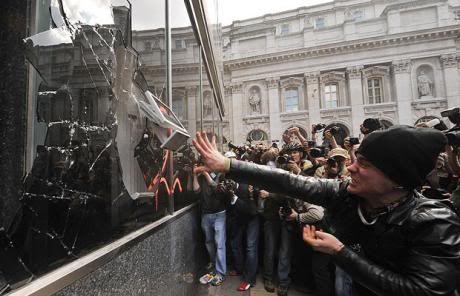
I remain very suspicious about the fact that the RBS, which is right next to the Bank of England, was left completely unguarded at the height of the G20 demonstration. The attack on it has already been used as an excuse to attack social centres around London and arrest a number of people, as this sickening report attests.

I spent a couple of hours yesterday arguing about this with a banker in Barclays and although he conceded that the demonstrators had a point, and that the police may have been a little rough, the main focus of his argument was that the protestors were there to smash things up and had to be stopped. This coincides exactly with the story that the police and the media have been telling, and the only evidence he had for it was the attack on the bank.

I am not a conspiracy theorist, but I am of the firm opinion that the attack on the RBS was essentially orchestrated by the police in order to provide the media with images of violent destruction of property. Just look at this photo: *dozens* of photographers, and *no* police. At the time, as anyone who was there knows, the police were *everywhere*. And, as this one shows, the RBS – the country’s most hated bank, and a blindingly obvious target – is *right next to the Bank of England*. In this video we can hear the news presenters trying very hard to convincingly explain to themselves and the viewers why it is that the police are standing back and doing nothing while the bank is trashed.

And according to someone who actually witnessed the attack:

‘There were a load of police further down from RBS who could have EASILY stopped the damage being done. Which for the record was done solely by about 10 people. The rest being a weird circle of cameras, waiting for the next kick. One guy started lighting the blinds on fire. I have footage also of a guy in a suit, maybe a bank worker, or police not in uniform, filming it, smiling, and laughing with another cop up above from the opposite building. They watched on amongst many other policemen with cameras as a fire was attempted to be lit. A photographer blew the small flames out before it got out of hand. Some protesters then went inside. Only after a while did the police then go into the building, and take a load more pictures of us all for their snatching operation later on in the day.’

Also, and I may be going slightly bonkers here, look at this clip, and watch the guys provoking the police from about 15 seconds in, two in black and one in white. They seem to be acting, acting in fact with a certain amount of impunity. The guy with the metal bar is by far the most violent of the protestors, and his identically dressed friend seems to be trying to egg the crowd on to more acts of bravado. The guy in white was on the front of several of yesterday’s newspapers, sneering in the faces of the police, covered in what appeared to me to be fake blood. Imagine that scene without those three guys, and then watch this. Ring any bells? I suggest that those three protestors are in fact police provocateurs.

I predict that given this kind of policing, and the ease of creating and distributing footage which exposes the lies of the police authorities with regard to who did what to whom, it is only a matter of a couple of years before the British Government follows the examples of China and Pakistan and clamps down on access to youtube!

Children’s Story: The Moth Inside My Head

It was my great-uncle, a zoologist, who invented the phrase ‘Make a beeline for somewhere’. Before him, people just used to say that they they were going to ‘go’ somewhere, but he changed all that.

That’s not true, of course. It’s nonsense, all made up. I have to go shortly, but before I do I’m going to tell you something that is true. When I was about ten years old, a moth flew into my ear. It stayed there for about two hours, and although now my recollection of events is patchy to say the least, it must looking back have been a stressful couple of hours, especially for the moth. Whatever it found inside my head it didn’t like; it screamed and screamed until eventually, thanks to the careful and patient administrations of the hospital staff, after I myself had screamed and stamped my feet enough for my parents to recognise that yes, it was not a figment of my imagination, but an actual winged insect flying around inside my head, eventually, as I say, the doctors and nurses were with the aid of a syringe able to extract the somewhat bedraggled, chastened but still intact insect from it’s temporary home, inside my head, dead.

(I asked my father if we could have a funeral for the moth, but he said ‘No’.)