More on China and Japan


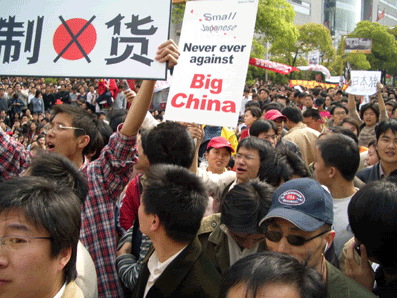
I recently got hold of a copy of ‘The Rape of Nanking’ by Iris Chang, which I think has brought me closer to an understanding of the mindset of young Chinese people.

Although I’ve read quite a bit on what the Nazis did, the massacres in Rwanda and in Cambodia and also what took place here during the Cultural Revolution, and am I guess like a lot of people desensitized to accounts of horrific violence, I could not finish the book. The things that she recounts are beyond and beneath my comprehension of what human beings can do to each other. It actually had me in tears at several points, and I can’t say that I would ‘recommend’ reading the book to anyone. Without wanting to sound too trite, perhaps it’s no accident that after years of researching what took place the author took her own life.

As I say I’ve been confronted with terrible violence in books and films throughout my own life, and I couldn’t deal with written descriptions of what took place. Imagine, then, how young Chinese schoolchildren feel, confronted again and again with not just words but also images and film footage depicting the most inconceivable tortures and acts of barbarity.

Of course, they generally do not know what happened in their own country’s recent past, and those who do are encouraged not to reflect on what their leaders have done or are up to. The only political feeling they are permitted is hatred of the Japanese. And young people like to get angry, as it says here, in one of the most incisive commentaries I’ve come across in years:

Chairman Mao knew it: it enabled him to launch the Cultural Revolution. As part of their post-adolescent struggle for identity, young students yearn for freedom. If they are not allowed to express their opinions, they have to finesse it, and pretend – somehow – that they identify whole-heartedly with the nation, and that such an identification has been arrived at with their consent and with a complete understanding of right and wrong. In a country where one is not permitted to express dissent, the only way to maintain one’s integrity is to pretend that one’s patriotism is freely chosen, and based on truth. And so, our patriot-rebels do not want to hear about the various apologies made by Japan over the years, because they have invested so much in the belief that their anger is rational and based on Japan’s refusal to apologize. (from Running Dog)

Maybe in the future the contradiction will become more apparent to them, and they will begin to see this incredibly cruel and bloody episode of their country’s history in the wider context of other murderous periods in China’s past, and realise that absolute power leads to absolute horror. For the moment, the attitude someone talked about on an English teachers’ message board is probably the best that can be hoped for:

I asked my Teaching Assistant what she thought about this issue the other night. She answered (rather predictably) that she hated what Japan DID. When I asked her if she would try and be friends with a Japanese person if they came here to teach, she said yes. By the end of the conversation, we’d established that she hated what the Japanese did, but that it happened a few generations ago, and that an individual Japanese person could be quite nice. Rather reasonable, really.

The Da Shan Dynasty Part 4: Die Wende


Obviously it’s a mistake to see the post-war pre-1989 Eastern European countries as one huge homogenous monolith governed by Moscow, but each of the Eastern Bloc states did either collapse or rapidly wither away during the historically brief period from 1989 onwards. The events in each country had certain basic things in common.

1. The economies were in tatters. Call it soviet-style communism, state capitalism or whatever you like, but by the late 1980s it had ruined the economic life of the countries.

2. The Communist Party leadership was ideologically bankrupt. They could no longer claim to be marching towards freedom, equality and prosperity for all. The 40 years of spying on each other and political repression was enough proof for the citizens that they were not really marching in any direction at all.

3. People could see and hear for themselves, on foreign TV stations and on radio drifting in from abroad, that things in neither the west nor their own countries were as the leaders told them they were. Furthermore, they could keep up to date with events in Russia and in their comrade nations, and know that changes were taking place and that their own leaders were starting to panic.

4. In most countries, there was an organised opposition. It may have been in prison or in exile, but it existed and it was clear that its ambition was to take power away from the Party.

5. In a lot of countries, the organised oppostion was led by a very clear figurehead. Probably ten years before, neither the leader of Solidarity Lech Walesa nor the intellectual dissident Vaclav Havel would have imagined that they would one day become President. But as events moved on it must have become clear that the people flooding into the streets and squares saw them as leaders. Hence it is very easy to look back now and see them as Presidents-in-Waiting.

6. According to one account I once heard (repeated here), the KGB had a decisive influence on events. They had allegedly decided to oversee the removal from power of the first generation of Eastern Bloc leaders, and settled on street demonstrations as a means of achieving this. Things subsequently got out of hand – I’d imagine that Vladimir Putin was not well pleased.

Then there was the domino effect, and the most significant factor here must have been the USSR itself. Change in Russia, as we all know, was not led from below but from above. Mikhail Gorbachev was, like De Klerk in apartheid South Africa, an insider who wanted to essentially preserve the system, but realised that it would have to change if it was to survive:

The Party, which I had joined, itself badly needed to be reformed and reoriented toward democracy. And through this, the country could begin to gain some freedom. That came later, but it all started with the desire to do something and show initiative. That was what led many good people to join the Komsomol (Communist Youth League) and the Party.

At a certain point, though, the momentum for fundamental change had built up to such an extent that ‘die Wende’ was reached. There was no turning back.

So when in August 1991 some Communist Party hardliners briefly kidnapped Gorbachev in an abortive coup attempt, the world saw them for what they really were: desperate old men whose time had passed. Not only were they no longer at the wheel of the ship of state – they had been thrown overboard.

Incidentally, the fact that the ex-head of the KGB is firmly entrenched as leader of the Great Bear tells us a lot, I think, about the difference between overthrowing a totalitarian state through popular uprising, and waiting on the leadership to quietly reform it and their own positions, powers and privileges out of existence.

Tags: china politics, china, tiananmen square massacre, da shan

  • The Da Shan Dynasty part 3: Stasiland

    June 17, 2005, 07:58

    It always used to be really good fun in left-wing circles to sit around speculating about who, come the revolution, should be among the first to be put up against the wall and shot. The people I talked about yesterday would appear at first glance to make ideal candidates, but I think it’s generally better to go straight for the top guys, even if their power is only symbolic. The Bolsheviks knew it was essential to get their hands on the Romanovs in order to make their revolution complete, and I’m sure dictators and despots all over the world are haunted by the fate of Ceucescu in Romania – they did actually put him up against the wall and shoot him, and his wife, and furthermore they showed it on TV, which must have come as a bit of a shock to Gil-Scot Heron.

    Other former Eastern Bloc leaders weren’t quite so unfortunate. East German President Erich Honecker was released from prison with cancer in 1992, and subsequently died in Chile two years later. Erich Mielke, the head of the Stasi, the hated GDR secret service, was also released from prison on the grounds of ill-health, and still lives quietly in Berlin.

    The Stasi was allegedly even more fearsome than the KGB. In Stasiland – Stories From Behind the Berlin Wall, the Australian writer Anna Funder has this to say:

    The Stasi was the internal army by which the government kept control. Its job was to know everything about everyone, using any means it chose. It knew who your visitors were, it knew whom you telephoned, and it knew if your wife slept around. It was a bureaucracy metastasised through East German society: overt or covert, there was someone reporting to the Stasi on their fellows and friends in every school, every factory, every apartment block, every pub. Obsessed with detail, the Stasi entirely failed to predict the end of Communism, and with it the end of the country. Between 1989 and 1990 it was turned inside out: Stalinist spy unit one day, museum the next. In its forty years, ‘the Firm’ generated the equivalent of all records in German history since the middle ages. Laid out upright and end to end, the files the Stasi kept on their countrymen and women would form a line 180 kilometres long.

    No surprise then, that when the regime’s days were up in 1989, it was the Stasi offices that were targeted by the demonstrators all over the country, beginning in Leipzig, the second biggest city:

    In early October, Leipzig was at a flashpoint. Petrol-station attendants were refusing to refill police vehicles; the children of servicemen were being barred from crèches. Those who worked in the centre of town near the Nikolaikirche were sent home early. Hospitals called for more blood. People made their wills and said things they wanted their children to remember, before going out to demonstrations. There were rumours of tanks and helicopters and water cannon coming, but then so were the postcards from friends who had already reached the west. The people went on to the streets.

    Honecker ordered that the ‘counter-revolutionaries’ in Leipzig were to be ‘nipped in the bud’. ‘Nothing’, he said, ‘can hinder the progress of socialism.’ On 8 October Mielke began to activate the plans for ‘Day X’, sending out orders to the local Stasi branches to open their envelopes (containing the lists of the people in their area to be arrested). But things were already too far gone. Instead of incarcerating the people, the Stasi, hiding in their buildings, locked themselves up. In the regional offices they had 60,000 pistols, more than 30,000 machine guns, hand grenades, sharpshooter’s rifles, anti-tank guns, and tear gas. Fears of lynching ran high. Leipzig police were shown photographs of a Chinese policeman immolated by the mob in Tiananmen Square and told, ‘It’s you or them.’ But they were also ordered not to shoot or use violence unless it was used against them.

    On 7 October 1989 the GDR celebrated its forty years of existence with lavish parades in Berlin. There was a sea of red flags, a torchlight procession, and tanks. The old men on the podium wore light-grey suits studded with medals. Mikhail Gorbachev stood next to Honecker, but he looked uncomfortable among the much older Germans. He had come to tell them it was over, to convince the leadership to adopt his reformist policies. He had spoken openly about the danger of not ‘responding to reality’. He pointedly told the Politbüro that ‘life punishes those who come too late’. Honecker and Mielke ignored him, just as they ignored the crowds when they chanted, ‘Gorby, help us! Gorby, help us!’

    In Leipzig the extraordinary courage of the people didn’t waver, and it didn’t break out into anything else. On 9 October 70,000 protestors went out in the dark, in big coats and carrying candles. They stood outside the local Stasi headquarters with their demands. ‘Reveal the Stasi informers!’ ‘We are not Rowdies – We are the people!’ and the constant, constant call of ‘No Violence!’ From that night on the demonstrations grew, footage of them was smuggled to the west and Leipzig came to be known as ‘the City of Heroes’.

    There were now protests outside Stasi offices all over the country. But even in the smallest towns, the Stasi men in them continued their meticulous work, faithfully sending back to Berlin reports of the demands of the crowds outside: ‘Stasi to the factories’ (heard at Zeulenroda), ‘We earn your money!’ (from Schmalkalden) and the prescient ‘Your days are numbered!’ (Bad Salzungen). In Leipzig the demonstrators had started to shout, ‘Occupy the Stasi Building Now!’ and ‘We’re staying here!’.

    In summer 2003 I went to the Stasi headquarters in Berlin, which is now the Stasi museum. A lot of the offices have been preserved exactly as they were on the last ever working day – the calenders on the wall all display a date some day early in 1990. Despite the relatively short period of time that has passed, it’s a very eerie place. I have never been to Pompei, but I’d imagine that it feels not too dissimilar. Within a very short few months following what the Germans call ‘die Wende’, the turning point at which it was clear that the regime was finished, the entire state security system was dismantled and everybody went home and tried to pretend that none of it had ever existed. The most striking parts of the exhibition for me, in fact, weren’t the empty offices or the displays of the astonishing range of spying equipment they used, but the posters advertising youth events, the front pages of newspapers, the clips from TV shows and the displays of the products that (sometimes) filled the shelves of East German supermarkets. These were the mundane events and items of everyday life, and after 1989 they were gone. It was as if an earthquake had suddenly swept away an entire civilisation.

    The suddenness of the changes that took place is captured in the film Goodbye, Lenin!, from 2002. It is a retelling of the story of Rip Van Winkle – on the eve of the revolution, the mother of the main character collapses into a coma, and when she wakes up several weeks later the doctor warns her family that the slightest shock could kill her. Her family go to all sorts of lengths to protect her from the truth, searching all over town for fast-disappearing products from the fast-disappearing GDR, and even filming pretend news broadcasts showing Westerners flooding over the border into East Germany in search of the good life.

    The film was hugely popular in Germany, particularly in the still much poorer east, where over the last few years there has been a popular wave of ‘Ostalgie’, or nostalgia for all those everyday items and events that disappeared so suddenly – the Trabants, the music, the films, and the TV personalities and programmes which occupied the screen every night throughout the GDR years, and then just vanished.

    It’s a bittersweet nostalgia of course – very, very few people would want to go back. In the book Anna Funder talks to a friend about her memories of East German TV:

    ‘The school was strict,’ she says. ‘There were things about it that were seriously traumatic, such as what we used to call ‘TV-torture”.

    By the 1980s most people in East Germany watched western television, especially the news bulletins. No-one watched the GDR news, despite the fact that it screened daily on both state-run television stations, in a long and a short version. Julia smiles. ‘At the school every night without fail we were sat down and made to watch ‘Aktuelle Kamera’ in the long version. It was hell.’

    The news program was so long because when Erich Honecker was mentioned, he was announced with every single one of his titular functions. Julia sits up straight with her hands on the table and puts on a media voice. In the flickering light and with her flickering hair she is a newsreader from outer space, coming through static: ‘Comrade Erich Honecker, Secretary-General of the Socialist Unity Party of the German Democratic Republic, First Secretary of the Central Comittee, Chairman of the State Council and of the National Defence Council, leader of the Fighing Groups bladibla-‘

    We laugh and she pushes back onto two legs of the chair. She is a relaxed and confident mimic. ‘And then the actual news item that came after all that would be null!’ She straightens up again. ‘ – today visited the steelworks such and such and spoke with the workers about the 1984 Plan targets which they have over-over-over-achieved by so and so per cent’ or, ‘today opened the umpteenth apartment built in the new district of Marzhan’ or, ‘congratulated the collective farm of Hicksville this morning for their extraordinary harvest results, an increase of so-and-so-many-fold on previous years.’

    We are laughing and laughing under the strobing light. ‘And the thing about it was,’ she slaps the table with her fine white hand, ‘it never told us anything that happened in the world!’ She shakes her head at the wordiness of no-news.

    Worse though than the no-news, was the anti-news. The students also had to watch ‘Der Schwarze Kanal’ (The Black Channel), with Karl-Eduard von Schnitzler. I have heard about this man, the human antidote to the pernicious influence of western television. ‘At home,’ Julia says, ‘everyone called him ‘Karl-Eduard von Schni-‘ because that was how long it took before one of us could jump up and change the channel.’

    Von Schnitzler’s job was to show extracts from western television broadcast into the GDR – anything from news items to game shows to ‘Dallas’ – and rip it to shreds. ‘That man radiated so much nastiness it just wasn’t credible. You’d come away feeling sullied, as if you’d spent half an hour atrociously badmouthing someone.’ Julia crosses her arms.’I mean you might have your doubts about the west – I sure did – but we also felt that our own country was feeding us lies and that our futures depended on seeming to agree with it all.’

    In the book the author tracks down and interviews both the victims of the Stasi and a lot of the people who worked for it, attempting to trace the real story of the GDR through the stories of ordinary men and women, since she contends that a veil of embarrased silence descended over the whole subject when Germany was united in 1990. And one of the people she manages to track down is the presenter of ‘Die Schwarze Kanal’, Karl-Eduard von Schnitzler.

    It’s a fascinating and often hilarious conversation, and I think it’s worth posting most of it here because it tells us a lot about the mentality about the people at the top of secretive totalitarian regimes, as well as showing how an insider rationalises the failure of a soviet-based centralised planned economic and social system. I’m not going to post the whole chapter, partly because it’s too long, partly because I don’t want to get told to take it down, but mainly because I hate typing and the space bar onmy keyboard doesn’talways work properly.

    By the way, if anyone is reading this looking for articles on China and wondering what the point of all this is, I can assure you that there is one, I’m just making my way towards it very slowly. Here goes:

    ‘The Black Channel’ aired until the very end in October 1989. ‘How did you start it? Was it your idea or were you given the task?’

    ‘It was my idea,’ he says. ‘I once saw the western politicians on the television news sprouting filthy lies about the GDR and before the program was even over I had prepared a script for broadcast! I socked it right back to them. Then the question was: how often? I insisted on once a week. Today-‘ – he leans towards me, furious – ‘Today I could make one every…single…day!’ This is a tantrum designed to frighten me. ‘That’s how disgusting this, this shitbox television is!’ He points with his stick at the set in the room.

    All right, I think, we’ll go in his direction. ‘What angers you most about the television today?’

    ‘Nothing ‘angers’ me!’ he says. He is incandescent with rage. Out of the corner of my eye I see Frau von Schnitzler raise her head.’That’s why I’m a Communist! So nothing can anger me!’ Then suddenly he’s quiet again. ‘What makes me sorry,’ he says in a withering tone, ‘is what is dished up today on that piece-of-filth television. For instance that, that idiotic program -whatsit called?’ He addresses no-one in particular, but a murmur comes from across the room.

    He ignores it. ‘They are all idiots, aren’t they?’ he says to me. ‘Marta, do you have to grimace like that?’ Then, as if to himself, ‘What was the name of that program? B-Block’?

    ‘B-Block?’

    ‘That one where they locked up ten people -‘

    ‘Ah yes,’ his wife says loudly, ‘now I know what you’re talking about. ‘Big Brozer’.’

    ‘Yes,’ he says, ”Big Brozer’.’

    He is looking at me. ‘I think that television tyrant of yours was involved in that -‘

    ‘She’s Australian,’ Frau von Schnitzler corrects him, ‘not American.’

    ‘I know what I’m saying,’ he says.

    ‘Murdoch,’ I say. ‘Yes, he was Australian but now he’s American.’

    ‘Who cares?’ von Schnitzler counters airily. ‘He’s a global imperialist.’

    I open my notebook. I want to quote him back to himself. I am apprehensive. ‘Can I read you something?’ I ask. ‘In November 1965 two easterners tried to get over the border, and one of them was shot to death. And at Christmas time that year you made a program -‘

    ‘Escapes were always tried on at Christmas time,’ he says. He uses the word ‘insziniert’ which means ‘staged’, as though escapes were orchestrated deliberately to make the regime look bad.

    He is so offhand about it, I feel my apprehension being replaced with something more businesslike. ‘I want to read you this text from your program, and ask you if you still agree with it.’ I read from my transcription:

    The politics of ‘freeing those in the Eastern Bloc’ is code for liquidating the GDR, and that means civil war, world war, nuclear war, that means ripping apart families, atomic Armageddon – that is inhumanity! Against that we have founded a state! Against that we have erected a border with strict control measures to stop what went on during the thirteen years that is was left open and abused – that is humane! That is a service to humanity!’

    When I finish, he’s staring at me, chin up. ‘And your question, young lady?’

    ‘My question is whether today you are of the same view about about the Wall as something humane, and the killings at the border an act of peace?’

    He raises his free arm, inhales and screams ‘More! Than! Ever!’ He brings his fist down.

    I’m startled for an instant. Then I’m concerned that Frau von Schnitzler will stop the interview. ‘You considered it necessary?’ I ask quickly.

    ‘I did not ‘consider’ it necessary. It was absolutely necessary! It was an historical necessity. It was the most useful construction in all of German history! In European history!’

    ‘Why?’

    ‘Because it prevented imperialism from contaminating the east. It walled it in.’

    The only people walled-in were his own. It is as if he has followed my thinking.

    ‘Moreover people in the GDR were not ‘walled-in’! They could go to Hungary, they could go to Poland.They just couldn’t go to NATO countries. Because, naturally, you don’t travel around in enemy territory. It’s as simple as that.’

    This is so mad that I can’t think of an answer immediately. But in the next breath he contradicts himself. It seemsto be his modus operandi to have a bet each way.

    ‘I do think, though, that in the last few years they should have opened it up earlier,’ he says. Then, almost ruefully, ‘The people would have come back again.’ I wonder if he can truly believe this. The eastern states are still, seven years on, losing people. He shifts in his seat. ‘Most of them, most of them would have.’

    Von Schnitzler is one of the cadre whose ideas were moulded in the 1920s by the battle against the gross free market injustices of the Weimar Republic and then the outrages of fascism, and who went on to see the birth and then the death of the nation built on those ideas.He is a true believer and for him my questions only serve to demonstrate a sorry lack of faith.

    ‘You lived through the whole GDR, from beginning to end -‘

    ‘So I did, so I did.’

    ‘Is there anything in your opinion that could have been done better, or differently?’

    ‘Oh I’m sure that there are things that could have been done differently or better, but that is no longer the question to examine.’

    ‘I think it is,’ I say, although something stirs uncomfortably in the back of my mind. ‘There was a serious attempt to build a socialist state, and we should examine why, at the end, that state no longer exists. It’s important.’ The something reveals itself to be the memory of the westerners I’ve met also having so little interest in the GDR.

    ‘I noticed relatively early,’ he says, ‘that we would not be able to survive economically. And when we started to get tied up in this ridiculous GDR success propaganda – exaggerated harvest results and production levels and so on – I withdrew from that altogether and confined myself to my specialised area: the work against imperialism. Exclusively. And for that reason today I am so be-lov-ed,’ he says, heavy with sarcasm.

    ‘What do you mean ‘beloved’ – by whom?’ I ask.

    ‘That’s why I’m so beloved by all those who think imperialistically and act imperialistically and bring up their children imperialistically!’ Each time he says ‘imperialistically’ he thrusts his fist on the stick forward towards me. This man, who could turn inhumanity into humanity, faces now perhaps his greatest challenge: to turn the fact that he is hated into the fact that he is, in spite of all available evidence, right.

    ‘Your program was based on exposing the lies of the western media. When you noticed the false success propaganda at home, didn’t you feel a responsibilty to do the same?’

    ‘No. I focused in my program quite deliberately and exclusively on anti-imperialism, not on GDR propaganda.’

    ‘But you understand my question., Herr von Schnitzler. The success propaganda in the GDR was also lies -‘

    ‘It did distance the people from us, because it was in such stark contrast to the reality.’ He can switch from one view to another with frightening ease. I think it is a sign of being so accustomed to such power that the truth does not matter bacause you cannot be contradicted.

    ‘Why didn’t you comment then on these lies?’

    ‘I wouldn’t even consider it!’ He frowns and pulls his neck in like a turtle in digust. ‘I’m not about to criticise my own republic!’

    ‘Why not?’

    ‘The critique of imperialism is quite enough!’

    ‘I criticise my own country -‘ I say

    He doesn’t miss a beat. ‘You’ve got a lot more reason to.’

    There’s nothing for it but to laugh. ‘That may be,’ I say.

    We switch to the present. He starts to talk about ‘my very good friend Erich Mielke’.

    ‘Did he have a file on you?’

    ‘I don’t know.’

    ‘You haven’t applied to have a look at it?’

    ‘Why should I?’

    ‘Out of curiousity.’

    ‘My curiousity is directed solely towards the machinations of imperialism and how they can be countered.’

    Checkmate. So I start another question. ‘The internal observation of the GDR population, with the apparatus of official and unofficial collaborators -‘

    He cuts me off. ‘You can throw 90 per cent of what you know about that out.’ He’s angry again. ‘It’s all lies. Mind you, in my opinion even 10 per cent of what they’re saying would have been too much.’

    ‘Are you saying that there was only 10 per cent of the number claimed of Stasi employees assigned to work on the East German population?’

    ‘Yes. It’s all been exaggerated immeasurably. In any case I am exceptionally sceptical about numbers.’

    He changes tack, back to his friend Mielke.’The Wall was necessary to defend a threatened nation. And there was Erich Mielke at the top, a living example of the most humane human being.’

    I have never heard Mielke referred to in this way. He was too fierce and feared to be referred to with anything like affection. I look away to the shelves on the wall close behind him. They are full of books and small objects of memory, a row of pill bottles and and a cheap tape deck. The words ‘the most humane human being’ hang in the air. He starts to cough, hacking and deep, into a handkerchief, then raises a pink drink to his lips.

    ‘And how are you finding it now after 1989, now that you are living in capitalism, or, as you say, in imperialism? Is it what you expected,’ I hold his gaze, ‘or is it not as bad as you thought?’

    ‘I live,’ he says fiercely, ‘among the enemy. And not for the first time in my life. I lived among the enemy during the Nazi time as well.’ He works himself into another little fury. I see Marta watching him, and I wonder if the medicine is to deal with this, or with its effects. ‘What I can tell you,’ he says, ‘is that as long as the GDR existed no swine in Bonn would have dared start a war!’ He gasps for breath. His hand has formed a fist, but he keeps it in his lap. ‘The GDR would have prevernted that by its very existence!’ He means that so long as the Iron Curtain was up, the NATO countries would not have bombed the former Yugoslavia for fear the Russians would have retaliated on behalf of the Serbs.

    He’s puffing and cross and, I think, finally stuck. He looks at me and I can see the tiny red veins filigreed across his eyeballs. ‘Full Stop!’ he screams. ‘This ….conversation….is….now….over!’
The Da Shan Dynasty Part 3: Stasiland

It always used to be really good fun in left-wing circles to sit around speculating about who, come the revolution, should be among the first to be put up against the wall and shot. The people I talked about yesterday would appear at first glance to make ideal candidates, but I think it’s generally better to go straight for the top guys, even if their power is only symbolic. The Bolsheviks knew it was essential to get their hands on the Romanovs in order to make their revolution complete, and I’m sure dictators and despots all over the world are haunted by the fate of Ceucescu in Romania – they did actually put him up against the wall and shoot him, and his wife, and furthermore they showed it on TV, which must have come as a bit of a shock to Gil-Scot Heron.

Other former Eastern Bloc leaders weren’t quite so unfortunate. East German President Erich Honecker was released from prison with cancer in 1992, and subsequently died in Chile two years later. Erich Mielke, the head of the Stasi, the hated GDR secret service, was also released from prison on the grounds of ill-health, and still lives quietly in Berlin.

The Stasi was allegedly even more fearsome than the KGB. In Stasiland – Stories From Behind the Berlin Wall, the Australian writer Anna Funder has this to say:

The Stasi was the internal army by which the government kept control. Its job was to know everything about everyone, using any means it chose. It knew who your visitors were, it knew whom you telephoned, and it knew if your wife slept around. It was a bureaucracy metastasised through East German society: overt or covert, there was someone reporting to the Stasi on their fellows and friends in every school, every factory, every apartment block, every pub. Obsessed with detail, the Stasi entirely failed to predict the end of Communism, and with it the end of the country. Between 1989 and 1990 it was turned inside out: Stalinist spy unit one day, museum the next. In its forty years, ‘the Firm’ generated the equivalent of all records in German history since the middle ages. Laid out upright and end to end, the files the Stasi kept on their countrymen and women would form a line 180 kilometres long.

No surprise then, that when the regime’s days were up in 1989, it was the Stasi offices that were targeted by the demonstrators all over the country, beginning in Leipzig, the second biggest city:

In early October, Leipzig was at a flashpoint. Petrol-station attendants were refusing to refill police vehicles; the children of servicemen were being barred from crèches. Those who worked in the centre of town near the Nikolaikirche were sent home early. Hospitals called for more blood. People made their wills and said things they wanted their children to remember, before going out to demonstrations. There were rumours of tanks and helicopters and water cannon coming, but then so were the postcards from friends who had already reached the west. The people went on to the streets.

Honecker ordered that the ‘counter-revolutionaries’ in Leipzig were to be ‘nipped in the bud’. ‘Nothing’, he said, ‘can hinder the progress of socialism.’ On 8 October Mielke began to activate the plans for ‘Day X’, sending out orders to the local Stasi branches to open their envelopes (containing the lists of the people in their area to be arrested). But things were already too far gone. Instead of incarcerating the people, the Stasi, hiding in their buildings, locked themselves up. In the regional offices they had 60,000 pistols, more than 30,000 machine guns, hand grenades, sharpshooter’s rifles, anti-tank guns, and tear gas. Fears of lynching ran high. Leipzig police were shown photographs of a Chinese policeman immolated by the mob in Tiananmen Square and told, ‘It’s you or them.’ But they were also ordered not to shoot or use violence unless it was used against them.

On 7 October 1989 the GDR celebrated its forty years of existence with lavish parades in Berlin. There was a sea of red flags, a torchlight procession, and tanks. The old men on the podium wore light-grey suits studded with medals. Mikhail Gorbachev stood next to Honecker, but he looked uncomfortable among the much older Germans. He had come to tell them it was over, to convince the leadership to adopt his reformist policies. He had spoken openly about the danger of not ‘responding to reality’. He pointedly told the Politbüro that ‘life punishes those who come too late’. Honecker and Mielke ignored him, just as they ignored the crowds when they chanted, ‘Gorby, help us! Gorby, help us!’

In Leipzig the extraordinary courage of the people didn’t waver, and it didn’t break out into anything else. On 9 October 70,000 protestors went out in the dark, in big coats and carrying candles. They stood outside the local Stasi headquarters with their demands. ‘Reveal the Stasi informers!’ ‘We are not Rowdies – We are the people!’ and the constant, constant call of ‘No Violence!’ From that night on the demonstrations grew, footage of them was smuggled to the west and Leipzig came to be known as ‘the City of Heroes’.

There were now protests outside Stasi offices all over the country. But even in the smallest towns, the Stasi men in them continued their meticulous work, faithfully sending back to Berlin reports of the demands of the crowds outside: ‘Stasi to the factories’ (heard at Zeulenroda), ‘We earn your money!’ (from Schmalkalden) and the prescient ‘Your days are numbered!’ (Bad Salzungen). In Leipzig the demonstrators had started to shout, ‘Occupy the Stasi Building Now!’ and ‘We’re staying here!’.

In summer 2003 I went to the Stasi headquarters in Berlin, which is now the Stasi museum. A lot of the offices have been preserved exactly as they were on the last ever working day – the calenders on the wall all display a date some day early in 1990. Despite the relatively short period of time that has passed, it’s a very eerie place. I have never been to Pompei, but I’d imagine that it feels not too dissimilar. Within a very short few months following what the Germans call ‘die Wende’, the turning point at which it was clear that the regime was finished, the entire state security system was dismantled and everybody went home and tried to pretend that none of it had ever existed. The most striking parts of the exhibition for me, in fact, weren’t the empty offices or the displays of the astonishing range of spying equipment they used, but the posters advertising youth events, the front pages of newspapers, the clips from TV shows and the displays of the products that (sometimes) filled the shelves of East German supermarkets. These were the mundane events and items of everyday life, and after 1989 they were gone. It was as if an earthquake had suddenly swept away an entire civilisation.

The suddenness of the changes that took place is captured in the film Goodbye, Lenin!, from 2002. It is a retelling of the story of Rip Van Winkle – on the eve of the revolution, the mother of the main character collapses into a coma, and when she wakes up several weeks later the doctor warns her family that the slightest shock could kill her. Her family go to all sorts of lengths to protect her from the truth, searching all over town for fast-disappearing products from the fast-disappearing GDR, and even filming pretend news broadcasts showing Westerners flooding over the border into East Germany in search of the good life.

The film was hugely popular in Germany, particularly in the still much poorer east, where over the last few years there has been a popular wave of ‘Ostalgie’, or nostalgia for all those everyday items and events that disappeared so suddenly – the Trabants, the music, the films, and the TV personalities and programmes which occupied the screen every night throughout the GDR years, and then just vanished.

It’s a bittersweet nostalgia of course – very, very few people would want to go back. In the book Anna Funder talks to a friend about her memories of East German TV:

‘The school was strict,’ she says. ‘There were things about it that were seriously traumatic, such as what we used to call ‘TV-torture”.

By the 1980s most people in East Germany watched western television, especially the news bulletins. No-one watched the GDR news, despite the fact that it screened daily on both state-run television stations, in a long and a short version. Julia smiles. ‘At the school every night without fail we were sat down and made to watch ‘Aktuelle Kamera’ in the long version. It was hell.’

The news program was so long because when Erich Honecker was mentioned, he was announced with every single one of his titular functions. Julia sits up straight with her hands on the table and puts on a media voice. In the flickering light and with her flickering hair she is a newsreader from outer space, coming through static: ‘Comrade Erich Honecker, Secretary-General of the Socialist Unity Party of the German Democratic Republic, First Secretary of the Central Comittee, Chairman of the State Council and of the National Defence Council, leader of the Fighing Groups bladibla-‘

We laugh and she pushes back onto two legs of the chair. She is a relaxed and confident mimic. ‘And then the actual news item that came after all that would be null!’ She straightens up again. ‘ – today visited the steelworks such and such and spoke with the workers about the 1984 Plan targets which they have over-over-over-achieved by so and so per cent’ or, ‘today opened the umpteenth apartment built in the new district of Marzhan’ or, ‘congratulated the collective farm of Hicksville this morning for their extraordinary harvest results, an increase of so-and-so-many-fold on previous years.’

We are laughing and laughing under the strobing light. ‘And the thing about it was,’ she slaps the table with her fine white hand, ‘it never told us anything that happened in the world!’ She shakes her head at the wordiness of no-news.

Worse though than the no-news, was the anti-news. The students also had to watch ‘Der Schwarze Kanal’ (The Black Channel), with Karl-Eduard von Schnitzler. I have heard about this man, the human antidote to the pernicious influence of western television. ‘At home,’ Julia says, ‘everyone called him ‘Karl-Eduard von Schni-‘ because that was how long it took before one of us could jump up and change the channel.’

Von Schnitzler’s job was to show extracts from western television broadcast into the GDR – anything from news items to game shows to ‘Dallas’ – and rip it to shreds. ‘That man radiated so much nastiness it just wasn’t credible. You’d come away feeling sullied, as if you’d spent half an hour atrociously badmouthing someone.’ Julia crosses her arms.’I mean you might have your doubts about the west – I sure did – but we also felt that our own country was feeding us lies and that our futures depended on seeming to agree with it all.’

In the book the author tracks down and interviews both the victims of the Stasi and a lot of the people who worked for it, attempting to trace the real story of the GDR through the stories of ordinary men and women, since she contends that a veil of embarrased silence descended over the whole subject when Germany was united in 1990. And one of the people she manages to track down is the presenter of ‘Die Schwarze Kanal’, Karl-Eduard von Schnitzler.

It’s a fascinating and often hilarious conversation, and I think it’s worth posting most of it here because it tells us a lot about the mentality about the people at the top of secretive totalitarian regimes, as well as showing how an insider rationalises the failure of a soviet-based centralised planned economic and social system. I’m not going to post the whole chapter, partly because it’s too long, partly because I don’t want to get told to take it down, but mainly because I hate typing and the space bar onmy keyboard doesn’talways work properly.

By the way, if anyone is reading this looking for articles on China and wondering what the point of all this is, I can assure you that there is one, I’m just making my way towards it very slowly. Here goes:

‘The Black Channel’ aired until the very end in October 1989. ‘How did you start it? Was it your idea or were you given the task?’

‘It was my idea,’ he says. ‘I once saw the western politicians on the television news sprouting filthy lies about the GDR and before the program was even over I had prepared a script for broadcast! I socked it right back to them. Then the question was: how often? I insisted on once a week. Today-‘ – he leans towards me, furious – ‘Today I could make one every…single…day!’ This is a tantrum designed to frighten me. ‘That’s how disgusting this, this shitbox television is!’ He points with his stick at the set in the room.

All right, I think, we’ll go in his direction. ‘What angers you most about the television today?’

‘Nothing ‘angers’ me!’ he says. He is incandescent with rage. Out of the corner of my eye I see Frau von Schnitzler raise her head.’That’s why I’m a Communist! So nothing can anger me!’ Then suddenly he’s quiet again. ‘What makes me sorry,’ he says in a withering tone, ‘is what is dished up today on that piece-of-filth television. For instance that, that idiotic program -whatsit called?’ He addresses no-one in particular, but a murmur comes from across the room.

He ignores it. ‘They are all idiots, aren’t they?’ he says to me. ‘Marta, do you have to grimace like that?’ Then, as if to himself, ‘What was the name of that program? B-Block’?

‘B-Block?’

‘That one where they locked up ten people -‘

‘Ah yes,’ his wife says loudly, ‘now I know what you’re talking about. ‘Big Brozer’.’

‘Yes,’ he says, ”Big Brozer’.’

He is looking at me. ‘I think that television tyrant of yours was involved in that -‘

‘She’s Australian,’ Frau von Schnitzler corrects him, ‘not American.’

‘I know what I’m saying,’ he says.

‘Murdoch,’ I say. ‘Yes, he was Australian but now he’s American.’

‘Who cares?’ von Schnitzler counters airily. ‘He’s a global imperialist.’

I open my notebook. I want to quote him back to himself. I am apprehensive. ‘Can I read you something?’ I ask. ‘In November 1965 two easterners tried to get over the border, and one of them was shot to death. And at Christmas time that year you made a program -‘

‘Escapes were always tried on at Christmas time,’ he says. He uses the word ‘insziniert’ which means ‘staged’, as though escapes were orchestrated deliberately to make the regime look bad.

He is so offhand about it, I feel my apprehension being replaced with something more businesslike. ‘I want to read you this text from your program, and ask you if you still agree with it.’ I read from my transcription:

The politics of ‘freeing those in the Eastern Bloc’ is code for liquidating the GDR, and that means civil war, world war, nuclear war, that means ripping apart families, atomic Armageddon – that is inhumanity! Against that we have founded a state! Against that we have erected a border with strict control measures to stop what went on during the thirteen years that is was left open and abused – that is humane! That is a service to humanity!’

When I finish, he’s staring at me, chin up. ‘And your question, young lady?’

‘My question is whether today you are of the same view about about the Wall as something humane, and the killings at the border an act of peace?’

He raises his free arm, inhales and screams ‘More! Than! Ever!’ He brings his fist down.

I’m startled for an instant. Then I’m concerned that Frau von Schnitzler will stop the interview. ‘You considered it necessary?’ I ask quickly.

‘I did not ‘consider’ it necessary. It was absolutely necessary! It was an historical necessity. It was the most useful construction in all of German history! In European history!’

‘Why?’

‘Because it prevented imperialism from contaminating the east. It walled it in.’

The only people walled-in were his own. It is as if he has followed my thinking.

‘Moreover people in the GDR were not ‘walled-in’! They could go to Hungary, they could go to Poland.They just couldn’t go to NATO countries. Because, naturally, you don’t travel around in enemy territory. It’s as simple as that.’

This is so mad that I can’t think of an answer immediately. But in the next breath he contradicts himself. It seemsto be his modus operandi to have a bet each way.

‘I do think, though, that in the last few years they should have opened it up earlier,’ he says. Then, almost ruefully, ‘The people would have come back again.’ I wonder if he can truly believe this. The eastern states are still, seven years on, losing people. He shifts in his seat. ‘Most of them, most of them would have.’

Von Schnitzler is one of the cadre whose ideas were moulded in the 1920s by the battle against the gross free market injustices of the Weimar Republic and then the outrages of fascism, and who went on to see the birth and then the death of the nation built on those ideas.He is a true believer and for him my questions only serve to demonstrate a sorry lack of faith.

‘You lived through the whole GDR, from beginning to end -‘

‘So I did, so I did.’

‘Is there anything in your opinion that could have been done better, or differently?’

‘Oh I’m sure that there are things that could have been done differently or better, but that is no longer the question to examine.’

‘I think it is,’ I say, although something stirs uncomfortably in the back of my mind. ‘There was a serious attempt to build a socialist state, and we should examine why, at the end, that state no longer exists. It’s important.’ The something reveals itself to be the memory of the westerners I’ve met also having so little interest in the GDR.

‘I noticed relatively early,’ he says, ‘that we would not be able to survive economically. And when we started to get tied up in this ridiculous GDR success propaganda – exaggerated harvest results and production levels and so on – I withdrew from that altogether and confined myself to my specialised area: the work against imperialism. Exclusively. And for that reason today I am so be-lov-ed,’ he says, heavy with sarcasm.

‘What do you mean ‘beloved’ – by whom?’ I ask.

‘That’s why I’m so beloved by all those who think imperialistically and act imperialistically and bring up their children imperialistically!’ Each time he says ‘imperialistically’ he thrusts his fist on the stick forward towards me. This man, who could turn inhumanity into humanity, faces now perhaps his greatest challenge: to turn the fact that he is hated into the fact that he is, in spite of all available evidence, right.

‘Your program was based on exposing the lies of the western media. When you noticed the false success propaganda at home, didn’t you feel a responsibilty to do the same?’

‘No. I focused in my program quite deliberately and exclusively on anti-imperialism, not on GDR propaganda.’

‘But you understand my question., Herr von Schnitzler. The success propaganda in the GDR was also lies -‘

‘It did distance the people from us, because it was in such stark contrast to the reality.’ He can switch from one view to another with frightening ease. I think it is a sign of being so accustomed to such power that the truth does not matter bacause you cannot be contradicted.

‘Why didn’t you comment then on these lies?’

‘I wouldn’t even consider it!’ He frowns and pulls his neck in like a turtle in digust. ‘I’m not about to criticise my own republic!’

‘Why not?’

‘The critique of imperialism is quite enough!’

‘I criticise my own country -‘ I say

He doesn’t miss a beat. ‘You’ve got a lot more reason to.’

There’s nothing for it but to laugh. ‘That may be,’ I say.

We switch to the present. He starts to talk about ‘my very good friend Erich Mielke’.

‘Did he have a file on you?’

‘I don’t know.’

‘You haven’t applied to have a look at it?’

‘Why should I?’

‘Out of curiousity.’

‘My curiousity is directed solely towards the machinations of imperialism and how they can be countered.’

Checkmate. So I start another question. ‘The internal observation of the GDR population, with the apparatus of official and unofficial collaborators -‘

He cuts me off. ‘You can throw 90 per cent of what you know about that out.’ He’s angry again. ‘It’s all lies. Mind you, in my opinion even 10 per cent of what they’re saying would have been too much.’

‘Are you saying that there was only 10 per cent of the number claimed of Stasi employees assigned to work on the East German population?’

‘Yes. It’s all been exaggerated immeasurably. In any case I am exceptionally sceptical about numbers.’

He changes tack, back to his friend Mielke.’The Wall was necessary to defend a threatened nation. And there was Erich Mielke at the top, a living example of the most humane human being.’

I have never heard Mielke referred to in this way. He was too fierce and feared to be referred to with anything like affection. I look away to the shelves on the wall close behind him. They are full of books and small objects of memory, a row of pill bottles and and a cheap tape deck. The words ‘the most humane human being’ hang in the air. He starts to cough, hacking and deep, into a handkerchief, then raises a pink drink to his lips.

‘And how are you finding it now after 1989, now that you are living in capitalism, or, as you say, in imperialism? Is it what you expected,’ I hold his gaze, ‘or is it not as bad as you thought?’

‘I live,’ he says fiercely, ‘among the enemy. And not for the first time in my life. I lived among the enemy during the Nazi time as well.’ He works himself into another little fury. I see Marta watching him, and I wonder if the medicine is to deal with this, or with its effects. ‘What I can tell you,’ he says, ‘is that as long as the GDR existed no swine in Bonn would have dared start a war!’ He gasps for breath. His hand has formed a fist, but he keeps it in his lap. ‘The GDR would have prevernted that by its very existence!’ He means that so long as the Iron Curtain was up, the NATO countries would not have bombed the former Yugoslavia for fear the Russians would have retaliated on behalf of the Serbs.

He’s puffing and cross and, I think, finally stuck. He looks at me and I can see the tiny red veins filigreed across his eyeballs. ‘Full Stop!’ he screams. ‘This ….conversation….is….now….over!’

The Da Shan Dynasty part 2: CCTV 9

1255933678160_1255933678160_r

One of the most useful tips in the not-always-reliable Rough Guide to China 2002 edition concerns Chinese television. You would, it points out, have to be desperately bored to resort to it for entertainment. Well, I have to confess that very occasionally, when I am extremely bored in hotel rooms or at home, I do find myself watching CCTV9. I’m not proud of it, and it never lasts very long, but there is a certain perverse fascination with some of the ‘useful idiots’ that present the shows. Unlike Edgar Snow and the British spy circle, however, I think it probable that a lot of the people on CCTV9 genuinely are idiots. At least you can say with some certainty that people like Snow, Burgess and Maclean were extremely intelligent individuals who had probably drawn some of the right conclusions about their own societies; they just seem to have been tragically misguided about the nature of the regimes they crossed over to (with the possible exception of Israel Epstein, who as far as I can tell was a great deal more Chinese than anything else). However, the ex-pats on Chinese TV are not quite in their league.

You have this guy, for example, who preens and stammers his way through some pretend economics programme, accompanied by a Chinese woman whose attempts to pronounce the word ‘aluminium’ brought tears of pity to my eyes – although I hasten to add that he didn’t do much better. There is a young American woman who, during an incisive piece I saw on the important subject of how mobile phones, like, exist?, and how, like, people in China use them?!? changed her clothes no fewer than seven times, which is more costume changes than in an average Kylie Minogue concert. Then there is a fairly geriatric guy who provides the links between the domestic news (propaganda) and the foreign news (footage from international news agencies with all the interesting bits cut out), and whose exclusive qualification for the job seems to be an Australian accent. Also, viewers are treated to the sight of a team of wide-boys in ill-fitting suits who tell us about China’s weather. They do it surprisingly quickly considering the size of the country. They also bounce in a jolly and wide-eyed fashion around the screen, and I could try and think of something nice to say about them but to be absolutely honest what most comes to mind is the word wankers.

I have to admit that with a lot of these people I don’t actually know what their voices sound like, because I find the only way I can abide CCTV9 is with the sound turned right down and the PC picking its way through my Kate Bush mp3s. The full stereo effect of the programmes is a bit too much to bear.

It would be interesting to know whether or not any of these people have ever worked in news media before. I suspect that in most cases they haven’t, partly on the basis of this very enlightening, often hysterically funny and surprisingly moving account of behind-the-scenes life at CCTV:

We lead a broadcast with a Xinhua item stating that 2,500 people have died as a result of the Falun Gong’s influence. The writer makes a mistake, it’s read on the air as 25,000. I’m the only one to notice, because it happens I read the same item that morning in the China Daily. We strike out a zero for the next broadcast and never hear from the audience or management. We report on an 8:00 a.m. broadcast that China will definitely launch a manned space mission in 2003. On the noon broadcast, “the launch date is still uncertain,” and the writer tells me it may be years away. Once again, writers of the source material at Xinhua or CCTV-1 are unavailable or irresponsible and there’s no one in our newsroom who knows or cares enough to pick up a phone for clarification. We don’t strive for it either; just change the story according to the latest copy and trust that no one expects any better.

The question I’m interested in is what happens when they leave China. Do they then try and put their journalistic experience to good use and try and find work in the media? Apart from the ignomy of working for an organisation called CCTV (“what, you were a Security Guard?!?“), there is a world of difference between the Disney Channel or CNN on the one hand, and totalitarian state media churning out nothing but state propaganda on the other.

Actually, on that last point about CNN, I suppose on the face of it they could always try applying for a job there!

The Da Shan Dynasty Part 1


When Mark Rowswell (aka Da Shan) is back in Clark Kent mode in suburban Canada, perched on the edge of the sofa chez les voisins politely sipping coffee, how does he explain what he does in life?

Does he say anything like “I’m the fresh-faced poster boy for the post-1989, post-WTO, pre-2008 Chinese Communist Party Government?” I can imagine the reaction. Because, let’s face it, he’s not quite pretty or memorable enough to make a convincing icon for revolutionary struggle, is he?

Or maybe I’m wrong. Maybe I’m not the best judge of this. So, to any women, or gay men, reading this, I would ask: which of the two pictures above is more likely to make you start perspiring slightly and feel a bit faint? And for everyone, male or female, I’d be interested to know, which of the two photos would make you feel more like manning the barricades and storming the palace? And which, while we’re at it, would be more likely to cause you to splash out 1,000 Kwai on a fairly crappy copy of a PDA?

How big is your chimney?


When I take the thoroughly modern local tram from our campus towards Carrefour to stock up on cheese and Alpen, I don’t actually get to see much of Dalian. What I do see is mile after mile of huge billboard advertisements for new condominiums called things like Your Marjesty (sic) and Tycoon’s Paradise Village. The developments themselves take up an increasing amount of space both in Chinese cities and in the countryside (I especially noticed it on the way from Beijing to the Great Wall), and in addition to the huge, huge billboards blotting out a lot of the landscape, adverts for them also take up page after page in in-flight and ex-pat magazines.

In fact it often seems like wherever you turn in China you’re faced with marketing of some kind, if not with those red banners which I never know if they display marketing, propaganda or a happy mix of the two. Waiting for the lift in the electronic department store where I go to pick up my weekly three dozen or so DVDs, there is a TV screen on the wall which shows adverts and nothing else. On the bus home the TV intersperses the same Tom & Jerry cartoon with adverts, adverts, adverts and the occasional karaoke video. It’s sometimes difficult to get into the local supermarket because of the crowd gathered around the stall outside handing out free samples of those really quite odd tasting milk tablets.

I’m prepared to accept that this is a sign of progress and there is not much in this that I didn’t have to put up with in Europe (apart from the karaoke and Tom and Jerry, that is. And the milk tablets, of course). However, advertising in China has taken on a new and particularly aggravating form: stickers prominently displaying a phone number and some sort of service (no, I don’t think it’s the obvious one so ubiquitous in London telephone boxes) for sale. These stickers don’t just attach themselves to lampposts and any available vertical surface – in an innovative move that I really hope hasn’t caught on elsewhere, they are stuck on the pavement.

I guess the people trying to drum up trade in this way have realised that if they hand people a leaflet it will just end up on the floor unread, so they have started advertising on litter, and litter that can’t be removed (the stickers they use are of that extremely irritating type that they stick directly onto the CDs in a lot of record shops, which you need washing up liquid and a brillo pad to remove) and cannot be avoided. Once a sticker is stuck, it stays there for quite some time, and probably does get its message across.

Now I’ve mentioned before that there are lots of things in China that make me angry or depressed, but which I know I’ve got no hope whatsoever of ever doing anything about. It’s the same with these things; here in China my opinion counts for nothing, and I’m leaving very soon anyway. However, I have a sneaking suspicion that this innovative new advertising medium – sticker litter – might well begin to catch on in other countries, if it hasn’t already. And I’ve got a good idea about how to do something about it.

My idea involves two very common items: one, a mobile phone, obviously very common indeed these days. The second thing is not so common, but very cheap, even lighter to carry and very easy to get your hands on: a simple ordinary whistle.

Imagine the scene: Poor Unfortunate (although she doesn’t know it yet) Receptionist is sitting tapping on a keyboard, looking for pictures of kittens on the internet and trying to avoid doing any actual work. The phone rings.

PUR: Hello, this is Tiny Tim Chimney Sweep Services, how can I help you?
ME (or maybe YOU): Hi, I saw an advert, is this the right number? It was stuck in the street, ‘We Clean Any Chimneys, Very Cheap Price, Very Small Chimney Sweep Gets Into All Nooks And Crannies, Does Not Soil Fireplace?’
PUR: Yes, that’s us, how big is your chimn..
ME (or maybe YOU): PHEEEEEEEEEEEEEEEEEEEEEEEEEEEEEEEEEEEE!!!!!!!!!!!!!!!!!!
PUR: AAAARRRRGGGGHHHHH!!! (Slams down phone, holds ears).

Phone rings.
PUR: I’m not ******* well answering that. BOOOOSS!!!

You know, at first it might be difficult for them to make the connection, but given time and persistence the message should get through. As I say, I don’t know yet if sticker litter advertising has taken off elsewhere, but I’m going to invest in a whistle, just in case. And I’m thinking of snapping up http://www.howbigisyourchimn.com before anyone else can.

Chinese Democracy and the Brave New World


The Chinese are not known for giving a straight answer to a difficult question. Partly this is to do with saving face; maybe it is a national trait, but maybe they learnt it from their leaders.

In a fascinating account of a visit to the recording of a CCTV talk show, Ann Condi makes the following point:

There is a very basic aspect of the Sino-foreign media dialogue that is so obvious that it is seldom commented on. It involves a common dynamic in human interactions where hypocrisy, deception, and issues of “saving face” intersect. It is this: If I find myself in disagreement with another person about something, and yet I sincerely believe in the correctness of my own position, I will seek to highlight our differences and show decisively why my position is sound and that of the other person is flawed. If, on the other hand, I am painfully aware that the other person has a point, and I am in the wrong, I will change the subject.

The strategy of the Chinese government is to change the subject. When complaints are lodged about the imprisoning of dissidents, the Chinese do not forthrightly proclaim “Indeed, we do put them in prison. We are justified in doing so. They are a threat to our security.” Instead they change the subject to “No country should interfere in the internal affairs of another country.” When America attacks China’s human rights record, the Chinese do not say “You are mistaken about our human rights problem, and here’s why.” Rather, they change the subject: “What about your human rights problem?”

Where the question of democracy is concerned, it’s very easy for them to muddy the waters. Is democracy right for China? If so, what kind of democracy? And most importantly, whose kind of democracy? I think by posing this question they are exploiting a sore point in the West at the moment, and maybe taking advantage of a basic schism in how we regard our own societies.

Oddly enough, this is not the case in China itself. Recently in class we were doing a quiz about life in Britain, and one of the questions was about the voting age. Most of them knew it was 18 – the same, they said, as in China. It turns out that they all believe that they live in a democratic country, where at the age of 18 they get to participate in elections, which are held at regular intervals. If anyone who’s not a member of the CCP could explain this to me, I’d be very grateful.

As I say, in Europe and the US many people are not so confident about the democratic credentials of their own societies. Despite the massive opposition to the wars in Iraq and Afghanistan, and their subsequent occupation, both went ahead regardless. People are understandably uncertain about the whole question of the West imposing democracy on other, poorer, countries, and about the legitimacy of the resulting political systems. As is, presumably, Hamid Karzai, whose recent request to the Americans that they give his Government some information about the military operations they are carrying out in his country was roundly turned down. Not to mention the 99% of Iraqis in the survey quoted by Noam Chomsky who do not believe that the Americans are in their country to bring democracy.

Back home, a lot of Americans’ confidence in their political system took quite a blow after the 2000 election farce, when the Supreme Court imposed the losing candidate as President. And despair really set in last year, when all the efforts to elect absolutely anybody not quite as dangerous as Bush came to nothing. In addition, the EU is currently in crisis because when people were given a chance to have a say in the future of their continent, they irresponsibly made what we’re repeatedly told was the Wrong Choice. After all, everyone within the political system in Europe agrees with the consensus over the need to make constant cutbacks because of the pressing demands of the Brave New World – anyone who questions this is torn to pieces and ridiculed in the press (George Galloway) or explicitly told, in the case of the French voters, that they don’t understand the future.

So does the West really believe in giving people a genuine democratic choice? If not, who are we to lecture the Chinese, who after all have had 5,000 years of history to learn from?

Well, the choice between the Republicans and the Democrats is not the widest choice in the world, it’s true. However, what people in the United States and many other countries do enjoy is democratic rights. And in the US they are under attack – laws on censorship, gay rights, positive discrimination and equality legislation, to name but a few, are in the sights of the group of fanatical bigots in the US administration, and absolutely must be defended.

But neither can we allow George W. Bush to define what we mean by democracy. He seems to believe in top-down democracy, with a small ruling elite managing the country on behalf of large commercial interests. In theory he believes that these large commercial interests best represent the core interests of citizens, although in reality it’s hard to see how anyone could sincerely defend this point of view.

I and many others believe in a grassroots participative democracy in which instantly recallable delegates are elected locally into positions which do not give them access to special privileges, and in which all major decisions are preceded by an extensive and open debate and then resolved through the active participation of ordinary citizens through voting.

This is my own democratic ideal. I don’t believe that this kind of democracy is likely to break out anywhere in the world any time soon, and least of all in China. Amongst the people I’ve had contact with over the last few months, multi-party democracy has never been mentioned. At the top end of society, nobody is keen to be seen as China’s Gorbachev, and the man least likely to is Hu Jintao, who recently announced that he wants China to closer resemble North Korea in political terms.

Nevertheless I don’t think China will continue in this direction for too long. Essentially I believe in what Jung Chang says at the end of 600 harrowing and bloody pages of recent Chinese history – that the momentum of liberalisation is unstoppable. Just as China will not attack Taiwan because of the mutual commercial interests, I think that some distant day there will be on offer some form of democracy, acceptable both to foreign corporations and to the most advanced sections of the CCP. In the same way, I think that one day much sooner we will see news items on the first McDonalds to open in Pyongyang, followed by the first Subway and the first Blockbuster video, until it starts to resemble every other city in the world, as the IMF and the World Bank send in legions of foreign companies to grab anything that isn’t nailed down…I could easily be completely wrong about both of these things, though, and one thing we do not have democratic control over is our environment, and that may start to finally give way before either Kim Il Jong or the CCP does. Certainly in the case of North Korea, economic change will arrive much, much quicker than any moves towards political openness.

(However, before I get too pessimistic about the direction the whole world is heading in, there is always the encouraging example of Hugo Chavez and the Bolivian peasants – I’d encourage anyone interested to take the time to listen to the interview with the American investigative reporter Greg Palast on this edition of the Democracy Now! radio show. In fact the whole show is a fascinating listen – towards the end there is a lengthy and very disturbing interview with a former CIA ‘Economic Hit Man’.)

In the meantime, then, there is the entirely unresolved question of democratic rights in China. To me it is indisputable that those democratic demands raised, possibly naively and with not much understanding of the costs they would entail, in Tiananmen Square in 1989 relate to real inalienable democratic rights that are currently enjoyed by real people all over the world, and which do not exist in China. The most important of those right now is the right to a genuinely independent free press. Only in this way can the Chinese people learn from the mistakes of the past and learn from them who not to trust.

Is it ethnocentric and culturally insensitive to demand a free press? Only if we believe that countries such as China, Zimbabwe, Burma and North Korea have some deep cultural connection which means that their people, unlike ourselves, must be permanently kept in the dark about what has happened, what is happening and what could happen in their own and in other countries.

My Pitch for a New TV Show

This summer I’ll be spending three months in the UK. It’ll be a welcome relief to be in a place with such an exceedingly free press. Unfortunately, though, more and more space in British newspapers is taken up by items of questionable news value, mostly concerning the adventures of that subspecies of micro-celebrities of whom there seem to be about 300,000 in the UK alone.

One of the people responsible for this is Max Clifford. For those fortunate enough never to have heard that name before, he is a celebrity agent – for any Chinese readers who aren’t familiar with the term, I might add that he is 比 日本人 好*, but only just. His important life’s work is promoting formerly famous and mostly notorious clients, who pay huge sums to ensure that they will never have to deal with the shame of nipping out to Tesco’s for some cat food without getting recognised and causing a commotion.

It’s not just the press that is the object of his attention. He also places clients on those TV shows where desperate celebrities are locked or sent away together and subject themselves to all sorts of debasements to create ratings and headlines. Unfortunately this doesn’t seem to grab ratings in the same way as it used to – it seems that no amount of humiliation or unlikely celebrity affairs is able to sate the public’s lust to see genuinely pathetic people suffer for media exposure.

So I had an idea that might just work. Basically, you get a group of these people, hungry to stay in the public eye, and put them in an average-sized Chinese city (Dalian would do just fine) for ten months. They needn’t put up with any discomforts of the kind that people enjoyed watching so much in that show that was set in the jungle – they could stay in the best hotel in town, eat Western-style food, watch CNN occasionally – and there would be no need for any humiliating stunts to attract the viewers.

So what would attract the viewers? Well, the real selling point is that it would put their appetite for fame to the test. How much would they really want attention, and how much attention would they really want?

Would they really want people following them round the supermarket, gasping with wonderment at the things they fill their trolleys with? Would they feel honoured to find people’s eyes tracking the progress of the chopsticks to their mouths and back to the bowl? Would they cherish the admiring gazes of fellow pedestrians, wondering just what their secret is as they totter in the middle of the road while traffic hurtles past in both directions? How would they feel about not being able to take two steps down the street without someone bellowing ‘HELLO’ at them, as every single passing taxi pulls in to the side of the road at the very sight of them? And would they feel that all the hard work had been worth it when dozens of gawping waiting and kitchen staff crowded round their table as they tried to decipher exactly what ‘Freezing Shark’s Bait’ was supposed to mean in actual English?

I suspect that as a result many of them might well decide that they preferred a quiet life, away from the spotlight of public acclaim. But for the winners, those who really value the attention given them, fabulous prizes would await. They could even challenge Da Shan in the lucrative and ever-growing Asian market for Western celebrities!

Obviously I’ve not yet had the chance to perform any detailed research into possible audiences. Consider this, if you will, as a pitch. All I can say is that personally it’s the kind of programme I’d love to see on UK television this summer.

Of course, for obvious reasons, Ken Ho and Vanessa Mae need not apply.

The Coming of the Kings of the East!


Also on the theme of the Christian right in China, someone reminded me of the role that Christian fundamentalists say China will play in their forthcoming apocalypse. They apparently believe that the rise of China is a clear sign that we are “nearing midnight”, and that China’s need for oil will soon push it into conflict with Israel, triggering the coming of their lord and the smiting of the godless. They also get very excited at any agreements between China and the EU (the rebirth of the Roman Empire), which they see as somehow connected to the Beast, as is Russia of course. I’d love to know how these Jesus freaks sell that to their potential converts!

You can read about it on sites like this:

Even newspapers in China now predict a war with the United States. China cannot match (yet) the U.S. in modern weapons and technology. For example, the U.S. has 18 times as many nuclear missiles. What China has many more times of is men. According to Revelation 9:14-16, an army of 200 million soldiers will cross the Euphrates from the East to fight at the battle of Armageddon.

According to Revelation 16:12, this gigantic army will belong to the “kings of the east” and advance over a prepared way. The way has been prepared. On April 20,2001, on a CNBC news program, Thomas Friedman, the New York Times international news analyst, stated that the real danger with which the United States will have to contend with in the future is China making an alliance with the nations of the East, which was now in progress.

Poking around in these dark corners of the Interweb is very entertaining as long as you try and forget that George W. Bush’s administration takes a lot of this nonsense seriously, and may have it in mind as they provoke chaos and rebellion across the Middle East.

The rules governing the church in China

Yesterday I mentioned that all churches in China have to recognise the ultimate authority of the Communist Party in order to practice here. Well, it’s not quite as simple as that:

1. Christian believers must fervently love the People’s Republic of China, support the leadership of the Chinese Communist Party and the Peoples Government, uphold the unification of the motherland and the harmony among ethnic groups, and work steadfastly on the road of socialism.

2. Christian believers must strictly abide by all the laws, regulations, and policies of the Communist Party and the State, and strive to be patriotic and law abiding citizens.

3. Christian believers must actively work to increase the material wealth and cultivate the spiritual morals of the socialist civilization. They must comply with the government’s labor codes and strive to contribute to the development of the “Four Modernizations.” When scheduled religious activities are in conflict with production and work schedules, the economic activities must take priority.

4. A permit must be obtained from the county Religious Affairs Bureau in order to establish religious meeting points. No unauthorized meeting points are allowed.

5. Christian believers must actively cooperate with the government to carry out thoroughly the Party’s religious policies to the letter. They shall not persuade and force others to believe in Christianity. They shall not brainwash teenagers under 18 with religious beliefs. They shall not bring children to religious activities.

6. One should see a doctor for medication when sick. Christian believers must not resort to prayer alone for healing so as not to endanger people’s health and lives.

7. Christian believers shall not preach their religion outside the church buildings and specific places which have been designated for religious activities. They shall not preach itinerantly. They shall not receive self proclaimed evangelists into their homes, churches, or meeting points.