Republicans have a duty to help get rid of Trump

donaldtrumpgop_2016_iowa-jpeg-06f62_c0-0-4752-2769_s561x327

A week ago I wrote that ‘Donald Trump is going to snap very, very soon’, but I may have been wrong. In any case, there’s another possibility.

The Republicans who put him into power knew the risks of doing so. Three days after his ‘election’ I argued:

…the Republicans have anointed the worst white man in the world to replace the first black President. The problem they now have is that Trump is utterly incapable of governing. He is a man who will clearly be unable to master the complex tasks inherent to the job. Being President of a large powerful nation involves dealing with huge amounts of detailed information. Although there is some limited evidence that Trump has some ability to understand short written sentences, there is no way that someone of his *extremely* restricted intellectual prowess will be able to read the morass of documents he will have to handle on a daily basis, or even to understand the most basic gist when they are explained to him. There’s also the question of workload. Here is Obama describing an average day in his life as President. It’s demanding stuff, and the mere fact that the word ‘intelligence’ is used three times suggests strongly that the new President will struggle. By contrast, Trump’s typical day almost certainly revolves around a heavy schedule of cheating at golf, inspecting prospective line-ups of mid-teen prostitutes, spending seven solid hours on Twitter in an increasingly frustrating bid for ego-gratification, signing documents for buildings that he does not own, telling his children that they are worthless, and looking out of the window of his plane wondering why his own father hated him so much. Much has been made of his lack of political experience but few have considered the possibility that this is man so lacking in concentration and stamina that he has probably never sat through an entire episode of the West Wing. (Neither have I, but no one has suggested making me President.)

I don’t know the precise nature of Trump’s mental disorders. As I’m not a psychologist, I’ll just say he’s dangerously deranged. I know that his fellow Republican Paul Ryan is an admirer of Ayn ‘Medicare’ Rand, which according to my personal DSM qualifies him for psychopath status. However, I also know that not all conservatives are driven by the will to power and the eradication of the ‘weak’. They have values, believing strongly in the importance of duty, loyalty, faith, family, community, stability, and the Republic. Their notion of freedom differs from mine, and has been usefully defined as freedom from rather than freedom to. It’s a noble tradition, one which there’s some sign Mike Pence retains some respect for, despite his absolute contempt for more than half of the human species.

It is by no means impossible for liberals and those of us on the left to find common ground with conservatives. Please watch this 5-minute video by the climate campaigner George Marshall. It’s crucial to my argument and he explains it many times better than I ever could.

Climate Change is traumatic for people with a conservative outlook. It demonstrates that they were wrong about the free market and the supremacy of private self-interest over the private good. Naomi Klein explains this very clearly in ‘This Changes Everything: Capitalism versus the Climate’. Many on the right have responded by going full-on psychotic in their denial of the facts.

Climate science is not the only thing that Trump’s administration is hell-bent on denying. It is also flouting basic constitutional rights and the political traditions of the United States in its pursuit of an openly sadistic agenda. Those who are not psychotic or driven by sadism, and who still respect the United States as an institution (as Trump clearly doesn’t), have to help get rid of him. I don’t know what form that will or should take. It would be good if grassroots Republicans could join the movement to resist the devastating (and probably illegal) changes he is imposing. Those who are in the centre or on the left need to be prepared to dialogue with them, using the techniques and language George outlines above. At the top of the Republican Party disposing of Trump will probably have to involve at least cloaks, if not actual daggers (we don’t want to be dealing with a martyr). I also wrote in November (in a mood of some despair):

“…the Republican Party is now faced with the conundrum of managing a situation which is to all intents and purposes impossible. There may already be whispers in the arras that he could be forcibly removed. In the light of his apparent insistence that Sarah Palin should play a prominent role in world affairs few rational people living or dead would be all that opposed to a good old-fashioned off-stage poisoning or stabbing. Or possibly an air crash? I sincerely hope that 1) there are still some Republican leaders out there who still have some measure of faith in the values they profess and the integrity to implement them and 2) that they have left no options off the table.

As I say, although I think it’s essential to avoid bloodshed as far as humanly possible, it will be very difficult for Republicans leaders to manoeuvre Trump off the stage. The fact that it may be dangerous for them doesn’t bother me unduly at this stage. In my darker moments I marvel at lack of the lack of suicides of leading conservative political figures in relation to Trump’s ascension. These are people who claim to love their country and cherish their democracy. Look at what they’ve done to it.

One commenter on this site described Trump’s present position as ‘thriving’. The situation of many of his first victims could fairly be characterised as ‘sitting at a foreign airport wondering how the hell to get back home to their families’. (Ironically, Trump himself is keen to spend as little time with his family as possible.) I think what we’ve seen in his first week in the White House is not an energetic burst of activity but a manic acting out of a mental disorder (whichever it may be) under the guidance of the nazi activist Steve Bannon, a proud wife-beater and probable alcoholic who will do whatever he can to destroy democracy and unleash chaos. Bannon resembles the trickster psychologists in the last few J.G. Ballard novels in that he seems to have learned to manipulate Trump’s psychopathology to the point where the ‘President’ trusts him and probably thinks he is his ‘friend’.

One comment I particularly valued among the hundreds of extremely wise remarks and reflections left in response to my first piece was the following, from someone called nychermes:

I respectfully disagree with your assessment that he will snap. I don’t think he is snapping anytime. That’s a misreading and I will explain as follows. You’ve reduced his complex assemblage to his insecurities – what YOU aren’t seeing is his very resilient, very strong core strength to always go for what he has his mind set to, however it may threaten his insecure ego. HE will NOT SNAP. He will get through every nuisance he creates even if he appears he’s in trouble – he WILL invert the very nuisance only to recreate more chaos to hide and bury his weakness while maintaining a storm of chaos and going after his objectives. HE will devolve the rest of the country and audiences into a pulp of insanity and emotional incoherence but he will stand. He is WAY more dangerous than your well meaning but one-dimensional – ‘insecure ready to snap manchild’ portrait for him. The ‘manchild’ is not ALL of the story as you have made it out to be in your article.

The title of my article was partly wishful thinking expressed as an extremely firm prediction. I think that’s one reason it was so widely shared and read, and I apologise if it made anyone feel in any way complacent about what lies ahead. Of course, Trump may well not ‘snap’ (not being a psychiatrist, I left that term unhelpfully vague). In the meantime, others need to snap into action. Debates over his mental stability need to take place in the open and journalists must openly challenge Government supporters and spokespeople on the issue. Then there are the politicians. According to Robert Reich, some Republican senators didn’t oppose Trump’s rise before the election because they were scared of being shot dead by his demented supporters. Well right now it seems to me that if the only people to lose their lives as a result of this madman’s brief reign as President were the people who installed him in the first place, it wouldn’t be such an absolute tragedy. The world is not going to suffer for their cowardice.

Donald Trump does not represent Republican values. If you are a Republican, you owe it to your country to help get him out of the White House as soon as possible.

Cancún: ¡Turistas de la Chingada!

dsc_0588The most refreshing experience you can have on Planet Earth is to dive into a cenote. In the blistering heat of the Yucatan Peninsula, particularly amidst the mega-scale tourism and traffic of the Mayan Riviera, to hurl yourself into ice-cold crystalline waters is to be reborn into a much more exhilarating universe. If you happen to belong to one of those denominations which still baptise their congregations by dunking them in water, get your budding new believers on a plane and there’ll be yours in this life and the next.

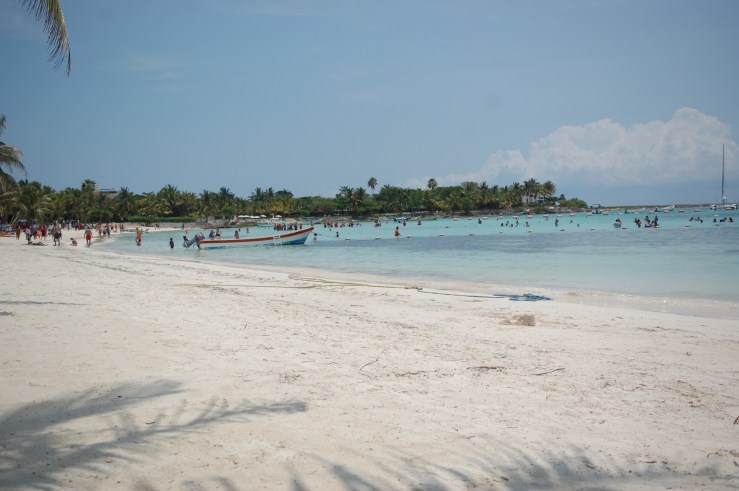
95% of tourists who visit Mexico go no further than the northwest corner of the Yucatan Peninsula. You can see why, but it shows. On our visit to Cancun we bypass the city entirely, but we do get a sense of the over-development around it, with its mammoth hotels and trumpian golf resorts. We go straight to Playa del Carmen. The bit where we’re staying is surprisingly pleasant: lowrise, backpacky. The following day we get to see the real, authentic Playa del Carmen, which is basically a gringo shopping mall with warehouse-sized discount souvenir outlets piled high with Chinese-made tat. I’m not sure how this works at the level of meaningful present-giving:

-Hey man, thanks for the gift!
– F*ck you. It only cost 20 cents.


I buy some fake Crocs, and then ten minutes later fall over and nearly break my ankle. Pinche fayuca de la chingada! I exclaim, feeling pretty sure I’m getting the swearing right. I hobble back to the sea where we get chatting to some Americans from the Midwest who are affable, chatty, and very big. I get the impression that if I ask them about the election later in the year I might start to hate them, so I don’t.
dsc_0563Just off the beach there’s a huge amount of commerce but on it there are, unusually for Mexico, no vendedores ambulantes. It’s quite a contrast from when we went to Playa Condesa in Acapulco in February, where we were approached by vendors every ten seconds. It was rather like the metro in Mexico City. They were selling beach gear, clothes, cold drinks, full meals, massages, and an hour with a massive bass-heavy speaker (thankfully there were no takers for that one). They were unceasingly polite and not particularly insistent. We know that they were taking a risk. Two weeks after our visit one was shot dead on the same stretch of sand*. The fact that there were heavily-armed (and, bizarrely, jungle-camouflaged) squadrons of soldiers running around the promenade was hard to tally with the whole lying-on-the-beach thing. A useful tip for visiting Acapulco is: Don’t talk to taxi drivers if you want to enjoy your visit, but do ask them questions if you’re at all interested in getting some sense of how f*cking dangerous the place is if you’re not a tourist.

The fact that on the beach in PDC there are no vendors means it’s actually hard to get hold of a beer or a bottle of water. Along the beach there are chain hotels where you can’t get anything to eat or drink unless you’re a guest. Entire stretches of beach are wholly-owned. Everybody we talk to agrees that it’s a safe place to visit. It is, for tourists, mostly. The fact that the locals are absent suggests that it’s not so for everybody. They depend on tourists for their economic survival, but have limited access to them. The situation puts me in mind of promotional photos of the alcoholic folk-punk band The Pogues in the late 1980s, where all bottles, glasses, spliffs, crack pipes, etc would be removed from the scene. (I see that in relation to cigarettes this phenomenon is known as ‘tobacco bowdlerisation’.) Frantz Fanon wrote about the ‘invisibility of the colonial subject’, but he could just as well have been talking about tourism. Most holiday brochures feature no images of the local people, except those in a servile capacity, pouring drinks or dancing their wacky dances. The roots of modern tourism do, after all, lie in colonialism, in taking possession of what we see, which is why John Urry called his classic study of the field ‘The Tourist Gaze’. This partly explain why we spend so much time on holiday taking photos, like the ones I’m showing off here. 

To travel down the coast we hire a small car, a Volkswagen. I can offset this from my personal carbon budget because I’m not the one who’s driving. My wife drives it to another cenote, while I sit in the passenger seat tutting and shaking my head. 

There are hundreds of sinkholes and caves connected to underground rivers all across the region. They allowed the Mayan civilisation to survive for several thousand years, given that the northern part of the peninsula has no rivers or major lakes. Their existence is now threatened by urban expansion and the direct commodification of the cenotes themselves, which means we’ll be to blame should they get poisoned or dry up. For the Mayans they had a sacred and symbolic role, representing the entrance to a mythical underworld (they probably didn’t call it a ‘mythical underworld’). After the Spanish arrived they were also used to hide sacred objects and other items that Catholic priests forbade, like first-generation ipods.dsc_0552We drive on to Akumal. The people selling snorkelling tours and turtle visitations are numerous and quite insistent. As we drive in, pass the tourist kiosk, get out and walk across the car park, walk onto the beach, and sit down, we are badgered (or perhaps, under the circumstances, turtled) by nine or ten touts. There are snakes of pink and orange lifejackets all round the turquoise bay. I start to apply suncream but a friendly person comes along immediately and tells me not to as it damages the coral. There are kindergartens of fish in the shallows of the water, and feeling a bit sun-addled I try to compensate them for our intrusion on their habitat by giving them some money, but there’s a translation problem. The setting reminds my wife of the Comoros Islands, which are nonetheless undeveloped and very poor. We are all here to see an unspoiled environment while trying not to think too hard about the fact that in doing so we are ourselves spoiling it.
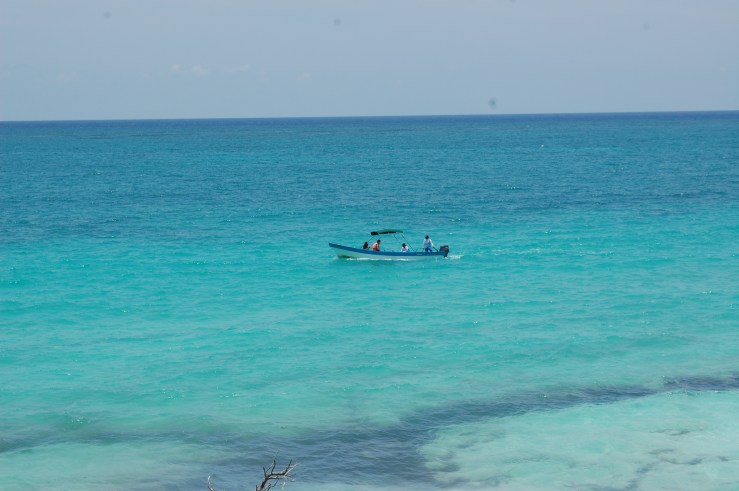

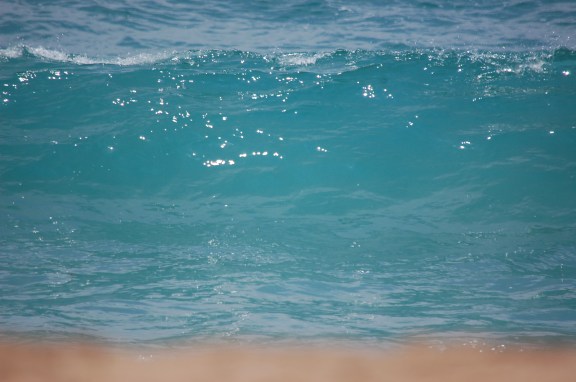
The beaches in Tulum are similarly paradisical; in fact, they are even more lovely because they have bits of a ruined city hanging over them. Tulum is also, thanks to people exactly like us, overdeveloped, but on a different scale. Beachside bungalows cover every square inch for about ten miles. They’re called things like Shalom, Ecochic, and Happy Hour. I see the word ‘spa’ so many times I start to feel like I need to lie down, shut my eyes, listen to the waves and forget about the word ‘spa’. As for the prefix ‘eco’, it loses a bit of meaning when followed by the term ‘quad bikes’. There’s also a bungalow resort called My Way, which to me makes it sound a bit like Dignitas, and actually it might be, given that this would not be a bad place at all to die.We avoid the suggestively-named Azulik, which is ‘clothing optional‘.  Once again my brain is bothering me for words to describe the colour of the water, so I trick it by taking this photo:dsc_0583
In the evening we go to a friendly German-run bar and I pick up the local newspaper. In addition to gruesome images and macabre details of those who’ve been shot dead for selling drugs to tourists, there’s an article about Akumal. A group of ecologists has reported that the coral reef is on the brink of collapse. Officially the site is only allowed to receive 250 visitors a day; it’s currently welcoming around 5,000 of us. On the other side of the main street of Tulum there’s a party taking place in the headquarters of a taxi sindicate called Tiburones del Caribe (Caribbean Sharks). The building is festooned in PRI banners and balloons and there is reggaeton blasting out. Like any Mexican town there’s a lot of competition for customers, but the notion that competition automatically leads to better efficiency is once again disproven by the fact that at the end of the night it takes our taxi driver 25 minutes to find our hotel, which is five minutes’ walk away.  Later I read about a number of assaults on tourists, and the smashing-up of cars from opposition companies. Mexico provides a lot of support for the argument that war is a continuation of capitalism by other means.

In Tulum we find it hard to track down anywhere interesting to eat. Being British in Mexico and complaining about the food is perhaps a bit incongruous, but we are, after all, kind of double foreigners here in that we live in Mexico City and the range of restaurants on offer in Tulum doesn’t begin to compare. The first question people ask us about DF (as everyone refers to the capital) is ‘is it dangerous’. Not for us it’s not, we say, smugly. Not in terms of crime, at least, although in environmental terms the city is some ways hanging por un fío. Mexico abounds in confirmation that cities can collapse, whether thanks to invasion or a range of factors. The Mayans in Yucatan were nearly wiped out by a massive prolonged drought. Although it’s not politically correct to say so, their climate changed and so their civilisation collapsed**. That can happen. In Mexico the term ecocidio is increasingly being used to describe events like that in Cancun, when an entire Mangrove forest was destroyed to make way for more tourist developments. Jared Diamond dedicates a substantial portion of  ‘Collapse: How societies choose to fail or succeed’ to the fate of the Mayans, who hung on for several centuries when the natural resources they had relied for millennia could barely sustain them any longer. The lifespan of their civilisation may have been shorter had they had millions of Volkswagen-driving hypocrites like us to provide for.dsc_0597

*I don’t know if it was the guy walking up and down with the speaker.

**Yes, I’m aware that I’m challenging the notion of ‘politically correct’ is. Here’s an experiment: ask the next human being you see ”How worried are you about climate change?’. They’ll almost certainly change the subject very, very quickly. 

Self-delusion 101: Conversation with a climate denier

internet-troll

There are several Facebook groups dedicated to the topic of Climate Change/Global Warming. The ones called ‘discussion’ and ‘debate’ are crawling with trolls. Some are better: I thought the one called something like ‘Air, Water, Energy, Resources’ was more serious. This is (what I remember of) a ‘conversation’ (insofar as that venerable term can be applied to online interactions) with someone who turned out to be one of the administrators of said group, who had commented on this article which I had posted a link to. I’m posting it here not out of self-aggrandisement (I’m not exactly proud of spending time online arguing about politics with people who for all I know may be only 13 years old) but because my site (this one) has now become the object of attention from climate trolls and I want to demonstrate one central delusion of their mission to disrupt efforts to save humanity: that their opinions about climate science have any validity or meaning whatsoever. The conversation no longer ‘exists’ because I left the group immediately afterwards, but I’ve tried to be honest in recalling what was said.

Thanks for what you wrote, I think a lot of it is wrong but I respect your right to say it. You’re very sure about scientific things that haven’t been proven. Anyway, do people really deny the holocaust? I don’t think so.

They do, sadly, in fact dedicated climate trolls very often moonlight as holocaust ‘revisionists’. Have a look around. And the science was settled several decades ago, as you must be aware.

That’s not true, you can’t be sure about anything. There are many different opinions. Science is never settled.

Well, it’s not a matter of opinion. Scientists conduct and repeat experiments and the results of those experiments are published and then themselves tested. It’s not guesswork. Anyway its odd that you should have chosen this particular area of science to dispute, because as it happens there’s a massive industry based on denying it, funded by the fossil fuel industry. Is that a coincidence?

I don’t care about fossil fuel companies. I’m interested in the science.

Are you yourself a climate scientist?

I have enough expertise to be a climate scientist.

I have enough expertise to fly a mission to Mars. I’m still waiting for them to call me back. Have you passed a series of exams which test your knowledge of the climate? Have you been rigorously trained in conducting experiments and interpreting their results? Has your expertise been recognised? Do you work in the field of climate science? Where can I find your work so I can see for myself?

I know a lot more than people who do.

But you’re not one. On the scale of climate scientist to internet troll, you’re way on the opposite side from climate scientist. Are you even an adult? Because it seems to me that your understanding of science is puerile.

Please be civil.

Civil? Scientists are essential to civilisation. Pretending to be one undermines the credibility of real scientists and thereby undermines civilisation. Do you pretend to be anyone else? When they say “is there a doctor on the plane?” Has anyone died as a result?

I’ve never pretended to be a doctor.

Well done. That’s really commendable. Look, I’ve just googled your name. This is what came up. You’re not a climate scientist. You may be just a schoolchild. I don’t want to be too hard on you, but get yourself another hobby. This issue is far, far too important to play these kinds of games. And I’ve got a word for you to learn: agnotology. I’ve googled it for you. It means the deliberate spreading of misinformation and uncertainty. That’s what you’re doing. Please, please stop.

This is a Climate Denial coup and we’re all part of it

640x-1

By the time Trump had finished burbling his way through the oaf of office, all references to Climate Change had been erased from the White House website.

As I have been saying all along to anyone who would listen, this is what Trumpism is ultimately all about.

It is a coup by the corporate climate denial movement.

I predicted that this would happen:

It now looks highly probable that within our own lifetimes the problem of ‘climate change’ or ‘global warming’ will, in one limited sense, disappear. It seems likely to me that the Trump administration will follow the lead of Florida Governor Rick Scott, who forbade government agencies from mentioning it, and former UK Environment Minister Owen Paterson, who refused to read any document containing either phrase.

If they hadn’t gained power this way, they would have done it by means of violence.

Trump’s supporters among ordinary working and not-working people know the facts at some level – only a true psychotic could sincerely ignore the spate of floods, droughts, hurricanes, etc — but they are prevented from articulating their fears by the cover-up campaign and by the social taboo it has generated. Their repressed fears express themselves as furious denial and hatred against any easily identifiable target they are presented with.

And then there’s the rest of us. You, for example. When was the last time you had a serious conversation about the changing climate?

If we continue to avoid discussing the causes and the consequences of the changing climate with our friends, families and colleagues, we are part of the “Trump Revolution”.

In the meantime, I want to say once again to anyone who is listening: Climate Denial and Holocaust Denial are, on a moral plane, identical. Dedicated climate liars should be treated with absolute contempt. Climate denial involves dismissing – indeed facilitating – the suffering unto death of billions of human beings, principally those who are considered to be far away and different. Those who perpetuate it, whether out of personal interest or misanthropy, are involved in the planning and execution of the corporate genocide of the entire human species. And what is taking place inside the White House is the “alt-right” equivalent of the Wannsea Conference. This is the Endlösung for the climate.

It is no accident, therefore, that very many of the same individuals who insist on disrupting all and any discussion of global warming also deny the massacre of millions of people by Hitler. The 2016 film about the Nazi activist David Irving, ‘Denial’, was also, implicitly, a film about climate denial.

Hence there is no need to check on what the stances of Marine Le Pen or Frauke Petry are on environmental questions. We know. They are serving the interests of the most evil forces to have ever held sway over the future of our species.

The most painful aspect is that we are all to some extent climate deniers. We have to be, or life would be impossible.

To explain this I want to post something I wrote on the subject in August 2010. I should have found some way to shout it louder at the time, or worked harder on working harder with people who felt the same way:

Why are so many otherwise entirely rational and intelligent people so prepared to give credence to the denialists? Of course it is partly to do with the media hegemony of corporate power, but not entirely. Personally I comfort myself in the secure knowledge that I myself am prepared to ‘believe’ in the reality of what is happening and what we face, that I ‘know’ that it is happening and will continue to happen; but I’ve come to think that I may be mistaken about my own belief.

There are after all very many things we think we believe, but actually we don’t, and to ‘know’ something is not the same as, in the words of Sven Lvindquist, to understand what we know and to draw conclusions. Despite my firmly held and rationally based opinions, my own actions suggest that I am not a strong believer in the reality of climate change. I do not place much importance in recycling, for example, choosing to regard it as something of a superstitious action akin to shouting at the TV to influence the result of a football match (nobody of course would ‘believe’ for a second that doing so would have any impact, but their ‘irrational’ behaviour might make one think otherwise). My position on recycling could probably be characterised as something of a ‘beautiful soul‘ one: given that other people refuse to change, and given the immense complexities involved, I refuse to act, regarding it (entirely logically, if not rationally) as both utterly ineffective and beneath me. Nevertheless it’s one that I have until now felt entirely comfortable with.

It’s very difficult, impossible perhaps, to take a realistic and rational view of climate change. There is no level of fear or anger that is proportionate, and none of our individual actions are remotely sufficient. I have come to realise, however, that gestures are important, contrary to what I’ve always thought and contrary to what Slavoj Zizek so entertainingly argues. My actions suggest that subconsciously, like anyone else, I refuse to accept the reality of climate change. The trauma is too great to integrate into my notion of the world, the future of the world and my place in it, and so I act as if I will never be affected. But changing my habits can force me into believing at a deeper level. In Alcoholic’s Anonymous they apparently call this ‘acting as if’: first you change your behaviour, and then hopefully, gradually, your beliefs, both conscious and unconscious, about your ability to manage your life without a drink in your hand begin to change.

To slip briefly into amateur Lacanese: because the Real of climate change is impossible to apprehend, we have to act within the realm of the symbolic. Symbolic tokens in the form of gestures do have a value; they can be exchanged for genuine belief. Not just recycling but skills shares and community gardens are important, as are all other forms of exchange not based purely on exploitation. Staying out of supermarkets is a good move for all sorts of reasons.

Nowadays, again like anyone else, we consume constantly, indiscriminately, or ironically, consuming our own gestures of consumption. This is the age of McDonalds happy meals consumed in a constant low-level muzak hum of cynicism, apathy and despair, flat screen Tvs gorged down in the midst of a recession. We consume because we are: what else are we, what else are we to do?

There is of course no substitute for collective political action, for maximum anger gathered and launched at those in power who notice our failure to genuinely believe and so pretend to act, understanding that for us, for now, pretending to act is enough. But it can serve to help us accept the anger and fear that climate change generates, to live with it and try to live differently.

I think I believe in the reality of climate change. But the fact that I fail for the moment to begin to live differently shows that I do not, yet. I first have to change the way I live my life.

Welcome back to 2016. We are now governed by a regime of climate trolls. Such creatures are, whether they like it or no, mouthpieces for the fossil fuel industry. In ‘Gravity’s Rainbow’ Pynchon writes:

Death converted into more death. Perfecting its reign, just as the buried coal grows denser, and overlaid with more strata – epoch on top of epoch, city on top of ruined city.

I don’t know what will now happen to the squads of trolls that have been mobilised. They can no longer pretend to themselves that there’s anything other than doglike obedience to corporate power motivating their actions. Some will continue to fight online battles, too stupid and/or rabid to realise that they’ve won. Their owners will probably give them another scented rag to chase down. Vigilante gangs may be formed offline in addition to online in order to help police dissent. In the meantime this blog will soon go much quieter, as I will have a bigger priority: our first child (thankfully a daughter). We have to protect and sustain life in the face of forces which represent nothing but death.

18 questions for climate deniers

  1. Do you accept the science of how babies are created?

  2. Do you accept the science of how ice is formed?

  3. Do you accept the science of how the earth goes in circles?

  4. Do you accept the science of where eggs come from?

  5. Do you accept the science of how water is heated?

  6. Do you accept the science of how light bulbs work?

  7. Do you accept the science of how planes stay airborne?

  8. Do you accept the science of how rainclouds form?

  9. Do you accept the science of how rubber ducks float?

  10. Do you accept the science of how sand becomes glass?

  11. Do you accept the science of night and day?

  12. Do you accept the science of the warming planet?

  13. Do you accept the science of how we evolved?

  14. Do you accept the science of how vaccines function?

  15. Do you accept the science of how greenhouses work?

  16. Do you accept the science of how flowers can grow?

  17. Do you accept the science of how birds and bees combine?

  18. Do you accept the science of how your car starts to move?

If your answer to any of those questions is ‘no’, get educated. You might find this site helpful.

The Great “Earthquake” Swindle

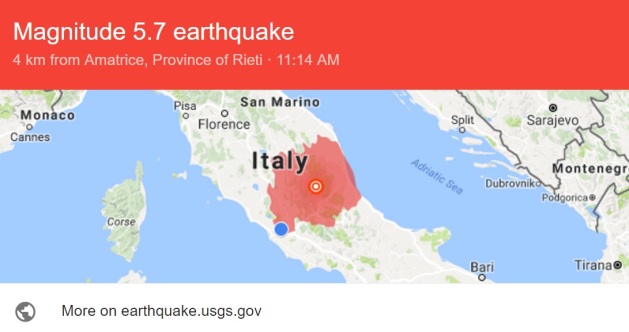
erthquake
If you believe this, you’ll believe anything! Notice btw that it comes from a *government* website.

It’s telling that the global warmist lobby, with their constant bombardment of fake news about floods in Thailand and drought in Africa (make your mind up, guys!) go out of their way to cover up the real stories. It turns out that those “doctors” would have you believe that “cells” within your “body” can go bad and ultimately “kill” you were lying. That’s right: “cancer” doesn’t exist. It’s a hoax that’s been played for decades, one perpetrated by the government and the mass media and believed by all those who don’t dare to question what they’re told. These are the same people who tell you that the President of the United States is married to an immigrant or that it’s (as one of these so-called “pediatricians” told me in person last week) “an act of grave irresponsibility” not to get your child vaccinated! Thank god (another fake news story that I bet you fell for!) that we have Facebook and Twitter so we don’t have to believe their bullshit any longer.

But even worse than so-called “climate” “scientists” and “cancer” “doctors” are this bunch of self-appointed experts who call themselves “seismologists”. This is a fancy name for people who want you to believe that the “earth” (which other “scientists” will tell you is as round as a baseball! – but that’s another story) can tremble and shake like a blancmange! The official story (and I can tell you, I’ve studied this in some detail) is that it’s caused by (try not to laugh) “sudden movements in the Earth’s crust”. Well I’m going to tell you a personal story, something that “happened” to “me” just this “morning”, which will show that this whole “earthquake” racket is no more than yet another official libtard hoax.

We went to our local “hospital” for a checkup with someone who calls himself a “gynecologist”. This shyster is paid thousands of euros of taxpayer’s money to tell us that as a result of a little cuddle time me and my “wife” enjoyed several months ago she is now “pregnant” and is going to have a “baby”. While we were “there” we visited another “couple” who apparently have just “given birth” (there was no actual evidence of this; there was a very small human being in the room and two beaming but exhausted new “parents” but there could be any number of explanations for that). After a few minutes of “conversation” (I noticed that the “baby” was pretending to be asleep the whole time) the “father” character drew our attention to the “fact” that the “water” in a bottle on the “bedside” was “shaking”. Sure enough, it “was”; I then “looked” at the “curtains” and they appeared to be moving – which obviously raised my suspicions! Then I “felt” with my “body” that the whole “building” (we were on the “eighth floor”, in the so-called “maternity department”) seemed (I’m being very careful with my language here!) to be “trembling”. I suddenly felt quite “scared”. Our “friend”, the new “mother”, checked on her “iphone” and said something about “the “epicentre””(it’s depressing to see how all this quakist jargon has wormed its way into the heads of ordinary sheeple) being near a place called “Rieti”, which I knew at once to be a lie, because although I’ve seen the name on a so-called map and noticed it on the front of “buses”, I’ve never actually been “there”.

We made our excuses, and “left”. I dread to think what fairy tales that baby will grow up hearing. They’ll probably tell it all the usual pseudo-scientific nonsense about “water” being “wet” and about how it gets “dark” at “night”. Personally I’m glad that I’ve seen through all that crap. As soon as “my” “child” is “born” I’m going to tell him the truth: that “hospitals” do more harm than good, that “teachers” do nothing but lie, and that so-called “parents” are the least trustworthy people he’ll ever meet. I’m also going to make sure he understands that whatever information he receives through his “eyes”, “ears”, “nose” and “fingers” is almost certainly bullshit, and that the last thing he should ever do in life – even worse than putting any faith in “experts” – is to use his “brain” to interpret the world. And you can stick your Dr Seuss, Alice in Wonderland and Roald Dahl books back where the sun don’t shine. I won’t be reading him any “bedtime stories” (in any case, if you believe that human beings “need” to “sleep”, quite frankly you’ll believe anything -and as for “breast” “milk”, don’t get me started on that junk!). Instead he’ll be staying up all night with me getting the real story from my good friends at Breitbart, Infowars and Wikileaks. I want my “child” to be brought up on a solid diet of the truth.

NB: This is a work of satire. In reality the only thing more dangerous than seismic activity is climate denial. They both serve to destroy the foundations of our existence.

French nudists and freak tornados on the Oaxaca Coast

dsc_0750

If you ever want to stay in a discreet nudist hotel, look out on Tripadvisor for codewords like ‘broadminded’, ‘especially for adults’ and ‘not child-friendly’. If you choose judiciously you may, upon walking through the door, be delighted – just like we weren’t – to see two French tourists splayed out in all their flaccid glory in the alfresco bar/reception area, umbrellas in their drinks and gallic pudenda making the most of the warm sea breeze*.

Conversely, if for some bizarre reason you don’t want to stay in such a place, do not choose places which are described as such. I.e: don’t make the same mistake that we did in Zipolite.

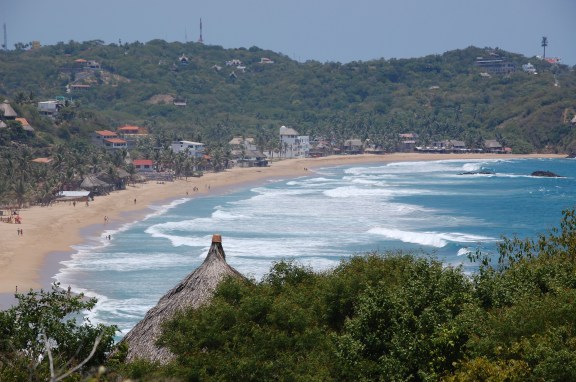
Like most tourist hotels and guesthouses we stay at in Mexico, the nudist colony happens to be foreign-owned. In Puerto Escondido itself we stay at a place owned by a Swiss couple, and when we move on to Mazunte the proprietors turn out to be French. The actually quite charming nudist place belongs to an Italian who got halfway to learning Spanish and then got stranded out of his depth. He flounders between the two languages in a way that’s distressing to witness. I would happily dive in and save him, but then he isn’t wearing a swimming costume. Italians love this bit of the Oaxacan coast, because it was the setting (and ‘Puerto Escondido’ was the title) of a 1989 film about a guy from Milan who looks like a young Silvio Berlusconi getting mixed up in drug smuggling, partly because of a series of misunderstandings. It’s therefore possible that the owner of the hotel didn’t know he was starting a naturist colony. It’s also possible I misunderstood the film as I was watching it in Italian and at this point, after three months in Mexico with my Italian wife, Itañol is rapidly becoming my best second language.

dsc_0694It’s certainly warm enough to strip off. We’re at the top of a cliff and the heat and wind are immense. I have to keep covered up, I tell everyone, because I’m scared of getting badly sunburnt. It wouldn’t be the first time. If you really want to know just how painful excessive exposure to the sun can be, go to Tioman Island in Malaysia at the hottest time of the year and spend five straight hours in the sun, dismissing every attempt by your sister to get you to put some suncream on. It hit me three or so days later on the bus from Singapore to Kuala Lumpur: I was seized by an extremely insistent itching deep beneath my skin all over my chest, back and shoulders. Fearing that I might be having a heart attack brought on by excessive exposure to all the spiciest foods that Asia has to offer, I looked up the health bit of the Lonely Planet and learnt it was probably something called ‘prickly heat’, and that I should apply talcum powder asap. When I got to KL I ran like the wind to the nearest pharmacy, where to my relief I saw that they also sold something called ‘tiger balm’. The word ‘balm’ sounded soothing, like ‘calm’. Or ‘balsam’. Or ‘balsamico’. It doesn’t matter. It made it (at a generous estimate) about thirty times worse, and I spent my entire first, last and only evening in the Malaysian capital showering my torso with cold water. Which, in turned out, also made it worse. Over the next three days I became a gibbering monkey, incapable of more than ten seconds of conversation before I would have to go back to grimacing, scratching and at some points actually screeching. I never got to the point of stealing cameras and throwing my excrement at tourists, but I can tell you it was a pretty close shave.

It was such a traumatic experience that I’ve never made such mistake again, unless you count once in Spain, the first few days in Thailand and pretty much any time I’ve been anywhere really hot where the prospect of getting a fabulous suntan really quickly was just too good to pass up on. That’s why, on the second beachday in Zipolite, having magically overcome my aversion to exposing myself as soon as we left the hotel complex, upon feeling a familiar deeply-buried itch in my chest I run like the wind to the nearest pharmacy, desperately garbling some nonsense about cream-of-after-the-sunshine**. Luckily they do have some, so I down it in a single gulp, give a satisfying burp of relief and go back to working on that tan.

dsc_0765

It’s blisteringly hot but we can’t cool down in the sea. It’s just too wild. It was actually on this beach that the wife of the Mexican-American writer Francisco Goldman was killed by a wave about three years ago, an event he describes in the heartbreaking memoir ‘Say Her Name’. We move on to another village in search of calmer waves, less violent winds and the Perfect Beach Hut, and luckily soon come across a collection of round bungalows on stilts with bamboo walls. This is perfect, I murmur as we lay back on the bed. Sorry? mouths Chiara. I say it again, this time MUCH LOUDER, but it’s no good. It sounds like we’re at the top of Mount Popocatépetl in a Force 12 gale. Using sign language I manage to communicate that we should go downstairs and change our booking from three nights to one. The Parisean owner is thankfully very obliging once I’ve explained that we have to leave earlier than expected to look for my aunt’s favourite pen, which has got blown away PAR LE VENT.

The wind might be annoying to tourists, but it’s being put to good use a little further down the coast. The Isthmus of Tehuantepec (quite a challenging name for a Spanish Spanish speaker to pronounce, I’d imagine) hosts most of the country’s wind farms. Although it obviously sounds laudable (and god knows Mexico desperately needs to move away from its dependence on fossil fuels) it’s more problematic than it might first appear. Objections have come from local indigenous people, who say that the resultant encroachment on their land and fishing resources has been accompanied by threats and attempts at bribery. Although in Europe campaigns against wind power are often fuelled and funded by fossil fuel companies or their self-appointed defenders (as this clip from the documentary ‘Age of Stupid’ demonstrates), in Mexico mitigating the effects of the changing climate will be, like so much else, riven by conflict between rapacious commercial interests and people whose land is their only livelihood.

dsc_0832

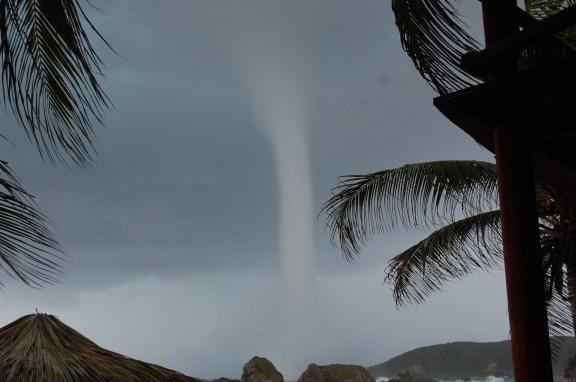
Not that this level of wind is normal, even for the Oaxacan coast. The following day we witness our, and apparently Mazunte’s, first ever tornado. It twirls inland a mere 200 metres down the beach and whips off a few roofs, but luckily no-one is hurt. For the second time in two months I narrowly avoid becoming a victim of climate change. Over the next few days no boats can go out to sea. On the last night of our holiday there’s a power cut, but the Italian restaurant next door is on hand with candles, lukewarm white wine and burnt pizza served up to a passionate soundtrack of Neapolitan swearwords. We move on to an open-air bar where they’re playing Electrocumbia (my new favourite kind of music). It takes a while to get going but then some French-Canadian crusties turn up with their dogs and take over the dancefloor. Maybe it’s the music, maybe the mezcal cocktails or maybe just the fact of being so far from home, but the dogs just can’t contain their romantic impulses. It adds another dimension to the phrase c’est une vie de chien, but it’s nice to know that it’s not only we humans who do slightly embarrassing things when we’re on holiday.

dsc_0624

* Apparently the French phrase for ‘wedding tackle’ is ‘bijoux de famille’ (lit: family jewels).

** Which I’ve learnt over the years is the product specifically designed for such situations.

RELATED ARTICLE: Do you want to see Trump naked?!?

Los Angeles: I kinda like LA

47799076

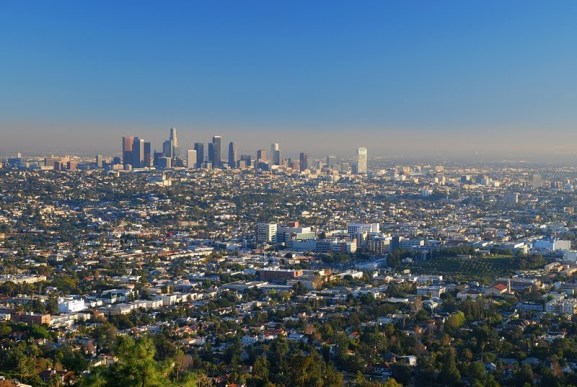
The film that LA reminds me of most is not ‘Chinatown’, ‘The Long Goodbye’ or ‘Mulholland Drive’, but ‘Tron’*. The absence of a specific centre is nicely disorientating, like a dream of a city with no centre, or with dozens of centres spread out across an undulating grid of (in theory) highspeed highways. Thomas Pynchon called LA “less an identifiable city than a grouping of concepts”; as it happens I quite like exploring concepts and I find LA surprisingly pleasant to move around. I am, after all, here on holiday. Those who live with its traffic jams and smog would probably question the impression created by the distortions employed here.

I’ve been to a number of cities modelled on or heavily reminiscent of the rhizomatic layout of LA (Johannesburg, Singapore and the Santa Fé part of Mexico City spring to mind), which have tended to be alienating and lacking in identity. But the original has a distinct character in that it’s suffused with images of itself, so I do feel that its history is present. It helps that I’ve just read Mike Davis’ incendiary chronicle of LA’s development, ‘City of Quartz: Excavating the Future in Los Angeles’. Davis writes like an Old Testament prophet, a West Coast Marshall Berman. The book was originally published before the riots of 1992, and mostly details the 20th century battles over local political power, water, and land, all conditioned by race and class. The history of LA is one of small-scale wars over land title and water rights, between newly-established communities and goon squads, vigilantes, landlords, lawyers and developers. One of those developers says in Pynchon’s novel (and subsequent film) ‘Inherent Vice’:

Look around. Real estate, water rights, oil, cheap labor—all of that’s ours, it’s always been ours. And you, at the end of the day what are you? one more unit in this swarm of transients who come and go without pause in the sunny Southland, eager to be bought off with a car of a certain make, model, and year, a blonde in a bikini, thirty seconds on some excuse for a wave—a chili dog, for Christ’s sake.”

dsc_0174

The French philosopher Jean Baudrillard saw LA as a mirage, a simulacrum, but if it is true that our mental images  of LA screen out the real city at least they’re familiar ones. The city I come from is famous for one film, whereas LA is known for tens of thousands, many of which by no means show the city in its best light. I knew something about the water wars thanks to ‘Chinatown’ and have learnt about LA’s vice, drugs, corruption and racist police brutality from films like ‘The Big Sleep’ and ‘LA Confidential’. Mike Davis writes that the film noirs of the 1930s onwards comprised an ‘ideological assault on the American dream’. Raymond Chandler was certainly not the most radical or critical of noir writers but neither ‘The Long Goodbye’ nor ‘The Big Sleep’ paints an idyllic picture of the city. A lot of the early noirs were written by exiled European writers, like Hans Eisler and Erich Maria Remarque, who hated LA’s lack of a civic centre and thought that the city ‘negated every classical value of European urbanity’. Bertolt Brecht simply called it ‘hell’. Nevertheless Theodor Adorno, someone who you might think, given his active antipathy to the culture industry, would have dedicated LA a particularly scathing Tripadvisor review, instead commented: ‘It is scarcely an exaggeration to say that any contemporary consciousness that has not appropriated the American experience, even if in opposition, has something reactionary about it’. And, in a different mood, Brecht once complained that his cottage was ‘too pleasant to work in’ .

dsc_0189

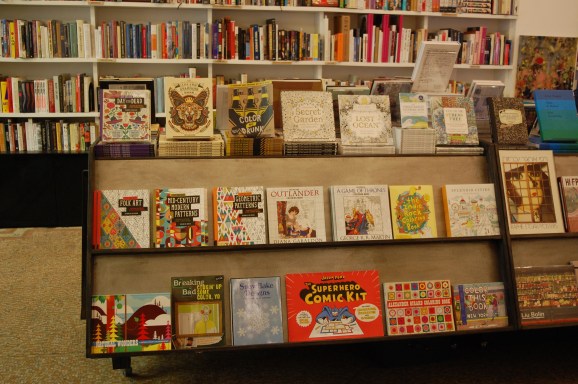
In my case I’m surprised to find that there is, if not a centre, a downtown, and that it’s actually quite likable. The fact that it’s mostly Latino and that casi everyone is speaking Spanish is comforting: given that I’ve just popped up for a week from Mexico City (another city that’s often misrepresented as consisting of nothing but traffic hell but is in reality remarkably walkable), I enjoy the feeling of being doubly foreign. It’s something I regularly experienced going from Portugal to Spain, and also the time when, living in China, I flew to Thailand and bumped into some ‘other’ Chinese people. Downtown LA also has some food markets, tidied-up versions of the ones at home. We visit one of the best bookshops I’ve ever visited (The Last Bookstore), in which I first go a bit mental buying English language novels, and then can’t help but feel a bit disdainful on discovering that they have an entire department dedicated to colouring books for ‘adults’. Out on the streets there are some sights recognisable from Hollywood films depicting a dystopian future. Although we visit on a weekday, most stores are closed and shuttered, there’s evidence of people sleeping in pretty much every doorway and a couple of distressed individuals pushing shopping carts a la ‘The Road’. However, from a Mexico City point of view, it’s all quite familiar – it feels a bit like one of the more abandoned sections of Insurgentes. Down in Chinatown there’s actual streetlife – food stalls, a couple of buskers, and groups of people standing around chatting – and when we pass through the area known as Skid Row people are quite affable, even when they think I’m trying to take photos of them, which I’m not. Much.

dsc_0193

The area where my friends live (Mount Washington) is extremely pleasant; it puts me in mind of the more lightly-gentrified parts of Hackney, like Lower Clapton. Some streets are like Dalston without all the ridiculous new apartment buildings. With its lowlit bars, ethnic restaurants, antique shops and hipsters, there’s a strong sense of quality of life. My friends have been here for about three years. When they arrived, she was pregnant and they were panicking about not having health insurance, but it turned out to their immense relief that the State of California has a scheme which meant they avoided having to pay out over one hundred thousand dollars just for giving birth. Even in terms of healthcare, the United States is a more complex society than I had assumed.

dsc_0624

Another day we head down to Manhattan Beach, where I’m sort of hoping I might bump into Thomas Pynchon, even though I nor anyone else have seen any photos taken of him in the last sixty years and he hasn’t lived here since around the late ‘60s. ‘Inherent Vice’ is set here during that time. It’s a hippy noir whose detective is permanently stoned, which doesn’t help the reader or viewer make much sense of the shaggy dog plot with its dozens of characters. Like most good detective fiction it’s less about who did what to whom than a study of the texture of a particular time and place. There are police buying off hippies to protect millionaire property developers and a shady operation called the Golden Fang which appears to be some sort of mafioso cartel crossed with a secretive corporation. But the novel shows that the LA ruled by such forces is not the only one that might exist or come to exist: the epigraph to the book is the situationist slogan ‘Under the pavement, the beach!’. The ‘60s was a time when another LA, another California, another America threatened to burst through the paving stones of mainstream society. In ‘Vineland’, a previous novel set (conversely) fifteen years later, one whose characters are addled and incapacitated not just by weed fumes but also by cathode rays, Pynchon explores a similar history to Mike Davis’ book: union battles in the film studios, McCarthyism, the FBI’s attempts to control and buy off any burgeoning countercultural forces and impose authoritarian rule. ‘The Crying of Lot 49’, from 1966, was written on the cusp of the hippy years, and has a lot in common with the critique of the situationists of the deadening effects of suburbanisation, bourgeois life and consumer spectacle. Pynchon apparently lived right down next to the beach and spent his time when not writing ‘Gravity’s Rainbow’ driving round and discoursing to his hippy companions on LA and its dependence on the war machine. And it’s on the beach that I come across this:

dsc_0618

From the beach we drive up to Malibu to a cheap fish and chip restaurant with ocean views and photos of Barbara Streisand, Rod Stewart and Dylan (Bob) on the wall. I pick up a brochure for local property but the prices are even more absurd than the ones in Dalston**. Although they’re very nice I’d actually pay more money not to have to tell people I live in a place which reminds them of one of the world’s most cloying drinks.

The megarich of LA have other concerns, however. Many of them spend their time worrying about the number of thetans they’ve built up, only to find after several years that the secret truth they were striving for involves some total bollocks about “a galactic overlord by the name of Xenu, a volcano, and souls that attach themselves to newborn babies”***. However, contrary to what a lot of people who spend too much online may tell you, Scientology is not the most dangerous and destructive aspect of the LA lifestyle. In the evening we go to a bar which is showing sport. As the commentators discuss the game a huge Volkswagen logo located right between them takes up roughly 80% of the screen.

dsc_0228

Much more than Scientology or the dreamlife that LA sells us, the cult of the car is the city’s most pernicious export. One consequence of the failure of our species to reduce our dependence on fossil fuels is that California is suffering from a massive and unprecedented (although not inexplicable) drought. There are notices of water restrictions everywhere. In Beverly Hills the locals have protested, however, explaining that they can’t reduce their water consumption because you know, they just need to consume that much water and anyway they’re rich so fuck off my lawn. You’d have to have the mentality of a cult member to think this kind of attitude has any kind of future.

Some people still see LA as representing the chance of stardom, despite all the cautionary tales told in movies and music from ‘Sunset Boulevard’ to ‘Do you know the way to San José’. In a burger restaurant round the corner from where all the Hollywood Boulevard nonsense is, we meet a young Austrian who’s been here for three years doing an acting course. The fact that she prefers to speak in German with someone (me) who struggles to remember the word for burger suggests the course may not have been all she hoped for, although she puts a brave face on it (or at least I think she does, I can’t remember how you say ‘brave’). Subsequently I see several adverts for such courses; it seems that, like the UK wrt EFL, the US also has a burgeoning ripping-off-foreigners-in-return-for-fuck-all industry disguised as something to do with ‘education’. We also meet a more long-standing immigrant, a Russian taxi-driver who is inspired by our late-night request for somewhere to buy a couple of cans of beer to drive us halfway to Seattle and stock up himself “for the night!”. He buys 16 cans, at 2am.

dsc_0271

LA has been called a commodity, a simulation, and a cultural desert, so it’s a pleasant surprise to find (pace Gertrude Stein on Oakland) that there is in fact a ‘there’ there. I can certainly see the appeal of living in LA, particularly up in the hills. Some parts of the city looks curiously like an area of my hometown, Sheffield. The ‘70s-built council housing in Gleadless Valley imitated Californian design to great effect. (If anyone thinks that this is nonsense please read this to verify). The wonderful place where my friends live, on the slopes of Mount Washington with a sweeping view across the train tracks towards downtown, puts me in mind of the 1970s, the LA of Tom Waits and Robert Altman’s version of ‘The Long Goodbye’, which are the sounds and images I most cherish from the city.

Nevertheless, the idealised LA way of life is one that doesn’t export well. Devoid of historical content and bereft of Los Angeles’ rich and complex set of visual associations, it produces bland suburbanisation, something far closer to what Baudrillard was talking about. In a word: Singaporisation. I find it hard to see the appeal of Dubai  to anyone who has an alternative****. Such places seem to me to be much better simulations of dystopia, rendered worlds with no civic or public life, no libraries or bookshops or public squares or walkable streets. A bland, privatised architects model, an outdoor shopping mall where the only game to play is pretend-you’re-a-millionaire. At least LA has a history: one of desert, drought, corruption, rats in palm trees, film noir and race wars. It is a gigantic incoherent confluence of human ambition, creativity and destruction. The brightness and the darkness. It’s thanks to the imaginations of filmmakers and writers that Los Angeles exists in a way that many cities that imitate its form don’t.

dsc_0218

* The original version, not the remake by Tim Burton or whoever.

** Nobody from London will believe this possible.

*** This is what it says in this South Park episode, accompanied by the words ‘This is what Scientologists actually believe’. I sometimes think of writing something similar on this blog just in case people think I’m doing this for a laugh.

**** Not that Dubai is lacking in intrigue. I think you’d have to be very brave to live there and go looking for it. One of my friends in LA wrote this excellent novel about oil business shenanigans.

Rome: Armed soldiers and homeless immigrants

img-20161224-wa0000-1These are some fairly disorganised thoughts scribbled in a station and on a train on 24th December last year. I have a bad habit of trying to (in the words of my wife) connect the dots and present a complete and coherent picture of an issue. For reasons that will become clear I don’t want to do that here.
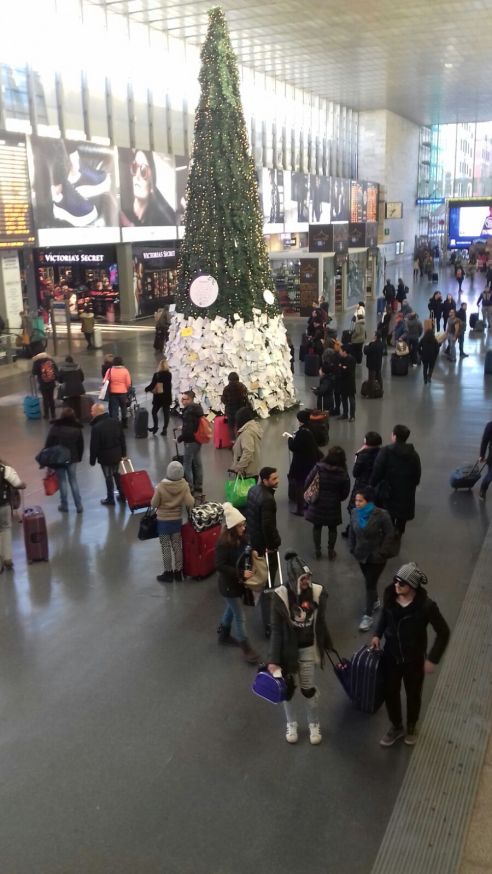
There have almost certainly been homeless people in Rome for as long as the city has existed. Similarly the presence of armed soldiers has probably been a constant. Here in and around Termini Station there is an abundance of both, but ordinary life is going on oblivious. On the main concourse there is a Christmas tree with messages and wishes stuck to it. One piece of paper reads simply: Gulio.

Gulio Regeni, whose name has been seen everywhere in Italy this year, was, after a fashion, a migrant, an Italian PhD student in Egypt. He was by all accounts an exemplary human being, the sort of person who quite simply gives you hope for the future. He was murdered by the security services. They saw him as a potential threat: a European in a repressive Middle-Eastern country asking searching questions and sticking up for people whose livelihoods and rights were threatened, and who had no alternative but to stand up for each other and take whatever outside help they could get.

He could have stayed in Italy and helped migrants here. There are lots of good people involved in such initiatives, people from the church and civil society. The Italian Navy has managed to save huge numbers of people from the Mediterranean, but the response of national and local government authorities has sometimes been a lot less helpful. Recently the police in Rome turfed out the inhabitants of a volunteer centre which was housing, feeding and advising homeless newcomers. Lots of people on the streets come from Senegal, Mauritius and Pakistan. They are, despite their religious background and the colour of their skin, the counterparts of the Italians who went in such huge numbers to the Americas a century ago and who now go to work and study in London and elsewhere. Any one of them could be another Gulio Regeni.

In Rome there is huge pressure on public housing. It started before the recent wave of migration. Nevertheless openly racist groups like Casapound have been exploiting the crisis for their own ends. A family of Moroccan origin, who have been here for several years and are now Italian, were prevented last month from moving into the apartment assigned to them by a group of ‘locals’ shouting “we don’t want blacks here”. I came across other migrants online (white European ones, who classify themselves as ‘expats’) who made excuses for the protests.

Homeless people, whether migrants or otherwise, are usually invisible. Armed soldiers are too, albeit in a different way. I’m used to guns, having seen so many of them in Mexico. When we came back to Europe last December they were already everywhere. It’s not just stations and airports and major tourist sites, but also our local metro station. They are there to identify and exclude anyone who might be a threat.

They are there in Brussels too. No-one talks about it, a friend of ours who lives there tells us. It’s become a taboo. Life must go on.

It’s all too complex and contradictory to assemble into a simple picture or a single narrative. The problems are multifaceted, dynamic and interlinked. What’s the proper reaction to attacks like the ones in Paris, Brussels and Berlin? Any response is inevitably partial and incoherent. For several days this month no big trucks were allowed to circulate in Rome. Last month there was a similar prohibition in place because of the pollution. In the first case no one complained. In the second people felt justified in doing so.

Any attempt to describe the future which doesn’t address Climate Change is meaningless and dishonest. Last Christmas someone gave me a book called ‘Sapiens’, which purports to be a complete history of the human race. The conclusion features one reference to the changing climate, and it dismisses the prospect in two lines. Yesterday in Feltrinelli I saw that the same writer has a new book about the future. This time there are three pages dedicated to the environment, on which he argues in a tone of staggering glibness that human beings will probably survive like they always have, probably just in much smaller number.

That’s all fine then.

Migration is one of the most basic evolutionary reflexes. ‘You only leave home/when home won’t let you stay’.

I take a photo of the scene with the tree and like any photo in any public place in Europe right now it could end up being captioned ‘five minutes before the shooting began’.

It’s easy to identify the main ingredients in this stew of fear and resentment: ‘We’ have to protect ourselves from ‘them’. ‘They’ get everything. ‘We’ get nothing. Far-right tricksters, agents of violence and chaos, keep throwing extra spice into the simmering unpalatable mix. We don’t want to accept what they are offering, but maybe after a certain point there will be nothing else to eat. That’s what they and their counterparts in the Middle East want to happen.

In the meantime lots of people are unhappy in their lives. The obvious thing to do would be to stop spending so much, get out of debt, but our mode of existence is based on over-consumption. That’s why Bush came out immediately after 9/11 and told American citizens to get back in the malls. That’s why the implied missing word in the ‘Keep calm and carry on’ meme’ is ‘…shopping’.

The Internet tells us there is no limit to how much we can consume. It’s an infinite resource. It increasingly determines how we regard that other reality, the one that sustains and troubles us so much. Maybe one of our secret thoughts is: Why can’t all these homeless people and migrants just do what we do and take refuge online?

Here’s a question that doesn’t get asked enough: if states are so keen to protect us from the threat of terrorism, why do they do basically nothing to protect us from climate change? Why don’t they tell us to consume less rather than more?

A neoliberal response to any question is that more markets are the answer. In the words of Thomas Pynchon, the real war is a celebration of markets. Perhaps it’s significant then that so many terrorist attacks target markets; generally local ones, as the global one is beyond reach or reproach.

Deaths from terrorist attacks are visible, immediate and spectacular. Terrorists target people like us because they know it will be newsworthy. Climate change will – probably already does – kill many more people than terrorism will, but more slowly and less visibly. It targets people who are more vulnerable than we believe ourselves to be, who do not have the protections that states founded upon and legitimised by liberal values and institutions provide.

It’s strange, or at least illogical, given the prevalence and persistence of climate change denial, that there is no-one (or at least no-one I’ve come across) who tries to get away with claiming that there’s no connection between a bomb exploding in a marketplace and people being killed and injured.

What’s Christmas like in Russia this year? After the massacre of Aleppo are people still sentimentalising the young, are orthodox priests preaching about the need for peace in the world? Are they mourning the ambassador to Turkey? Will anyone around the Christmas dinner table point out that bombing Aleppo to pieces would have consequences?

What are the consequences of me, a British citizen, asking these questions? One of my compatriots once wrote:

‘Those to whom evil is done/Do evil in their turn’.

There is a tension around the issue of belonging, and the line between those who do and don’t belong is fraught. That’s why we ignore armed soldiers and homeless people in our midst. In the words of the great Zygmunt Bauman (RIP), the greatest fear we have nowadays is of being excluded.

It’s the day before Christmas. There are adverts for luxury goods everywhere we look.

It’s Not Just Me, Then: Fiction, Music, Comedy and the Cl*mate

sin-tituloWhat I’m trying to do on this site is make links between things I haven’t seen connected together elsewhere*. Hence the links themselves are usually more important than what I have to say about them. In the last couple of days I have come across three things which I think vindicate (albeit, inevitably, in an infinitely more coherent and detailed fashion, one based on research and careful thought rather than guesswork and ‘affect’) the thoughts I’ve been trying to articulate over the past few weeks. First there is this article by Carole Cadwalldr which details the ways in which right-wing trolls have been able to infiltrate the algorithms of Google and Facebook in order to create their own reality, one which is increasingly conditioning ours:

The technology that was supposed to set us free may well have helped Trump to power, or covertly helped swing votes for Brexit. It has created a vast network of propaganda that has encroached like a cancer across the entire internet. This is a technology that has enabled the likes of Cambridge Analytica to create political messages uniquely tailored to you. They understand your emotional responses and how to trigger them. They know your likes, dislikes, where you live, what you eat, what makes you laugh, what makes you cry.

Continue reading “It’s Not Just Me, Then: Fiction, Music, Comedy and the Cl*mate”