The Age of Agnotology: The Importance of Reading Newspapers in an Era of Fake News

Of all the possible places to try to sell a dogmatically Leninist newspaper in 2016, the gates of a small, private, right-wing Catholic university is probably not the best location. Leaving work earlier this week I was surprised to encounter an actual 21st Century Bolshevik selling Lotta Comunista (Communist Struggle). Che testardo! The front page featured an actual hammer and sickle and an exhortation to the workers of the world to put down their bloody phones for a minute and UNITE!. Inside there was a closely-written article on US energy policy that featured nary a mention of the changing climate, while page 6 featured a total of 448 individual statistics relating to socio-economic class and voting habits in the USA. At least its position on Sunday’s absurd and suicidal referendum was more sensible than that of the rest of the ‘left’: they recommend that their readers stay at home memorising ‘What is to be done’ rather than bothering to vote. If you’re so inclined you can read your way through the rest of it here.

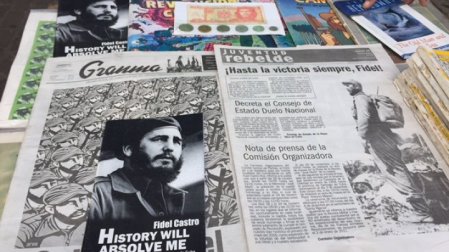
A thought experiment: imagine a country in which such a publication was the only newspaper. Actually come to think of it I don’t have to try that hard because I’ve been there quite recently – in May, in Cuba, where the only two daily newspapers are the black-and-white 12-page Government propaganda sheet Granma (named after the tiny vessel that brought Fidel (RIP) and friends back to Cuba in 1956), and an 8-page supplement for03-cuba-fidel-granma young people called Juventude Rebelde (Rebel Youth), which is similar in look, style and content to the kind of publications the Worker’s Revolutionary Party used to try (and fail) to hand out for free. Both newspapers are hard to track down and (after a couple of days of cheap laughs, and once you’ve set aside a few copies as very cheap presents) genuinely not worth the effort. When in the 1990s the US not-an-embassy put up LED screens to broadcast subversive information to the city it must have had quite an impact. In Mozambique – also nominally a Communist country – the national newspapers are remarkably similar in style and content to the cheaper Portuguese tabloids. I once read a very depressing article (it wasn’t supposed to be depressing) about how popular A Bola (The Ball) is in Angola. In some countries, the main journals of record are ones which just report the achievements of government (rather like a lot of local newspapers nowadays in the UK in relation to local councils). In others, the only opposition newspapers are those owned by politically ambitious oligarchs . There are other channels of communication but the absence of a free press makes a country much culturally and socially poorer and less free.

Continue reading “The Age of Agnotology: The Importance of Reading Newspapers in an Era of Fake News”

Don’t Mention the Climate

15-115I wanted to write about the new US President’s decision to stop NASA conducting research on the earth’s climate, but word fail me, or maybe I them. Where to begin? It’s too depressing to even link to. It would require a command over language which I don’t possess. Maybe poets and other artists are better placed to develop the new forms of expression which will be able to address this new reality. Or perhaps I should get round to watching ‘Hypernormalisation’. Here are three writers who have tried to think through the topic (more or less) head-on.

Continue reading “Don’t Mention the Climate”

Paris

The people who committed the atrocities in Paris are unspeakable beings, pitiful scum, socially and sexually constipated cowards and bullies, and there can be no possible excuses for what they did. We can only hope and pray that they burn in hell for all eternity and that anyone who is contemplating or preparing similar attacks is caught quickly and put out of circulation for good. We must also hope that there are enough people at the top of our states who have some sense of what human rights are and why they came into existence in the first place so that we can preserve some vestige of civilisation rather than falling straight into the terrorists’ trap.

There is no excuse whatsoever for what the evil bastards of Isis did in Paris. But once again it is necessary to point out the distinction between excusing an atrocity and making an attempt to understand how it came to happen and what the consequences might be. France is unambiguously part of the civil war in Syria, being the only country apart from the US currently bombing Isis in Syrian territory. There is a sense therefore in which these attacks were the equivalent of a retaliatory bombing raid. The people who died were innocent in the same way as Syrian civilians, who are faced with this kind of barbarity ever day, are, or as the residents of London were during the Blitz. The French Government, however, is complicit. The point is not simply to stop attacks in Europe and keep the war safely contained several hundred miles away — it is to end the war. Do I know how to do this? No, I don’t, but it is undeniable that this is the context in which the horrifying bloodbath took place. It is not an isolated incident carried out by a bunch of random psychopaths. It is a spilling over of the Syrian civil war. The fact that these attacks took place in a city where people were simply enjoying an entirely innocent night out should give us cause to reflect that the Middle East is not a desert. The places being bombed by our governments contain cafes and other places where ordinary people gather and chat, laugh, stretch their legs and where little children play with balloons and scream when they’ve had too much Pepsi.

The point about the connection between what happened in France, what is happening elsewhere and how it is connected with what the French Government is doing in other countries is explored extremely eloquently in this piece by someone in Beirut. The level of solidarity being expressed around the world is striking, as it was at the beginning of the year in relation to Charlie Hebdo. I’m seeing posts on Facebook by people expressing sorrow, solidarity and anger about the events in Paris who never usually post about injustice or violence elsewhere. Is this a good thing? I genuinely don’t know. I presume that everyone is aware that it’s not only French lives that matter in this world. Could it be that in the case of the UK the fact that it took place in Paris has triggered a Diana effect? Or perhaps just that the cultural connections between the two countries are so deep. Maybe I’m being a little unfair but promoting symbols of Frenchness while ignoring the equally barbaric attacks in Beirut and Baghdad does partly play into the hands of Le Pen, who’s obviously dancing for joy right now as she has just been granted a license to embark on a festival of racist hatred and quite possibly a free pass to the Presidency. I am aware of the danger of constructing paper tigers on the basis of very little evidence but I am also acutely aware that the people I choose to have appear on my social media timelines are people with whom I broadly agree — if I chose to peek outside my bubble it is very obvious that tendencies that I find slightly worrying are being played out with fury elsewhere.

We must express solidarity with the victims and the families and friends of the victims of the barbaric attacks. But we are not one with Le Pen, with the press which attacks refugees, or with the French police who over the last few days have launched another series of brutal attacks on people in Calais, on men, women and children who are in many cases escaping from places where events like those in Paris are a daily occurrence, only to find that the countries providing the weapons and carrying out the bombing raids have their doors firmly fermée. It bears repeating again and again: the terrorists who carried out these attacks are working in league with the racists who attack refugees. Blaming refugees for the attacks, as many have instinctively done and as certain sections of the media are keen to do, is like trying to deal with a serial killer by going after the families of his previous victims. Those on social media expressing a desire to kill Muslims would be best advised to go and join Isis, as that is exactly what they have been doing for the last few years. This issue is one in which horrifying ironies and contradictions abound, and none of us is immune.

There is another level of tragedy to the events in Paris which I haven’t yet seen explored anywhere in the media (update: there is now an excellent article on this very subject by the editor of The Ecologist here). As it happens Paris should have been on everyone’s lips over the next few weeks for a totally different reason. For what it’s worth, at the start of December talks will take place on the subject of the changing climate. As at previous such conferences, certain governments and a great deal of corporate lobbyists are very keen that nothing be agreed at the conference which might in any way come to threaten their GDP or their profits. There is now a good chance that the activities which have been planned for months to put pressure on the delegates to introduce measures to respond to the multiple and exponentially accelerating crisis the world faces will have to be scaled down or may even be outlawed. There have been incidents, particularly in the UK, of climate activists being treated as criminals and even prosecuted under anti-terrorism legislation. The same has happened in the UK and in France to people trying to provide help to refugees — many of whom are, lest we forget, Isis’ victims. As things stand, corporations such as Exxon, Shell, Volkswagen, BP and so on will be able to go on contributing freely to carbon emissions, in the process making sure that in the future there will be many more hashtags expressing solidarity and concern for the victims of future hurricanes, floods, forest fires and droughts without anyone thinking to point the figure at those at the head of those corporations who were fully aware of the consequences of their actions but decided to pull the trigger anyway. Time will tell that such organisations will be the cause of much more death and destruction than the psycho death cult of Isis, and unless we begin to come to terms with the connections between their actions, our behaviour and the floods of refugees escaping northwards around the globe, there will be no-one left to protect us when our time comes.

So who stands to benefit from the events in Paris, apart from a certain death cult spread throughout the Middle East? Not the pricks who did it, because they are mercifully dead. Fascists like Le Pen, Farage and Trump will already be thinking in terms of shiny golden epaulets and which particular salute to adopt. Arms dealers and oil barons will be thinking about how best to cash in. In the meantime, there are people fighting Isis and trying to establish some sort of meaningful democracy in the Middle East. Last week the Kurds managed to win a series of strategic victories against Isis. Maybe in addition to expressing sympathy for all the victims of terrorist attacks, in Paris and elsewhere, one of the most valuable things we can do to combat terrorism in the future is to look for ways to support them.

Veracruz: Shot dead in the pick n’ mix aisle

La transición mexicanaIt’s a shock to walk into a branch of WalMart to be greeted by the sight of three security guards brandishing the kind of major weaponry currently being used elsewhere to pulverise Isis and their victims to pieces. It’s simultaneously comforting and disconcerting to see that no-one else is paying the slightest attention to their presence, in fact the three Robocop clones are acting just like security guards might elsewhere, except for the fact that they are dressed for World War Three, or possibly Four. I don’t ask. They are strolling around, yawning and playing disconsolately with their Motorolas, eying up the Pick n’ Mix and looking ready to blast into space anyone who looks like they might try to smuggle a 48-inch flatscreen down their trousers. I only popped into the place to buy a tiny bottle of Mezcal to entertain myself with post-work while watching the IT Crowd on Netflix; not finding one, I contemplate the possible consequences of trying to leave empty handed. For the first time in my life I am genuinely apprehensive that someone might shoot me dead unless I purchase some alcohol.

Security (or, rather ‘security’) is generally pretty visible these days in Boca del Rio. This seaside suburb of Veracruz was the site of an incident remarkable even by the standards of Mexico’s mid-level civil war, when, on 20 September 2011, 35 corpses were dumped in the street outside a shopping centre by one of the rival gangs of narcos said to dominate the state. The Governor of the State of Veracruz, Javier Duarte de Ochoa, called the episode ‘abhorrent’. Duarte is doing his best to control the situation as he knows best, taking regular lessons from his idol and role model General Franco. He is particularly keen to control the media, particularly when it takes photos of him looking overweight, and he also keeps a keen eye and a heavy fist on the activities of groups of students who try to challenge his rule and hold him accountable. He also keeps himself busy violently refuting persistent and seemingly well-founded allegations that he is directly connected to the activities of narco cartels in his state.

So whenever I come here (it’s my third visit) I find that the word regime tends to play on my mind, partly because in this state, unlike in Mexico City, the ubiquitous state police tend to wear military camouflage uniforms and drive around with heavy armoury mounted on the back of their jeeps. Still, largely because the role of the repressive apparatus is partly to keep the city safe for tourists and business travellers, it feels safe enough, indeed extremely pleasant, to walk around in the sunshine. As I stroll along the malecón I come across a monument to a century of Lebanese immigration, possibly paid for by the country’s most famous Lebanese descendant, who is also one of the world’s richest (and quite possibly dodgiest) men. A hundred metres further on a similar monument, unveiled by the country’s President in 2012, commemorates Jewish immigrants, presumably many of whom fled what Benjamin Netanhayu apparently regards as the Palestinian-inspired Holocaust. Certain kinds of visitors and migrants are therefore welcomed by the regime, others not — in a stark contrast with the two monuments, right across the street above a hair salon is the Honduran consulate. According to Amnesty International (the organisation under whose auspices I myself am ultimately here in the country), Mexico has become a “death trap for migrants”, with tens of thousands of people who are fleeing violence and poverty in Central America and trying to reach the US facing a serious risk of mistreatment, kidnapping and murder along their tortuous route at the hands of both state authorities and drug gangs (in Mexico these are very often the same people). It’s hard to correlate this with my own direct experiences, which are better reflected in a separate report by something called Expat Insider magazine, which places Mexico in second position in terms of its ‘expat quality of life’, with “nine out of ten expats describ(ing) the attitude of the Mexican people toward foreign residents to be friendly”. My instinctive abreaction to this is to vomit; however, a moment’s honest refection exposes the fact that while I may abhor the status of ‘expat’, I enjoy the many protections and freedoms it affords me.

This profoundly simple contradiction sharpens my reflections on my experiences this very morning, when I spent a reasonably difficult hour or so buying tickets for my upcoming trip to Los Angeles (during which I discover that when I try to pay on Expedia using my Mexican card, the price automatically doubles). Nevertheless the level of frustration I experience confirming my passage to the land of the free is put into some perspective when I leave my room and head towards the rooftop pool. Leaving the lift one of the maids greets me, asks me if I speak Spanish and also where I’m from. She then asks to speak to me in private.

Yolanda’s Story

I haven’t seen my husband since eight years ago, when I left Miami and came back to Mexico to be with my children. Now he has contacted me and told me that he wants a divorce. He has met a woman, twenty years older than him who tells him she can get him papers if they get married. He says she doesn’t want any money, and that there is nothing going on between them; she says that after the marriage he will get his papers in three months. I don’t know what to do. He insists that the only reason he wants to do this is so that our children will be able to travel to and live in the US when they are older.

Do you think what he says is true? What do you think I should do?

The sociologist Zygmunt Bauman argues that nowadays power is measured in mobility. The benefits I enjoy in being able to live in and visit different countries at will constitute profoundly unfair privileges, but this incontrovertible fact is one I find very easy to forget when judging people and situations around me. The sacrifices necessary for Yolanda to guarantee some chance of a future for her family and maintain some some of connection with her husband (who, as I delicately suggest to her the following day when I’ve done a bit of research online, sounds a little bit ingenuo if not a total pendejo) are the result of injustices so absurd that it is hard for me to express to her how abject and awkward they make me feel. As many have commented in the past, one of the damaging and damnable things about privilege is how quickly and insidiously it generates a sense of automatic entitlement.

The exam candidates I interview in the few hours of actual work I do during my visit are mostly trainee sailors, who dream of seeing the world and being able to travel the world with impunity. From 2004–2005 I taught, as it happens, in a maritime university in China, where I tried my best to work my way through the separate, but connected, labyrinth of contradictions which my presence there implied. Over these few days it becomes clear that representatives of what I have gradually and grudgingly been forced to accept is my own government suffer no such moral qualms on their visit to the Middle Kingdom, having cut their way through the maze of ethical considerations and abandoned overnight any notion that the UK has a responsibility to at least pay lip service to a human-rights-and-democracy agenda. In Veracruz I am surprised to see the first Chinese English language school I have ever seen outside China. Media allies of the Cameron regime have themselves seemingly been taking lessons from their Chinese counterparts in how to deal with the opposition, launching a vicious campaign of slander against the Guardian journalist Seamus Milne, who Jeremy Corbyn has had the temerity to try to appoint as Director of Communications without first asking their permission, while also in another transparent attempt to impress their new best friends banning the artist Ai Wei Wei from working in the UK.

China is of course not the only repressive regime the UK Government has been working more closely with of late. In addition to its renewed deep personal friendship with the Democratic Republic of Saudi Arabia, this is also the strictly-not-political Year of Mexico UK; ironically, I’m here in Veracruz on behalf of the main organisations involved in promoting this. If it is fair, as I believe it is, to talk about a global neoliberal regime, I myself am working for it.

The day before I leave I pass through the lobby of my hotel and see another first — a banner advertising $10,000 executive trips by luxury yacht, complete with champagne buffet and shark fishing, which warns potential customers that such trips are ‘subject to climate change’. The following day I wake to a text from Ch. warning of a hurricane on the Pacific coast. Dozily, I look at the bright blue sky out of the window and check the weather for Veracruz online. Nothing — little wind, no hurricane. It is only when I browse twitter for all the latest outrage about Israel and Palestine, the global refugee crisis, Corbyn and Milne, George Osborne’s visit to China and all the rest that I see a post about the biggest hurricane ever, which is headed straight for the opposite coast, the part of the country I am due to fly into that very evening — it is scheduled to arrive in Guadalajara at exactly the same time as I am. On the BBC website there is a startling image making it clear that, while everyone on the coast will die and all the buildings will be destroyed, the bright orange section a little inland is probably the second worst place in the world to be flying to any time soon. Meanwhile on the TV news I hear Enrique Pena Nieto boasting that car sales in Mexico hit 900,000 in the first nine months of the year. Unprecedented hurricanes and record-breaking car sales. I am relieved, in a way, at such clear evidence that the immense contradictions to which I am subject do not only exist in my own head. Subsequently, I delay going to Guadalajara, the destruction caused by Hurricane Patrícia turns out to be a lot less than expected, and I am glad that it is not just me who is enormously lucky.
Corbyn, Climate Change and the British media

Articles published in the British press are read and believed far beyond the UK. A good, or rather really rather bad, example of this is the Sunday Times’ concocted story about climate science in 2009. The story resulted from a successful plot by what we might as well call the pro-climate change lobby to troll climate scientists by sending so many freedom of information requests about their work so as it to render it impossible. One email among the millions they acquired in which one scientist asked another about the best way to present some information was seized upon by a climate change troll, who found a principle-free journalist at Rupert Murdoch’s flagshit periodical to turn it into a story about fraudulent climate science. The story flew around the world at great speed, and glasses were clinked in corporate offices right around the rapidly warming planet. The cause of investigating the causes of the changes in the world’s climate was set back for several years, possibly for good. Or, in this case, for very, very, bad.

What does this have to do with Jeremy Corbyn? Well, as we all at some level know, and as we all to some degree refuse to accept, the changes necessary for us to avoid the nightmare scenario of a very rapid change in temperatures are extremely radical, and they must be taken immediately. Vested interests must not just be challenged and persuade to cooperate — the power they wield must be wrested from them. As Naomi Klein points out at length, if companies such as Exxon and Shell had openly admitted the facts of climate change and its implications much earlier, such earthshaking changes would not now be necessary. But they didn’t. They hid the truth, and they paid enormous amounts of money to politicians and opinion formers to create confusion and the appearance of uncertainty about the basic facts of climate science (there’s even a new word to describe this — agnotology). So now that climate change is upon as, and with droughts assailing some parts of the planet while others slowly begin to disappear under unfathomable quantities of water, the question of how we are going to find the resources necessary to deal with all this, and how we are going to wrest the power away from those who value higher and higher numbers on a computer screen over our common ability to survive becomes so pressing and so compelling that it is hardly ever asked — or, at least, the issue is rarely mentioned in the media.

Where are the voices in mainstream politics today who are even beginning to address these questions? Is democracy even the means by which we will find answers, or will we just find that authoritarian capitalism already has all the solutions (in a nutshell: let most people die, continue to deny the causes, instruct the populace to blame the victims, and lock up or kill anyone who protests)? Well, there are but a few. One person who is doing his best to get hold of the wheel and steer us away from the edge of the cliff is the afore-mentioned record-breakingly popular Labour politician Jeremy Corbyn. So how are the British media, respected as they are far beyond the UK’s borders, responding to that challenge? Well, reader, they’re trying to destroy his reputation and his credibility as quickly as they can. They’re making absolutely sure that within any plausible future scenario there will be no visible political alternative to the dogma that no matter how big the problem, the market will be able to fix it. That’s the market dominated by companies like Exxon and Shell, who knew the facts about the effects of their activities forty years ago but hid that information so as to protect their profits. In the media market control lies in the hands of companies like News International, which conspires to discredit climate scientists and potentially disruptive politicians and whose stories, no matter how dishonestly obtained or how inaccurate, dictate the news agenda right across the world.

Ideally, a politician who took up the cause of the climate catastrophe would be acceptable to the mainstream media. He or she (wouldn’t it be great if it was a woman?!) would be feted by the political establishment and her or his prescriptions for how to address the crisis would be welcomed (they would also be a lot more radical than Corbyn’s, but that’s beside the point here). That’s what would happen in a perfect world. But it hasn’t, and it won’t. Anyone who challenges the political agenda according to which the habitat that earth affords us must be sacrificed to feed the insatiable needs of the global market, anyone who looks like they could potentially block the pipeline which runs directly from our suffering to their bank accounts, must be destroyed. That is one very significant aspect of what is happening right now in British politics and in the UK media.

Left Unity: The Importance of a Green Agenda

The last couple of weeks have seen the publication of two articles in the mainstream media whose implications could not be any more explicit or terrifying. According to last week’s Guardian we face a(nother) global economic crisis as a result of the imminent bursting of the ‘carbon bubble’: http://www.guardian.co.uk/environment/2013/apr/19/carbon-bubble-financial-crash-crisis. What this means is that the energy markets have not yet priced into their models the fact that  most of the world’s fossil fuel resources will have to stay in the ground if the world is to make any serious attempt to tackle climate change. The energy industry’s concerted efforts to sponsor inaction on climate change have, therefore, been an ongoing and desperate attempt to stave off the inevitable moment when their share prices take into account either the fact that their well will very soon run dry or that the global ecosystem which sustains all human activity will soon collapse.

Another article published today on the BBC News website (http://www.bbc.co.uk/news/business-22002530)  goes by the title ‘How is the world going to become extinct?’, and reports that a group of Oxford scientists are addressing this question very seriously indeed, speculating about what will (not might) deal the killer blow to the human race: an unpredictable and uncontrolled acceleration in computer technology is a contender, the unforeseen ecological side-effects of new synthetic organisms another. As this is the BBC, the article makes no specific reference to climate change, but it is unlikely that the scientists themselves are quite so complacent. In the words of Dr Nick Bostrom, “There is a bottleneck in human history. The human condition is going to change. It could be that we end in a catastrophe or that we are transformed by taking much greater control over our biology…this could be humanity’s final century.”

So, to recap: either we fundamentally and immediately transform our economic way of life and our relationships with technology and our environment, or we face not just social collapse but planetary annihilation. Could the need for a workable alternative to the insanely destructive logic of neoliberal turbocapitalism be any starker?

It is therefore critical that Left Unity have at its base a radical green agenda. It is not enough to pay lip service to the need to ‘protect the environment’. Every aspect of our opposition to austerity and our revisioning of society, each one of our policies and initiatives must be conditioned by the need to dramatically reduce our dependence on fossil fuels and develop sustainable alternatives. The concept of climate justice must also be a founding tenet of our organisation, especially given that climate change is already having a devastating impact on the lives of millions of people around the world, especially the very poorest. Above all, the question of who pays for climate change is a profoundly political one; thanks to another recent Guardian report (http://www.guardian.co.uk/business/2012/jul/21/global-elite-tax-offshore-economy) we know that no less than $21 trillion is currently hidden in offshore accounts by the world’s rich. The resources we need in order to begin to reconstruct society on a fairer and more sustainable basis are there. If we are to survive for more than a few short and painful decades we simply have no alternative but to join together and seize them.

Denial 2: On Blinkeredness

filterbubblesI noticed a couple of years ago when living in a fairly nondescript part of East London, in the kind of Olympically lifeless area where absolutely everyone comes from everywhere else and no-one sticks around for long, that in some parts of the country, and maybe the world, it is becoming more and more difficult to find a shop where get your hands on a physical newspaper. Conversations with my international students confirm this: the regular purchase of a newspaper is increasingly a minority pursuit, an odd and probably slightly quirky habit of people over 35 or so. Younger people inevitably get their news online, if at all – the news might simply consist in what their friends are up to on Facebook or maybe a glance at Google or Yahoo headlines. Given that so much of what we perceive of the world is mediated in some way, what does this imply about our collective experience of a shared reality?

A few years ago I remarked on my Chinese students’ reluctance to engage with information which might conflict with what they had grown up and been taught to believe about their own society. Despite the opportunities presented by the internet, they continued to prefer Chinese sites and to steer well clear of alternative sources of news, ideas and information despite having the language to make sense of what was being said. At the time I tended, rather patronizingly I now see, to regard this as a symptom of ideological brainwashing by the evil Chinese Communist Party, but since then I have come to see this kind of instinctive and wilfull blinkeredness as more generalized and not remotely restricted to authoritarian societies.

Now obviously my Facebook news update page and Twitter feed are different from yours. I chose to follow or to be friends with certain people, and am of course aware that the information I receive in this way does not give me a particularly comprehensive view of what is going on in the society in which I live or around the world. However, news sites tend now to work in a similar way, or at least offer to let you have your news your way – just business and sports headlines if that’s what you’re interested in, with none of that bothersome stuff about earthquakes and floods and generally what’s been happening to people you’ve never even met.

To go back to when I was in the authoritarian society of China, it caught my attention that the results I got from Google searches tended to be quite different from the results I got outside China. This has been quite ably demonstrated elsewhere – if you type Tiananmen Square into google anywhere else in the world, you are confronted with the famous picture of the guy standing in front of the tank, whereas if you do so in China. you get some American people’s holiday snaps (and if you look for human rights in google in China, your internet connection goes down for five minutes). In China, then, we are dealing with a formal kind of censorship, acknowledged or not. Whether or not google colludes in this is not generally known. But what is clear is that, these days, something similar happens wherever we are in the world.

In the interview below Eli Pariser shows us what happens when he types Egypt into google: he gets a page of results which pertain to recent developments: the fall of the dictator and the ongoing revolution. He then shows us what happens when a less socially conscious friend did the same thing – the results he received were mostly related to holidays. Google uses a series of filters to show us what it thinks we as individuals do and do not wish to know. It does so automatically and for our own benefit – just as the authoritarian Chinese Commmunist Party does.

The kind of people I teach here in London are about as likely to type human rights into google as they are to buy a copy of the Guardian.The same is certainly true for climate change – any attempts, even in the most underhand and careful of ways, to raise the topic result in what George Marshall describes as a ‘spinach tart’ moment. Not only are they very unlikely to seek information on the impending annihilation of the human species or indeed on what we individually and collectively can do to prevent it, they are also, these days, extremly unlikely to come across any information on it, given the way that they, and we, increasingly experience the world through a tighter and tighter set of filters, for our own benefit and convenience.

However, for all that we may be inclined to hope that we can hide from the four horsemen in our own private and sealed utopias online, it transpires that this is not the case. According to a recent government report, it is predicted that climate change will play havoc with our internet connections: ‘higher temperatures can reduce the range of wireless communications, rainstorms can impact the reliability of the signal, and drier summers and wetter winters may cause greater subsidence, damaging masts and underground cables’. Maybe our best option would be to challenge climate change to a game of (offline) chess.

by Rich

Some thoughts on Wikileaks and Climate Change denial

11748cartoon20-20climategate20bearNina Power picked up on one little-noticed aspect of the Wikileaks affair, and I want to pick up on another.

I saw in the Guardian that intelligence analyst Bradley Manning, the source of the leaks, wrote excitedly to his (poorly) chosen contact in the outside world, ‘it’s Climategate with a global scope and breathtaking depth‘.

Climategate: we hoped it had quietly gone away, but this snippet shows it has had a monumental impact on public opinion of climate change. Or at least, it has legitimised a stance of total denial.

Why are so many otherwise entirely rational and intelligent people so prepared to give credence to the denialists? Of course it is partly to do with the media hegemony of corporate power, but not entirely. Personally I comfort myself in the secure knowledge that I myself am prepared to ‘believe’ in the reality of what is happening and what we face, that I ‘know’ that it is happening and will continue to happen; but I’ve come to think that I may be mistaken about my own belief.

There are after all very many things we think we believe, but actually we don’t, and to ‘know’ something is not the same as, in the words of Sven Lvindquist, to have understood what we know and to have drawn conclusions. Despite my firmly held and rationally based opinions, my own actions suggest that I am not a strong believer in the reality of climate change. I do not place much importance in recycling, for example, choosing to regard it as something of a superstitious action akin to shouting at the TV to influence the result of a football match (nobody of course would ‘believe’ for a second that doing so would have any impact, but their (irrational) behaviour might make one think otherwise). My position on recycling could probably be characterised as something of a ‘beautiful soul‘ one: given that other people refuse to change, and given the immense complexities involved, I refuse to act, regarding it (entirely rationally) as both utterly ineffective and beneath me. Nevertheless it’s one that I have until now felt entirely comfortable with.

It’s very difficult, impossible perhaps, to take a realistic and rational view of climate change. There is no level of fear or anger that is proportionate, and none of our individual actions are remotely sufficient. I have come to realise however that gestures are important, contrary to what I’ve always thought and contrary to what Slavoj Zizek so entertainingly argues. My actions suggest that subconsciously, like anyone else, I refuse to accept the reality of climate change. The trauma is too great to integrate into my notion of the world, the future of the world and my place in it, and so I act as if I will never be affected. But changing my habits can force me into believing at a deeper level. In Alcoholic’s Anonymous they call this ‘acting as if’; first you change your behaviour, and then hopefully, gradually, your beliefs, both conscious and unconscious, about your ability to manage your life without a drink in your hand begin to change.

To slip briefly into amateur Lacanese, because the Real of climate change is impossible to apprehend, we have to act within the realm of the symbolic. Symbolic tokens in the form of gestures do have a value; they can be exchanged for genuine belief. Not just recycling but skills shares and community gardens are important, as are all other forms of exchange not based purely on exploitation. Staying out of supermarkets is a good move for all sorts of reasons.

Nowadays, again like anyone else, we consume constantly, indiscriminately, or ironically, consuming our own gestures of consumption. This is the age of Mcdonalds happy meals consumed in a constant low-level muzak hum of cynicism, apathy and despair, flat screen Tvs gorged down in the midst of a recession. We consume because we are; What else are we, what else are we to do?

There is of course no substitute for collective political action, for maximum anger gathered and launched at those in power who notice our failure to genuinely believe and so pretend to act, understanding that for us, for now, pretending to act is enough. But it can serve to help us accept the anger and fear that climate change generates, to live with it and try to live differently.

I think I believe in the reality of climate change. But the fact that I fail for the moment to begin to live differently shows that I do not, yet. I first have to change the way I live my life.

Scraping the Barrel


Many of the comments on this thread in relation to what I wrote about China yesterday have revealed a less-than-surprising but still extremely discomforting ignorance about the future of our planet, especially in ..one of the world’s more powerful countries, let’s say. Impressively blinkered ideas like this:

As the article shows, many places are showing increases in a variety of alternatives as well as technologies that decrease oil-dependency. It’s slow, but I don’t see any reason to speed things up. Unless there’s some hard numbers that you’re aware of that you could show me? As far as I know, we have plenty of oil for the time being. By the time we start running out, I’ve little doubt that other technologies will have matured enough to take its place.

…reminded me of what our beloved George Monbiot had to say a couple of years ago what the declining supply of oil will mean for the lives of every one of us in the not-at-all-distant future:

The only rational response to both the impending end of the oil age and the menace of global warming is to redesign our cities, our farming and our lives. But this cannot happen without massive political pressure, and our problem is that no one ever rioted for austerity. People tend to take to the streets because they want to consume more, not less. Given a choice between a new set of matching tableware and the survival of humanity, I suspect that most people would choose the tableware.

Bottom of the barrel
The world is running out of oil – so why do politicians refuse to talk about it?

If you multiply the growth of India and China by the declining stocks of oil and natural gas, you get…a very small or large number, depending on how maths works. It’s beyond me. But especially if you factor in the glib complacency which seems to be endemic in that country I mentioned earlier, it all gets very very frightening.

Living the Chinese Dream


I did not meet one student in China who did not want to live what might be termed the ‘Chinese Dream’ – to work hard for a multinational company, live in a brand-new apartment in a big city and own their own car. Death of a Salesman anyone? Very few people who aspire to that lifestyle are going to be able to achieve it – and if they do, the consequences for China and the world are almost too horrendous to contemplate. I mean, I have tried to think about what it means for our environmental resources, but thankfully this guy has gone several steps further and actually done the maths. And while I find Maths itself pretty traumatic to deal with, his conclusions may make you want to pack up and head for Mars:

The western economic model – the fossil fuel-based, car-centred, throwaway economy – is not going to work for China. If it does not work for China, it will not work for India, which by 2031 is projected to have a population even larger than China’s. Nor will it work for the 3 billion other people in developing countries who are also dreaming the “American dream”.

The key point though, which a lot of people writing about the consequences of China’s massive industrial growth rate seem shy to confront, is that it’s not just a question of how the Chinese do things, but about the unsustainability of our own model of development, which developing countries are simply encouraged to emulate:

In an increasingly integrated global economy, where all countries are competing for the same oil, grain and iron ore, the existing economic model will no longer work for industrial countries either.

It’s a very refreshing and not entirely dispiriting article – if you happen to live in China you might not be able to find it via Google:

After holding out longer than any other major internet company, Google will effectively become another brick in the great firewall of China when it starts filtering out information that it believes the government will not approve of.

According to one internet media insider, the main taboos are the three Ts: Tibet, Taiwan and the Tiananmen massacre, and the two Cs: cults such as Falun Gong and criticism of the Communist party.

I reckon I could do that job!