 Isn’t our revulsion at Trump’s victory partly abhorrence at those aspects of ourselves which make us most ashamed and uncomfortable? Sometimes recently I’ve heard an echo of Trump’s worldview and temperament in my own thinking: a moment of selfishness, resentment or arrogance. Continue reading “Sunday Sermon/Unsolicited Trump rant no. 3”
Tag: denial
Two impossibilities: Brexit and Trump
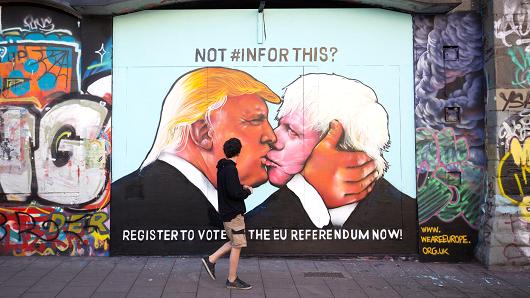 Two impossibilities: Brexit and President Trump. Not in the conventional sense that they were both considered impossible events until they became real, but rather in the sense that they still are. Continue reading “Two impossibilities: Brexit and Trump”
Denial 3: Remarks on ‘Shoah’
 To sit down for a full nine and a half hour showing of the Holocaust documentary ‘Shoah’ is to embark on a long-haul flight into terrible, dark skies. It may be a little glib to suggest that it would be of an ideal length to show on transcontinental journeys to and from Germany and Poland (and perhaps also Israel, of which more later), but in the face of the testimonies presented in the film, all aspects of life and all commentaries take on shades of glibness. It is oddly salutary to note that the same cinema that presented the film is also currently showing one by the noted Holocaust affirmer Mel Gibson (affirmer in the sense that those who would deny the Nazi genocide took place know full well that it did, they just thought it was a good thing).
The interviews are conducted in German, English, French, Polish, Hebrew and Italian. The consecutive translation from Polish meant that I was always trying to make sense of what could not be understood, which seems apt. Another curious thing is that a lot of the language used can be called Business German, given that people are describing, in the words of one former SS commander, ‘an efficient production line of death’. The talk is of Ware (merchandise), Verschiffungen (shipments), Verarbeite (processing) and technische Änderungen (technical changes). The purpose of the enterprise was partly to appropriate Jewish goods, a wealth accumulated over centuries during which repeated attempts were made throughout Europe to seize it; hence the Nazi’s Endlösung (final solution).
 Now as I mentioned it is practically impossible to talk about the events described in the film without sounding trivial or as if one is revelling in the morbidity of it all. If Adorno famously found it impossible to conceive of how poetry could be written and art created after Auschwitz, a blog post written by me is certainly not going to add anything of meaning. The instrumental use of the Holocaust as a moral yardstick with which to draw comparisons is something explicitly rejected by, for example, the director of the film. However; it is hard to watch this scene without hearing future echoes in one’s brain of what happened in and after 1948, indeed is very much still going on, in another part of the world. I do not want to focus on this explosively contentious analogy here, nor is this the place to explore the uncanny resonances when the historian Raul Hilberg talks about what happened when the Greeks were unable to acquire enough Deutschmarks in order to exchange their stolen Jewish drachmas so they could pay for the selfsame Jews’ journey to death: they were forced to default.
One word that crops up repeatedly in Shoah is Gold. The Jews were the victims, Polish villagers tell us, not only because they were rich and lazy and their women were like sirens to the local men, but ‘because they were the richest’ and ‘they controlled the capital’. Primitive accumulation is clearly one of many reasons for the Nazi genocide.
We may be about to enter very deep waters of glibness, to coin a somewhat ungainly phrase. But still.
 We are in a period in which what is most of value in this society is being converted into money. From the Cash for Gold ads on TV to the impending attempts to sell off our future health to the highest bidder, it is a process which David Harvey has characterised as ’accumulation by dispossession’. Everything must go, we are told: islands in Greece, pensions in Spain, social welfare here in the the UK, the sentimental objects you have accumulated in your attic. There is no alternative; everything, as Mark Fisher has pointed out, must be evaluated in terms of its immediate or potential exchange value, including ourselves. News has become Business News, philosophy has become Business Philosophy, and all this business is conducted in the new global language of Business English.
About this time last year I was at a music festival and I got chatting to a young woman who had just graduated in a health-related discipline. I mentioned that this was possibly not a great time to be doing so what with the impending destruction of the NHS, but she corrected me, saying that in her field of private health consultancy things were about to boom and opportunities abounded.
 Now, I think in the broadest possible sense we as humans today tend to avoid reflecting too much on the broader consequences of the things we do all day at work, especially when jobs and careers are very difficult to obtain and easy to lose. Few people would be happy to fully accept that what they do for eight hours or more in their jobs makes the world a worse place. In any case, we are not for the most part the ones pulling the switches and deciding where the particular train on which we are riding is going to go. The same is true in the film; four Nazis are interviewed and they all have excuses and explanations – inevitably they did not know, or ‘they saw’ prisoners being beaten to death, by others doing the same job, and it was terrible, terrible for me…or literally in this case, I was so very busy working I never got round to asking where the trains I was coordinating were going, nor why there so very many of them, over such a long period, and anyway it wasn’t the done thing to ask…
To return for the final time this week to Zizek, he writes in ‘Violence’:
‘Hannah Arendt was right: these figures (the Nazis) were not personifications of sublime Byronesque demonic evil: the gap between their intimate experience and the horror of their acts was immense.’
 No-one sees themselves as a personification of evil; we all have interior rationalisations of what we do. The horror of capitalism is not only that in commodifying our time and our mental and physical energies it also forces us to sell off our ethical consciousness; it is that it does the same to those around us, and our sense of what we should do is largely based on copying what others seem to think they should do. Zizek goes on to remind us:
‘The experience that we have of our lives from within, the story we tell ourselves about ourselves in order to account for what we are doing, is fundamentally a lie — the truth lies outside, in what we do.’
Much was written a number of years ago rightfully castigating the Sinead O’Connor line on the Hitlers and Stalins of history, that they were probably abused as children or something. But we were all abused as children. We simply cannot use it as an excuse to abuse others. And if we know that abuses are going on elsewhere in our name or for our cause, or as a result of our daily enterprises, whether for financial gain or out of some vicious inexplicable cruelty, we have an absolute moral imperative to stop them.
Denial 2: On Blinkeredness
 I noticed a couple of years ago when living in a fairly nondescript part of East London, in the kind of Olympically lifeless area where absolutely everyone comes from everywhere else and no-one sticks around for long, that in some parts of the country, and maybe the world, it is becoming more and more difficult to find a shop where get your hands on a physical newspaper. Conversations with my international students confirm this: the regular purchase of a newspaper is increasingly a minority pursuit, an odd and probably slightly quirky habit of people over 35 or so. Younger people inevitably get their news online, if at all – the news might simply consist in what their friends are up to on Facebook or maybe a glance at Google or Yahoo headlines. Given that so much of what we perceive of the world is mediated in some way, what does this imply about our collective experience of a shared reality?
A few years ago I remarked on my Chinese students’ reluctance to engage with information which might conflict with what they had grown up and been taught to believe about their own society. Despite the opportunities presented by the internet, they continued to prefer Chinese sites and to steer well clear of alternative sources of news, ideas and information despite having the language to make sense of what was being said. At the time I tended, rather patronizingly I now see, to regard this as a symptom of ideological brainwashing by the evil Chinese Communist Party, but since then I have come to see this kind of instinctive and wilfull blinkeredness as more generalized and not remotely restricted to authoritarian societies.
Now obviously my Facebook news update page and Twitter feed are different from yours. I chose to follow or to be friends with certain people, and am of course aware that the information I receive in this way does not give me a particularly comprehensive view of what is going on in the society in which I live or around the world. However, news sites tend now to work in a similar way, or at least offer to let you have your news your way – just business and sports headlines if that’s what you’re interested in, with none of that bothersome stuff about earthquakes and floods and generally what’s been happening to people you’ve never even met.
To go back to when I was in the authoritarian society of China, it caught my attention that the results I got from Google searches tended to be quite different from the results I got outside China. This has been quite ably demonstrated elsewhere – if you type Tiananmen Square into google anywhere else in the world, you are confronted with the famous picture of the guy standing in front of the tank, whereas if you do so in China. you get some American people’s holiday snaps (and if you look for human rights in google in China, your internet connection goes down for five minutes). In China, then, we are dealing with a formal kind of censorship, acknowledged or not. Whether or not google colludes in this is not generally known. But what is clear is that, these days, something similar happens wherever we are in the world.
In the interview below Eli Pariser shows us what happens when he types Egypt into google: he gets a page of results which pertain to recent developments: the fall of the dictator and the ongoing revolution. He then shows us what happens when a less socially conscious friend did the same thing – the results he received were mostly related to holidays. Google uses a series of filters to show us what it thinks we as individuals do and do not wish to know. It does so automatically and for our own benefit – just as the authoritarian Chinese Commmunist Party does.
The kind of people I teach here in London are about as likely to type human rights into google as they are to buy a copy of the Guardian.The same is certainly true for climate change – any attempts, even in the most underhand and careful of ways, to raise the topic result in what George Marshall describes as a ‘spinach tart’ moment. Not only are they very unlikely to seek information on the impending annihilation of the human species or indeed on what we individually and collectively can do to prevent it, they are also, these days, extremly unlikely to come across any information on it, given the way that they, and we, increasingly experience the world through a tighter and tighter set of filters, for our own benefit and convenience.
However, for all that we may be inclined to hope that we can hide from the four horsemen in our own private and sealed utopias online, it transpires that this is not the case. According to a recent government report, it is predicted that climate change will play havoc with our internet connections: ‘higher temperatures can reduce the range of wireless communications, rainstorms can impact the reliability of the signal, and drier summers and wetter winters may cause greater subsidence, damaging masts and underground cables’. Maybe our best option would be to challenge climate change to a game of (offline) chess.
by Rich
Denial 1: On denialism
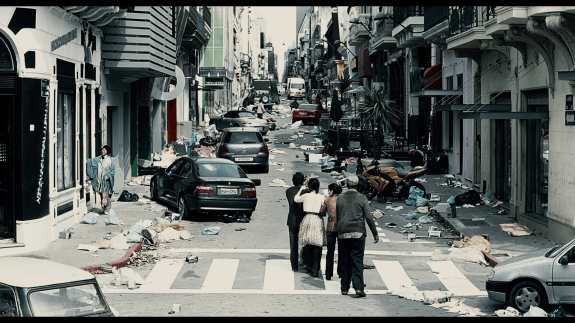 I mentioned to a friend that I had foolhardishly bought a ticket for a full showing of the nine and a half hour long Holocaust documentary Shoah. He responded that it would be effective aversion therapy for a Holocaust denier. Now personally I have never thought of myself as a Holocaust denier, but I guess there must be a reason why I have decided not just to subject myself to presumably the most upsetting and depressing celuloid experience of my life but also to pay a much delayed visit to Auschwitz this summer. Maybe, deep down, without knowing it, I am a Holocaust denier. Or maybe my interest is more casually macabre, like this guy (or on another level WG Sebald may have something to do with it). Perhaps we all are Holocaust deniers, in that most of the time, we go about our daily lives not reflecting upon the import not only of that most base of human achievements, but all the horrors that we know full well are going on around us, some of which we know at some level that we are deeply implicated in (and the means we increasingly use to try to escape from this reality allow us to also avoid our ethical responsibilities: a friend’s facebook profile reads, ‘Zen is not some kind of excitement, but concentration on our usual everyday routine…’…hmm, no need to worry about the ethical consequences of what we do all day at work then). Perhaps, as someone wise once speculated, we simply choose to be blind.
As Zizek pointed out, some traumas are too, well, traumatic to be integrated into the human psyche. There is no rational or appropriate response to knowledge of the Holocaust. It simply defies our categories of knowledge and belief, shatters the coordinates of our reality. In a very similar way, there would be no appropriate response to the coming horrors of climate chaos, and no visible means by which we can alert ourselves, those we love and those who do not exist yet in order to somehow prevent it from happening. So we all, at some level, deny it is happening.
Speaking of the holocaust, the French philosopher Raymond Aron articulated very well how ideology works today: ’“I knew, but I didn’t believe it, and because I didn’t believe it, I didn’t know.” Sven Lindquist said something similar: “You already know enough. So do I. It is not knowledge we lack. What is missing is the courage to understand what we know and to draw conclusions.” George Marshall of the Climate Outreach Information Network makes a similar point with reference to Climate Change: we need to stop calmly telling people about what is happening and concentrate on showing them how scared and angry we are. Actually, he didn’t say scared, I did. Here is a video in which he explains what he means; you can find much more of this sort of thing here:
Some thoughts on Wikileaks and Climate Change denial
 Nina Power picked up on one little-noticed aspect of the Wikileaks affair, and I want to pick up on another.
I saw in the Guardian that intelligence analyst Bradley Manning, the source of the leaks, wrote excitedly to his (poorly) chosen contact in the outside world, ‘it’s Climategate with a global scope and breathtaking depth‘.
Climategate: we hoped it had quietly gone away, but this snippet shows it has had a monumental impact on public opinion of climate change. Or at least, it has legitimised a stance of total denial.
Why are so many otherwise entirely rational and intelligent people so prepared to give credence to the denialists? Of course it is partly to do with the media hegemony of corporate power, but not entirely. Personally I comfort myself in the secure knowledge that I myself am prepared to ‘believe’ in the reality of what is happening and what we face, that I ‘know’ that it is happening and will continue to happen; but I’ve come to think that I may be mistaken about my own belief.
There are after all very many things we think we believe, but actually we don’t, and to ‘know’ something is not the same as, in the words of Sven Lvindquist, to have understood what we know and to have drawn conclusions. Despite my firmly held and rationally based opinions, my own actions suggest that I am not a strong believer in the reality of climate change. I do not place much importance in recycling, for example, choosing to regard it as something of a superstitious action akin to shouting at the TV to influence the result of a football match (nobody of course would ‘believe’ for a second that doing so would have any impact, but their (irrational) behaviour might make one think otherwise). My position on recycling could probably be characterised as something of a ‘beautiful soul‘ one: given that other people refuse to change, and given the immense complexities involved, I refuse to act, regarding it (entirely rationally) as both utterly ineffective and beneath me. Nevertheless it’s one that I have until now felt entirely comfortable with.
It’s very difficult, impossible perhaps, to take a realistic and rational view of climate change. There is no level of fear or anger that is proportionate, and none of our individual actions are remotely sufficient. I have come to realise however that gestures are important, contrary to what I’ve always thought and contrary to what Slavoj Zizek so entertainingly argues. My actions suggest that subconsciously, like anyone else, I refuse to accept the reality of climate change. The trauma is too great to integrate into my notion of the world, the future of the world and my place in it, and so I act as if I will never be affected. But changing my habits can force me into believing at a deeper level. In Alcoholic’s Anonymous they call this ‘acting as if’; first you change your behaviour, and then hopefully, gradually, your beliefs, both conscious and unconscious, about your ability to manage your life without a drink in your hand begin to change.
To slip briefly into amateur Lacanese, because the Real of climate change is impossible to apprehend, we have to act within the realm of the symbolic. Symbolic tokens in the form of gestures do have a value; they can be exchanged for genuine belief. Not just recycling but skills shares and community gardens are important, as are all other forms of exchange not based purely on exploitation. Staying out of supermarkets is a good move for all sorts of reasons.
Nowadays, again like anyone else, we consume constantly, indiscriminately, or ironically, consuming our own gestures of consumption. This is the age of Mcdonalds happy meals consumed in a constant low-level muzak hum of cynicism, apathy and despair, flat screen Tvs gorged down in the midst of a recession. We consume because we are; What else are we, what else are we to do?
There is of course no substitute for collective political action, for maximum anger gathered and launched at those in power who notice our failure to genuinely believe and so pretend to act, understanding that for us, for now, pretending to act is enough. But it can serve to help us accept the anger and fear that climate change generates, to live with it and try to live differently.
I think I believe in the reality of climate change. But the fact that I fail for the moment to begin to live differently shows that I do not, yet. I first have to change the way I live my life.
 Infinite Coincidence