Locked Out in La Condesa

I once heard it said that when you move into a new home, one of the first things you should do is get yourself locked out, so as to try to work out how, if you were a burglar dead set on robbing your house, you might go about doing so, all in order to work out how to best protect your property and shore up your possessions. Another game I recently invented, quite inadvertently, is to get yourself locked out not in order to find your way in, but to find your way, as it were, out. After all, in almost all certainty, very, very few of your immediate neighbours are right now planning to rob your house. And getting yourself locked out is a wonderful way to meet your neighbours and find out a little bit about how the society (or, ideally, community) around you works.

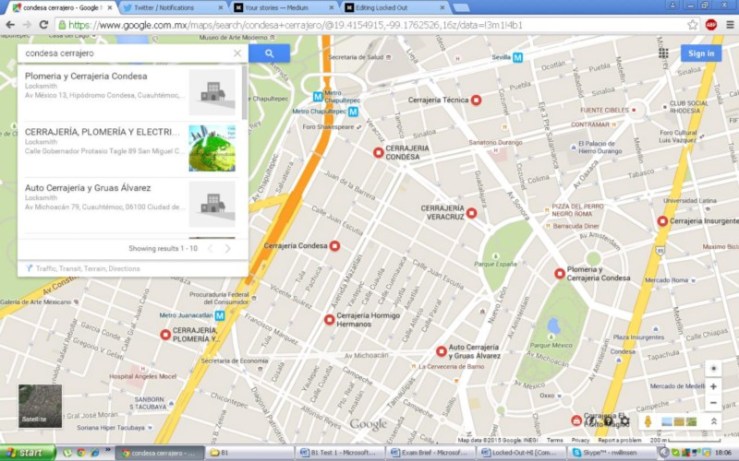
It turns out that, at least in Mexico City, contrary to what you might, quite reasonably, have expected of the place, not everyone needs, or even uses, locks on their doors. Paradoxically, the local locksmith, to whom I swiftly turned in my actually really rather relatively desperate plight, given that I, on the way to the gym, had got myself locked out with no money or phone (and, even more significantly, no keys), two days after my wife, who for comedy reasons also likes to refer to herself as my ‘flatmate’, had flown off to the most racist country on earth for two whole weeks, and given that my landlady, who I managed to contact via Skype having begged my way onto a computer in an extremely obliging local internet café just down the road, didn’t, it transpired, have any keys herself, the locksmith, that one to whom I referred at the start of the sentence, wasn’t actually there, and had left his shop (which doesn’t have a door, let alone a lock) completely unguarded while he went out on a job, but then when he did return, he promised to be round to the flat ‘ahorita’, a word guaranteed to send a chill down the spine of any recently arrived foreigner who tries really hard not to base their knowledge of Mexico on what they’ve read on the internet, but can’t help wondering if that means today, next week, or never, and then (the locksmith) came round five minutes later and, using an instrument the usefulness of which certainly gives one pause for thought (that thought being, my god, it’s really easy to break into houses) he opened the seemingly impregnable door in less time than it takes to put a much-needed full stop at the end of this sentence.

So it turns out that we are lucky to live in a medium-sized village in the centre of what is very probably the largest city on earth. One which, it turns out, unusually for a village, has so many nice places to eat which subsequently turn out to be chain restaurants that you’d start to wonder if when Karl Marx came up with that natty line about the whole world being in chains he might actually have just spent a couple of weeks in Condesa, but one which clearly benefits from a strong sense of, if I can’t quite bring myself to call it social solidarity, certainly abounds in helpfulness and basic good-hearted neighbourliness. Which I must say, and here I risk revealing myself as someone who’s deeply immersed in the third stage of culture shock, is quite refreshing after London. One wonders, and I will return to this shortly, how the UK will deal with the next stage of psychopathic structural adjustment, given that, unlike in a society like Italy, where, as this programme details, young unemployed people will stay with their families, and also unlike (according to David Harvey), in China where it is the ancestral village that provides social support when the state is absent — when a Chinese migrant worker gets ill, they go back to their hometown, in the UK (rejoinder: it seems to me that…) the social fabric, the social safety net that lies underneath the formal state safety net, is extremely frayed. What the UK has in abundance is negative solidarity, a spiteful attitude towards those who are suffering, a contempt for anyone might be seen as a loser or victims. That’s not remotely to claim that compassion and solidarity are absent, but is does mean that, unlike in Spain, where extremely well organized movements have managed in numerous cases to prevent people being kicked out of their homes, in the UK such movements have had very little (one of Russell Brand’s favourite new words coming up!) purchase. In some ways, Mexico (and Spain, and Italy) are probably better societies in which to find yourself locked out of your house, or indeed to be without a home at all, than the UK.

Coincidences

…or, to be more precise, two coincidences. Were I a journalist of any kind (which I’m not), I would be looking for a third to corroborate the sense that something is up, that there is something in the air. Actually there is indeed, as it happens, something troubling the atmosphere — it’s called precontingencia, a word I learnt this morning from the newspaper, a word which, by coincidence, is seemingly only used (or useful) to describe the set of unnatural and unhealthy climatic conditions persisting over the last few days in Mexico City.

It just so happened that in the cheerful café where I was having lunch today, probably the only non-Hollywood Mexican actor I’ve heard of was sitting at the next table. To be fair he had to be pointed out to me, but it was none other than Damián Alcázar, star of every one of Luis Estrada’s enormously successful, extremely entertaining and utterly horrifying depictions of Mexican society. Coincidentally, just this very morning, while investigating buying tickets for his new play, which I had, by coincidence, seen advertised, I was surprised to see it had been cancelled. I decided that a pinche gringo molesting him about this while he was enjoying a social lunch would not have been at all welcome.

Subsequently, while strolling through the plaza which is not called Plaza Cibeles, I happened upon a plaque commemorating the life’s work of Carlos Monsivais, someone who I had been unaware of until four days ago, when my Mexican teacher directed me towards the books of this polymath intellectual and theorist of Mexican culture, society and identity, who also happened to be a fellow traveller (or camper) of the ever-more-interesting Zapatista movement, and was the originator of the enticing theory that the Mexican elites who, perhaps more than ever before, have a stifling grip on power, are essentially gringos who just happen to have been born in Mexico.

That’s enough coincidences for the time being. Maybe I should fear a third — it might be less serendipitous. Perhaps there are superstitions pertaining to this. Too many coincidences could be a bad omen, for example of a prolonged period of no rain. As I walked along Calle Ensenada just now there was a young guy watering the flowerbeds outside a restaurant, indifferent to the very rapidly very darkening skies overhead. Another coincidence, then: before coming here I was nervous about the possibility of prolonged drought, like the truly terrifying ones going on in California and São Paulo. Given that it apparently rains around 200 days a year here (and is currently raining torrentially), you wouldn’t expect a lack of water to be a problem. But it is. El DF could run out of water at any moment. At least here in Mexico there are solutions at hand.

Day 11

There any only a finite number of ways to find out what’s going on around you: observe, listen, ask, participate, guess…or read. Me, I like newspapers and detective fiction. Adopting a newspaper is my standard operating procedure when trying to get to grips with a language and a culture. Except when I lived in China, where, exiled from the written word in terms of my interaction with the society around me, I mostly used guessing to work out what was going on — not a foolproof procedure when dealing with a culture and society as complex as China’s. I did ask questions, but with hindsight they weren’t very good questions. Not that I knew that at the time. While in China, knowing that for me it was a stopping-off point on the way to Spain, I fought my way through an original language copy of Cien Años de Soledad, not so much a whodunnit as a whatthefuckisgoingon, especially given my copy had no árbol genealógico. Since I was already trying to cram my head with Chinese and rescue a clearly doomed relationship I needed to read something simpler which did not feature literally hundreds of characters who were seemingly all called Aurelio or Rebeca Buendía.

Around that time I discovered that Subcomandente Marcos, the (ahem) Leader of the Zapatista army, had written a crime novel with another writer and it was being serialized in what was evidently Mexico’s primary daily left-wing newspaper, La Jornada (the newspaper I’ve now been reading assiduously since we arrived in DF). From that experience came the few bits of Mexican Spanish which don’t basically mean f*ck yer mum. I can’t claim to have finished the novel because it was a written in dense literary Mexican Spanish, so I interspersed my adventures with Melquíades and the gang by reading a tacky French crime novel from an American crime series presented by someone who turned out to be some sort of a catholic fascist. I didn’t really mind at the time because, what with my French being essentially shit, all I was trying to understand at the end of each chapter was who’s dead? Who killed them? Who’s going to die next? By the time I got to the end I had a lot of passive vocabulary for describing various sorts of murders, which I would say made my French about 2% better, but given that in China I didn’t know anyone else who spoke rudimentary French, and certainly not anyone I wanted to murder (in French), it was all a little bit whatever-the-French-word-for-moot-is.

Crime fiction is a great way of learning about a city, about the urban texture but also what might be going on beneath its surface. If I was going to live in Edinburgh I’d be sure to gem up on the work of fellow Thomas Pynchon enthusiast Ian Rankin. Yesterday, looking for Mexico City policiacas, the name Paco Ignacio Taibo II came up and, recognising him as the co-author of the novel by El Sup I’d struggled with ten years ago, I immediately identified with his particular absurdist take on crime fiction, particularly given his politics and his comments on living in Mexico City:

“In DF (everyday you’re) forced to deal with complexity, economic inequality, corruption, environmental destruction and pollution. The only way to survive (is) to accept the chaos and become one with it.”

“Mexico City is the safest city in Mexico. Everybody says that. I even believe it. And it’s true. Why? The narcos have created paradise here…they can live here but [they don’t] work here. It’s the resting city of the narcos. What is this? Very complex city, I love it.”

From his twitter account I learnt that, somewhat serendipitously, he was giving a talk round the corner yesterday connected with the election. We went along, or at least we tried to, as we ended up getting horribly lost somewhere en route, and given that the event had already started, it was taking place in a park, and the Aztec gods had just unleashed yet another mind-bendingly intense thunderstorm, we were forced to give up and go home. This felt appropriate as I’m sure that even had we managed to find the place we would have ended up even more lost in the infinitely complex thoroughfares of Mexican politics and history. It’s the names which cause most problems, whether I’m reading the paper or trying to find a particular place — names of places and people, plazas and politicians — not by coincidence, as a cursory knowledge of Mexican history confirms that most streets take their names from past presidents or revolutionary adventurers.

Getting lost in a city is like getting lost on the page. It hurts nicely in the head and even though you may not get where you originally wanted to go, you end up discovering things that, to mildly paraphrase Donald Rumsfeld, you didn’t even know that you didn’t know. The first thing to do in a new city is get lost, and use the few clues you have to help you identify where you might be. On the first page of Taibo’s first novel his Detective Belascoarán sits in his office staring at newspaper pages spread out on the floor, looking for clues to no crime in particular. Anything at all could come in handy one day. Nunca se sabe.

Day 1

Strolling down the monumental leafy boulevard that is Paseo de la Reforma I come across an Occupy-style camp dedicated to the 43 students who were presumably murdered by people connected to state power last September. Among the photos of the missing students there are exhortations not to vote in the upcoming elections as a protest against corruption and abuses of power, and as I stand there looking in vain for someone from the camp to talk to a cyclist goes blasting out mariachi music in support of one of the candidates. The question of whether or not to vote inevitably brings to mind Russell Brand’s about-turn in the recent UK elections. Back in London there is no equivalent of Ayotzinapa (a word it took me a few days to learn), no mass graves of missing students, and therefore, in a way, less at stake, although admittedly Ian Duncan Smith is doing his little bald best to boost, and cover up, the tally of state-sponsored deaths.

Two minutes further down the road two blue buses suddenly pull out, packed with heavily armed police on their way somewhere, while other police stand at the side of the buses bossing people around. It’s hard to tell whether the people around me are nonplussed, cowed or resigned. There are a lot of guns around in Mexico — yesterday’s edition of La Jornada reported the deaths of ten people in two days in Acapulco, and not to be outdone, in today’s paper you can read about the 30 who have been killed in five days in Chilapa, Guerrero State, the same state as Ayotzinapa. FARC rebels from Colombia are reported to be training narcotrafico gangs in the north of Mexico. Adding all this up, a new report from the International Institute for Strategic Studies puts Mexico in third place for violent deaths, behind only Syria and Iraq. If there is a Mexican equivalent of Russell Brand out there he or she is risking somewhat more than mere credibility.

As I walk on down the avenue a small procession passes by, people carrying placards for PAN, the party that governed Mexico between 2000–2012 before being replaced by the Instutional Party of the Revolution, PRI. The PRI has often been compared to the Irish political party Fianna Fail in that it is the official party of the revolution and has been the main font of corruption for almost 100 years. People still seem to be in shock that it could ever return to power. The precise details of the political panorama of this country defy my understanding but I have heard that the current president, Enrique Peña Nieto, is, in addition to allegedly being enormously corrupt, a profound idiot — there is even a website dedicated to his pendejadas.

This is a complex, beautiful, and dangerous place. Not so dangerous for me, of course — I’m trying to make sense of these things from an extremely privileged and partial position. Where to begin? Who can tell me what’s going on? I have my guide book and the odd bits of information I’ve picked up here and there from conversations and newspaper articles. I’ll always be little more than a tourist here, and I’m aware of my tendency to make snap judgments and facile connections about and between things I have no or next to no understanding of. My duty is to be polite, to recognise when it’s a good idea when to get involved and when to stay out of the way and to try, humbly, to learn.

This reality is new to me but it’s also ancient, and I have to keep reminding myself not to make assumptions. Even in the UK, a country I grew up in and have been living in for the last ten years, I fail to understand the dynamics of the society in which I’m living. So this blog is not an attempt to explain what is going on in Mexico but a series of hopefully interesting reflections and not completely inaccurate observations by someone with a very limited and privileged perspective and a tendency to make unsubstantiated judgments. It will hopefully make connections between what is happening here and the gathering shitstorm elsewhere. And it will also attempt to explain the experience of being here in this seemingly infinite, and infinitely delightful, city, with its tamarind juice and Iron Maiden t-shirts , its cordiality and variety. In addition to being mostly inaccurate, it will contain far too many links, be clumsily written, insifficeienly prrofread, peripatetic and, in many ways, like all blogs, including the one I did when I was in China, almost entirely irrelevant. In any case, aquí lo tienes.