The tyranny of structurelessness

‘The idea of ‘structurelessness’, however, has moved from a healthy counter to these tendencies to becoming a goddess in its own right…If the movement is to move beyond these elementary stages of development, it will have to disabuse itself of some of its prejudices about organisation and structure. There is nothing inherently bad about either of these. They can be and often are misused, but to reject them out of hand because they are misused is to deny ourselves the necessary tools to further development. We need to understand why ‘structurelessness’ does not work.’

As Jo Freeman detailed in the classic essay from which the above quote is taken, in social networks which are initally informal and horizontal hierarchies tend to emerge. If this is not acknowleged and its implications considered in all their seriousness, the current trend for decentred models of political organisation will lead up a series of blind alleys, and two excellent articles from the last few days make this clear beautifully.

In the midst of the swarm of networked intelligence, centres tend to form, which connect to other centres. For example, to know in advance about the Netroots event yesterday, you had to be connected to the right people on twitter and facebook. All nodes are equal, but some nodes are more equal than others.

Organisations develop their own interests, and the initial objective tends to be principally obfuscated by the need to survive. Bureaucracies and hierarchies inevitably emerge. Most social movement organisations go from informal non-hierarchical organisations towards becoming institutionalised and formalised as advocacy groups and mass membership organisations. As they do so, they inevitably slow down and become less reactive, putting more emphasis on their long-term survival and effectiveness, partly because ‘Bureaucratic organizations often are more successful at gaining access to established political channels, being recognized as legitimate movement representatives and at sustaining ongoing interactions with diverse constituencies including “allies, authorities, and supporters”’.

This represents a constant problem for the fashionable model of informal, hyperreactive, mobile, non-hierarchical organisations. New, informal movements will spring up more or less on a whim to replace those that become formalised and hierarchical, but for example in this country no sustainable or effective anti-cuts movement can be built on the basis of a new UK Uncut-style group suddenly springing up every two weeks, while preceding mini-generations of previously non-hierarchical groups turn to the slow and morbid business of lobbying and advocacy work.

As Richard Seymour also points out, the fetishisation of the power of headless decentred networked movements to overcome the ‘old centralised, top-down, upright, phallic feudal army without contradiction’ ignores the fact that power itself is diffuse, distributed, with a multiplicity of centres. The future of the struggle against power cannot be left to the whims of those who are better connected. There is a need for explicit political leadership.

The best thing is for that leadership to be open, elected and accountable, rather than pretending it does not exist. Hence the need for consistent political organisation around a democratically agreed shared programme, on a regional, national and international scale.

Me and Billy Bragg, Billy Bragg and me

billy-bragg-p0x2_o_tnOn my bedroom wall I have a signed poster of Billy Bragg. This suggests that I am a Billy Bragg fan, which is something about which I feel a certain awkwardness. To be a Billy Bragg fan is to associate oneself with someone always seen by many as gruff, proletarian, sexless, musically staid, and chippy. But nevertheless it remains a fact that the first single and album I bought were both his, his play ‘Pressure Drop’ was one of my highlights of last year, and I kicked myself recently on learning I’d missed his national tour, which ended last week. I’ve always felt an admiration with his seemingly boundless wit and warmth, and partly thanks to these qualities, and partly due to having, like that other group my fanship of whom has always occasioned a certain embarrassment, the Pet Shop Boys, he has managed to hang around just within public sight for over twenty five years without pissing off everyone too much and has in middle age been achieved the status of avuncular national treasure. Nevertheless like any uncle some of his pronouncements over the last few years have been somewhat dubious and increasingly conservative, especially around the questions of English national identity and tactical voting. There is an unpleasant element of both left-baiting in his relentless scorn for the far-left, and a not unrelated level of anti-intellectualism, both of which were evident in a Guardian interview published yesterday.

It is touching to read about his enthusiasm for the student protests, although predictably he also uses it as an excuse to indulge in some cheap digs at the far-left and anyone who tries to apply the lessons of the past to the present situation. There are signs that Bragg’s long-standing embarrassment with the legacy of socialism and communism colours his view of how things should develop, an awkwardness has always led him to temper his radicalism and try to sell it as instinctive, and organic, rather than intellectual. It seems churlish to point out that Bragg did not go to university and seems to harbour a certain resentment against those whose ideas for changing the world derive from detailed and patient analysis of complex ideas about society and how to change it. He is a proselytiser of what José Saramago used to call ‘hormonal’ socialism, although he now prefers to avoid the word itself if at all possible:

‘The people out protesting now, Bragg says, are the first generation ever to be able to talk about socialism without having the long shadow of Karl Marx hanging over them. If, indeed, they even describe it as such. “To be honest, I don’t care if it’s called socialism,” he says. “Anyway, what is socialism but organised compassion…They (the students) are making their own connections, and at the bottom of them all is an absolute sense of unfairness. That’s what’s politicised them. Not some abstract interest in dialectical materialism…We’ve got a lot to learn from them – their ability to join things up, take the initiative, not hang around and see what Marx would have said.”

He has also engaged in these debates in the last week or so, making very similar points on the already seminal Comment is Free piece by Laurie Penny:

“I now understand that what annoys you about Laurie and her generation is their refusal to be kettled in by either the Metropolitan Police or by the SWP and their ideological bedfellows.

Whether we like it or not, we are currently living in a post-ideological era. The language of Marxism is dead. Don’t mourn, organise! That’s what the students are doing – in a manner that is both different and challenging to those of us whose politics were forged in the 20th century.

We can either carp from the sidelines or join them as they take action.”

And is righteously smacked down:

“Laurie Penny, and in fact everyone ‘resisting’ the coalition’s education reform agenda, frequently draws on Marxism, even if she/they don’t know that that is what they are doing. And I don’t blame them, because if they want to talk about the ‘marketisation’ (i.e. commodification) of higher education, then they are de facto drawing on Marx! So to argue that the langauge of Marxism is dead is just a laughably ill-informed comment to make. It beggars belief.” (oxymoronic)

One wonders if Bragg has also been following that other debate about the meaning of communism and the role of Communist ideas in the struggle for a different world sparked off by Alain Badiou’s article in the New Left Review two years ago. The conference which that article inspired took place in the Logan Hall of the Institute of Education, the same venue as last year’s Compass conference, which Billy was at; but I suspect that the On the Idea of Communism event may have been anathema to him, given that it featured a series of Marxist intellectuals, two words guaranteed to provoke a spluttering splenetic reaction. It would be a shame if he hadn’t at least read Badiou’s article, because his aversion to the very names of Communism and Socialism is not uncommon, but to really think about what we do need to retain from the past, indeed to insist upon, and what we need to jettison, and who is this ‘we’ that needs to find answers to these questions, is an intellectual process, which demands that we analyse in depth revolutionary ideas and practices from the past. It is perhaps too easy to see Bragg’s dismissal of such debates of symptomatic of a British culture of anti-intellectualism, but it is highly likely that the experience of ferocious debates with SWP student firebrands on the Red Wedge tour in the 1980s traumatised the man and provoked this very evident revulsion at the very mention of revolutionary politics.

As I mentioned at the start, I love the wit and warmth at the heart of the best of Bragg’s music. Growing up I even preferred his poetry to that of Morrissey, someone who had a more grandiose emotional range which I as a teenager couldn’t yet aspire to. There was something in the combination of plaintiveness and gruffness in songs like ‘St. Swithin’s Day’ and ‘A Lover Sings’ which echoed my more stoical sense of myself. Morrissey seemed too much at home in his outsiderness, seemed to enjoy his symptoms too much, while Bragg was (for me) comfortingly gauche in his sense of romance and bitter at the world. I recognised myself in his songs, and admired his sense of engagement.

This heightened poetic sense can lead to political confusion, however. In yesterday’s interview he draws an analogy which seems to work beautifully at first, but quickly collapses when subject to further reflection. He rightly condemns the slavish devotion to market ‘dogma’ of all three parties over the last number of years (he clearly prefers this word to its near cousin ‘ideology’, which, given that he insists we live in a ‘post-ideological age’, would complicate things somewaht, but what the hey). But then he produces a metaphor which sounds apt, but isn’t:

“‘The market’s like fire, you know? Constrain it, harness it, and it’ll provide you with warmth and light and heat for your cooking … Let it rip, and it’ll destroy everything you hold dear.”

Now that is a fabulous image, but as I say it doesn’t work. Why not? Well, in a world increasingly subject to the iniquitous dictates of the so-called free market, billions around the world lack precisely that warmth, light and heat for their cooking. And this is not because the market is improperly regulated and managed, but because as reality shows quite clearly it is not an appropriate mechanism for providing the essentials of life. Warmth and heat and fuel for cooking are commodities exchanged for profit, but they are not, as Bill Clinton remarked of food, commodities like any other, or at least, they shouldn’t be. The market may one day have a role of some kind in a world ordered justly and democratically, but the essentials of life – housing, food, energy, transport, health, education – cannot be left to be distributed according to a system in which the winner takes all and the loser freezes or starves.

I very much hope that Billy Bragg continues to play a part in what appears to be a growing movement for radical change. But his aversion to intellectual and ideological debate may be an obstacle to his making a full contribution. The debates of the last week over the role of revolutionary organisations, and what new forms of media imply for how radical activists should and can organise have been very important and useful. The legacy of the reluctance of certain far-left groups to engage in honest and open debate in the past may be something that can be overcome, or it may be something that serves as an obstacle to greater unity, but at the very least people are now trying to have that debate rather than cynically bitching about the irrelevance and inadequacies of the far left, as Bragg has long been prone to do.

The statistical value of a human life

Another curious snippet from the Wikileaks documents relates to nothing less than the value of a human life. The logs reveal that when Afghan civilians are killed as a result of military clumsiness, American policy is to compensate them to the tune of 100,000 Afghani, which may sound like a lot but actually amounts to the rather less than generous sum of $1,500.

Now in a world which aims to, in the words of Bill Hicks, put a price tag on every goddamn thing of value, it is inevitable that there should be a generally accepted measure of the value of a single life, and given the inequalities which condition every aspect of our lives, it is inevitable that it should differ considerably. According to the Value of Statistical Life (VSL), the measure used by insurance agencies and so on, the estimated value (in terms of foregone earnings and the lost contributions to the economy) of a (US) soldier in the Iraq war was between $6.1 and $7.2 million. So Harmad Karzai appears to have a point when he protests that Afghan lives are regarded by the occupying forces as ‘cheap’.

Another interesting point of comparison comes from Turkey, In 2004, the Turkish Government adopted Law 5233 on “the Compensation of Losses Resulting from Terrorist Acts and the Measures Taken Against Terrorism” in favour of those who had suffered losses or damage as a result of “action by terrorist organisations and measures taken by the government to combat it” since 1987. There was considerable anger at the meagre levels of compensation involved; for example For example in Diyarbakir, the amounts offered were 16,000 YTL (€10,000) for a death, while in other provinces it was offered 15,000 YTL (€9,500).

This case contrasts sharply with the amount of compensation paid to the family of a British tourist, also in Turkey. In this incident, one killed and 5 injured in the same family, victims of a terrorist attack while on a holiday in 2005 were awarded more than £1m by the Turkish government.

A non–monetary echo of this can currently be seen on the Guardian website, where the deaths and displacement of tens of thousands of Pakistanis, a tragedy apparently greater than that of the 2004 tsunami, the Haiti disaster and the 2005 earthquake in Pakistan combined, is relegated halfway down the page, below the huge splash on the tragic resignation of a football manager. Evidence that, in the oft- and fondly-quoted words of Bill Shankly, football is so much more important than either life or death.

Treasury Bounce 2010


One of the tragedies of the failed New Labour experiment is that it was always based on a repudiation of all historical precedent. Alistair Darling seems to be feeling the pinch of this somewhat. He has attacked the Tories for fiddling the figures to make it appear that government borrowing over the next period will be higher than it actually is, and to pretend that the rate of growth will be lower, all in aid of their plan to slash away at jobs and public services.

I recently came across a very instructive lesson from history, from the notoriously dark decade of the 1970’s, a decade we are repeatedly warned against returning to. As Andy Beckett makes clear in ‘When the lights went out: What really happened in the 1970s’, whenever the seventies are evoked we are shown a certain very partial picture, painted in stark and ominous Thatcherite tones, of what happened. We all know that in 1976 the prospects for the economy were so bad that Britain had to go ‘cap in hand’ to the IMF. But Beckett uncovers a darker and more complex picture of what went on.

Callaghan did indeed enter very lengthy negotiations with the IMF, which had recently shifted from its original remit to adopt what we now know to be a harsh neoliberal line. In return for the loan it demanded huge cuts in public services. The Prime Minister himself, along with his increasingly rightwing Chancellor Dennis Healey had already been implementing a series of cuts to public spending in response to a series of runs on the pound and was not entirely averse to more. But he did manage to bargain the IMF, which initially demanded cuts of 4.5 billion, down to less than half that amount. He had quite a job getting it through cabinet, with Tony Benn in particular resolutely opposed. But the figures seemed to speak for themselves: with a loan due to be paid back to a number of countries by the end of December, the Bank of England would be left with only two billion in the kitty, and in the event of further speculative attacks on the currency, the country would be bankrupt.

The cuts were carried out and the prospect of bankruptcy narrowly avoided; so far, so familiar. However, the story has a sting in its tail. When the Public Sector Borrowing Requirement was announced six months later, it was as if the crisis had never happened. In direct contradiction with what the Treasury had predicted would be the case, the PSBR was not 10 billion, as had been thought, but 5.6. The emergency IMF loan, and the cuts upon which it had been conditional, had been unnecessary.

How had Sir Humphrey and the gang got it so very wrong? The answer is, they hadn’t. Here we learn of a ‘hallowed Whitehall tactic known affectionately to all insiders’ as the ‘Treasury Bounce’, as a Whitehall insider is kind enough to explain:

‘You can’t manage the economy tightly over a long period. You only get a chance once every decade to get the economy under control. What you need is a crisis that frightens ministers into accepting [your ideas]. … It’s what we call the Treasury Bounce.’

Here we find a very resonant echo of what Naomi Klein would write about in ‘The Shock Doctrine’: a crisis designed and manufactured in order to push through changes in public policy which would otherwise be politically unacceptable.

Callaghan’s Government paved the way for Thatcher’s attacks on public services and jobs. In much the same way, in 2009-10 New Labour were already talking of the urgent need for massive cuts, once again serving up a steaming platter of public sector spending reduction for the Tories to feast upon, allowing them to carry out “a fundamental reassessment” of the way government works. The kinds of cuts that are being planned for a huge range of government services are of the kind that never heal. If only Alistair Darling was able to read we might not have found ourselves in this dismal situation.

Jack Straw, Zizek and UK Border Force

mail
An article in last week’s Guardian made it difficult for me to take Jack Straw’s liberal posturing on Question Time at face value. A ten-year-old girl tried to hang herself after being locked up for the second time and faced with deportation to Nigeria. She had recently been dragged screaming from her home by a team of UK Border authority officials. The ten-year-old’s attempted suicide was also an echo of an incident in 2005, when an Angolan man said goodbye to his son and then hung himself in the stairwell of a detention centre, in order that his son be able to stay in the country as an unaccompanied minor.

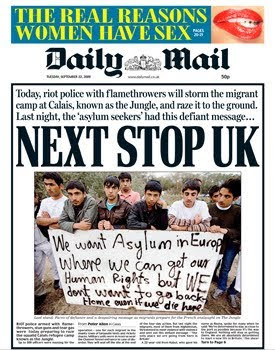
Perhaps when both families were being dragged kicking and screaming from their homes they were being filmed for UK Border Force. This is a Sky One programme, now in its second season, which is presumably made with the full participation and encouragement of the Home Office. It showcases the Government’s policy of sending out teams to hunt down and and round up ‘illegals’ and highlights the ‘tragic stories and challenges’ that they (the immigration officials, not the immigrants) face every day. Raids have recently been staged on a market in East London, dragging off immigrants whose only hope of survival is to work illegally given that the Government not only forbids them from working legally, but is also actively reducing even their most basic means of survival. Presumably in this way New Labour ministers hope to quench the thirst for brutal violence as a solution to the ‘problem’ of ‘illegal immigration’ which is, of course, a mainstay of Jack Straw’s favourite newspaper (see above).

Perhaps the Daily Mail is missing the boat somewhat when it comes to their bitter opposition to further British involvement in and cooperation with the European Union. Slavoj Žižek recounts the case of the Tunisian fishermen who face up to fifteen years of imprisonment for rescuing forty-four immigrants off the coast of Lampedusa. Other fishermen who have beaten off boatloads of people with sticks and left them to drown suffered no punishment. Zizek then quotes what Robert Brasillach, a ‘moderate anti-semite’, wrote in 1938:

‘We grant ourselves permission to applaud Charlie Chaplin, a half Jew, at the movies; to admire Proust, a half Jew; to applaud Yehudi Menuhin, a Jew; and the voice of Hitler is carried over radio waves named after the Jew Hertz . We don’t want to kill anyone, we don’t want to organise any pogroms. But we also think that the best way to hinder the always unpredictable actions of instinctual anti-semitism is to organise a reasonable anti-semitism. ‘

I can only presume that this is what Jack Straw et al are up to with their quasi-fascist hounding of immigrants. They certainly don’t want to organise any pogroms, but they seem to think that TV programmes which present pogroms as entertainment might serve as a means of pacifying violent racists, somehow making them less inclined to get off their sofas and round up ‘illegals’ themselves. Attempts to use similar means to combat racism and fascism in the 1930s met with limited success.

“Let’s cross our fingers and hope he forgets not to turn up in Nazi uniform”

Whatever happens on Thursday (and, perhaps more importantly, on Friday, on Saturday etc etc), Nick ‘well-directed fists and boots’ Griffin will come out of this whole sorry affair smelling of roses rather than shit and with a much higher national and international profile than before. To put it simply, he is absolutely not going to describe himself as a racist or nazi on national television. And according to the Guardian’s diary this week (can’t find the link unfortunately), the Labour Party is absolutely determined to avoid referring to him in this way in any case in case it makes them look, erm, anti-racist. Instead Jack Straw (that name pretty much says it all) is planning to attack individual BNP policies as unworkable and contradictory. Of course to do so is to absolutely miss the point. The BNP’s policies are, as Griffin himself has repeatedly and openly admitted, both a red herring and a smokescreen. The entire aim and meaning of the BNP is racist violence; there is nothing more to be said about them. I will certainly be there protesting on Thursday, but since we are dealing here with how these events are portrayed in the media, I fear that the protests will allow the BNP to present itself as an unfairly maligned and beseiged minority, given that, as I said earlier, when they are accused of being nazis their strategy is simply to laugh it off, thereby sidestepping and defusing the issue.

Mandelson’s lies about Royal Mail

Peter Mandelson, friend of the filthy rich and aspiring Tory minister, is reported to be ‘beyond anger’ with the unions for ‘obstructing’ his ‘modernisation’ plans for Royal Mail. An obvious question here is about his notion of ‘modernity’; in the midst of the crisis earlier this year Mandelson himself was proposing the creation of a People’s Bank, constructed around the national network of post offices. Such an idea appeared at that moment to be much more ‘modern’ than continued slavishly adherence to an ideology which had led to social chaos, political repression, war, vastly increased inequality and a near total collapse of the economy. It was of course quickly forgotten in favour of continuing with the same policies of handing essential national institutions over to a gang of speculators, gamblers and crooks, thereby destroying the kinds of secure jobs that are fundamental to a functioning economy and laying wastage to public services.

It seems clear to me that promises have been made to the private sector with regard to the Royal Mail, promises that the Government is determined to keep at any cost. It all puts me in mind of Blair’s secret promise to Bush about the war in Iraq. Let’s be clear: we are dealing with a bunch of liars. Nothing that the Government says with regard to the present or future of Royal Mail can be trusted in the slightest, as this excellent LRB article makes clear.

A prediction: in just under a year’s time we will see this utter scumbag sitting on the stage at the next Conservative Party conference. The fact that the Labour Party is determined to spend its last few months in power on a hell-bent mission to destroy jobs and services as a favour to the private sector says it all. I would sooner vote for the Monster Raving Loony Party than this bunch of cynical f******* *****.

After the decimation of trade union power over the last thirty years, a lot of people simply don’t seem to have any understanding of why people in public services go on strike. Comments abound such as, it’s all very well to go on strike as long as it doesn’t harm the public, or, I don’t see why i have to suffer, I’m not responsible for the policies of the Government. I believe that the government is the government of all of us; we as citizens have an ethical duty to accept or to fight against the decisions that our Government takes. The most powerful tool the postal workers have in their fight to defend jobs and services (for them and for all of us) is the right to withdraw their labour, and I for one support them wholeheartedly, even though it may well mean that I suffer personally in the short term.

Our own little mini-Pearl Harbour?!

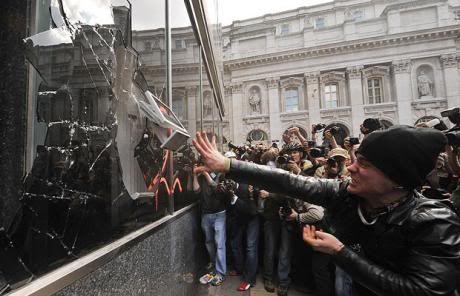
I remain very suspicious about the fact that the RBS, which is right next to the Bank of England, was left completely unguarded at the height of the G20 demonstration. The attack on it has already been used as an excuse to attack social centres around London and arrest a number of people, as this sickening report attests.

I spent a couple of hours yesterday arguing about this with a banker in Barclays and although he conceded that the demonstrators had a point, and that the police may have been a little rough, the main focus of his argument was that the protestors were there to smash things up and had to be stopped. This coincides exactly with the story that the police and the media have been telling, and the only evidence he had for it was the attack on the bank.

I am not a conspiracy theorist, but I am of the firm opinion that the attack on the RBS was essentially orchestrated by the police in order to provide the media with images of violent destruction of property. Just look at this photo: *dozens* of photographers, and *no* police. At the time, as anyone who was there knows, the police were *everywhere*. And, as this one shows, the RBS – the country’s most hated bank, and a blindingly obvious target – is *right next to the Bank of England*. In this video we can hear the news presenters trying very hard to convincingly explain to themselves and the viewers why it is that the police are standing back and doing nothing while the bank is trashed.

And according to someone who actually witnessed the attack:

‘There were a load of police further down from RBS who could have EASILY stopped the damage being done. Which for the record was done solely by about 10 people. The rest being a weird circle of cameras, waiting for the next kick. One guy started lighting the blinds on fire. I have footage also of a guy in a suit, maybe a bank worker, or police not in uniform, filming it, smiling, and laughing with another cop up above from the opposite building. They watched on amongst many other policemen with cameras as a fire was attempted to be lit. A photographer blew the small flames out before it got out of hand. Some protesters then went inside. Only after a while did the police then go into the building, and take a load more pictures of us all for their snatching operation later on in the day.’

Also, and I may be going slightly bonkers here, look at this clip, and watch the guys provoking the police from about 15 seconds in, two in black and one in white. They seem to be acting, acting in fact with a certain amount of impunity. The guy with the metal bar is by far the most violent of the protestors, and his identically dressed friend seems to be trying to egg the crowd on to more acts of bravado. The guy in white was on the front of several of yesterday’s newspapers, sneering in the faces of the police, covered in what appeared to me to be fake blood. Imagine that scene without those three guys, and then watch this. Ring any bells? I suggest that those three protestors are in fact police provocateurs.

I predict that given this kind of policing, and the ease of creating and distributing footage which exposes the lies of the police authorities with regard to who did what to whom, it is only a matter of a couple of years before the British Government follows the examples of China and Pakistan and clamps down on access to youtube!

Why was Africa not a popular destination for emigrants from Portugal?


One word can be said to characterise the attitude of the Portuguese people to the question of emigration to Portugal’s African colonies: reluctance. In the late nineteenth century only approximately fifty emigrants a year went to Portuguese Africa. In the first half of the twentieth century, while more than one million Portuguese emigrated to Brazil, the United States and Argentina, only 35,000 made their way to the largest Portuguese colony, Angola. In the year 1908, the official figure for emigration to the whole of the Portuguese African colonies stood at a mere fifteen people.

This reluctance had deep roots. In Portugal and Angola, Wheeler and Pelíssier partly attribute the failure to attract sufficient numbers of early settlers to five factors: the high mortality from tropical diseases; African hostility; an arid climate; the domination of the slave trade to the detriment of all other economic activity; and the poor quality of the of the largely convict colonists (the ‘flotsam and jetsam of the Portuguese speaking world’).

These factors would emerge as recurrent themes over the centuries. Another abiding reason was what might be termed the ‘Old man of Restelo’ syndrome. The Portuguese Age of Expansion was partly an ideological crusade for the crown and for the explorers, but for those Portuguese who were so desperately poor as to consider emigrating, those ‘masses who derived little or nothing from the overseas wealth’, patriotic or religious fervour cannot have played such a major role when considering the different options available. Wheeler and Pelíssier write of Portugal as:

‘..two nations, rich and poor…(the poor) tending to be indifferent or even hostile to elite ideas and actions as well as to the outside world. The other nation has (…) participated little in the expansion (and) colonialism (…) most of Portugal did not willingly follow and sometimes opposed the lead of the Lisbon elite into overseas expansion.’

This lack of willingness had to be compensated for through forced emigration. The sending of degradados – ‘murderers, arsonists, rapists and thieves’ – in such huge numbers created such a climate of hostility and turmoil that Governor Sousa Coutinho advised his superiors in Lisbon that ‘the only way to avert total ruin in Angola was to replace degredados with free Portuguese farmers’. The problem was, of course, that free Portuguese farmers showed little inclination to relocate to Angola, and ‘before the end of the seventeenth century Angola’s reputation as a penal settlement and a white man’s grave was both firmly established and well deserved’.

In fact, not just Angola but the whole of Africa was considered ‘a graveyard for Europeans, who were in almost constant battle with Africans and/or the climate, animals, and insects such as the deadly malarial mosquito’.

As Wheeler and Pelíssier note, the calibre of the available settlers presented another huge problem for the Portuguese. Bender writes:

‘The Portuguese upper and middle class either remained in Portugal or had already left for better-known parts of North and South America. As a result, the government’s appeals for prospective settlers were generally answered by rural peasants or the poor and unskilled in urban areas’.

From the very beginning of Portuguese involvement in Africa, those who established themselves more successfully were those who realised that the slave trade was a considerably more attractive and lucrative proposition than agriculture. In Mozambique many of the holders of prazo titles became more ‘africanised’, established their own personal dominions and did not feel they owed a great debt of loyalty to the Portuguese colonial authorities. For the most part they traded in what was by far the most lucrative of the available commodities. Slaves accounted for four-fifths of Angola’s exports between 1550 and 1850. The gradual end of the slave trade would inevitably, therefore, create huge difficulties for Portuguese settlers who had no other source of income. Hence the determination of the slave traders to hang on to their livelihoods in the face of increasing pressure. Duffy writes, ‘The violent reaction in Portuguese Africa to emancipation has been noted’.

The loss of exclusive Portuguese access to Brazilian markets in 1810 combined with the ending of the slave trade mid-century inspired liberal politicians in Portugal such as Sa da Bandeira to devote new energies to making the colonies an attractive destination for both investment and emigration. Crucial to this new vision for the overseas territories was the principle that:

‘Angola must not be a place of exile for convicts and undesirables; settlement there by honest industrious citizens should be one of the first orders of business for the new regime’.

The success of this campaign depended upon a constant campaign of ‘education in the metropolis and sufficient capital and foresight in the provinces to create a community in which the immigrant could not only prosper but live comfortably’. But as Bender points out, ‘Lisbon appeared to be incapable of overcoming the lack of settlers without a heavy dependence on degredados’. Various plans were discussed and finance was provided for large-scale schemes of white agricultural settlement, but by the early 1880s penal colonies were being expanded to accommodate more convicts.

Those who did emigrate found life almost intolerable. Of the 1,500 desperately impoverished Madeira farmers who went to the highlands of Southern Angola in the mid-19th century, Gervase Clarence Smith writes:

‘Visitors to the highlands were shocked by the sight of these landless, impoverished, illiterate whites, who wore no shoes, were dressed in rags and lived in hovels’.

Emigrants to Portugal’s other African colonies fared little better. Duffy writes:

‘If farmers from Madeira found life difficult in the highlands of Angola, existence for them in the low-lying territories of Mozambique would be intolerable under present conditions’.

They were not generally at all well equipped for the difficulties they would face. Bender quotes Nascimento and Mattos as reporting that they were ‘generally poor, ignorant and illiterate, and for those reasons, without much ambition, withdrawn and lacking initiative’. According to Antonio Enes, ‘the Portuguese emigrants to Mozambique were rarely other than hands possessed neither of capital nor of the energy and aptitudes required to do duty for it’. Of course, even those with agricultural experience and expertise were to find that the African climate and the range of crops that could be cultivated were considerably different from what they were used to and presented often insurmountable challenges.

Understandably, many of the settlers showed more inclination to settle in the cities than in the rural areas. But they were no more immune than the farmers from many of the obstacles that Clarence Smith describes:

‘Independent fishermen, small farmers, petty traders and the like were constantly threatened by impoverishment and proletarianization. They were at the mercy of natural disasters and social calamities and were often incapable of breaking out of the vicious cycle of debt’.

Mirroring the reluctance of prospective emigrants to consider Africa as a destination, banks and small investors showed little willingness to risk their resources in areas with such a high rate of failure. Also the land set aside for the potential colonists was ‘inadequately surveyed’ and preparation of the schemes was poor, leading to settlers often abandoning the plantations and making their way to the more prosperous South Africa.

In the south of Angola, the Portuguese government did have some success at attracting foreign settlers. Attempts by Portuguese settlers fleeing from persecution in Pernambucano to settle in Moçâmedes were not initially successful but communities were eventually established. More successful was the settlement of Boer families in Huila in the early 20th century. Also small fishing communities were formed at Porto Alexandre by Algarvios who had made their own way in their own humble vessels in 1853. But these seem to have been rare exceptions.

In the judgement of Clarence Smith, Sa da Bandeira’s ‘plans of massive white settlement came to nothing. Apart from coastal southern Angola, the trickle of whites entering the colonies were nearly all convicts’. Bender records that ‘a series of plans and decrees, designed to augment free white settlement, either atrophied on the drawing boards or failed for lack of settlers’.

In 1845 they had been only 1,832 whites in Angola. By 1900 this had increased to about 9,000 and by 1911 the white population of Mozambique had expanded to about 11,000. However, a large proportion of the white population of Mozambique were not Portuguese, and English was heard almost as much as Portuguese. The Portuguese Community consisted almost exclusively and convicts and traders. Degredados continued to be imported and those in critical professions such as teaching and medicine showed little inclination to go and live in Africa:

‘A (..) serious problem was the want of trained personnel, teachers, nurses and doctors, willing to work overseas in a questionable environment for a paltry governmental salary’.

Equally disinclined to do so were Portuguese women; or, at least, Portuguese men were not inclined to bring their families with them to ‘a land infested with insects, wild animals, hostile Africans and degredados’. Those persuaded or forced to make the trip usually died within a few years of arriving, often during childbirth. In 1846 it was claimed that there was ‘still no case of a white woman giving birth when it didn’t cost the life of the mother and child’. In 1897 there were reportedly only two white women in Lourenço Marques.

This high death-rate, which obviously affected male settlers as well – Clarence Smith talks of the settlers dying ‘like flies’ – meant that the top-tier officials of the colonial civil service could never fully develop into a stable class, and therefore experienced and competent administrators were in short supply. Pay for these postings was not high, conditions were not at all satisfactory and, until the advent of the better-organised and more stable structures introduced under the Estado Novo, motivation remained very low. According to António Enes, one of the problems with Portuguese colonization in Mozambique was precisely this lack of a ‘colonizing class’.

However, emigrants both rich and poor did willingly make their way to Brazil, which offered poor Portuguese emigrants ‘a much better chance of surviving and making good’ than Africa. From the end of the 17th century until shortly after World War II Brazil accounted for the ‘overwhelming majority’ of Portuguese emigrants; between 1850 and 1950 1.5 million Portuguese emigrants chose Brazil over Africa. Evidently this was partly due to cultural links, but Brazil already had a long history of making fortunes in gold, diamonds, and coffee. Bender writes that ‘the perennial pot of gold sought by Portuguese emigrants was to be found in America, not in Africa’. The emigrants knew that they stood a very good chance of making or earning enough to enjoy a good life and to send money back to Portugal. By the end of the nineteenth century:

‘Brazil possessed the essential conditions to stimulate large-scale immigration: an expanding economic infrastructure which required large labour inputs (and) a commitment to pay living wages…the absence of these conditions in Angola explains to a considerable degree why Angola attracted far fewer white immigrants than Brazil.’

The ending of the slave trade, with the resultant demand for labour, had created a ‘sensational increase in emigration’ from Portugal:

‘Between 1840 and 1850, the Brazilian empire had still taken in about 33,500 slaves a year. This figure was reduced to 3,287 in 1851(…) thereafter the Brazilian economy entered the era of the expansion of coffee (…) The New world attracted numerous emigrants.’

Another essential factor is that while the climate and tropical diseases took their toll on a considerable proportion of the few settlers that made it to Africa, in Brazil the colonizers were able to deal with the climate; in fact, the diseases that the Europeans brought with them contributed significantly to the decimation of the indigenous population.

Life throughout Africa was known to be ‘hard and uncertain’. Hammond quotes a newspaper article from 1861 which directly addressed the question of why emigrants did not go to the colonies:

‘The reason is obvious. Whoever emigrates is poor, nay, of the poorest. His sole wealth is his labour, his sole capital his personal activity. He needs wages, not virgin soil. He needs an employer, not workers. Whither shall he take his way? To Angola? But what is he to do there? What industries exist there? What activity already established? What accumulated wealth? What cultivated lands? What industry? What trade? Trade – that of the blacks. Industry – none. Shall he go to Mozambique? Worse…’

The figures show that, while such an article would probably not have been read by the kind of people who might have been desperate enough to consider emigrating to Portuguese Africa, in the popular understanding these were the ideas that had most influence. In ‘Republican Portugal’ Wheeler mentions the difficulty that the Republican regime had in making pro-war propaganda amongst a largely illiterate population. The successive attempts to promote relocation schemes to Africa presumably encountered the same problem in trying to counter such negative impressions.

Under the Republic there was an expansion of public employment in the colonies. Clarence Smith writes that ‘it looked as though the republic had found the magic formula for expanding the white population of the colonies’. However, such state involvement no more constituted investment in their productive capacity and economic development than did the government subsidies paid to the colonos, of which Bender writes:

‘Such dependence on the state made the colono more of a civil servant than an independent farmer (…) In particular, the financial subsidies actually discouraged many colonos from devoting their full energies to their new farms.’

However, by the mid-twentieth century it was ‘clear that the long-standing reluctance of metropolitan Portuguese to emigrate to the colonies had been overcome’. The white population of Angola had increased to 78,826 by 1950, and that of Mozambique to 97,200; in the following ten years these figures would more than double. What had changed?

In the early years of the Estado Novo the Government had little more success than before with its rural settlement schemes. However, the 1940s and 50s was a period of ‘general prosperity in Africa, in which the Portuguese colonies (…) naturally shared’. In the 1950s there was a change in government policy: the Portuguese National Development Plan of 1953 allocated $100,000,000 to Angola and $85,000,000 to Mozambique, with a lot of the money being invested in dams, roads and railways. In 1959 another $237,000,000 went to Angola and $125,000,000 to Mozambique. Included in this was money for new and ambitious settlement programmes. It has been estimated that the cost of settling a single family in Cela, Angola was $100,000. The settlement programmes themselves were not overwhelmingly successful, but Portuguese emigrants were attracted in very large numbers to the cities; also in the 1959 plan, investment in health and education – essential given the rapidly increasing demand for skilled labour – featured for the first time.

Huge numbers of Portuguese immigrants continued to arrive throughout the wars of independence, right up to the revolution in 1974. Of the hundreds of thousands of retornados who fled back to Portugal shortly afterwards, more than half of them had only arrived in Africa during the previous fifteen years.

Conclusion

Apart from the physical difficulties that Europeans had faced in simply staying alive in Africa, the principal reason for the reluctance to emigrate to the colonies lay in the image that the Portuguese people held of Africa. In contrast to the developing and expanding society of Brazil, Africa had always been seen as a place from which resources – slaves and mineral wealth – were extracted rather than invested. Portugal’s nineteenth century dream of creating a new Brazil in Africa ignored this basic dichotomy.

Portugal’s attempts to build a society on captive labour had worked in Brazil, in much the same way as had Britain’s in Australia, but in both cases the indigenous populations were more or less wiped out within a couple of centuries of the Europeans’ arrival. This was clearly never a possibility in Africa, so the Portuguese attempts to create ‘new’ societies had to find some way to work with, rather than against, the African population.

Would Britain have been successful at creating a new United States in the areas of Africa from which it took its slaves? Of course Britain also had its lucrative Indian and Australian colonies, so such a notion is unlikely to have ever been suggested. Portugal, on the other hand, had no other significant territories. However, in developing Brazil, it had severely disrupted the complex societies which already existed in Africa without seeking to repair the damage until, crucially, it was too late.

The End of Communism and the Death of Vinyl

808-1226466881_rock-and-rollHow much is an album worth these days? On CD, surprisingly little, given that I haven’t bought a CD since, erm, 2002. You can pick up a physical copy of the marvellous new Pet Shop Boys album for only £7.95 at HMV. Online, if you care to make a donation to the ailing record companies, you can get it track by track for merely 79p a pop. But why pay for a physical product? Music is now in the air, floating around for free. And according to Bob Dylan, it’s not worth paying for:

“It was like, ‘everybody’s gettin’ music for free’. I was like, ‘well, why not? It ain’t worth nothing anyway’.”

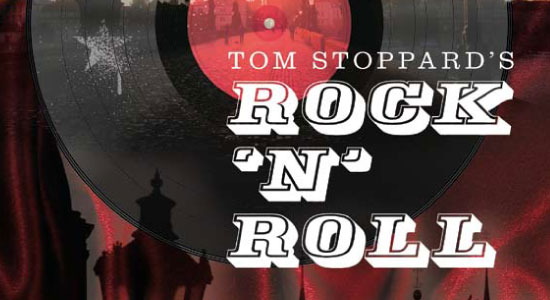
There is of course a marked difference between price and value. I’m sure Dylan didn’t feel the same way about the folk and blues discs he treasured when he was growing up. Tom Stoppard’s new(ish) play ‘Rock n’ Roll‘ is on one level an elegy to rock music as preserved on vinyl. In one of the most memorable scenes the main character returns to his flat in Prague to find that all of his beloved records have been smashed to pieces by the Communist secret police. His immediate reaction is to go to the bathroom and violently throw up.

Anyone who grew up with 12 inch LPs will immediately be able to sympathise. As someone recently wrote:

Entire lifestyles built up around albums, smoking dope to albums, having sex to albums. You lent your favourite albums out with trepidation; you ruefully replaced them, on CD, when they didn’t come back. Getting hitched paled into insignificance next to merging record collections with your loved one. Getting rid of the doubles made divorce unthinkable. Elastica once sang, of waking: ‘Make a cup of tea, put a record on.’ That’s how generations of hip young (and not so young) people have lived.

People’s relationship with their physical albums – and singles too – was an intensely personal and jealously guarded one. Tom Stoppard chose several of his favourite tunes to be interspersed throughout the performance. His choices are fairly predictable ones, covering the broad canon of late-sixties early-seventies rock music, but then he is getting on for sixty or so; I would have made quite a different selection, with maybe more Motorhead and Momus and less Pink fucking Floyd and no Guns n’ bleedin’ Roses, but then I am only twenty-seven years old. In my mind, anyway. But I digress.

There’s no doubt that the songs he chose are those that have been most important to him, and the titles and names of the performers are displayed on a screen between each scene, emphasising just how much these little details are or were so important in the fetishing of each individual record. But if nostalgia for the days when rock music assumed such critical importance in our lives is one theme, the main one is the role of rock music in the ideological struggle against the repressive Czech regime. The characters argue bitterly and passionately about music and about politics. The polarisation of the debates about materialism, about sex, about human happiness, and about what could be endured (in the name of freedom) and what must be resisted (in the name of freedom) is very clear. There is an appetite for ideas and a willingness to explore the implications of a particular stance; just as a vinyl disc had two sides, every idea must have its counterpart, both in the mind and in the ‘real world’. In the era of the two tribes, nobody could deny the existence of an alternative way to organise society, however pitiful and repressive that alternative might eventually turn out to be.

Perhaps since the advent of the CD, and certainly since the revolutions of 1989 and 1990, the debate about how we organise our economic and social life has become considerably more one-sided. A couple of weeks ago I visited the Museum of Communism in Prague, which proudly advertises itself as ‘above McDonalds, right next to the Casino’. It stands on a street which looks, with its Mango and Zara and Starbucks et al, not too dissimilar to the centre of Leeds. Consumer capitalism has swept all before it; who now would defend the Communist project, or argue for any different kind of society?

As a friend of ours pointed out during the interval, it’s unusual to hear passionate debates about basic political questions these days. And about music too; maybe because it’s harder to defend something that exists only as a list of ones and zeros on a device that may stop working from one moment to the next, rather than a physical artefact which you have held and cherished and studied intently for hours on end. The days of getting to know someone that bit more intimately by flicking eagerly through their record collection, making connections and laughing at their occasional folly, are long over. These days the question ‘what kind of music are you into’ reveals the unfortunate truth that so many of us have no longer have any discretion.

Discretion. There is an irony in the fact that, as we chat after the play to one of the actors about how quickly so many political arguments about the past and future of our planet simply dried up in the six months after the Berlin Wall fell, we do so sitting in one of central London’s many Caffe Unos (or maybe that should be Caffe Uni?!). Not a place I would choose to go, you know, it was raining and, hey, what’s the alternative?

One day in Prague an Australian businessman we got chatting to recalled how in 1990 he had seen trucks belonging to French antique dealers queuing up at the border into Czechslovakia waiting to load up with as much heritage and history they could get for a handful of francs and cart off back to France to sell for une fortune. It’s a truism that since then capitalism has run riot across that whole swathe of countries that were then just emerging from forty or more years of isolation and deprivation. But it struck me watching the play that we have experienced something akin to what James Connolly called a ‘Carnival of reaction’. The euphoric triumph of big business capitalism can be seen just as clearly in London, Lisbon or Leeds as it can in Prague or in Poland. Now everything has, as Bill Hicks put it, a price tag on it; usually, in the case of our own service-station nightmare of a nation, a highly inflated one.

But as music itself has got cheaper, political debate has too, to the point of having very little or next to no currency. Including, of course, in the realm of pop and rock music. The current consensus dictates that absolutely everyone, from Bill Gates to George Bush to Hu Jintao, and presumably Pol Pot if he were still around, has the interests of the poor and unfortunate of the world at heart. Is there any near equivalent to the Plastic People of the Universe, the dissident Czech rock group that Tom Stoppard’s play celebrates? Well, there is always the most prominent of our rock n’ roll heroes, Bongo of U2 and the UN, a defender of both the poor and the rich, and a man so politically stupid that he cannot see the contradiction between fighting for global justice and an end to poverty on the one hand, and studiously evading contributing to the cost of public hospitals, social welfare and schools on the other (fucking) one. Tax efficiency, they apparently call it. I’m sure Jesus Christ would have been very, very proud.

We stand outside in the rain mulling over these questions until the one-minute bell goes and then go back in for the second half of the play. The action has moved on to 1987 and so the curtain raises to the sound of … U2. On the train on the way home some young Australians are discussing whether if they were rich they would buy a Lambroghini or a Ferrari, a group of drunken English people are talking about how much they love working for their software company, and someone is gloating over the defeat of a football team belonging to the Russian oligarch Roman Abramovich. I find myself wondering: is this oh-so-ironic Schadenfreude the very best kind of challenge to authority we can offer up these days?