We need a global progressive alliance against the far-right

NB: I wrote this two days ago and now that I am no longer overcome with/by fury can see it has big holes in it. I am starting to accept that the argument for abstention had some political justification and that my own partial and privileged position has, along with my ignorance, prevented me from understanding the importance of certain dynamics. Thanks to those who have corrected me and I apologise for calling anyone who even knew anyone who was thinking of abstaining a connard. I’m posting it without fanfare as I think it has some merit and also because I want to use it to mark my resignation from my self-appointed role as a commentator on French politics.

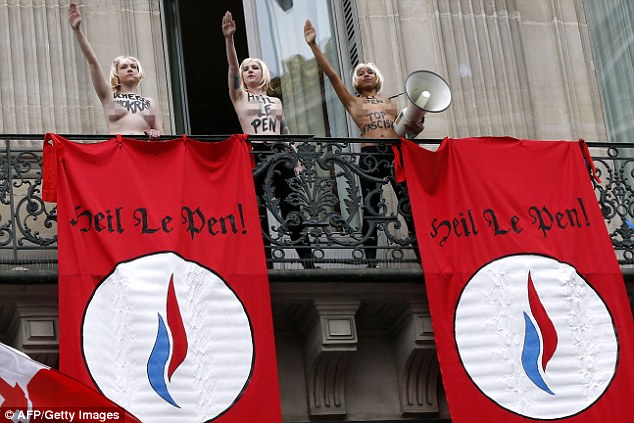
The fascists lost. That’s by far the most important thing about the French Presidential election. They tried to cheat, hack and smear their way to victory and failed. There is no doubt whatsoever what they would have done with power: installed a regime based on violent repression. I think their defeat is absolutely worth celebrating at a time when so little else is.

Nonetheless, 33% voted for a Nazi and twelve million abstained. That’s twice the number murdered in the Holocaust denied by the family and friends of the candidate they couldn’t be bothered to vote against. I understand there were reasons to abstain or spoil one’s ballot but I think they were invalid. Had circumstances been slightly different Le Pen would have won and been in a position to continue the work of her father, who has a direct connection to Vichy and the Third Reich.

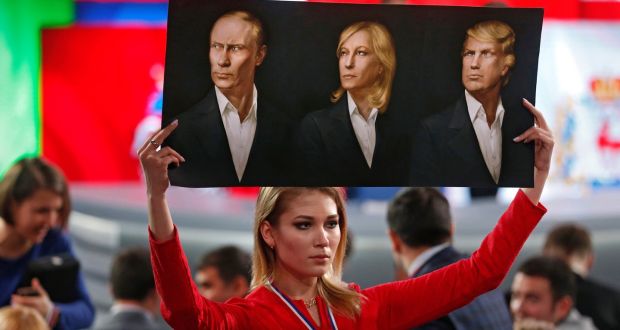
The Front National is now the main opposition and parliamentary elections could consolidate their position and cripple Macron’s administration. Nonetheless the global far-right wanted another figurehead and they didn’t get one. This is a massive setback for their project. Her victory was in the script. Even my political science masters students saw it as inevitable: Le Pen’s victory would be followed by that of Grillo/Salvini here in Italy, then Germany… Supporters of the far-right on social media are right now hurt and demoralised. Such armchair fascists thought it would be easy. Putin’s photo with Le Pen looked threatening a few weeks ago, a ready-made meme lacking only the cartoon toad; now it just looks like an awkward photo of two arrogant people who probably barely even spoke to each other.

As for the Left which actively encouraged people to abstain, I’m left feeling a little like those left-wingers who in previous generations lost faith with Stalinism upon seeing the brutal repression in Hungary in 1956 and Prague in 1968. Just as the initial burst of support for Mélenchon was encouraging, his subsequent abdication of moral responsibility was shocking. Le Pen could actually have won. Macron had no automatic base of support. The establishment right could have swung over (I don’t think by the way they would have supported Mélenchon). An opportune terrorist attack could have created a bloodthirsty atmosphere which Le Pen would have luxuriated in. The desperate attempts at hacking (seemingly started by the US far-right with Russian assistance and then actively promoted by Wikileaks) could have been better coordinated and might have worked. Perhaps a fascist government wouldn’t have damaged the immediate life chances of the teenage edgelords running round Paris last week, but overnight the plight of refugees would have worsened immeasurably and the whole infrastructure of human rights, climate action and international cooperation per se would have collapsed. I find the lack of solidarity with fascism’s potential victims contemptible. Credit to those Mélenchon voters who voted for the centrist to stop the fascist at a time when the arrogance and delusion of a generation of failed left leaders was on unproud display.

On the other hand, Macron (as everyone in the world knows) is a ‘Neoliberal’. This week I got my students to study his English in the form of a BBC interview about what he stands for. He produces neoliberal buzzwords like a windup toy: Innovation, Competition, Markets, Reform, Liberalisation… Nevertheless, he is a highly contradictory figure: he’s also instinctively and consistently socially progressive. His comments on French colonialism in Algeria were principled and brave. To dismiss him as a mere apparatchik of a soviet-style regime is misleading and unfair. Neoliberalism is not a monolith and in any case an appreciation of the role of markets doesn’t make you a neoliberal zealot. If the French Left were to ease off on using that deeply problematic term they could choose to view him as a social democrat and put pressure on him to behave as such.

Such an idea won’t go down well with those who insist that there is no difference between capitalism and fascism, between a ‘banker’ and a Nazi. The notion that voters are being ‘blackmailed’ between the two plays into the hands of the far-right. Žižek argues that we are all being held to willfully held to ransom by an elite and that we should refuse their terms, an argument that quickly gained currency. In reality it’s a deadlock, one in which progressives are objectively forced to join forces with all those opposed to fascism, even those who we judge to be responsible for its resurgence . Evidence of the folly of the blackmail thesis is is all over social media in the form of increasing crosspollination in the discourses of the far-right and the far-left. From pro-Brexit Labour supporters to Jill Stein fans and supporters of Mélenchon I’ve detected a confluence with the far-right, particularly in the escalation in attempts to be seen as something other than ‘liberal’. This is a zero sum game in which only the only winner is the far-right. The frequency with which the antisemitic canard of Rothschilds has been pointedly evoked reveals undertones of anti-semitism. I’ve always rejected the notion that the two ends of the political spectrum meet up, but thanks partly to the inanity of online political ‘debate’ that dismissal is becoming more and more valid.

Some times over the last few weeks I’ve found myself thinking: if this is the left, maybe I no longer want to be part of it. But then as a friend sagely retorted when I put the thought to her, where else are we? As a result I’ve finally come round to thinking of it as no longer a helpful category. We need to know who’s really on our side, who we can trust in a context where political feelings are subject to massive manipulation. This has to be the last time that anyone pays any attention whatsoever to Wikileaks. Žižek’s ulraleftist posuring demonstrates yet again that, just as he argues in relation to poets, philosophers don’t make good political leaders. People like him are far too given to iconoclasm and provocative thought experiments. Nor are his political prescriptions plausible: for all his edgy neomaoist statements about divine revolutionary violence, his actual political interventions have tended to be reformist in nature (for example DIEM 25).

We progressives also need to accept that Facebook is not our friend. To quote a former executive for the company, by flicking a switch they can change the results of elections. We are just beginning to understand (too late) how insidious microtargetting is. Monstrously powerful far-right interests are able to tap with eerie precision into secret wells of resentment beneath the surface, to direct psychopathological undercurrents in directions which serve their requirements. Anyone who has not done so needs to read Carol Cadwalladr’s terrifying and riveting piece on just how connected, powerful and pernicious the digital far-right is. Companies like Cambridge Analytica may well be the most dangerous forces on the planet. As repression and manipulation heat up degree by degree in step with the warming climate, we will need to stay out of the hothouse of social media, where our worst innermost fears and recriminations are being cultivated in a way that makes Soylent Green look like a children’s TV cartoon.

I think the global priority for progressives must be to crush the far-right, to humiliate them as Macron did so well in the debate. We have to insist that our media ostracise them rather than allowing them to present themselves as normal. Just as Daesh and their followers are not given access to the airwaves or granted debating rights, our homegrown extremist terrorist organisations should not be either. Europe’s equivalents of Isis are also agents of Putin, who the results of the last few elections (Austria, The Netherlands, France) is far less omnipotent than he and his acolytes pretend. In some ways Putin’s Machiavellianism is a busted flush. Macron’s team’s way of dealing with the hacking was a masterpiece of defusing a powerful weapon and will make it far harder for Putin and his acolytes to manipulate public sympathies via spectacular leaks.

The world is facing a confluence of massive crises and life cannot go on as it is. Nevertheless, as Paul Mason argues, Macron’s victory is evidence that racism need not be a inevitable defining element of the future. To fight back against the forces of the far-right I think we have to (regardless of its complicated history), make full use of the term ‘progressive’. What exactly that term means is not a question that cannot detain us. On certain shibbloths of the left we we will have to accept differences of opinion. There are specific things we could all agree on, unambiguously progressive causes: Climate change, an alternative to a growth-led economic model, an end to the power of fossil fuel companies, internet privacy and much more. I find much to recommend in Yanis Varoufakis’ thesis that it is the job of progressives to save liberal capitalism from the extreme neoliberals. Markets do have a part to play in the economy but the idea that they are always the answer has no credibility. Neither do protectionism and nationalism: some form of social democracy is probably the best we can hope for, and in order to achieve or hang onto it we have to insist on human rights, the primacy of the environment, democracy, and freedom of the press. Protecting the media from political and commercial corruption means subscribing to publications which we consider important.

How does a progressive movement relate to those who are righteously angry about the role and rule of the banks? I don’t know. But as Sunny Hundal points out, contemporary political affiliations are not just about the economy. We can partly undermine the appeal of the far-right, to challenge its self-portayal as voice of the economically disenfranchised, by constantly exposing its contradictions and compromises, emphasising that the Le Pens and Trumps and Farages just represent a deeply corrupt and illiberal elite. While it’s not a question of mounting a naive defence of the EU as perfect, we can also recognise the efforts of politicians like Merkel in trying to stand up for immigrants. Although this is a defensive battle we must also make clear that we have aspirations to a world which is better than this one, as distant as such a prospect may appear.

In doing so we can’t adopt populist language: no sneering at ‘liberals’ and ‘cosmopolitans’. Liberalism is not our enemy. Our foes are Trump, Putin, Le Pen, Erdoğan, Farage, May and all others like them. There is now a broad global movement based on hostility to democracy and liberal values, on racism and climate denial. The opposition to it needs to involve everyone who understand that those things matter, that we live in the space between democracy and fascism. If we allow ourselves to think, as I have seen some argue in nominally progressive fora over the last few weeks, that we already live in a fascist society, then all is lost. Such attitudes are a form of slow suicide. Democracy may in some ways be a facade, but it’s a facade which protects us from the elements in stormy times.

In order for this movement to exist, I believe that those who are not already members should join a progressive political party. Individually we are powerless, prone to snapping up every product that briefly assuages our feelings of fear, powerlessness and guilt. I have rejoined the UK Green Party and will be encouraging friends and family to do the same. I agree with Caroline Lucas, Compass and others that progressive people should campaign for the person best placed to beat the candidate of the increasingly far-right Tory Party. Knocking on doors and handing out leaflets on windy shopping precints may be demoralising but it is one of the few chances we have. Facebook is useful for organising activities but it is emphatically not itself a form of political activity. We will not be able to defend refugees and protect the climate online. In whichever country we live, we have to join together in person with people we disagree with about some of the things we care most about. That will be tough but is is absolutely necessary. After a few years in which the notion of political parties has lost some appeal partly due to a widespread sense that our individual feelings and identities are more important, I think it’s that model we have to return to. That does not mean subordinating everything to election cycles. As Aditya Chakrabortty says of what the British Labour Party needs to do to survive:

It needs to turn itself into a social institution. It should be providing welfare rights advice to those whose benefits are being cut, legal support to tenants battling greedy landlords and arguing with the utilities to provide cheaper and better deals. 

We can’t afford any more ideological purity: no more refusing to vote against candidates who can defeat fascists. And we can no longer pretend that political parties are dead. Macron built one and won, and Mélenchon created a vehicle for radical political change which still has a huge role to play. The far-right organise through them. We need them to exist and the best way to make sure they do is to play an active part, pushing for our progressive agenda where possible. Doing all of this doesn’t mean that we will win; in the words of one of Thomas Pynchon’s characters:

“Maybe it’s unbeatable, maybe there are ways to fight back. What it may require is a dedicated cadre of warriors willing to sacrifice time, income, personal safety, a brother/sisterhood consecrated to an uncertain struggle that may extend over generations and, despite all, end in total defeat.”

Sounds daunting, but we don’t have a choice. 
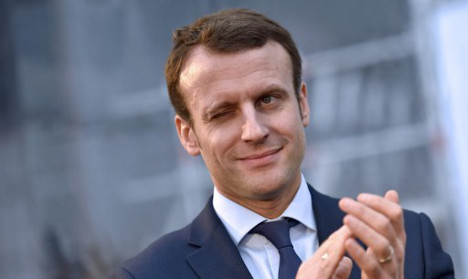
“Not just the Rothschilds”: Wikileaks reveals truth about Macron

In a not-quite-a-shock move designed to shift the balance of the French Presidential Election in favour of the candidate who denies the Holocaust, Wikileaks (previously renowned as a media transparency organisation, now more widely regarded as an amalgam of mercenary hacking collective, source of digital forgeries which benefit the far-right and rape cult) has published documents that prove “conclusively” that “former Rothschild usurer” Emmanuel Macron is connected to a “secret conspiracy to dominate the planet”. 

Describing the revelations as “extraordinary and unprecedented”, cupboard-dwelling Wikileaks founder and aspiring Bond villain Julian Assange said that the documents raised “very serious questions” about the long-term goals of Macron and other “globalist neoliberals” such as George Soros “and various other jews”.

Assange also stated that as a proven and powerful ally of “at least three major world leaders”, the chances of his getting away “scott-free” with raping a “reasonable” number of women were now looking “very much improved, thank you for asking”. He then, to giggles from a number of male Wikileaks colleagues, added the words “allegedly raping”. In response to a question about the global implications of enabling a lifelong fascist to be elected as leader of one of the world’s most powerful countries, Assange replied that he found it “funny”. Asked about connections between his organisation and the Kremlin, he smirked and said “no comment” in what appeared to be a comedy Russian accent.

The Wikileaks tranche of emails relating to Emmanuel Macron (released as part of an ongoing collaboration with the Breitbart website and the Office of the Presidency of Russia) can be found here.

P.s. Someone has responded to this written-on-the-bus-in-five-minutes-in-a-blind-rage piece of hot-take satire by pointing out that Assange has claimed Wikileaks has nothing to do with the slurs against Macron. The fact that he was threatening three months ago to do exactly this suggests very strongly that he’s lying. He will do and say literally anything to get out of that cupboard (except face trial on several well-substantiated rape charges, obviously).

Mélenchon and Žižek; Accelerationism and Edgelordism

There’s a particular set of attitudes or postures which I’ve always known as Ultraleftism. A central element of this is the notion that the masses need to hit rock bottom in order to gain consciousness of their plight, that things will only start to get better when they get as bad as they possibly can.

This idea seems to be undergoing a revival, particularly online. I recently learnt a new word: edgelord. It designates someone who, in the words of urbandictionary.com, “uses shocking and nihilistic speech and opinions that they themselves may or may not actually believe to gain attention and come across as a more dangerous and unique person”.

The term seems to have derived from the forum 4chan, the breeding swamp of the ‘alt-right’. It’s inevitable that in the face of the various crises assailing humanity disaffected teenagers feel inclined to sound like they can tough out armageddon, and hence it’s routine to see expressed on Facebook pseudo-nihilistic sentiments like ‘the human race is a blight on the planet’ or sub-Nietzschian statements like ‘morality is for assholes’.

However, there’s also an ideological rationale for such outbursts: Accelerationism. Derived partly from Deleuze and Guattari, this is a dense and complex theory with a number of variants but in simple terms it proposes that the self-destructive processes inherent to capitalism should be accelerated in order to provoke radical social change, that (as Steven Shaviro puts it here) that “the best way to shorten capitalism’s lifespan is to push it to the extreme”.

Someone else who has written on the subject and who you can see here addressing it in a excerpt from a speech which actually accelerates in speed and incoherence towards the end, is Slavoj Žižek. Although he seems to dismiss the notion of accelerationism in that clip, an exemplary instance of it in a contemporary poltical context is his endorsement of Trump. It’s easy to dismiss this as yet another semi-serious pantomime attempt to provoke his audience. However, if we link it to his purposefully obnoxious statements about those who help refugees, we can see accelerationism (or, as I would call it, ultraleftism, and possibly more than a little edgelordism) at work. It is of course essential to remember that Žižek is cleverer than his audience, and that he wants to stay ahead of it at every turn. When he attacks ‘liberals’ and bemoans the failures of ‘the Left’ it is those who read his books, attend his lectures and share his videos that he is targetting (and blaming). For all his crypto-Maoist invocations of a divine revolutionary ‘event’, he knows that there can be no ‘True Left’ and we are no more about to try to build one than he is to command it. He is leading his (mostly young and in many cases very impressionable) audience on. He is, after all, whether he accepts the responsibility or not (and I believe that his trolling his followers in this way is a characteristically perverse way of rejecting the role), a political leader and the people he leads are, whether he or they accept the label or not, pretty much all left-liberals*.

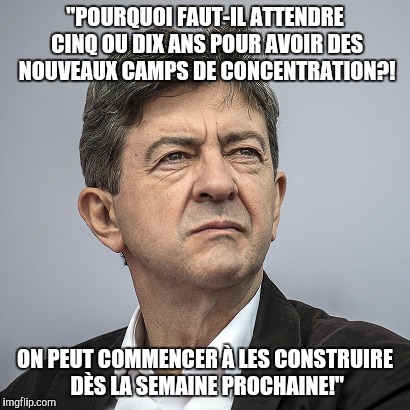
Recently in France there has been a surge of support for a more conventional left-wing political leader: Jean-Luc Mélenchon. He has a proud history of fighting fascism, but in the wake of his failure to make the second round of the presidential election he has refused to back the centrist candidate, leaving wide open the possibility of a fascist victory on Sunday. One common argument from his followers is that there is no point voting against the far-right now as they will only grow in strength over the next five years of ‘neoliberalism’. His failure to pronounce in favour of the only candidate who can beat Le Pen has inspired a movement for absention, with only one third of his first-round voters saying they will vote against her. If the Front National wins on Sunday it will be largely thanks to the ‘Left’.

In Paris nowadays it’s common to see armed soldiers on the streets. The same is true of Rome, where I live. They’ve never bothered me, although more than once I have seen them stop random black people walking into metro stations. They’re there to prevent terrorist attacks, which are by no means a remote possibility. But if there was a sudden change in political power the mechanisms of armed repression would already be in place, and the same is true in France.

Is the French ‘Left’ in a position to resist a militarised fascist dictatorship starting in two days’ time? In the coming years, as the rising tide of racism meets the coming climate crisis, we will all need to engage in acts of bravery and sacrifice. Are we ready, powerful and united enough to do so now? Once they see a hard-right government in power, will the masses be magically compelled to rebel and bring about socialism? No, no and non. As things stand, the Left hasn’t even managed to sand off the hard edge of market fundamentalism. It has failed to cohere and communicate a specific programme, and whether in the US, the UK or France it refuses to accept any responsibility for the consequent rise of the far-right. Letting Le Pen get elected – just like allowing Trump to take power in the States – would be a hysterical response to that failure, a gesture of impotence and despair, not all that different in essence from the empty and petty words of politically frustrated teenagers on internet forums.

In the midst of this petulant quasi-adolescent posturing, it’s refreshing to see that there are still some adults on the Left. This week Yanis Varoufakis laid out clearly why failing to vote for Macron to stop Le Pen would be a catastrophe and a betrayal. He rightly finds the notion that ‘neoliberals’ and fascists are equatable is particularly egregious. The epithet ‘neoliberal’ has become synonymous with the name Macron, as a handy political insult. Up until now I’ve continued to use the term despite the widespread lack of clarity with regard to its meaning. Having read lengthy books on the subject by writers such as Philip Mirowski and David Harvey, I don’t think that its existence is by any means a myth. However, seeing the cataclysmically inane way it is being thrown around in this election (as Mirowski says, it is often used nowadays as “a brainless synonym for modern capitalism”) I’m now inclined to agree with Geoffrey Hodgson that its use should be abandoned**.

*****

We live inside the Temple. If it collapses, we all die. That doesn’t mean we can’t dismantle it, or prepare for our eventual escape. But if we think it’s just a matter of blowing it up we may as well join Isis. Such self-destructive impulses have nothing to do with enlightened or egalitarian values. Such thinking is more a form of Nihilism than anything remotely progressive.

If you have a vote in the French election, use it. Don’t be an ultraleftist connard.

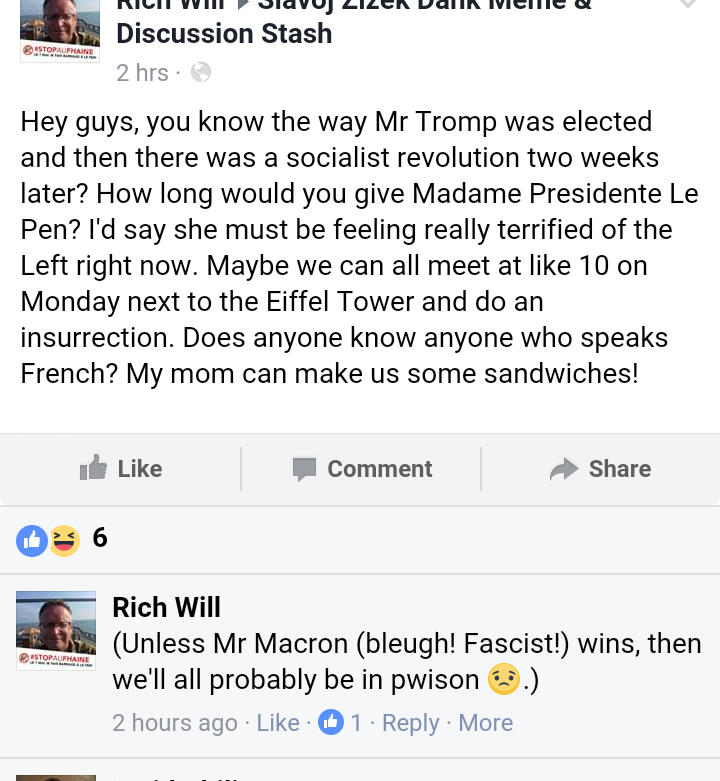
* Some are currently finding that rejecting the label ‘liberal’ and using it as a term of abuse puts them into pretty unsavoury company. Incidentally it’s now been pointed out to me that Žižek is indeed abusing his position to argue the same irresponsible nonsense as he did with Trump. Because Donald’s really been wobbling on his throne of late, hasn’t he. I’d give American cryptofascistneoliberalcapitalism a week more at the very most. In the meantime, fascist victory Sunday, communist revolution Monday, ça marche pous vous?! Don’t forget the book signing! Exit through the death camp!

** Anyone even vaguely interested in these issues should read that article. There’s also a far more articulate and evenly-tempered reponse to this whole depressingly predictable/predictably depressing Zizek-doesn’t-mind-Le Pen furore here.

*** This article didn’t go down too well on one particular Zizek fanboy forum. Oh well, if you can’t beat em, join em:

Bryan Adams in Mozambique: Parts 1, 2 and 3

If you should ever visit the island of Inhaca in the Bay of Mozambique and make your way on foot in the 35° heat along the mangrove-lined coast to the south of the island to visit an abandoned lighthouse, and should you along the way get talking to a charming young local kid called César who appoints himself as your guide for the rest of the trek and tells you among other things about his life that he’s a particularly big admirer of the Canadian rock singer Bryan Adams, don’t tell him this story:

In the mid-1990s (a newspaper once reported) Bryan Adams was living in London. Next to his (obviously very expensive) house or apartment there was a pub which played loud music late into the night. Bryan Adams was annoyed by the noise so he bought the pub and closed it down.

If you make the mistake of telling César that story, something very like this will happen:

César: (laughs for ten minutes)

Ele… (He…) (laughs for another ten minutes)

Ele….comprou o bar… (He…bought the pub…)

Richard: Sim (Yes)

César: …e não gostou…da música….(and he didn’t like the music)

Richard: Não (No)

César: (Laughs for another four minutes)

Richard: Este farol, está perto? (Are we getting close to the lighthouse yet?)

César (still laughing): Foi em Londres? (Was this in London?)

Richard: Sim (Yes)

César (still laughing): Que zona de Londres? (Which part of London?)

Richard: Acho que foi em Chelsea. (I think it was in Chelsea)

César: Como é que se chamava o bar? (What was the bar called?)

Richard: Não sei (I don’t know)

César: Mas aconteceu mesmo? (Did it really happen?)

Richard: É o que dizem (Apparently)

César: Mas é verdade? (But is it true?)

Richard: Sim (Yes)

César: (laughs for six minutes) Ele…comprou…e mandou fechar…(he bought the bar…and closed it down) (laughs for eight minutes)

Richard: Sim (Yes)

Richard’s wife: Temos água? (Did we bring any water?)

César: (still laughing) Mas quando foi? (When was this)

Richard: Nos anos noventa, acho (In the 1990s, I think)

César: Ele mora lá ainda? (Does he still live there now?)

Richard: Não sei (I don’t know)

Richard’s wife: Porque não trouxemos água? (Why didn’t we bring any water?)

Richard: Desculpa (Sorry)

César (still laughing): Mas muita gente gostava do bar? (Was the bar popular?)

Richard: Não sei (I don’t know)

César (still laughing): Ele…(He…) (laughs for seven minutes)

Richard’s wife: Este farol, está perto? (Are we getting close to the lighthouse yet?)

César: Podes contar a historia de novo? (Can you tell me the story again?)

Richard: Não (No)

*****

Here’s a story I didn’t tell César:

I once (in about 1995) heard an interview on Irish radio in which Bryan Adams explained the genesis of his most recent hit song (see below). He recounted that he had been messing around in his home studio (possibly in London, I don’t know). He had a tune in his head but was feeling short of lyrical inspiration. Then his pet dog walked in, and he ended up writing a song about his dog.

Here’s the song:

 *****

Yesterday I was in Birrificio Marconi, a pleasant bar round the corner from our apartment. The TV screens were showing motor-racing (declaration: I fucking hate motor-racing) but thankfully the sound was turned off and the stereo was playing a not-unpleasant selection of Classic Rock. The song ‘Summer of ’69’ by Bryan Adams came on. Here are some thoughts inspired by the experience:

1. The intro sounds exactly like a number of songs on one of Billy Bragg’s first two albums. (I’ve thought this for over 30 years but never got round to mentioning it to anyone.)

2. It’s also a Bruce Springsteen pastiche, just like many of Bon Jovi’s early hits. In the memo on my phone it says ‘teenage working class nostalgia’, which is a bit of a weak insight, I mean it’s obvious that’s what it is. I might be able to redeem this point by telling you that Adams’s dad went to the horrendously posh English military college Sandhurst, which happens to be true and does suggest that the image on the front of the single (see above) was playing on Brucie’s success and was a bit fake.

3. I think the choice of ’69’ as the setting for the song was to some extent laviscious and contributed to the song’s success as with its lyrics about ‘playing til my fingers bled’ etc etc it’s partly about discovering sex. (NB I’ve just read the Wikipedia page about the song and my interpretation is 100% spot on.) (I didn’t edit it myself.)

4. It’s entirely up to you whether you wish to relate point 3. above to the preceding anecdote (part 2).

5. Although it appears to be a simple let’s-do-the-gig-right-here bash-it-out rock song the very impressive surround speaker system of the Birrificio Marconi drew my attention to its emblematically mid-80s production: it has a lush, inflated sound which I believe started in the late 70s with Fleetwood Mac, particularly their hugely expensive album ‘Tusk’, which features one of my favourite songs (‘Sara’). That particular production style puts me in mind of the later stages of the films ‘Boogie Nights’ and ‘Goodfellas’. As the action moves into the cocaine bloat of the early 80s it’s soundtracked by the empty and gargantuan (but at those specific moments on those specific films actually quite moving) sound of stadium rock (Journey and the like), which speaks to me of cushioned studio walls and million-dollar recording budgets. You can hear this in the Bryan Adams song, as on a decent surround sound set of speakers it has a multidimensional sound, like you’re inhabiting the music. Those studio effects quickly became ubiquitous (think of the vacuous horrors of Heart and Starship and also Dylan’s almost unlistenable 1985 album ‘Empire Burlesque’, with its empty, echoey, overproduction values), and it’s no accident that the antihero of ‘American Psycho’, Patrick Bateman, rhapsodised about the sound of Whitney Houston’s debut album and the ‘consumate professionalism’ of Phil Collins and Huey Lewis and the News; the curious thing about hearing the Bryan Adams song yesterday was that it actually sounded really, really great.

*****

I would like to apologise to anyone disappointed to find that parts 2 and 3 of this whatever-it-is have nothing whatsover to do with Mozambique. If there’s any demand for parts 4, 5 and 6 I’ll see what I can do but I’d imagine it’s quite unlikely to emerge anytime in the near future.

Are the Tories throwing the election to escape responsibility for Brexit? No, but…

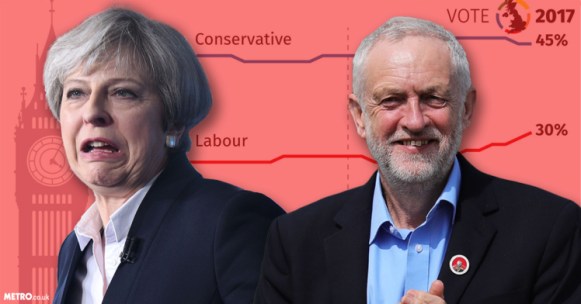
aw-theresa-may-jeremy-corbyn-poll

As I’ve argued all along would be the case, an orderly Brexit is turning out to be impossible. The early stages of negotiations have been like trying to make an omelette using shit instead of eggs. It was never going to be anything like a ‘clean divorce’ – that metaphor is just as unhelpful and misleading as Thatcher’s comparison of a national economy to that of a household. Instead the UK wants to unilaterally break a contract with 27 partners and define some sort of mutually beneficial relationship afterwards in the face of a politically justifiable desire from other partners to eliminate any possible benefit.

It may not be clear from reading the domestic press, but the UK Govt is currently undergoing galaxy-wide humiliation at its lack of preparedness, its self-delusion and its misplaced arrogance. Foreign news outlets tend to report what people like Juncker have actually said, not some self-serving distortion of it. The Tories and their pet bulldog newspapers can snarl emptily about sabotage and bluff and bluster about being ganged up on but the fact that May et al do not know what they are doing is now public knowledge from Torino to Timbuktu. There are probably peasants in the North Korean countryside having a good laugh at May’s plight over their breakfast of grass and bits of their house as they try to find light relief from thoughts of impending nuclear annihilation, not to mention spladgequards from planet Beetlewoox 4 scratching whatever they have for heads and wondering why this particular species of human known as The British insists on behaving in such a hostile manner towards its nearest neighbours.

At the same time, Corbyn’s Labour Party is rising slightly in the polls (not that much – it’s rather like someone you were sure was dead moving an eyelid slightly). Would Corbyn be better placed if this somewhow was to become known as the Lazurus election? That would place him in the not-exactly-to-be-coveted position of having to negotiate in the national interest for something which is against the national interest. After all, even the most ardent Brexiteers did this primarily for their own ideological jollification. Instead, the likeliest scenario is that following a probably slightly less emphatic Tory victory than we had feared, the UK will call off talks and resort to extreme hostilities as the economy collapses and the country quite possibly prepares North Korea-style for a war which may or may not ever arrive. If the whole thing wasn’t so depressing I would bet good money on some form of conscription being introduced before Article 50 expires. That’s the sort of thing merchants of chaos like Farage wanted all along and Cameron was prepared to risk for the sake of short-term political expediency.

The Tories are, of course, not about to throw the election. They want to achieve their long-standing ambition of crushing the godawful upstart Plebs Party for good*. The polls may well be misleading – Michael Ashcroft certainly made sure they were in 2015. But they must be having very serious qualms about the trap that they’re backing themselves into. The Tories have been able to get away with austerity by blaming everything that’s wrong in society on the previous Labour Government. No opposition means fewer scapegoats at a time when they need them like never before. This is not a good time to turn the country into a one-party state.

* It may be due to missing the irony in this sentence that some idiot on the Labour Party forum (possibly a troll) said that this article ‘reads like Tory Party propaganda’. This may mark an all-time high in terms how inane political debate on social media can go, I’ll keep you posted.

My days as an early internet scamster (and troll)

dialup2.gif

In the British sitcom ‘Only Fools and Horses’ Uncle Albert would always bore the shit out of everyone by droning on about life ‘during the war’. I used to wonder what my generation’s equivalent would be, and I didn’t have to wait long to find out. When I try to explain to my students that life before the internet, smartphones and etc didn’t just involve sitting round in black and white waiting for those things to be invented I can almost hear them groan. As it happens I was involved in one of the first internet scams, and was also one of the first people to realise the potential of the web for what would become known as ‘trolling.

The first ‘proper’ ‘job’ I had (I’d already done about 15 things by the time I left school, from delivering the world’s shittest newspaper and selling dusters door-to-door to being shouted at in restaurant kitchens), was with a company based in Battersea which went by the sublimely Delboy-esque moniker of Business Trade Bureau. My bosses were a resting Islington actor who worked a little on our RP vowels and a dapper elderly gentleman who had a touch of the Frankie Frasers about him; my colleagues included two ribald white Kip Tiwnians who had left Sith Ifrica after the end of apartheid because of all the (ahem) ‘crim’.

Here’s how the scam worked. ‘Our’ ‘secretaries’ would phone round numbers from regional editions of the Yellow Pages: one week it would be plumbers, the next electricians, etc. Their ‘bosswanted to talk to the sole trader about something important, some work, in fact – their company had been ‘recommended. This was the bait, and as it was recession-deep 1993 small contractors usually leapt like adolescent perch at it. Most called back and were put through to a pseudonymous version of ‘me’ (there was much fun to be had doing ‘rallies’ round the office, transferring the call until they hung up. I think the record was sixteen.) We would, sounding as pompous as humanly possible (I’d never seen or heard Boris Johnson at this point, but…), lead them through a bullshit questionairre designed to see if they could satisfy the needs of our ‘subscribers’, who paid us a ‘handsome’ sum to access our ‘website’ (a ‘sort of private computer database’ which they accesed via a ‘modem’, ‘a bit like teletext, but considerably snazzier’ ‘it doesn’t matter what it is, because it doesn’t exist’ – that last explanation I often omitted) and get the details of ‘topnotch’ ‘handpicked’ contractors in their area.

What’s a modem? people would ask, usually sounding a bit tired. I’d never seen one, and I wouldn’t get the chance to go online for another year or so, at which point I would mostly use it to get Simpsons scripts and send rude messages to members of the Wu-Tang Clan (I never got a reply, thankfully). Some people were satisfied to be told that the system was similar to Minitel (I didn’t really know what that was either). I usually explained that a ‘webpage’ was like a fax machine, but with computer information instead of paper. This wasn’t a bad guess as it goes.

My spiel was often interrupted by weary queries as to the inevitable cost of this to them, the contrators. I would imperiously bat away such footling concerns, telling them it was our clients who paid for the service. The trick came at the end when, having obtained their go-ahead, I would tell them I’d be faxing the contract right away and if they could send it back post-haste (suddenly speaking impossibly fast) along with a cheque for £145 plus VAT we’d get them set up asap (pronounced asap). Cue drawing of breath, cursing, remonstrations about twenty wasted minutes followed quickly by my slightly hurt-sounding placatory protest that it was merely the cost of designing their non-existent ‘website’ (I didn’t say ‘non-existent’) which was done by a crack team of (with all the fogeyness I could muster) ‘whizzkids’.

Desperate business. At least it taught me the vitally important life skill of sounding self-important while lying through my gums. Given that we were paid mostly on commission there was a strong incentive to work hard but what we were doing was clearly so sociopathic in nature I often just covered the phone with The Guardian (the desk had no computer on it – how quaint!) and pretended there were no calls. Often, when I was called or forced into action, the acting bit was fun but there was a certain point at which the caller, after a couple of minutes of spiel, would refer bitterly to an uncannily similar-sounding conversation they’d had a few months before with a representative of another telltellingly-banally-named firm which had ended up scamming exactly £145 plus VAT off of them. That firm had, as it happened, operated from the exact same premises on the exact same premise. After I got wise to this I began to anticipate it, saying there were ‘cowboys’ in any ‘trade’ and it was essential to weed them out. I stuck out the job until I got a much better offer consisting of going to live in Dublin and signing on for a couple of glorious but now somewhat smoky years during which my skills at mini-pool and my indepth knowledge of Aerosmith videos developed considerably but my job prospects sort of stultified.

Within a few years I had been corralled back into the workforce and was spending all my working day online. The job consisted of helping people with their computer virus issues and mind-numbingly dull problems with (nods off) utility software. The company was located in the uniquely uninspiring setting of a subsuburban business park in comparison with which central Slough would have been like Djemaa El-Fna. I also spent a lot of time trying to avoid answering the phone. At least I got properly paid, although this was Dublin, in 1998, which generally restricted my disposable income to three pints of Harp and a red lemonade for the lady. The day was spent employing the usual skives: donating blood at lunchtime and spending the afternoon in a selfless snooze, urgent private tete-a-tetes which actually just consisted of paper plane competitions, trying to get the French speakers to direct calls my way so I could get in some invaluable language practice, and etc. Luckily I found an original way to perforate the tedium: the virtual version of Schiphol Airport, Amsterdam. I’d passed through the real place a few weeks before on my way to Singapore so was tickled to find that I could return in the form of a (rudimentary) avatar. The trick was to walk up to ‘people’, engage them in innocuous conversation and then let fly a series of uproarious Afrikaans obscenities copied and pasted from another website we’d tracked down (‘Jy was uit jou ma se gat gebore want haar poes was te besig, ‘Ek wens jou vingers verander in vishoeke, en jou balle begin te jeu and the classic ‘Jou ma se hond se poes). This would usually result in the deliriously rewarding sight of seeing their insuffiently-pixellated digital representative wordlessly turn around and totter off ‘in’ the ‘direction’ of another non-existent ‘part’ of the poorly-rendered ‘luchthaven’.

I’m not particularly proud of either of these episodes, but looking back now I do sort of miss those times when I had all that spare time at work to mess around and totally waste my time on the…er…internet. These days, I have to…er…what time is lunch?

Anti-fascist lesson plan

This is an anti-fascist lesson for the week leading up to the potential election of a fascist leader of a major European country. Although in some teaching contexts political content is discouraged, engaging with questions of power and society is one way of allowing your students to develop their rhetorical skills, and also a means of encouraging a sense of group unity and shared purpose at a time of increasing division and social atomization.

It’s possible that you have a fascist or two in your class. Let’s hope not. This lesson isn’t designed for them, but who cares. Maybe they can leave the classroom and go and troll Twitter instead. It aims to enable your normal students to engage politically on an international level through the medium of English. If you don’t feel comfortable with that, don’t do the lesson, but it’s worth bearing in mind that a) English is not just a language for conducting trade, presenting innovative product ideas, etc and also b) if fascists such as Le Pen triumph your livelihood as teacher of a globalising language will be under threat and a lot of your students (and your friends, your family and you) will end up exiled, in jail, dead, or guarding concentration camps for a living.

The lesson as designed is 75 minutes long and should work well for high Upper Int/B2.2 upwards. I did it on Tuesday with a B2-ish class of Political Science students and it worked wonderfully.

Lesson procedure

1. Write on the board ‘fascism’. Ask what it is. Elicit names of famous fascists but also ideas about how to define it. Offer no definitions of your own. (5 mins)

2. In pairs students write their own definition of fascism. (5 mins)

3. Now look at the one on Wikipedia. Do your students agree? How would they change it? (5 mins)

4. On their phones or together as a class, edit the definition on Wikipedia (NB. your/their definition(s) will be rejected almost immediately, but you don’t need to tell them that.) (10 mins)

5. In small groups students address the following

Questions for discussion:

Do you know any fascists personally?

What would you do if a friend of yours started talking about:

  • Voting for a fascist candidate?
  • Joining a fascist organisation?

Have friends on or off social media been talking about the French election?

What would you say to a French friend who was talking about voting Le Pen?

(10 mins including brief report back from each brief pair on what was briefly said – don’t let this bit drag on. Make it brief.)

6. Half the students read Article A, half Article B. They take notes on the MAIN points (stress this and jog them along if they get stuck on details – with less strong groups tell them to just read the first seven or eight paragraphs), check difficult vocab and compare with a partner who’s read the same article. (15 mins)

7. Students swap partners and share what they learnt, taking notes on other person’s article. (10 mins)

8. Share and clarify the meaning of vocab they learnt on the board. (5 mins)

9. Students imagine they have a French friend who has been posting pro-Le Pen stuff online. They write an email to their friend telling them what they think. Depending on their level you could instruct them to use a certain number of conditional sentences (‘if Le Pen wins’, etc). Be on hand to offer vocab and grammar suggestions, etc. They then share what they wrote with a partner, asking for constructive suggestions, etc (20 mins)

10. For homework students write a second draft and then email it to you for corrections, etc.

C’est tout. Nique les fachos!

The Tories are ‘strong and stable’. What are Labour?

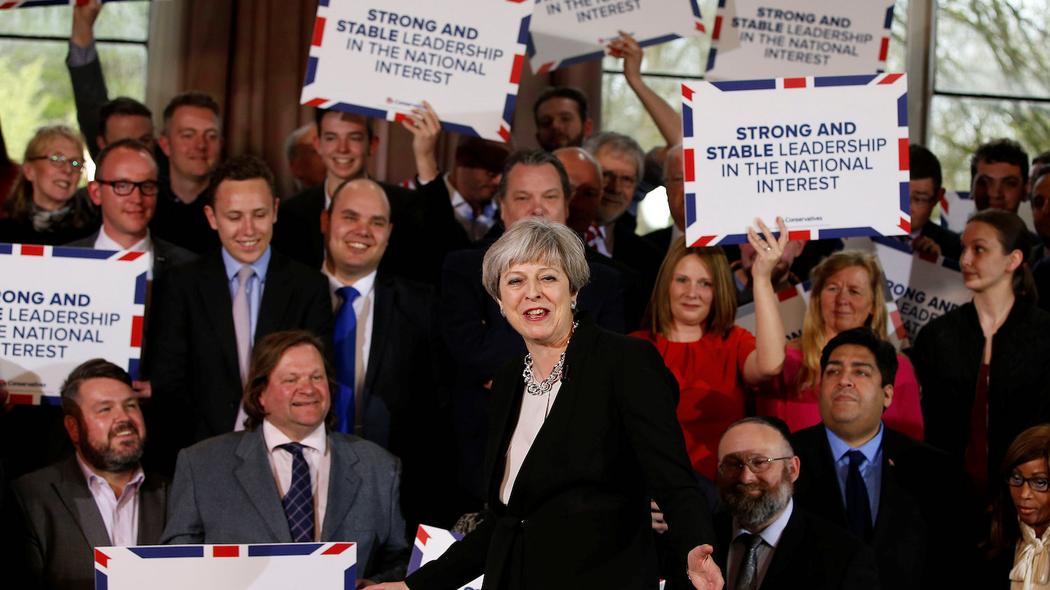
Theresa May gave a speech a few days ago in which she used the slogan ‘Strong and Stable’ twelve times in ten minutes. As a result she is being royally ridiculed on social media, with countless memes being diffused exponentially as I write.

A further outcome of the Tories’ faultless message discipline and the responses to it is that on 8th June millions of people will go and vote on the basis of strength and stability (DECLARATION: I fucking hate The Tories and will be voting Labour in June). Satirising the message will just serve to reinforce and spread it. That’s what happened in the last two general elections and in the referendum last summer. At different points each leading representative of the Leave campaign was torn to pieces on Facebook and Twitter for ‘overusing‘ the expression ‘take back control’. The result of the referendum showed that all that repitition was actually the slogan being implemented successfully – the Leave campaign even consulted Paul McKenna to help them drill the message into people’s heads. It’s not a rational process. ‘Strong and stable’ will have been chosen from a list of potential slogans after a rigorous process of testing it on groups of potential Tory voters.

The science of this is well-known but doesn’t always find acceptance on the left and doesn’t seem to have had much of an impact on the people at the top of the Labour Party. On doing some research I found out that Labour’s slogan for #GE2017 is ‘For the many, not the few’. Although I’ve been following the election the phrase didn’t spring into my head immediately as the Conservatives’ slogan will and tellingly there haven’t as yet been a furore about opposition politicians overusing it. I don’t get the impression it’s been tested – it sounds more like a phrase that our avuncular leader plucked out of thin air. On my Facebook page yesterday I saw a post on the Labour forum about John McDonnell’s 20 Pledges to Workers. Okay, twenty is a round number but it’s also a large one. As Owen Jones has repeatedly pointed out, only people who are actively interested in politics take an interest in what lies behind slogans, ie the details of policy. Each of those individual items may strike a chord with working people but in order to be effective they need to be framed into clear pithy messages whose memorability has been exhaustively put to the test. 

Nevertheless, the central slogans have been chosen and Labour leader, supporters and representatives need to put them into operation by repeating them as often as humanly possible. In the meantime we need to stop doing the Tories’ work for them by effectively advertising, whether in jest or not, what May’s Conservative Party stands for.

Here’s why I’m so angry about the French election

A relatively apolitical visitor to this website over the past week or so might be puzzled as to why on earth someone who doesn’t even live in France is getting so worked up about something so petty as the potential election of an undisguised fascist as leader of a major European country, not to mention so angry about the role of people supposedly on the left of the spectrum in helping to bring about such an eventuality by campaigning for people to abstain*.

I suppose from an early age I’ve tended to take politics too seriously and too personally. In the place and time I grew up everyone had a private store of venom reserved for the pronunciation of words like ‘Thatcher’ and ‘Tories’. Nevertheless, over the last few years I’ve made a concerted and conscious effort to uproot my political sentiments from the fertile manure of rage and resentment in which they originally flourished and replant them in soils of empathy and compassion. Some might say that given that over the last few days I’ve written lots of sentences like ‘I’m starting to despise the so-called ‘Left”, ‘FN voters are welcome to their shitty lives’ and ‘I fucking hope that President fucking Macron fucking puts anyone who fucking abstains in a fucking death camp’** I’m not trying hard enough.

Such sentiments do tend to stand out on my timeline of mostly liberal/lefty Facebook friends, where people generally avoid giving offence and potentially upsetting valued friends, family and acquaintances. In right-wing jerk circles, by contrast – and especially on Twitter – it’s fine to give vent to one’s most violent impulses and bond around the bonfire of all accepted values (except values oddly similar to those of one’s most conservative great-great-grandparents, but still). The libidinal charge of such outbursts helps explain why social media have contributed so very much to the recent success of a politics based on fear and hatred. It’s a version of Orwell’s two-minute hate and as such it can be exhilarating. 

I know this because I used to absolutely waste my time/try to escape my self-reaffirming bubble by arguing with racists and climate liars on Twitter. In the process I repeatedly saw confirmed the wisdom of the famous advice about never wrestling pigs: you both get dirty but the pig enjoys it. Nevertheless, in these fraught times and particularly among friends, those of us who worry about rather than welcome the rise to power of forces dedicated to scapegoating and violent repression should still open our mouths and express our fear and anger rather than hiding our feelings so as not to risk unpopularity. After all, members of our great-grandparents’ generation sacrificed their and others’ lives in the fight against Nazism. Surely the occasional Facebook post or tweet is not too much of a risk. Perhaps pretending we don’t know about climate change has taught us all some very bad habits with regard to (not) talking about unpopular topics.

Regardless of the comfortably numbing effects of social media, no one with a vote in the French election (remembering both that France has a comprehensive education system and that you have to officially be an adult to vote) can claim to be unaware that Le Pen proudly represents a lineage of racial supremacism as a justification for torture and mass death. As for those elements of the puerile and petulant left actively campaigning against Le Pen’s sole remaining opponent, let’s recall that France’s proud history of righteous political violence is by no means limited to guillotines and lobster thermidors. France in 1945 established a proud tradition of dealing with collaborators, which mostly involved shaving their heads and parading them through the streets so that normal people could spit in their faces. Presuming that the forces of reason rather than hatred do win out next Sunday, it would be hard to argue against the same treatment of those supposed progressives who, knowing the dangers of fascism, did everything they could to try to descredit the only candidate who could defeat it.

Now, I’m aware that the latter part of the preceding paragraph may be legitimately used as evidence by those who’ve argued that in my diatribes about the French election I’ve exhibited a lack of empathy for the plight of those left out of globalisation, people drawn towards Le Pen because they’ve had their life chances and those of their children damaged beyond repair, and who look to the future with fear mixed with a large dollop of resentment towards a political class that throughout their whole lives has lied to their faces while robbing them sourd, muet and aveugle***. I don’t want to come across like one of those Remainers who sneered at people whose plight was ignored by society and the economy to the point where they were desperate enough to fall for cheap demagoguery and tabloid manipulation, or smug Clinton supporters looking down on the millions who fail to qualify for the Democrats’ not-so-inclusive vision of ‘middle class’ Americans and who voted for a reality show tycoon in preference to a professional politician from one of the same old establishment dynasties. In the case of France I would have some understanding of those calling for abstention if it were the truly atrocious Fillon against Le Pen. But for all that I try, I cannot help but put voting for an actual fascist in an entirely different moral and political category. This is not about being duped by cheap promises of jobs or ‘sovereignty’. Successive generations of Europeans have grown up understanding Hitler and the Nazis to be an emblem of absolute evil. There is no one in France who does not know of Le Pen’s associations with those who deny the Holocaust and the monstrous crimes of the Nazi’s French allies (not because they think they didn’t happen, but because they approve and want to achieve something similar). In a French setting the FN openly celebrate the colonial wars, which brutalised entire societies – Le Pen’s father was a proud torturer of fighters for Algerian independence. There is no excuse for voting for such repugnant characters, and I also have nothing but seething contempt for those who ‘argue’ that an aspiring centrist Presidential contender is on the same moral scale. The trade unions and political parties who are calling the choice between a liberal democrat and a fascist**** ‘the plague or the cholera’ deserve to catch both, and as for the schoolkids running around organising anti-Macron demonstrations, they are, whether they know and are amused by it or not, tools of the far-right. As such I don’t find them a particularly compelling case for empathy. Let’s use whatever meagre means we might have – let’s, at the very least, use social media to share our anger and fear of a fascist victory – to help ensure that next Sunday the spirit of anti-fascist resistance fighters prevails over the fetid ghouls of Nazi collaborators.

* They might also be inclined to think, jesus, are all the sentences going to be this long?

** To be fair I didn’t actually write that one, although I might well have thought it momentarily.

*** The French term for ‘dollop’ is apparently ‘bonne cuillerée’.

**** Le clue devrait être dans le mots, n’est-ce pas?!