7 Amazing Facts about Vladimir Putin

il_570xn-688197171_7zpk

I suspect that some of the people rightly expressing outrage at last night’s horrible events in Berlin were far more sanguine about the even more horrifying events last week in Aleppo. I’m thinking in particular about the people I’ve met in person over the last few months who expressed the belief that Vladimir Putin is essentially a good leader who knows what he is doing: the English couple I got talking to over lunch last month who thought that aligning with Assad was the only possible option in terms of ensuring ‘global’ ‘security’; the Colombian IELTS candidate last weekend who felt he was cruelly unrepresented in the ‘Western media’; the Italian Quaker who believes that Putin’s sterling work in ‘growing’ the Russian economy was a good model to follow. For what it’s worth, I want to lay out some facts that challenge this point of view, one which I think is heavily conditioned by the deeply insidious pseudo-radical state propaganda outlet Russia Today and the useful fools such as Max Keiser, Julian Assange (clearly neither of them actual fools, but both of them possible tricksters), Ed Schultz and George Galloway who lend it their credibility (odd that we should still be talking about Galloway’s credibility in 2016, but still…). Other prominent pro-Putin advocates include that orange prick and other far-right demagogues like Le Pen, Farage, Salvini, etc, along with their fellow travellers such as Beppe Grillo (another possible trickster). This propaganda effort is all part of a much bigger initiative to restore Russia’s power and I doubt that my teeny little blog is going to make much of a dent in their tanks but what the hey.

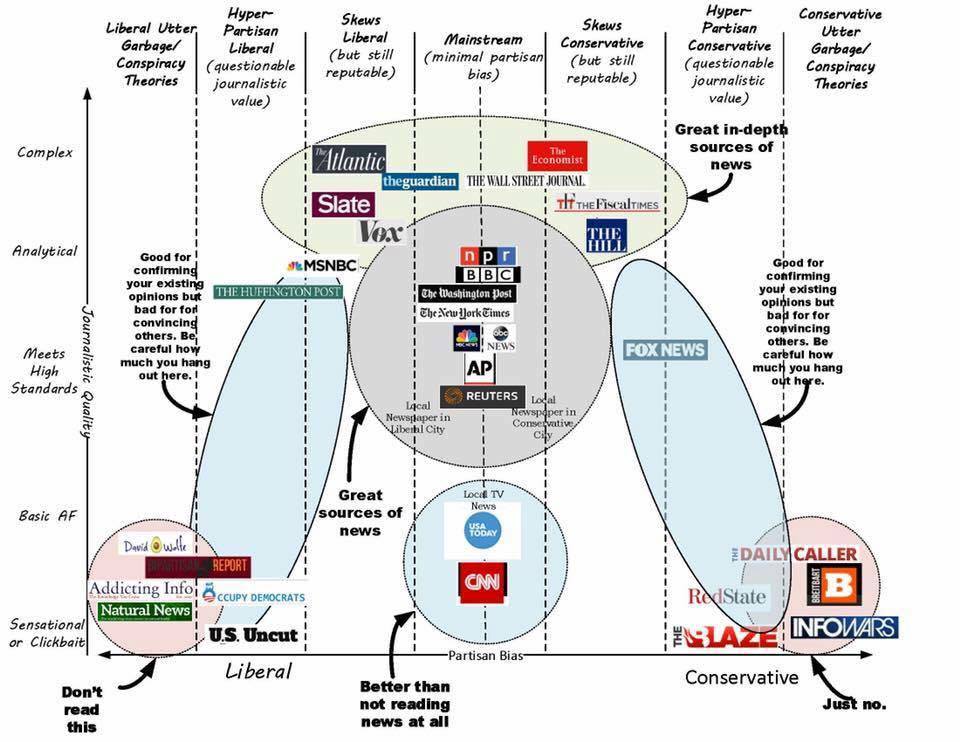
You will notice by the way that the sources for these facts are reputable news organisations. For a useful breakdown of which news sources are trustworthy and which are garbage this is a very useful graph.

  1. The immediate violent reaction to the full-scale destruction of Aleppo was absolutely predictable.
  2. There is very strong evidence that Putin was directly complicit in the murder of hundreds of his own citizens in 1999 in order to instill fear and panic in the population, justify a new war in Chechnya and delay the election so he could take power.
  3. Putin is enormously personally corrupt.
  4. On the singlemost important issue facing the world today Putin is profoundly stupid. He is on record as saying that “two or three degrees” of warming could be good for Russia because residents wouldn’t need to spend as much on fur coats. Actually with two to three degrees of warming Russia would be в жопе.
  5. The Russian economy is tanking, with millions having been plunged into poverty in the last two years. Any supposed growth under Putin has been wiped out.
  6. His supposed popularity with the Russian people is partly based on electoral fraud.
  7. Putin is weaker than his slavering supporters like to pretend.

As I say, you don’t have to take my word for any of these things; please click through to the links from newspapers of record and they will confirm in the form of carefully-researched detail what is stated above (the first one is self-evident). Alternatively, if you prefer to trust in internet ерунда, there are millions of sites just like this, all just about as credible as Russia Today. As for Trump, I hope that when he gets to meet his hero his backup staff have some sort of sexual sedatives on hand as I fear that otherwise Putin might have difficulty shaking the US President off his leg.

Guanajuato: What the Catholic Church has in common with Slayer

incredible-views-in-guanajuato-mexico-1Guanajuato is the kind of place where you spend most of your time hoping you can come back one day. The term Pueblo Mágico is somewhat overused in a Mexican context – you’d be hard pressed to find a reasonably attractive town of a certain size to which that classification hasn’t been applied – but the charms of this place are plentiful and immediately apparent: an undulating landscape of colourful roofs and baroque churches spread over several hills, from which a bird’s eye view swoops down to tight-knit labyinths of alleyways which put me in mind of Alfama in Lisbon or the Ribeiro in Porto, these twisting callejones opening suddenly upon laurel-lined colonial squares laid out in their own haphazard maze. Its effect was such that even though we have now left Mexico I still have the vague but somewhat vain hope that we will go back before we leave. Somehow.

We happen to be there during the Day of the Dead celebrations and there couldn’t really be a more appropriate place to visit. Many of the streets are carpeted in intricate tapestries in colours which surpass my vocabulary in any language, composed of various flora and foodstuffs depicting calaveras and other catrinas or commenting slyly but wittily on political events.
Although the notion that Death is more present or more acknowledged in everyday life in Mexico can be challenged on various fronts*, this is a city built on the sacrifice of hundreds of thousands of silver miners. We descend to one of those mines and learn about the horrendous conditions endured (or not) by countless generations of mostly indigenous workers, and then we climb back up into the baroque ornateness of a church resplendent in the produce of all that toil. The whole of Guanajuato, it seems, was developed because the owners of the mines had nothing better to do with their money than build shrines to themselves. In the words of Walter Benjamin, there is no document of civilization which is not at the same time a document of barbarism.

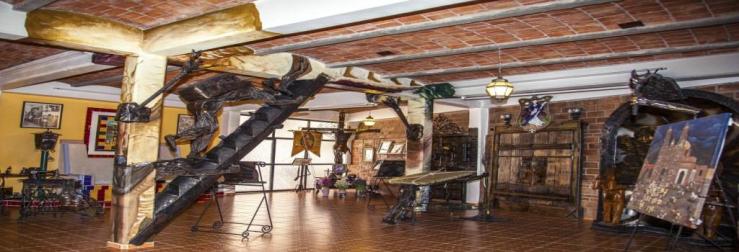
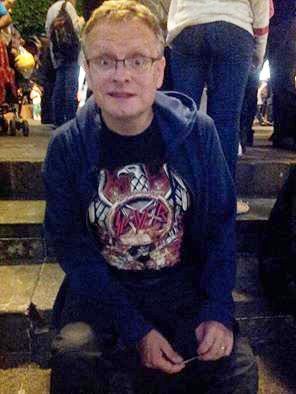
It wasn’t just indigenous workers who broke their backs digging up precious metals. A caption in the local museum alludes coyly to the ‘presence’ of African ‘workers’ who were brought in to complement the Nahuas, Michoacanos, Otomis, and Chichimecas commandeered from other parts of Mesoamerica. Nowadays there is a glut of workers for a far smaller pool of jobs in tourism and the culture industry, with something of an an oversupply of hotels. We are certainly well catered for. The owner of our rambling hillside guesthouse turns out to be a gringo, one who typifies a certain kind of voluble effusiveness particular to North Americans, a characteristic which I personally find very endearing. He is full of stories about how he and a small team of in-laws hewed the place out of raw rock. It is a genuinely staggering achievement, involving hauling hunks of stone up and down the hill and hacking out waterways where there were none. casa-zuniga-b-bTalking to him I am reminded of Fitzcarraldo, or any number of mad semi-mythical geniuses who headed south, grabbed machetes and gouged out their visions in the tropics. The sprawling establishment has a lot in common with the local churches in that there is silver and steel everywhere, but the decorations do not depict angels or edenic scenes, instead they consist of rather macabre, twisted metal sculptures. It looks like a workshop where the stage set for the new Iron Maiden world tour is being welded and hammered together.148216400712045Fittingly, my less-than-elaborate costume for the Day of the Dead itself is a Slayer t-shirt I buy for 100 pesos. Here you can see a photo of me in all my gothic grandeur.

Even more of a frightening sight are the mummies which have long been one of Guanajuato’s main tourist attrations. The corpses were perfectly preserved but a century or so of morbid gawping has worn them out a bit. It strikes me that so much of the histrionic shrieking and visceral iconography of heavy metal music are in part an unwitting parody of certain aspects of the Catholic Church. While most metal bands would probably describe themselves as nihilistic, they are actually for the most part deeply moralistic, albeit more id than superego, a celebration of all the sadistic and grisly elements that priests pretend not to enjoy. There are few passages as gothic and rich in potential death metal imagery as the description of the sermon on the eternal tortures that await the damned in hell in James Joyce’s ‘Portrait of an Artist as a Young Man’.

A clue to what lies behind all these representations of gore is on display throughout the city: many churches are covered with huge images of fetuses reminding anyone who needed reminding of the fervent desire of the medieval and neomedieval church to control women’s sexualities at all costs. The museum where the mummies are housed also houses a few preserved examples of desiccated embryos. It may be that the historic treatment of women by the church and the state has contributed to the development of a culture in which men feel free to seize and dispose of women’s bodies with impunity. After all, certain still-dominant elements of the church hierarchy do not regard women’s bodies as their own property, but rather as mere vessels for the next generation of male heirs and child-carriers. Just a few hundred miles south of here the Church is having women locked up for decades for the mortal sin of having a miscarriage.

It comes as something of a shock to discover several weeks after visiting Guanajuato that I had already, in a sense, visited the place before. Rewatching a documentary about Thomas Pynchon I learn that he fled here when running away from a journalist who had tracked him down in Mexico City after his first novel became an overnight success. Subsequently while rereading ‘About the Day’ I notice with a start that he even visited and described the mummies in some detail. It gives me an curious insight into how he composes his immensely complex and often encyclopedic novels, because while he was here in 1963, the novel didn’t emerge til 2006. He gives the impression that he writes down absolutely everything that he learns and experiences and it all goes into his books.

A far more bloodless place is only an hour away from Guanajuato on the bus: San Miguel de Allende. This is Mexicoland, the kind of place which someone like Bill Gates probably finds pleasant and safe to wander round in his polo shirt and chinos. It is awash with serious tourist money and the effect is somewhat bland, like a golf course whch just happens to be covered in colonial buildings. Nowadays the rich don’t build palaces, they acquire cultural capital instead. The streets are teeming with vapid art galleries selling tasteful but meaningless decoration. We are very glad that we reversed our original plan of staying here for five days and nipping over to Guanajuato for one. Está bien aburrido, guey! Guanajuato, por otro lado, es una maravilla macabra.


*On the last night in Guanajuato we met someone dressed as a ghoul, an American artist who has defeated death and now openly and joyously taunts it.

** All but three of the photos in this piece were taken by the author. Anyone who can guess which three stands to win an all-expenses-paid trip to the bathroom.

*** This is part of an ongoing occasional series of reflections inspired by cities I have been to recently. Other entries can be found tagged below under Cities.

Buying a pushchair? Read this first!

img-20161216-wa0005Are we ready, Chiara asks.

Of course we are, I respond. We’ve reached that state of grace all couples arrive at exactly seven weeks before the scheduled birth of their first child, when everything that can be taken care of has been and it is now time to relax. Nothing can surprise us from this point on; there is nothing we haven’t already anticipated, either before or after the birth. There are no more decisions to be made and no more tasks to be carried out. All we have to do now is wait for exactly seven weeks and then pop along to the hospital, where they will give us a bag with a baby in it. We’ll probably just have to sign a piece of paper or something; after all, this is Italy. The only other thing we have to do is to choose the pushchair.

Now among all the tricky aspects of preparing for impending parenthood, this is by far the most complex. It shouldn’t be; there are after all only three companies which manufacture passeggini: Inglesina, Chicco and another one I can’t be bothered to think of the name of right now. The problem is that between them they have over 65,000 separate but essentially identical models. It appears to be an agnotological product range, designed to spread doubt and confusion to the point where prospective mums and dads are driven so insane that they are happy, indeed grateful, to hand over the price of a roadworthy second-hand car. I’ve noticed over the last week or so that when we’ve seen a freshly-born child we are far more likely to coo over the buggy than the baby itself. It’s always tempting, after getting the how-old-is-it-does-it-make-a-lot-of-noise preliminaries out of the way, to bombard the proud parents with questions about their pram. Then there’s YouTube and its sottomondo of buggy-demonstration videos, none of which feature any actual babies. The products themselves have all been given bastard portmanteaux of words such as urban, rural, walker, stroller, runner, jogger, all-terrain, duo, doppio, duopoly, duology, trio, el tri, trilogy, threesome, quad, quinny, compact, kompakt, kompact, smart, mini, maxi, espresso, flat white hazelnut macchiato…a simpler choice would appear to be the one called Zen, but then do we go for Zen Light, Zen Life or Zen Lux, all of which happen to cost exactly €600. Personally I’d like one of the ones you can fold up and fit into a backpack, because this would suit my (ahem) ‘lifestyle’*. But then there’s my wife’s ‘lifestyle’ to consider. Plus the baby’s ‘lifestyle’, which will presumably for the time being revolve around eating, crying, soiling itself, getting cleaned up, soiling itself again, giggling and getting pushed around by its parents**. But what will we push it around in? All of the makes and models are modular (like the DELTA!), meaning you get all three out of pram, pushchair, and carseat***. Not that we have a car, and we’re not planning on getting one, because that would send completely the wrong message to the child about how to live, which means we need a special pushchair for forcing our way on and off the 170 bus when it finally deigns to show up****. I’d also like to get back to my pre-pregnancy weight, preferably from about 12 years ago when I used to go jogging all the time, which means getting one of the running options. I believe there’s even a model designed in conjunction with British Military Fitness (which is competitively priced at €600), although actually the Crossfit one also looks good, in fact it comes with six months’ free Baby Krav Maga lessons for an all-inclusive price of (you guessed it) €600. Obviously given our lifestyle needs we’re going to have to buy more than one, which means we will also need to get a bigger apartment to store them all in. I bet there are six-month-old babies who can show off entire garages full of gleaming luxury strollers and have whole teams of servants who fine-tune them and who get horse-whipped if the baby’s first word isn’t ‘lamborghini’. After all, Prenatal does have a VIP range, giving the lie to the now-laughable claim that we are all born equal; indeed a moment’s ‘research’ reveals that, yes, we could indeed pay much more than €600 if we so desired or could afford. I’m sure Godiva do their own range of strollers, and I’d be very surprised if Marlboro hadn’t got in on the act*****. However, our needs are more modest, partly because we happen to live in a small flat with a tiny lift, which means we’re looking at one of the light/lite/compact/kompakt/smart ranges with a wingspan of less than 50”, which luckily narrows the choice down to only 30,000 separate options. Or maybe we can get one that is specially designed to be used only inside the lift, but nowhere else, and then another intended for people whose lifestyle involves getting into the lift, and a third aimed at that specific market segment which prioritises departing lifts.

I suppose it’s easy to see why the all-terrain models are proving increasingly popular. The other day I saw a photo from Aleppo of a woman running, pushing her child in a pushchair, escaping the Russian bombs. It was a heartbreaking photo, and for once it didn’t occur to me to look at the make or model. I think I did, however, spend slightly longer than usual thinking about her plight and if there was anything I could do to alleviate it. We are enormously lucky to be able to spend time thinking about pram-related nonsense, and it’s even fun, if exasperating, to do so. We’re also very fortunate to be having a baby at all, as there are so many people who have to pass through the purgatory of IVF, paying a great deal more than €600 in the process. Plus there are very many wannabe parents for whom the idea of funding the upkeep of a child is about as realistic a prospect as buying a second home on the moon. So we’re privileged in number of ways, although personally I tend to think my main blessing in life is that I do not have to work in the marketing department of a pushchair company.

I was, of course, joking at the start. I know that these will be some of the busiest few weeks of our lives. For one thing, I’ve got to try and get my hands on a photo of Chiara in a carrozzina to put at the end of this article******. Then I’m planning to produce a piece based on my experience of migrating between countries centring on particular songs which have marked my trajectory. After that I want to finish a thing I’ve had in the pipeline for a while about the street where we live. It’s going to be a difficult few months but I’m sure at some point Chiara will be happy to stop moaning about her back pains for a few minutes and lend me a hand. They say that having a blog is one of the most stressful experiences you can go through in life, so it’s essential that we work together on getting through the next few months and end up with something we can both feel really, really proud of.


* This word is intended to be pronounced similarly to the way in which Natalino Balasso pronounces ‘Farmville’ in this video. Or ‘smartphone’ in this one.

** Maybe we should leave the whole passeggino-buying decision for another thirteen or fourteen years or so, just in case she decides to become a goth or something.

*** You can in theory buy all the individual components separately, except for the fact that for the carseat one you also need to buy an adaptor, but you can’t find the adaptor anywhere online, and none of the supposed stockists stock the adaptor, so you have to buy all the components together, for €600. It takes a lot of googling and a huge amount of swearing to get to the point where you find this out.

**** Mind you if we do at some point decide to give up on Rome’s ancient, crumbling and bad-tempered public transport system and buy a car on the basis that she needs one even if we don’t, at least we can put the debt to the planet on her karmic balance sheet rather than ours. We could then offset our guilt about this by refusing to buy her a smartphone until she’s at least 21 years’ old. It’s important to think about such things in advance.

***** People who read footnotes but are disinclined to google things for themselves will be astonished to learn that there 247,000 results for ‘Marlboro strollers’.

****** I was partially successful:n-1-one-year
Due incontri per strada a Roma/Two street encounters in Rome

sin-tituloIt’s a bright blue Monday morning in mid-October 2016 and I’m standing at the corner of Via dei Gracchi and Via Alessandro Farnese in the centre of Rome, having just left work. I’m partly waiting to cross the road and partly trying to get fivethirtyeight.com to load on my phone. There’s a guy in a car looking at me, stopped at the traffic lights on this quiet street, shouting and laughing. At first I don’t think he’s talking to me, maybe on his phone or to himself. But no, it’s me, he’s beckoning me over, and he seems to know my name, so I must know him, but I feel bad because I have no idea whatsoever who he is. He looks very Italian, in a slightly fighetto kind of way – bald head, properly shaven, shirt well-ironed, smart and garrulous with his hands. He’s speaking quickly with a Napoli accent, and he’s saying something about an embassy, and 2011. I explain that I wasn’t here in 2011, that I was in London, but then it turns out he’s talking about the school. Il British! Ah! Well, that’s where I worked, after a fashion. British Study Centres, in Marylebone. He clearly knows me. Matteo!, he exclaims. He’s an ex-student! I taught dozens of such people over the course of eight years or so in London, so many Matteos and Giovannis and Robertos so I feel bad that I don’t remember him. Seeing him again I’ve got a feeling of nostalgia. I’m delighted to tell him that I live in Rome nowadays, I’m here to stay, in fact I’m married to an Italian. And she’s pregnant! He’s delighted, and we shake hands again. He tells me he’s now living in Frankfurt. Just to show off, I switch to German, but he waves his hand dismissively. He’s going back to Germany after a week doing business here, driving all the way there in this quite plush new vehicle. When I ask why he doesn’t fly he laughs again and explains that he’s not had a good week, he’s been working overtime and still getting nowhere. He says he works in l’abbigliamento, and as he’s sure I’m aware i tempi sono dificili. In fact, he says, he wants to give me a gift, from the clothes he hasn’t managed to sell. He reaches back and grabs an expensive looking bag, explaining that this is his company: Tutti Frutti. The jacket he takes out is maybe a bit natty for daily use but not remotely unpleasant. He gets me to try it on, and it is quite a good fit. When he tells me it’s worth mille euro, I start to regret putting it on; it’s clearly not worth a thousand euros, although it is worth…something. Money is an issue, he explains. He needs some, to buy petrol to get back to Germania. By now I’m inevitably having my doubts, even here. Surely if he’s genuine he’ll remember the names of some other students. Male Italian students always buddy up, play off each other. If he was in the school he will remember other people who I should be able to recall. Plus I’m also very aware that Il British is the generic name that Italians use for all English language schools. I ask who else he remembers from the school but he’s a bit vague on the details. Then he has another idea. My wife! He also sells women’s clothes! He jumps out, goes to the boot of the car and takes out another bag. This time it’s a dress. I know Chiara’s shape and style, and this is not it. By this point I’m experiencing quite a lot of confusion, so there is the temptation to just walk away, but the whole exchange is just too good-natured for that. If he’s an actor, he’s a very good one, and the situation just doesn’t allow me to break character and accuse him of being a liar. And the clothes must be worth something. There’s a lot of face at stake and on the small chance that this is real I don’t want to humiliate him and thereby myself. I look in my wallet and see that I have 30. He sees it too, and I reluctantly hand it over. But then he says it’s not enough. He’s driving all the way to Germany, after all. He wants me to go to the cashpoint and withdraw more money. This is clearly una stupidaggine. Sure, I tell him. Torno subito. I take the bags and walk round the corner onto Via Cola di Rienzo while he drives alongside me. I need to get some more money out anyway as I’ve just bought some probably-stolen clothes that I didn’t want from someone I’ve quite clearly never met before. I spend two minutes in the bank lobby, take out some cash for myself and then slip outside, immediately turning left and then left again, onto a side street. As I turn the corner a young African man holding out a baseball cap asks me for some change, but I shake my head, and just as I do so I hear someone calling my name. I turn, see the car and give il mio truffatore a look designed to get him to leave me alone and drive away.
* * * * *

Two months pass. I’m just getting to work on a Monday morning, having walked all the way from Viale Marconi because of another bus strike. I’ve reached the corner of Via dei Gracchi and Via Alessandro Farnese, and am lost in my own thoughts, wondering what to do in the off-chance my students should turn up, when suddenly I notice that there’s a young African man standing right in front of me and talking to me at high speed. It’s hard to make out what he’s saying at first because he’s speaking a mix of French and Italian. He’s on the street selling trinkets, colourful plastic beads and the like, and so he pushes a red tortoise representing African folk art into my hand, but the curious thing is that just as he does so he turns away, not seeming to want anything in return. At the same time he’s thanking me for taking the time to talk to him, because most Italians don’t. And this is a very special day, he says, and he wants to share his happiness with someone because his wife, back home in Senegal, has just had three kids, the night before in fact. I shake his hand and congratulate him, and say that I’m about to become a father myself, in just a few weeks. I ask him the names of the children and he shows me a photo, sent via Whatsapp just a few hours before, of his wife lying in hospital with her arms around Amadou, Fatou and Mariam. Their father is called Mustafa. I ask him how long he’s been away from his wife and he tells me just four months, he came here to play professional football in San Remo but as I can see things didn’t work out.  This reminds me of the recent Guardian article about the thousands of football players, particularly Africans, stranded with no salaries around the world. There must be a whole subculture of budding Drogbas and Tourés exiled in Europe, their peak years of skill and fitness quickly slipping by. Now he has a problem because his wife needs medicine, there were complications in the birth and there are some products that exist in Italy but can’t be found back home. I think of what I’ve learnt in the last few weeks about the process of childbirth and try to imagine what having three in quick succession must be like. I offer to help; although I don’t have any money in my wallet I know there’s an ATM just round the corner on Via Cola di Rienzo. As we walk I try to remember the word used in Senegal to describe white foreigners, particularly Europeans, and I feel embarrassed because I can’t, although I should, because when I learnt it from a book I bought from someone from Mauritania in the street outside la Feltrinelli on Viale Marconi last December I thought, I must remember that (the word, I remember later, is tubab). We reach the cashpoint, I take out 20 and give it to him, and then realise it’s already past the time for class. Time to run to work.

A Game of Me

tumblr_ntr3clyrxw1qbch0vo1_1280One of the most important life-lessons I have ever learnt was taught to me by a Belgian theatre company at a one-to-one drama festival somewhere in London in July 2010. I don’t want to give any more identifying details on the infinitesimal chance that someone (but who?!) reading this will then go on to ‘see’ the same ‘play’. If you do get a chance to experience the (short) piece in question, seize it, even though you don’t know its name or that of the theatre company which produced it. Basically, if it sounds like your bowl of stoemp, your best bet is probably to move to Belgium and start going to the theatre a lot. Or just email me and I’ll happily tell you. But do be prepared to learn things about yourself which will surprise and may appal you.

Here is what I learnt about myself:

  • My name is Mark, or possibly Peter.
  • I live in California and am not married.
  • I like going to the theatre.
  • I like cars.
  • I look like I work in advertising.

As we shall see, I got off lightly on a karmic level.

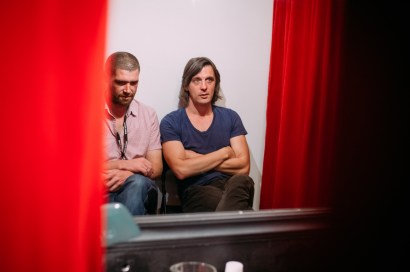
The first thing that happened was that I arrived five minutes early and chatted to a youngish (mid-30s) woman from London (or possibly Essex) who was ahead of me in the queue. She said she was a huge theatre fan, to the extent that she had recently given up her job to pursue a career as an actor. After a couple of minutes’ pleasant conversation they indicated that it was time for ‘her’ performance to start. Then, five minutes later, I was called to pull aside a velvet curtain and step into a small room. In the room there were a couple of chairs facing a large mirror, and a small table with a bottle of water and some plastic cups, some action figures and a notepad and paper. I poured myself some water, put the action figures in relation to one another (as one does), and waited. Around me I could hear occasional buzzers and muffled voices. After a couple of minutes a man walked through the curtained doorway to my right. He was dressed in a short-sleeved shirt and jeans, with a shaved head and a card hanging from his neck identifying him as a participant in the theatre festival. He introduced himself (he had a woman’s name, which struck me as odd) and asked me if I minded if he talked about himself for a moment or two. I shrugged. He told me that he felt a bit hemmed in by his lifestyle. He spent too much time in his flat watching TV with his partner, who didn’t share his hobbies. He said that he felt frustrated and deathly bored in his job in university administration, and that ultimately what he most wanted to do in life was to be creative. I sympathised with him, telling him that he should seize the day, follow his own path, etc. Presently a buzzer sounded and he thanked me for my time and invited me to step into the room to my right.

This room was similar to the first except that instead of a mirror there was a glass window, behind which sat a devastatingly attractive young woman who spoke English with what sounded like a German accent and who, in an extremely friendly tone, started to ask me some questions about myself, in particular about how I think I come across to others. I mentioned that people often mention that I look puzzled, and when she asked why this might be so I explained that sometimes I find life, other people and myself perplexing. She also asked me about my hopes and fears. This being July 2010, I probably talked about wanting to do a Ph.D and go to live in Brazil. I confessed some aspects of my insecurities around others but for the life of me I cannot remember any details of what I said. In any case after a couple of minutes a buzzer buzzed and I stepped into the next room.

There was another actor waiting for me (maybe 40, bald, plumpish, clearly gay), and in front of us a large screen on which we could see a youngish woman fidgeting, drinking water and occasionally scribbling something in a small notepad. To her left was a table with a bottle of water, some plastic cups and some small action figures who appeared to be involved in some sort of orgy. The actor asked me what I thought the woman was called. In response I told him that although I hadn’t asked her name, I had already spoken to her before. I guessed that her name might be Rachel or Rebecca. Rachel, I decided. He asked me what I thought she did. I said that I knew that she was hoping to be an actor, and then volunteered that maybe she had left it a bit late in life. I then made some unprompted comments about how actors always think they’re going to make the big time but then (if they’re lucky) the highlight of their career turns out to be that time they stood outside a shopping centre handing out McDonalds leaflets dressed in a Barney the Big Purple Dinosaur costume. I intimated that that might be as far as Rachel’s acting career would go if she did every actually decide to pursue her dreams, which was unlikely in any case, and threw in for good measure that her Essex accent might get in the way of her progress unless, that is, she managed to get a bit part in Eastenders. I think I was basically trying to be funny and to get him to like me as a person.

After a couple of minutes of this he invited me to move on into the next room. The room was dark and I found myself looking through a large glass window into another small room with two people in it. The one on the right was a young woman who looked Chinese, and the other a young casually-dressed man in his 30s who looked oddly familiar. He looked straight at me and then started speaking to the Chinese-looking woman. He asked her if she minded if he talked about himself for a moment, got some things off his chest. She nodded, nervously. He told her that people often commented that he looked puzzled. He went on to talk about some of his frustrations in life, like his so-far thwarted plans to go and live in Brazil and do a Ph.D, and his ongoing struggle to make sense of his identity. She sympathised, telling him in halting English (I would say late pre-intermediate, about mid-B1 or IELTS 5 on a good day) that she understood his plight (she obviously didn’t use the word plight).

Once more I was invited to step out of the room. This time I found myself in a corridor. All around me I could hear the usual muffled voices and the occasional buzz, and also an old-fashioned telephone ringing from behind a curtain at the end of the corridor. I pushed aside the curtain into a room where a geekish-looking man was quietly working on a laptop and picked up the phone. It was a male voice. He sounded like he might be German or Dutch but said his name was Rachel. He sounded a bit hurt, and said that he had been a bit dismayed about what I’d said about his prospective acting career, particularly about his age and his accent. I apologised profusely, saying it was hard to judge people on the basis of such a short encounter, and also wrong to do so. I wished him luck with becoming an actor and put down the phone, feeling a little crestfallen and a bit abashed. The man sitting at the computer silently handed me a freshly-burnt CD. Later that night I listened to a woman with a Chinese accent tell me all about myself. She said my name was Mark, or possibly Peter, that I lived in California, and wasn’t married. She said I looked like a happy person who likes driving cars and going to the theatre. Another woman’s voice asked her what she thought my job might be. She thought for a few seconds and said maybe I worked in advertising.

As previously mentioned, I think I got off very lightly indeed.

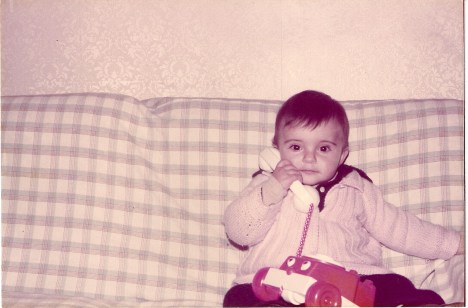
Naming a child

1202333

Someone recently asked me for advice about what they should name their child. Actually that person is my wife, and the child is ours, or will be, in about two months’ time, but we don’t have a name yet.  It feels like a major responsibility, like writing a one-word poem for a stranger to have tattooed on their forehead; as Louis CK points out (WARNING: contains very obscene language),  you can call a child whatever you like. It seems to me we have a simple choice. We either:

Give her a name with meaning

In this way we could preload her up with a default value or something that has importance for us. This would, of course, be nice for us, but perhaps not so pleasant for her. Hence while we’ve been thinking of Maya (because she was conceived in Mexico), I worry that according to playground logic other kids will nickname her Maialina. Kids are like that. Gaia has also been an option but it might be a leetle beet depressing for her growing up and hearing about how she’s in the process of total collapse. I mean, we all are to some extent, but let’s give her a chance to get born and do something about it without somehow feeling that she’s got that particular burden on her shoulders alone.

There are other nice messages to pass onto the child and, through her, to the world, like Grace, Serenity or Justice. Or ones that represent the times in which she is born, like Crisis, Cookie Warning or #F*ckTrump*. However, it’s essential to remember that to imbue a child with a heavily meaning-laden name is to expect her to carry that burden throughout her whole life. In some ways I admire the idealistic/acid-addled flower children of the late ‘60s who gave their kids names like Starchild or Moonprancer. However, since that decade is nowadays the most heavily-commercially exploited of all time we might as call her Body Shop or Lush. Clearly giving her a name like Patience or Serenity is just asking for trouble as she one day becomes embroiled in relationships with other humans (including, presumably, us) who will inevitably test both. Alba and Aurora both sound a bit fascist to my ears. Although we both want her to do well in life we’d hate it if she came to represent the rebirth of the white race. Nowadays it’s fashionable to raise your children to be gender-neutral. Such is the case with Russell Brand, who did however then go on to choose the name Mabel, which is not going to do his kid any favours on the football field. In any case all the suggestions here sound like the names of characters in Dynasty. If there is such a concept as power-naming, someone should definitely deinvent it.

My own name has never done me any great favours. Any Derren Brown-style gains made by my introducing myself with the words “Hi, I’m Rich” are generally offset by the impression created by my evident inability to iron my clothes properly. As it happens one name I really love, and one that has a great deal of significance for me, is Chiara, but apparently that’s also not an option either. Then there are the names of significant relatives. One of my little nieces goes by the name of Heather, and she was very pleased when I told her that in various other languages her name is Erica, which happens to have been to be the name of her great-grandmother. Just by chance I once had a Chinese student who had chosen Erica as his English name**. I explained to him that it was also the name of my paternal grandmother, and he was delighted. China’s like that: I also had students called Killer, Adolf, Blue, Jamily and Ruál (named after the famous Spanish foobtaller). Given that la fagiolina, as she is currently referred to, spent the first few months of her gestation in Bangkok, we could give her a Thai name, like Bumsick or Porn.

Those names, of course, make sense as part of a culture. Separated from their cultural context the choice of some ‘exotic’ names can sound arrogant, pretentious, and, well, a bit Essex-y, giving the impression that your parents, and by extension you, are making a claim on cultural qualities which you have no right to. Shanti falls into that category. You might as well call her Unique, Élite or Notachav. Imagine someone spending their whole having to tell new acquaintances “it means humble in, er, Sanskrit”, and explaining once again that no, she wasn’t brought up in a Sanskrit-speaking household. I wouldn’t want her to be called something that David Beckham would have as a tattoo. I personally quite like the name Pondicherry but it does sound a bit colonial, like the name Addis for an Italian. Plus some of my more off-the-wall suggestions are immediately vetoed as it’s luckily not just me making the decision.

Nevertheless given that my wife’s Italian, I’m English (and A Bit German), and we’ll probably spend more time in Spanish-speaking countries, we would like something that works in different languages, perhaps Una, Ana,or Zöē. Maybe to give her a headstart in life we should just call her Ambilingual. We both quite liked the name Día until I remembered it’s also the name of a cut-price Spanish supermarket, so it would be like calling her Aldi or Eurospin. Also to be avoided are the names of students and ex-girlfriends. I have had hundreds of the former and…some of the latter. I certainly don’t want her to remind me of some sulky Portuguese teenager who failed First Certificate in 2002 because she could never be bothered to do any homework.

The second option, then, is to give her an ordinary name. A name is a badge, a tattoo, a mark of distinction, and also a vessel. The person it carries or contains is what gives it meaning; the name need not be special because the person it identifies will be, in her own way, like every one of us, physically and spiritually unique, and she doesn’t need a wacky name to remind her and everyone she meets of that fact. Choosing a name may feel like writing a one-word poem, but ultimately the name is not the poem. The person is the poem. I suspect that the final decision will be made in a spirit of total exhaustion and bliss, and we will probably end up giving her the name that we knew we would choose all along. We just don’t know what it is yet. She will let us know, when the time comes, which name she has chosen for herself.


* This will be sorely tempting if – and this is a distinct possibility – she happens to be born on the day of his inauguration.

** I think his Chinese name was Ben or something.

On ‘Anecdote of the Jar’ by Wallace Stevens

Poets tend to get annoyed when asked to explain what a particular poem ‘means’. If I could have expressed it in any other way, thinks the poet, I would have done so. In the words of one particular poet, a poem should not mean, but be, and in a quote which I now can’t track down T. S. Eliot apparently once remarked that the meaning of a poem is akin to the bone that a postman throws to a dog, a metaphor presumably designed to stop slavering strangers insisting that he ‘explain’ The Wasteland to them on the late-night tube. In my ongoing struggle to experience poems in a meaningful way rather than simply being intimidated and thus bamboozled by them, I tend to cheat, asking not what they mean but rather what goes on in my mind when confronting myself with them. Trying to memorise poems is one way of unlocking them; reaching a point of semantic saturation is a means of getting beneath the surface, to get at the poem’s sense and effect, or maybe of slowly allowing it to detonate; after all, in the words of Ezra Pound, poetry is language charged with meaning to the utmost possible degree. An imaginary bomb with real shrapnel. Or, if we want to be more esoteric,  a pheasant disappearing in the brush. That line is from Wallace Stevens, whose work has, since I was introduced to it in a consistently rivetting poetry class in Limehouse (given by someone I think of as the Angela Carter of poetry), presented an ongoing challenge to any tentative techniques I have developed for handling poems. Stevens’s poems seemingly mix abstract modernism with mystical, often gnomic images. Here is a particularly enigmatic example:

The Anecdote of the Jar

I placed a jar in Tennessee,
And round it was, upon a hill.
It made the slovenly wilderness
Surround that hill.

The wilderness rose up to it,
And sprawled around, no longer wild.
The jar was round upon the ground
And tall and of a port in air.

It took dominion every where.
The jar was gray and bare.
It did not give of bird or bush,
Like nothing else in Tennessee.

It would be wrong to think of the poem as presenting a riddle to be solved. There is no key or set of keys which will allow me to ‘get’ this poem or any other; it is not a cryptic crossword clue. Whatever is happening, it is going beneath the surface.

If we begin with the first word and syllable: an I, presumably that of the poet. This being poetry, the difference between eye and I is often moot. The eye, like the jar, is round, and seeks to take dominion over what it surveys. Some have pointed to Emerson’s eyeball: “The eye is the first circle; the horizon which it forms is the second; and throughout nature this primary figure is repeated without end.” It might even be the eye of a blackbird:

Among twenty snowy mountains,
The only thing moving 
Was the eye of the blackbird.

In both cases the I/eye unifies the universe, placing itself at the centre and organising the world around it: The wilderness rose up to it. In this poem, the jar contains the I. It is the poet who has consciousness, not the jar.

Given the difficulty of making sense of this poem one sensible approach is to walk away,  to take a step back, and to get a sense of the scale of the absurdity. Does placing a jar on a hill give that jar dominion over the surrounding countryside, somehow over a whole state? Or a city?

20161210_121616-1

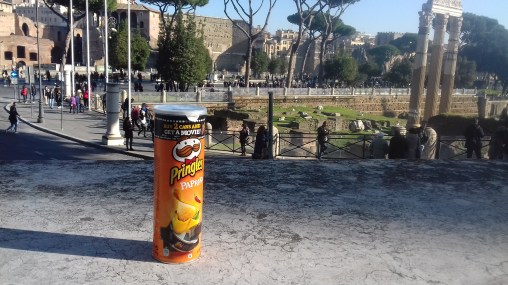
On Saturday morning, 10th December 2016 someone placed an empty tube of paprika-flavoured Pringles on a wall outside the Vittoriano Museum in the centre of Rome, overlooking the Foro Romano*. It jarred in its landscape. After all, litter is ‘matter out of place’.  

Oddly enough, just up the road, there is this. Someone ordered it placed there.

20161210_122638

Trying to memorise Stevens’s poem in Rome draws my attention to all the domes and other round things placed on hills, all embodying consciousness and seeking to impose order on the landscape. It makes me think of the architects’ drawings and models that must have preceded them. All architects are in a sense utopians, imagining a world transformed with the embodiment of their vision at the centre, colonising and framing the landscape, making the wilderness surround what they have placed there. Maybe one counterpart for the poem is ‘Ozymandias’, another example of power centring the universe around it. Then, on a different scale from the Colosseum: this blog. In writing it I am also claiming dominion. This is my perspective, and simultaneously a container, one which claims a certain domain. Such interventions in the landscape are now nothing new – indeed, they go back almost as far back as the human species.

The difference here is that Stevens isn’t actually placing a jar, or even, in a sense, pretending to. The jar does not have the properties of consciousness and dominion; it is the I who places the jar who imputes them, or rather, it is the writer of the poem, or rather it is the I reading it who does so. Let’s be glib: the jar is an empty signifier (or at least it is until we throw a match into it); the jar-as-poem is just a vessel for the meaning the reader puts in it. The poem is the jar. Hence it has often been read as a commentary on art itself. In 2009 the artists Miroslaw Balka placed a literal shipping container in the Tate Modern, and in another flawed attempt to centre the universe on myself I wrote about it. As for Steven’s poem, the only true response would be another poem (beginning I placed a tube of Pringles… **) or another work of art. Some have argued that the poem can only be read as a response to Keat’s ‘Ode On A Grecian Urn’, and to the claims it makes to a unity between of consciousness and nature. Steven’s poem seems to refuse such a claim – the jar apparently dominates the wilderness, but it is not part of it. Others have looked at the biblical allusions. We can  easily picture the jar as a cross on a hill, and the echoes of the phrase ‘burning bush’ certainly evoke this sense. There are obvious political interpretations: imagine the jar as a flag. Or a burning flag. Or a phallic object.

This may be cheating. The poem is explicitly about a jar, one that is gray and bare. It seems odd, then, that someone identified the type of jar in question – a transparent glass jar. The claim that it is a mass-produced object evokes Warhol, and also Duchamp taking the piss (possibly in the jar). But while Ai Wei Wei smashed up Ming vases as a comment on his own cultural heritage, this jar seems to represent nothing but power, dominion, a colonising consciousness. If the poem were called Dominion it would be less mystifying. But that would be (again) cheating. We have to deal with the poem as it is, which is hard on initial readings, because it jars, not just in the landscape but also in its form: while most lines feature four stressed syllables, there are two which break the rhythm, with only three. I’m counting Tennessee as two stressed syllables, which may be why he chose that particular state; or maybe it was because he was in Tennessee and he did place a jar there. It is after all an anecdote.

I am now going to memorise ‘Ode On A Grecian Urn’ and then see what happens. A poem may emerge. A poem may not emerge.


* To quote the 21st century Jamaican-American poet Shaggy, it wasn’t me.

** Except I didn’t.

It’s Not Just Me, Then: Fiction, Music, Comedy and the Cl*mate

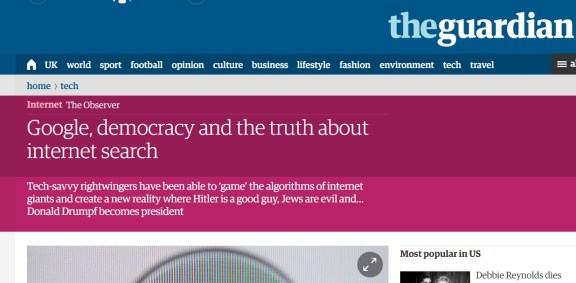
sin-tituloWhat I’m trying to do on this site is make links between things I haven’t seen connected together elsewhere*. Hence the links themselves are usually more important than what I have to say about them. In the last couple of days I have come across three things which I think vindicate (albeit, inevitably, in an infinitely more coherent and detailed fashion, one based on research and careful thought rather than guesswork and ‘affect’) the thoughts I’ve been trying to articulate over the past few weeks. First there is this article by Carole Cadwalldr which details the ways in which right-wing trolls have been able to infiltrate the algorithms of Google and Facebook in order to create their own reality, one which is increasingly conditioning ours:
The technology that was supposed to set us free may well have helped Trump to power, or covertly helped swing votes for Brexit. It has created a vast network of propaganda that has encroached like a cancer across the entire internet. This is a technology that has enabled the likes of Cambridge Analytica to create political messages uniquely tailored to you. They understand your emotional responses and how to trigger them. They know your likes, dislikes, where you live, what you eat, what makes you laugh, what makes you cry.

Continue reading “It’s Not Just Me, Then: Fiction, Music, Comedy and the Cl*mate”

The Age of Agnotology: The Importance of Reading Newspapers in an Era of Fake News

Of all the possible places to try to sell a dogmatically Leninist newspaper in 2016, the gates of a small, private, right-wing Catholic university is probably not the best location. Leaving work earlier this week I was surprised to encounter an actual 21st Century Bolshevik selling Lotta Comunista (Communist Struggle). Che testardo! The front page featured an actual hammer and sickle and an exhortation to the workers of the world to put down their bloody phones for a minute and UNITE!. Inside there was a closely-written article on US energy policy that featured nary a mention of the changing climate, while page 6 featured a total of 448 individual statistics relating to socio-economic class and voting habits in the USA. At least its position on Sunday’s absurd and suicidal referendum was more sensible than that of the rest of the ‘left’: they recommend that their readers stay at home memorising ‘What is to be done’ rather than bothering to vote. If you’re so inclined you can read your way through the rest of it here.

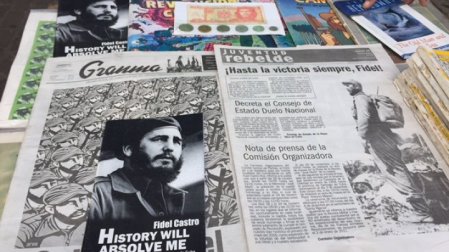
A thought experiment: imagine a country in which such a publication was the only newspaper. Actually come to think of it I don’t have to try that hard because I’ve been there quite recently – in May, in Cuba, where the only two daily newspapers are the black-and-white 12-page Government propaganda sheet Granma (named after the tiny vessel that brought Fidel (RIP) and friends back to Cuba in 1956), and an 8-page supplement for03-cuba-fidel-granma young people called Juventude Rebelde (Rebel Youth), which is similar in look, style and content to the kind of publications the Worker’s Revolutionary Party used to try (and fail) to hand out for free. Both newspapers are hard to track down and (after a couple of days of cheap laughs, and once you’ve set aside a few copies as very cheap presents) genuinely not worth the effort. When in the 1990s the US not-an-embassy put up LED screens to broadcast subversive information to the city it must have had quite an impact. In Mozambique – also nominally a Communist country – the national newspapers are remarkably similar in style and content to the cheaper Portuguese tabloids. I once read a very depressing article (it wasn’t supposed to be depressing) about how popular A Bola (The Ball) is in Angola. In some countries, the main journals of record are ones which just report the achievements of government (rather like a lot of local newspapers nowadays in the UK in relation to local councils). In others, the only opposition newspapers are those owned by politically ambitious oligarchs . There are other channels of communication but the absence of a free press makes a country much culturally and socially poorer and less free.

Continue reading “The Age of Agnotology: The Importance of Reading Newspapers in an Era of Fake News”

Chi è veramente di sinistra voterà sì

Nota bene: I now accept, having read and talked and listened a great deal more on this topic that I was very wrong on this point. People who voted no are generally very aware that they were not doing so at the behest of Salvini or Grillo. See, ad esempio, qui. Or qua.

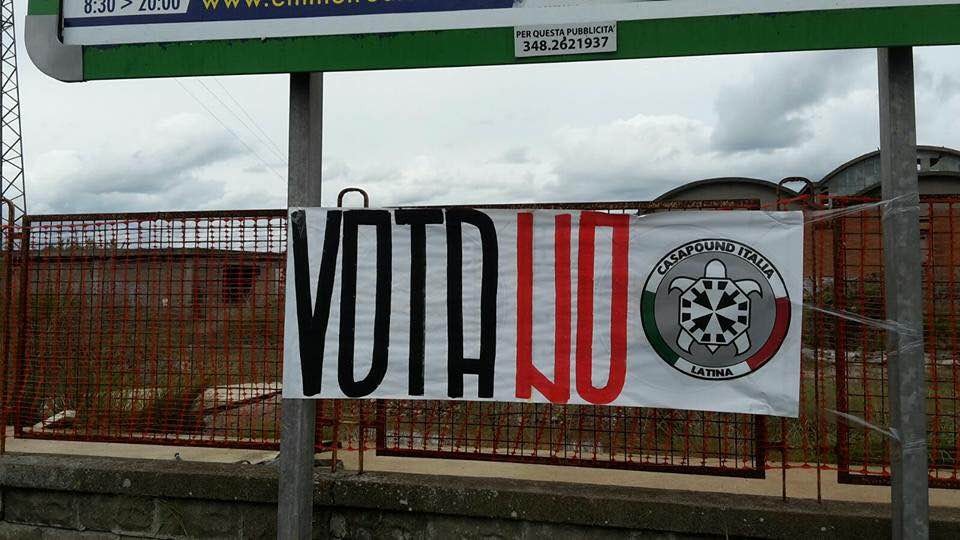
Everywhere you look in Roma right now you are confronted with the word NO, and it is notevole that it is often not possible to distinguere between the posters of the ‘left’ and what is known here eufemisticamente as the ‘centre right’ (i personaggi principalof the Italian ‘centro destra‘ make Steve Bannon look like a member of the Tea Party). Disgraziatamente, the tattered ruins of the Italian left seems to have learned assolutamente nulla from the Brexit and Trump débacles, and it is oltremodo tragico that so many who think of themselves as progressisti are succumbing to il canto delle sirene of the trickster Grillo, who in the words of the leftwing collective Wu Ming has “confined the potential energies of an uprising against austerity to a discursive cage which makes a parody of political conflict”. Of course the riforma constituzionale is not by any means ideale and the whole referendum was una idea del cavolo in the first place. In modo molto simile, the European Union has never been perfect and Hillary Clinton was chiaramente not the best candidate for the Casa Bianca. Però, the left’s campaigning for the no side – inspired, like the ‘Lexit’ and Jill Stein campaigns, by a mix of ingenuità, cinismo and misplaced opportunismo – will help ensure that next week we will see Salvini (an outright teppista fascista), Grillo (choice quote: “l’antifascismo is outside my purview”) and Berlusconi (any italiani wondering who this ‘Silvio Berlusconi’ character is may like to fare una visita to the internet website google.it) brindando alla vittoria and being congratulated by Le Pen, Putin, Trump, and mentre che ci siamo, probably Assad. Qualsiasi persona con coscienza e cervello voterà sì. Anything else is francamente just puerile.

https://www.theguardian.com/world/2016/nov/27/matteo-renzi-politics-italy-european-union-brexit-trump