Denial 2: On Blinkeredness

filterbubblesI noticed a couple of years ago when living in a fairly nondescript part of East London, in the kind of Olympically lifeless area where absolutely everyone comes from everywhere else and no-one sticks around for long, that in some parts of the country, and maybe the world, it is becoming more and more difficult to find a shop where get your hands on a physical newspaper. Conversations with my international students confirm this: the regular purchase of a newspaper is increasingly a minority pursuit, an odd and probably slightly quirky habit of people over 35 or so. Younger people inevitably get their news online, if at all – the news might simply consist in what their friends are up to on Facebook or maybe a glance at Google or Yahoo headlines. Given that so much of what we perceive of the world is mediated in some way, what does this imply about our collective experience of a shared reality?

A few years ago I remarked on my Chinese students’ reluctance to engage with information which might conflict with what they had grown up and been taught to believe about their own society. Despite the opportunities presented by the internet, they continued to prefer Chinese sites and to steer well clear of alternative sources of news, ideas and information despite having the language to make sense of what was being said. At the time I tended, rather patronizingly I now see, to regard this as a symptom of ideological brainwashing by the evil Chinese Communist Party, but since then I have come to see this kind of instinctive and wilfull blinkeredness as more generalized and not remotely restricted to authoritarian societies.

Now obviously my Facebook news update page and Twitter feed are different from yours. I chose to follow or to be friends with certain people, and am of course aware that the information I receive in this way does not give me a particularly comprehensive view of what is going on in the society in which I live or around the world. However, news sites tend now to work in a similar way, or at least offer to let you have your news your way – just business and sports headlines if that’s what you’re interested in, with none of that bothersome stuff about earthquakes and floods and generally what’s been happening to people you’ve never even met.

To go back to when I was in the authoritarian society of China, it caught my attention that the results I got from Google searches tended to be quite different from the results I got outside China. This has been quite ably demonstrated elsewhere – if you type Tiananmen Square into google anywhere else in the world, you are confronted with the famous picture of the guy standing in front of the tank, whereas if you do so in China. you get some American people’s holiday snaps (and if you look for human rights in google in China, your internet connection goes down for five minutes). In China, then, we are dealing with a formal kind of censorship, acknowledged or not. Whether or not google colludes in this is not generally known. But what is clear is that, these days, something similar happens wherever we are in the world.

In the interview below Eli Pariser shows us what happens when he types Egypt into google: he gets a page of results which pertain to recent developments: the fall of the dictator and the ongoing revolution. He then shows us what happens when a less socially conscious friend did the same thing – the results he received were mostly related to holidays. Google uses a series of filters to show us what it thinks we as individuals do and do not wish to know. It does so automatically and for our own benefit – just as the authoritarian Chinese Commmunist Party does.

The kind of people I teach here in London are about as likely to type human rights into google as they are to buy a copy of the Guardian.The same is certainly true for climate change – any attempts, even in the most underhand and careful of ways, to raise the topic result in what George Marshall describes as a ‘spinach tart’ moment. Not only are they very unlikely to seek information on the impending annihilation of the human species or indeed on what we individually and collectively can do to prevent it, they are also, these days, extremly unlikely to come across any information on it, given the way that they, and we, increasingly experience the world through a tighter and tighter set of filters, for our own benefit and convenience.

However, for all that we may be inclined to hope that we can hide from the four horsemen in our own private and sealed utopias online, it transpires that this is not the case. According to a recent government report, it is predicted that climate change will play havoc with our internet connections: ‘higher temperatures can reduce the range of wireless communications, rainstorms can impact the reliability of the signal, and drier summers and wetter winters may cause greater subsidence, damaging masts and underground cables’. Maybe our best option would be to challenge climate change to a game of (offline) chess.

by Rich

My most local pub is

like an empty living room in a house that was demolished twenty years ago, it is like a private nursing home long ago victimised by Panorama and it also in certain aspects closely resembles a  pub. It is the kind of place which people who have never visited romanticise as an authentic old mans pub but it is authentically dire and the people in it are quite simply in the very final stages of alcoholism. The only permitted topics of conversation are football and other pubs but it is also ok to bring in £1.20 boxes of fried chicken and chips as long as you pay a corkage charge of 15p and allow your terrible, terrible meal to congeal in front of you as you spend at least twenty minutes staring into space with a kind of deserted longing in your sad and broken eyes. It is the kind of exotic oddity which people who like to visit sad, dismal, forgotten places love to go, the sort of place which people like me crave to find in places like the Ukraine, that we fetishise in books like ’Tea Coffee Cappuccino’, a kind of badly carpeted Bhutan with a gross happiness index rating of less than zero. If it were one inch closer to Hackney  there would be a cynical amateur urban anthropologist sitting in the corner sneering secretly at the place while simultaneously congratulating themselves on having found somewhere so authentically pitiable. Oh wait, no, there is somebody. Gentrification ruins the character of an area, discuss.

Seven Stories About Language and Identity

China Miéville’s recently published (and much, and rightly, lauded) novel Embassytown concerns a far-flung species of alien on a planet colonised by humans, aliens who speak a language in which they cannot lie. Not only can they not say what is not, they can also not say what things are like. The existential crisis provoked by this inability to express themselves figuratively eventually causes a majority of the species to tear out their hearing organs to escape the prison of their Language, while others manage to survive, painfully, by learning to express their experiences through the use of similes. When they finally manage to do so, there is an explosion of poetic language:

‘Before the humans came we didn’t speak so much of certain things. We were grown into Language. After history we made city and machine and gave them names. We didn’t speak so much of certain things. Language spoke us… when the humans came they had no names, and we made new words so they would have places in the world…Language took them in.

We were like hunters. We were like plants eating light. The humans made their town in our town like a star in a circle. they made their place like a filament in a flower… we spoke the name of their place, but we knew it had another name, sitting in the city like an organ in a body, like a tongue in a mouth.

You have not spoken before. You will. You’ll be able to say how the city is a pit and a hill and an animal that hunts and a vessel on the sea and the sea and how we are fish that swim in it..you have never spoken before’.

In the novel we at no point encounter a description of the aliens themselves. We learn of some of their physical characteristics but we never find out what they look like. This seems apt.

In this spirit of the recognition of likeness I wanted to draw a series of comparisons and make explicit what my experience and interpretation of certain ideas I have encountered in certain books is like.

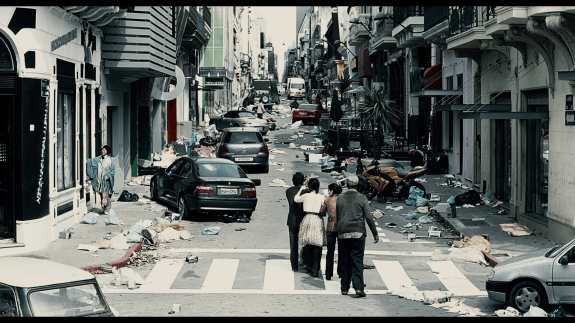
In the novel Blindness by José Saramago the characters in an unnamed city lose their ability to see and henceforth to recognise one another. A mysterious epidemic deprives them of sight, and all social bonds and connections are broken. Civilisation collapses as the individuals are no longer able to acknowledge to themselves that the people who surround them and on whom they depend are like them.

Blindness is like the novel New Finnish Grammar by Diego Marani (the inventor of the language game Europanto) in which the main character wakes up on a quayside in Trieste during the Second World War with no memory of his identity or his language.  He is mistaken for a Finn, taught the language and sent to Finland in order to allow him to discover his identity and his place in the world. He eventually realises that he has no means of recovering his true identity and enlists with the Finnish armed forces to fight on the border against the invading Russians, never to return.

New Finnish Grammar by Diego Marani is like Austerlitz by WG Sebald, in which the main character, who grew up in Wales but has no memory of his origins, follows an impulse to go to Prague, where he discovers that he speaks the language of the city from which he was exiled from his Jewish parents on a Kindertranport at a very young age.

Austerlitz by WG Sebald is like the novel Budapest by the Brazilian songwriter and novelist Chico Buarque, in which a ghost writer travelling back to Rio de Janeiro passes through the eponymous city and resolves to stay until he has mastered the language from scratch. He invests all his energies in his quest for a new identity, abandoning his life back home in Brazil, but comes to experience a crushing personal defeat whe he is told that his voluntary exile has been in vain, that the poems that he has so painstakingly created under the pseudonym of a moribund Hungarian poet ‘read like they were written by a foreigner’.

Budapest by Chico Buarque is also like another two novels written in the Portuguese language, one which, like the Marani novel, was written by an Italian. Afirma Perreira by Antonio Tabucchi tells the tale of a newspaper editor in Salazar’s Portugal of the 1930s, who comes to identify with an exiled Italian dissident and then to take enormous risks on his and  his comrades behalf, putting his own life in danger and finally engaging with a society from he had previously felt almost entirely detached.

And Afirma Perieira is like (indeed too similar, according to the author) another Saramago novel, The Year of the Death of Ricardo Reis, in which one of the Portuguese poet Fernando Pessoa’s heteronyms, the eponymous poet who has previously been exiled to Brazil, returns to his native country and also becomes drawn into a plot against the regime in which his own sense of detachment from the world around him must be sacrificed together with his freedom if the life which he has lived is to have (had) any meaning.

None of these novels are particularly like the short story by Will Self, Story for Europe, in which a young couple, concerned that their child has not acquired the ability of coherent speech, take him to a specialist in child language acquisition on Harley Street, who listens to the burblings of their son for some minutes before declaring solemnly that their child only appears to be able to communicate in Business German.

Perhaps this could be a challenge for another Diego Marani or George Perec: would it be possible to write a novel in the ‘business’ version of a language, if such a thing actually existed? Unlikely.

Vaping

Those friendly young people, the ones pushing electronic cigarettes outside King’s Cross and Euston stations, the smokeless cigarettes which you can smoke on the plane, that just give you the deadly fix of nicotine without the pleasurable and sociable rituals of a real cigarette – how do they sleep?

India’s war on the poor

by Andrew

On Sunday, with 500 others, I attended a meeting on ‘India’s war on the poor’ at Friends House in London. The headline speaker was the novelist Arundhati Roy. She spoke eloquently and movingly about the war by the Indian state on the tribal peoples (adivasis) on behalf of companies like Vedanta that want to exploit the natural resources of these lands. She also spoke about the state’s attacks on poor farmers on behalf of rich landowners.
She read a passage from her new book ‘Walking with the Comrades’, which described how she met the Maoist rebels who are resisting government and paramilitary incursions into tribal lands. In many areas villagers have to hide in the forest, only venturing out to harvest their crops under the protection of militias. Roy was quite clear that the state’s attempts to destroy a way of life – by means of murder, rape, intimidation, disruption of economic activity – amounted to genocide. Yet an unusually candid police chief suggested to her that perhaps the best means of overcoming the Maoists would be to put a TV in every home: ‘unless they become greedy, there’s no hope for us’.

There were so many things that she and the other speakers said that resonated. First of all, the idea that India’s vaunted democracy is hollowed out, just for parts of Delhi, for the elite. There is no appeal to local or national courts, since they are corrupt. Why wouldn’t the people resort to armed resistance?

Jan Myrdal, a Swedish writer, talked of ‘the biggest land grab since Columbus’. I was reminded of what Hugo Blanco said during his European tour last year – that the indigenous are at the forefront of resistance because they suffer the heaviest attacks of a system which must exploit the planet in order to survive. The indigenous in India number 100 million. But there are 400 million others whom the state must drive from the land if it is to fulfil the stated target of 70% of the population living in cities. To do that, it has to resort to military means.

Roy spoke of the cold sense of purpose that animates the elite. Europeans ‘have a history’ they say, ‘why shouldn’t we?’ They mean the European history of genocide, ethnic cleansing, systematic exploitation of territories and peoples. The Indian elite assert their right to emulate this history.

To me, this means that anyone who abstractly defends the ‘right of developing nations’ to pursue a ‘Western model’ of growth should be confronted with the following questions: which ‘nation’ are you speaking of? Which classes in that nation? Whose interests do you actually support?

She talked of ‘the opening of two locks’ – Hindu fascism and market fascism. They are absolutely intertwined, in her view. Murderous Islamophobia in Kashmir and Gujarat, anti-tribal violence in the forest area that the police call ‘Pakistan’ – all promoted by a state that is in thrall to the free market.

She pointed out that while this huge grab for territory goes on, under the military umbrella of ‘Operation Greenhunt’, the Indian upper and middle classes have engineered their own ‘secession into outer space’. I took this to be a reference to the Indian space programme – but probably also to cyberspace, the home of a global, supposedly deterritorialised, cyber-elite.

Very informative website at www.icawpi.org. Watch an interview with Arundhati Roy here.

Originally published at socialistresistance.org.

Denial 1: On denialism

mmezqI mentioned to a friend that I had foolhardishly bought a ticket for a full showing of the nine and a half hour long Holocaust documentary Shoah. He responded that it would be effective aversion therapy for a Holocaust denier. Now personally I have never thought of myself as a Holocaust denier, but I guess there must be a reason why I have decided not just to subject myself to presumably the most upsetting and depressing celuloid experience of my life but also to pay a much delayed visit to Auschwitz this summer. Maybe, deep down, without knowing it, I am a Holocaust denier. Or maybe my interest is more casually macabre, like this guy (or on another level WG Sebald may have something to do with it). Perhaps we all are Holocaust deniers, in that most of the time, we go about our daily lives not reflecting upon the import not only of that most base of human achievements, but all the horrors that we know full well are going on around us, some of which we know at some level that we are deeply implicated in (and the means we increasingly use to try to escape from this reality allow us to also avoid our ethical responsibilities: a friend’s facebook profile reads, ‘Zen is not some kind of excitement, but concentration on our usual everyday routine…’…hmm, no need to worry about the ethical consequences of what we do all day at work then). Perhaps, as someone wise once speculated, we simply choose to be blind.

As Zizek pointed out, some traumas are too, well, traumatic to be integrated into the human psyche. There is no rational or appropriate response to knowledge of the Holocaust. It simply defies our categories of knowledge and belief, shatters the coordinates of our reality. In a very similar way, there would be no appropriate response to the coming horrors of climate chaos, and no visible means by which we can alert ourselves, those we love and those who do not exist yet in order to somehow prevent it from happening. So we all, at some level, deny it is happening.

Speaking of the holocaust, the French philosopher Raymond Aron articulated very well how ideology works today: ’“I knew, but I didn’t believe it, and because I didn’t believe it, I didn’t know.” Sven Lindquist said something similar: “You already know enough. So do I. It is not knowledge we lack. What is missing is the courage to understand what we know and to draw conclusions.” George Marshall of the Climate Outreach Information Network makes a similar point with reference to Climate Change: we need to stop calmly telling people about what is happening and concentrate on showing them how scared and angry we are. Actually, he didn’t say scared, I did. Here is a video in which he explains what he means; you can find much more of this sort of thing here:

The Big Community

by Rich

A few doors down from Fortnum & Mason’s on London’s Piccadilly might seem like  an odd place for a community centre offering free computer classes, tea dances, free legal advice and a charity shop. Someone just happening upon the place might find that it jars somewhat with its surroundings. Who would have thought that in such an upmarket area there were groups of people who had need of such facilities?

The community centre has not been opened by the council, however. There are rumours among the people who use it that a mystery benefactor is behind it. And indeed this is the case; although the centre’s staff are not eager to spread the information around, the centre is the creation of the Swiss artist Christoph Büchel.

However, for those visiting the centre as an art work rather than to use its facilities, it is disorientating to experience just how much the installation, which seamlessly occupies the entirety of the premises of the Hauser and Wirth gallery, is functioning as a fully-formed community centre, with large groups of mostly older people enjoying the facilities and making the space their own. There seems to be a general sentiment that it is a shame that a facility which is clearly both necessary and appreciated is not provided by local councils and that it will also close at the end of July.

The artwork, then, is not merely the flawless simulation of a community centre in the vein of, say Thomas Demand’s purposely sterile cardboard recreations of office environments. What is being produced, in fact, is an actual community.

This might be seen as a cynical gesture by the artist. After all, what will become of this community after the closure of the centre? There is after all no chance of a public institution offering to keep such a laudable project going after the end of July. The gallery obeys the needs of the international art market rather than any local community.

Perhaps one solution would be for a high-minded philanthropist to provide a similar space nearby for the recently-formed community to use. Or, perhaps the members of said community could somehow band together and create their own space, staffed by volunteers. It is unlikely however that either solution would be able to find or to afford a such an ideal location, right bang in the middle of some of the most lucrative real estate in the world. Also the people who use the centre come from diverse parts of London: Camden, Southwark, Chiswick and elsewhere. Where could they find a space which would serve their needs as a community, and how would they sustain it?

The centre, then, is haunted by the ghost of its own future absence, and of the inevitable dissolution of the community formed by those who use it. In it one hears an echo of a comment made by Slavoj Zizek a year or so ago, when he was asked about the identity of this ‘we’ he refers to when he talks about what ‘we’ must do in the face of the multiple crises that we face. Is such a political identity discernible today? His answer seems particularly perceptive now, in the light of the first few months of 2011, of Tahrir Square and Plaza del Sol and, closer to home, Stokes Croft. He said that the ‘we’ he refers to is a ghost from the future, a political subjectivity not yet formed. In Buchel’s installation we can see how this can happen. A space has been created in which a social identity, if not yet a political identity, has come into existence.

So is this then a version of the social centres which have sprung up around Europe in the last few years, such as the Rampart Centre in East London and the 56a infoshop down the road in Elephant & Castle? Büchel is clearly keen to draw this comparison, providing a meticulous recreation of an communal anarchist squat in the building’s loft, beyond the reach of the centre’s elderly clientele. I would say that something entirely different is on display downstairs. For one thing, the people using the centre are not doing so because they already share a political identity. In this case, their social need for a space to commune may, indeed will, give birth to an idea of themselves as a distinct group which needs to make specific demands of power (space, facilities, resources) if it is to go on existing. Although what this particular group needs cannot be provided by the market, it can be safely assumed that the centres users are not about to occupy the space.

Of course occupying premises on Piccaddilly in order to emphasise the primacy of social need over the demands of the market has a very recent historical resonance. The rich generally have no need of community centres proving free classes, meeting rooms, free legal advice and  therapy sessions, tea dances and free tea and coffee. They have Fortnum and Mason’s.

In the basement of the community centre there is a door marked Private. Visitors to the exhibition, as opposed to users of the centre, are quietly encouraged to enter. It is an uncomfortable experience; an intimate space filled with the seemingly chaotic detritus – bedclothes, notebooks, piles of books and VHS videos – of an intensely private existence. It is an emphatically non-public space which conjures up the same feelings of being an intruder that Büchel worked  with in his creation of a bizarre abandoned hotel/warehouse in Coppermill in 2006, with its piles of seemingly abandoned ethnographic mementos, rooms full of unmade beds, collections of dogeared pornographic magazines and rooms full of second-hand electrical appliances. That feeling of possibly intruding on a space which was not mine I also felt when I made my way upstairs to the floor where the tea dance was in full swing. To the left of the room is a cloakroom, which I felt distinctly disinclined to enter. A salutory experience, of course. Even in the context of what was for me a visit to a gallery, I was forced to recognise that I was not part of the community of users, that despite the absence of a sign explicitly warning me that I was not allowed to enter, an automatic sense of respect for the community prevented me from doing so.

The installation, if it can be so called, is destined to provoke a sense of unease in those who visit it purely as an object to be contemplated. It constitutes a lesson in the distinction between what is and can be shared, and what is private, and the need for respect for a community of which we are not part, and it also raises a series of difficult questions about how a sense of social belonging is created and how it can be sustained. The community centre can and should be visited, with respect for the users of the facilities, until the end of July, when it will, like so many treasured and desperately needed public and community institutions, be suddenly and heartbreakingly closed down in accordance with the wishes of the market.

Conspiracy theories are everywhere…

I have a conspiracy theory. There are millions of lunkheads out there who seem to have nothing better to do than to come up with conspiracy theories.  I don’t know where they get them from but I suspect they get them from a large group of loosely knit, politically unmotivated people.  They probably don’t even need a smoke-filled room to discuss them in because they seem to communicate telepathically.  (Yes, there’s the internet, which is another conspiracy by a large group of…).

Sitting outside a pub a couple of weeks ago, I overheard a man telling one of his colleagues that the US had caused the Libyan revolt in order to get rid of Ghaddafi.  Interesting that people are suspicious of American power but would never question the orientalist idea that the Arabs don’t really want democracy.  This man had previously stated that governments are able to stop climate change by causing volcanic eruptions that would send out a pall of smoke, thus blocking the sun’s rays. 

Many people obscurely feel, like Neo in The Matrix, that ‘something is wrong’, but unlike Neo, they do not espouse ideas that allow them agency, the power to change things.  It’s all down to ‘government’, or other small groups of powerful males. There’s a strong flavour of apocalypticism in some of these theories, of huge forces which are out of control and which can only be stopped by a sort of scientific or technological magic. 

Or perhaps they can’t be stopped. I was at another social occasion over Easter, when an apparently perfectly sensible, politically switched-on bloke stopped discussing the exploitation of Amazonian tribes and starting talking about an undiscovered planet coming between us and the moon (or sun) in 2012.  He said this would cause a reversal of the earth’s magnetic poles and other catastrophes. Why is this a conspiracy theory?  Because governments know about it and won’t tell us.

Of course, there are huge forces that exist outside of our control –  mainly in a political and economic sense – though it’s also true that we won’t be able to prevent some climate change happening, even if we start now.  In any case, at the moment there are few countervailing forces (in Britain at least), that can begin to address these problems, except the anti-cuts organisations, which are mostly local and embryonic.  Social movements and workers’ organisations are weak, left parties are small.

A conspiracy theory has been called a ‘poor man’s ideology’, meaning that the relatively coherent view of the world that used to be provided by classic left/liberal/conservative political ideologies is lacking. These theories can be tied to a sort of anti-imperialism, or anti-capitalism, of fools (as in the Libyan example above)  which is often not too distant from far right theories.

There is a problem with the phrase I just quoted, however.  It’s revealingly classist as well as sexist.   It might imply that proper ideology – a rational, coherent, global analysis – is for rich males, or academics.   That’s the trouble – it’s too easy for lefties to adopt an elitist attitude and sneer at the lumpen mass.  It may be fun to do, but it’s just another kind of passivity, and unless we snap out of it, we are just as much prisoners of the historical moment as those other poor fuckers. 

by Andrew

Blorenge

Blorenge

“To hell with all this wedding blather”

Said next table’s bloke.  “I’d rather

To the table nail my scrotum

Than put up with this royal hokum”.

Next day, on Blorenge hill, a wind:

A piece of blue balloon blew past,

Like a stretchy old factotum

Torn to tatters by the blast.

Once round and full, the Orange Prince

Who came to lead our Revolution.

King, Lords and Commons, balanced powers,

Bloodless, bloody constitution.

Andrew, May 2011

‘But what does the earthquake mean for the markets…?’

The BBC World Service boasts of offering ‘expertise on why stories matter’, and we have just heard an excellent example of this: ‘The World Health Organisation has said that the rising prices of staple food commodities could lead to millions of people in Central Asia living in extreme poverty. But what does that mean for stability in the region?’

So the possibility of miliions of people starving is not in itself as significant in news terms as the issue of stability, ie. the continuing smooth functioning of the global system of political and economic power. Hilary Clinton’s call for ‘stability’ during the protests in Egypt against a regime based on torture springs to mind. News is concerned primarily with anything that might interrupt the flow of trade. Food for thought, if not for eating.

And on the subject of potential (in)stability...