The F Word part 4: In which I arrive in China


Any pretensions I may have entertained of Learning Chinese Through FootballTM would have quickly been doomed to failure. Although I had a good grasp of the basic numbers, the names of the world’s leading clubs and players are often unrecognisable and hellish to pronounce. I wouldn’t imagine that Paul Gascoigne found it particularly easy.

I did, briefly, try: in my first or second week I played my first game of football in quite a while. Disappointed to see the fruitless-yet-predictable results of my time-honoured technique of chasing-the-ball-all-over-the-pitch-and-then-kicking-it-straight-to-the-other-team, I turned to our goalkeeper and asked him how the Chinese say ‘Fuuuuck!!!’ He told me, I repeated it about ten times and then promptly mispronounced it catastrophically for the next ten months.

Chinese kids (male kids, that is to say, which is most of them) love playing football, especially in a curious 20-a-side variety. Nor is it unusual to have to share your tennis court with two or three other pairs. There are just so many young people with so much energy to expend. Now personally, as I may have mentioned somewhere around here, my own preference would be for them to devote their efforts to storming the bastions of power and making their country into a decent place to live, but what the hey. They prefer to direct their youthful frustrations elsewhere.

One of my students, faced with the question of which people he would least like to meet, surprised me by not offering the standard responses (usually ‘the Taiwanese President’ or ‘anyone from Japan’). His answer was that he would hate to meet the football players of AC Milan, given that he was a fan of their city rivals Inter.

How had this 20-year-old boy (as the Chinese like to say), no more from the north of Italy than I’m from Shanghai (I’m not), developed such a strong emotional attachment to Inter Milan? Well, he’d read about the team in officially approved articles in state-controlled newspapers and on the government-sponsored internet. These days, if Michael Owen fails to score for Newcastle of a weekend, or if the Chelsea manager suggests he may need to strengthen his right-back position, it is back-page news around the world – and in China (and probably in Japan, although for different reasons) it makes the front page.

This contrasts with a genuine lack of interest in home-grown football. In early 2005 the start of the soccer season was delayed for several weeks because a number of clubs didn’t have the funds to field a full team and to travel to matches. When I went to see China’s number 1 team Dalian Shide I saw a sparsely populated stadium witness the most desultory performance I’d seen since, well, my own a few months earlier. After what I think was the fifth goal (I wasn’t sure, as we arrived late, the result of a fairly unnecessary argument with my slightly irrational then-girlfriend over my paying almost three euros for two tickets), the players left the pitch five minutes early, presumably because they simply couldn’t be bothered to run around in the cold to such a lukewarm reaction any more.

In European football and American baseball, though, there is a huge amount of interest. The Government don’t mind; they seem quite happy to see their young people doped up to the eyeballs on this particular foreign opiate. And football and basketball are foreign imports – it is a form of cultural imperialism just as profound as Hollywood movies or McDonalds.

This Guardian article from two days ago, about the aspirations of a certain British football club to cash in on this new ‘goal rush’, reads like a grotesque and hilarious satire of the original Age of Expansion:

Sheffield United’s manager could become a household name in Chengdu after his club revealed at their AGM yesterday that contracts have been exchanged on a deal to buy the Chinese second division club Chengdu Five Bull FC for a “minimal” sum with completion anticipated early in the new year.

“We are taking the Blades global,” enthused Kevin McCabe, the chairman of Sheffield United’s plc, who already has extensive real estate development interests in China. “Chengdu city has a population of 11m and is the capital of Sichuan province which has a population of 100m. Although I don’t expect them all to become Sheffield United fans, this does represent a potential fan base which we can use to develop both the Five Bull and Sheffield United brands.”

Five Bull boast a 40,000-capacity stadium, but it represents virgin marketing and merchandising territory. Previously effectively under government ownership – the club was run by a collective of state enterprises – the Chinese government’s recent decree that the country’s soccer clubs can no longer be even indirectly state-owned dictates that Five requires outside investment.”We intend to establish a club shop at the stadium for the first time as well as a Blades Bar in the city and to sell branded merchandise, also for the first time,” McCabe explained.

The idea is that Five Bull fans will develop a twin affection for the Blades, their enthusiasm fuelled by the internet and satellite television transmissions of English football.

Now speaking as someone from Sheffield, there is little more absurd to me than the thought of someone from Sichuan province dreaming of visiting Bramall Lane. I’m aware that what might appear mundane to me could seem exotic to someone from China and vice-versa, but I can assure anyone who hasn’t had the opportunity to see it for themselves that there is very little of the exotic or charming about that part of the city. There are, of course, many positive benefits of globalisation – the internet and being able to buy pesto in Dalian spring to mind – but this, while certainly not the worst thing about our brave new world, is definitely not the best.

The article put me in mind of William Gibson’s article about Singapore: a place where the past has ceased to exist. Forget about silk dresses, Mao suits and charming Sichuan tea shops – what the future has to offer China is a replica Sheffield United football top – made, in China, natch – and a Blades theme bar.

To me, it sounds uncannily like my particular vision of hell.

The F Word part 5

The F Word part 3: In which I leave Portugal


Summer 2000 in Portugal felt like a truly great time and place to be alive. The sun shone, the beer flowed and there was an atmosphere of alegria; where I was, people filled the praças of Guimarães to watch on the giant screens which the local council had kindly provided as the national football team swept all before them in the Euro 2000 football championship.

They didn’t prevail in the end, beaten by an only slightly superior World Cup-holding French side in a foul-tempered (semi-) finale. But the shouts of ´Port-u-gal! Port-u-gal!´ were to echo throughout my life over the following four years. And not only when Figo & Companhia were strutting and grunting their stuff on the pitch; occasionally I’d turn the corner on a sunny day in Lisbon to be confronted with a left-wing demonstration which would inevitably conclude with raised fists and cries of ´Viva Portugal!´ In fact, sometimes it seemed that a lot of the people gathered to hear someone speak were suffering patiently, hands clenched in readiness, in the rarely forlorn hope that they would have the opportunity to give vent to their frustrated nationalist impulses, regardless of any political affinities.

Portuguese nationalism, then, takes much of its form and energy from football, and the national devotion to football is partly a consequence of nationalism. After all, who are the best-known Portuguese people in the world? And just as football makes up a large part of the national discourse, nationalism tends to colour Portuguese attitudes to the rest of the world. People look to Figo, Christiano Ronaldo and José Mourinho to provide them with affirmation of an identity which is based first and foremost on not being Spanish, English, Brazilian or, while we’re at it, Welsh.

The continued promotion of football as a national project and as a projection of national self-esteem led to Portugal’s hosting of Euro 2004. Although a great success, especially for the Greeks, it led to problems. The people who own and run Portuguese football clubs are often, like Florentino Perez, also owners of large construction concerns and also, as their association with sport and money seems to dictate, very closely involved with the decisions of local councils. So when the lucrative contracts for the building of the not-entirely-necessary brand-new Euro 2004 football stadiums were being handed out, they tended to do rather well. As they often do – in 2004 itself, as part of an investigation called ‘Golden Whistle’, the Presidents of a number of clubs were put under investigation, kept under house arrest or, in the case of the President of the football league, sent to prison.

I want to make it clear here that I’m not suggesting that these problems do not occur in other countries. I happen to know more about Portugal because I lived there for five years. Professional football – and again I’m talking about the thing we see on TV, not the game played on the beach, in the park or, while we’re at it, on a football field – is all about corruption, whether it’s the odd case of match-fixing or dodgy politicians or tycoons looking to ingratiate themselves with the hoi polloi.

Here I have a bias to declare: I am no more a fan of dodgy businessmen or corrupt politicians than I am of football. I am also not a paid-up member of any nationalist organisations. For me, nationalist attitudes are generally inseparable from racist ones, and to say that football has in many places a problem with racism is a bit like saying that some Christians occasionally got injured as a result of gladatorial lion-feeding combats.

As I said, those cries of ´Port-u-gal! Port-u-gal!´ echoed throughout my life down the years in countless frustrating and depressing conversations with what were basically Portuguese nationalists, and on my very last night in the country, as horns beeped and flags were waved in celebration of the defeat of Holland in the semi-finals of Euro 2004, I couldn’t help but find it a bit nauseating and more than a little bit pathetic. Surely 10 million people could find some other way to identify themselves than with 11 men chasing a ball around a patch of grass?

Today’s conclusion, then: Professional football – and it should be made clear here that da da da in a park etc etc etc – somehow manages to encompass so many of the idiocies, injustices and cruelties of our modern age, that perhaps one day, in a less idiotic and more just world, it will go the same way as the games in the Coliseum.

The F Word part 4

The F Word part 2: In which I become an expert on Real Madrid


In summer 2001 I decided that, having honed my football conversation skills to the enésimo degree, it was about time I got myself an actual team to support. There were three, no wait four, reasons why I, although I was living in Lisbon at the time, didn’t want to choose a Portuguese team:

1)I happened to be holidaying in Spain at the time, and I had decided to Teach Myself Spanish Through Football.
2)Like, in my humble non-fish-or-seafood-eating opinion, Portuguese food, consisting as it often does in either Fish-&-Potatoes-&-Lettuce Combination or Meat-Fried Egg-&-Chips Combination, Portuguese football is Not Up To Much.
3)I am a contrary bastard.
4)It was clear to me that Real Madrid’s policy of buying up the world’s greatest players was going to be a disaster, and that what would follow would make quite an entertaining soap opera.

Why did I think this? Well, even someone as unkeen on sports as me could understand that a team is more than a collection of superstars. Even the most elementary knowledge of group dynamics can tell you that unless there is some team spirit and fellow feeling amongst the players, the group will not succeed.

As if to back this up, my copy of Marca told me that this, now my, new all-singing all-dancing superteam had just drawn their first match of the new era, with a team from Egypt, which is probably at the end of the day, Brian, one of those countries where it’s just too hot and possibly too interesting to waste time and energy playing football.

Another reason, and I will have to briefly revert to technical football language here, was that their defence was rubbish.

El tiempo pasó, and I watched proudly from afar as their policy of buying up the world’s most sought-after soon-to-be-past-their-prime players, while systematically getting rid of any good defenders, curiously failed to bear fruit. Any good defenders, that is, apart from Michel Salgado, presumably because Florentino Perez (a man who evidently knows and cares even less about football than I do, and who was re-elected President with a huge majority last year) didn’t want to get the shit kicked out of him. They resorted to fielding what were basically little more than local kids who, it was clear to me, had never played football in front of more than 200 people before. One of them, Ruben, was cruelly substituted 26 minutes into his debut, which they were already losing three-nil; he responded by, quite understandably I felt, crying a little bit like a girl.

And since then all my predictions have come true – they haven’t won anything for two years, and stand no chance whatsoever of doing so this year, and it is obvious that the players cannot stand the sight of one another. And as for the analysis and criticism filling the pages of the Spanish and foreign press: I could have told you the same information in a cafe in San Sebastian in ten minutes in 2001.

I’m not in the least bit proud to say this, but it would be difficult to say the least for anyone to tell me anything about the last four years in the life of Real Madrid that I don’t already know. I have to consider myself something of an expert, which is a shame because at the same time my Spanish is only Quite Good, and the game of football remains as boring as ever. Other people know and care a hell of a lot more about the sport, however; how was I able to predict with such accuracy what would unfold?

The reason was, I think, because understanding the world of football requires very, very little intelligence. It stimulates very few of your comprehension skills, and talking about it demands very few leaps of imagination. This remains true despite all the detailed coverage and analysis in grown-up newspapers and all the wordy ramblings of Nick Hornby et al. Once you take a step back from boyish enthusiasm and submit it to a good hard look, all analysis of football is a futile intellectual exercise which reveals little we don’t already know about the world.

Today’s conclusion, then: Football – and here I’m talking about the thing we see on TV, not the game played on the beach, in the park or, while we’re at it, on a football field – is on the whole a sport followed by boring and notveryintelligent people, and choosing to dedicate your time to following it can make you a more boring and less intelligent person than you were before.

And neither is it a particularly effective way to learn Spanish.

The F Word part 3

The F Word part 1: In which I arrive in Portugal

They often say that at the time of the Salazar dictatorship in Portugal there were three pillars of the regime: Fatima (or Faith), Fado and Football. And upon moving there in 1999 I quickly realised that if I wanted to learn to communicate with people, I would have to learn not just their language but also how to express opinions about a sport that, since the age of about 11, I had had no interest in whatsoever.

In fact in Portugal, football is such a ubiquitous topic of conversation that it really should be awarded the status of a second language. I soon discovered that I could hold a very basic conversation with taxi drivers and cafe owners by just making reference to different teams, learning the numbers from nil to five and chucking in a good few recently and proudly acquired swearwords. It was taken deadly seriously by some; the one club in town, Vitória de Guimarães, sometimes questionably claimed to be Portugal’s fourth ‘grande’, had two dedicated ‘claques’, something like a cross between a fan club and a ‘firm’ of hooligans, which existed purely as deadly rivals of one another. The head of one of the groups, the unfortunately named ‘White Angels’, kept a baseball bat behind the bar of his, well, bar, in case he spied any members of the enemy sect, the tragically named ‘Insane Guys’, trying to enter.

I took advantage of the conversational opportunities open to me by trying to ‘teach myself Portuguese through football’; one of the first sentences I taught myself to say was ‘A minha última ambição é falar melhor português que Bobby Robson’ (‘My ultimate ambition is to speak better Portuguese than Bobby Robson’, the English football manager who had trained two of the three big clubs in Portugal (inevitably someone, possibly hailing from Guimarães, is going to respond and claim that there are in fact four, which isn’t true) and whose Portuguese was very limited and the source of much mirth – and, it must be said, more than a little affection).

And at the end of five years in Portugal I could accurately say that I, in all probability, sei mais do futebol do que ele – I know more than him about football, or at least as much. In Portugal it is inescapable: the two biggest selling and most widely-circulated newspapers are football ones, it takes up most of the news bulletins, and it seems to be the default theme for casual and not-so-casual conversation. Everybody knows which team the President and the Prime Minister support, and it tends to colour people’s opinions of their politics. Everybody knows the affinities of each of their friends, families and workmates, and, oddly enough, in this women are not entirely excluded.

It’s very easy to get caught up in the banter, the name-calling and the pre- and post-match analysis (mostly, it must be said, of the performance of the referee), partly because it tends to exclude and take the place of other topics of conversation – and in this, I would argue, football plays exactly the same role as it did before the Revolution, stifling proper political debate with a populist call for unity behind the largely fictional entity of a football club. But also because it’s not in the end a very complicated thing to understand, and a small quantity of information combined with a large amount of irrelevant opinion added to a tiny amount of insight can lead to a very lengthy but inevitably boring conversation.

I must admit I got caught up in the swing of things. It provided a quick common denominator to start conversations with people – finding a Portuguese person who doesn’t claim to have a team to support and an opinion on the footballing issues of the day is like finding a Chinese person with no interest in food. But when I did occasionally meet someone like this, I’d realise I had crossed a line and was in very dangerous and disturbing territory.

Sometimes, faced with a stranger or acquaintance, I’d ask them what they thought of the previous night’s game (football in Portugal is often a seven-nights-a-week thing). And it was when they responded that they didn’t much care for the sport, that it would hit me with shame and horror that, at the end of the day, Brian, neither did I.

Which led to a confused spell during which I was struck by the insight that nobody actually likes football, they’re just pretending, because they think that everybody else does.

But that can’t possibly be true, can it?!?

The F Word part 2

Fried Greenland Tomatoes At The Willmsen Cafe


Since I started this blog visitor tracking lark about, ooh, 12 hours ago, I have had no visitors from any of the white countries above, so if you’re reading this in Africa, Mexico, Mongolia, the Middle East including Turkey or what I take to be Greenland, I’d like to extend a very special welcome, and point out that, a lot of the time, I simply don’t know what the hell I’m talking about.

In other news, I did finally get round to stealing a tomato the other day. Not exactly top-notch criminal behaviour, of course, but it was quite a large tomato, and I helped myself to it via what I thought was the tried and tested method of sticking three or four tomatoes in a bag, weighing it and sticking on the, er, sticker and then adding a couple more for good measure. It turns out, after consulting several of my peers, that this is not quite as common as I’d always thought it was, but I should stress that I have still not, as of the time of writing, been fed to the crocodiles or hanged.

So give it a try. I’d imagine, although I can’t say for certain, that it also works with either bananas, sweet potatos or plums.

(Incidentally, I’m aware that Africa is not normally thought of as the White Continent, and that it’s odd to refer to Greenland as white, except obviously in the very important sense that, although I’ve admittedly never been there to see for myself, it is said to snow a fuck of a lot.)

Building Beijing


I have to provide a link to a tremendous William Gibson article from Wired, which is from 1993 and about Singapore but rings so many bells in terms the kind of place that the authorities currently want to build where China used to stand – a ‘single-party capitalist technocracy’, ‘a place where the physical past has ceased to exist’:

Singapore looks like an infinitely more liveable version of convention-zone Atlanta, with every third building supplied with a festive party-hat by the designer of Loew’s Chinese Theater. Rococo pagodas perch atop slippery-flanked megastructures concealing enough cubic footage of atria to make up a couple of good-sized Lagrangian-5 colonies. Along Orchard Road, the Fifth Avenue of Southeast Asia, chocka-block with multi-level shopping centers, a burgeoning middle class shops ceaselessly. Young, for the most part, and clad in computer-weathered cottons from the local Gap clone, they’re a handsome populace; they look good in their shorts and Reeboks and Matsuda shades.

There is less in the way of alternative, let alone dissident style in Singapore than in any city I have ever visited. I did once see two young Malayan men clad in basic, global, heavy metal black – jeans and T-shirts and waist-length hair. One’s T-shirt was embroidered with the Rastafarian colors, causing me to think its owner must have balls the size of durian fruit, or else be flat-out suicidal, or possibly both. But they were it, really, for overt boho style. (I didn’t see a single “bad” girl in Singapore. And I missed her.) A thorough scan of available tapes and CDs confirmed a pop diet of such profound middle-of-the-road blandness that one could easily imagine the stock had been vetted by Mormon missionaries.
Disneyland with the Death Penalty

The article, which is well worth reading right through to the end, could so easily in some places be talking about Beijing, Shanghai, or indeed Dalian, particularly when it compares the sterility of ahistorical Singapore with the spice and teeming variety of life in Hong Kong, which seemed to be, with the coming of the handover, under threat:

In Hong Kong I’d seen huge matte black butterflies flapping around the customs hall, nobody paying them the least attention. I’d caught a glimpse of the Walled City of Kowloon, too. Maybe I could catch another, before the future comes to tear it down.

Traditionally the home of pork-butchers, unlicensed denturists, and dealers in heroin, the Walled City still stands at the foot of a runway, awaiting demolition. Some kind of profound embarassment to modern China, its clearance has long been made a condition of the looming change of hands.

Interesting too that in Singapore they have realised that a city with no history is not just marketable but also something that can be franchised – to the Chinese:

In the coastal city of Longkou, Shandong province, China (just opposite Korea), Singaporean entrepreneurs are preparing to kick off the first of these, erecting improved port facilities and a power plant, as well as hotels, residential buildings, and, yes, shopping centers. The project, to occupy 1.3 square kilometers, reminds me of “Mr. Lee’s Greater Hong Kong” in Neal Stephenson’s Snow Crash, a sovereign nation set up like so many fried-noodle franchises along the feeder-routes of edge-city America. But Mr. Lee’s Greater Singapore means very serious business, and the Chinese seem uniformly keen to get a franchise in their neighborhood, and pronto.

It’s one thing setting up brand new privatised developments for the new rich; on the other hand, the process of quickly turning cities with millions of people and thousands of years of history into sparkling imitations of the world’s cleanest and most boring city is neither a straightforward nor painless one, especially for the people who happen to have spent their whole lives there, and especially when tens of thousands of hopefully high-spending VIPs will be spending up to three weeks in the city in, er, three years’ time. Part one of this excellent BBC documentary gives a very precise account of what is going on.

Of course it’s not something unprecedented in the modern world; the comments from the old man talking about the prospect of being shipped 20 or 30 kilometres away from his home in the centre to a place with no public transport or facilities reminded me of what someone told me years ago about being moved from the centre of Dublin to Crumlin in the south of the city in the 1950s – he compared it to going to live on the moon. The last number of years in Europe have seen a gradual hollowing out of the centre of our cities, making them more resemble cities in the US, destroying any civic sense and making us more dependent on private transport. The difference in China, I think, is to do with both the speed and the violence of the destruction.

Dalian sucks!


I’ve sometimes been asked here to provide some advice or tips about Dalian, given that I recently spent ten months living there. I’m not a big fan of the place, I think it resembles a lot of Chinese cities in that it feels over-sized, characterless, hastily assembled and without any sense of its own history; as for it’s the future, the term ‘Singaporisation’ seems to be entirely apt to describe a city like Dalian, which, when all the ubiquitous building projects have been completed and tidied up and it is finally ‘finished’, will be a pretty boring place to live.

For the edification of people who haven’t been there, I’m going to post an, erm, post that I made two or so months after arriving in Dalian to a foreign teacher’s discussion board peopled by, er, people who had, when I was trying to decide on a destination city, recommended and extolled the city to me.

I need to say before I start that when I wrote this I was in a Very Bad Mood, and, as Paul Theroux commented, it is never good to record your response to a city or country when you are feeling down. Other factors played a part in my reaction: our University had gone out of its way to provide no kind of a welcome or orientation whatsoever (which on balance is not totally rare, I believe), and my personal situation was a bit, shall we say, Conflictuous.

I’m also happy to admit that other people have been to or are in Dalian and really like the place. And I should add that things, and my mood, definitely improved as time went by, aided in no small part by a six-week jaunt around Thailand halfway through the year. There were, it is evident, lots and lots of wonderful things about day-to-day life in China that escaped my attention (and I hadn’t yet realised what the letters KTV referred to), as of course there still are. I was also being as provocative as possible. These were, however, in an exaggerated and hot-headed form, my first impressions, and I do think that they are not entirely without foundation, so while I could easily muck around with it and edit out all the things I’m embarrassed about today, I’m going to leave it as it is:

There are lots of reasons why I chose to take a job in Dalian rather than any other city. When I was teaching in Dublin a few years ago I had lots of students from here who couldn’t speak highly enough of the place, they gave me the impression that it was a laidback city with a relaxed atmosphere, and although at the time I wasn’t considering coming to China to work it stuck in my head.

Another important reason is the comments I read on Tefl websites, especially this one. As I’d never met anyone who’d taught in China it was the only way I could get honest first hand accounts of what it is like to live and work here. So I was interested to read the various comments proclaiming that (somebody actually said this) ‘Dalian is the best city to live in in China’ and suchlike.

Now, I know that a lot of people on this forum may have been here for a while and got used to things. I had never been to China before and so was willing to face whatever challenges came up. I’d done a bit of reading which had made to clear to me that there are places in China where nobody in their right mind would want to go and live. But I had been persuaded that Dalian offered the opportunity to get to witness the real China close up without having to abjure all possible creature comforts (clean air, some kind of social life) for a year.

Now I’ve been here two months and am more than a little distressed to report that not only is Dalian an ugly, ugly city with just a very short coastline path and a few green hills surrounded by building sites to escape to, there is also absolutely nothing to do at night.

Now I know there are a couple of bars where if you’re lucky you might get talking to some people who happen to speak the same language as you, but this is not my idea of a good time. I was led to expect at least some sort of fledgling local scene, places where young Chinese people go to enjoy themselves. But there is nothing of the kind. So by day your choices range from wandering round some department stores to clambering up the same dirty hill for the umpteenth time to get a view of thousands of factories and construction sites. At night you can sit in bars a 45 minute bus ride away with other foreigners feeling just as depressed and isolated as you are.

There are some cities in the world which I’d never even think of going to visit, let alone to live. Off the top of my head Barnsley comes to mind, as does Vladivostok for some reason. As I said at the start of this rant, some places in China I’d sooner cut off my legs than visit. But having been to Qingdao, where at least you can go for a long long walk by the sea, I know there are much better places to visit and live in in China than here. I found out pretty soon after arriving that amongst lots of people here Dalian is regarded as a fairly shitty place to live. Now I know the reason why my students still tell me it’s China’s most beautiful city – it’s because the government has told them it is, and they don’t know any better. As for the foreigners who have maybe been here too long and forgotten what it’s like to live somewhere with a nice environment, interesting things to see and a variety of things to do in the evening, I wish they hadn’t used this public forum to try and persuade themselves and others that they live somewhere ‘exotic’! I gave up a secure job in the beautiful city of Lisbon to come to this dump!

Work and Play

6a00d83452241169e20111684196f3970c-200wiI’ve got this possibly slight mad theory about boring things, specifically that it’s useful in life to learn how to embrace them; eating bananas for breakfast, for example, is boring as hell, but undoubtedly good for you, and going jogging is one of the most tedious things you can do with your time, but nevertheless leaves you feeling nicely healthy and smug. And in relation to work, you will always be faced with tasks that bore the hell out of you, but which you have no choice whatsoever whether to do them or not.

Which, combined with something to do with a slightly irrational ex-girlfriend and an unfortunate misunderstanding about money, goes some way towards explaining why for the moment I have ended up teaching Business English. Not something I’m proud of, inevitably, particularly when I read something like this, which makes me wonder how, in the admittedly unlikely event of eventually having to explain what I’ve done with my life to some sort of omniscient being, I will defend myself from accusations of totally wasting my life.

So, I spend all my working hours visiting companies and talking to people about their jobs. Which, although it often pushes my boredom tolerance to the limit, gives me some ideas about the way that people are expected to work these days, particularly in large multinational companies. And it’s a truism to say that people are generally stressed and feel that they have too much to do.

Let’s say for the sake of argument that there are two basic kinds of jobs. One is typified by working on a checkout in a supermarket, behind the counter or in the kitchen of a food or drink chain or in any kind of warehouse or factory environment. Inevitably it is monotonous and poorly-rewarded, has no social status whatsoever, and consists in doing exactly what you are told in return for a generally diminishing hourly wage. Nobody can make jobs like this seem exciting or life-enhancing, and on the whole I think companies have given up trying to do so.

Of course this is not the kind of work that I spend most of my time talking about. The other kind of job is one where people are given are given a certain amount of autonomy and control about how they divide up their time; they are expected to have a detailed understanding of the problems they encounter within their sphere of responsibilities and to spend a lot of their time thinking up creative ‘solutions’. In return for this they receive higher financial rewards and a relatively high level of social status. The structure of their jobs is not about the amount of hours that they spend at work, but how they deal with the range of tasks that they are given. Because their work involves a certain amount of creativity, people often see these jobs as means of achieving some measure of personal fulfillment as it allows them to adopt company challenges as personal ones. Which is why so many people all over the world will do anything to get into these positions, efforts exemplified by graduates who are prepared to work for a year or so for free in order to get their foot in the door.

As I say, the first type of work is clearly being downgraded, while in the second case companies are increasingly keen to make their employees feel an important part of their collective project. Which is one of the reasons why they are keen to furnish them with all manner of convenient devices like Blackberry mobile phones and the like.

It is flattering to think that your particular talents are so important to a company that you must be connected at all times. But the real point I want to make is that the impression I get when visiting people and talking to them in detail about their jobs is that what is happening is that, through the use of mobile devices and the active promotion of a working lifestyle which is based around tasks and not time, the division between work and free time is steadily and deliberately being eroded.

Take the example of a business traveler. When he or she is not asleep in the hotel, every single waking moment is company time. And the nature of so many jobs is such that, whether or not travel is a major part of the job, people feel that thinking about work is a responsibility which accompanies them wherever they go. Being ’empowered’ to do your job in airports, hotels and from home implies not having much of an alternative to seeing yourself as always in the office, and being connected to your workplace via a sexy wireless device can feel like being chained to your desk.

Many companies are increasingly conscious of the pressures staff feel and the potential bitter reaction or burnout that can ensue, which is why they are keen to make them feel that paid work is a source of ultimate personal fulfillment and that the office is a fun place to be. Hence, of course, all the pizzas and paint-balling and so on.

Former-pop-star-turned-intellectual Pat Kane wrote brilliantly about the current work climate in the Observer:

This we know: we’re stressed-out, debt-ridden, exhausted. We have less time for our families than we feel we should have. We take fewer pleasures from our entertainments and consumptions than we expected to take. We feel less connected to our communities than we ever did. In our workplaces, we subject ourselves to routines and duties which at best seem pointless, at worst unethical or immoral. Yet we also feel like hollow citizens, too weary to respond to any political entreaty with anything other than a shrug. In short, we are workers.

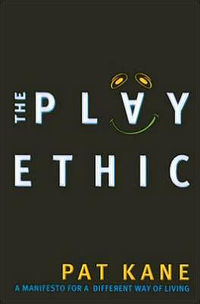
And then went on to explain his concept of The Play Ethic:

Welcome to the play ethic. First of all, don’t take ‘play’ to mean anything idle, wasteful or frivolous. The trivialisation of play was the work ethic’s most lasting, and most regrettable achievement. This is ‘play’ as the great philosophers understood it: the experience of being an active, creative and fully autonomous person.

The play ethic is about having the confidence to be spontaneous, creative and empathetic across every area of you life – in relationships, in the community, in your cultural life, as well as paid employment. It’s about placing yourself, your passions and enthusiasms at the centre of your world.

By clearing space for activities that are pleasurable, voluntary and imaginative – that is, for play – you’ll have better memory, sharper reasoning and more optimism about the future. As Brian Sutton-Smith, the dean of Play Studies at the University of Pennsylvania, says, ‘The opposite of play isn’t work. It’s depression. To play is to act out and be wilful, exultant and committed, as if one is assured of one’s prospects.’

So to call yourself a ‘player’, rather than a ‘worker’, is to immediately widen your conception of who you are and what you might be capable of doing. It is to dedicate yourself to realising your full human potential; to be active, not passive.

The play ethic is what happens when the values of play become the foundation of a whole way of life. It turns us into more militant producers and more discriminating consumers. It causes us to re-prioritise the affairs of our hearts, to upgrade the quality of our emotional and social relationships. It makes us more activist in our politics, but less traditional in their expression. And most of all, the play ethic forces us to think deeply about how we should pursue our pleasures – and how we reconcile that with our social duties.

In addition to writing a very positively reviewed book, his consultancy offers itself to organisations like the Prime Minister’s Office and companies such as Bartle Bogle Hegarty to give what they call ‘playshops’ in which they promote the idea that play is fundamental to both society and the individual, and that ‘the work ethic that has dominated the last three centuries is ill-equipped to deal with’ the way we live and work today. As one detailed review of the book says:

Play has since been viewed as antithetical to the rational and efficient management and control of organisations. Under the forms of mass-production that the ideas of Taylor and the practices of Ford made possible the role of play was variously seen as something that might well be good for working people to engage in, but ‘in their own time’. Playing in the works time was seen as subversive, as wrong, as resistance to the natural order, as misbehaviour, by both sides of the labour process.

The idea, then, is to encourage companies and organizations to realise the ‘interdependence of play, purpose and profit’ and to incorporate ‘play’ in their working processes. An extended but enlightening example of what this might mean is given in the same review:

An excellent example can be gained by viewing a television documentary series called Slave Nation, made by Darcus Howe and shown on Channel 4 in the UK in 2000. In one episode, Howe spends time in a call-centre in Derby, the home of the online bank egg:¦. What follows is a brief description of the opening scenes.

In a building that resembles a warehouse or a factory hundreds of people are gathered into several collective ‘work’ stations, i.e. a number of desks, with computer terminals and tables and chairs, there are also a number of pool tables and table football games in the spaces between. Around the walls of this vast warehouse- like building, are posted league tables, the teams have names that represent sports teams e.g. Team Juventus head the league. There are posters containing figures and statistics, the posters are big they need to enable people from across the floor to see them and see if their team is climbing the league.

The ‘work’ stations themselves appear bedecked in balloons and various brightly coloured posters. The people themselves are dressed casually some in jeans and poloshirts (not a suit in sight), some are in fancy dress, many are wearing funny hats.

‘The places we work in are kitted out with designated chill out areas. So if you need to get away from the grindstone, there’s always somewhere to go and sit. You can even take in a game of pool or table football. On top of that, we have a relaxed, informal dress code – we want to get to get to work feeling comfortable.’ (An employee)

This is the home, or workplace of ‘egg-people’, a term used by staff to describe themselves. Some are ‘egg-couples’, that is ‘egg-people’ who are in a relationship where both work for egg:¦. They spend their days at the call-centre and their evenings at the nearby sports centre, playing football for an ‘egg-team’, or running as members of the egg: running club. Monday to Friday, they spend their time as ‘egg-people’: most hours in a day are spent together, ‘working hard, playing hard’, as they like to put it.

While at work during the day they may be in competition with each other, as members of different teams within the call centre striving to win the monthly sales league (as members of Team Juventus, for example), simultaneously they may be competing against each other at pool or table football, again representing their team, as the company web site states: “You see, it’s not all about work, there’s lots of opportunity to relax as well. So when you start, you’re almost bound to find the kind of fun you like.”

Perhaps a little bit…wacky, no? And if someone, God forbid, doesn’t like football, sees their relationship as nothing to do with the company, or basically does not want to regard themselves as an egg, they might just prefer to have a…job.

Another example they give is nothing to do with the Play Ethic people, but an organisation called the Xplicit Porn School:

We finally offer what might be seen as our most extreme example. In the UK Sunday Times ‘Style’ supplement of 9th January, 2005 was an article entitled, ‘Xplicit Executive Relief’. This article reported on a new team building exercise that involves a team of colleagues working together to produce a pornographic movie scene. The consultancy, a partnership between Impetus Training and The Xplicit Porn School charges corporations up to £5,000 per day, for this the clients are provided with actors and equipment. The ideas and directions come from the individual team members, aided by the consultants.

It’s…difficult for me to see the people I go and teach around Madrid going for that kind of thing. But as they say, it is an extreme example.

All the theory behind this is undoubtedly very interesting and it does offer a useful means of thinking hard about what we mean by work and how it is changing. However, anybody who has worked in an environment like the one at Egg will acknowledge that such a workplace is profoundly irritating to have to spend every day in.

But my problem is not really with the forced and wacky way in which any of these laudable suggestions will inevitably be enacted in actual workplaces. My problem, like I said, is about the disappearing division between work and free time.

The impression that I get is not that people want their work to be more fun. It is simply that they want to work less. And regardless of whatever initiatives companies introduce to make their workers feel part of a team or to encourage them to kick balloons around the office when they’re not too busy or to share pizzas and beer after the working day has finished, the fact remains that the aim of the company is to get their workers to work as hard as possible as much of their time as possible for as little financial reward as possible.

On the metro the other day I saw a woman with a bag from a mobile phone company which said that it offered telephone and Internet ‘solutions’ for you and for ‘your company’. Which left me thinking that we are, in the way that we think about our relationship with our employers, overlooking something very important. Namely, that for all the time and effort that you put in, for all the hours that you lie awake worrying about problems at work, the company that you work for is not yours, it is theirs. And the moment that you walk out of the office at the end of the working day, the time before you is not included in the deal you have made with your employer; it belongs exclusively to you.

Another reason I don’t Miss China


A couple of things I’ve written here about China find an echo in a recent Guardian article about China’s successive hostings of the Miss World contest (it seems that, like the Eurovision Song Contest, no other country would touch it with a chopstick):

For a regime keen to publicise its economic success and internationalist credentials at home and abroad, the month-long beauty-fest is propaganda gold dust. Miss World may not yet have her own float in the National Day parade in Tiananmen Square; but in a country where media content still falls under governmental control, the heavy coverage that the contest receives sends a powerful signal that the senior cadres feel the contest serves their ends.

Domestic TV coverage has a clearly defined political function. In general, the Chinese media like to broadcast footage of resident westerners going about their daily lives. Inevitably the subject is shown praising China – and if, like last year’s Miss USA Nancy Randall, they do so in endearingly elementary Chinese, all the better. This kind of material has a significance over and above the feelgood factor; it underlines the success of recent liberalising policies.

Meanwhile on an international level the Miss World contest allows a carefully constructed Chinese message to be broadcast to an audience of two billion across the globe. Over the past 10 years the Chinese have worked hard to dispel once ubiquitous images of China, the bicycling factory state, and glamorous events like Miss World are a tonic. Not only that – the contest sends a strong message to the world about China’s changing values and internationalisation, that the days of the Red Guards are over. “This sort of programming helps build an international image that is unthreatening and somehow reassuring,” says Crane. “After all, beauty pageants were once considered as American as apple pie.”

Unfortunately, what these witless and seemingly profoundly vapid Communist Party dullards, whose apparent ambition is to transform China into somewhere as bland and unthreatening as a Disney theme park, are incapable of realising is that it also portrays China as a country which is utterly, utterly naff.

A very long sentence about money


Hopefully a final comment on the subject of pobreza for a while: one of my favourite quotes of the moment is from another of my new heroes – along with Buckminster Fuller and Mr Potatohead, natch – George Monbiot, the campaigning journalist (and how quaint that phrase has been made to sound, particularly in the country of George Orwell), who wrote recently that ‘”If you can live on five thousand pounds a year, you are six times as secure as someone who needs thirty thousand to get by”, o sea if in one year you manage to earn that much money, with all the sacrifices and compromises that that entails, you will be under a huge amount of pressure to earn the same sum the following year, which also implies that an ability to hold on to your earnings, your savings and any putative future income in the face of that relentless and omnipresent pressure to spend money on things you in no sense need, a pressure which has come to dominate virtually every single aspect of our public lives and has gradually been allowed to subsume more and more of what used to be public space, has to constitute some sort of holy grail for present and future generations of working people.