The F Word part 4: In which I arrive in China


Any pretensions I may have entertained of Learning Chinese Through FootballTM would have quickly been doomed to failure. Although I had a good grasp of the basic numbers, the names of the world’s leading clubs and players are often unrecognisable and hellish to pronounce. I wouldn’t imagine that Paul Gascoigne found it particularly easy.

I did, briefly, try: in my first or second week I played my first game of football in quite a while. Disappointed to see the fruitless-yet-predictable results of my time-honoured technique of chasing-the-ball-all-over-the-pitch-and-then-kicking-it-straight-to-the-other-team, I turned to our goalkeeper and asked him how the Chinese say ‘Fuuuuck!!!’ He told me, I repeated it about ten times and then promptly mispronounced it catastrophically for the next ten months.

Chinese kids (male kids, that is to say, which is most of them) love playing football, especially in a curious 20-a-side variety. Nor is it unusual to have to share your tennis court with two or three other pairs. There are just so many young people with so much energy to expend. Now personally, as I may have mentioned somewhere around here, my own preference would be for them to devote their efforts to storming the bastions of power and making their country into a decent place to live, but what the hey. They prefer to direct their youthful frustrations elsewhere.

One of my students, faced with the question of which people he would least like to meet, surprised me by not offering the standard responses (usually ‘the Taiwanese President’ or ‘anyone from Japan’). His answer was that he would hate to meet the football players of AC Milan, given that he was a fan of their city rivals Inter.

How had this 20-year-old boy (as the Chinese like to say), no more from the north of Italy than I’m from Shanghai (I’m not), developed such a strong emotional attachment to Inter Milan? Well, he’d read about the team in officially approved articles in state-controlled newspapers and on the government-sponsored internet. These days, if Michael Owen fails to score for Newcastle of a weekend, or if the Chelsea manager suggests he may need to strengthen his right-back position, it is back-page news around the world – and in China (and probably in Japan, although for different reasons) it makes the front page.

This contrasts with a genuine lack of interest in home-grown football. In early 2005 the start of the soccer season was delayed for several weeks because a number of clubs didn’t have the funds to field a full team and to travel to matches. When I went to see China’s number 1 team Dalian Shide I saw a sparsely populated stadium witness the most desultory performance I’d seen since, well, my own a few months earlier. After what I think was the fifth goal (I wasn’t sure, as we arrived late, the result of a fairly unnecessary argument with my slightly irrational then-girlfriend over my paying almost three euros for two tickets), the players left the pitch five minutes early, presumably because they simply couldn’t be bothered to run around in the cold to such a lukewarm reaction any more.

In European football and American baseball, though, there is a huge amount of interest. The Government don’t mind; they seem quite happy to see their young people doped up to the eyeballs on this particular foreign opiate. And football and basketball are foreign imports – it is a form of cultural imperialism just as profound as Hollywood movies or McDonalds.

This Guardian article from two days ago, about the aspirations of a certain British football club to cash in on this new ‘goal rush’, reads like a grotesque and hilarious satire of the original Age of Expansion:

Sheffield United’s manager could become a household name in Chengdu after his club revealed at their AGM yesterday that contracts have been exchanged on a deal to buy the Chinese second division club Chengdu Five Bull FC for a “minimal” sum with completion anticipated early in the new year.

“We are taking the Blades global,” enthused Kevin McCabe, the chairman of Sheffield United’s plc, who already has extensive real estate development interests in China. “Chengdu city has a population of 11m and is the capital of Sichuan province which has a population of 100m. Although I don’t expect them all to become Sheffield United fans, this does represent a potential fan base which we can use to develop both the Five Bull and Sheffield United brands.”

Five Bull boast a 40,000-capacity stadium, but it represents virgin marketing and merchandising territory. Previously effectively under government ownership – the club was run by a collective of state enterprises – the Chinese government’s recent decree that the country’s soccer clubs can no longer be even indirectly state-owned dictates that Five requires outside investment.”We intend to establish a club shop at the stadium for the first time as well as a Blades Bar in the city and to sell branded merchandise, also for the first time,” McCabe explained.

The idea is that Five Bull fans will develop a twin affection for the Blades, their enthusiasm fuelled by the internet and satellite television transmissions of English football.

Now speaking as someone from Sheffield, there is little more absurd to me than the thought of someone from Sichuan province dreaming of visiting Bramall Lane. I’m aware that what might appear mundane to me could seem exotic to someone from China and vice-versa, but I can assure anyone who hasn’t had the opportunity to see it for themselves that there is very little of the exotic or charming about that part of the city. There are, of course, many positive benefits of globalisation – the internet and being able to buy pesto in Dalian spring to mind – but this, while certainly not the worst thing about our brave new world, is definitely not the best.

The article put me in mind of William Gibson’s article about Singapore: a place where the past has ceased to exist. Forget about silk dresses, Mao suits and charming Sichuan tea shops – what the future has to offer China is a replica Sheffield United football top – made, in China, natch – and a Blades theme bar.

To me, it sounds uncannily like my particular vision of hell.

The F Word part 5

Building Beijing


I have to provide a link to a tremendous William Gibson article from Wired, which is from 1993 and about Singapore but rings so many bells in terms the kind of place that the authorities currently want to build where China used to stand – a ‘single-party capitalist technocracy’, ‘a place where the physical past has ceased to exist’:

Singapore looks like an infinitely more liveable version of convention-zone Atlanta, with every third building supplied with a festive party-hat by the designer of Loew’s Chinese Theater. Rococo pagodas perch atop slippery-flanked megastructures concealing enough cubic footage of atria to make up a couple of good-sized Lagrangian-5 colonies. Along Orchard Road, the Fifth Avenue of Southeast Asia, chocka-block with multi-level shopping centers, a burgeoning middle class shops ceaselessly. Young, for the most part, and clad in computer-weathered cottons from the local Gap clone, they’re a handsome populace; they look good in their shorts and Reeboks and Matsuda shades.

There is less in the way of alternative, let alone dissident style in Singapore than in any city I have ever visited. I did once see two young Malayan men clad in basic, global, heavy metal black – jeans and T-shirts and waist-length hair. One’s T-shirt was embroidered with the Rastafarian colors, causing me to think its owner must have balls the size of durian fruit, or else be flat-out suicidal, or possibly both. But they were it, really, for overt boho style. (I didn’t see a single “bad” girl in Singapore. And I missed her.) A thorough scan of available tapes and CDs confirmed a pop diet of such profound middle-of-the-road blandness that one could easily imagine the stock had been vetted by Mormon missionaries.
Disneyland with the Death Penalty

The article, which is well worth reading right through to the end, could so easily in some places be talking about Beijing, Shanghai, or indeed Dalian, particularly when it compares the sterility of ahistorical Singapore with the spice and teeming variety of life in Hong Kong, which seemed to be, with the coming of the handover, under threat:

In Hong Kong I’d seen huge matte black butterflies flapping around the customs hall, nobody paying them the least attention. I’d caught a glimpse of the Walled City of Kowloon, too. Maybe I could catch another, before the future comes to tear it down.

Traditionally the home of pork-butchers, unlicensed denturists, and dealers in heroin, the Walled City still stands at the foot of a runway, awaiting demolition. Some kind of profound embarassment to modern China, its clearance has long been made a condition of the looming change of hands.

Interesting too that in Singapore they have realised that a city with no history is not just marketable but also something that can be franchised – to the Chinese:

In the coastal city of Longkou, Shandong province, China (just opposite Korea), Singaporean entrepreneurs are preparing to kick off the first of these, erecting improved port facilities and a power plant, as well as hotels, residential buildings, and, yes, shopping centers. The project, to occupy 1.3 square kilometers, reminds me of “Mr. Lee’s Greater Hong Kong” in Neal Stephenson’s Snow Crash, a sovereign nation set up like so many fried-noodle franchises along the feeder-routes of edge-city America. But Mr. Lee’s Greater Singapore means very serious business, and the Chinese seem uniformly keen to get a franchise in their neighborhood, and pronto.

It’s one thing setting up brand new privatised developments for the new rich; on the other hand, the process of quickly turning cities with millions of people and thousands of years of history into sparkling imitations of the world’s cleanest and most boring city is neither a straightforward nor painless one, especially for the people who happen to have spent their whole lives there, and especially when tens of thousands of hopefully high-spending VIPs will be spending up to three weeks in the city in, er, three years’ time. Part one of this excellent BBC documentary gives a very precise account of what is going on.

Of course it’s not something unprecedented in the modern world; the comments from the old man talking about the prospect of being shipped 20 or 30 kilometres away from his home in the centre to a place with no public transport or facilities reminded me of what someone told me years ago about being moved from the centre of Dublin to Crumlin in the south of the city in the 1950s – he compared it to going to live on the moon. The last number of years in Europe have seen a gradual hollowing out of the centre of our cities, making them more resemble cities in the US, destroying any civic sense and making us more dependent on private transport. The difference in China, I think, is to do with both the speed and the violence of the destruction.

Dalian sucks!


I’ve sometimes been asked here to provide some advice or tips about Dalian, given that I recently spent ten months living there. I’m not a big fan of the place, I think it resembles a lot of Chinese cities in that it feels over-sized, characterless, hastily assembled and without any sense of its own history; as for it’s the future, the term ‘Singaporisation’ seems to be entirely apt to describe a city like Dalian, which, when all the ubiquitous building projects have been completed and tidied up and it is finally ‘finished’, will be a pretty boring place to live.

For the edification of people who haven’t been there, I’m going to post an, erm, post that I made two or so months after arriving in Dalian to a foreign teacher’s discussion board peopled by, er, people who had, when I was trying to decide on a destination city, recommended and extolled the city to me.

I need to say before I start that when I wrote this I was in a Very Bad Mood, and, as Paul Theroux commented, it is never good to record your response to a city or country when you are feeling down. Other factors played a part in my reaction: our University had gone out of its way to provide no kind of a welcome or orientation whatsoever (which on balance is not totally rare, I believe), and my personal situation was a bit, shall we say, Conflictuous.

I’m also happy to admit that other people have been to or are in Dalian and really like the place. And I should add that things, and my mood, definitely improved as time went by, aided in no small part by a six-week jaunt around Thailand halfway through the year. There were, it is evident, lots and lots of wonderful things about day-to-day life in China that escaped my attention (and I hadn’t yet realised what the letters KTV referred to), as of course there still are. I was also being as provocative as possible. These were, however, in an exaggerated and hot-headed form, my first impressions, and I do think that they are not entirely without foundation, so while I could easily muck around with it and edit out all the things I’m embarrassed about today, I’m going to leave it as it is:

There are lots of reasons why I chose to take a job in Dalian rather than any other city. When I was teaching in Dublin a few years ago I had lots of students from here who couldn’t speak highly enough of the place, they gave me the impression that it was a laidback city with a relaxed atmosphere, and although at the time I wasn’t considering coming to China to work it stuck in my head.

Another important reason is the comments I read on Tefl websites, especially this one. As I’d never met anyone who’d taught in China it was the only way I could get honest first hand accounts of what it is like to live and work here. So I was interested to read the various comments proclaiming that (somebody actually said this) ‘Dalian is the best city to live in in China’ and suchlike.

Now, I know that a lot of people on this forum may have been here for a while and got used to things. I had never been to China before and so was willing to face whatever challenges came up. I’d done a bit of reading which had made to clear to me that there are places in China where nobody in their right mind would want to go and live. But I had been persuaded that Dalian offered the opportunity to get to witness the real China close up without having to abjure all possible creature comforts (clean air, some kind of social life) for a year.

Now I’ve been here two months and am more than a little distressed to report that not only is Dalian an ugly, ugly city with just a very short coastline path and a few green hills surrounded by building sites to escape to, there is also absolutely nothing to do at night.

Now I know there are a couple of bars where if you’re lucky you might get talking to some people who happen to speak the same language as you, but this is not my idea of a good time. I was led to expect at least some sort of fledgling local scene, places where young Chinese people go to enjoy themselves. But there is nothing of the kind. So by day your choices range from wandering round some department stores to clambering up the same dirty hill for the umpteenth time to get a view of thousands of factories and construction sites. At night you can sit in bars a 45 minute bus ride away with other foreigners feeling just as depressed and isolated as you are.

There are some cities in the world which I’d never even think of going to visit, let alone to live. Off the top of my head Barnsley comes to mind, as does Vladivostok for some reason. As I said at the start of this rant, some places in China I’d sooner cut off my legs than visit. But having been to Qingdao, where at least you can go for a long long walk by the sea, I know there are much better places to visit and live in in China than here. I found out pretty soon after arriving that amongst lots of people here Dalian is regarded as a fairly shitty place to live. Now I know the reason why my students still tell me it’s China’s most beautiful city – it’s because the government has told them it is, and they don’t know any better. As for the foreigners who have maybe been here too long and forgotten what it’s like to live somewhere with a nice environment, interesting things to see and a variety of things to do in the evening, I wish they hadn’t used this public forum to try and persuade themselves and others that they live somewhere ‘exotic’! I gave up a secure job in the beautiful city of Lisbon to come to this dump!

Another reason I don’t Miss China


A couple of things I’ve written here about China find an echo in a recent Guardian article about China’s successive hostings of the Miss World contest (it seems that, like the Eurovision Song Contest, no other country would touch it with a chopstick):

For a regime keen to publicise its economic success and internationalist credentials at home and abroad, the month-long beauty-fest is propaganda gold dust. Miss World may not yet have her own float in the National Day parade in Tiananmen Square; but in a country where media content still falls under governmental control, the heavy coverage that the contest receives sends a powerful signal that the senior cadres feel the contest serves their ends.

Domestic TV coverage has a clearly defined political function. In general, the Chinese media like to broadcast footage of resident westerners going about their daily lives. Inevitably the subject is shown praising China – and if, like last year’s Miss USA Nancy Randall, they do so in endearingly elementary Chinese, all the better. This kind of material has a significance over and above the feelgood factor; it underlines the success of recent liberalising policies.

Meanwhile on an international level the Miss World contest allows a carefully constructed Chinese message to be broadcast to an audience of two billion across the globe. Over the past 10 years the Chinese have worked hard to dispel once ubiquitous images of China, the bicycling factory state, and glamorous events like Miss World are a tonic. Not only that – the contest sends a strong message to the world about China’s changing values and internationalisation, that the days of the Red Guards are over. “This sort of programming helps build an international image that is unthreatening and somehow reassuring,” says Crane. “After all, beauty pageants were once considered as American as apple pie.”

Unfortunately, what these witless and seemingly profoundly vapid Communist Party dullards, whose apparent ambition is to transform China into somewhere as bland and unthreatening as a Disney theme park, are incapable of realising is that it also portrays China as a country which is utterly, utterly naff.

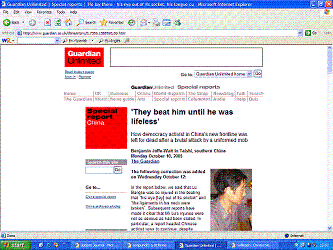
The Beating of Lu Banglie


I haven’t got anything useful to add to the debate about the attack on the democracy activist Lu Banglie, and I am not one to blow my own trumpet, but reading this article from Running Dog put me in mind of what I said a few months ago about attempts to ‘reform’ the CCP:

“Throughout the country party officials and to a certain extent ordinary Party members are allowed to run amok: charging peasants illegal taxes, running up restaurant bills for thousands of dollars, stuffing their pockets with public cash, paying thugs to beat villagers off their own land, building up huge unpayable debts with banks, everywhere doing favours for people they like and making life difficult or impossible for those who they don’t. And doing all this with relative impunity – who is going to stand in their way? Other Party members?

It is only a tiny amount of cases of corruption that we ever get to hear about. As far as I can see, corruption and abuse is the rule and not the exception. My second analogy, then, is the Mafia.

In the Godfather Part 2 Michael Corleone is young, idealistic and determined not to follow the example of his father. He is going to clean up his family businesses and make them respectable. So what happens? I don’t want to spoil it for anyone, but it is the Mafia we are talking about here after all. How can you reform an organisation that is based on criminal corruption, on the systematic hoarding and abuse of power? Maybe we can conclude that what Michael wants doesn’t really change, but as a leading member of the organisation he has a crucial job to do: Protect the Family.”

As well as Asiapundit’s post, I though that Rebecca MacKinnon’s challenge to Chinese bloggers was right on the money:

“At the same time, I hope this question of a foreign correspondent’s responsibility will not become a convenient way of distracting people from the core issue: one of human rights and the suppression of a democracy movement in Taishi.

Will Chinese netizens be successfully manipulated into foreigner-bashing as an acceptable alternative to communist party-bashing?”

Vive la Chine!


En honneur du pays où je me trouve actuellement (à Bretagne), j’ai fait un effort de traduire un article…ah whatever, here’s an article from Libération about the recent climax of the ‘France in China’ year. I think the conclusions of the article are quite interesting, in terms of what it says about ‘exchanges culturelles’ between China and the rest of the world.

Apologies in advance for the inevitable mistakes in the translation. Anyone who, unlike me, actually speaks French can read the original article here.

L’Année de la France en Chine, a damp squib

It was supposed to be ‘the incredible adventure’, an event on the scale of the parade down the Champs-Elysées celebrating this year’s Chinese New Year. In the end, after one year of work, €1,500,000 and two hundred special guests flown in from France, it was no more than a simple country fair at the foot of the Great Wall near Beijing, with snacks and white wine for several thousand officials. Somewhere between Chinese authoritarianism and the great follies of the French, the dream had cruelly turned sour.

They’re just peasants!

This, then, marked the end of L’Année de la France en Chine, with a final note of bitterness and an immense sense of waste: Gad Weil, the organiser of the ‘giant picnic’, the idea for which came from the French Government, could not hide his anger on Saturday upon seeing the efforts of his team reduced to almost nothing by the presence of delegations of officials. The initial project, which was to bring together 120,000 people over two days along the length of a wall peopled by representatives of different French provinces promoting their traditional products and traditions, had been rendered more or less unrealisable by the obstacles put in place by the local authorities. The final straw came on Saturday, when the police kept the non-invited public away behind safety barriers, a distinctly colonial scene in which hundreds of Chinese watched at a distance as the French and their important guests enjoyed themselves. When Gad Weil complained, the response was: ‘But they are peasants, they are of no importance to you, they will never go to France!’ ‘I am an acrobat’, explained in vain the organiser of the Chinese New Year parade in Paris, ‘what I do is organise spectacular events for the general public’. His anger was assuaged by the greater access granted to the general public yesterday, but there were very few who turned up owing to the Chinese Mid-Autumn festivities.

L’Année de la France en Chine had begun a year ago with a similar misunderstanding about the ‘popular’ nature of events, with the concert given by Jean-Michel Jarre inside the Forbidden City. The public on that occasion was hand-picked: no spectators without badges, invitations, verification…That concert was among the most expensive events of the year, only available to ordinary Chinese via television. Now, a year later, not much had changed.

Forty million euros

Obviously L’Année de la France en Chine cannot simply be reduced to these two expensive large-scale flops. With over 200 exhibitions, concerts and festivals, there have been many popular successes, such as the travelling Impressionist exhibition or the Transmusicales of Rennes transplanted to Beijing, despite, once again, an overbearing level of security. But the balance cannot be complete without taking into account the financial cost: 40 million euros, a record for a marketing operation. The financing was mixed, involving for the first time private Chinese interests who contributed six million euros, the rest being shared between the State and French companies. ‘Nothing on this scale has been done before’, underlines proudly a French official. A lot has also been wasted on an inumerable number of visits by delegations to China (it’s the fashion), wining and dining, and vague and botched operations.

The rewards of such ‘investment’ are impossible to quantify, and the promoters of the campaign take comfort from the fact that other countries, beginning with Italy, plan to carry out their own ‘exchange years’ following the French model. But this campaign, more diplomatic than cultural, presented initially as an attempt to modernise the image of France, which is traditionally seen as ‘romantic’ in the eyes of the Chinese, will not serve for much more than confirming that the French are friendly and rich…culturally. It will be difficult to break down those barriers.

The lesson

The Chinese are happy to welcome such initiatives: they reap the benefits of this courting by Western countries in search of market share. And they do it on their terms. Intractable on Saturday with regard to the Wall, they were very generous with the Summer Palace, where, on the occasion of a reception given by the city of Beijing to France, the magnificant site, long ago pillaged and destroyed by the French army in 1860, was superbly decorated in the colours of France. But no question of it being a popular fête: the invitees were all wearing badges. In China, cultural exchanges are something too important to be left to the people. France has learnt that lesson at it’s own expense.

The Face of Mao


I’m not usually a huge fan of Xinran, but this is a great article from today’s Guardian, about a kid’s game involving a Chinese bank note:

“You have been moulded by the western media, which has hardly any positive press about China and the Chinese. You often go back to China, so tell me why Mao’s picture still hangs on the walls of so many people’s houses, shops and offices. You think it is because the Chinese government orders them to display them, or because those people have never heard western views? Or do you think they don’t know that Mao did terrible things to his people and how much he damaged his country? Be honest to our history, Xinran. I know your family has lost people under Mao’s cruel policies, I know your parents were sent to prison for years and you suffered in the Cultural Revolution as an orphan.

“I am sorry to remind you of your unhappy memories. But don’t look down on what Mao did for Chinese national pride, and for those poor parents in the early 1950s. I feel it is unfair to Mao.”

I stopped her. “What about the millions of Chinese who died under his rule, because of his policies, in the 50s and 60s?”

“If westerners still believe their God is just after he flooded the world for his own purpose, or George Bush could invade Iraq with growing numbers of deaths for his campaign for moral good, why shouldn’t Chinese believe in Mao, who did lots of positive things for the Chinese but also lost lives for his own mission for good?”

For me this seems to neatly sum up two widely held beliefs in China: that all westerners are christians who unquestioningly accept the decisions of their leaders, and that Chairman Mao should be regarded as a kind of god!

Free the Chinese Clothes!


The eyes of the world are being opened to a tragedy far, far greater than that in Sudan, and with more disturbing implications for our planet than the war on terrorism or global climate change: the tragedy of the 40 million jumpers, 50 million pairs of trousers and one billion bras being piled up in European warehouses and ports as a result of the restrictions on Chinese clothes imports into the EU.

All over Europe shoppers are terrified of the very real possibility of the shelves of Zara, Mango and H & M having slightly less cheap Chinese-made garments. Says recently laid-off factory operative Edna Typical, 22, a woman who already owns more clothes than the entire population of Jiangsu Province, “Am I to wander the cavernous empty shopping centres of my land unshod, with nary a stitch of clothing, bereft of accesories? Can not the Governments of the world see a way to resolving this catastrophe to the benefit of consumers?!”

The crisis is being watched anxiously in the clothes’ home villages in China. The China Daily quotes one woman as saying, “I work 12 hours a day in basically inhumane conditions for the equivalent of three dollars a day to produce those clothes, and it breaks my heart to think that those poor Western consumers might soon only be able to make four as opposed to twelve separate clothes purchases on a single Saturday afternoon. Long live Chairman Mao.”

Pressure is indeed mounting on those governments to take immediate action to Free The Chinese Clothes. According to one real person on the radio who I have honestly not just made up, “the priority now is to find some way to get those garments onto the shelves in time for the Winter Collection”.

One solution that has been mooted is to move forward next year’s quota of Chinese clothes imports. However, this will inevitably lead to problems next year, when the 2007 quota will have to be brought forward to 2006, and so on, and so on, until the world ends, or Peter Mandelson dies, whichever happens first.

In the meantime millions and millions of human beings who are happy to do nothing whatsoever with their free time apart from eating junk food, watching home improvement shows and shopping for that perfect £6.99 spangly green top are in for an uncertain weekend.

On Injustice


I’ve recently found myself in what is for me a very unusual situation; that of being the victim of an injustice. I’m not going to go into any details here, suffice it to say that it’s a workplace-related dispute which I’m determined to resolve in the calmest and most effective way possible, which is to get those responsible into big heaps of trouble themselves. I find that doing so actually gives me a fair bit of satisfaction and moral purpose. When I was striding purposefully to work this morning I idly started to imagine myself as some sort of Soldier of Fortune making a stand on behalf of the world’s downtrodden and mistreated. Fortunately the consequences for me or for the world as a whole are not particularly serious, but it’s gratifying to feel that I’m definitely taking the right course of action for a change.

If by any chance you hear of a bloodbath taking place in a language school in Cambridge, you’ll know that I’ve had a change of tactics.

On the theme of the struggle against injustice, there is someone, quite possibly a child, who has taken to hanging round this website expressing heartfelt concern for the possible fate of Britain’s muslims as a result of the Government’s catastrophic reaction to the terrorist attacks in London. He, she or it has also repeatedly expressed outrage on behalf of the malogrado Brazilian executed in cold blood and with apparent impunity by the British police several weeks ago.

This may appear puzzling to anyone who has visited this site before, given that it focuses almost exclusively on issues related directly to my experiences of teaching English in China. However, I have a sneaking suspicion that the person concerned may just be Chinese, and that a basic fact about the big wide world outside China may remain tantalisingly outside their grasp.

It goes pretty much like this: it is not just that people living outside of autocratic regimes enjoy the freedom to openly think and speak critically about what goes on in their and in other countries – many, many people around the world do not see the country where they happened to be born as the single defining factor in the way they choose to see the world. This means that they see injustice as something that exists in every country, and something that must be exposed and fought wherever it occurs in the world.

For this reason, until I begin to meet many more Chinese people who can and will express concern for the victims of injustice in China, I will not be inclined to regard their expressions of outrage at injustice elsewhere as genuine or sincere. Which is a shame, because I have the feeling that some very noble and laudable sentiments, especially amongst young Chinese people, are being led carefully astray.

Still among the living


There’s nothing funny or insightful contained in these few lines, just to say that I’ve been far too busy to write anything recently but it’s still my intention to add to this site regularly.

I’ve been alternately chuffed and appalled to read all the many comments that I’ve been getting of late. If you have left comments or just enjoyed the site many thanks, I can only say that I feel very encouraged that people read and are so often inspired to respond to what I’ve left here. As for the negative comments, I have always been an extremely contrary bastard and given to acts and statements of outright provocation. Hence the picture.

Unfortunately my only bit of original thinking recently has been the invention of the word ‘Chaiwanese’ to refer to about 70% of the students I have here, who I must say have been getting along swimmingly in most of the classes. I have actually been shocked and not a little disappointed to find quite a few pro-Chinese students among those from the country that dare not speak its name – in fact most of the few classroom conflicts that have taken place have been provoked by this rogue element, rather than by the Chinese themselves.

I will find time sometime in the next few weeks to do some writing again. In the meantime, I would suggest that anyone thinking of starting their own blog but hampered by time constraints seriously consider moving to China to teach English. If I hadn’t been so fucking bored I would never had got around to starting this in the first place.

Just for the record, though, I’d stay well clear of Dalian in general, and Dalian Maritime University in particular. Now how do I get that sentence to show up in Google?!?