As long as Trump plays ignorant, his supporters will too

The psychoanalyst Jacques Lacan came up with the concept of the ‘subject-supposed-to-know’, an impersonal and intangible entity which carries knowledge on our behalf. As I understand it, this relates to the conscience. When we feel morally guilty, what authority is it that knows we have done something wrong? For many, the answer is an omniscient god. Lacan’s insight is that we all in a sense believe in God whether we like it or not.

This raises two questions for me. In a heavily mediated society where even our most intimate thoughts and gestures are mediated back to us even while we think and act, could a mediating institution play such a role? Or perhaps a political tyrant, as George Orwell posited? Social media could well come to embody the two, in that so many of our experiences are thought of in terms of their value, evaluated as potential cultural capital, and also because the affordances it offers to directly repressive regimes are boundless.

The other thing that concerns me ( in fact I now see that the idea actually came from Slavoj Žižek) is what we can call the subject-supposed-not-to-know. For example, most of us have grown up in the light of terrifying facts regarding the climate which, were we to take them seriously, would compel us to transform every aspect of our lives*. Instead, we deal with the question as we do with death, pretending it’s not real and dealing with each instance of it as though it were occasional and incidental, with no implications for how we ourselves should think and act. There is clearly some sort of (as Lacan calls it) ‘Big Other’ that embodies and excuses our lack of awareness, an authority which, unlike us, is truly ignorant of the problem. Here we can see that these tools are particularly useful for understanding the role of mass and social media in our lives.

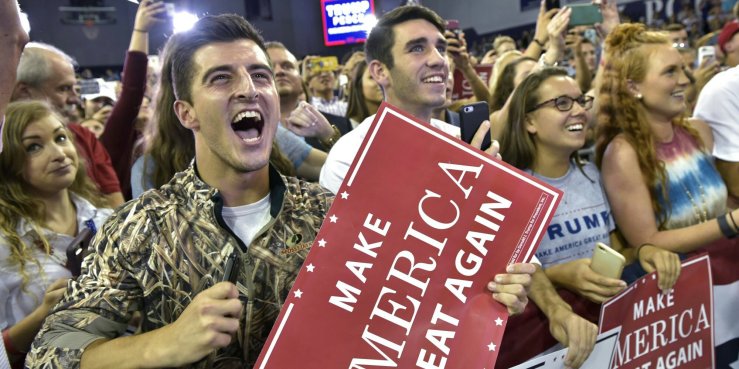
The other pressing instance of the subject-supposed-not-to-know is directly related to this: supporters of Donald Trump. In a way unerringly similar to that of a cult leader, Trump acts out their ignorance and thus allows them to continue with a kind of hysterical blindness. This is true not just of the climate, but also of his own behaviour. If we want to understand why they are so resistent to acknowledging his failings while so ready to blame others, this provides an answer. As long as he pretends that the allegations (including admissions he has himself made in the past) don’t exist, it’s as if they’re not real. He is aided in this by partisan media outlets and social media platforms which facilitate tunnel vision/amplify our blind spots and enable wilfull ignorance of that which their participants do not want to acknowledge. Trump’ s supporters embody an increasingly prevalent condition which affects us all, just in a more extreme form: they and we are effectively, as José Saramago pointed out, blind.

*The now-ubiquitous term ‘triggered’ (as in provoked) actually describes an effect of Post-Traumatic Stress Disorder. What else is this trauma which we’re so keen to avoid addressing that we displace our fear and stress onto substitute targets, eg race?

The world’s most infantile cult

Trump’s tweets about ‘making friends’ with Kim Jong Un, complete with exclamation marks more befitting an eight-year-old, confirm once again a level of naivety about world affairs which most people, judging his role and the background to such statements, will regard as both terrifying and contemptible. But his online supporters (presuming there are some who are not automated) seem to lap it up, insisting that his appeals for everyone to get along be taken at face value. Their insistence that the most superficial aspects of world affairs – reports of personal conversations between individual world leaders – are the only defining ones also explains their (faux?)-naif response to his statement about Putin’s ‘response’ to his (apparently pretend) questions about election meddling. For one thing, the theme of lying is too adult to acknowledge; for another, they appear to be too deeply embedded inside a particular worldview to truly care about what’s true or false, or, as Reza Aslan wrote last week, ‘Trump has been spectacularly successful at getting his supporters to believe his blandishments rather than their own eyes’.

It’s common to see Trump supporters on social media extol love and friendship, and denounce the ‘hatred’ and ‘negativity’ of his opponents. I’ve written before about the sentimentality of tyrants. With his gold bath fittings, made-up golf trophies and puerile insistence that such tokens of his success – his toys – be explicitly acknowledged and admired, Trump resembles a more insecure version of the man who will inevitably, in the next few days, become his new BDF (Best Dictator Friend): Rodrigo Duterte of (as it’s correctly spelt) the Philippines, who combines unmitigated brutality and obscene outbursts with teen-like melodrama, especially when it comes to karaoke. There is a long history of autocrats seeing their subjects and counterparts in a mawkish light; there’s also a Michael Jackson element to both Trump’s worldview (and that of his immediate family members) and his appeal, which it’s fair to suspect may suggest similar predilections. Maybe some Trump supporters think that Roy Moore, like the King of Pop, just wanted to play innocently with those children, and would react just as nonchlantly if it were revealed that their hero does too.

I’ve long contended that such naivety is a symptom of a retreat to a less complex and frightening world in the face of the changing climate. The infantile depiction of the world of Fox News and the bogeyman worldview of Infowars are cases in point. There are a number of factors that account for the success of such propaganda. For me, such a retreat to a world of fairy tales is a response to our inability to discuss the environmental consequences of our way of life responsibly. If you can deny the facts of global warming, you can (be persuaded to) deny anything. Once confronted, acolytes of the new right habitually deny everything we try to use to counter them: reason, the experiences of others, universally-agreed upon historical fact, intellectual and scientific authority, even what they themselves have just said. This last is telling: owning one’s own statements and the logical consequences thereof is a habit one acquires as one matures. Instead, faced with truly incontrovertible evidence that their argument is based on false premises, both children and self-declared supporters of Trump repeatedly try to shift the blame by changing the subject, and when that doesn’t work resort to insults. I find most of the time that I have no response but to plead with such people to grow up.

Trump supporters and their equivalents elsewhere may perceive and behave in accordance with a cartoon version of reality, but it’s not a innocent or harmless one. It encompasses the cruelties of children: spitefulness and bullying, including racism of the most puerile kind. Read, for example, this exchange between two adult Trump supporters as reported by Kyle Griffin. Then there are phenomena like the trans bathroom controversy and the building of a wall to keep out outsiders. It is not a world defined by and for adults.

Social media exacerbates this. It’s a playground in which it’s extremely easy to discard the standards of reasonable debate. Bullies and political manipulators were much quick to recognise and mobilise its radical potential than defenders of progressive values. I suspect that as fascism takes hold across the planet, meaningful resistence will not be centred on social media in its current form.

Children often begin to distinguish themselves from their parents by forming gangs. Some join cults. I think it’s essential to take seriously the notion that Trump’s base is a cult. Thus in trying to turn the tide – and, Canute-like or not, we have no choice – we need to turn to the wisdom of deprogrammers and those who know how to counsel individuals caught up in the cult mindset. Trump (etc) supporters behave and argue like children, because that is the mentality particular to their cult. The critical question is: given that their childish retreat into a more reassuring world is partly a symptom and result of our own failure to begin to address very real problems which, Trump or no Trump, threaten our continued existence, what do we have to offer them which is better than the comfort blanket they are so attached to? How do we engage with them without getting drawn into a cartoon-level battle of good versus evil? Should we even treat them as adults, or as children? I have no idea whatsoever. I think it’s time to read up on how cults work.

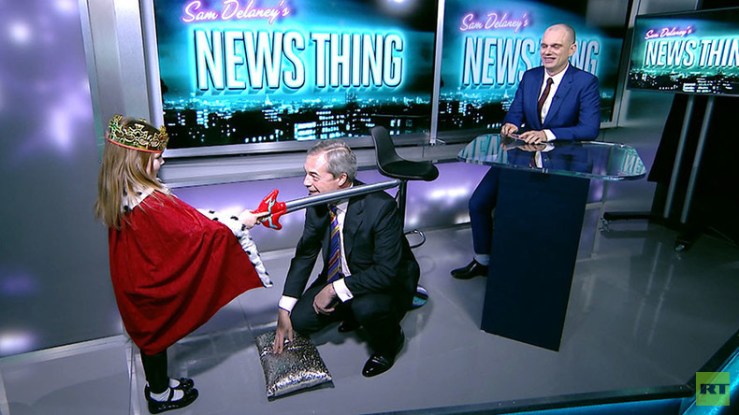
You think Youtube’s bad? Wait til you see Russia Today’s kids channel

aaaaaaaaaaaaaaaaaaaaaaaaaaaaaa
What a jape!

I saw the best minds of my and other generations destroyed by Youtube videos, friends sending me 3am emails furiously denouncing the conspiracy by the powerful to sell us the idea that the climate is changing, kept awake by the conviction that the Twin Towers were a mere hologram, or convinced that Isis is an illusion created by the CIA.

Having just sent some thoughts along those lines to a friend who had also read this essay detailing how soon and how easily our offspring are, thanks to Google, being entranced by and drawn into a world which is infinitely crueller and more absurd than our own, I was startled to see that the very first comment on the piece included a link to another article centred on the very same poem I had (in my glib manner) just quoted.

Such serendipitous connections are, of course, infinitely abundant on Youtube, which plays a particular role not just in the lives of very young children but also, as another friend recently pointed out, in the growth of the alt-right. As the writer says, and as that semi-regular succession of emails from newly- (and, mercifully, usually briefly-) converted conspiracist friends confirms, the role of the platform in the spread of political propaganda is terrifying to the point of nausea. In a not unrelated phenonmenon, it’s a salutary and unsettling experience to see how our baby daughter’s face lights up when it meets the screen of our phones. Like all sensible parents we had decided that we would keep the whole world of digital screen technology a dirty secret from her for as long as humanly possible; anyone who sets out with this intention soon finds that given the preponderance of Whatsapp calls, Skype and so on combined with our evident dependence on it for our own purposes, the talismanic qualities of the device are impossible to disguise. One creeping influence is indeed Youtube, with its immediate and infinite access to hours of nursery rhymes. We are allowing her to be led right into the jaws of the monster that will seize her imagination and attention as soon as it gets a chance.

The article describes how the word salad titles of the billions of videos aimed at infants (typical example: Wrong Heads Disney Wrong Ears Wrong Legs Kids Learn Colors Finger Family 2017 Nursery Rhymes) right from the moment they can tap on the device are an indication that they are produced not by conscious humans but by algorithims set to maximise views and thereby income. Perhaps the non-syntactical way in which such mechanisms operate resembles or is a part of the same phenomenon as Trump’s seemingly incoherent appeals. Such messages, although ostensibly nonsensical, bypass our rational brain and go straight for the limbic system, triggering our deepest and least conscious fears and desires. If we combine what we know about Youtube on a political level and the formative effects it has on very young brains, it starts to make any dystopian fantasy such as The Matrix or Brave New World almost quaint and comforting. Even leaving aside the horrors of Twitter (which at last now with 280 characters stands a chance of becoming more thoughtful and respectful) Youtube is becoming the 24-hour two-minute hate, opium-of-the-masses and soma all in one.

More disturbing still are some of the reflections contained in this must-must-must read account of how the Brexit and Trump nightmares came about, which includes several points of crossover with the previous article. The head of Russia Today once said that

“It is important to have a channel that people get used to, and then, when needed, you show them what you need to show. In some sense, not having our own foreign broadcasting is the same as not having a ministry of defense. When there is no war, it looks like we don’t need it. However, when there is a war, it is critical.”

Evern worse than finding out that a friend has been spending dozens of hours puffing away contentedly on the crackpipe of Youtube conspiracy nonsense is discovering that they are being exposed to the pseudo-radical manipulations of RT (often in the form of Youtube clips). I know that within a couple of years our daughter will start clamouring for access to the likes of Nickelodeon and Cbeebies (along with, it should go without saying, Youtube); if Putin and his cronies ever hit on the idea of creating a version of Russia Today for children, we really are screwed.

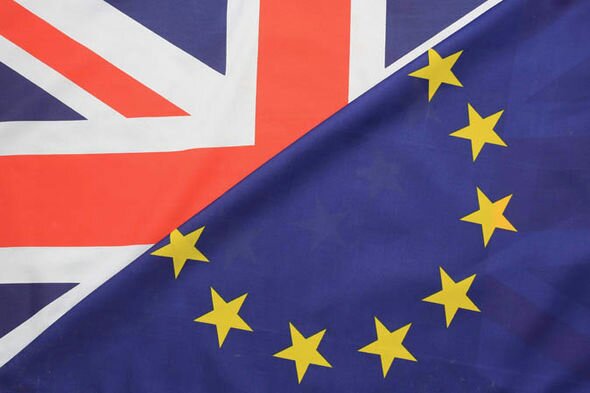
Motion for a second f*cking referendum

This house recognises:

1) That all this bluster and bravado about a ‘no deal’ Brexit makes it abundantly clear that the Government has no plan and no strategy for what lies in store.

2) That no one who voted to leave the European Union did so on the understanding that the purported departure would be conducted under conditions of total chaos.

3) That those who argue for a no deal Brexit have no basis for their dishonest predictions of sunny uphills, tally ho and full steam ahead beyond a desire to cause maximum disruption to British society and the economy; that they hope to take advantage of the resultant catastrophe to satisfy their personal political ambitions.

This house proposes:

1) That a second referendum be held, during which the only slogans permitted to the pro-Brexit forces be the following:

‘WE DON’T KNOW WHAT THE FUCK WE’RE DOING’;

‘VOTE FOR TOTAL CHAOS’;

‘LET’S TAKE ALL THE BENEFITS WE GET FROM EU MEMBERSHIP AND FLUSH THEM DOWN THE FUCKING TOILET’.

(The latter to be postered on every form of transport in the country and also tattooed on Boris Johnson’s face and hands.)

2) That the Conservative Party be outlawed as a political organisation for a period of at least 50 years.

3) That anyone who expresses an view on continued EU membership without taking due account of the findings of experts be jailed.

4) That Nigel Farage be banned for the duration of the referendum campaign from inciting racial hatred and political violence; that he also be prohibited from appearing on ‘Question Time’ for a period of one (1) week.

5) That the name of our country be changed forthwith to ‘The United In The EU Kingdom Of Being In The EU #fuckbrexit #fuckmurdoch #fucktrump’.

Why I’ve switched from the Guardian to the Telegraph

IMG-20171018-WA0000

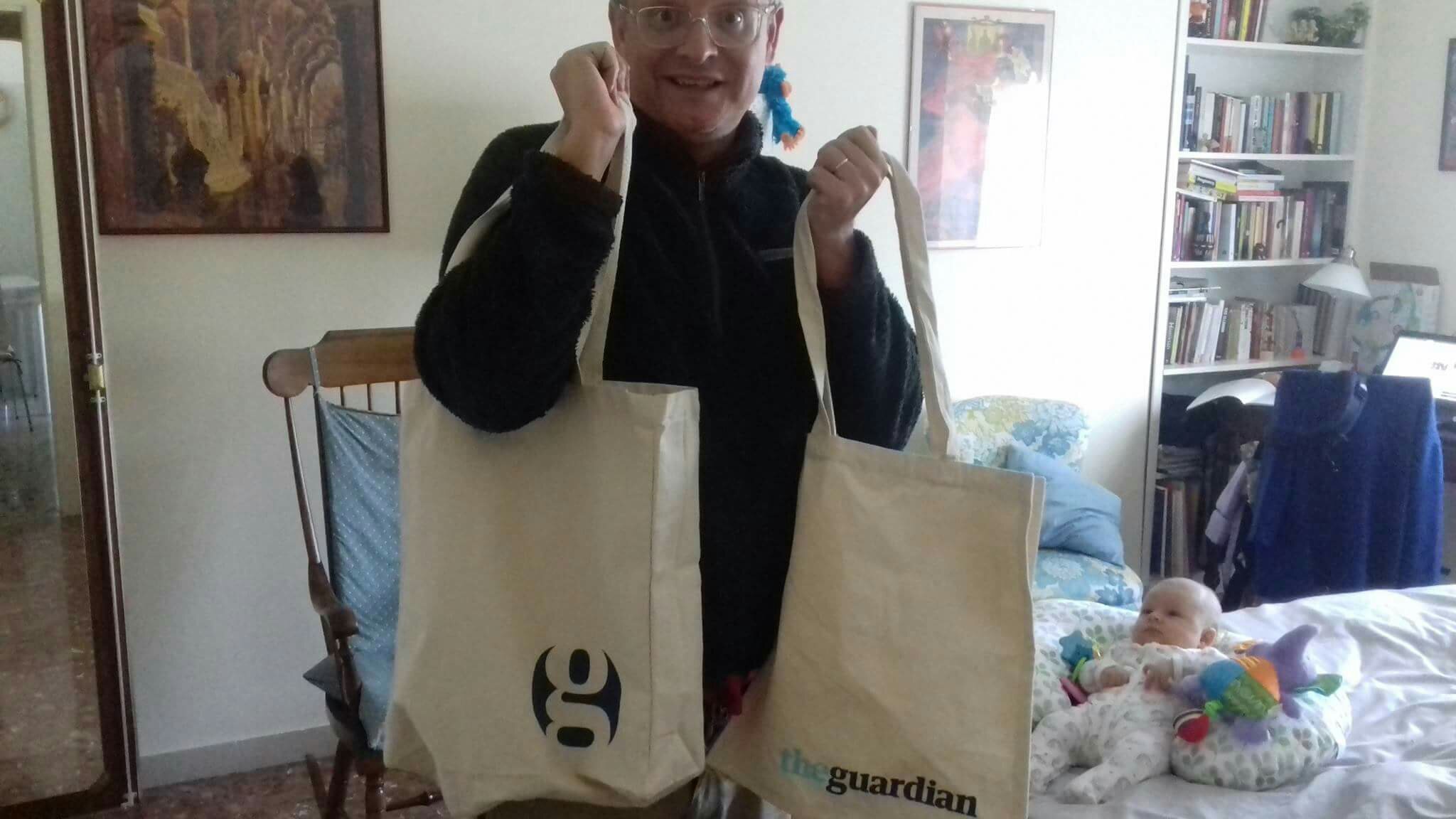
One thing that’s characterised this website throughout its nearly a year! of existence is a puppy-like loyalty to the newspaper The Guardian. I do read other news sources (including the BBC, the WaPo and various outlets in Italian, Spanish and, you know, Welsh), but my mainstay has always been the favoured journal of pinko bleeding heart libtard scum. Having read Nick Davies’ book on churnalism, I’m not an unquestioning reader of the Guardian’s coverage, but I do have a strong emotional attachment to it, to the extent that in our house we have not one but two subscriber-only Guardian-branded shopping bags. Within my world the phrase ‘I read it in the paper’ is always understood to refer to one publication, and it’s definitely not the Daily f*cking Telegraph.

However, I’m increasingly aware, in this age of filter bubbles, that I should seek to broaden my ideological horizons by varying my media diet, to push through the algorithmic fences that limit and direct our online movements*. News coverage biases aside, there’s obviously a risk of being exposed to the party line if I only read whatever George Monbiot, Aditya Chakrabortty, Suzanne Moore, and Owen Jones think of the world. James Ball, in his book ‘Post Truth’, lists reading a wider range of news sites as one means of resisting the tide of bullshit news. He also argues that newspapers themselves should seek to represent a range of political viewpoints. To be fair, The Guardian has made some efforts in this direction, employing columnists such as Matthew Norman, Simon Jenkins, Max Hastings, and for one brief period in the mid-2000s, Nick Griffin**. It’s important to challenge readers’ preconceptions from time to time. Maybe, since he’s no longer at the Guardian, Seamus Milne now writes a weekly column for the Daily Express. I wouldn’t bet my Guardian shopping bags on it though.

The obvious counterpart to the Guardian is the Daily Mail. If you can get past the almost always hateful front page it does have some stories which are both entertaining and reassuring if you happen to share its splenetic worldview. However, even though I live in Rome I simply cannot take the risk of being seen by a compatriot looking at the Daily Mail website on my phone. Maybe it’s merely my own projection, but I would actively sneer at such a person. Then there’s The Times, which does have lots of quality journalism and thoughtful columnists such as Caitlin Moran and Matthew Parris. The problem there is the paywall:  I’m not paying Rupert Murdoch a fucking penny***. So, further to the right, without dropping down a level to the Dailies Express or Star, we have the Torygraph. Although I don’t have any Telegraph-reading friends, in my family history there was one: Duncan, my favourite uncle, who was extremely affable, fittingly avuncular and profoundly Conservative. He would not have been seen dead with a copy of the Guardian – indeed, he still hasn’t been in the five or so years since he passed on. While he was alive his relationship with the Telegraph mirrored mine with the Guardian. This letter gives a flavour not just of his character, but also that of a lot of Telegraph readers: slightly blimpish but jocular with it. The perfect audience for Boris Johnson’s ultimately ruinous shtick, essentially.

My uncle lived all his life in the provinces; you very rarely see people in London reading The Telegraph (and even fewer in Rome, oddly enough****). It’s the favoured newspaper of Tims-nice-but-dims and white-haired colonels living in Surrey. When I picture the archetypal reader it’s Jim Bergerac’s friend Charlie Hungerford that springs to mind: an image of blustering pomposity unmatched by intellectual brilliance. I once knew a journalist who told me that during her training she’d learnt that regardless of its range of vocabulary, the level of argumentative sophistication of Telegraph articles is equivalent to that of The Sun. But these are ultimately prejudices, ones I want to, if not overcome, subject to rigorous reexamination.

However, there’s an immediate problem, viz: if I even think about that c*ntrarian Toby Young my blood starts to simmer. Plus, whenever there’s a Telegraph journalist on ‘Question Time’ you can pretty much guarantee that he or she will agree with at least 80% of whatever verbal effluence Farage comes out with. The Telegraph provides a platform for people who it’s very, very hard not to regard as mere trolls. Its chief political commentator is Charles Moore, whose climate denial makes it very hard to take seriously anything he writes on other topics. In addition, the Brexit vote almost certainly wouldn’t have happened had it not been for Boris Johnson’s Telegraph column spreading outright lies about the EU. Then there’s episodes like this, not to mention the tone of snobbery endemic to the whole enterprise. Nevertheless, the Telegraph does also employ proper journalists, experienced fact-finders who assiduously follow professional guidelines to render the truth with accuracy and fairness, even though it’s presented in the form of articles whose editorial bias occasionally makes people who care about others want to vomit with rage :-P.

Another reason for becoming a Telegraph reader***** is that in contrast to the Guardian’s Comment is Free pages, pretty much all of whose content I’m primed to agree with, it would surely be more useful for me to engage with those with opposing views (insofar as I have to discuss newspaper articles online. Obviously I don’t.) However, as it happens there’s no shortage of right-winger commenters on CIF, in particular following articles written by women or those that dare to mention racism and/or climate change. Ideally, online debates on newspaper articles would be a meeting of minds and a serious engagement across the lines of political affiliation which would put our ideas and assumptions to the test; in reality, the internet doesn’t work like that, regardless of the masthead. At this point, anyone commenting below the line can be regarded as a troll unless they specifically prove otherwise.

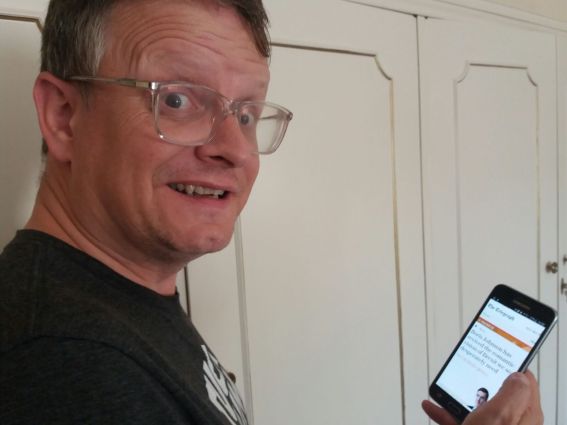
It’s time to don the surgical gloves and get a forensic feel for the innards of this exotic creature, the Daily Telegraph website. As it happens, I’ve just received a handy email drawing my attention to the publication’s star columnists. When I click through to the site, however, I’m faced with an obstacle: much of what they write is only available to ‘Premium’ subscribers. I don’t have a problem with paying for online content – the Guardian will be forced to introduce something similar one day – but that particular word I find off-putting, designed to appeal to elitist values that I don’t subscribe to. There’s an echo of ‘How to spend it’, as though quality reporting and incisive commentary is a luxury. It turns out that unless I’m a paid-up subscriber I also can’t comment. But this is a club in whose leather-bound armchairs I don’t think I’d be very welcome to recline.

On the front page, however, I immediately feel more comfortable. There’s some bad news about Brexit, which is as it should be, and a report on George Sanders’ Booker Prize win. I really should get round to reading that novel, I think. I’m already starting to relax and feel that I’m simply reading a newspaper, rather than creeping through a rat-filled gas-reeking enemy trench. The Sanders article does have a particular angle which if I was feeling vexatious I could choose to regard as Typically Telegraph, the idea being that the Booker’s opening up to non-British and Commonwealth writers was misjudged. I could choose to get annoyed about this but on reflection its a fair point, and one I’ve come across elsewhere. There’s far more promising trigger material in an article by someone called Zoe Strimpel: an attack on the #MeToo meme, whereby women who’ve suffered sexual harrassment out themselves on social media. With its dismissive tone, references to “dated” 70s-style feminism, I soon find that the finger is starting to tighten. The whole piece seems like exactly the kind of thing you’d expect to find in The Daily Telegraph website, or maybe it would, except I can’t read the whole piece because I’m not a subscriber. Oh well. I click instead on (part of ) an article by Michael Deacon, who I’ve come across on Twitter, where he’s constently thoughtful and smart. On the Telegraph site he’s literally smart, with an colourful oversized tie and a sardonic expression which is also present in his writing – it has the wry tone of a parliamentary sketch writer. The piece is enjoyable (he’s having a go at David Davis), but it’s also Premium, so it also stops halfway through. I can take out a trial subscription, easily cancellable if I decide that the Barclay Brothers are to be trusted. At this point I think about all the things I could be doing in life rather than signing up for the Daily Telegraph website, but then remind myself that (at the risk of sounding as pompous as a Telegraph leader writer) understanding what other people think is probably one of the top three most important things in life. I decide that I will give it a week: no Guardian for seven days, just a steady diet of p̶o̶m̶p̶o̶u̶s̶,̶ ̶b̶i̶g̶o̶t̶e̶d̶ ̶h̶o̶r̶s̶e̶s̶h̶i̶t̶  news and commentary from an unfamiliar source. Hopefully the experiment will serve to both broaden and refine my view of the world; if, on the other hand, I suddenly start sporting a bow tie, declare Brexit to be the best thing since the slave trade and proclaim Jacob Rees-Mogg to be the saviour of Western civilisation, you’ll know something’s gone horribly wrong.

*A clear example of, in the words of Thomas Pynchon, ‘unshaped freedom being rationalized into movement only in straight lines and at right angles and a progressive reduction of choices, until the final turn through the final gate that leads to the killing floor’ (Against the Day, 2006, p11).


**A clear example of fake history.

***Why are there far fewer pubs in the UK than there used to be? The reasons are manifold and well-understood: housing market pressures; the smoking ban; changing demographics; cheap supermarket booze; and, perhaps most importantly, the greed of Rupert Murdoch. Recently, in a conversation about Cardiff’s disappearing drinking establishments, a taxi driver told me about a pub he used to pick the staff up from. It was on the verge of shutting down, according to the duty manager, because the owners couldn’t keep up the payments on the Sky Sports package. They were paying, I shit you absolutely not, £600 a week. In case you’re too shocked to think, I’ve done the maths for you: that’s more than £30,000 a year. The effects of Murdoch’s social impoverishment of British society are akin to the damage that his Zimbabwean counterpart has done to his country’s economy.

****You may be able to buy a paper copy of the Telegraph from Roman newspaper kiosks, it’s never occurred to me to enquire. There’s always ‘Il Giornale’.


*****Apart, that is, from the cricket coverage.

Read the sequel here.
Six years in Marylebone 

FOT1168956

The renowned architectural critic Ian Nairn recorded in his 1961 essay about Marylebone that at the heart of the district, one he called ‘terribly civilised’, stood the Listener magazine. The fact that the area is now prominently home to Monocle seems to exemplify a shift. Although I’ve never lived in that part of London, I was a sort of blow-in, in that I worked from late 2009 to early 2015 in a language school on Manchester Street, one which bravely hung onto to a very marketable location for some years but has recently been forced out by rents in the region of £100,000 a year.

It’s customary to think of Marylebone as well-heeled and genteel. It certainly has a character, albeit not one that I particularly identify with. In any case that character may be getting killed off, written out of the script. Chiltern Street is the centre of the gentility, with its reliably expensive wedding dress outlets, woodwind shops and hunting gear outlets, seemingly straight out of Jeeves and Wooster. It’s deeply Old Tory: patrician, leisurely, all tweed and creased leather. By contrast, the advent of Monocle with its neoliberal hipsters seems like a Viz parody of the ‘globalist’ worldview. (A typical cover of the magazine proclaims that ‘style has returned’ to wherever has been most crippled by austerity. It’s easily parodiable.) There’s also a bit of a walking joke striding around, in the form of Jeremy Clarkson, who seems to have a liking for an absurd gentrified pub called Gunmaker’s, one which is so salubrious it’s like an upper class person’s idea of a British local, bedecked in pristine union jacks and selling high-faluting sausage rolls and £8 scotch eggs from the Ginger Pig across the square .

International money is buying into that image – or possibly buying it up. The anodyne ‘luxury’ new flats may be a sign that local Tory sympathisers are being priced out by people who don’t exist and therefore don’t vote. Significantly, the owner of our school was a personal friend of Jeremy Hunt, someone heavily invested in education-as-online-transaction, and David Cameron was seen trying to endear himself to the neoliberal gentry in the Chiltern Firehouse (maybe he was also a regular customer at the Ginger Pig…). The greasy spoon cafe Blandford’s went suddenly upmarket, in competition with the Nordic Bakery and various other healthier outlets catering to European eating habits. Then there are the chains which, rather as Karl Marx – whose daughter stood as a local election candidate – predicted, increasingly dominate: Pizza Express, Sandro, six or seven branches of Eat crowding each other out. In my time there restaurants and shops came and went in the space of a few months, due to the hurricane-like pressures of retail rents.

It would be a tragedy if Daunt Books (on Marylebone High Street) fell prey to such forces. It’s one of London’s best bookshops, with its friendly and erudite staff. Although its selection of literature and poetry is almost beyond equal, it’s not the kind of place that has a section on critical theory or hosts talks by Ian Sinclair. It’s a long way from Hackney, more Alan de Button than Jeanette Winterson. The atmosphere is like Stanford’s, with its slightly late-19th century travel section. The fact that it is just up the road from the typically overstocked Oxfam and round the corner from the reliably excellent library is some indication of the local quality of life.

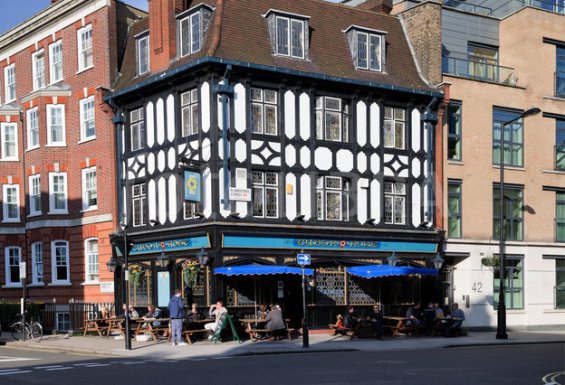
An emblematic loss which my time in Marylebone bore witness to was the demise of the Tudor Rose. It combined the worst pub menu outside Scholar’s Pub in Rome with the kind of clientele who even Jeffrey Bernard might have turned his nose up at, including a landlord whose own alcohol consumption may have been the only thing keeping the place in business (not much of a business plan, it turned out, especially if you are also fond of the old gee-gees). It’s been replaced by the kind of place which is probably lovely if you can afford it. Although my colleagues insisted that Marylebone counts as central London, it always felt to me more like the west, peopled mostly by sloanes who rarely went east of Tottenham Court Road. The closure of a place like the Tudor Rose definitely moved it a few more inches in the direction of the setting sun.

There was a sense of an uneasy coalition between old and new money. This LRB article details how the values of Theresa May are not the same as those of the neoliberal ‘globalists’. What the impact of Brexit will be on London no one can say. Britain will be more ‘open for business’ than ever before, which is another way of saying that everything of value will be for sale to all comers. As it happens, most of the time I spent working there I was living in Haringey, whose council is currently doing all it can to get rid of its human population and replace it with notional numbers on distant computer screens, or at least happy smiling computer-generated white people on vandal-proof billboards. Cycling back and forth between Haringey and Marylebone probably balanced out my life expectancy: in 2011-2013 there was a two-year difference between the two. Although that may have been levelled off by the fact that as I hit Euston Road, I passed through the area with the highest level of air pollution in the country. At least, thanks to Brexit, London’s contravention of EU clean air regulations won’t be a problem for very much longer. Anyone who thinks that bodes well for the local quality of life may well find that they’re whistling, or rather coughing, in the wind.

Zac Goldsmith: “I honestly don’t see what’s offensive about the word”


Numerous Conservative MPs have rallied round their colleague, Anne Marie Morris, who is reported to have uttered the highly offensive phrase ‘n***** in the woodpile’ in a speech at a public event about Brexit.

The first to rush to her defence was recently reelected Richmond MP Zac Goldsmith, who commented: “It’s quite simply a word I use all the time. We have an open fire in the main living room, and round the back of my mansion there’s a pile of firewood. When it’s cold, I have some of the servants fetch some wood and build a fire. It’s not an offensive term”.

When pressed as to whether he thought it was appropriate for politicians to use the other word in the phrase, commonly referred to as the N-word to avoid offence, Mr Goldsmith was nonplussed.

“I don’t even see why it’s called the N-word”, he responded. “It begins with ‘i’, for a start. It’s merely a prepo…”

At this point our reporter was obliged to clarify. When the nature of the word was explained to Mr Goldsmith, he was silent for almost two minutes. Eventually an aide (subsequently identified as his brother Ben) intervened and whispered something in his ear. Mr Goldsmith looked perplexed. A hushed conversation then took place, during which the MP seemed to grow agitated. He appeared to be seeking some sort of clarification from the aide, but further explanations only seemed to puzzle him even more. Upon moving closer to the conversation, our reporter was able to distinguish words such as ‘darkies’ and ‘coloureds’. After several minutes one of Mr Goldsmith’s butlers politely asked us to depart the premises. He explained that Mr Goldsmith was suddenly indisposed as he had been “working like a n*****” all week” and had to urgently prepare a speech for a Bring Back Slavery event at the Commonwealth Club the following Thursday.

In a subsequent email the MP for Richmond apologised for having cut short his interview. In relation to the question of his colleague’s remarks, he stressed that he saw “nothing racialist about the word ‘the'”, and said he hoped the whole issue would soon disappear, “like a n….. in a blackout”.

When asked for a response to Goldsmith’s own potentially inflammatory use of language, Prime Minister Theresa May said it would not derail her plans to appoint him Secretary of State for Race Relations in The Colonies in the upcoming reshuffle. As for Mrs Morris, she said, the prime minister herself would, in her capacity as leader of the Conservative, Unionist and Obviously Racist Party, soon be making a formal apology on the MP’s behalf to any woodpiles who “may have taken offence” at the use of the term.

Anti-semitism and the ‘Left’

Who is responsible for all the world’s spiralling problems? A video posted on the ‘AnoNews’ Facebook page claims that two powerful individuals are to blame: Jacob Rothschild and George Soros. Those two leading, er, financers conspire together wih others of their ilk to cause wars, famines, false flag attacks and (I haven’t watched the video in question, so I’m surmising) the mass eating of Christian babies.

The video is going down a sturm online. It was posted in a group I follow called Jeremy Corbyn – True Socialism and is still there right now, despite repeated requests to the moderators to remove it*. But why on earth would you want to do so, say some unaccountably naive individuals? Aren’t we allowed to talk about the control that all-powerful je…sorry, I meant to say ‘zionists’**, exert over our lives?

The Rational Wiki website, a reliable source for information about climate and holocaust deniers and those who carpool with them, points out that invocations of theories involving the Rothschilds “is a good sign you’re in the more conspiratorial and anti-Semitic neighborhood of the Internet”. As for Soros, it points to a couple of instructive examples of sites which reveal the ‘truth’ about his ‘agenda’. They are, as you may have already gathered, explicitly anti-semitic ones, and inevitably they also make a big thing of his, erm, connection to ‘the Rothschilds’.

Does this mean I automatically defend what politically significant billionaires get up to, or that I’m a supporter of the Israeli State’s quasi-genocidal treatment of the Palestinians? Of course not. But it should be absolutely clear to anyone who regards themselves as progressive that when online memes target those particular individuals and not the Koch Brothers and Rupert Murdoch (etc), they are deliberately evoking anti-semitism. The sharing and liking of the Anonymous video confirms that while the campaign to smear Corbyn himself as anti-semitic was utterly dishonest and quite disgraceful***, among his supporters there are people who are not in the least bit inoculated against insidious anti-Jewish sentiment.

Certain kinds of populist political discourse serve the interests of the far-right, and such language and the ways of thinking that it encodes are prevalent on the Left nowadays. The University of Sheffield politics blog (written by department academics rather than lizards) recently argued that one of the main weaknesses of the pro-Corbyn movement is a tendency to think in terms of conspiracies rather than capitalism, to talk about secretive and malevolent elites rather than the workings of an impersonal and chaotic system which produces inequality, exploitation and injustice. This bad habit – based partly on a desire for a comforting narrative that pretends that someone, somewhere is in control – leaves the Left wide open to far-right manipulation. There is a fetid, bubbling swamp which now covers a great deal of territory thought of as ‘radical’ (including Infowars, various sites claiming to be ‘Anonymous’ and (increasingly) Wikileaks), and the gases it belches out stink of antisemitism and other far-right tropes. The Left has to learn to steer as far away from it as possible if it is not to be tainted by the same toxic associations, or, even worse, sucked in altogether.

*Whenever I’ve seen similar material in other such groups it has been removed with alacrity.

**Various people tried to defend the video in these terms. In fact, the only people who describe Soros as a zionist are anti-semites. Don’t believe me? Google the words Soros zionist. Fanatical defenders of Israel hate him, partly because he (laudably) funds Palestinian and Israeli human rights organisations. Here’s an article from the Jerusalem Post on the matter, and here’s one from a pro-Israel US Jewish newspaper. As for the living members of the Rothschild family, if you care to do a quick internet search you’ll see that their relationship with Israel is by no means straightforward. Ergo, when anyone uses the term zionist to describe either man, they mean jew. Btw, if you still have doubts about the whole premise of this piece, viz you think the video may be harmless, simply google Soros Rothschild and have a look at what sorts of site appear. If you’re still not sure which side you should line up to bat for (cricket metaphor!), here’s a quick quiz.

***Anyone tempted to picture me as a lizard would do well to reread that sentence.

P.s. The argument that any amount of anti-semitism is acceptable because: Israel is unerringly close to that made by the far-right a couple of weeks ago in relation to the attack in Finsbury Park. The victims do and did not bring it on themselves.

P.p.s.: The original title of this piece  (‘There *is* anti-semitism on the far-left’) was chosen in a bad mood and didn’t reflect the content. The new title is an adaptation of a famous phrase from the German politician August Bebel.

P.p.p.s. As a means of apologising for all the footnotes and p.s.s, here is a cartoon:

‘Lexit’ supporters welcome new round of austerity

Supporters of the ‘Lexit’ faction in last June’s EU referendum have proclaimed themselves “satisfied” with Chancellor Philip Hammond’s explanation that Brexit will necessitate a new round of austerity for the public sector.

Jane Blobb, from Sheffield, said she was “not in the least bit surprised” that Britain’s leaving the EU will now serve as a pretext for even more cuts to services essential to the running of society. “It’s just what I expected”, she said. “I mean, Remain voters did warn me that this is exactly what would happen, that they would use it as an excuse, another ‘shock doctrine’ if you will, but I’m not in the least bit bothered that they are indeed doing so, because…er…the EU is a…capitalist club. For…neoliberals”.

Fellow Lexit enthusiast, SWP member John “Johnny” Johnson of Hemel Hempstead, agreed. “It’s a price worth paying”, he said. “We’ll almost certainly see the end of the NHS now, and I helped make that happen. As a lifelong socialist, I’m proud of the decision I made. The EU is a bosses’ club. A neoliberal one.”

Hammond also warned that their calls for wage hikes for teachers, nurses and others may have to mean tax rises for millions and further ‘savage’ cuts to social welfare benefits.

“Well that’s fine,” said Billy Bonehead as he folded and unfolded a three-day-old edition of the Morning Star while waiting for the off-license to open. “I haven’t worked since 2013, and I’ve been sanctioned six times for the pettiest reasons you can imagine. I’ve been staying on a friend’s sofa for the last three months and it’s getting to be a real strain. But if Mr Hammond says that we need to tighten our belts even further, I can respect that. People like him have got a difficult job on their hands managing public finances, and at least it’s not the EU calling the shots this time. They’re neoliberals, you know.”

Hammond, one of the ministers battling for a “soft” UK exit from the EU, defended the 1% pay cap for public sector workers, declaring the Government “must hold our nerve”. He also said that any attempts to address the climate crisis would now have to “take a back seat” to efforts to promote economic growth at any cost, and that any responsibility the UK has to help tackle the global refugee crisis were “not now a priority”. He added that the Government is looking seriously at abolishing corporation tax, bringing in a ‘fasttrack’ fracking compulsory purchase order system, erasing all health and safety legislation from the statute books, tripling VAT and replacing the progressive tax regime with a flat tax, in addition to reintroducing conscription, setting up a network of Victorian-style workhouses, decriminalising child labour and introducing on-the-spot execution of dissidents. This was all necessary because of Brexit, or “whatever you choose to call it”, he added.

“Fair enough,” said another Lexit supporter, Sadiq Eejit of Birmingham. “That’s more or less what I voted for. As long as it doesn’t affect my political principles, I’ll put up with it. God knows what sort of world my kids will live in. It defies thinking about. But as long as we do whatever Mr Hammond and Mrs May think is necessary, we’ll get through this. We’re all British, after all. I’m sure after a few more decades or possibly centuries of entirely necessary austerity and corporate looting, we’ll be back on our feet again, and then there’ll probably be a revolution, or something. Did you know that the EU is run by neoliberals? It said so on The Canary.”

Additional reporting courtesy of The Huffington Post.

Tory MPs call for pretend rethink in response to Corbyn threat

Theresa May is facing a chorus of Tory demands for the appearance of a radical overhaul of state funding for public services as cabinet ministers and senior Conservative MPs back the simulation of a commitment to higher pay for millions of NHS workers, more purported cash for schools and the feigning of a “national debate” on student debt.

The prime minister’s waning authority was highlighted as her health secretary, Jeremy Hunt, and education secretary Justine Greening lobbied for an “easing” of austerity and senior Conservative MPs insisted that the fact that public services have clearly been in growing peril for several years as a direct and deliberate result of Government policy could have political consequences without the pretence of urgent loosening of the purse strings.

Separately, Damian Green, the de facto deputy prime minister and a May loyalist, hinted at a PR initiative aimed at giving the impression of a wider rethink when he said there might need to be talk of a national debate about the level of student fees, in order to appeal to younger voters. He stressed that the outcome of such a debate would be a “foregone conclusion, naturally”, given that all current Conservative MPs, and particularly those in the Cabinet, continue to believe that poor people should “pay through the teeth” to obtain even secondary education.

The level of internal pressure for a series of gestures indicating a purely notional abandonment of austerity puts chancellor Philip Hammond under huge pressure to consider seeming to raise taxes to fund any extra public spending. It comes as the official body that regulates nurses and midwives – the Nursing and Midwifery Council – prepares to reveal new evidence on Monday of a growing crisis in the recruitment of nurses, something about which top Conservatives are said to be “entirely sanguine”, given that they believe such a state of affairs to be politically desirable.

Government sources made it clear that Hunt was prepared to publicly “take on” Hammond and call for the lifting of the maximum 1% pay cap for nurses and other NHS workers, citing as evidence a hard-hitting report by the government’s own NHS pay review body published in March this year which reveals no new information whatsoever, “it’s just that in the General Election Labour did much better than expected, so we have to say we’re going to change things, even though we’re not”. The sources stressed that Hunt’s “change of heart” would not go beyond a series of concocted headlines in sympathetic newspapers and said that “articles like the one you’re writing will hopefully help give people the right, that is to say the wrong, impression”.

In the NHS pay report, the government’s advisers warned that the cap “will not be electorally sustainable for much longer” and said the cost (in parliamentary seats) of plugging gaps caused by staff shortages could soon be greater than the “savings”. It also highlighted the effects of Brexit, saying “changes in the UK’s relationship with the EU may reduce the ability to fill shortfalls in staff numbers from overseas”, and that this is important “only because it could lead to the replacement of a Conservative Government by a Labour one, which we’re all desperate to avoid. I mean, Brexit is going to be an absolute farce, but at least it’ll be a profitable one for those in the know”. The report concludes that if the Government “plays its cards right” the chaos resulting from EU withdrawal will allow it to impose “the ultimate shock doctrine”, with “not a brick” of the post-war Welfare State” left standing, but stresses that for such a goal to be reached the Conservatives will have to “cling to power as if to the edge of a cliff”.

Meanwhile, there are growing worries about the possible loss of political power occasioned by the otherwise unproblematic lack of nurses and other NHS staff in areas of the country where the cost of living is highest, notably London.

The Tory MP Dr Sarah Wollaston, a former GP who is seeking to extend her term as chair of the Commons health select committee and who profits directly from NHS privatisation at the expense of both her constituents and her erstwhile patients, said: “We have got to address this and work out at the same time how to seem to pay for a better settlement for public sector workers. Is that the sort of thing they want? Can I go? I’ve got a meeting with a private healthcare company that pays me £70,000 a year for five hours’ work and a couple of judiciously-placed parliamentary questions.” Another Tory MP, Dr Dan Poulter, who works without any apparent moral qualms as an NHS psychiatrist with patients whose mental health has been exponentially worsened by Government policies specifically designed to do as much damage to the public health system as quickly as possible, said that while difficult choices had been made to improve public finances, “the time has come to lift the pay cap and reward nurses, midwives, doctors and other health care professionals. Will that do? It makes me physically sick to say such things even though I know it doesn’t really mean anything in policy terms. I’m sure if we just throw the plebs the odd crumb of hope we’ll be through this by Christmas”.

A poll for the Observer by Opinium shows the extraordinary extent to which May has lost the trust of voters since the height of her popularity in April, and equally strikingly, since the June general election.

Over the same period, Labour leader Jeremy Corbyn, who has called for an end to austerity and the public sector pay cap, has soared in public esteem. On 19 April, May’s net approval was +21% (when the number who disapprove is subtracted from those who approve) while Corbyn’s was -35%. Now May is on -20% and Corbyn on +4%. Since the general election 61% of voters say their opinion of May has become more negative. Labour (45%) is now six points ahead of the Tories, who are on 39%, enough to give Labour a clear win if another election is called.

Last week Tory MPs were ordered to vote down a Labour amendment to the Queen’s speech calling for an end to the public sector pay cap. Hunt accused Labour of using the NHS as a “political football” in the vote and said that the selling off of the health service should be a “non-partisan” issue, even a source of national pride. Aspiring Tory leader Andrea Leadsom accused the Labour leader of a “blatant lack of patriotism” for suggesting that Britain’s “lazy, overpaid, good-for-nothing” emergency services personnel should receive a pay rise for the “frankly quite pointless” work they do.

But while the Conservatives do not want to be seen to be responding to Labour pressure, behind the scenes there is a growing view that May and Hammond will have to give a clear signal that the government will change direction before parliament breaks for the summer on 20 July. There is a widespread belief in the party that the public will have “forgotten” such a pledge by the time the autumn session opens, by which point influential pro-Conservative media figures such as Rupert Murdoch, Paul Dacre and George Osborne will have successfully identified a plausible new scapegoat to distract “rabid” voters.  Many Tories say the £1bn deal to secure the support of the DUP has made the case for the public sector pay cap impossible to defend, so feigning a change in policy “will have to do” until new targets for public opprobrium are successfully established.

Zac Goldsmith, the racist Tory MP for Richmond Park and racist former London mayoral candidate, said much progress had been made in privatising education. “But the financial pressures are mounting fast and the government cannot avoid providing a better funding deal,” he said. “I can’t believe I actually got reelected”, he added, and said it was now his political priority to draw the Goveenment’s attention to a series of “surprisingly sophisticated” policy proposals outlined in a selection of BNP leaflets from the early 1990s. Asked about whether he would also pressure the Government to take action on Climate Change, he laughed heartily and slapped our reporter on the back, repeating the phrase “top hole”.

Green, the first secretary of state and an outspoken critic of people “sitting at home living on benefits” while he works hard representing the interests of private water companies in parliament, said yesterday that the level of tuition fees may need to appear to be reconsidered in order to reach out to younger metropolitan voters. He said he was confident that the “kinds of hopelessly naive, dope-addled scum” who voted Labour in such droves “could easily be bought off by a couple of vague gestures from Number 10”. While £9,000-a-year fees allowed high quality courses and teaching, student debt had become a “huge issue”, but said it would “of course, in reality” remain Conservative policy to privatise all aspects of higher education “thoroughly, entirely, absolutely”.

Answering questions after a speech at the Bright Blue think tank before he left to attend “another of these educational finance knees-ups”, Green said the only way to cut fees and retain standards would be to put up taxes. “Governments would have to take money from everyone at work and companies that provide jobs to provide those essential services. And while we have no intention whatsoever of doing that, it may well be that this is a national debate that we need to appear to have in order to stay in power.”

Additional reporting courtesy of The Guardian.