Donald Trump is going to snap very soon, and here is how I know

curbtbewiaaaj0h

I believe that rather than smashing our own glass houses to pieces in the act of destroying Donald Trump’s Presidency, we need to be aware of our own inner Trump, to reflect on our own tendencies to think and behave in catastrophically immature, venal and insecure ways. I therefore offer up this short account of my own personal emotional development, and then explain why I think it helps explain why Trump is heading for a breakdown very, very soon.

I used to suffer from a quite disabling insecurity, particularly when it came to things like being creative and forming relationships with other people. I got better, partly by virtue of living in and studying Portugal, learning about its people’s tendency to swing between moments of self-aggrandisement and self-abnegation, from ‘we are great’ to ‘we are nothing’. I also learnt about my own habit of projecting my own feelings onto others, both people and countries. The work of the Portuguese poet Fernando Pessoa showed me that we’re all characters on a stage acting out different roles, and that that is okay. I identified strongly with the philosopher Eduardo Lourenço’s diagnosis that Portuguese people tend to suffer from taking on too many identities, and I took enormous inspiration, consolation and guidance from his insights that Portugal is ‘marvelously imperfect’, ‘no worse and no better than anyone else’, and that progress comes from accepting one’s limitations.

Living in China taught me to accept the existence of other perceptions of my own identity, even if I feel embarrassed about it, particularly in terms of my national identity. Everyone has one and I can’t let the fact of my British or Englishness inhibit me unduly. Writing about my misunderstandings of Chinese society and about my role there helped me accept that I, like everyone else, have an ego, and also that I can use writing as a vehicle for making connections between things and to help find people who’ve noticed the same things, who share my perspective. Spending time with a Lacanian psychoanalyst in London helped me develop confidence in my own voice while also teaching me about the foibles of my tendency to overthink. I got better (although not necessarily good) at identifying and cultivating friendships with other people. I met the woman who later became my wife, who loves me for who I am rather than who I pretend to be. Through my job I became better at listening to people and more accepting of others and myself. I learnt that honest self-reflection is a more effective medium for personal development than alcohol is. Through acquiring other languages I discovered that learning is one of the things I most enjoy and value about being alive.

I still screw up, as we all do, but I accept that doing so is part of life, and when I do or get something wrong I try to apologise without fear or recrimination. I know that I’m not mad in any meaningful sense. I accept that I have some ability to write entertainingly and insightfully, and I have less fear than I did before of saying what I want to say. I have a wonderful editor in my wife and I accept that I sometimes miss things and perhaps expose some parts of myself to criticism and ridicule. I know that what I write doesn’t and doesn’t have to please everyone. I accept that everyone is fallible, and that it takes hard work to produce writing of quality. Sometimes I don’t put in enough hard work, and that’s my fault. I try hard not to depend emotionally on the responses or lack of responses to what I write. In a nutshell, I’ve matured, to the point where I can now face the prospect of becoming a father, something which, say, 15 years ago was (so to speak) inconceivable.

All this means that I understand something of the fragility of Donald Trump’s ego. Having struggled to maintain friendships in the past, I can see how Trump can get to a point where he has, according to a piece in Newsweek based on several months spent around him, no close friends. As I’ve acknowledged before, it’s essential for us to have the humility to recognise that we don’t have the ability to diagnose Trump at a distance. But that there’s something of the manchild about him is inescapable.

These first two days of his ‘Presidency’ saw paranoid and recriminatory tweets, a speech to the CIA in which he ranted bitterly about media reports of his coronation, and his press spokesperson being sent out to deliver another paranoid self-pitying rant. People are mercilessly taking the piss out of the piss-poor attendance at his pitiable inauguration, and Trump appears to be following every single one of them on Twitter. It’s clear to me that whatever means he’s used to survive up until this point aren’t going to work in his new role. There’s simply too much scrutiny and ridicule, and it’s going too deep. He’s too much of a shallow narcissist to ignore it. Trump is going to learn the wisdom of Jacques Lacan: “the madman is not only a beggar who thinks he is a king, but also a king who thinks he is a king”. Whatever monster he has buried in his mind is going to rise up to bite off huge chunks of him from within.

Trump is famously hostile to the notion of learning: no-one has anything to teach him. He was born rich, and that means he’s a genius and that everyone must respect him. He appears to have no ability for self-reflection. The mirrors he has in his mansion may be framed in gold, but he’s never been able to bring himself to look into them for more than a few seconds. Instead he’s surrounded himself with people who tell him what he wants to hear, who repeat back to him his inner mantra: you’re the richest, the best, the greatest writer, builder, statesman, etc etc etc. But it’s his inner voices that are the problem, the ones that tell him that he’s nothing, a failure, that everyone sees him as a joke. The ones that (presumably) sound a lot like his father.

His tweets in particular reveal that at some level he knows that his self-aggrandising self-image is hollow and brittle. So he lashes out, including physically. And it’s getting worse. People are laughing louder. He’s now put himself in a position where the entire world knows that he is venal, insecure, stupid and deluded.

He’s become in two days the paranoid and deluded ruler of so many novels by Latin American and African writers. Usually this point is reached after several decades of rule and the imposition of terror and a cult of personality. He’s the kind of leader that the U.S. has imposed on so many other countries; there is an element of chickens coming home to roost. He obviously took enormous consolation from his media image, the idea that he was ‘America’s CEO’. He believed this and seems to have internalised it, but is also taunted by a nagging awareness that it was little more than a joke, a stupid slogan to sell a TV show. His supporters may not know that, but some will learn. He’s already starting to turn some of them against him. As he attacks their standard of living and doesn’t have the political skills necessary to calm their anger, they will see through him to the delusion, insecurity and vanity within. He’ll have no more dgefences and will be unable to hide from the stark fact that his flatterers don’t respect him. Putin in particular is evil but not stupid. He knows that Trump is an absolute moron. And he can’t control that smirk of his.

Lacan said that what matters in psychoanalysis is not so much what the client says, but what falls out of his pockets while speaking. Trump appears to have absolutely no idea what he has in his pockets, and now everyone on the planet is picking up things, inspecting them and telling him what they are. They are teaching him things about himself that he cannot bear to learn. He also knows that he is President in name only, and that’s not enough to sustain his ego.

He will snap very, very soon.

Our job is to increase the tension.

New post: ‘Trump is going to snap -a rejoinder’.

TWO YEARS ON: I guess (and there’s a great deal of guesswork in this piece) that I underestimated how tenacious Trump would prove to be in his pretence of being President. More importantly, I failed to predict how slavishly and irresponsibly the mainstream media would collude in that pretence.

This is a Climate Denial coup and we’re all part of it

640x-1

By the time Trump had finished burbling his way through the oaf of office, all references to Climate Change had been erased from the White House website.

As I have been saying all along to anyone who would listen, this is what Trumpism is ultimately all about.

It is a coup by the corporate climate denial movement.

I predicted that this would happen:

It now looks highly probable that within our own lifetimes the problem of ‘climate change’ or ‘global warming’ will, in one limited sense, disappear. It seems likely to me that the Trump administration will follow the lead of Florida Governor Rick Scott, who forbade government agencies from mentioning it, and former UK Environment Minister Owen Paterson, who refused to read any document containing either phrase.

If they hadn’t gained power this way, they would have done it by means of violence.

Trump’s supporters among ordinary working and not-working people know the facts at some level – only a true psychotic could sincerely ignore the spate of floods, droughts, hurricanes, etc — but they are prevented from articulating their fears by the cover-up campaign and by the social taboo it has generated. Their repressed fears express themselves as furious denial and hatred against any easily identifiable target they are presented with.

And then there’s the rest of us. You, for example. When was the last time you had a serious conversation about the changing climate?

If we continue to avoid discussing the causes and the consequences of the changing climate with our friends, families and colleagues, we are part of the “Trump Revolution”.

In the meantime, I want to say once again to anyone who is listening: Climate Denial and Holocaust Denial are, on a moral plane, identical. Dedicated climate liars should be treated with absolute contempt. Climate denial involves dismissing – indeed facilitating – the suffering unto death of billions of human beings, principally those who are considered to be far away and different. Those who perpetuate it, whether out of personal interest or misanthropy, are involved in the planning and execution of the corporate genocide of the entire human species. And what is taking place inside the White House is the “alt-right” equivalent of the Wannsea Conference. This is the Endlösung for the climate.

It is no accident, therefore, that very many of the same individuals who insist on disrupting all and any discussion of global warming also deny the massacre of millions of people by Hitler. The 2016 film about the Nazi activist David Irving, ‘Denial’, was also, implicitly, a film about climate denial.

Hence there is no need to check on what the stances of Marine Le Pen or Frauke Petry are on environmental questions. We know. They are serving the interests of the most evil forces to have ever held sway over the future of our species.

The most painful aspect is that we are all to some extent climate deniers. We have to be, or life would be impossible.

To explain this I want to post something I wrote on the subject in August 2010. I should have found some way to shout it louder at the time, or worked harder on working harder with people who felt the same way:

Why are so many otherwise entirely rational and intelligent people so prepared to give credence to the denialists? Of course it is partly to do with the media hegemony of corporate power, but not entirely. Personally I comfort myself in the secure knowledge that I myself am prepared to ‘believe’ in the reality of what is happening and what we face, that I ‘know’ that it is happening and will continue to happen; but I’ve come to think that I may be mistaken about my own belief.

There are after all very many things we think we believe, but actually we don’t, and to ‘know’ something is not the same as, in the words of Sven Lvindquist, to understand what we know and to draw conclusions. Despite my firmly held and rationally based opinions, my own actions suggest that I am not a strong believer in the reality of climate change. I do not place much importance in recycling, for example, choosing to regard it as something of a superstitious action akin to shouting at the TV to influence the result of a football match (nobody of course would ‘believe’ for a second that doing so would have any impact, but their ‘irrational’ behaviour might make one think otherwise). My position on recycling could probably be characterised as something of a ‘beautiful soul‘ one: given that other people refuse to change, and given the immense complexities involved, I refuse to act, regarding it (entirely logically, if not rationally) as both utterly ineffective and beneath me. Nevertheless it’s one that I have until now felt entirely comfortable with.

It’s very difficult, impossible perhaps, to take a realistic and rational view of climate change. There is no level of fear or anger that is proportionate, and none of our individual actions are remotely sufficient. I have come to realise, however, that gestures are important, contrary to what I’ve always thought and contrary to what Slavoj Zizek so entertainingly argues. My actions suggest that subconsciously, like anyone else, I refuse to accept the reality of climate change. The trauma is too great to integrate into my notion of the world, the future of the world and my place in it, and so I act as if I will never be affected. But changing my habits can force me into believing at a deeper level. In Alcoholic’s Anonymous they apparently call this ‘acting as if’: first you change your behaviour, and then hopefully, gradually, your beliefs, both conscious and unconscious, about your ability to manage your life without a drink in your hand begin to change.

To slip briefly into amateur Lacanese: because the Real of climate change is impossible to apprehend, we have to act within the realm of the symbolic. Symbolic tokens in the form of gestures do have a value; they can be exchanged for genuine belief. Not just recycling but skills shares and community gardens are important, as are all other forms of exchange not based purely on exploitation. Staying out of supermarkets is a good move for all sorts of reasons.

Nowadays, again like anyone else, we consume constantly, indiscriminately, or ironically, consuming our own gestures of consumption. This is the age of McDonalds happy meals consumed in a constant low-level muzak hum of cynicism, apathy and despair, flat screen Tvs gorged down in the midst of a recession. We consume because we are: what else are we, what else are we to do?

There is of course no substitute for collective political action, for maximum anger gathered and launched at those in power who notice our failure to genuinely believe and so pretend to act, understanding that for us, for now, pretending to act is enough. But it can serve to help us accept the anger and fear that climate change generates, to live with it and try to live differently.

I think I believe in the reality of climate change. But the fact that I fail for the moment to begin to live differently shows that I do not, yet. I first have to change the way I live my life.

Welcome back to 2016. We are now governed by a regime of climate trolls. Such creatures are, whether they like it or no, mouthpieces for the fossil fuel industry. In ‘Gravity’s Rainbow’ Pynchon writes:

Death converted into more death. Perfecting its reign, just as the buried coal grows denser, and overlaid with more strata – epoch on top of epoch, city on top of ruined city.

I don’t know what will now happen to the squads of trolls that have been mobilised. They can no longer pretend to themselves that there’s anything other than doglike obedience to corporate power motivating their actions. Some will continue to fight online battles, too stupid and/or rabid to realise that they’ve won. Their owners will probably give them another scented rag to chase down. Vigilante gangs may be formed offline in addition to online in order to help police dissent. In the meantime this blog will soon go much quieter, as I will have a bigger priority: our first child (thankfully a daughter). We have to protect and sustain life in the face of forces which represent nothing but death.

Tale of Two Donalds: Winnicott on the infant Trump

The renowned pediatrician and psychoanalyst Donald Winnicott died in 1971, when Donald Trump was 24 years old. This article is an excellent short assessment of his life and achievements. A central element of his thinking is that the analyst should take on the role of the mother and repair parts of the psyche that were damaged in early childhood. He wrote of his own work:

I find it useful to divide the world of people into two classes. There are those who were never ‘let down’ as babies and who are to that extent candidates for the enjoyment of life and of living. There are also those who did suffer traumatic experiences of the kind that result from environmental letdown, and who must carry with them all their lives the memories of the state they were in at moments of disaster. These are candidates for lives of storm and stress and perhaps illness.

In preparation for the birth of our first child I’m currently reading Adam Phillips’ biography of Winnicott. On doing so, several passages struck me as relevant to understanding the other Donald, the one who is now (nominally at last) one of the most powerful people in the world.

While Winnicott is admired for his gentleness and intelligence, Donald Trump is not. It is certain that the latter has never heard of the former, as he doesn’t read books. It’s possible that he has never read a single one. Neither has he read the Constitution of the country he now (on paper) governs. He doesn’t have the time. He may have never even sat through an entire film: in Mark Singer’s then-funny now-not 1997 New Yorker profile of Trump he writes:

We hadn’t been airborne long when Trump decided to watch a movie. He’d brought along “Michael”, a recent release, but twenty minutes after popping it into the VCR he got bored and switched to an old favorite, a Jean Claude Van Damme slugfest called “Bloodsport,” which he pronounced “an incredible, fantastic movie.” By assigning to his son the task of fast-forwarding through all the plot exposition—Drumpf’s goal being “to get this two-hour movie down to forty-five minutes”—he eliminated any lulls between the nose hammering, kidney tenderizing, and shin whacking.

According to Russell Brand (who has met Trump), the new “President” is “a wanton baby”. Reading about Winnicott makes me think we should take this seemingly glib assessment seriously. There’s been a lot of speculation as to his precise mental condition. His cognitive faculties and emotional temperament appear to be only slightly more sophisticated than those of an adult pig, although there is evidence that pigs do experience some measure of empathy for the suffering of others of their species. I know that when Jon Ronson wrote The Psychopath Test his express intention was to ensure that people should not go throwing the term around with wild abandon, but his book is a very useful primer on the subject, and although some have claimed that Drumpf is nothing more than an absolutely appalling human being, the fact that he was the hero of Patrick Bateman in ‘American Psycho’ tells us a great deal*.

I’m not a psychologist, and obviously have never spent time with Trump. I hope I never will, and I pray that my daughter will never meet him or anyone remotely like him. It’s possible that he should be in a controlled environment where his access to other people is strictly limited. Instead, thanks to the bitterness and puerility of those who voted for him and the cynicism and apathy of those who refused to oppose him**, he will be dealing directly with people who have the authority and means to destroy humanity. His delusions will not be contained but given full expression: after all, as Jacques Lacan said, the madman is not only the beggar who thinks he is King, but also the King who thinks he is King.

His supporters, if there are any that are capable and honest enough to read through an entire 1,000-word article, may feel that a man who punches his own sons in the face and openly talks about being sexually attracted to his own daughter is not a priority for clinical attention. Anyone who has such an attitude clearly has their own issues they need to address. For those who are not yet so immersed in the Trump cult mentality, the following quotes from and about the work of Winnicott with regard to early infant development may give such people a further opportunity for reflection on just what kind of fucked-up creature is now in charge of the most powerful nation on earth.

Trump’s tweets: In a baby’s life there are long periods when he is just a bundle of disparate feelings and impressions and he doesn’t, as an adult would say, mind that this is the case as long as from time to time he comes together and feels something.

Trump the climate denier:

Real development can only come out of, and is the process of finding, belief in the environment.

Psychotic patients are notoriously and maddeningly oblivious of bombs, earthquakes and floods.

Trump the sociopath: He wants to know how much damage he can do, and how much he can do with impunity. Then if he finds that he can be physically managed, he starts to test by subtlety, putting one person against another, trying to make people give each other away, and doing all he can to get favoured himself.

Trump the sadistic baby turned authoritarian adult: Fascism is a permanent alternative to puberty.

And my personal favourite: Fascism, delinquency, rage, misogyny, alcoholism are only the symptoms of poor childhoods that the collective will have to pay for. The road to a better society begins in the nursery.

There you have it: Trump is stuck at some point in his infant development. He is by no means a mature adult, and he certainly should not be anywhere near political power. And if you’re still unconvinced by what I and Donald Winnicott have to say on the matter, don’t take our word for it: have a listen to Trevor Noah.

* – in the words of the New Yorker, Drumpf “exhibits levels of egotism rarely witnessed out of a clinical environment”; meanwhile the ghost-writer of one of “his” “books”(‘The Art of the Deal’) says openly that if he were to write it now he would simply call it ‘The Psychopath’.

** I really hope that the sorrow that such people feel today is commensurate with the extent of their betrayal.

UPDATE: It’s not only Trump that doesn’t know how to read, his supporters don’t either. I posted this article in a pro-Trump Facebook group and within ten minutes it looked like this:

trump

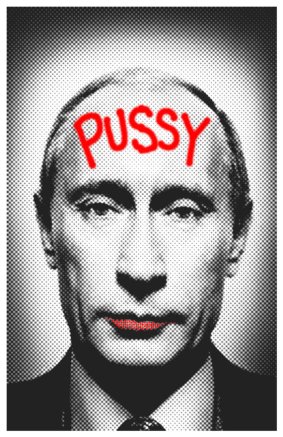
7 Amazing Facts about Vladimir Putin

il_570xn-688197171_7zpk

I suspect that some of the people rightly expressing outrage at last night’s horrible events in Berlin were far more sanguine about the even more horrifying events last week in Aleppo. I’m thinking in particular about the people I’ve met in person over the last few months who expressed the belief that Vladimir Putin is essentially a good leader who knows what he is doing: the English couple I got talking to over lunch last month who thought that aligning with Assad was the only possible option in terms of ensuring ‘global’ ‘security’; the Colombian IELTS candidate last weekend who felt he was cruelly unrepresented in the ‘Western media’; the Italian Quaker who believes that Putin’s sterling work in ‘growing’ the Russian economy was a good model to follow. For what it’s worth, I want to lay out some facts that challenge this point of view, one which I think is heavily conditioned by the deeply insidious pseudo-radical state propaganda outlet Russia Today and the useful fools such as Max Keiser, Julian Assange (clearly neither of them actual fools, but both of them possible tricksters), Ed Schultz and George Galloway who lend it their credibility (odd that we should still be talking about Galloway’s credibility in 2016, but still…). Other prominent pro-Putin advocates include that orange prick and other far-right demagogues like Le Pen, Farage, Salvini, etc, along with their fellow travellers such as Beppe Grillo (another possible trickster). This propaganda effort is all part of a much bigger initiative to restore Russia’s power and I doubt that my teeny little blog is going to make much of a dent in their tanks but what the hey.

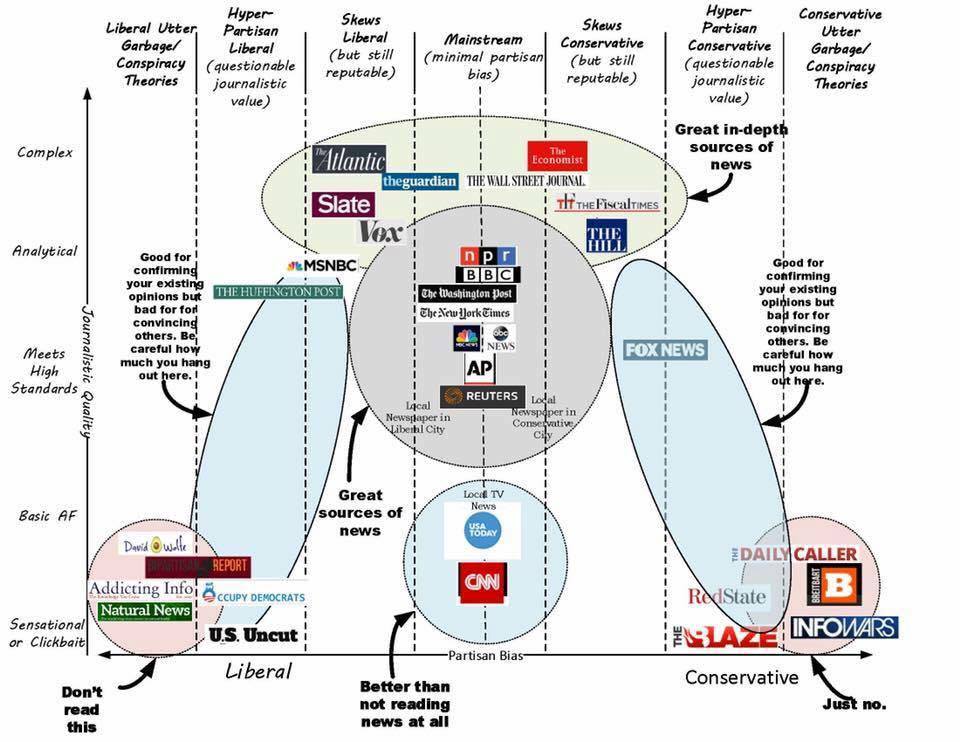
You will notice by the way that the sources for these facts are reputable news organisations. For a useful breakdown of which news sources are trustworthy and which are garbage this is a very useful graph.

  1. The immediate violent reaction to the full-scale destruction of Aleppo was absolutely predictable.
  2. There is very strong evidence that Putin was directly complicit in the murder of hundreds of his own citizens in 1999 in order to instill fear and panic in the population, justify a new war in Chechnya and delay the election so he could take power.
  3. Putin is enormously personally corrupt.
  4. On the singlemost important issue facing the world today Putin is profoundly stupid. He is on record as saying that “two or three degrees” of warming could be good for Russia because residents wouldn’t need to spend as much on fur coats. Actually with two to three degrees of warming Russia would be в жопе.
  5. The Russian economy is tanking, with millions having been plunged into poverty in the last two years. Any supposed growth under Putin has been wiped out.
  6. His supposed popularity with the Russian people is partly based on electoral fraud.
  7. Putin is weaker than his slavering supporters like to pretend.

As I say, you don’t have to take my word for any of these things; please click through to the links from newspapers of record and they will confirm in the form of carefully-researched detail what is stated above (the first one is self-evident). Alternatively, if you prefer to trust in internet ерунда, there are millions of sites just like this, all just about as credible as Russia Today. As for Trump, I hope that when he gets to meet his hero his backup staff have some sort of sexual sedatives on hand as I fear that otherwise Putin might have difficulty shaking the US President off his leg.

It’s Not Just Me, Then: Fiction, Music, Comedy and the Cl*mate

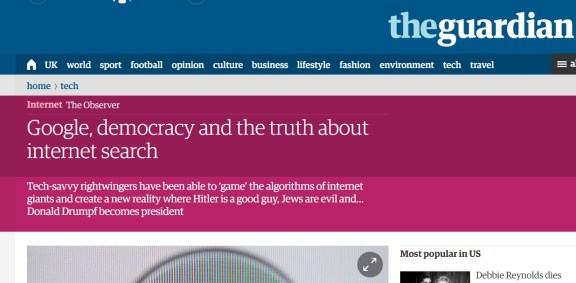
sin-tituloWhat I’m trying to do on this site is make links between things I haven’t seen connected together elsewhere*. Hence the links themselves are usually more important than what I have to say about them. In the last couple of days I have come across three things which I think vindicate (albeit, inevitably, in an infinitely more coherent and detailed fashion, one based on research and careful thought rather than guesswork and ‘affect’) the thoughts I’ve been trying to articulate over the past few weeks. First there is this article by Carole Cadwalldr which details the ways in which right-wing trolls have been able to infiltrate the algorithms of Google and Facebook in order to create their own reality, one which is increasingly conditioning ours:
The technology that was supposed to set us free may well have helped Trump to power, or covertly helped swing votes for Brexit. It has created a vast network of propaganda that has encroached like a cancer across the entire internet. This is a technology that has enabled the likes of Cambridge Analytica to create political messages uniquely tailored to you. They understand your emotional responses and how to trigger them. They know your likes, dislikes, where you live, what you eat, what makes you laugh, what makes you cry.

Continue reading “It’s Not Just Me, Then: Fiction, Music, Comedy and the Cl*mate”

The Age of Agnotology: The Importance of Reading Newspapers in an Era of Fake News

Of all the possible places to try to sell a dogmatically Leninist newspaper in 2016, the gates of a small, private, right-wing Catholic university is probably not the best location. Leaving work earlier this week I was surprised to encounter an actual 21st Century Bolshevik selling Lotta Comunista (Communist Struggle). Che testardo! The front page featured an actual hammer and sickle and an exhortation to the workers of the world to put down their bloody phones for a minute and UNITE!. Inside there was a closely-written article on US energy policy that featured nary a mention of the changing climate, while page 6 featured a total of 448 individual statistics relating to socio-economic class and voting habits in the USA. At least its position on Sunday’s absurd and suicidal referendum was more sensible than that of the rest of the ‘left’: they recommend that their readers stay at home memorising ‘What is to be done’ rather than bothering to vote. If you’re so inclined you can read your way through the rest of it here.

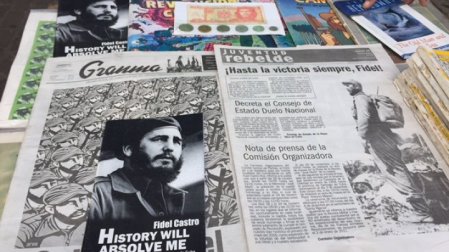
A thought experiment: imagine a country in which such a publication was the only newspaper. Actually come to think of it I don’t have to try that hard because I’ve been there quite recently – in May, in Cuba, where the only two daily newspapers are the black-and-white 12-page Government propaganda sheet Granma (named after the tiny vessel that brought Fidel (RIP) and friends back to Cuba in 1956), and an 8-page supplement for03-cuba-fidel-granma young people called Juventude Rebelde (Rebel Youth), which is similar in look, style and content to the kind of publications the Worker’s Revolutionary Party used to try (and fail) to hand out for free. Both newspapers are hard to track down and (after a couple of days of cheap laughs, and once you’ve set aside a few copies as very cheap presents) genuinely not worth the effort. When in the 1990s the US not-an-embassy put up LED screens to broadcast subversive information to the city it must have had quite an impact. In Mozambique – also nominally a Communist country – the national newspapers are remarkably similar in style and content to the cheaper Portuguese tabloids. I once read a very depressing article (it wasn’t supposed to be depressing) about how popular A Bola (The Ball) is in Angola. In some countries, the main journals of record are ones which just report the achievements of government (rather like a lot of local newspapers nowadays in the UK in relation to local councils). In others, the only opposition newspapers are those owned by politically ambitious oligarchs . There are other channels of communication but the absence of a free press makes a country much culturally and socially poorer and less free.

Continue reading “The Age of Agnotology: The Importance of Reading Newspapers in an Era of Fake News”

Chi è veramente di sinistra voterà sì

Nota bene: I now accept, having read and talked and listened a great deal more on this topic that I was very wrong on this point. People who voted no are generally very aware that they were not doing so at the behest of Salvini or Grillo. See, ad esempio, qui. Or qua.

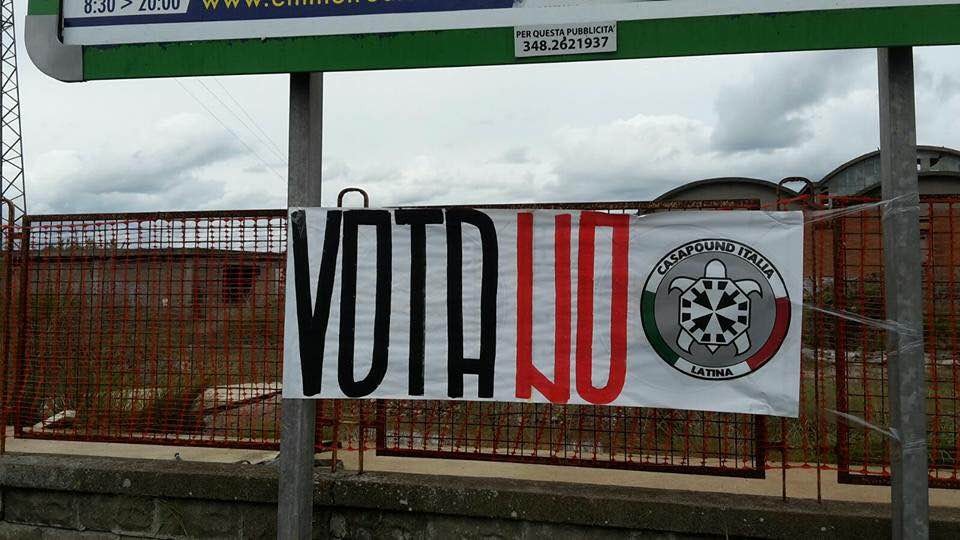
Everywhere you look in Roma right now you are confronted with the word NO, and it is notevole that it is often not possible to distinguere between the posters of the ‘left’ and what is known here eufemisticamente as the ‘centre right’ (i personaggi principalof the Italian ‘centro destra‘ make Steve Bannon look like a member of the Tea Party). Disgraziatamente, the tattered ruins of the Italian left seems to have learned assolutamente nulla from the Brexit and Trump débacles, and it is oltremodo tragico that so many who think of themselves as progressisti are succumbing to il canto delle sirene of the trickster Grillo, who in the words of the leftwing collective Wu Ming has “confined the potential energies of an uprising against austerity to a discursive cage which makes a parody of political conflict”. Of course the riforma constituzionale is not by any means ideale and the whole referendum was una idea del cavolo in the first place. In modo molto simile, the European Union has never been perfect and Hillary Clinton was chiaramente not the best candidate for the Casa Bianca. Però, the left’s campaigning for the no side – inspired, like the ‘Lexit’ and Jill Stein campaigns, by a mix of ingenuità, cinismo and misplaced opportunismo – will help ensure that next week we will see Salvini (an outright teppista fascista), Grillo (choice quote: “l’antifascismo is outside my purview”) and Berlusconi (any italiani wondering who this ‘Silvio Berlusconi’ character is may like to fare una visita to the internet website google.it) brindando alla vittoria and being congratulated by Le Pen, Putin, Trump, and mentre che ci siamo, probably Assad. Qualsiasi persona con coscienza e cervello voterà sì. Anything else is francamente just puerile.

https://www.theguardian.com/world/2016/nov/27/matteo-renzi-politics-italy-european-union-brexit-trump

Don’t Mention the Climate

15-115I wanted to write about the new US President’s decision to stop NASA conducting research on the earth’s climate, but word fail me, or maybe I them. Where to begin? It’s too depressing to even link to. It would require a command over language which I don’t possess. Maybe poets and other artists are better placed to develop the new forms of expression which will be able to address this new reality. Or perhaps I should get round to watching ‘Hypernormalisation’. Here are three writers who have tried to think through the topic (more or less) head-on.

Continue reading “Don’t Mention the Climate”

“All I know is what’s on the Internet”: All heil President Troll

161202Rall.jpgIn China eleven years ago I noticed something surprising about democracy and something disturbing about the world economy. They both involved discrediting and devaluing. In the case of the world economy, what I noticed in China indicated to me that the chief function of neoliberal globalisation was to reduce western wages and conditions to a Chinese level. I also noticed that the notion of democracy had lost a lot of its value, especially in comparison with the student uprising of fifteen years earlier. Since that time global events have, to paraphrase Thomas Pynchon, been proceeding in accordance with an ominous logic. Continue reading ““All I know is what’s on the Internet”: All heil President Troll”