 I was tickled to see that someone on Tripadvisor had described the restaurant immediately underneath our flat as being in an ‘absolutely insignificant quarter of the city’. The area may not have a name as such (we have to describe it using a series of awkward coordinates) or any singular identity but it is of significance to us for two reasons: one, there’s the fact that we live here, and two, that it embodies certain tendencies and pressures both global and local*.
Take, for instance, that restaurant. It’s become quite popular of late partly by virtue of its very good rating on Tripadvisor (and/or the other way round). It also attracts quite a few foreigners, a lot of whom may well be staying locally. There’s now something which calls itself a ‘guesthouse’ in our building, but no hotels nearby. I attribute the presence of those tourists to (and I presume the guesthouse is part of) Airbnb. Will Self once remarked that most inhabitants of London don’t actually live in London itself, but rather on the map of underground stations. In a similar way, nowadays most tourists visit a Google Maps version of a city: sleeping in Airbnb homestays, eating in Tripadvisor restaurants, getting driven round by Uber**. A recent report on the effects of Airbnb in Amsterdam mentioned established local businesses getting pushed out by new concerns catering to tourists such as bike rental shops, so it’s not by chance that one has just opened up right across the street from us. To be fair, those tourists do need some way of getting around, given that Uber barely exists in Italy and the public transport system appena funziona. Finding a normal taxi in Rome often feels like getting your hands on something to smoke in an unfamiliar city: you have to hang about in particular places and hope you get lucky, or try to get hold of the number of someone who might be able to supply you with one. At least our area is more or less within walking distance of Trastevere, a much more Woody Allen part of town altogether.
In terms of local changes, it’s noteworthy that the restaurant itself used to (until about two years ago) be a Jewish one. Although I don’t know its history, there’s certainly a community centred on our street, with two butchers and a bakery on the other side of the road. It reminds me of the few weeks in the summer that I spent staying near to the huge Orthodox Jewish colony of Stamford Hill. It struck me as curious that the Orthodox people and the other locals rarely acknowledged each other. Those few interactions I had – looking for directions, asking to get past people on the bus – felt kind of encouraging. Although rumours abound in London about what the Orthodox community gets up to behind closed doors, peaceful coexistence is based on letting other people get on with their lives rather than bashing down doors in case someone’s doing something you could enjoy getting annoyed about. Racism itself is becoming conditioned by the intrusive habits and prurient morés of online life. It seems so easy to resolve conflicts and differences on the internet: you just call people names and it instantly feels like the world’s a better place. In offline reality respectful distance is the basis of civilised accord.
It sometimes seems as if anti-semitism is bubbling away, just beneath the surface, everywhere you look. Just beneath our apartment is a shop run by a guy from Bangladesh. This also feels like home from home; I used to live in a bit of Bangladesh, in Whitechapel to be exact. However, while almost all Bangladeshis in East London come from a tiny part of the country called Sylhet, most here seem to be from Dhaka. The proprietor of the shop works extremely long hours, and is tired of it. He wants to go to London, and he wants to know if there is any way I can help him. He got 5.5 in IELTS ten years ago and he used to work as a pizzaiolo. It’s hard to see how he might get a visa. After ten years here he finds Italy ‘disgusting’. Why doesn’t he like the country any more? my wife asked him once. ‘Because there are too many Jews’, was his rather startling response. Not a great move. Now we choose to shop elsewhere.
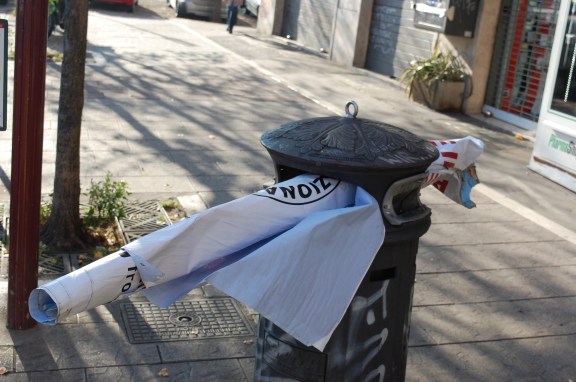
Although they might not welcome his support, he may have something in common with the local fascists. A couple of years ago there was a sudden local spate of far-right graffiti and posters against ‘usury’. I recently came across some graffiti from the teenage fascist collective Casapound reading ‘respect the hero, not the refugee’. This seems to be something of a trope on the far-right. They worship violent sacrifice and martyrdom in much the same way as their jihadi counterparts in the Middle East. Both are puerile Valhalla-worshpping death cults. Last December, in one of my proudest moments, I tore down and disposed of a huge fascist poster stuck up next to our local bus stop spreading the standard lies about immigrants getting precedence over local people in housing and healthcare. Then we got on the bus and went to the Museum of Liberation, which focuses exclusively on the Nazi occupation of the city. In Italy there is a keen distinction made between nazis and fascists. In some circles calling oneself a fascist is almost respectable, or at least it doesn’t have the same stigma as nazifascista, which applies only to the German forces. I recently read a book by a prominent US historian of fascism who argued that the Italian version wasn’t nearly as bad and had more in common with Mao’s China than Hitler’s Germany. I find this dubious – such arguments are destined to give succour and credibility to the contemporary far-right.
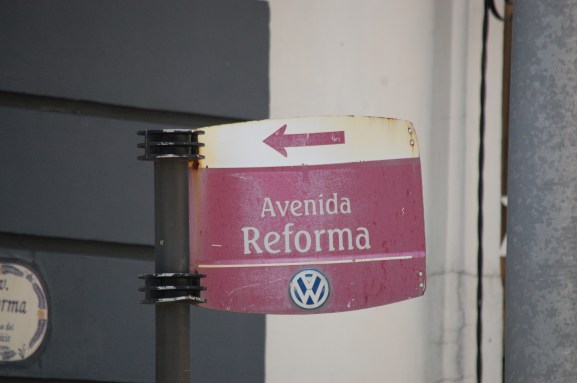
‘Nationalism is an easy illusion’. That’s what’s written in huge letters on a nearby railway bridge, more or less where Garbatella begins. This area was built during Mussolini but it houses a radical tradition, with lots of squats putting on politically-inspired music events. Just to the south there is the vast district of EUR, also inaugurated by Mussolini as a showcase for fascist architecture; Bertolucci used it to very great effect in Il Conformista. It does have some remarkable and not at all unpleasant-to-look-at buildings, such as the Square Colosseum. Nevertheless, things seem to get poorer and grubbier as you follow the main arteries further south, and the new far-right is keen to take advantage of popular discontent. I recently saw a news report about a squatted social centre in EUR being turfed out by ‘local’ people repeating the usual lies about immigrants. Also beginning just around the corner from us is Via Magliana. This area of the city gave the city the Magliana gang, which appeared to be dormant until about two years ago when a huge scandal broke, centring on the figure of Massimo Carminati. He boasted that his mafia operation was making far more money from running refugee centres than it does from dealing drugs. The investigation revealed a level of murkiness in the distribution of public money that most hoped was a thing of the past. The whole affair reminds me, once again, of Mexico. The fact that the new Mayor, Virginia Raggi, seems to be feeling the unexpected strain of her job may be part of a deliberate design to teach her who really runs the city. Two months ago she lamented that Rome is ‘full’ and can take no more migrants, and then a week later made a laudable statement attacking a gang of racists in a deprived part of town for trying to exploit the housing crisis for their own ends. In the meantime, a series of transport strikes have combined with the ongoing garbage collection crisis to create a sense of impending municipal doom.
There is a vibrancy to this area which is partly attributable to the presence of immigrants. When I first visited in 2012 we popped into the haberdashers to get keys made and I found out that the guy I thought was Sicilian turned out to be from Egypt. I feel comfortable speaking Italian with other foreigners. The lingua franca is Imperfect Italian. There seems to be a sense of shared experience despite my evident privilege. One common sight on Italian streets is recent (and sometimes not so recent) immigrants selling books. There appears to be a whole publishing industry based on these street sales, and over the years the quality of the publications has improved considerably. They sell illustrated children’s stories (which will soon come in handy) along with recipe books and some excellent volumes of African poetry.
The Algerian-Italian writer Amara Lakhous used our district as the setting for one of his novels. His books are always pleasurable and easy to read despite the abundance of new and old Italian slang. He presents a laudable defence of multiculturalism without flinching from the difficulties, with terrorism and the suspicion it generates an ever-present background. The world he describes is one I catch glimpses of, one of overcrowded apartments and constant anxiety about renewing one’s permesso di soggiorno (residence permit). One of the largest groups of recent immigrants is from Bangladesh, and they tend to be the ones you see in tourist places selling selfie sticks, luminous flying things and mobile accessories. Like the goods sold on the Metro in Mexico city it’s hard to find out how the goods are distributed. I asked my Bangladeshi hairdresser but he didn’t know or didn’t want to tell me. Visiting his shop is a cheap if not always cheerful experience. The first time I was there I had my hair cut by an Afghan who spoke no Italian, the second time it was the owner, who has been here for three years. I soon felt guilty about favourably comparing my Italian to his. His first year or two years in Italy were spent working in agriculture in Apuglia, which is apparently not exactly a bucolic idyll. Before that he had been stuck for months in Libya, before managing to escape with hundreds of others on a boat designed for dozens. It’s tempting to call him one of the lucky ones but I wouldn’t swap my luck for his.
In addition to a local Chinese shop selling useful plastic tat, on the corner of the street there is a coffee bar run by cheerful second-generation Chinese people who seem to speak better roman dialect than the locals (after all, they are locals). It’s a very popular place to hangout, read the paper and argue and also doubles up as a gambling emporium. Although betting shops are becoming more prevalent in Italy, they are more subtly woven into the urban fabric than they are in the UK, and are easily confused for normal cafés. There may well be a link between their increasing number and the amount of people begging on Viale Marconi, outside the hundreds of shops selling expensive baby accessories and the dozens of french fries outlets that have sprung up in a sign that globalisation and austerity may be doing permanent damage to the Italian diet. There are also signs of gentrification, such as the brand new and very swish birreria just around the corner and the artisan beer shop on our street. Given that I am, in theory at least, its perfect customer and I’ve never been in there or seen anyone buying anything, I don’t know how it survives. However, Mexico taught me that just because somewhere doesn’t have any customers doesn’t mean it’s not…solvent. So chi lo sa.
Some tourists come to our area to go to Saint Paolo’s Basilica, in whose café I’m sitting as I write this. Since December 2015 it has been under very heavy guard, with armoured vehicles and fully-armed and camouflaged soldiers outside. The church is of huge historical and religious significance as it houses the remains of St Paul. You could fit several ordinary-sized cathedrals inside it and still have room for one or two smaller basilicas. I used to use it as a soulful shortcut to get to the metro station, but the experience of passing through a metal detector with a machine gun pointed at your feet is guaranteed to shush any spiritual siren calls that were beckoning you in.
To get to the Basilica and the Metro station you have to cross the river. At some not-quite-conscious level I’m always contemplating bridges and rivers and the relationship between the two. Along the Tiber you can walk all the way into the centre. On the other side of the river, towards the working class district of Testaccio, with its former gasworks and warehouse clubbing scene, you see signs of gypsy encampments amidst the overgrown foliage.
Like most areas of Rome our district has its share of dog shit**, graffiti, broken glass and smashed-up pavements. This is not a part of Rome that Penélope Cruz or Jesse Eisenberg will be spotted in any time soon. I haven’t written about many of the delightful things that this area and Rome in general have to offer, its restaurants and gelaterias and galleries and bookshops. I didn’t want to (and I probably wouldn’t know how to) write an Eat-Pray-Love-style elegy in which I boast of the tiny pleasures of sipping on a perfectly-formed cappuccino and nibbling at a melt-in-your-mouth cornetto in a picturesque Roman piazza while reading Dante in the original language. But there is much of significance on any street and I hope I’ve given something of a sense of what it’s like for this individual (me) to be living in this part of Rome at this particular moment in its immensely complex history and some suggestion of what it must be like for those less blessed with good fortune than myself.
* I’ve only been living here since September 2016 but me and my wife had already been visiting regularly since 2012.
** I’m aware of the irony of writing about this on the internet.
*** Mind you if you really want to see some dog shit the place to go is Via Vaiano near La Magliana. Mamma mia.
 Writing teaches you some salutary lessons about yourself, the world and the relationship between the two. Last week someone gave me an
 One of my roles in life involves testing the English language to make sure it’s working properly. It’s in this capacity that I get to fly down to Mérida for a few days, eat
  Ultimately it’s a question of marketing. What the London Academy is selling is a tourist experience. For the students (or at least for their parents) the school is a corner of a foreign field. They will be immersed in the classroom in an English-only environment with a representative of the target culture. What the teachers get is a reasonably-paid job and an experience of living abroad, one which gives them the chance to learn some of the language and, if they’re lucky, become friends, or possibly very good friends*, with some of the locals. Nowadays in the world of English language teaching this is quite a retro model. It is based on the promotion of the assumption that the teacher is a monolingual native speaker with no or little knowledge of the host culture. Bringing a new cohort of teachers over every year is very expensive at a time when there is more competition from schools which use other images and associations to promote the learning of English.
 Sadly, thanks to a combination of international competition in the education market, arbitrary and ill-thought-out changes to visa rules and the global economic situation, the language school industry in the UK (and London in particular) has taken a hammering over the last few years, with very well-established places going to the wall and the survivors getting snapped up by international concerns. It is also possible that over the next few years the international marketing of British English by institutions such as the British Council will encounter difficulties in a world which no longer views Britain as vibrant, mobile and welcoming but rather as insular, hostile and closed. Whereas most marketing of English courses tends to sell an image of mobility – in the words of an advert I saw recently, ‘Where can you go if you don’t know English?’ – all this talk of shutting borders is designed and destined to do permanent damage to one of the very remaining industries which the UK still dominates.
 There seems to be growing acceptance nowadays that the best attribute a teacher can have is the ability to teach, regardless of where they happen to have been born. The spread of English as a lingua franca has led to a growing recognition that it does not ‘belong’ to any one national group. Indeed, it helps to have consciously learnt the language you’re teaching. Having done so gives the teacher insights into the learning experience which allow them to give their students shortcuts and to identify potential pitfalls and misunderstandings. Non-native teachers also make more realistic role models, as the old joke about an English learner saying that when he grows up he wants to be a native speaker acknowledges. Plus it’s also true that a ‘native’ level of English is not a desirable goal. In international settings it is often British, American and Australians
 I myself found out quickly in Portugal many years ago that in a monolingual EFL classroom it’s the monolingual teacher who has problems expressing what they want, especially when dealing with teenagers. Students know their own culture and can communicate perfectly well with each other. Hence they can run rings round a teacher who has little training and almost no experience of inspiring learning and imposing discipline. Such a relationship depends partly on the personality of the teacher and partly on their ability to assert their authority over the language on the basis of their national identity. Anyone who has taught in such a context will recognise the frustrations described by George Orwell in his story ‘
 I would like therefore to put forward five suggestions for roles that EFL teachers can usefully adopt in a monolingual teaching/learning environment:
 These tips are written with the teaching of English in mind. Some of them also apply to other languages. For example, I can’t say that the list of characteristics of various French supermarkets I spent ninety minutes learning in an intermediate French class a few years ago has helped me a great deal when talking to recent Senegalese immigrants in Rome. The same applies to Spanish and to an extent Portuguese; there’s not much point learning to lithp or to use
  Several years ago in London there was a best-selling book/CD for English language learners called ‘
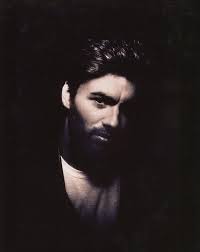 Poulton-Le-Fylde, Blackpool, 1986. I’m staying with my grandmother. She has a small red turntable from the 1960’s. Music is my lifeline to a life I’ve yet to live. The place, that room, that record player I associate with ‘State of the Nation’ by New Order, the 12″ version of ‘Bring on the Dancing Horses’ by Echo & the Bunnymen and the second coming of Frankie Goes to Hollywood. I see now that the timeframe is all wrong – I’m confusing two visits from the same year. But then like all 14-year-olds I was mixed up. It strikes me as significant in some way that I don’t remember my life in Sheffield at the time. I know school was hard in some long-since undefinable ways and Blackpool represented some sort of escape.
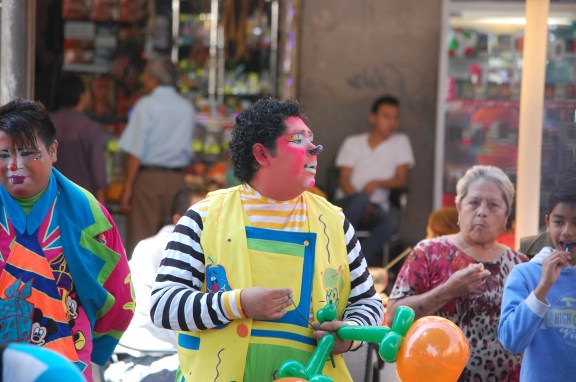 In Puebla I have my first ever attack of coulrophobia. The Zócalo (the main town square) plays permanent venue to a group of local clowns, and although I can’t understand everything they’re saying I can just about get the gist and it is uproariously obscene. It’s night time and we are part of a small, appreciative and apparently unoffendable crowd, some older and some very young. Behind us there’s what appears to be a genuinely spontaneous outbreak of live music and dancing. It’s one of the most beautiful places I’ve ever been to. We stand and laugh for a while and then go to a nearby bar where a succession of singers entertain us with trova classics, some of which even I’m able to recognise.
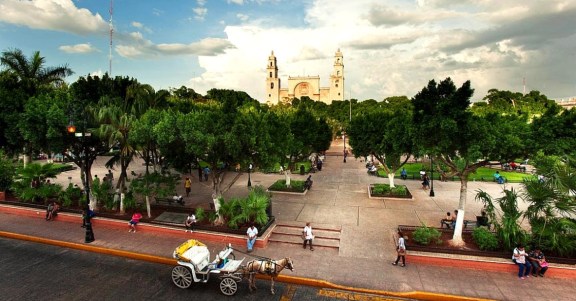
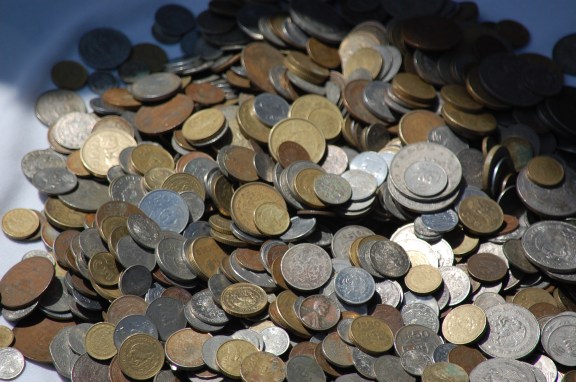
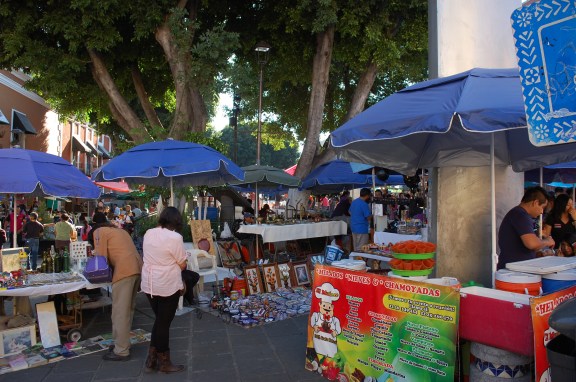 Puebla is only about two hours from DF (Mexico City). The Zócalo itself is well worth a visit, with its gargantuan cathedral (the second largest in the country) and a vast range of human activities taking place at any given moment. The city centre also has a number of local street markets. My observations in the UK have taught me that one of the functions of the global ‘market’ is to displace and replace such places; it’s always a tragedy to see a well-established one close or go upmarket, because a city should give local people the opportunity to sell things, not just to buy them. Luckily some of Puebla’s markets deal in much more than just the usual Frida-related tourist tat. There are puestos selling books, vinyl records, coins, and ornamientos, which is apparently the Spanish word for nick-nacks. I have an entertaining conversation with one stall-holder about the relative merits of various Iron Maiden live albums. He’s a fan of Rock in Rio, while I’m sticking with Live After Death. To be fair he may have a point, because I haven’t actually listened to Live After Death since I was about fourteen, and I’ve never even heard Rock in Rio. Nor would I want to. Iron Maiden are terrible, but heavy metal never ceases to be kind of funny, especially when you’re conversing about it in another language.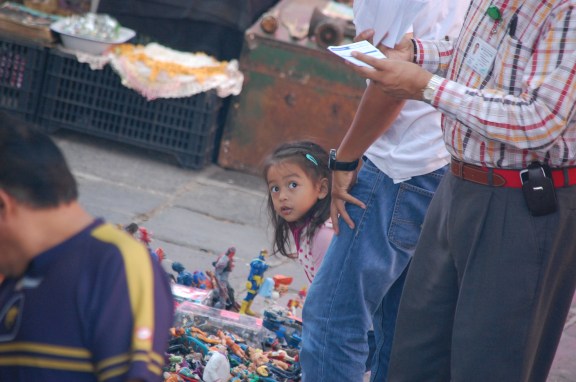
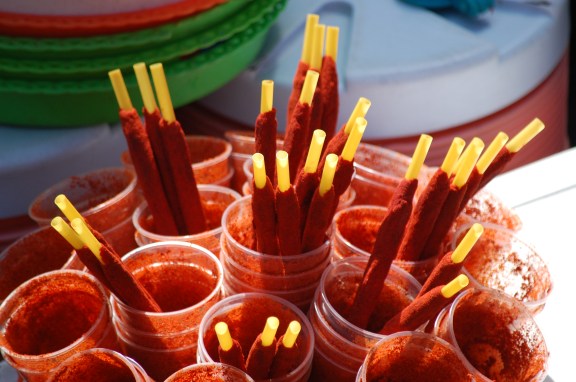 We take a turibus ride around the city, and when we disembark and go to pay it turns out to have been free because the machine isn’t working. Then, just as we walk away from the bus we see and hear an extremely loud and colourful demonstration coming down the street towards us.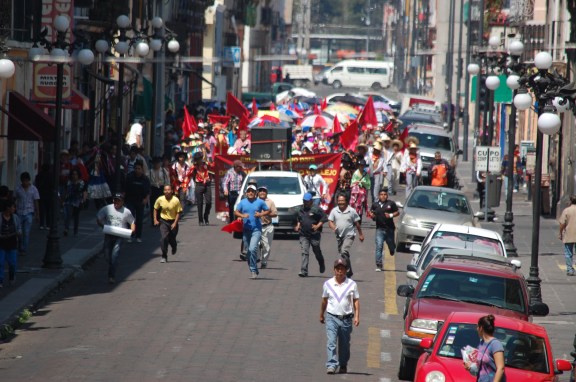
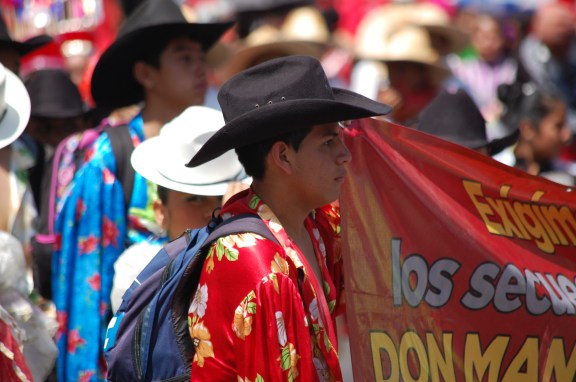
 I’m surprised to see people holding parasoles promoting the Partido Acción Nacional. For anyone out there interested in analogies between Mexican and Irish politics (er…), this is the Fine Gael of Mexico, the substitute party, the one that proved, when in power between 2000 and 2012, to be just as corrupt and violent as the ruling (and staggeringly corrupt and violent) Partido Revolucionario Institucional. Like Fine Gael it allegedly has
 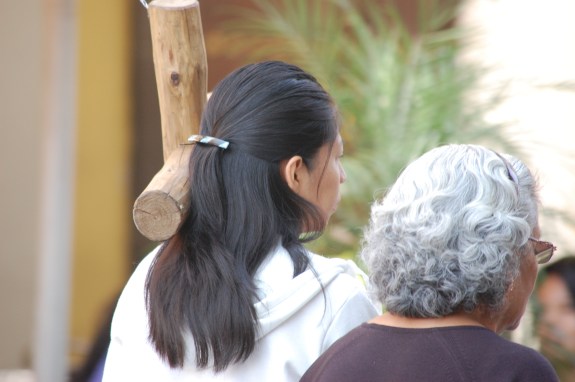 The march culminates on a stage in the Zócalo, where they have some speeches calling for justice for Don Manuel Serrano Vallejo, the father of a local PRI politician, who was kidnapped and murdered two years ago.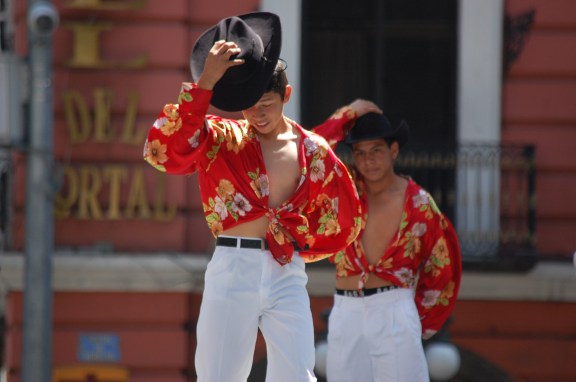
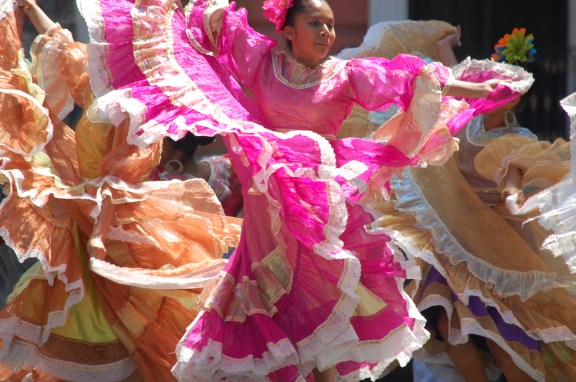
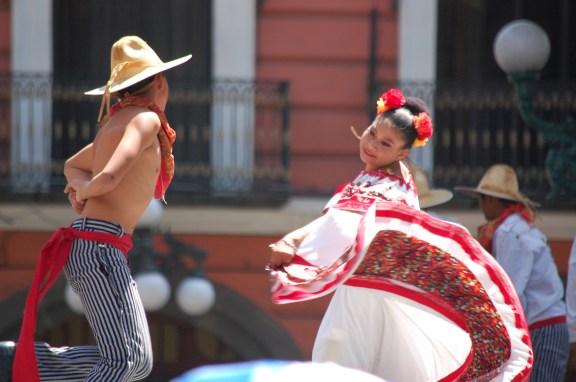
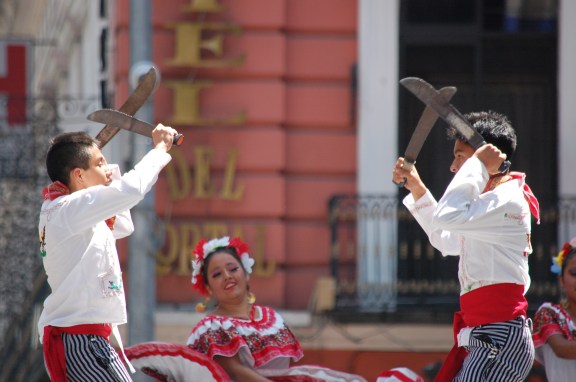 Later I read up on the Antorchistas and find that for some time they have formally been part of the PRI, and are therefore a lot less radical than their posturing might suggest. Hence today’s demonstration may have been another example of the phenomenon of
 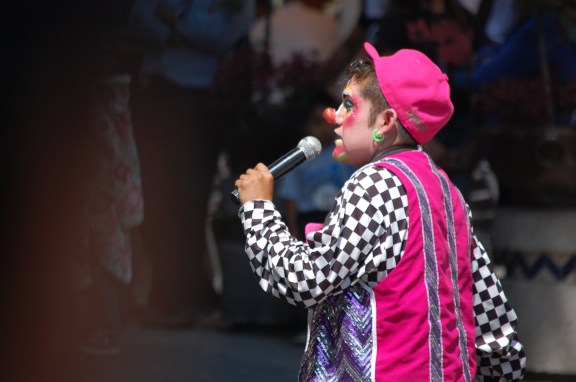 It’s an idyllic scene. All around us the square is packed with people of all ages walking around with beaming smiles, holding balloons, selling balloons, popping balloons, eating ice-cream, playing music, listening to music, dancing and eating. Which suddenly seems like a good idea. After lunch we wander over to watch the clowns. I have my hood up and I’m hiding because something about them makes me nervous. And sure enough within a few seconds the thing I dreaded, the thing I dread most in the world, actually happens: They see me. Possibly because I’m trying to accomplish the difficult task of hiding while taking decent photos. Immediately the question comes, in English: “Hey gringo, where are you from?”. Dozens of people are now looking at me, laughing and pointing and laughing some more.
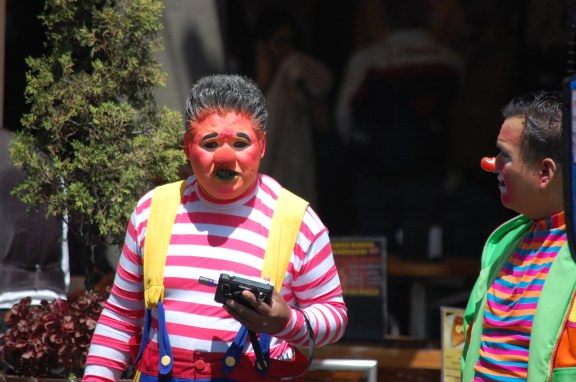 I hate being exposed as an English speaker, so just doing the blindingly obvious thing and making myself part of the show is, tragically, not an option. I feel ashamed that other people will think I don’t speak Spanish and am thus some sort of unsophisticated monolingual oaf. I feel challenged. Such situations touch upon a very raw nerve, which is particularly close to the surface when, as now, I’m living in another country. In insisting on speaking other languages I’m making a claim on another identity while trying to shake mine off. I want to join another club, not my own, and I’m scared of being rejected. I feel objectified, seen as a representative of my own culture and country, which is awkward because even at the age of 40 or so I’m still not very clear what my relationship to that country and culture is. But I’m also aware that this ridicule I’m faced with is (apart from the damage I’m letting it do to my ego) harmless. Although these clowns have presumably seized on my presence as a chance to go into a tried-and-tested (and probably merciless) routine about foreigners, I’m very rarely greeted with hostility. I’m not the victim of negative stereotyping and I don’t face any threat of violence. Normally when people address my evident out-of-placeness it’s a friendly, good-natured, genuine interest. Besides, people want to use English. They, like me, want to be accepted as part of another community, in their case the global English-speaking one. The fact that this anxiety is such a constant theme in my life is an irony beyond all measure. I teach English. I examine people on their English. In a very important sense that is why I am here. I am not unaware of these things, but for some reason my subconscious self refuses to accept reality. One of Jacques Lacan’s key insights is that the unconscious is structured like a language. He might also have mentioned that it can sometimes behave like an absolute f*cking idiot.
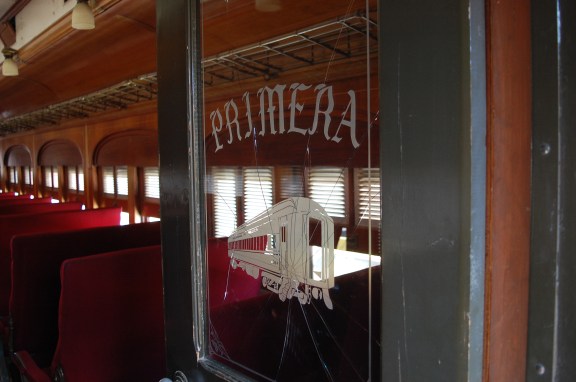 We head away from the centre towards the train graveyard, also known as the National Railway Musem. It has dozens of passenger and freight wagons, mostly from Mexico but also the US. There is a photo exhibition in one of the carriages on some of the now-despondent towns which the train line from Puebla to Veracruz used to pass through. The city of Puebla was created to secure the route between Mexico City and the port of Veracruz, so the train line was of vital importance when it was opened in 1873, particularly for the transport of goods. Then, after decades of neglect, in the early 1990s the entire network was broken into four and privatised. The line from Puebla to Veracruz closed, and now Puebla focuses on producing cars. On the way here from Mexico City you pass a huge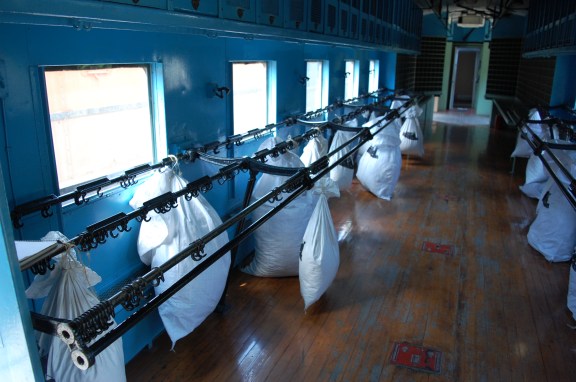
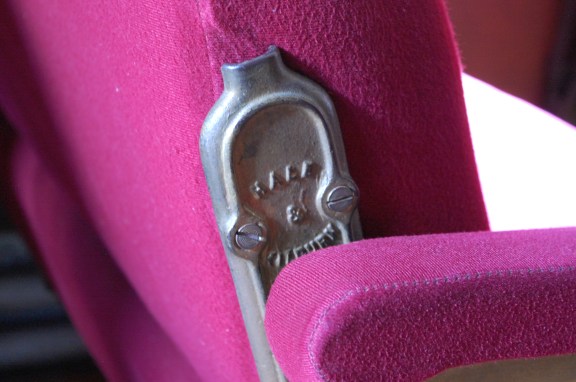
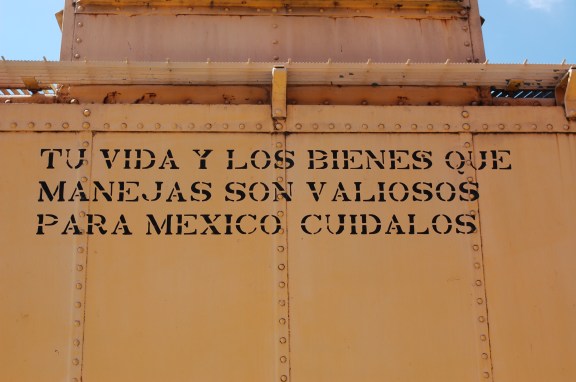
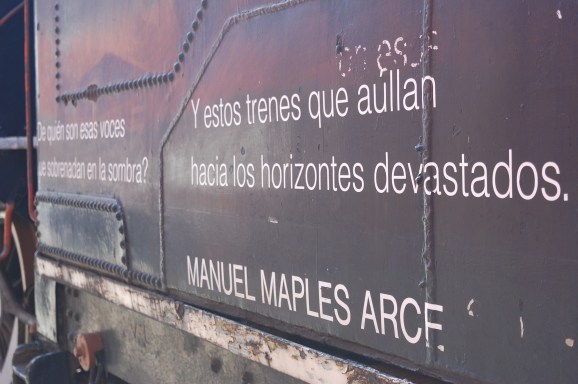
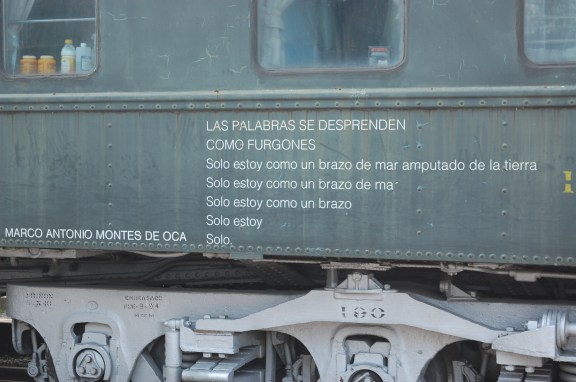
 Then there is La Bestia. This is not a single train but a network of freight trains used by Central American immigrants to get from the south to the north of the country on their way to the US. It is so dangerous that it is also known as el tren de la muerte, the train of death. Since 2014 passengers have been banned from travelling on top of the train, partly thanks to an
 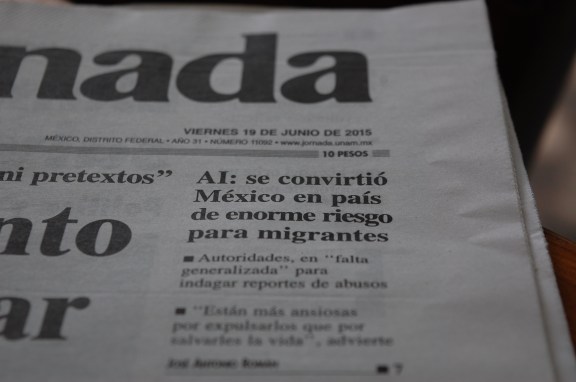 In the main building of the museum is another exhibition dedicated to the work done by Padre Alejandro Solalinde, who runs an organisation providing Central American immigrants with humanitarian aid and education. In return for his efforts his life has been threatened on several occasions.
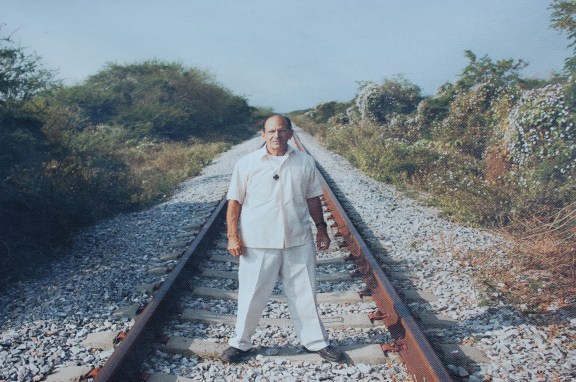 It puts my fear of clowns into some perspective.
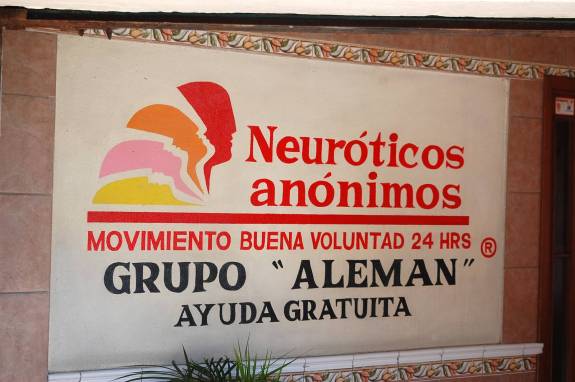 I don’t know how many German-speaking branches of Neurotics Anonymous there are outside the Bundesrepublik. There’s probably a couple in Austria, and possibly a Geriaticneurotikenanonymous in Paraguay, but that’s beside the Punkt. We were surprised to find one in Oaxaca, Mexico. For a moment I was tempted to go entlag to one of their meetings, but I was visiting the city on holiday with my wife, herein known as Ch, who, despite my very best efforts, does not sprechen sie Deutsch, and in any case mein Volkabeln isn’t quite up to the Mark. Plus I’m not neurotic.
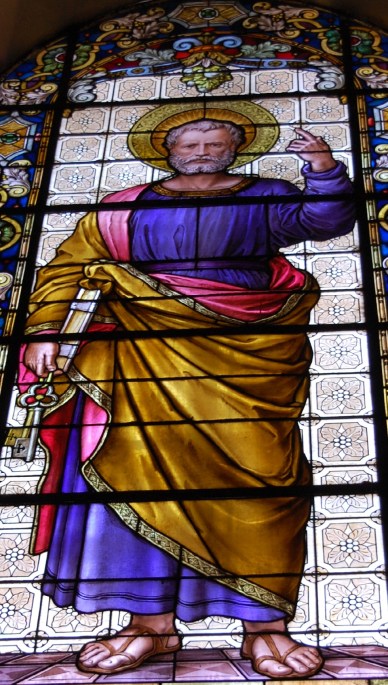 A wander around the Museum of Culture testifies to this. ‘Oaxacan’ culture unifies all sorts of traditions with their own belief systems, cultural artifacts and artisan technologies. The many local markets and the makeshift stalls spread on the ground in the town’s squares by people from often distant villages show off handcrafted and painted wooden sculptures called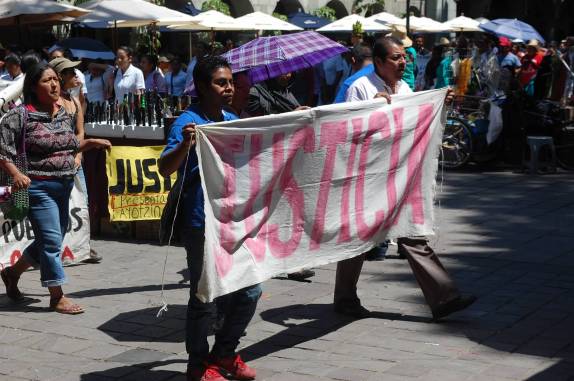
 village, it is still on the tourist trail – every time I wear the t-shirt over the next few months, from Havana to Angkor Wat, I receive masonic nods and winks from those who share my apparent knowledge of arcane
 After we’ve tromped up and down a fair few pyramids in the 40 degree heat, taken more photos than we will ever have time to look at and visited enough artisanal workshops to last the lifetimes of several Aztec gods, we are all keen to get back to Oaxaca, sink a couple of mechiladas and
  There is also the question of who has money to invest to take advantage of all the visitors. Most mid-range places we stay in happen to be owned by foreigners, and at the level of higher-end tourism, it’s international money that dominates – indeed it often physically displaces both local investment in addition to causing the eviction of local people and the destruction of natural environments. A recent and spectacular example of the latter were the
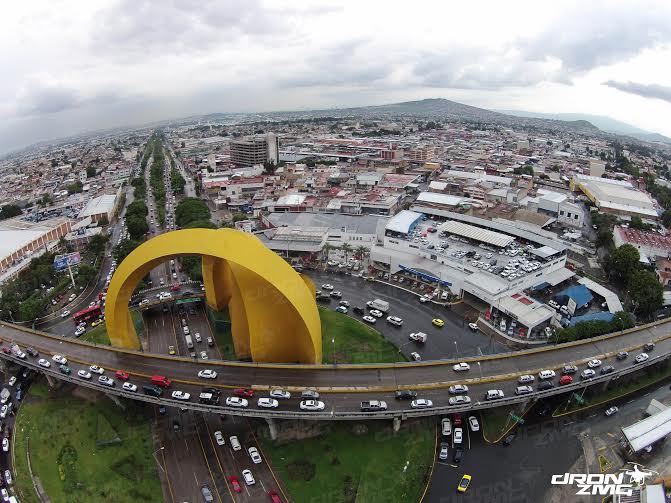 Across the doors of the lift in my hotel in Guadalajara there is a huge peel-and-stick painting of someone’s idea of a blue-sky palm-tree paradise, but where you might expect to see golden sands and sunlounges, what greets your eyes instead is a Burger King concession next to a huge line of cars. The good people of Guadalajara, it seems, enjoy their traffic jams. They are also fond of shopping centres, and of the car parks that must therefore surround and lie underneath them, which is why in search of an actual bar it takes me about half an hour of hard work to find one amidst the Walmarts and VIPs and Chili’s and VIPS and Chili’s and VIPs and drive-in Walmarts Walmarts Walmarts. The entire landscape in the area where I happen to be hotelled is composed of shopping centres, megamarts, car showrooms and names of stores in six-foot writing designed to be read by people speeding past or more realistically biding time in embotellamientos. It’s on another scale from where we live in Mexico City. The city is effectively unwalkable and the only places I can find to eat without giving up and joining the traffic are restaurants rated for their parking rather than their food. It doesn’t help that Guadalajara is immense and it takes 45 minutes to get anywhere fun even by car – it feels strangely much larger than DF. It’s the kind of hyperalienating environment which José Saramago deplores in ‘The Cave’, a place which is, in the words of Frederick Jameson, ‘useless as a conduit of psychic energy’. It puts me in mind of Cabot Circus, that huge alien spaceship which has obliterated the centre of Bristol. There’s nothing new about such an environment and there is little to say about it that authors such as JG Ballard, William Gibson and Will Self haven’t already written. But my individual experience of it is inevitably physically and spiritually exhausting. 20th Century modernity became fixated on the private motor vehicle and the 21st Century shows no signs of moving on despite its own terminal obsession with the smartphone. Who cares about a three-hour bottleneck when you can sit in your car and text. It takes me three attempts to get to the centre using public transport and my feet; eventually I give up and take a taxi.
 I always learn a lot from Mexican taxi-drivers, about politics and the ins-and-outs of gang wars. Asking about who controls the city (and which politicians they are in league with) starts to feel a bit like asking how the local football teams are faring. In Guadalajara there has recently been a low-level war between two mafia groups and now things are (ostensibly) relatively calm because one of the sides won. For taxi drivers in Guadalajara the theme of violence and politics is intimately connected to their jobs and to the increasing dominance of one particular cartel known as…Uber.
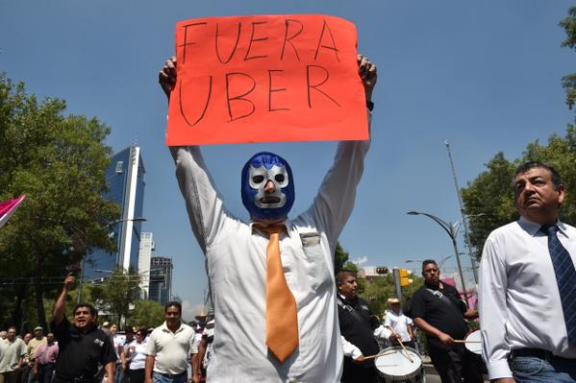 In addition to the damage it does to the livelihoods of working people, there are several reasons why using Uber makes me so uncomfortable despite its obvious advantages in terms of convenience and (ironically) comfort. It’s useful to take the name seriously. Uber provides a comforting and flattering sensation of belonging to the elite – in
 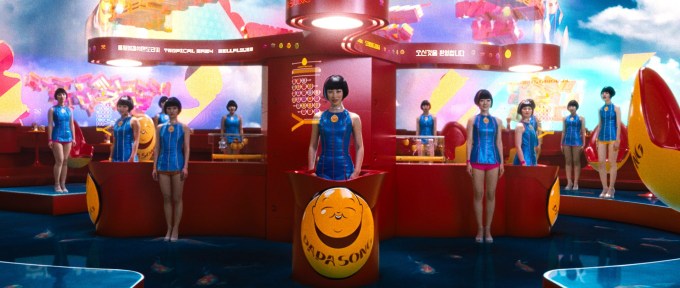 When we pay for special treatment what we are paying for is an enhanced image of ourselves. This is the ‘added value’ that companies are desperate to add to their products. This cultural tendency to fantasise ourselves as superconsumers partly explains the appeal of figures like Trump and the Kardashians. Trump in particular lives a fantasy life of a fantasy billionaire, and by taking Uber we also partake in this roleplay. This aspiration-as-pure-fantasy is what capitalism is increasingly betting on. An
  When I do at long last get to the centro histórico of Guadalajara its beauty and charm stupefy me; I’m glad that on this third and final visit I finally made the effort. The colonial heart of the city was designed, set out and built specifically in order to ridicule any humble attempts I might make at describing it. Jalisco es Mexico is the slogan used to promote the region and the symbols and bright colours you see emblazoned all around insist on this, as do the ubiquitous mariachi music and the incessant invitations to try out the local tequilas. In a tiny sundrenched plaza called Nueve Esquinas I gorge on birria, the ingredients of which are one entire dead goat boiled in its own blood, four different kinds of chilli, and about two litres of my own sweat, as the local beer and a shot of the regional moonshine sieve right through my hair back into the bowl and so I promptly grab some more tortillas, dive in and perform a perfectly executed Mexican version of La Scarpetta. Afterwards I walk around in a daze in the blistering heat and take a hypnogogic doze on a bench. It’s all too much to take in, and I don’t want to have to deal with the tedium of rush hour, so I take a taxi back to the hotel with a driver called Alberto who comes from Monterrey and whose girlfriend is scheduled to give birth to twins any day now. It’s a high-speed, bumpy but convivial experience soundtracked by norteño music a un volumen ensorcedor. Addled as I am with goodwill, goat and agave I offer to do a deal over the price so I will pay double the pittance I am charged and then claim it back from my employer. I try to explain the phrase stick it to the man, for which I’m sure Mexican Spanish must have range of equivalents, but only confusion results and I decide it’s probably about time for another siesta.
 Infinite Coincidence