Republicans have a duty to help get rid of Trump

donaldtrumpgop_2016_iowa-jpeg-06f62_c0-0-4752-2769_s561x327

A week ago I wrote that ‘Donald Trump is going to snap very, very soon’, but I may have been wrong. In any case, there’s another possibility.

The Republicans who put him into power knew the risks of doing so. Three days after his ‘election’ I argued:

…the Republicans have anointed the worst white man in the world to replace the first black President. The problem they now have is that Trump is utterly incapable of governing. He is a man who will clearly be unable to master the complex tasks inherent to the job. Being President of a large powerful nation involves dealing with huge amounts of detailed information. Although there is some limited evidence that Trump has some ability to understand short written sentences, there is no way that someone of his *extremely* restricted intellectual prowess will be able to read the morass of documents he will have to handle on a daily basis, or even to understand the most basic gist when they are explained to him. There’s also the question of workload. Here is Obama describing an average day in his life as President. It’s demanding stuff, and the mere fact that the word ‘intelligence’ is used three times suggests strongly that the new President will struggle. By contrast, Trump’s typical day almost certainly revolves around a heavy schedule of cheating at golf, inspecting prospective line-ups of mid-teen prostitutes, spending seven solid hours on Twitter in an increasingly frustrating bid for ego-gratification, signing documents for buildings that he does not own, telling his children that they are worthless, and looking out of the window of his plane wondering why his own father hated him so much. Much has been made of his lack of political experience but few have considered the possibility that this is man so lacking in concentration and stamina that he has probably never sat through an entire episode of the West Wing. (Neither have I, but no one has suggested making me President.)

I don’t know the precise nature of Trump’s mental disorders. As I’m not a psychologist, I’ll just say he’s dangerously deranged. I know that his fellow Republican Paul Ryan is an admirer of Ayn ‘Medicare’ Rand, which according to my personal DSM qualifies him for psychopath status. However, I also know that not all conservatives are driven by the will to power and the eradication of the ‘weak’. They have values, believing strongly in the importance of duty, loyalty, faith, family, community, stability, and the Republic. Their notion of freedom differs from mine, and has been usefully defined as freedom from rather than freedom to. It’s a noble tradition, one which there’s some sign Mike Pence retains some respect for, despite his absolute contempt for more than half of the human species.

It is by no means impossible for liberals and those of us on the left to find common ground with conservatives. Please watch this 5-minute video by the climate campaigner George Marshall. It’s crucial to my argument and he explains it many times better than I ever could.

Climate Change is traumatic for people with a conservative outlook. It demonstrates that they were wrong about the free market and the supremacy of private self-interest over the private good. Naomi Klein explains this very clearly in ‘This Changes Everything: Capitalism versus the Climate’. Many on the right have responded by going full-on psychotic in their denial of the facts.

Climate science is not the only thing that Trump’s administration is hell-bent on denying. It is also flouting basic constitutional rights and the political traditions of the United States in its pursuit of an openly sadistic agenda. Those who are not psychotic or driven by sadism, and who still respect the United States as an institution (as Trump clearly doesn’t), have to help get rid of him. I don’t know what form that will or should take. It would be good if grassroots Republicans could join the movement to resist the devastating (and probably illegal) changes he is imposing. Those who are in the centre or on the left need to be prepared to dialogue with them, using the techniques and language George outlines above. At the top of the Republican Party disposing of Trump will probably have to involve at least cloaks, if not actual daggers (we don’t want to be dealing with a martyr). I also wrote in November (in a mood of some despair):

“…the Republican Party is now faced with the conundrum of managing a situation which is to all intents and purposes impossible. There may already be whispers in the arras that he could be forcibly removed. In the light of his apparent insistence that Sarah Palin should play a prominent role in world affairs few rational people living or dead would be all that opposed to a good old-fashioned off-stage poisoning or stabbing. Or possibly an air crash? I sincerely hope that 1) there are still some Republican leaders out there who still have some measure of faith in the values they profess and the integrity to implement them and 2) that they have left no options off the table.

As I say, although I think it’s essential to avoid bloodshed as far as humanly possible, it will be very difficult for Republicans leaders to manoeuvre Trump off the stage. The fact that it may be dangerous for them doesn’t bother me unduly at this stage. In my darker moments I marvel at lack of the lack of suicides of leading conservative political figures in relation to Trump’s ascension. These are people who claim to love their country and cherish their democracy. Look at what they’ve done to it.

One commenter on this site described Trump’s present position as ‘thriving’. The situation of many of his first victims could fairly be characterised as ‘sitting at a foreign airport wondering how the hell to get back home to their families’. (Ironically, Trump himself is keen to spend as little time with his family as possible.) I think what we’ve seen in his first week in the White House is not an energetic burst of activity but a manic acting out of a mental disorder (whichever it may be) under the guidance of the nazi activist Steve Bannon, a proud wife-beater and probable alcoholic who will do whatever he can to destroy democracy and unleash chaos. Bannon resembles the trickster psychologists in the last few J.G. Ballard novels in that he seems to have learned to manipulate Trump’s psychopathology to the point where the ‘President’ trusts him and probably thinks he is his ‘friend’.

One comment I particularly valued among the hundreds of extremely wise remarks and reflections left in response to my first piece was the following, from someone called nychermes:

I respectfully disagree with your assessment that he will snap. I don’t think he is snapping anytime. That’s a misreading and I will explain as follows. You’ve reduced his complex assemblage to his insecurities – what YOU aren’t seeing is his very resilient, very strong core strength to always go for what he has his mind set to, however it may threaten his insecure ego. HE will NOT SNAP. He will get through every nuisance he creates even if he appears he’s in trouble – he WILL invert the very nuisance only to recreate more chaos to hide and bury his weakness while maintaining a storm of chaos and going after his objectives. HE will devolve the rest of the country and audiences into a pulp of insanity and emotional incoherence but he will stand. He is WAY more dangerous than your well meaning but one-dimensional – ‘insecure ready to snap manchild’ portrait for him. The ‘manchild’ is not ALL of the story as you have made it out to be in your article.

The title of my article was partly wishful thinking expressed as an extremely firm prediction. I think that’s one reason it was so widely shared and read, and I apologise if it made anyone feel in any way complacent about what lies ahead. Of course, Trump may well not ‘snap’ (not being a psychiatrist, I left that term unhelpfully vague). In the meantime, others need to snap into action. Debates over his mental stability need to take place in the open and journalists must openly challenge Government supporters and spokespeople on the issue. Then there are the politicians. According to Robert Reich, some Republican senators didn’t oppose Trump’s rise before the election because they were scared of being shot dead by his demented supporters. Well right now it seems to me that if the only people to lose their lives as a result of this madman’s brief reign as President were the people who installed him in the first place, it wouldn’t be such an absolute tragedy. The world is not going to suffer for their cowardice.

Donald Trump does not represent Republican values. If you are a Republican, you owe it to your country to help get him out of the White House as soon as possible.
The Amtrak Trilogy Part 1: Costa Rica to New York

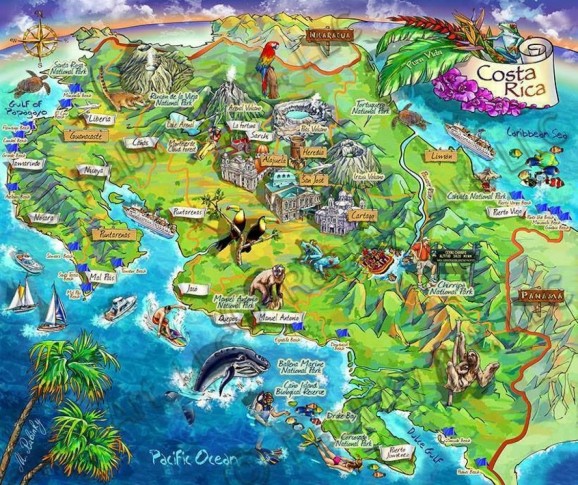
timthumbI yawned deeply amidst the luxury bedding of the boutique hotel on the slopes of the volcano in Costa Rica, and prepared to go back to sleep. It was 5.45am, December 21, 2012. I know the date because I just (now, in 2017) double-checked the details of my flight from San José to JFK. This is something I’d been oddly reluctant to do for the previous ten days, which my then-girlfriend now-wife and I had spent enjoying the resplendent flora, abundant fauna and disappointing food of the ‘Switzerland of Central America’*. Occasionally Chiara had reminded me to look up the time of my return journey, which was different from hers because I’d bought my ticket as a special surprise present for her birthday (er…) and the flight I’d booked was half an hour later and (inevitably) on a different plane. I knew that my flight was in the evening, as was hers to Madrid, but whenever the subject came up I didn’t happen to have my phone to hand, or was too busy looking up names of birds, or just trying hard to ignore a muffled thought I’d locked in a cupboard in my head which was saying something that sounded a bit like, Richard, your flight isn’t in the evening, it’s actually first thing in the morning. So I didn’t get round to checking until once again prompted by her on the morning of the very last day, which we had planned to spend eating a big boutique breakfast followed by a stroll to look at the innards of the big farty mountain with the hard-to-pronounce name. When I looked at the details I “gave a start”. Although I’d never consciously reflected on what that phrase means, I now know it means “to run round the room of a boutique hotel shouting fuck! Fuck! FUCK! and trying to find one’s glasses while also having a shower and packing one’s bag. And apologising. A lot.”
The friendliness of the South African couple who ran the place turned out to be able to withstand having their bedroom door banged on loudly at 5.52am, especially when it became clear that the English guy from Room 4 was too lost in panic to understand the value of money. $100 and forty-five minutes later, I was at the airport.

On the plane I had something of a epistomological crisis. What did I really ‘know’? Could I trust my own ‘knowledge’ of the world? Is our perception of reality based purely on choosing to believe that which suits us and ignore everything else? What other blindspots were there in my worldview? What did this imply about our ‘awareness’ of Climate Change? Like, if I was really as worried about global warming as I told myself I was, what was I doing on yet another plane? And what would my girlfriend’s parents and friends say when they found out how stupid I was? Could I even trust the evidence of my own eyes? The ticket before me, for example, clearly indicated a four-hour gap between my arrival at and departure from JFK. That suggested I could go to the centre of New York and walk around for a bit, right? But who was I to judge such a thing? I would need to ask another human, anyone who wasn’t me, to make the decision for me.

Once deplaned at JFK that’s what I did. I asked a nearby baggage handler to confirm that I could safely set foot in Manhattan or The Bronx or wherever and be back in time for the connection to London. I’d never been to New York before, I explained. She peered at the ticket. No, she said.

Twenty minutes later I was walking down a street in Queens. In New York! It was just like in the films, although not so much ‘Mean Streets’ or ‘Annie: The Musical’, more like ‘Frozen’, ‘My Fingers Just Fucking Fell Off’ or ‘300 Degrees Below Zero’. I reckoned I had enough time to eat some pizza pie, grab a beer in some nondescript bar, shoot dead Donald Trump and maybe track down Thomas Pynchon before heading back to the warmth of the airport.

How does one order pizza in New York? By the slice? How big are the slices? These were the questions I didn’t want to ask as I stood in line. I wanted to feel like I belonged, like a Native New Yorker, but I didn’t, like the song says you should, ‘know the score’. The guys behind the counter seemed to be Middle-Eastern,  but I could hear some proper sweary Italo-American voices coming out of the kitchen. I confidently ordered enough food to feed the entire population of San José for two months and sat down unobtrusively in the corner to peruse some sports magazines which may as well have been written in Patagonian Welsh for all that I could understand of them.

It was technically my first visit to the US but in a sense I’d been there for the previous ten days. Costa Rica sometimes felt a bit like a Disneyland version of Latin America. We’d met so many North Americans even I’d started pronouncing it Coaster Rica. The first was Darylle, whose Airbnb place we stayed at in San José upon arriving. I hadn’t known much about the country we were visiting except that it once had a President who thought it was sometimes okay to spit on people and that it didn’t have an army. (I knew those things because I’d written about them here.) Having breakfast with Darryle was like doing a Master’s in Costa Rican history, society and politics. (It was also the best meal we would have in Costa Rica.) He was an expat lawyer who, after a spell in the Peace Corps in the ’60s, had moved to San José and was very much part of life there. He also sponsored a school in Nepal along with a bewildering list of other laudable activities.

In a blues bar in Quepos we talked to and danced with exiles from Reagan’s America who’d decided to stay for good; just up the road there was a reminder that Costa Rica had been friendly to the US in more disturbing ways, another remnant of the Reagan years in the form of a plane used to transport ‘aid’ to the Contra death squads in neighbouring Nicaragua. Also in Quepos we came across the remains of a banana processing factory – Costa Rica was for almost a hundred years used as a massive banana plantation by US corporations. On the last night, in that boutique guesthouse on the volcano, we had dinner with a New York couple who talked in quiet tones with immense sensitivity and intelligence about the suffering inflicted by Hurricane Sandy and what we as a species could do to prevent it happening elsewhere. In all the personal encounters I recognised and admired that particular openness and readiness for conversation, that effusive volubility that characterises pretty much all the US citizens I’ve ever met. As I munched on my mountain of pizza pie and worried about missing my plane I had the feeling that this was a country where anyone could start to feel like they belonged.

I’d be back.

dsci1142

* We spent the first couple of days in Cost Ric puzzling over why there were so many Argentinians employed in the tourist industry, but then we realised that Central Americans also go in for that whole voseo thing. Another surprise came at about 4am in a hammock, when I heard this sound from what seemed like less than a metre away. Our favourite animal of the holiday, though, was the local version of the sloth, which apparently only comes down from its tree once every two weeks to take a dump. Pura vida!

Help me help Donald Trump

159844477-jpg-crop-rectangle3-large
New US President Donald Trump and his charming American-born wife Melania greet the adoring crowds before his inauguration ceremony last week.

In the last few days this modest blog has become a major focus of attention, with over 600,000 visitors in four days. This has come as a shock, as I had assumed that something I wrote before I’d technically got out of bed could only have a very limited impact. Nevertheless it means that I now have a platform and I’d like to put it to good use.

Your President is very upset at media reports of the poor showing at his inauguration. He even phoned the National Parks director to see if she had any photos which might back up his assertion that there were at least seventetysquidzilliontrillion people in attendance. Unfortunately there aren’t any. This won’t bother his core supporters that much, because they’ve apparently stopped paying attention to the news, and won’t therefore get to hear about the destruction of their livelihoods and dwellings in the impending economic and ecological meltdown. They’ll just continue as normal in an America which is once again great but where most of the people are dying or dead.

I’d like to help them, and I’d like to make amends to Mr Trump for speculating in my piece that he may have the reading age of a 5th grader. A commenter remarked that this was probably inaccurate, and to be fair I’m not very familiar with the US schooling system, so I hurriedly changed it to 12th grade, but then another commenter remonstrated, pointing out the average reading age for US citizens is 7th grade, so I edited it again and now it stands at 8th grade, which is probably a bit generous. Now, Mr Trump probably won’t have read my article – he’s probably seen it, because it was tweeted by his arch nemesis Rosie O’Donnell, but according to an online readability index thing I just submitted it to it has an ‘Average Grade Level’ of 11.3, so at best he might have just looked at it and thought, I wonder what that says. Nonetheless, I’ve read quite a few things about how obsessed he is about this whole inauguration numbers thing, so I thought I’d use this platform that I’ve been granted and try to find some people who maybe didn’t appear in the photos, but are ready to assert that they were in the Washington Mall last Friday during his speech, and then we can do a tally and tweet him the overall number, and that’ll cheer him up so he can go back to ruining the lives of every single person on the planet in order to drown out his memory of that time Rosie O’Donnell called him an asshole on national TV.

So, were you there last Friday? Did you actually make the trip to Washington to cheer on the new Commander in Chief, but for some odd reason spend the entire time hiding from aerial photographers? Just leave a comment here. It doesn’t matter if we only get a few responses. After a week has passed I’ll start an inspiring hashtag called something like ‘#therewerefourmore!’, and then everything will go back to being nice and normal, just with Eric Cartman in charge of the nuclear codes.

Why I write (but won’t be doing so much of it in the near future)

20161229_130702-1
“There is no more sombre enemy of good art than the pram in the hall” – Cyril Connolly

One of the main things you’ll find on this site is a collection of pieces inspired by visits to cities and other places I visited during our year in Mexico. They consist mostly of observations and reflections which I hadn’t seen written down elsewhere, and which I therefore take to have something original about them. Some of them I’m very pleased with, others are a bit silly, and most have very little to do with the city in question. I hope they will not be taken as failed pieces of travel journalism, as that wasn’t my intention in writing them.

I’ve always found the thought of writing somewhat daunting, because I used to have difficulty rationalising my reasons for doing it. For most of my life presenting what I write to others has seemed like the height of arrogance and presumption. Now I understand that all writers to some extent fear that they will come across as callow, naive, incoherent, pompous, ignorant, friendless or depressed etc etc etc. Many write against all that. Inevitably it’s partly a question of getting better, at working hard at producing things that are more enjoyable and/or insightful than I did before. Although there may be people out there who would prefer me to shut up, the voice in my own head telling me not to write is louder. Nevertheless I find it pleasurable to write as I do, and doing so helps me and maybe others make sense of life and the world.

I started my first blog when I was in China, and within the smallish world of foreign bloggers in and on China it was gratifyingly successful. I used to enjoy getting comments and starting debates. Over time, as is the pattern with blogs, my interest dwindled. In the meantime I have tried sending things for publication but I’ve come to understand that my style is too particular, personal, and digressive, often based on guesswork, sometimes deliberately obtuse. I had the vague idea of turning the Mexican pieces them into a book, but then got carried away with a novel which I didn’t finish. Which is not to say it won’t come back. I don’t really know the first thing about novel-writing but I do know that the second thing is that it’s messy and it takes a long time.

One insight into writing that’s always stayed with me is Raymond Carver’s remark that he became a short story writer because he had young kids so couldn’t focus enough to write novels. Although when I first came across that I’d never even thought about being a parent, we now, twenty five or so years later, have an actual pram in the hall. Maybe what I’m trying to do here is get myself into a position where I can write short stories. ‘They’ do say you should write about what you know. A friend recently sent me a Bukowski poem that makes much the same point*. Some writers write down everything all the time, and that’s the raw material for their work. I noticed in Guanajuato that that’s what Thomas Pynchon seems to do. In my case I believe that becoming a parent will teach me to write less but better**.

Personal experiences are extremely easy to write about. Writing something like this was an exercise in memory. Hence the difficulty of writing a novel. The fact that I had a topic and a vague plot made it feel a bit like trying to climb a mountain starting from the peak when the mountain didn’t even exist yet. I learnt that instead you have to build the mountain yourself and then climb up it, paying particular attention to minute crevices and potential pitfalls. I don’t think I’m good at that. I tend to miss nuances and subtleties. At the same time, writing can help me improve. It also makes me a better reader. I like what Geoff Dyer said about photography, that it teaches you to pay attention when you’re not taking pictures. Right now, at this time in my life, I need to start paying better attention to details. I also need to get better at inventing and telling stories. Writing is a way of learning to write, and also about learning to live. (I apologise if that previous sentence reminded anyone of Alan de bloody Botton.)

I know I have some bad habits, some tricks I overemploy, like sarcastic asides and wacky digressions. I’m come to accept that they are part of my ‘voice’. (Martin Amis argued that voice and style are the same thing. Don’t bother reading ‘Yellow Dog’.) The nicest thing anyone ever said about my writing is that I have a ‘fascinating voice’. The most demoralising was in a writing class at university, when the tutor called a short story of mine ‘sub-Douglas Adams’. I know that these tropes, quirks and divagations can be irritating and off-putting. Like in John Lanchester’s description of a young but ill-fated superstar footballer in ‘Capital’, people quickly learn your tricks and anticipate them. They lose their effect. I need to work hard on developing a wider range of voices. Extremely skillful writers like Thomas Pynchon have a huge array of styles at their disposal***. Apparently in person Pynchon is a brilliant verbal mimic. That’s another skill I need to develop if I’m going to be the kind of parent I want to be.

One means of becoming a more attentive writer and human being is to immerse myself in poetry, which is language at its most alert and charged. I find poetry to be a constant struggle, but one with immense and intense rewards of concentrated wisdom, not always at a level that can be articulated even in conscious thought. The poems that I’ve read and studied have definitely made me a better writer, even if I still don’t really know how to go about writing one myself. The novelist José Saramago said that he wrote novels because he didn’t know how to write essays; in the same way, I see whatever it is that I post here as the raw material for poems I don’t know how to write.

I believe that if I can write differently it will help me see and act differently, particularly to escape the prison of my own thought and enter more deeply in the lives of my fellow beings. It can help me develop patience, guile and subtlety, to use more refined tools than irony, hyperbole and pathos/bathos****. I’d like to write in a way that’s not zany and glib, but earnest though entertaining. (In the words of Pynchon: ‘Be cool, but care’.) Writing is an extremely powerful tool for transforming all aspects of consciousness and reality. As my former neighbour Iain Sinclair says, there is something magic about the act itself and the effect it produces.

I believe in books. I believe in the wisdom of writers. Although I have friends who believe in the power of the Good Book, I tend to think there are many more than one. I think writing stories encodes a very deep human wisdom far beyond the control or comprehension of any single human being. Without wanting to sound too much like Salman Rushdie, we are made up of an infinite number of stories. Our DNA is a cosmological narrative. (Next week or so I will witness the birth of a whole new universe.) As Proust exemplified, a single second, a momentary sensation contains several books. Writing can be a form of meditation (another way of explaining why you won’t hear from me very much over the next few months).

In any case, what do I do with all the things my life and my privileged education have taught me? How do I share what I’ve experienced, noticed and imagined? Writing for me is about remembering what I’ve learnt while simultaneously learning new things about myself and about the world. It’s a means of remembering and of thinking. Both David Harvey and Geoff Dyer have said that they write books to learn about new subjects. Writing is also a way of paying attention to language, particularly to metaphors, to ways of thinking that we don’t even know are there, and creating new ones. All these questions, of learning, language, memory and identity are about to take on a new depth and a fresh intensity. I hope to have the time to write what some of it is like, but for all that I’ve said here our baby will have more priority than my blog.

*Maybe Bukowski was one of ‘them’!

**It would obviously be pretty dang evil of me to blame an as-yet-unborn child for nipping my writing career in the bud. Notably, it was a man who came up with that thing about the pram in the hall. Speaking of which, whether you have kids or not this is a lovely read. Incidentally, although I’m sure Trump has never heard the Cyril Connolly quote, I’m sure he’d identify with it, and who can help but pity Barron Trump right now? And speaking of Trump’s family, this is priceless.

*** One impulse for writing longer-form things comes from wanting to know how the works of my favourite novelists work, to investigate what a novel really is.

**** …and also footnotes.

‘Trump is going to snap’: a rejoinder

The post I wrote two days ago in the first hour after waking up has proven to be hugely popular and so is generating a lot of responses. Thank you to everyone who has liked, shared and commented so far. I’m endeavouring to reply to all the comments on the site but it’s beginning to get a bit out of hand. I want to be sure in myself that I haven’t misled anyone with what I wrote. In particular I’d hate to be responsible for any sense of complacency. Here are some nagging reservations I have about what I wrote, plus some stuff I missed out.

  1. A lot of people are saying that Pence is worse: more rational, more stable, but with an equally psychotic agenda. Some of the things he stands for and has implemented in relation to women’s rights would make the Taliban nudge each other and raise an eyebrow. He would (try to) be the President from ‘The Handmaid’s Tale’. I can see this point but also think that while he may not be strictly speaking mentally ill as Trump appears to be, he does at least have some respect for the USA as an institution, while Trump doesn’t. I think it does show that the resistance movement has to be against not just the figurehead but the whole women-hating climate-lying agenda.
  2. It’s not inevitable that Trump will break down; there is an element of wishful thinking in what I wrote. However, the events on Sunday at the CIA suggest to me that he’s unable to cope without a cheering or baying crowd. He got that at his rallies and he gets it on Twitter but being President doesn’t work like that. I suspect that whatever happens we will see a lot less of him in public. His Government is (already, after four days) adopting a bunker mentality. They’re banking on using social media as their chief means of communication with their supporters. So much for the internet making the world a more democratic place.
  3. The men who are telling Trump what to do seem to be frontloading his Presidency with a wishlist of items (abortion, climate, restrictions on the press) which any ‘normal’ Republican President would be much more careful about. They’re also allowing him to play with his new toy by humouring him over things like his wall. They don’t care about the consequences for his mental stability if there is a popular revolt on any of these issues – they’re using him as a buffer.
  4. The most dangerous aspect of Trump’s Presidency is his censorship of all mention by the Federal Government of Climate Change. As I feared, he’s following the example of the Florida Governor Rick Scott. I pray that it backfires. It represents the singlemost authoritarian measure yet taken by any government as part of the corporate conspiracy to let the planet burn. Mussolini himself said that fascism is when corporate power and the State become inseparable. Climate denial was always going to have to lead to fascism at some point because it pits the interests of corporations against those of human beings.
  5. Anyone who was at all ambivalent on the question of the climate now needs to see and reflect on the similarity between a government banning citizens from talking about politics and prohibiting them from talking about the weather. In response we have to overcome the social taboo on talking about Climate Change. Every time we change the subject we are cooperating with Trump and Pence’s agenda.
  6. I live in Italy, so in relation to Trump I’m basically limited to ranting online. If you live in the US and you want to push Trump over the edge into total mental incapacity while helping destroy the openly psychotic agenda of this Republican Party, please join together with others offline to protest what it’s trying to do on climate, refugees and women’s rights. Facebook and Twitter are good for organising protests, but they are not in themselves forms of protest.
  7. There’s a lot of significance in the fact that upon leaving office former Presidents open their own libraries. Even George Bush did so. If you go there you will doubtlessly find a section dedicated to biographies of his predecessors. Trump, on the other hand, has never read a biography of a former President. He’s never read any books about former child stars either. He’s just doesn’t read books, period. He probably hasn’t even read the pieces of paper those five scumbags have been getting him to sign this week. There’s a genuine possibility that his reading age is no higher than that of an 8th grader. What this means for his present role is that he doesn’t have any idea what a President is or what he’s supposed to do. He has no reference points. He’s got a vague idea that he’s in a powerful position in relation to something called the United States, but he wouldn’t be able to draw its borders on a map. The reason he’s not enjoying the job is that he’s basically a kid. He thought it was a game, or a best a game show. He does not have the knowledge or the level of intellectual and emotional maturity to grasp such a complex series of interrelated concepts and tasks. Explaining a notion like ‘conflict of interest’ to him must be like trying to get a dog to understand the principles of the Slow Food Movement. No wonder he can’t get the White House staff to stop leaking stories about how nuts he is. This stuff is just so f*cking funny. And the most important thing about it is, is that the “alt-right” idiots think he’s some sort of Godhead, a Randian Supermensch. They actually think he’s smart. Which would be almost inconceivably hilarious if it weren’t for the damnable fact that this coalition of misanthrope trolls, frat boys sociopaths and outright Hitler-worshippers is now in the perfect position to wipe our species off the face of the earth for good /end of rant.

Ahem.

I apologise if you leave a comment and I don’t get round to responding – my wife is due to give birth any day. Feel free to email me via the Contact page.

“You can hold yourself back from the sufferings of the world. That is something you are free to do and it accords with your nature, but perhaps this very holding back is the one suffering you could have avoided.” (Franz Kafka)

“Pessimism of the intellect, optimism of the will.” (Antonio Gramsci)

Cancún: ¡Turistas de la Chingada!

dsc_0588The most refreshing experience you can have on Planet Earth is to dive into a cenote. In the blistering heat of the Yucatan Peninsula, particularly amidst the mega-scale tourism and traffic of the Mayan Riviera, to hurl yourself into ice-cold crystalline waters is to be reborn into a much more exhilarating universe. If you happen to belong to one of those denominations which still baptise their congregations by dunking them in water, get your budding new believers on a plane and there’ll be yours in this life and the next.

95% of tourists who visit Mexico go no further than the northwest corner of the Yucatan Peninsula. You can see why, but it shows. On our visit to Cancun we bypass the city entirely, but we do get a sense of the over-development around it, with its mammoth hotels and trumpian golf resorts. We go straight to Playa del Carmen. The bit where we’re staying is surprisingly pleasant: lowrise, backpacky. The following day we get to see the real, authentic Playa del Carmen, which is basically a gringo shopping mall with warehouse-sized discount souvenir outlets piled high with Chinese-made tat. I’m not sure how this works at the level of meaningful present-giving:

-Hey man, thanks for the gift!
– F*ck you. It only cost 20 cents.


I buy some fake Crocs, and then ten minutes later fall over and nearly break my ankle. Pinche fayuca de la chingada! I exclaim, feeling pretty sure I’m getting the swearing right. I hobble back to the sea where we get chatting to some Americans from the Midwest who are affable, chatty, and very big. I get the impression that if I ask them about the election later in the year I might start to hate them, so I don’t.
dsc_0563Just off the beach there’s a huge amount of commerce but on it there are, unusually for Mexico, no vendedores ambulantes. It’s quite a contrast from when we went to Playa Condesa in Acapulco in February, where we were approached by vendors every ten seconds. It was rather like the metro in Mexico City. They were selling beach gear, clothes, cold drinks, full meals, massages, and an hour with a massive bass-heavy speaker (thankfully there were no takers for that one). They were unceasingly polite and not particularly insistent. We know that they were taking a risk. Two weeks after our visit one was shot dead on the same stretch of sand*. The fact that there were heavily-armed (and, bizarrely, jungle-camouflaged) squadrons of soldiers running around the promenade was hard to tally with the whole lying-on-the-beach thing. A useful tip for visiting Acapulco is: Don’t talk to taxi drivers if you want to enjoy your visit, but do ask them questions if you’re at all interested in getting some sense of how f*cking dangerous the place is if you’re not a tourist.

The fact that on the beach in PDC there are no vendors means it’s actually hard to get hold of a beer or a bottle of water. Along the beach there are chain hotels where you can’t get anything to eat or drink unless you’re a guest. Entire stretches of beach are wholly-owned. Everybody we talk to agrees that it’s a safe place to visit. It is, for tourists, mostly. The fact that the locals are absent suggests that it’s not so for everybody. They depend on tourists for their economic survival, but have limited access to them. The situation puts me in mind of promotional photos of the alcoholic folk-punk band The Pogues in the late 1980s, where all bottles, glasses, spliffs, crack pipes, etc would be removed from the scene. (I see that in relation to cigarettes this phenomenon is known as ‘tobacco bowdlerisation’.) Frantz Fanon wrote about the ‘invisibility of the colonial subject’, but he could just as well have been talking about tourism. Most holiday brochures feature no images of the local people, except those in a servile capacity, pouring drinks or dancing their wacky dances. The roots of modern tourism do, after all, lie in colonialism, in taking possession of what we see, which is why John Urry called his classic study of the field ‘The Tourist Gaze’. This partly explain why we spend so much time on holiday taking photos, like the ones I’m showing off here. 

To travel down the coast we hire a small car, a Volkswagen. I can offset this from my personal carbon budget because I’m not the one who’s driving. My wife drives it to another cenote, while I sit in the passenger seat tutting and shaking my head. 

There are hundreds of sinkholes and caves connected to underground rivers all across the region. They allowed the Mayan civilisation to survive for several thousand years, given that the northern part of the peninsula has no rivers or major lakes. Their existence is now threatened by urban expansion and the direct commodification of the cenotes themselves, which means we’ll be to blame should they get poisoned or dry up. For the Mayans they had a sacred and symbolic role, representing the entrance to a mythical underworld (they probably didn’t call it a ‘mythical underworld’). After the Spanish arrived they were also used to hide sacred objects and other items that Catholic priests forbade, like first-generation ipods.dsc_0552We drive on to Akumal. The people selling snorkelling tours and turtle visitations are numerous and quite insistent. As we drive in, pass the tourist kiosk, get out and walk across the car park, walk onto the beach, and sit down, we are badgered (or perhaps, under the circumstances, turtled) by nine or ten touts. There are snakes of pink and orange lifejackets all round the turquoise bay. I start to apply suncream but a friendly person comes along immediately and tells me not to as it damages the coral. There are kindergartens of fish in the shallows of the water, and feeling a bit sun-addled I try to compensate them for our intrusion on their habitat by giving them some money, but there’s a translation problem. The setting reminds my wife of the Comoros Islands, which are nonetheless undeveloped and very poor. We are all here to see an unspoiled environment while trying not to think too hard about the fact that in doing so we are ourselves spoiling it.
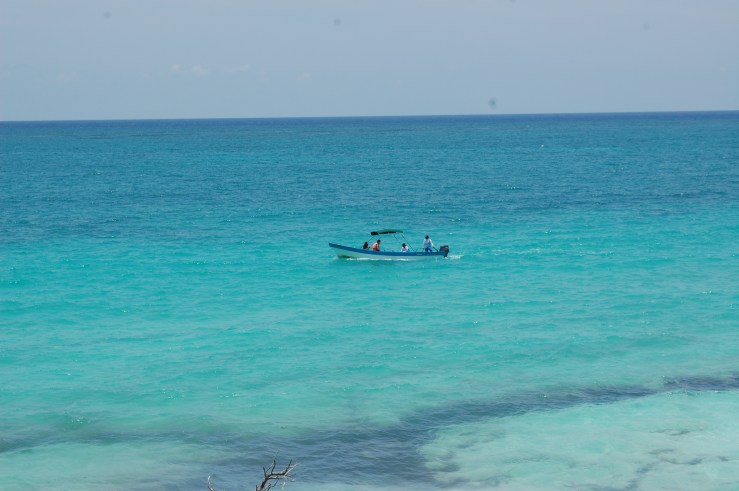
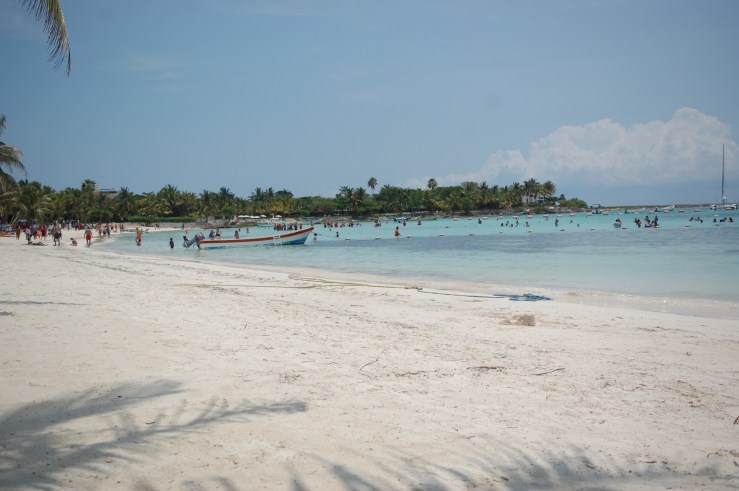
The beaches in Tulum are similarly paradisical; in fact, they are even more lovely because they have bits of a ruined city hanging over them. Tulum is also, thanks to people exactly like us, overdeveloped, but on a different scale. Beachside bungalows cover every square inch for about ten miles. They’re called things like Shalom, Ecochic, and Happy Hour. I see the word ‘spa’ so many times I start to feel like I need to lie down, shut my eyes, listen to the waves and forget about the word ‘spa’. As for the prefix ‘eco’, it loses a bit of meaning when followed by the term ‘quad bikes’. There’s also a bungalow resort called My Way, which to me makes it sound a bit like Dignitas, and actually it might be, given that this would not be a bad place at all to die.We avoid the suggestively-named Azulik, which is ‘clothing optional‘.  Once again my brain is bothering me for words to describe the colour of the water, so I trick it by taking this photo:dsc_0583
In the evening we go to a friendly German-run bar and I pick up the local newspaper. In addition to gruesome images and macabre details of those who’ve been shot dead for selling drugs to tourists, there’s an article about Akumal. A group of ecologists has reported that the coral reef is on the brink of collapse. Officially the site is only allowed to receive 250 visitors a day; it’s currently welcoming around 5,000 of us. On the other side of the main street of Tulum there’s a party taking place in the headquarters of a taxi sindicate called Tiburones del Caribe (Caribbean Sharks). The building is festooned in PRI banners and balloons and there is reggaeton blasting out. Like any Mexican town there’s a lot of competition for customers, but the notion that competition automatically leads to better efficiency is once again disproven by the fact that at the end of the night it takes our taxi driver 25 minutes to find our hotel, which is five minutes’ walk away.  Later I read about a number of assaults on tourists, and the smashing-up of cars from opposition companies. Mexico provides a lot of support for the argument that war is a continuation of capitalism by other means.

In Tulum we find it hard to track down anywhere interesting to eat. Being British in Mexico and complaining about the food is perhaps a bit incongruous, but we are, after all, kind of double foreigners here in that we live in Mexico City and the range of restaurants on offer in Tulum doesn’t begin to compare. The first question people ask us about DF (as everyone refers to the capital) is ‘is it dangerous’. Not for us it’s not, we say, smugly. Not in terms of crime, at least, although in environmental terms the city is some ways hanging por un fío. Mexico abounds in confirmation that cities can collapse, whether thanks to invasion or a range of factors. The Mayans in Yucatan were nearly wiped out by a massive prolonged drought. Although it’s not politically correct to say so, their climate changed and so their civilisation collapsed**. That can happen. In Mexico the term ecocidio is increasingly being used to describe events like that in Cancun, when an entire Mangrove forest was destroyed to make way for more tourist developments. Jared Diamond dedicates a substantial portion of  ‘Collapse: How societies choose to fail or succeed’ to the fate of the Mayans, who hung on for several centuries when the natural resources they had relied for millennia could barely sustain them any longer. The lifespan of their civilisation may have been shorter had they had millions of Volkswagen-driving hypocrites like us to provide for.dsc_0597

*I don’t know if it was the guy walking up and down with the speaker.

**Yes, I’m aware that I’m challenging the notion of ‘politically correct’ is. Here’s an experiment: ask the next human being you see ”How worried are you about climate change?’. They’ll almost certainly change the subject very, very quickly. 

Learning Metaphors lesson – good fun and very useful

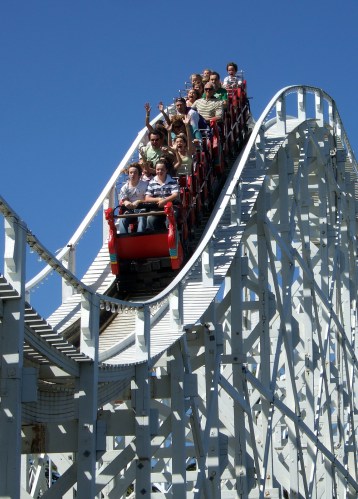
luna_park_melbourne_scenic_railway

You’re a teacher. You’re in a classroom, and you’re teaching a class. But where do your students think they are? Do some of them feel like they’re in prison, while others are just hanging out with their mates and having fun? Is there anyone who feels like they’re in a courtroom, or that they’re being experimented upon? This is a great activity for helping your students reflect on their experiences of learning English, and also for you to find out what they really think of your classes. It should take around 30 mins. You can try it with high pre-int upwards, and as you’ll see it can easily be extended into all sorts of other activities.

Procedure

Stage 1: Briefly tell your students about a classroom language learning experience you’ve had. It could be good or bad, but make sure you compare it with something, e.g.: being in the army, being back at primary school, being on trial…put them in pairs and tell them to compare similar experiences. After 3 minutes, gather a couple of experiences, encouraging them to think about what it was like, e.g.: “sounds like being at a party!” or “sounds like a disco!”.

2. Tell your class they’re going to look at some metaphors for learning English (make sure they understand what a metaphor is). Tell them you’re going to start with a memory game: you’re going to show them some photos and you want them to try to remember all the things they see, and then write down all those they can remember.

3. Silently show them this presentation once.

4. On their own, then in pairs, students write down all those they can remember.

5. Show them this and let them write down the ones they missed.

6. Clarify any vocab issues and make sure they’ve all got them written down.

7. Write up on the board:

‘A classroom can be like a ___________ because…’

‘A classroom should be like a ___________ because…’

‘A classroom shouldn’t be like a ___________ because…’

8. Make sure they understand the difference between the three phrases. Give them one example for each. Try to use places which were not in the presentation.

9. Students in pairs write sentences. It works well if they write each one on a post-it note, if you have any. (10 mins)

10. Student stick their sentences up on the wall, walk round reading the others and ticking the ones they like. If they don’t understand one of them, they can seek out the pair who wrote it and ask them what they meant.

HW: If you and they like, they could write a paragraph or short essay on ‘the ideal classroom’, using the ideas they’ve come up with in class.

Çok kolay!

Donald Trump is going to snap very soon, and here is how I know

curbtbewiaaaj0h

I believe that rather than smashing our own glass houses to pieces in the act of destroying Donald Trump’s Presidency, we need to be aware of our own inner Trump, to reflect on our own tendencies to think and behave in catastrophically immature, venal and insecure ways. I therefore offer up this short account of my own personal emotional development, and then explain why I think it helps explain why Trump is heading for a breakdown very, very soon.

I used to suffer from a quite disabling insecurity, particularly when it came to things like being creative and forming relationships with other people. I got better, partly by virtue of living in and studying Portugal, learning about its people’s tendency to swing between moments of self-aggrandisement and self-abnegation, from ‘we are great’ to ‘we are nothing’. I also learnt about my own habit of projecting my own feelings onto others, both people and countries. The work of the Portuguese poet Fernando Pessoa showed me that we’re all characters on a stage acting out different roles, and that that is okay. I identified strongly with the philosopher Eduardo Lourenço’s diagnosis that Portuguese people tend to suffer from taking on too many identities, and I took enormous inspiration, consolation and guidance from his insights that Portugal is ‘marvelously imperfect’, ‘no worse and no better than anyone else’, and that progress comes from accepting one’s limitations.

Living in China taught me to accept the existence of other perceptions of my own identity, even if I feel embarrassed about it, particularly in terms of my national identity. Everyone has one and I can’t let the fact of my British or Englishness inhibit me unduly. Writing about my misunderstandings of Chinese society and about my role there helped me accept that I, like everyone else, have an ego, and also that I can use writing as a vehicle for making connections between things and to help find people who’ve noticed the same things, who share my perspective. Spending time with a Lacanian psychoanalyst in London helped me develop confidence in my own voice while also teaching me about the foibles of my tendency to overthink. I got better (although not necessarily good) at identifying and cultivating friendships with other people. I met the woman who later became my wife, who loves me for who I am rather than who I pretend to be. Through my job I became better at listening to people and more accepting of others and myself. I learnt that honest self-reflection is a more effective medium for personal development than alcohol is. Through acquiring other languages I discovered that learning is one of the things I most enjoy and value about being alive.

I still screw up, as we all do, but I accept that doing so is part of life, and when I do or get something wrong I try to apologise without fear or recrimination. I know that I’m not mad in any meaningful sense. I accept that I have some ability to write entertainingly and insightfully, and I have less fear than I did before of saying what I want to say. I have a wonderful editor in my wife and I accept that I sometimes miss things and perhaps expose some parts of myself to criticism and ridicule. I know that what I write doesn’t and doesn’t have to please everyone. I accept that everyone is fallible, and that it takes hard work to produce writing of quality. Sometimes I don’t put in enough hard work, and that’s my fault. I try hard not to depend emotionally on the responses or lack of responses to what I write. In a nutshell, I’ve matured, to the point where I can now face the prospect of becoming a father, something which, say, 15 years ago was (so to speak) inconceivable.

All this means that I understand something of the fragility of Donald Trump’s ego. Having struggled to maintain friendships in the past, I can see how Trump can get to a point where he has, according to a piece in Newsweek based on several months spent around him, no close friends. As I’ve acknowledged before, it’s essential for us to have the humility to recognise that we don’t have the ability to diagnose Trump at a distance. But that there’s something of the manchild about him is inescapable.

These first two days of his ‘Presidency’ saw paranoid and recriminatory tweets, a speech to the CIA in which he ranted bitterly about media reports of his coronation, and his press spokesperson being sent out to deliver another paranoid self-pitying rant. People are mercilessly taking the piss out of the piss-poor attendance at his pitiable inauguration, and Trump appears to be following every single one of them on Twitter. It’s clear to me that whatever means he’s used to survive up until this point aren’t going to work in his new role. There’s simply too much scrutiny and ridicule, and it’s going too deep. He’s too much of a shallow narcissist to ignore it. Trump is going to learn the wisdom of Jacques Lacan: “the madman is not only a beggar who thinks he is a king, but also a king who thinks he is a king”. Whatever monster he has buried in his mind is going to rise up to bite off huge chunks of him from within.

Trump is famously hostile to the notion of learning: no-one has anything to teach him. He was born rich, and that means he’s a genius and that everyone must respect him. He appears to have no ability for self-reflection. The mirrors he has in his mansion may be framed in gold, but he’s never been able to bring himself to look into them for more than a few seconds. Instead he’s surrounded himself with people who tell him what he wants to hear, who repeat back to him his inner mantra: you’re the richest, the best, the greatest writer, builder, statesman, etc etc etc. But it’s his inner voices that are the problem, the ones that tell him that he’s nothing, a failure, that everyone sees him as a joke. The ones that (presumably) sound a lot like his father.

His tweets in particular reveal that at some level he knows that his self-aggrandising self-image is hollow and brittle. So he lashes out, including physically. And it’s getting worse. People are laughing louder. He’s now put himself in a position where the entire world knows that he is venal, insecure, stupid and deluded.

He’s become in two days the paranoid and deluded ruler of so many novels by Latin American and African writers. Usually this point is reached after several decades of rule and the imposition of terror and a cult of personality. He’s the kind of leader that the U.S. has imposed on so many other countries; there is an element of chickens coming home to roost. He obviously took enormous consolation from his media image, the idea that he was ‘America’s CEO’. He believed this and seems to have internalised it, but is also taunted by a nagging awareness that it was little more than a joke, a stupid slogan to sell a TV show. His supporters may not know that, but some will learn. He’s already starting to turn some of them against him. As he attacks their standard of living and doesn’t have the political skills necessary to calm their anger, they will see through him to the delusion, insecurity and vanity within. He’ll have no more dgefences and will be unable to hide from the stark fact that his flatterers don’t respect him. Putin in particular is evil but not stupid. He knows that Trump is an absolute moron. And he can’t control that smirk of his.

Lacan said that what matters in psychoanalysis is not so much what the client says, but what falls out of his pockets while speaking. Trump appears to have absolutely no idea what he has in his pockets, and now everyone on the planet is picking up things, inspecting them and telling him what they are. They are teaching him things about himself that he cannot bear to learn. He also knows that he is President in name only, and that’s not enough to sustain his ego.

He will snap very, very soon.

Our job is to increase the tension.

New post: ‘Trump is going to snap -a rejoinder’.

TWO YEARS ON: I guess (and there’s a great deal of guesswork in this piece) that I underestimated how tenacious Trump would prove to be in his pretence of being President. More importantly, I failed to predict how slavishly and irresponsibly the mainstream media would collude in that pretence.

Self-delusion 101: Conversation with a climate denier

internet-troll

There are several Facebook groups dedicated to the topic of Climate Change/Global Warming. The ones called ‘discussion’ and ‘debate’ are crawling with trolls. Some are better: I thought the one called something like ‘Air, Water, Energy, Resources’ was more serious. This is (what I remember of) a ‘conversation’ (insofar as that venerable term can be applied to online interactions) with someone who turned out to be one of the administrators of said group, who had commented on this article which I had posted a link to. I’m posting it here not out of self-aggrandisement (I’m not exactly proud of spending time online arguing about politics with people who for all I know may be only 13 years old) but because my site (this one) has now become the object of attention from climate trolls and I want to demonstrate one central delusion of their mission to disrupt efforts to save humanity: that their opinions about climate science have any validity or meaning whatsoever. The conversation no longer ‘exists’ because I left the group immediately afterwards, but I’ve tried to be honest in recalling what was said.

Thanks for what you wrote, I think a lot of it is wrong but I respect your right to say it. You’re very sure about scientific things that haven’t been proven. Anyway, do people really deny the holocaust? I don’t think so.

They do, sadly, in fact dedicated climate trolls very often moonlight as holocaust ‘revisionists’. Have a look around. And the science was settled several decades ago, as you must be aware.

That’s not true, you can’t be sure about anything. There are many different opinions. Science is never settled.

Well, it’s not a matter of opinion. Scientists conduct and repeat experiments and the results of those experiments are published and then themselves tested. It’s not guesswork. Anyway its odd that you should have chosen this particular area of science to dispute, because as it happens there’s a massive industry based on denying it, funded by the fossil fuel industry. Is that a coincidence?

I don’t care about fossil fuel companies. I’m interested in the science.

Are you yourself a climate scientist?

I have enough expertise to be a climate scientist.

I have enough expertise to fly a mission to Mars. I’m still waiting for them to call me back. Have you passed a series of exams which test your knowledge of the climate? Have you been rigorously trained in conducting experiments and interpreting their results? Has your expertise been recognised? Do you work in the field of climate science? Where can I find your work so I can see for myself?

I know a lot more than people who do.

But you’re not one. On the scale of climate scientist to internet troll, you’re way on the opposite side from climate scientist. Are you even an adult? Because it seems to me that your understanding of science is puerile.

Please be civil.

Civil? Scientists are essential to civilisation. Pretending to be one undermines the credibility of real scientists and thereby undermines civilisation. Do you pretend to be anyone else? When they say “is there a doctor on the plane?” Has anyone died as a result?

I’ve never pretended to be a doctor.

Well done. That’s really commendable. Look, I’ve just googled your name. This is what came up. You’re not a climate scientist. You may be just a schoolchild. I don’t want to be too hard on you, but get yourself another hobby. This issue is far, far too important to play these kinds of games. And I’ve got a word for you to learn: agnotology. I’ve googled it for you. It means the deliberate spreading of misinformation and uncertainty. That’s what you’re doing. Please, please stop.