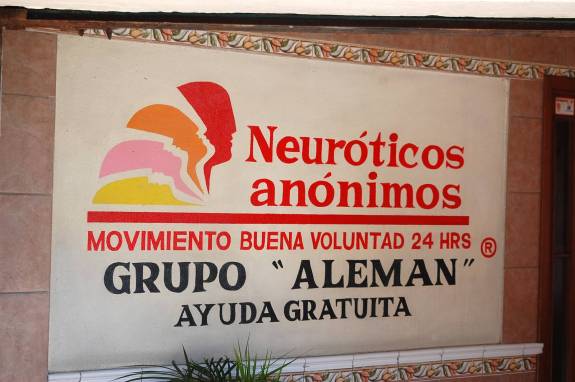
 I don’t know how many German-speaking branches of Neurotics Anonymous there are outside the Bundesrepublik. There’s probably a couple in Austria, and possibly a Geriaticneurotikenanonymous in Paraguay, but that’s beside the Punkt. We were surprised to find one in Oaxaca, Mexico. For a moment I was tempted to go entlag to one of their meetings, but I was visiting the city on holiday with my wife, herein known as Ch, who, despite my very best efforts, does not sprechen sie Deutsch, and in any case mein Volkabeln isn’t quite up to the Mark. Plus I’m not neurotic. Wirklich.
 Everybody loves Oaxaca. The first thing that Mexicans talk about whenever the place is mentioned is the food, which is indeed delicious and hard to find good versions of elsewhere. Mole is the most iconic dish – it’s actually a family of dishes of immense complexity. Coloradito, the one most associated with Oaxaca and also the most picante, is made with 36 ingredients, including chocolate, chillies, fruit, nuts, spices of various kinds, pumpkin seeds and about, er, 28 other things. Vanesa, a Oaxacan friend of Ch’s who we met up with in Mexico City shortly after we arrived, got very excited when telling us about all the eating we’d be able to do on our holiday, and then very angry when she moved on to tell us about los maestros – the teachers. Of whom more later.
Oaxaca (pronounced waHAca) is the name of both the city and the state. The latter is vast, and cut in half by mountains. After we leave the city it takes us 12 hours by bus to get to Puerto Escondido on the coast and it’s only 85 miles mientras el cuervo vuela. The rugged terrain isolates communities, which means that Oaxaca is the country’s most ethnically diverse state, with an indigenous population of 48% (mostly Zapotec and Mistec), the second highest in Mexico after the Mayan Peninsula, where most of the population are…Welsh (just testing).  A wander around the Museum of Culture testifies to this. ‘Oaxacan’ culture unifies all sorts of traditions with their own belief systems, cultural artifacts and artisan technologies. The many local markets and the makeshift stalls spread on the ground in the town’s squares by people from often distant villages show off handcrafted and painted wooden sculptures called alebrijes, and intricately woven and brightly dyed tapetes, huipiles, sarapes and the ubiquitous rebozos. Some of these artefacts we have seen elsewhere in Mexico, but we get something of a surprise on entering the adjacent church and former monastery of Santo Domingo de Guzmán when we see an image of someone we recognise from home (see photo). It’s by no means the only connection Jeremy Corbyn has with Mexico. His wife, Laura Álvarez, is a human rights lawyer who also runs a business importing chocolate made by indigenous communities. Little else is known about her (except, presumably, by him), so it’s not completely beyond the realms of possibility that she did some sort of deal over local produce and insisted that a stained-glass window image of her husband be installed as part of the agreement. Certainly there is no shortage of chocolate and chocolate products on sale in the UNESCO-approved colonial centre, along with hundreds of varieties of mezcal, of which I sadly only get to try about half.
In the Zócalo (the main town square) most of the people selling things seem to be of indigenous origin, and so do most of the people protesting. The centre of the plaza has been turned into an Occupy-style camp. These are the famous teachers. I’m still trying to clarify what the situation is with them as their activities inspire a considerable amount of revulsion and rage amongst Mexicans I’ve met elsewhere. Reading their banners and the sheets they’ve hung up setting out their case and briefly chatting with some of them helps to make things clearer. Their movement, led by the dissident teachers’ union CNTE, has been fighting for decades for decent wages and proper schools and over the years their struggle has to some extent become instituionalised, particularly under the leadership of the phenomenally controversial Elba Esther Gordillo. One key date in the long history (detailed here) was May 2006, when police fired on striking teachers in Oaxaca. This led to a seven-month state of siege in the city. State forces unleashed massive repression, which to some extent continues – police vehicles armed with enormous machine guns are a regular sight around the city centre – and was stepped up in response to furious protests after 43 poor indigenous students from the neighbouring state of Guerrero were kidnapped, tortured and murdered by the army in September 2014. More recently teachers from Oaxaca, Michoacán and Chiapas have been striking and protesting against President Peña Nieto’s asinine education reforms, which seem partly designed to provoke and destroy the unions; they also attempt to sabotage the carrying-out of elections by attacking and burning polling stations, and very regularly sequester road-toll booths and block major highways. It is this kind of action which enrages locals like Vanesa, who are simply unable to go about their daily lives as a result. I sympathise with the frustration of people like her – I have never had to live with such massive and constant disruption. But I also grew up in a country with a decent school system where there were properly-remunerated teachers, plentiful materials and classrooms with roofs. Plus I’m aware that at least some of the opprobrium towards the teachers is at least related to racism; that certainly has been the case among members and supporters of successive national governments. This is one of those issues on which I have to bow to the greater wisdom of people who properly live in Mexico.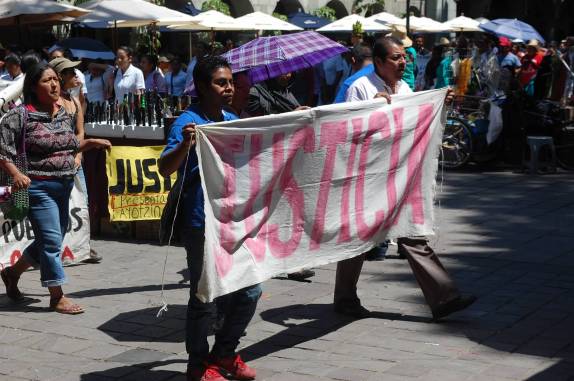 So, Oaxaca is a complex place. Maybe a third eye would help make sense of things. In the market I buy a t-shirt featuring an image of Maria Sabina, the Queen of Mushrooms. She became an international celebity in the 1960s, attracting seekers of ancestral cosmic wisdom such as (it was rumoured) Dylan, Lennon, Jagger and Richards. She herself wasn’t impressed by the hordes of new arrivals. She was a curandera, for whom the point of taking psilocybins was not to find the divine but to heal sickness. Although we don’t visit her
  village, it is still on the tourist trail – every time I wear the t-shirt over the next few months, from Havana to Angkor Wat, I receive masonic nods and winks from those who share my apparent knowledge of arcane hallucinogenic rituals. We do, however, end up taking a trip: a bus excursion to Monte Albán to look at Some More Pyramids. We are lucky to be assigned a tourguide with some alternative theories to explain why some of the stone carvings depict people with deformed limbs, the upshot of which is that archeologists are all liars, historians are full of shit and we ourselves are a bit thick and should go to infowars.com if we can bear to learn the real Truth about the world. We also visit the jaw-dropping petrified waterfall and the hot springs at Hierve l’Água. Afterwards we share a collective taxi with some other tourists in order to rejoin the main bus. Halfway along an otherwise deserted track, the truck comes to an unexpected stop, and a representative of a small contingent of men requests that we all get out of the vehicle and into another one with no immediate explanation. Some of us start to suspect that something a bit kidnappy might be underway, but thankfully the new driver reassures us, explaining that the place where we got out marks the boundary between two taxi concessions, and that there have been ‘problems’ in the past when drivers from one village have encroached on the other’s territory. This makes me wonder if the preponderance of recovery groups in Mexico might be somehow related: perhaps one cartel controls all the Narcotics Anonymous groups in a given town and another armed gang rakes in the income from the meetings in the adjacent pueblo. I can’t imagine that such a situation would be particularly good for anyone’s sense of serenity.
 After we’ve tromped up and down a fair few pyramids in the 40 degree heat, taken more photos than we will ever have time to look at and visited enough artisanal workshops to last the lifetimes of several Aztec gods, we are all keen to get back to Oaxaca, sink a couple of mechiladas and echar una siesta. So we’re delighted to hear we’ll be taking in one more attraction: we’re going to see some black pots being made. The black pots turn out to be useless, at least for their primary purpose of containing liquids. If you put water in them, it apparently goes all murky and you can’t drink it. They are nonetheless very pretty decorative objects, with their black sheen achieved by polishing them before firing them. Oh. It turns out that I am the only person in the world who finds pottery boring*. Everyone else wanders round the shop cooing at the crockery on display, or at least they do until the heavens intervene. Unfortunately the shop is open to the elements, which is a shame because the elements are in a very bad mood; like us, they’re probably a bit tired and just want to be driven back to the hotel. They descend on the place and smash bits of it to pieces while we cower in the corners and try to avoid getting lacerated by shards of falling pottery. In fact the weather gods have done us a major favour, because as soon as the torrent ceases we wade across the car park and get back in the van.
There’s a limit to what we can see in and around the city in three or so days. You could easily spend a month in Oaxaca State and not even get round to a third of the places you are recommended to visit. It is the fourth most visited state in the country, and also happens to be the second poorest, with 76% of the population living in extreme poverty. In my English language examining job I often pose this conundrum to candidates when the topic of tourism arises. It suggests to me that tourism is not a good or fair strategy for developing a region. Oaxaca does not suffer from a lack of promotion or even a shortage of visitors, and it’s rich in terms of both natural and cultural resources. It has a range of outstanding natural landscapes and no shortage of well-preserved ruins reflecting its historical complexity, the range of civilisations that have existed there. However, while most images of Oaxaca depict things of indigenous origin, whether archaeological sites or local products, in tourism-related jobs indigenous people themselves are rarely seen. This must be partly because of racism, but it is also clearly related to education. People whose schools do not have books and roofs are far less likely to acquire the skills necessary to obtain such jobs. Compared to a national average of 26%, only 5% of Oaxaca’s indigenous population reaches middle or higher education. There is also the question of who has money to invest to take advantage of all the visitors. Most mid-range places we stay in happen to be owned by foreigners, and at the level of higher-end tourism, it’s international money that dominates – indeed it often physically displaces both local investment in addition to causing the eviction of local people and the destruction of natural environments. A recent and spectacular example of the latter were the mangroves in Cancun. Where tourism does create jobs for local people, they tend to be of poor quality – short-term, badly-paid and often very exploitative. Betting on tourism as a development strategy also has an opportunity cost. It replaces other forms of development and means that everything is valued in terms of its potential appeal to visitors. This is something I hear all the time in IELTS exams, regardless of the topic: parks are good because tourists like them. National cinema is useful because it promotes the country and might encourage tourists to visit. Museums and galleries are important because tourists seem to like them. The success of this ideology is demonstrated by the fact that to many people it seems to be a natural way of thinking, a common sense point of view. Drawing people’s attention to the fallacy of it (not exactly my job, but what the hey) is like the joke about one fish remarking to another on the temperature of the water. It’s an ideology which lends itself to exploitation by private interests. In ‘The Shock Doctrine’ Naomi Klein detailed how after the Asian tsunami of 2004 fishermen along the coasts of Sri Lanka and Thailand were displaced by hotel developments. In the case of Mexico, we learn of a similar situation towards the end of the film ‘Y Tu Mama También’: the young family who the three main characters have become friends with on the beach (filmed in Huatulco, Oaxaca) will soon be forced to leave their beachside home because of a new holiday resort. The same dynamic is in operation around the world, and not just along coastlines, but also in major cities, as the urban geographer (and my personal friend) David Harvey explores in some detail here. As he explains, tourism is a great product for capitalists to invest in because, unlike a vacuum cleaner or a mobile phone, it is instantly and infinitely consumable, with no product cycle. There is no limit to the amount that tourists can consume. Meanwhile local people are locked outside this endless festival of superfluous consumption, and in many situations are left with no other available means of survival but to sit on the pavement and try to sell whatever they have to the tourists. As for how people excluded in this way feel, Jean ‘Binta’ Breeze tries to put herself in their huaraches in her brilliant poem ‘Third World Girl‘:
Jean ‘Binta’ Breeze poem: ‘THIRD WORLD GIRL’ from Tilt Spoken Word on Vimeo.
The poem also addresses cultural appropriation. Oaxaca is important to Mexico in a similar way to how the Northeast is important to Brazil. In both cases the region provides symbols and icons which are central to national identity, and in both cases the people of the region are amongst the most deprived in the country. One such Mexican national emblem is the rebozo. In summer 2015 the Franz Mayer Museum held a special exhibition on Frida Kahlo’s use of the garment, titled, revealingly in English, Made in Mexico**. (The same exhibition had been held in London a year earlier). We learn from the information on display that this outfit is “one of the feminine Mexican garments par excellence … it has (much) meaning in the creation of the identity of women and the country.” The text that introduces the exhibition does not speak mainly of the rebozo, but of national identity:
‘Mexico is a rich tapestry in which multiple threads are interwoven. Its long and tumultuous history, from the ancient pre-Hispanic towns to the modernity of its urban culture, has brought many influences and ideas to the country, adapting to a cosmovision and way of life singularly Mexican. The decorative arts, an integral part of Mexican culture, reflect the intersection of traditional culture, colonial legacy and contemporary and political life. The rebozo has been – and continues to be – a resistant emblem of Mexican identity.’
In the words of Subcomandante Marcos of the Zapatista Army of National Liberation, what the Mexican state and its elite values is not its indigenous population, but an image of it. It then sells Mexico on the global market using images of indigenous people and indigenous products, but denies the people themselves the education that would give them the chance to exploit those things for themselves if they chose to do so. It’s comforting and flattering to think that our visit to Oaxaca helped develop the region in some small way. We certainly found it a deeply enriching experience. But I don’t believe that tourism is a equitable or sustainable way to develop a region or a city. Social and economic policies should focus on improving the living standards and human potential of the people who live in a particular place, and not the experience of those who are merely there on holiday. To which I suppose the only logical corollary is: if I ever go back to Oaxaca, I very much hope that I have a worse time than I did on my first visit.
* José Saramago’s novel ‘The Cave’ (which I also mentioned yesterday, oddly enough) is partly an essay In Praise of Pottery. Those bits of it are profoundly dull.
** I wrote a piece in Spanish about it in Spanish here (it’s in Spanish).

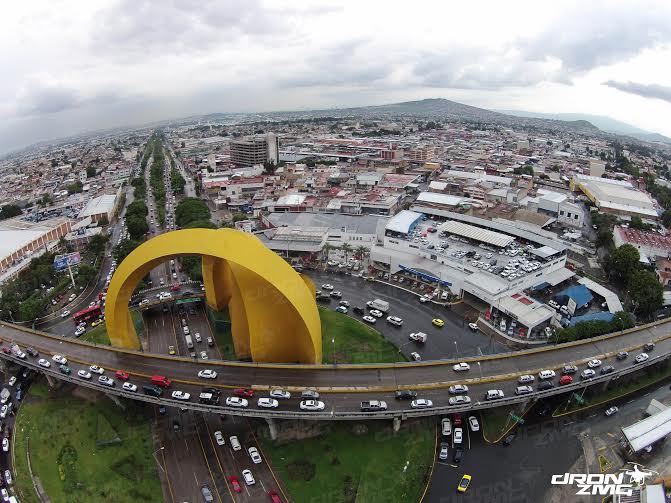 Across the doors of the lift in my hotel in Guadalajara there is a huge peel-and-stick painting of someone’s idea of a blue-sky palm-tree paradise, but where you might expect to see golden sands and sunlounges, what greets your eyes instead is a Burger King concession next to a huge line of cars. The good people of Guadalajara, it seems, enjoy their traffic jams. They are also fond of shopping centres, and of the car parks that must therefore surround and lie underneath them, which is why in search of an actual bar it takes me about half an hour of hard work to find one amidst the Walmarts and VIPs and Chili’s and VIPS and Chili’s and VIPs and drive-in Walmarts Walmarts Walmarts. The entire landscape in the area where I happen to be hotelled is composed of shopping centres, megamarts, car showrooms and names of stores in six-foot writing designed to be read by people speeding past or more realistically biding time in embotellamientos. It’s on another scale from where we live in Mexico City. The city is effectively unwalkable and the only places I can find to eat without giving up and joining the traffic are restaurants rated for their parking rather than their food. It doesn’t help that Guadalajara is immense and it takes 45 minutes to get anywhere fun even by car – it feels strangely much larger than DF. It’s the kind of hyperalienating environment which José Saramago deplores in ‘The Cave’, a place which is, in the words of Frederick Jameson, ‘useless as a conduit of psychic energy’. It puts me in mind of Cabot Circus, that huge alien spaceship which has obliterated the centre of Bristol. There’s nothing new about such an environment and there is little to say about it that authors such as JG Ballard, William Gibson and Will Self haven’t already written. But my individual experience of it is inevitably physically and spiritually exhausting. 20th Century modernity became fixated on the private motor vehicle and the 21st Century shows no signs of moving on despite its own terminal obsession with the smartphone. Who cares about a three-hour bottleneck when you can sit in your car and text. It takes me three attempts to get to the centre using public transport and my feet; eventually I give up and take a taxi.
 I always learn a lot from Mexican taxi-drivers, about politics and the ins-and-outs of gang wars. Asking about who controls the city (and which politicians they are in league with) starts to feel a bit like asking how the local football teams are faring. In Guadalajara there has recently been a low-level war between two mafia groups and now things are (ostensibly) relatively calm because one of the sides won. For taxi drivers in Guadalajara the theme of violence and politics is intimately connected to their jobs and to the increasing dominance of one particular cartel known as…Uber.
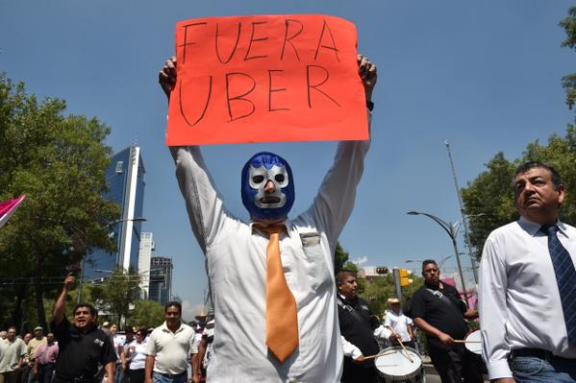 In addition to the damage it does to the livelihoods of working people, there are several reasons why using Uber makes me so uncomfortable despite its obvious advantages in terms of convenience and (ironically) comfort. It’s useful to take the name seriously. Uber provides a comforting and flattering sensation of belonging to the elite – in
  When we pay for special treatment what we are paying for is an enhanced image of ourselves. This is the ‘added value’ that companies are desperate to add to their products. This cultural tendency to fantasise ourselves as superconsumers partly explains the appeal of figures like Trump and the Kardashians. Trump in particular lives a fantasy life of a fantasy billionaire, and by taking Uber we also partake in this roleplay. This aspiration-as-pure-fantasy is what capitalism is increasingly betting on. An
  When I do at long last get to the centro histórico of Guadalajara its beauty and charm stupefy me; I’m glad that on this third and final visit I finally made the effort. The colonial heart of the city was designed, set out and built specifically in order to ridicule any humble attempts I might make at describing it. Jalisco es Mexico is the slogan used to promote the region and the symbols and bright colours you see emblazoned all around insist on this, as do the ubiquitous mariachi music and the incessant invitations to try out the local tequilas. In a tiny sundrenched plaza called Nueve Esquinas I gorge on birria, the ingredients of which are one entire dead goat boiled in its own blood, four different kinds of chilli, and about two litres of my own sweat, as the local beer and a shot of the regional moonshine sieve right through my hair back into the bowl and so I promptly grab some more tortillas, dive in and perform a perfectly executed Mexican version of La Scarpetta. Afterwards I walk around in a daze in the blistering heat and take a hypnogogic doze on a bench. It’s all too much to take in, and I don’t want to have to deal with the tedium of rush hour, so I take a taxi back to the hotel with a driver called Alberto who comes from Monterrey and whose girlfriend is scheduled to give birth to twins any day now. It’s a high-speed, bumpy but convivial experience soundtracked by norteño music a un volumen ensorcedor. Addled as I am with goodwill, goat and agave I offer to do a deal over the price so I will pay double the pittance I am charged and then claim it back from my employer. I try to explain the phrase stick it to the man, for which I’m sure Mexican Spanish must have range of equivalents, but only confusion results and I decide it’s probably about time for another siesta.


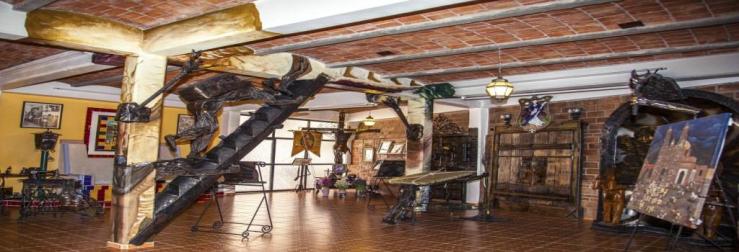 Talking to him I am reminded of Fitzcarraldo, or any number of mad semi-mythical geniuses who headed south, grabbed machetes and gouged out their visions in the tropics. The sprawling establishment has a lot in common with the local churches in that there is silver and steel everywhere, but the decorations do not depict angels or edenic scenes, instead they consist of rather macabre, twisted metal sculptures. It looks like a workshop where the stage set for the new Iron Maiden world tour is being welded and hammered together.
 Are we ready, Chiara asks.
 It’s a bright blue Monday morning in mid-October 2016 and I’m standing at the corner of Via dei Gracchi and Via Alessandro Farnese in the centre of Rome, having just left work. I’m partly waiting to cross the road and partly trying to get fivethirtyeight.com to load on my phone. There’s a guy in a car looking at me, stopped at the traffic lights on this quiet street, shouting and laughing. At first I don’t think he’s talking to me, maybe on his phone or to himself. But no, it’s me, he’s beckoning me over, and he seems to know my name, so I must know him, but I feel bad because I have no idea whatsoever who he is. He looks very Italian, in a slightly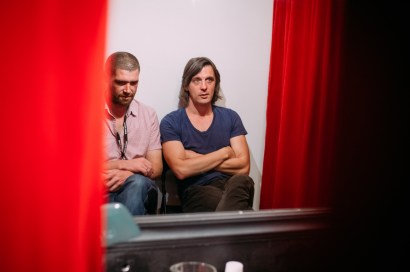

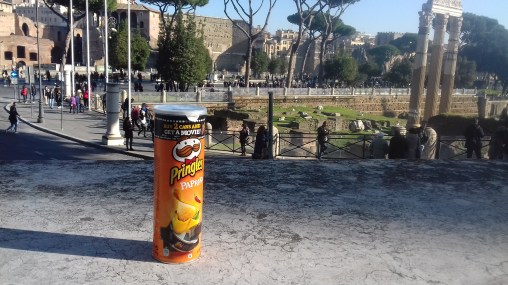

 What I’m trying to do on this site is make links between things I haven’t seen connected together elsewhere*. Hence the links themselves are usually more important than what I have to say about them. In the last couple of days I have come across three things which I think vindicate (albeit, inevitably, in an infinitely more coherent and detailed fashion, one based on research and careful thought rather than guesswork and ‘affect’) the thoughts I’ve been trying to articulate over the past few weeks. First there is
  Infinite Coincidence
