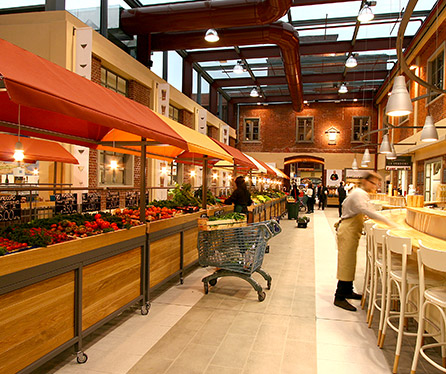
Ecco perché Eataly non mi piace

01_torino

Wouldn’t it be great if someone could combine the range and quality of Italian food with the style and convenience of Ikea? No, it would be shit. How can I be so sure? Well, I’ve been to such a place, and I also live surrounded by images of it. Eataly is marketed rather aggressively here in Rome – entire metro stations are smothered with adverts for the place, leaflets litter the streets, and while it may be true that all roads eventually lead to Rome, in the città eterna itself around a third of the road signs direct you to Eataly Ostiense.

The founder of the company is a friend of perma-gurning Flash Harry past-but-not-future Prime Minister Matteo Renzi. Oscar Farinetti is an odd character, who stresses the importance of local food culture but has also defended Coca Cola and McDonalds. His company only started in 2007 but already has 28 stores in six countries, 18 of which are in Italy. The flagship Ostiense branch occupies a huge building (a former air terminal) 170,000 square feet in size. It is an upscale food court mixed with Whole Foods or Waitrose. Farinetti was inspired by the thought that “unfortunately the world of small food shops, those small places dedicated to quality food, like Americans imagine, died many years ago”, a dubious statement but one that serves a self-serving and self-fulfilling prognosis – there would be more independent food outlets in Rome were it not for Farinetti’s mission to replicate and supercede them. Italy doesn’t have many chains but Eataly is starting to be as dominant as Starbucks is elsewhere.

The Eataly brand is selling lifestyle just as much as convenience. What it trades in first and foremost is the experience of being the kind of person who shops there. Hence the tone of its advertising is aspirational and (as befits any place associated with Renzi) smug. The atmosphere is anodyne, sterile, antiseptic, the kind of non-place Frederic Jameson characterised as ‘useless as a conduit of psychic energy’, an example of the nicely-packaged and air conditioned but ultimately boring future that J.G.Ballard predicted. Paradoxically, given that it has replaced a large chunk of the centre of Rome, it’s not easy to get to; as the New York Times wrote, it’s not designed for people arriving on foot. I’ve yet to get there from Piramide metro station without getting lost at least twice. Parking is a central selling point, meaning for those who live nearby, even more unsustainable levels of traffic. Rome is one of the world’s greatest walking cities, but this is a big box mall is just as remote from the pavements and piazze of Testaccio as a mall in the LA suburbs.  And given the sheer quantity of produce on offer (no reflection of the range) it is not at all clear what is quality and what not.

Rome has a dearth of food markets. The one near us is friendly but small, and the one in Testaccio, near Eataly, is pleasant and varied but under-occupied. There is a larger market near Termini station (Mercato Esquilino) which is bursting with immigrant energy and variety, but longer-standing homegrown equivalents are scarce. As it happens, the first Eataly was in Torino, also home to one of the most vibrant markets I’ve ever been to, whose atmosphere was earthy, foul-mouthed, and sometimes abrasive, the vendors not there to impress you or to sell you an image of yourself. Such a place exists because it exists, not because some tycoon with political connections decided to remake the city according to their megalomaniac vision.

The experience reminds me of the surprise I felt in 2001 when it turned out that a Portuguese student’s ‘favourite restaurant’ turned out to be in a shopping centre. Nowadays, with Giraffe and Carluccio’s and Zizzi’s and Wahaca and Las Iguanas and Viva Brasil and The Real Greek and Wagamamma and Yo! Sushi, it seems that many cities are, to recall Karl Marx, in chains (with London the most obvious example) . It can sometimes be hard to tell the difference between local and corporate, with many global cafés imitating the stylings of independent outlets. It took us a few months of living in the Condesa area of Mexico City to realise that many of the cafés and resturants were replicants of places in Polanco, a similarly safe-but-kinda-dull part of town. It was disappointing to see that the recently-revamped Cardiff Bay only offers the same eight or nine international chains one sees everywhere from Bangkok to Bangalore.

Eataly thus exists on the Uber GPS map of Rome, disembedded from the city itself. It depresses me that visitors go out of their way to come here. Rome may be messy, disorganised, inconvenient and occasionally overpriced, but it is Rome, not some branded and airbrushed simulacrum of itself. Its fascination partly lies in its being covered in remains of fallen empires; this one, sadly, is in the ascendant.
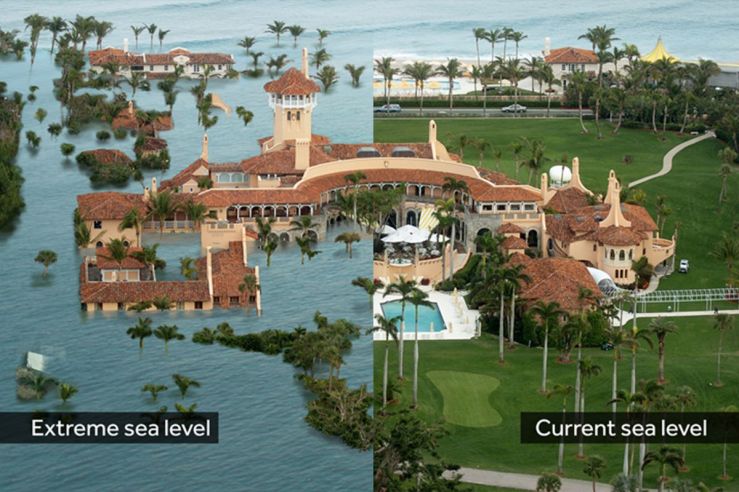
No one deserves to lose their home to a hurricane. Well, almost no one.

The question of whether or not it’s acceptable to use violence to stop fascism was resolved to the satisfaction of pretty much the entire human race in the middle of last century. Few in the late 1940s would have had much respect for the notion that genocide is merely a expression of the right to free speech. But if, as Patrick Mcgrath argued cogently this week, fascism is a monster which keeps growing new heads, then each one that emerges needs to be crushed with maximum force – or, as the finale of Psychoville spectacularly demonstrated, exploded.

Many of those fleeing hurricanes in Florida and Texas over the last week will inevitably have more awareness of and engagement with the problem of the changing climate than the writer of this blog. Others will, like me, be aware of the basic facts and share in the generalised but rarely-acknowledged terror at what a righteously vengeful planet next has in store. But there are inevitably many of those currently witnessing the destruction of all they hold dear who have actively dedicated much of their time and energy over the last couple of decades abusing mass and digital communication media to spread disinformation with a view to ensuring that such catastrophes would both take place and be wholly unprepared for by states with the duty and means to protect their subject populations. Many of them will even have lent their support to corrupt and venal political demagogues who have built their careers and fortunes on the spreading of staggeringly irresponsible lies  which deny the present and future suffering of millions of fellow human beings.

Many of those victims happen to be poor, dark-skinned and far away. It’s by no means an accident that the kind of scum who marched straight from 4chan to Charlottesville a few weeks ago divide their online time fairly equally between scapegoating and ridiculing foreigners, threatening and bullying women who dare to speak freely and attempting to disrupt every single online conversation about how scientific findings account for extreme weather events. Climate denial is a key component of 21st century fascism, the formal and explicit imposition of elite power through violence. (Hurricanes are extremely violent events – no wonder the manchild Trump appears to revel in their power.) Just as when those who seek to gain power by means of violence are pushed back by any means necessary, when people who have inflated their egos, boosted their careers and augmented their Paypal balances by denying the experiences of climate refugees themselves become climate refugees, who can spare them any sympathy? Of all the tragedies to be visited on the US over these few weeks, maybe the greatest, or at least the most ironic, is that Hurricane Irma appears to be steering clear of Mar-a-lago. While some may be #prayingfortexas or #holdinghandsforflorida, I’m hoping that the next extreme weather event brings in its wake a tsumani of divine justice. In the meantime, perhaps a more appropriate nickname for a hurricane ripping apart the south-west corner of the United States would be simply #RickScott.

Support Trump? Want to earn $1,000?! Here’s how!!!

Although I no longer have a Twitter account, it’s proven impossible over the last few weeks to divert my eyes from the rolling car crash dumpster fire of Trump’s hamfisted attempts at pretending to be President while hanging on to his (ahem) integrity. As things stand right now, with his entirely pathetic tweets praising protestors and protesting, he has lost, bigly, the respect of the only person whose opinion he truly cares about, a portrait of whom is apparently the only picture hanging in the Oval Office office: his KKK-supporting father*. Donald wanted so much to honour the memory of his progenitor by continuing to stand up for his white supremacist cheerleaders, but he couldn’t do it. Last night, unable to sustain the arrant sub-Alex Jones nonsense he’d been posting about ‘anti-police agitators’, he tweeted about the need to ‘heel’ America, oblivious to, or maybe secretly recognisant of, the fact that he and all he represents is the cancer that the country is trying to fight off. Trump is his own Achilles’ heal. (Although, to be fare, maybe he was actually trying to spell ‘heil’.)

Much like his verbal incoherence, Trump’s combination of limited vocabulary (like his Mexican counterpart, it appears he has never read a book) and partial iliteracy seems to endear him to his supporters, a large proportion of whom would not only put up with his spelling mistakes but actually anything  he could conceivably do (including total nuclear annihilation, but quite possibly excluding his speaking out for protests and against racism. They really won’t like that in the slightest). Maybe in tribute, his supporters’ tweets are similarly poorly composed. Uniformly so, in fact. Given that there are only 140 characters at steak, you’d think that just once one of them might produce an accurately-written post, but no. So far not one Trump supporter has been able to produce a single tweet which does not contain at least one glaring and laughable mistake.

Maybe it’s a question of motivation. After all, Trump’s political victory was the ultimate realisation of the principle that money is the only driving force in any human endeavour. Maybe if his hate-addled disciples had a gold-plated carrott dangled in front of their faces (they’re already seem vulnerable to various hypnotic effects), it might propel them to think more carefully about their spelling, punctuation and grammar. Trump’s own linguistic incompetence is not in this sense a cause for optimism, but maybe he just has too much money in the first place. Although he’d happily set fire to his own trousers for $1,000 (or its rouble equivalent), he’s not intrinsically motivated to do so. His supporters are another kettle of deplorables entirely. Lots of them could certainly do with such a sum.

I’ve decided to help out. I am offering that amount via Paypal to any Trump supporter who manages to compose an error-free tweet between now (mid-August) and Christmas. It does not have to be a work of pithy genius – a simple statement regarding current events from the standard wilfully myopic/blissfully misinformed perspective will do. It just needs to obey the basic rules of English orthography, grammatical structure and punctuation. If it were also possible to make it factually accurate, that would trigger a million-dollar jackpot bonus; however, its not feasible that any statement based on factual information could be supportive of Trump, and in any case I don’t have access to that sort of money, not being, like some, in league with the mob.

To give budding entrants some practice in spotting their errors, I’ve litered this post with several speling, punctuation and grammatical mistakes of my own. However, as always on this website, their are no prizes for pointing them out. This is, after all, merely a blog, not an official statement on behalf of the Comander in Cheif or anything like that. As for whether or not you should trust me…maybe you should look up the spelling and the meaning of the word ‘gullible’.

* Nigel “Nazi flags in 2017? Whoever would have thunk it?!” Farage seems to have similar issues with his own dad, his initials being by no means a coincidence.

** There’s also the hilarious possibility that Trump was trying to be presidenshul, viz. like Obama.

Helping your students to understand Scottish accents

One of the most bizarre moments of my teaching career was when a whole class of Portuguese students complained to the Director of Studies because they’d paid tens of thousands of escudos for a ‘native’ teacher and had been assigned a Glaswegian. The conversation in which it was explained to them that Scotland is an English-speaking country was apparently a little awkward but the cause of much subsequent staffroom mirth. If there’s one thing EFL students love more than talking about their driving tests, it’s complaining about the range of accents that people (uh?) the English-speaking world. Two popular sources of confusion are Indian accents (which sometimes smacks a bit of racism, given that India is partly (and officially) an English-speaking country, so get used to it) and Scottish wans. It’s useful but sometimes fruitless to point out in response that by no means everyone from Scotland sounds like Rab C. Nesbitt. Although doing so by first explaining who Rab C. Nesbitt is tends to complicate things still further.

I decided to take on the task of challenging the notion that Scottish accents are hard to decipher, and have enlisted the help of Glasgow comedian Limmy, who in 2006 introduced the world to a cast of inimitable characters from that deer green city. I have chosen three clips with three of those characters and prepared some compehension questions which will, with a little guidance from you the teacher, enable your students to see through the mist of culturally-conditioned prejudice and grasp the gist, the details and the subtext of the monologue in question.

N.B. One or two of the videos include(s) the occasional example of raw or vernacular language.

  1. Who was ‘Sandy’?
  2. Why did John Paul dial 1471?
  3.  What did he then tell his friend Craig?
  4. How long did he wait before calling the woman back?
  5. What did he say to the woman the second time he calls?
  6. What did the woman do to try to stop him calling her, and why doesn’t it work?
  7. How long did John Paul then wait before calling her back?
  8. What happened in the end?
  1. What was ‘D-Day’?
  2. What sort of company was BAMN Concepts?
  3. What did Benjamin send the client?
  4. What question did Benjamin ask himself?
  5. Who did he call, and what did he ask them to do?
  6. What did the people of Glasgow find graffiteed all over their city on Monday morning?
  7. What made news of the campaign go global?
  8. What were the consequences for everyone involved?
  1. What kind of event did Jacqueline decide to go to?
  2. Why did the organisers take her photo?
  3. Why did she feel awkward about what she was wearing?
  4. What happened at 8.30?
  5. How long would the partners have to talk to each other?
  6. What did Jacqueline start to explain to her partner?
  7. How many partners did she dance with altogether?
  8. Was the night out a success?

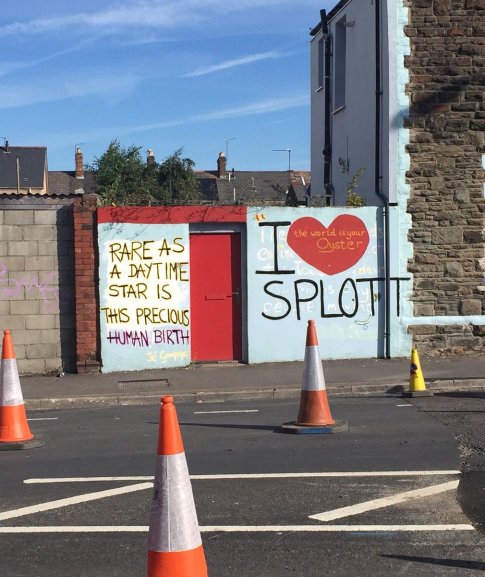
Six days in Splott

DFBWxbVXsAAwI3I
Image borrowed from @AndyReganCDF*

“Isn’t that Ninjah?”

My companion laughs. Everyone in Cardiff knows Ninjah, and when I mention him the response is always the same. As soon as I’d said that I’d be spending a couple of months here a friend of who knows the city told me I must look out for him. I listened to his somewhat madcap first album, watched a couple of videos in which he entertained people on of the city’s main thoroughfares by banging percussively on some bins, and started following his escapades on Facebook. And it is him, cycling towards us, half an hour after I arrived. I tell my friend about it and he’s surprised it took me so long to bump onto him.

The area I’m staying in is called Splott. When I got off the coach and told the taxi driver where we were going, his unenthusiastic response told me it held something of interest, and as we were driving along one of is narrow streets or tiny terraced houses I saw a mural proclaiming pride in the area. It’s clearly economically and socially deprived, but not lacking in curiosity or character. Or indeed controversy, starting with its bathetic name. There’s an apocryphal tale that it derives from ‘God’s plot’. In a more contemporary attempt to talk up where he lives, the landlord of my Airbnb place prefers to refer to it as /spləʊ/. In addition to the name, it’s got quite an involved history. Apparently a lot of Irish moved there in the late 19th century, taking refuge from the famine. Clashes with the local Presbyterian population ensued. As a legacy of that period, Splott still has quite a collection of churches. They were joined by a number of factories, including a steelworks and brewery and, at one point, a university for disadvantaged youth. Both the steelworks and the brewery shut down in the late 1970s.

Shirley Bassey grew up in Splott and started to make her name there, singing in the local pubs, of which there used to be dozens. Now there are two or three. There is very little passing trade to bolster the dwindling disposable income of the locals. When I set foot into one of them, one of the drinkers mentions Deliverance. The place in question is a amiable, run-down, drinking barn, with a handful of local men getting properly drunk to the jukeboxes and and looking forward to the karaoke on Friday. The patrons are welcoming and happy to talk, sharing tales of long days in insecure jobs.

The effect of two-thirds of a decade of ‘savage cuts’ (thanks Nick) are very visible. Local churches have regular and well-attended food banks. A couple of years ago the cash-strapped council shut down a popular swimming pool, provoking furious protests. Along with the pride, there’s defiance, as seen in the drive-by gestures of the mobility scooter owners in this locally-filmed video (directed, as it happens, by Ninah). It shows off the Magic Roundabout, which marks one end of Splott. The area is hard to walk to and around. When, on my third day, a church collapsed, the ensuing detours made it even more isolated. Still, while the tragedy ruined my sole attempt to get to work by bus, it did make it even easier to talk to people. On my way home from an exploration of the remaining local pubs (which mostly involved conversations about all the pubs which have closed), people asked me for directions, which was quite entertaining.

Splott is probably not dissimilar to a lot of smaller towns in Wales or the north of England. There may even be areas of Sheffield (my hometown) which are comparable. On June 23rd last year, Cardiff voted to remain in the EU, but I can see why Wales as a whole rebelled. Whatever Vince Cable and (oh yes!) Nick Clegg have to say on the matter, you can’t separate the Brexit vote from the increasingly dire conditions in which so many are forced to live. Splott is clearly struggling but by no means the worst. While for some life seems to revolve around the acquisition and consumption of cans of beer, the takeaways are mostly old-school Chinese rather than fried chicken, and although there are some betting shops (which may well help explain the disappearance of the pubs) there isn’t a Ladbrokes and Paddy Power and another Ladbrokes on every corner. That may well change. After all, once the safety net is torn down, people will grab at anything in the attempt to survive.

There’s quite a contrast with the city centre, which seems to have been refurbished to suit the assumed requirements of slumming premier league footballers. On a Sunday afternoon it proved impossible to find somewhere to eat that was neither a sports bar or part of a chain, those gargantuan blinged-up all-you-can-eateries which only justify the extortionate prices if you eat enough for a week. Cardiff Bay is nice to look at and from, but it’s a shame that it has the exact same seven or eight franchised restaurants, thought to attract the right kind of consumers. It’s a pity when other parts of the city have so much character.

The local market, once I track it down, proved to be one of those places which take place in a car park and specialise in cans of vehicle spraypaint and hefty bacon sandwiches. Easy to disparage, perhaps, but it’s what people most need on a Saturday morning, and you can set out your own stall for only £7 a day. It’s a shame the council clearly does nothing to promote it or to maintain the premises. The wrong kind of enterprise, the wrong kind of consumer. It seems I stood out in my overcolourful shirt (passing comment from stallholder: “I didn’t know we were in fucking Bermuda!“), because when I asked someone about other markets around town, after a couple of references to local landmarks which met with blank looks, he uttered the (for me) delightful phrase “You’re not British, are you?”. Regular readers of this blog will understand my joy on being asked this.  As it happens, I wouldn’t actually mind being Welsh, although of course I’m not really anything more than a tourist. If you want to know more about Splott, this is an excellent place to look.

https://youtu.be/bFfq9TlbkV4

Camino de Santiago: A long walk to an unexpected destination

1434977298_8281-60278181752
I did not take this photo.

In these days of diabolical heat and biblical drought I find refreshment in my memories of late August/early September 2011, when in just five days I walked in its entirety (wow!) a tiny part of (oh…) the Camino de Santiago or St James’ Way in northern Spain. I would have loved to do the whole 800km and end up in Galicia, but I only had a few days left out of my annual break from my largely inane life in London. I also, unbeknownst to me, had a date with destiny in early October, which my soulful sojourn perhaps served to prepare me for. Plus after 150km or so I had a blister so big I could no longer get my walking boot on.

I firmly recommend the Camino to anyone seeking focus and/or fun in their life. You can keep your buddhist meditation retreats, quaker spiritual awakening weekends and hallucinogenic bonding sessions deep in the Guyanese jungle: I found the whole 5-day trip from St Jean Pied de Port through the Pyrenees via Pamplona to Estella an exhilarating pilgrimage. As I greeted and was greeted by everyone I met over those five or so days, buen camino.

Being a two-legged being from a city bordered by an abundance of peaks and valleys, I’d always taken an interest in walking as a pastime, and some of my favourite books involve long solitary journeys on foot: The Snow Leopard, Exterminate all the Brutes, and The Wisdom of Donkeys. Although I’d not come across it at the time, subsequently reading Rebecca Solnit’s Wanderlust (a history of walking as a leisure pursuit, as an act of rebellion, as a means of exploring the mind as much as the world) reminded me that as a kid I would take myself off on long solitary walks to clear my head and always return home with new obsessions, the result of new paths stamped into my brain, new connections. Walking and thinking have a huge amount in common.

Although I expected to spend a lot of the camino trudging along on my seul, it turned out that I was rarely alone, but part of an adhoc community united by the ritual of perambulting through a series of pleasant settings towards a daily common goal. The act of falling into step and keeping the same diurnal and nocturnal rhythms served to bond us all together as we caught up with and were caught up by feet attached to faces that soon became familiar. In the process, legends about other walkers quickly emerged. One was of a Finn who had apparently walked all the way from Lapland without a word of any other language. It was a moment of great excitement when, having come across him in one of the hostels, I was able to introduce him to some other Finns I’d met, two psychologists from Helsinki, who later told me (in their habitually deadpan manner) that he was kind of pähkinöitä.

There was an austerity to where we all slept, in bunk beds in sometimes rudimentary single-sex dormitories. Getting used to the physicality of others was a salutary experience: the rising and falling Stockhausian chorus of smells, snores and farts. As an erstwhile revolutionary who has never done military service it made me think of the barracks of a very benign and slightly decrepid army. Particularly for those who were walking as a means of escaping the labyrinth of their own daily existence, there did also seem to be an element of very mild self-flagellation.

One of the most enjoyable aspects of the walk involved languages. I’d never had the opportunity to follow an intensive language course, and this was a multilingual ambulatory version. I spent the day chatting to Germans, Brazilians, Italians, French speakers and hispanohablantes. It’s easier to talk honestly and, it seems, accurately while walking unhurriedly, a lot less restricting than sitting on a couch or in a classroom. I subsequently incorporated this insight into my teaching, although getting students to swap shoes was never an unbounded success.

Some of the people who I met I might have taken a dislike to in ordinary circumstances. Not all the mild-to-devout Catholics I met were liberation theorists. We instinctively steered clear of topics which might put us off our stride. On the second night, sharing a quiet drink with an Irish musician I’d spent the afternoon walking with, I remarked on just how loud and annoying was the voice of a South African guy whose argument with his mum we could hear in full detail from over 100 metres away. The following day I fell into step and conversation and found him to be full of voluble wit and charisma. Such experiences became an ongoing (and much needed) lesson in not judging other people. (This blog could be taken as evidence that it didn’t stay with me for long.) We soon formed a group consisting of an Austrian woman, an English guy and two Israelis. Their friendliness and charm of the latter was something I decided to take at face value despite the fact that they were both ex-IDF and not ashamed of it. I felt that it should in some ways of a problem, but I was unsure of if and how to make it one. In almost all certainty they had done horrendous things to Palestinians, but I absolutely did not want to become infamous as the guy who stood in the middle of the path shouting abuse at those nice Israeli men. I tried to overcome my own impression of being subjected to hasbara by developing a gentle but sardonic dialogue over the politics of the situation and their part in it. Their sense of irony was bayonet-sharp, and so such attempts to broach the subject of Palestine mostly involved twisted, dark humour. Late one night I embarked on a willfully tortuous analogy involving some sheep in a neighbouring field and incursions by a notional pack of wolves. It was a briefly sobering moment, in that it was hard to see how we could continue to be friends once we’d departed from the path. Aside from their skills at blowing up people’s homes and bullying commuters, their ability to mock the absurdly overblown melodrama of the camino-set movie The Way, which they’d seen and I hadn’t, was peerless.

Away from the constant interference of phones and in a climate conducive to strolling and reflection, I thought about how other people’s weaknesses and culpabilities are so easy to spot, whereas our own tend to occupy a blind spot. I always criticise others for over-depending on their phones, or moan about my students’ refusal to talk about climate change, whereas in fact those things are largely projections of my own anxiety about my own failings. Around that time I was engaged in an intensive phase of the deeply individualistic (and not a little narcissistic) pursuit of internet dating, which involves a constant process of superficial self-examination: how do I present and promote myself to others? The experience of coming into such close proximity with a range of flesh-and-blood humans with whom I ostensibly had little in common was one I found therapeutic. Unlike so much of online life in the attention economy, there was nothing competitive about our interactions, but rather a shared purpose, a communal ethos. Some of that was established by the phatic salutations we exchanged with everyone regardless of who they were or where they’d been. We all shared a destination and a route.

Buen camino. Buen camino. Buen camino. Solnit recommends walking as a form of meditation, and that was its mantra. By contrast, I’d recently read a nonsensical article which argued that writing greetings at the beginning and end of emails was a waste of time and energy. The argument seemed to exemplify a turning away from the social, a retreat into solipsism. The few days I spent walking towards Santiago was an antidote to such introversion. Perhaps if it hadn’t been for that experience, I wouldn’t have recognised in its full potential the moment of serendipity that took place just two three weeks later, on October 5th 2011 to be precise, when I fell into step with a stranger I felt I’d already known for some time. As Solnit says, walking has a lot in common with writing, and as I inscribe myself into the landscape of memory by writing this down, I can see that walk as the passing of a border which separated the person I had been from the person I would become. There’s a miraculous line of footsteps that leads from August 27th 2011, when I first set foot on the Camino de Santiago, via that evening in the Candid Café in Islington three weeks later, to January 30th 2017, which is the day our daughter was born. Buen camino a todos.

Wikileaks bravely shocks world with Trump Jr email revelations

The world has been rocked to its core by the revelation that, contrary to all its previous claims, the Trump campaign did indeed have direct contact with individuals it knew to be directly connected to the Russian Government and who offered to provide it with information damaging to Hillary Clinton. The document in question was posted on the Wikileaks Twitter account a mere 25 minutes after Donald Trump Jr had shared it on his own Twitter feed. In a series of further revelations from Wikileaks, it has also been divulged that:

  • The Titanic was sunk by an iceberg.
  • There is very little actual chicken in KFC chicken products.
  • The terrorist group behind the 9/11 attacks is called Al Qaeda.
  • Polar bears are not actually white.

  • Julian Assange doesn’t want to be put on trial for rape
  • Bonn is no longer the capital of Germany
  • Barack Obama was not born in Kenya
  • Bears shit in wooded areas
  • The Pope is not a protestant
  • Hillary Clinton’s leaked emails didn’t actually expose any serious wrongdoing
  • While Edward Snowden and Chelsea Manning are heroes, Julian Assange is a bit of a fucking joke
  • Wikileaks aren’t very good at hacking
  • Vladimir Putin used to work for the KGB

Wikileaks founder Julian Assange appealed to world governments, civil society organisations and media outlets to act immediately on the revelations by helping him get out of the cupboard he’s lived in for several years so he can get to Moscow and recieve some sort of medal without having to pass through Sweden, where he is wanted for questioning on several charges of rape.

Zac Goldsmith: “I honestly don’t see what’s offensive about the word”


Numerous Conservative MPs have rallied round their colleague, Anne Marie Morris, who is reported to have uttered the highly offensive phrase ‘n***** in the woodpile’ in a speech at a public event about Brexit.

The first to rush to her defence was recently reelected Richmond MP Zac Goldsmith, who commented: “It’s quite simply a word I use all the time. We have an open fire in the main living room, and round the back of my mansion there’s a pile of firewood. When it’s cold, I have some of the servants fetch some wood and build a fire. It’s not an offensive term”.

When pressed as to whether he thought it was appropriate for politicians to use the other word in the phrase, commonly referred to as the N-word to avoid offence, Mr Goldsmith was nonplussed.

“I don’t even see why it’s called the N-word”, he responded. “It begins with ‘i’, for a start. It’s merely a prepo…”

At this point our reporter was obliged to clarify. When the nature of the word was explained to Mr Goldsmith, he was silent for almost two minutes. Eventually an aide (subsequently identified as his brother Ben) intervened and whispered something in his ear. Mr Goldsmith looked perplexed. A hushed conversation then took place, during which the MP seemed to grow agitated. He appeared to be seeking some sort of clarification from the aide, but further explanations only seemed to puzzle him even more. Upon moving closer to the conversation, our reporter was able to distinguish words such as ‘darkies’ and ‘coloureds’. After several minutes one of Mr Goldsmith’s butlers politely asked us to depart the premises. He explained that Mr Goldsmith was suddenly indisposed as he had been “working like a n*****” all week” and had to urgently prepare a speech for a Bring Back Slavery event at the Commonwealth Club the following Thursday.

In a subsequent email the MP for Richmond apologised for having cut short his interview. In relation to the question of his colleague’s remarks, he stressed that he saw “nothing racialist about the word ‘the'”, and said he hoped the whole issue would soon disappear, “like a n….. in a blackout”.

When asked for a response to Goldsmith’s own potentially inflammatory use of language, Prime Minister Theresa May said it would not derail her plans to appoint him Secretary of State for Race Relations in The Colonies in the upcoming reshuffle. As for Mrs Morris, she said, the prime minister herself would, in her capacity as leader of the Conservative, Unionist and Obviously Racist Party, soon be making a formal apology on the MP’s behalf to any woodpiles who “may have taken offence” at the use of the term.

Conspiracy sites are a gateway drug leading to the far-right

I’ve always rejected out of hand the notion that the political spectrum is a horseshoe, that the far-right and far-left are close to one another in various ways. However, what I’ve seen in Facebook groups on both sides of the Atlantic is that the far-right is stealthily digging a tunnel in order to insinuate its ideas into the far-left and beyond.

This mostly takes the form of memes promoting conspiracy theories which target ‘privileged elites’. Superficially persuasive videos blame (most commonly) the Rothschild family (a long-standing anti-semitic canard) and The Vatican for the world’s chaos and corruption. Such videos are distributed by sites which a moment’s investigation reveals to be teeming in pro-Putin/Trump and climate denial material. However, the conspiratorial tone in which they are presented is like catnip to online audiences desperate for easy explanations of troubling but confusing events.

Conspiracy thinking has often been called ‘the poor man’s ideology‘. It’s easier to understand the notion that a secretive group of powerful people controls the world than it is to pick apart the myriad ways in which capitalism preserves itself as a chaotic but impersonal system, in terms of both interacting repressive institutions and also via conservative ideas which circulate at every level – including the ideas that we ourselves hold.

It’s also deeply comforting to think that someone, somewhere is in charge, partly because it lets our own roles in preserving that system off the hook. The problem is always other people’s corruption and venality, none of which can even be addressed directly because They Control Everything. This enables the consumer of conspiracy theories to do nothing but read, watch and share the hidden truth, and to remain in every other way politically passive. Like the ultimate function of a dream, conspiracy theorising works to keep you asleep.

The conspiracist worldview also, ironically, makes those who subscribe to it easy manipulable. Trump’s anti-‘MSM’ tweets are a very clear sign that widespread hostility towards all mass media suits the needs of those who hold formal office. It means what they do and their reasons for doing it face no scrutiny. The fact that he calls all media which questions his power ‘fake’ and instructs his supporters to ignore whatever it says should remind us how essential a free media is to democracy.

What Trump is doing in his blundering way has already been done in a much more sophisticated manner by the Kremlin, with Russia Today. With its line-up of charismatic rebels such as Max Keiser, RT is consistently entertaining. Like all such media, it provides simple but compelling explanations of complex events. Much of its coverage is relatively innocuous, following the same line as other channels. But there is a clear and very clever conspiratorial line in its reporting which dovetails with the content of explicitly right-wing outlets like Infowars and Breitbart, with their pseudo-radical insinuations of a secret Jewish liberal agenda known as the New World Order. That narrative is not coherent, because it doesn’t need to be: it just needs to titillate to the point of being shareable. It is a very short succession of clicks from RT videos showing the ‘truth’ about Russia’s involvement in Syria to ones promoting the idea of a jew-run plot to dominate humanity or denying climate change. It and the videos which (not by coincidence) exist in its orbit are a gateway drug to the far-right.

A key element of media literacy is knowledge of who owns a particular outlet. We need to know who is telling us a given story. Those of us on the Left know to steer clear of Fox News, The Sun, etc. People are also right to be suspicious of the BBC’s coverage of UK politics, given the compromises and connections at the level of personnel. Westminster journalists are often too close to their subjects to have a wider perspective, and they often come to identify with the worldview of those they cover. But the question of whose media we are consuming is even more important on the Internet, because there we are exposed to much more and much more sophisticated means of manipulation.

We need to know which sites to avoid. In particular, those who moderate left-wing forums need to know which sites to automatically block. A good rule of thumb is that if something mentions the Rothschilds or talks about the NWO, it comes from a far-right source and has no place in a left-wing group. However, given the sophistication of attempts to insinuate reactionary ideas into radical circles, we need to be more precise. That’s why this list (helpfully posted by a friend on a pro-Corbyn forum) is so very useful. It consists of a checklist of sites, identifying which are legitimate and which are known to be pushing an insidious agenda. It flags up, for example, the sites yournewswire.com and anonews, both of which I have seen linked to several times in nominally left-wing Facebook groups over the last few days. On each occasion dozens of people who see themselves as progressive have been taken in, liking and sharing material which a moment’s inspection reveals to be far-right propaganda. The Left needs to be much more vigilant about the danger such videos represent. Jeremy Corbyn may represent many things to many people; those who see him as the new David Icke need to be made actively unwelcome in left-wing circles.