In which I renounce blogging

life-of-brian-still-2

So far today 3,300,798 blog posts have been written and shared. This is the 3,300,799th, or probably, by the time I’ve finished probably the 3,333,333rd. (You can check for yourself here).

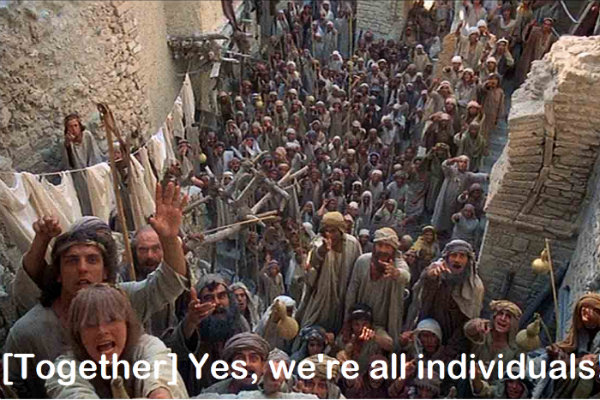
Someone has to read all this stuff and (shamefully) it’s not me. I don’t read many other blogs, or at least not regularly. This one is not part of a community of such sites, with fellow bloggers commenting on each others’ latest thoughts and discoveries. Such things can happen (when I was in China it was the case) but it hasn’t this time round. Thus I feel like I have a direct, individual relationship with the Internet rather than being part of a congregation or community of faith. It’s a Protestant relationship, in that there’s no mediating hierarchy and it encourages hard work towards an unclear reward.

Come to think of it, the Internet shares certain properties with a Christian God:

  • Its existence manifests itself almost exclusively thorough rituals (such as status updates, blogging and posting photos)
  • It offers the faithful the very occasional miracle (see below)
  • It’s omniscient
  • It’s ubiquitous
  • It’s omnipresent.
  • Its mood is alternately punishing and consoling

As you can see, theology is not my forte. On this blog I’ve written mostly about what could broadly be considered political questions and my relation to them. Around twenty years ago, for a period of about four years while I was living in Dublin, I was active in (and occasionally wrote for the publications of) a left-wing political organisation. My individual identity was subordinated to the needs of the party. As a foot soldier my time and energy were given over to hard work and disclipine on the basis of a shared faith in a common project. This necessitated being involved in relationships which were never entirely political and never wholly personal. Arguments ensued whose resolution often obliged me to swallow my pride and accept that I was wrong, that my perspective was too limited to see essential details or to grasp the bigger picture. As for writing, I mostly wrote reviews of films or books, evaluating them in terms of how well they contributed to the revolutionary struggle and stalinistically rebuking the cultural worker who had produced them if they had failed to do so.

Inevitably, I find this activity (blogging) much more satisfying. It allows me to fully express my personality and my identity with hardly any risk of admonishment. It engenders no personal dischord and involves as much or as little ‘discipline’ as I like. I am completely unaccountable, whether in terms of choosing what to wrote about or in terms of how true or how good what results is. There is no measure of success or failure. Whether I scribble some mild satire about Theresa May while my students are doing a test and only 25 people read it, or bash out some anti-Trump diatribe on the way to work that (after my having done the rounds of anti-Trump groups on Facebook) gets a couple of thousand views, what I post here is (for the most part) gloriously/frustratingly inconsequential. At the same time, I’ve got some lovely responses from some extremely knowledgeable and thoughtful people who’ve come across the site and whom if I’d never put finger to keyboard I would never have encountered, I’ve discovered some others who make astonishingly inventive use of the medium, and no one’s spat on me outside the GPO for being a ‘Trot’.

Politically, however, it’s hard to make a case for the usefulness of blogging. (Plus it remains a uniquely unpleasant-sounding word.) Even the most popular thing I’ve written here (by far) was essentially urging passivity and complacency. That explains why it took off as it did. The dream of any blogger came true for me – this was the miracle I referred to earlier. My post went viral, with 750,000 views in about four days. The feedback almost universally positive; very few took issue, which was extremely gratifying if also a little perturbing. Hard to keep up with, because a week later, we had a baby, which put things into some perspective.

*****

The internet is a good fit for Herbert Marcuse’s concept of repressive desublimation, in that it allows people to let off fetid bursts of steam while constituting no threat to power structures. On last week’s ‘Under the Skin‘ podcast the filmmaker Adam Curtis argued convincingly that the development of late ’60s hippy counterculture led to an explosion of individualism which consumer capitalism was all too ready to facilitate. Nowadays, the Internet encourages us to believe that our individual feelings, rituals and gestures mean something, that they register on some elusive scale of value. While I may believe that I’m expressing my individuality, my unique perspective on the world, it just so happens that there are probably 30,000 people out there saying exactly the same things. The internet is a perfect manifestation of the power of the spectacle, one adapted to the pretensions and projections of every individual who accesses it and one in which we frantically produce and consume images of ourselves as productive and influential beings; the spider’s web of communicative capitalism eats up all individual protest, all the rants and outbursts and cogently-argued denunciations and feeds upon them. In providing me with a virtual patch of land in which to cultivate my narcissism, it allows me the illusion that I am engaging politically. Who benefits most is wordpress.com, which profits from my (briefly vomits) ‘content’ and that of millions of individuals who are all convinced that what they are doing is unique and important.

The role of the internet in relation to our political consciousness also validates the pessimism of the Frankfurt School, and the subsequent reflections of critical theory as to what Saul Bellow called ‘the late failure of radical hopes’. Our migration to a life lived online is partly responsible for and partly symptomatic of the fact that in the face of the absolute need for immediate and massive political transformation present generations are (in the modern era) unprecedentedly conservative. Adam Curtis hones in on the ubiquity of risk aversion in contemporary finance, and the ways in which this colours our everyday expectations and aspirations. Something I’ve noticed among some of those opposed to Brexit is a sense that everything was perfect before June 23rd and that the vote is a brutal intrusion, an ugly flaw in an otherwise unproblematic reality. For those who benefit from a certain measure of economic stability, any social or political change is something to be feared rather than encouraged. Seven years of talking to (mostly young) exam candidates from around the world, hearing and reading their thoughts about political and social issues, has for me repeatedly confirmed Mark Fisher’s diagnosis of ‘capitalist realism’, the notion that no matter how bad things get there is simply no other horizon to look towards. Curtis gives the example of Yemen – the resignation which which we greet the news that our Governments are funding – indeed, profiting from – what appears to be genocide. Speaking out against such horrors might put our own status at risk. The taboo that governs mentioning climate change on social media is reminiscient of those scenes in which the line-up of troops on parade quivers with fear, terrified that if they stand up against the bullying commandent they will be next to be humiliated. In this case its our peers who we fear might see us overly earnest or excessively serious in a medium designed for irony and levity – or, in the case of Twitter, irony and abuse.

The famous statement that it’s easier to imagine the end of the world that a slight alteration to capitalism implies that we would be unable to respond to anyone who demands to know what our alternative is. Instead we respond to gruesome disasters with Facebook prayers. Some sneer at Twitter hashtags like #prayforparis without reflecting on what a status update or a shared meme is but an invocation of, an appeal to, a higher power. Like Kierkegaard said of prayer itself, it is more useful to the person doing the updating than anything else. And what do memes resemble if not religious icons? The priests of this religion are those wannabe-demagogues who have a sufficient command over the arcane means of diffusing their messages or who already have access to a sufficiently elevated pulpit. Comedians do politics and politicians seek first and foremost to entertain, mostly by evoking outrage and giving it a clear and convincing focus. TED Talks mask the fact that for all that we live in a time of stupendous technological wizardry our age is also one of social stasis marked by economic ruination and a profound and widespread lack of moral and political agency.

Jodie Dean wrote in ‘Communicative Capitalism’ about the illusion that what we share must register in some significant but vague way, and the fantasy that posting online constitutes a meaningful political intervention. Lacan’s Big Other, that invisible and ineffable authority before which we genuflect, is somewhere online, reading everything we write. The Matrix is an increasingly efficient metaphor. FOMO is largely driven by fear of no longer existing. Disconnection means death.

There’s something deeply religious about all this frenetic online blathering, this blind compliance with the rituals of the world’s biggest ever cult. But while most Gods are benign, this one definitely is not. I want no more part in propagating these illusions, principally my own. It’s time to end this vanity project and to get involved in something useful.
I try to interest my two-month-old daughter in the music of The Fall

mi0001765995

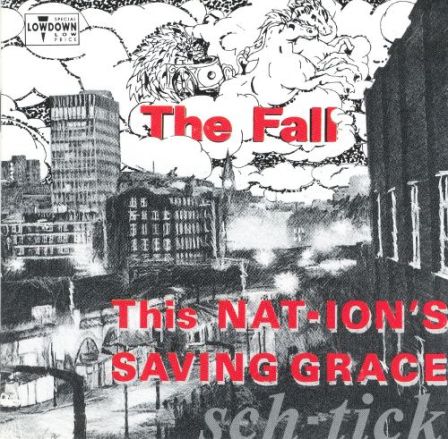
In what must have been September 1985 (when I was 13) I started seeing the above image on posters around my hometown of Sheffield. I wasn’t clear if it was advertising music or politics. Subsequently I started reading the music press, in which Mark E. Smith’s ensemble were ever-present. For around seven years, from 1987 (when they had their first Top 40 single) to 1993 (when they had a Top Ten album), you could legitimitely call him a pop star.

I tried hard with The Fall. At one point I ‘owned’ (what a quaint concept!) all of the albums from ‘Extricate’ to ‘Middle Class Revolt’, but I couldn’t call myself a fan. His manner on and off record was wilfully obtuse, his public statements drunk and ornery, his lyrics oblique and the music mostly discordant. There was the occasional glimpse of a more lilting and reflective side to their work which appealed to me, but overall the cut-up-William Burroughs/indied-up-Captain Beefheart mixup left me, if not cold, then certainly not warm enough to qualify as a Proper Fall Fan.

At the same time, I’ve always had a sneaking regard for real fans of the group. It seemed like a genuine sub-culture. The congregation at Fall gigs (I must have seen them three or four times) shows a stubborn attachment to something difficult-to-like that I find endearing and admirable. It seemed like a really cool club to belong to and I kind of wished I’d shown more curiosity back in 1985, when I was a disaffected schoolchild looking for an identity. Maybe if I’d gone for ‘Bend Sinister’ instead of ‘Please’ or ‘The Frenz Experiment’ instead of ‘Bobby Brown: The Remixes’ I would have gone on to become cool.

It’s a cliché whose truth I’ve recently had occasion to observe that all parents want their (now our) children to experience what we never could. In relation to The Fall I left it too late. I’d like to give my own daughter the chance to rectify that mistake on my behalf.

So far, although she’s been responding with animation to the music that I’ve exposed her to, it’s mostly been pretty accesible stuff like Prefab Sprout and Belle & Sebastian. Nursery rhyme pop, if you like. Twee stuff. (Or, given that we’re in 2017, snowflake music.) Now she’s two months old I think it’s time for her to start branching out. (Plus I think that lots of their songs are genuinely great, whether or not that’s deliberately the case I’m never quite sure.)

For my purposes I’ve chosen a series of tracks which I personally love (or at least don’t mind) and have chosen a time when her mum is out to avoid any unnecessary arguments about inappropriate childrearing techniques. I have provided a Spotify playlist should you wish to repeat the experiment with your infant – in the case of emergencies, go to track 12.

  • ‘Totally Wired’. This is one of the group’s early singles, very much a post-punk product with jagged edges. I was a bit late for post-punk, being born in 1972, but I did grow up listening to the John Peel Show, so the abrasiveness of the music is something I appreciate. To say that my daughter would struggle to tell the difference between Devo, Magazine and Wire is no exaggeration, because she was born in January 2017. The phrase ‘it’s like punk never happened’ was rarely better employed. Hence she struggles to get past this first hurdle. Although she neither starts screaming or falls asleep, she does start moving her head in a slightly disturbingly frenetic manner, one which suggests the grating guitar is getting on her incipient nerves. We have to abandon the attempt after one minute and eleven seconds in case her head falls off and we end up on the front of Woman’s Weekly looking sorrowful and accompanied by the headline ‘TOTALLY WIRED: I lost my baby at two months because I was writing a tongue-in-cheek online thing about The Fall’.
  • ‘Hex Enduction Hour’ is (according to those who know about these things) one of the Fall’s very greatest 45 minutes*. ‘The Classical’ is tuneful and the baby perks up (she’s in a jolly mood due to a recent infusion of milky-wilky). Unfortunately as soon as the second track (‘And the day’**) starts she goes puce and makes it clear why Fisher Price never use The Fall to soundtrack their products. There’s too much going on and from a newborn perspective it’s an audio nightmare. I quickly change to ‘Billy’ by Prefab Sprout, which she’s heard around 300 times, and once I’ve taken advantage of a pause for breath to angle her miniscule ear towards the speaker she stops bawling immediately. Mark E. Smith 0, Paddy McAloon 1.
  • ‘Victoria’. This feels like a bit like cheating because it’s a straightforward version of a Kinks song which The Fall covered in 1987, and which gave them a top 30 hit. It’s a cheerful if jingoistic romp and goes down extremely well with the baby, who takes very kindly to being bobbed around the living room in a lively BUT NOT IN ANY WAY DANGEROUS manner.
  • ‘Edinburgh Man’. Always a personal favourite, I’m hoping that this single-handedly turn her into a lifelong fan. She looks quite wistful, like she’s reminiscing about long-ago visits to the festival in Auld Reekie. Whatever she is thinking, it’s probably not that, but I add this to the mental list of songs to play when we need her to calm down a bit. Thanks, Mark.
  • ‘Bill is Dead’. I wonder what Mark E. Smith was like as a baby. Mine falls asleep immediately both times I play this and misses the epically tender bit at the end. One day if she ever hears the Happy Mondays she might notice that this sounds a bit like them slowed down.
  • ‘The Mixer’. This is an extremely accessible and fun conventional pop song. They’re aren’t any Fall songs which sound like The London Boys, but this one has got handclaps on it. My high hopes are dashed, however, because my wife reminds me that it’s bath time and after that she (the baby) falls fast asleep for seven hours. I’m feeling pretty knackered myself so I’m not about to wake her up so I can play her ‘The Mixer’ by The Fall.
  • ‘Free Range’. Released in 1992, this seems to be about the European Union in the year when borders opened up. I feel pretty sure that given his relentlessly chippy persona Mark E. Smith would turn out to be in favour of Brexit, but as it happens he seems to have been uncharisterically silent on the topic, although he did keep his end up by saying some quite twatty things about refugees last year.  Sadly I don’t remember anything the baby did when this was on, but she did seem to quite like ‘Birmingham School of Business School’ from the same album, maybe because for the first time she was able to relate to the lyrics, as the opening lines go ‘wa wa waa wa wa waa wa wa wa wa wa’. Maybe it was one of the very first songs that Mark E. Smith wrote.
  • ‘Reformation’. One of the few Fall songs from the last twenty years that I know and like. A curious thing about The Fall is that although the singer doesn’t seem to do much apart from write lyrics, drink alcohol and periodically sack the other members of the band, they do maintain a distinctive but varied sound. This one is almost metallish in its ferocity, so I play it quite quietly in order to avoid any disputes of the aforementioned variety. If you didn’t know that newborn babies could be nonplussed, you do now.
  • ‘Facebook Troll’***. In doing ‘research’ for this piece the title of this one caught my eye. It’s actually two songs because it’s medleyed with one called ‘No Xmas for John Quay’. I can’t make head or tail of the lyrics and the music is shit. Maybe when she’s a bit older my daughter will be able to explain to me what it means. For the time being she stares at one of the speakers for a bit in a way that suggests her nappy needs changing.

The result, then: Inconclusive. To close, just in case my daughter should ever come to read this, I’d like to paraphrase the ending of ‘London Fields’ by Martin Amis (someone who’s been looking almost as decrepid as Mark E. Smith himself): So if you ever heard something, when you weren’t even two months old, like catchy-but-dissonant post-punk music, a bit like the Stooges but fronted by a verbally incontinent and cantankerous Mancunian drunkenly shouting half-remembered chunks of HP Lovecraft short stories mixed with items from his shopping list, it was The Fall. It was The Fall“.

* ‘Hex Enduction Hour’ is actually 60 minutes long.

** Spotify happened to be on shuffle.

*** Spotify gets the title wrong, it’s actually called ‘Fibre Book Troll’.

Thank you to members of the excellent Fall online forum at http://z1.invisionfree.com/thefall/index.php?showforum=7 for occasional fact- and spellchecking.

(Incidentally, the Bobby Brown album I referred to wasn’t actually called ‘Bobby Brown: The Remixes’ but ‘Dance!…Ya know it!’.

That last correction did not come from the Fall online forum.)

Brexit lesson plan

Immagine

As I’m a British person living abroad, I’ve found that my students are very keen to know what I think of Brexit and are generally relieved to hear that (like most people in my situation) I think it was a catastrophic decision. However, I think it’s very important not to fall into the trap of thinking that everyone who voted for it did so out of xenophobia or because they’re all thick, as the Guardian reporter John Harris patiently explains here. Many were frustrated with society, left out of globalisation and duped by nationalist politicians and self-interested newspaper moguls into thinking the EU was somehow to blame. So now you know what I think. Just for a change.

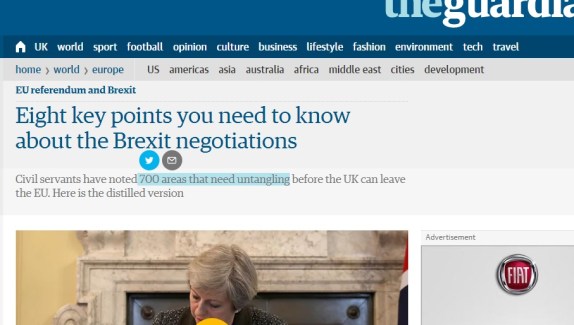
This lesson doesn’t focus on the causes of the vote, but rather uses a Guardian article from yesterday (March 29th) to help your students (and you) understand some complex issues involved in the negotiations which will now take place. This can be followed by a speaking activity in which they express their own opinions about the broader consequences. The lesson was designed for B2+ Politics students but could be used with any Upp Int+/Adv class interested in the issue.

Procedure

  1. Show them this article and draw their attention to the subject (Brexit) and the date (March 29th). Ask them what happened on March 29th (Theresa May wrote a suicide note) (you don’t have to call it a suicide note).
  2. Draw their attention to the subheadline. Make sure they understand what civil servants are. Demonstrate what ‘untangle’ means and establish that in this case ‘distill’ means to reduce a list of 700 areas down to eight.
  3. Scroll down pointing out the categories (Timing, The ‘divorce’ bill, Citizenship, Borders, Trade, European Court of Justice, Transition, Ratification). Elicit a brief definition/translation for each.
  4. Show them the questions below and get them to copy them off the board. This will enable them to identify any which cause confusion. Point out that the answers can be found in the text and that they should only use their dictionaries as a last resort.
  5. Either handout printed copies of the article or get them to find it on their phones/tablets/pcs/etc.
  6. Students in pairs find the answers. Monitor to offer occasional hints to any pairs who are struggling.
  7. After 20 minutes or so, swap partners to check their answers.
  8. Go through the answers on the board (make sure you know the answers first).
  9. Tell them they’re going to be interviewed about the consequences of Brexit, and that there will be two questions: 1) What are the short-term consequences a) for the UK b) for Europe? 2) What are the long-term consequences a) for the UK b) for Europe?
  10. Give students three minutes to prepare, looking up vocab they will need and asking you for help if necessary. Make sure they are taking notes and not preparing a speech.
  11. Students interview a partner for 3-4 minutes and then swap roles and repeat.
  12. They change partners and repeat the exercise but this time film/record each other on their phones.
  13. HOMEWORK: Students write a transcript of the interview they gave, making corrections where necessary, and then email it to you for comments.

Questions for reading exercise

Timing

1) When will Brexit happen?
2) What’s the main disagreement between the UK Govt and the EU on this point?

Divorce Bill

1) How much does the EU think the UK should pay?
2) How much does the UK Govt think it should pay?

Citizenship

1) Why are a lot of people in Europe angry about this?
2) What does pretty much everyone agree on?

Borders

1) What do both the UK and the Irish Govts want to protect?
2) What do some people hope?

Trade

1) What do most Europeans believe is most important?
2) What is a “bespoke customs union”?

European Court of Justice

1) What doesn’t the UK Govt want to do after it leaves the EU?
2) What possible solution is the UK Govt considering?

Transition

1) What “painful concession” could May face?
2) What have business and the City insisted is important?

Ratification

1) What are the names of the chief negotiators on each side?
2) Why would the UK Govt have problems obtaining a “generous trade deal”?

Tady Prosim!

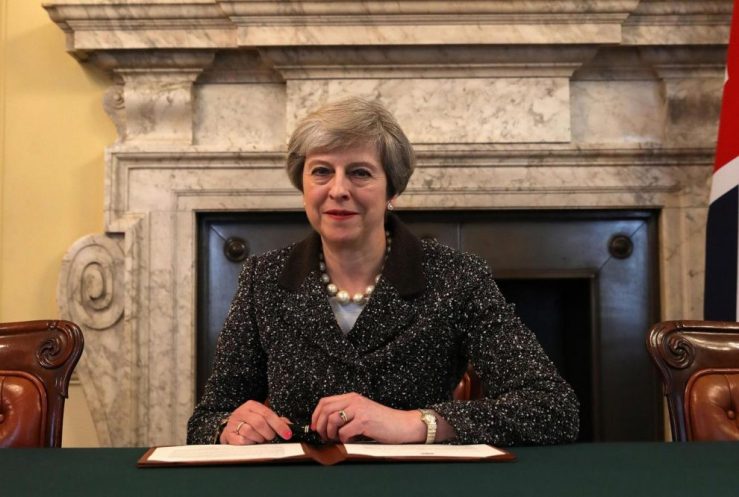
Cursing the day she ever got involved in politics, Theresa May signs Article 50

17436204_small-990x666

Theresa May has vowed to represent some sections of the country – maybe including EU nationals, she doesn’t know – as she triggers Article 50 and begins an arduous two-year negotiation to sever ties to Brussels.

It is anticipated that the Channel Tunnel will be closed by mid-August.

On Tuesday afternoon, following a thirteen minute period during which she repeated that she ‘didn’t have a pen’, the Prime Minister signed the letter that starts the formal exit process. It is not known under which name she signed, as she is on record as saying within the last two years that Britain’s leaving the EU would be ‘unthinkable, an utter catastrophe, Christ what a…stupid idea’. Other members of the Government were quick to remove themselves from the range of the assembled cameras at the crucial moment. Tomorrow, the document will be hand-delivered by a senior diplomat to EU chiefs along with a note that simply says ‘help’.

Once it has been accepted, Article 50 has been officially launched. To mark the occasion there will be a celebratory event in Trafalgar Square featuring Boris Johnson, the grandson of Oswald Mosely, Nick Griffin and his beautiful wife Kate Hooey, Mumford & Sons and a number of forlorn stalls specialising in cupcakes containing broken glass and dog feces, vintage National Front leaflets and faded Royal Wedding mugs with the handles missing.

On the eve of that historic handover, Ms May urged the country to come together. She didn’t specify who the country should come together against, but did promise to keep the assembled journalists posted.

“When I sit around the negotiating table in the months ahead, I will represent every person in the whole United Kingdom – young and old, rich and ‘poor’, city, town, country and all the villages, hamlets,…townships…and, er, dwellings in between,” she said, unconvincingly.

“And yes, possibly those EU nationals who have made this country their (at this point the Prime Minster made a wiggly gesture in the air with her fingers) ‘home’. It really depends on what Paul Dacre thinks, to be honest.

“It is my fierce determination to get the right deal for every single person in this country. I don’t just mean single people, that includes married people and people in relationships. It was a figure of speech. Sorry, I’m not really up for this.”

She said her guiding principles would be ensuring the UK was even stronger and fairer than it is today. Several onlookers report that she then said under her breath ‘or what’s left of it’ and giggled nervously.

Ms May also repeated her mantra about creating a “truly global Britain” that “builds relationships with old friends and new allies around the world”. She then went on to repeat this mantra 17 times in an increasingly faltering voice. She concluded by simply whispering ‘I’m sorry’.

After a lengthy pause during which she sat slumped on a chair staring at the ceiling looking deeply unwell, she eventually concluded: “We are one great union of people and nations with a proud history and a bright future. A bright, bright future. You’re going to have to wear…sunglasses. All the time.

“And, now that the decision has been made to leave the EU, it is time to come together. I’m sure…Primal Scream would agree with me on that point.”

The PM’s top team will gather around the Cabinet table at No 10 on Wednesday morning as she informs them about the content of the letter formally invoking Article 50 of the Lisbon Treaty – the formal notification of Britain’s intention to leave the EU. Rupert Murdoch will be listening in on speaker phone just in case anyone’s tempted to make any last-minute false moves.

Then, at some point after 12.30pm, Ms May will inform MPs that Brexit is being triggered and in Brussels, British ambassador to the EU Sir Tim Barrow will deliver the document to European Council president Donald Tusk. If Sir Tim Barrow is for some reason indisposed the task will be carried out by an intern who will then be granted a new identity in a fellow EU country Wales.

Meanwhile, three current cabinet ministers have warned of the catastrophic consequences of a so-called hard Brexit.

David Davis branded the move a “nightmare”, Sajid Javid said it was equivalent to “shooting ourselves in both feet”, and Chris Grayling wrote the word ‘no’ on the wall of his office in his own blood as he expired from a severe self-inflicted injury to the throat.

(Additional reporting courtesy of The Independent).

DO YOU WANT TO SEE TRUMP GET NAKED?!?

One of the most popular (or at least most visited) posts on this site is called ‘French nudists and freak tornados on the Oaxaca coast’. It gets dozens of hits a day because it has the word ‘nudists’ in the title. I know this because I can see what people search for to arrive here. The article in question is an account of a two-week beach holiday me and my wife enjoyed in Mexico, one which briefly mentions that we inadvertently stayed in a clothing-optional hotel. It then goes on to recount the tornado that passed by us and relates it to global changes in the climate.

Ah, that word. You’ve stopped reading now. Bye bye. Nice while it lasted, cheerio. Que te vaya bien.

Of course, although the Oaxaca piece is tagged ‘Climate Change’, no one has ever found it by searching for that term, and no one in the whole sorry history of the internet has ever clicked on such a tag. Why would they? It would be depressing.

I once read an excellent piece (sadly now untrackdownable*) called ‘Why climate change will never go viral’, which pointed out that the topic is essentially taboo on social media. If you have any doubts about that, post any article whose title contains that phrase. If it gets more than 5 likes or retweets and sparks a discussion to which at least two people other than yourself contribute, do a screenshot, attach it to an email and I will send you $15 USD via Paypal.

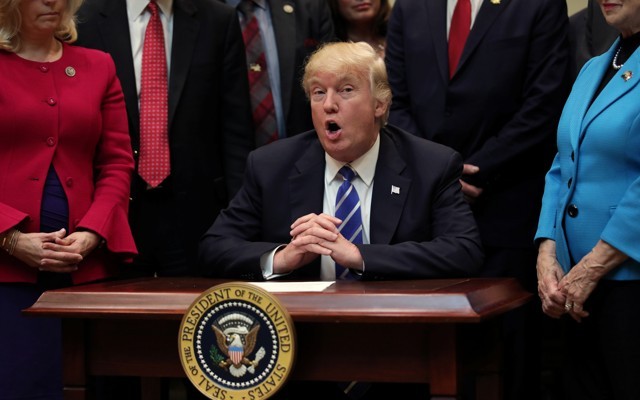
All hail, then, the new US President, who, whether we on reflection feel comfortable about it or not, is doing us an enormous favour. His actions in reversing Obama’s already very limited regulations on climate-disturbing activity will make us wake up to what’s happening and form a dynamic mass movement to finally – it’s never too late! – address this existential threat once and for all. HA!, only joking! (not sure why, no one is reading this any more ’cause it’s about climate change). The favour he’s doing us es otro – viz. making the whole topic go away so we don’t have to think about it any more. You may think you don’t want him to do this, but (pantomime voice) OH YES YOU DO!!!

Now that the heroic measures taken on our behalf by Mr Trump and the representatives of oil companies standing right behind him have been, er, not sure where this sentence is going actually, but it doesn’t matter as no one’s reading this because it’s about Climate Change, or NOIRTBIACC for short.

As for your kids, well, I’m just as sure as you are that even though we can’t bring ourselves to mention the very subject, they’re probably learning about it at school, or if not, they’ll be busy educating themselves by watching Ted Talks, or something. Anyway, who cares? The whole thing’s probably illegal to talk about now in any case. Muchas gracias, Señor Trump.

donaldtrump-900x440

* the person who wrote it probably got murdered by the NWO as part of the cover-up of the link between chemtrails and the fact that Asian people don’t drink milk (one for the Infowars crew there).

Brexit and the Climate

The noted child psychologist and pediatrician Donald Winnicott wrote that the greatest danger to the child’s developing self is that it be faced with demands for precocious adaptation to the environment. The parents must protect the infant at all costs from aspects of reality that are incomprehensible or beyond its grasp, and gradually present the world in manageable doses.

On the 58th day of our daughter’s life, the US President signed an order which cancelled all the previous Government’s regulations regarding Climate Change. On the same day, several members of the British Parliament who had campaigned for the UK to leave the European Union walked out of a select committee meeting because the facts they were being presented with in relation to the consequences of Brexit were ‘too gloomy’.

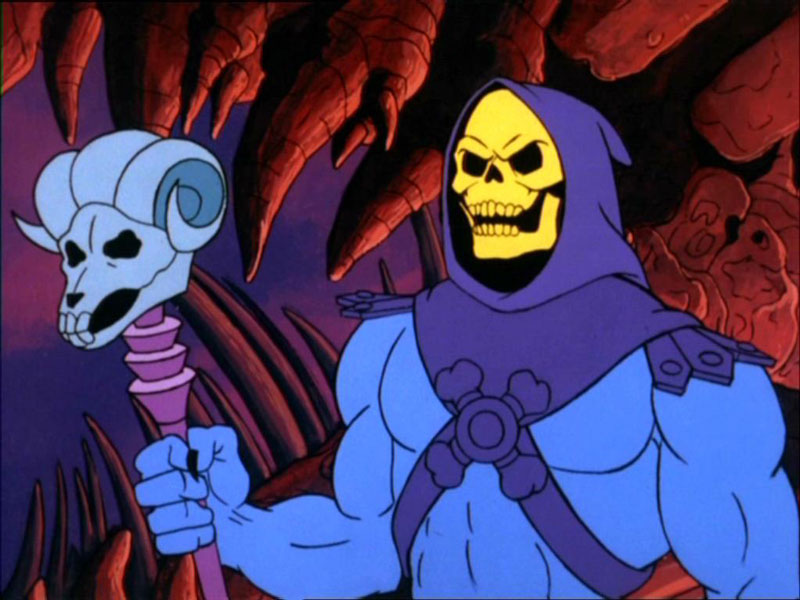
I see that the top trending topics on social media right now are ‘Messi’, ‘Ken Barlow’ and something called ‘Skeletor and He Man’.

We’re going to have a hell of a job in a number of years trying to convince her that not all adults are completely fucking stupid.

‘New atheists’ are useful tools for the far-right

crop_358maher03_28_14.jpg

The US comedian and chatshow host Bill Maher has been on the rant about Islam again, saying that it needs a ‘reformation’. This is a common trope on the right, and Maher’s latest declarations are, as this excellent article details, just the latest in a long history of anti-Muslim statements which place him firmly on the right of the political spectrum in relation to one of the most disturbing developments of the Trump Era.

It’s typical for those caught out making crass and ill-informed generalisations about Muslims to defend themselves by arguing that their quarrel is with religious faith itself. Maher did make a documentary called ‘Religulous’ (2008), which attempts to satirise all the world’s leading religions. His show has often featured the ‘New Atheist’ Sam Harris, whose work has, since the publication of a book in which he tries to use secular beliefs to justify the use of torture, been a rallying point for islamaphobes. Thankfully, partly thanks to being articulately challenged by people like Reza Aslan, Harris recently seems to have had doubts about drinking from the same pond that outright nazis like Pamela Geller piss and bathe in, and he has spoken out forcefully against Trump’s “Muslim Ban”. The internet doesn’t work via reasoned debate, however, but by memes. On social media it rarely takes more than a short scroll down the followers lists of people quoting Harris to find proper full-on racists who also include antisemitism and white supremacy in their repertoire of photoshopped hatred. His assertion (on Maher’s show) that Islam is “the motherlode of bad ideas” has had a vigorous afterlife despite his having since sought to distance himself from his more rabid disciples. Daring to question the wisdom of Harris on Twitter is like removing the pivotal can from the bottom of a pyramid of tinned human shit.

A standard trope among those on Twitter who declare themselves ‘atheists’ is the idea that because Muslims are not a ‘race’ it is legitimate to unleash the most violent impulses against people of that faith. This belief is supported and encouraged by Maher, and may even be derived from him: he said in 2010, expressing sentiments that anyone who has spent any time on social media will recognise as those of the far-right:

“Am I a racist to feel alarmed by that? Because I am. And it’s not because of the race; it’s because of the religion. I don’t have to apologize, do I, for not wanting the Western world to be taken over by Islam in 300 years?”

(From http://flavorwire.com/600169/reminder-bill-maher-is-garbage)

Anti-Muslim prejudice is also fast becoming the Achilles’ heel of self-styled progressives. In  more than one pro-Bernie Sanders Facebook group I have seen the most horrendous far-right material being shared and commented on approvingly. Isis and their affiliates know what they’re doing in trying to eradicate basic liberal principles, and their allies on the far-right clearly appreciate the effort being made.

Harris, of course, is not a theologian. None of the New Atheists are, even their Pontiff Richard Dawkins. Terry Eagleton’s classic takedown of Dawkins in the LRB is sublime:

Dawkins speaks scoffingly of a personal God, as though it were entirely obvious exactly what this might mean. He seems to imagine God, if not exactly with a white beard, then at least as some kind of chap, however supersized. He asks how this chap can speak to billions of people simultaneously, which is rather like wondering why, if Tony Blair is an octopus, he has only two arms. For Judeo-Christianity, God is not a person in the sense that Al Gore arguably is. Nor is he a principle, an entity, or ‘existent’: in one sense of that word it would be perfectly coherent for religious types to claim that God does not in fact exist. He is, rather, the condition of possibility of any entity whatsoever, including ourselves. He is the answer to why there is something rather than nothing. God and the universe do not add up to two, any more than my envy and my left foot constitute a pair of objects.

While Dawkin’s mischaracterisation of religious faith is seemingly based on a Sunday school understanding, adult faith is infinitely far more profound and complex. I was inititally attracted by the work of Dawkins and Harris, but I quickly lost faith in such a simplistic and deterministic view of human affairs and became curious about other ways of thinking and praying. I can see a great deal of sense in Kierkegaard’s line about the function of prayer being not to influence God, but rather to change the nature of the one who prays. I also identified with William James’ notion of a ‘will to believe‘ – what is (for example) confidence in ourselves but a form of faith? Several years ago I started attending Quakers meetings. I wanted to develop a commitment to making the world a better place which was not rooted in rage and resentment and to seek communion with others in a spirit of shared compassion and reflection rather than kneejerk condemnation.

I also wanted to have an area of my life which is not conditioned by the ideology of selfishness and social darwinism that Dawkins – with very great eloquence – espouses. I wanted to try (pace James) to develop a conscious faith as opposed to being controlled by assumptions and impulses that I don’t understand or control or often even recognise.

Blind faith and superstition play a huge role in our lives. Our entire way of life is sustained by a set of unquestioned assumptions, whether that be in the supremacy of the market, the integrity of a sports team or the primacy of our nation state. All of the above are affirmed in rituals of consumption, fanship and symbolic allegiance which are entirely irrational and often intimately related to discrimination and violence in the form of the dispossession and/or humiliation of others. We also suffer greatly from a vague and largely unexamined notion that somehow ‘technology’ (in some ways a metonym for the global market) will somehow liberate us from environmental pressures, that staring at our smartphones will redeem us from reality, that this peculiarly narcissistic medium will save us from nature’s revenge.

You also don’t need to be a theologian to see that the popularity of Dawkin’s book at the same time as the West’s attack on Iraq was no concidence. It’s not by chance that an culture of intellectually tearing apart the Koran appeared just as agents of a supposedly more rationally-based societies were systematically destroying one of the oldest civilisations on earth. Dawkin’s work also raises issues of privilege and complacency: the belief that the world is simply the way it should be, that the distribution of wealth and life chances has been ordained according to logic and science and that faith in something greater is therefore ‘unnecessary’. This is a return to late-19th century positivism at its most arrogant. That does not imply that all those taken in by the arguments of Dawkins et al are guilty of racism. However, anyone doubting the link between New Atheism and Trump’s attempts to exclude Muslims from the United States would be well advised to watch this video, gleefully retweeted by Dawkins in 2015. It also suggests that his attitude to feminism is not all that far removed from that of either his many bigoted followers or, for that matter, Islamic fundamentalists.

Interventions like Maher’s make such stuff respectable among an audience that likes to think of itself as progressive. This is not, after all, a theoretical intellectual debate taking place in a vacuum. It primes them to accept further abuse of Muslims by a Government they should in theory have no affinity with and draws them into the sphere and influence of the far-right.

In saying all this I want to be clear that I am aware of the stultifying and repressive nature of religious belief, particularly when organised into hierarchical and bureaucratic institutions allied with terrestrial power structures. Religious beliefs have also been exploited throughout history by Buddhists, Christians, Muslims and everyone else under the sun to pursue psychotic murderous agendas. Anyone wanting to argue that Islam was uniquely prone to violence and destruction would have to point to a continuous history of such violence in Muslim societies over the last 1,400 years. Nor is there anything particularly distinct about Islam’s treatment of women. From Northern Nigeria to Central America and from West Virginia to East Africa, barbaric manifestations of both Christianity and Islam seek to control women’s fertility. The Misogynist-in-Chief himself is an odd kind of Christian, one who apparently doesn’t believe he’s accountable to God for his moral actions. He’s not a good advert for such a belief. The presence in his administration of figures like Mike Pomeo and Betsy DeVos, both of whom actually welcome the ‘Apocalypse’, should be a screaming red alert for liberals. For American progressives to think that such problems (and their political priorities) lie elsewhere right now is bizarre.

Comedians don’t make for good political leaders, any more than primetime ‘billionaires’ do. Michel Houellebeqc was prescient in making the main character in ‘The Possibility of an Island’ a Doug Stanhope-type comic who becomes a cult leader. Charlie Brooker predicted something similar in ‘Black Mirror’. Both could well have been predicting the Italian agitatore-in-capo Beppe Grillo. The world is awash in comedians-turned-political-preachers urging their audiences to question all authority! – except their own authority as narcissistic/megalomaniac white men making the most of their God-given right to be listened to.

Even among comics, there are better role models. Louis CK’s personal campaign against Trump was heartfelt and humble and didn’t entail his putting himself forward as an alternative. His views on religious faith allow for a certain ambivalent respect in relation to others’ beliefs:

“I’m not religious. I don’t know if there’s a God. That’s all I can say, honestly, is “I don’t know.” Some people think that they know that there isn’t. That’s a weird thing to think you can know. “Yeah, there’s no God.” Are you sure? “Yeah, no, there’s no God.” How do you know? “Cause I didn’t see Him.” There’s a vast universe! You can see for about 100 yards — when there’s not a building in the way. How could you possibly… Did you look everywhere? Did you look in the downstairs bathroom? Where did you look so far? “No, I didn’t see Him yet.” I haven’t seen 12 Years a Slave yet; it doesn’t mean it doesn’t exist. I’m just waiting until it comes on cable.”

Then there’s Russell Brand, who, burnt by the failure of his highfalutin political pretensions, is now educating himself on the subject of religion and global politics (and sharing what he learns here). Perhaps Maher should do something similar. Or maybe it’s time for him to be retired before his constant and deliberate flirting with far-right ideas does any more damage.

‘Brexit’ considered existentially, ontologically, epistemologically and phenomenologically

brexituk-election

What, the fuck, is ‘Brexit’? I’m as confused and scared as everyone else about what is about to befall us, so I’ve decided to use the analytical tools of Philosophy to try to find out. This will also help me to revise some stuff I supposedly learnt 25 years ago, back when the notion of Britian choosing to leave the European Union was about as likely as a white supremacist being elected US President or someone who’s completely shit simultaneously having 15 songs in the Top 20. Ho hum.

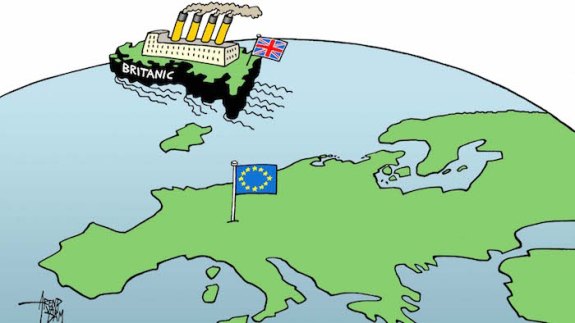
First of all, existential. This is the easy one. If you google ‘Brexit existential’ you get 346,000 results, mostly casting doubt on the ongoing existence of both the EU and the UK. Just today Guy Verhofstadt was talking about an ‘existential crisis’ in the EU. After ‘Brexit’ has gone through, Britain won’t exist in its current form. You write some total lies on a big red bus, drive it round the country for a couple of days, and before you can say ‘we won without a single bullet being fired‘ you’ve destroyed your supposedly beloved United Kingdom for good. Simple as.

Now, ontological. ‘Ontological’ relates to the entire field or category of Being. It predetermines the existence of all else. The word ‘fulcrum’ springs to mind for some reason. Thus Mark Fisher wrote of neoliberalism imposing a ‘business ontology’, in which the only things recognised as possessing existence (political ideas, cultural phenomena, institutions, people) are those considered to have exchange value. Its ubiquity makes it difficult to perceive, as in that joke about one fish asking another ‘what’s water?’. This may explain why, in his brand-new list of ten pledges, Jeremy Corbyn makes no mention of ‘Brexit’. He’s already taken its existence for granted. Britain’s EU departure will dominate all that now takes place in British life, to the point where it will very soon be impossible to tell which problems are the fault of ‘Brexit’, which are due to permanent austerity and which can be attributed to immigration. Of course, according to the Government and The Sun and The Daily Mail, all existing problems will be due to immigrants (and Muslims). As the sociologist Nathan Combs says in his essay ‘Politics and Ontology after Brexit and Trump‘, oh sorry the link doesn’t work.

Epistemological-ness is do with Knowledge. Apart from Theresa May, no one knows what ‘Brexit’ is. And Theresa May doesn’t know either. It’s of epistemological significance that she doesn’t even believe in what she’s doing. ‘Brexit’ is thus an epistemological unknown, a known unknown unknown containing a number of other unknowns, a fetid fog of unknowing- and unknownness in which the only foghorn is the sound of Nigel ‘fucking’ Farage blaming you-know-whom. Perhaps, however, even at this very late stage, all is not lost: the Kennedy Institute has argued that ‘there is another, broadly epistemological, reason for a second referendum’, but unfortunately that link doesn’t work either.

Phenomenological. Hmm. ‘Brexit’, of course, can’t happen. It is and has always been impossible. So how will this impossible thing be realised? Current reports indicate that it’s being directed by a group of Tory MPs on Whatsapp. How will it be experienced? How will it manifest itself in our daily lives? The academic Steve Fuller reckons that “collateral damage will appear in the form of the riots in working class neighbourhoods which will take place once the non-elites who voted to leave the European Union realize that they were delivered on a plate from one set of elites to another”, but he’s a epistemologicalist so doesn’t belong in this paragraph.

Finally, just for the hell of it, because it’s a word everyone’s been bandying around in academica for the last few years, there’s the affective aspect. This explains why people voted the way they did. It also tells us how this came to happen. Millions of people felt unhappy with their lives and clever strategists played on their hate strings. As Dr Tim Haughton of the University of Birmingham explained, “The reason why the United Kingdom voted to leave the European Union can be expressed in three words: ‘Take Back Control’. The Leave side used the alluring slogan repeatedly and relentlessly whereas the Remain side never coined a simple and affective slogan”.

So, that’s it then. A complete, if brief, existential, ontological, epistemological, phenomenological and guide to Brexit, with a bit of the old affect thrown in just for good measure. I hope it’s enlightened somebody. If you feel that this whole thing was misconceived, poorly executed and has been a total waste of your fucking time, I know exactly how you feel. I voted Remain.

Do you still think Putin is on the left?

So, you’re a progressive. You wanted Bernie Sanders to win the Presidential election and were disgusted to see how he was cheated out of the nomination. You were delighted to see that the underhand and frankly treacherous machinations of the Democrats backfired. Not that you wanted Trump to win, of course, but what the hell did they expect, and who’s to blame? Instead of promoting a program for change, they pushed the same corrupt, neoliberal, pro-corporate warmongering agenda that stained the Obama years.

In the case of Russia, you’re sick of all the misinformation and scaremongering. It’s not so long ago that the US was persecuting supposed Russian agents and ruining the lives of anyone considered a ‘red’. What’s changed? Pro-Clinton newspapers and TV networks are trying to make up for the terrible mistake they made in choosing a corrupt candidate by undermining a democratically elected Government – not one to your liking, obviously, but the only way to get rid of it is to choose a genuinely popular candidate with a proper radical agenda the next time round.

In any case, who believes what the mainstream media says any more? People can see through their fake news bullshit. There are alternative news sources, ones that let you know what’s really going on behind the scenes of this farce.

Personally you like Russia Today. It has some genuinely brave alternative voices, people like Max Keiser, Abby Martin, Glenn Greeenwald and Ed Schultz. You’ve come across people online – mostly shills for Clinton – who claim that it’s just a mouthpiece for the Kremlin. More russophobic propaganda, you think. Putin is demonised in the MSM but he’s a geopolitical pragmatist, and he also dares to challenge some of the most powerful interests on earth – NATO, the EU and the entire corrupt financial establishment in the form of families like the Rothschilds. That’s why he’s become the latest embodiment of evil. The disinformation in the so-called liberal Western media about Russia’s involvement in Ukraine has been particularly disgraceful.

It’s partly thanks to RT that you’ve been broadening your outlook, following political developments in other countries. The US is not the centre of the world! You thought it was a shame that Geert Wilders didn’t win the Dutch election. His call for the Netherlands to leave the EU and NATO was too dangerous for the political establishment and so he was painted as a racist and the sitting candidate (a right-wing neoliberal) was shoehorned back into power.

With Le Pen, you’re not so sure. You agree that there’s a problem with Islamic terrorism, and it’s one that the EU doesn’t seem to have a response to. But you also remember that she comes from a tradition (in her party and in her family) of fascist ideology, including holocaust denial. Now, you’re no fascist and you’re no antisemite. You oppose what Israel is doing with the settlements and the occupation – you’ve sometimes thought about going there to volunteer in some capacity – but you’ve certainly got nothing against Jewish people. Bernie Sanders himself is Jewish!

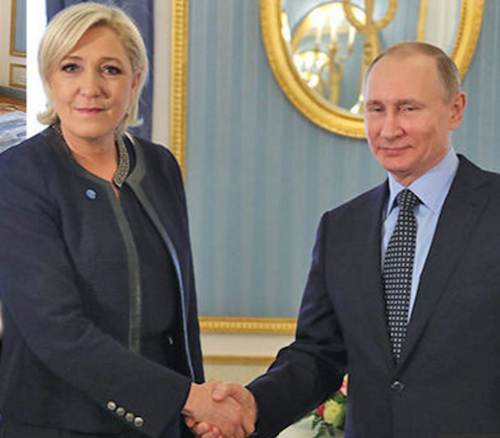
You open Facebook and there’s a post from Infowars (you enjoy hearing about what Alex Jones says about Clinton, but you avoid watching the vidoes where he goes on his syphilitic rants about Trump). The post has a photo which shows Vladimir Putin on the right, holding hands with an actual full-on holocaust-denying antisemite aspiring fascist demagogue to the left. Putin is (for him) smiling broadly.

And you? Where are you in this picture? Are you, as you have always assumed, on the left, or have you somehow ended up supporting the far-right?

It’s probably about time you stopped watching RT.

Some thoughts on language, education and class

russell_brand_doesn_t_answer_my_emails_any_more_says_jeremy_paxman

I spend my working life around people (students of English for Academic Purposes) who are insecure about their language use. That means I get to think and pontificate about issues of status, ownership and standard versus non-standard forms.

I can identify with the anxieties of my students, and not just as someone who has (in the past) enjoyed learning other languages. I’ve also long been self-conscious about my command over/of English. Like some of my students(,) I’m very sensitive about being corrected, tending to take corrections as a bit of a put-down rather than a chance to learn. The ego-insecurities I experience when expressing myself in other languages are clear manifestations of anxiety about my own status as an English-speaker.

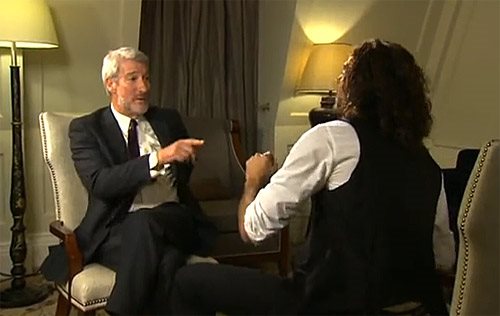
Some of that anxiety is related to having a parent for whom English is a second language, and part is related to class. My background is not exactly humble but I was the first person in my family to go to university. Working in higher education feels like an achievement, but I’m vulnerable to a certain feeling of being out-of-place. Someone who came from a similar background was the critical theorist, academic and blogger Mark Fisher (aka k-punk), who wrote this in 2013 about the response of the ‘left’ to the comedian and actor Russell Brand’s famous interview with Jeremy Paxman about the need for revolution:

I’ve long been an admirer of Brand – one of the few big-name comedians on the current scene to come from a working class background…(His) forensic take-down of Paxman was intensely moving, miraculous; I couldn’t remember the last time a person from a working class background had been given the space to so consummately destroy a class ‘superior’ using intelligence and reason. (However) Brand was quickly judged and-or questioned by at least three ex-private school people on the left…It’s alarming how many ‘leftists’ seemed to fundamentally agree with the drift behind Paxman’s question: ‘What gives this working class person the authority to speak?’ It’s also alarming, actually distressing, that they seem to think that working class people should remain in poverty, obscurity and impotence lest they lose their ‘authenticity’. Someone passed me a post written about Brand on Facebook. The whole tone was horrifyingly high-handed, as if they were a schoolteacher marking a child’s work, or a psychiatrist assessing a patient. There’s also a shocking but revealing aside where the individual casually refers to Brand’s ‘patchy education [and] the often wince-inducing vocab slips characteristic of the auto-didact’ – which, this individual generously says, ‘I have no problem with at all’ – how very good of them! This isn’t some colonial bureaucrat writing about his attempts to teach some ‘natives’ the English language in the nineteenth century, or a Victorian schoolmaster at some private institution describing a scholarship boy, it’s a ‘leftist’ writing a few weeks ago.

Fisher himself wrote movingly about an episode when his own mother confided that she didn’t want to go into a Georgian teashop in a neighbouring town for High Tea because she was worried she would “do the wrong thing”:

We know this too, really, we felt it going on to University, feel it still, my sister and I, she with her anxiety around her middle-class friends whose parents are all teachers and doctors, me with my endless writing of novels I can’t bear to do anything with as it means engaging with them, having to make them like me, listen to their opinions of my work. But for us, half clambered out of our class as we are, we don’t find a Grange tea-room existentially threatening. She said it herself, my mum, and it immediately struck me, the disavowal, “some people get nervous in tea rooms, don’t they?

These are the wounds of class, ever-present, life-long. Knowing that you’re common, not good enough, not one of the decent people.

In the case of Russell Brand, faced with mass and social media sneers at his upstart activism and the ‘sub-undergraduate dross’ of his writings about politics, he retreated. He realised that if he wanted his right to discuss his concerns to be recognised, he would have to reeducate himself. He is now doing a three-year MA in Religion and Global Politics at SOAS, and is sharing his newly-acquired knowledge via a (frankly unmissable) podcast. In the first episode, an interview with the political philosopher Brad Evans on the theme of political violence, he gave what I think is an inspiringly honest account of how he arrived at this point and how it feels to be there:

“Being briefly in the academic world, as I have been, obviously loads of it’s really really exciting but I think a lot of what I hear feels reiterative, like someone says ‘what’s a country? It’s just an agreement in our minds, and I think, I knew that, anyway, those are things I’ve come to myself. But then there are things that are so complex I can’t begin to come to terms with them, and in this field I’m having to learn about political history, critical theory, philosophy, so I’m suddenly having to learn about Foucault, Derrida and all these other names I can’t even say confidently yet. And my original impulse for doing that course was, I got really deeply involved in the political world, and (…) I realised that this was a very complex world and I didn’t have the armoury, the artillery to engage in this battle. And I’ll like our listeners to be able to embark on this journey with me, so what do you think is a good entry point for someone like me who feels disillusioned with politics but doesn’t know quite where to begin on a journey of understanding?”

One theorist who Russell would find very useful in terms of issues of language, politics and class is Pierre Bourdieu. He relates that feeling of being out of one’s depth and beyond one’s station to what he calls ‘habitus’: the attitudes, mannerisms, tastes, moral intuitions and habits that influence our life chances. This behavioural comfort zone is a manifestation of our level of cultural capital. While Brand may have a high level of objectified cultural capital in the form of fame and wealth, his attempts to acquire institutionalised cultural capital (formal educational qualifications) are hindered by accent, which is a manifestation of embodied capital. In particular fields (for example in the academic world) it can be hard for individuals from a working-class background to obtain a “feel for the game” and to feel they should be (as it were) on the pitch.

This seems to me to be related to the experiences of people from ‘foreign’ language backgrounds in higher education. ‘Foreigners’ don’t automatically have a pre-assigned rung on the social ladder, and hence struggle to find an appropriate station even when they have a sufficient mastery of the language. I’ve been thinking about a friend of mine who has an excellent command of the spoken language and who knows things and can do things in it that I certainly couldn’t. I wonder how he views Brand, and how he relates to what Brand says about his own struggle to feel like a valid participant in the academic world. My friend recently dropped out of a university course he’d long dreamed of doing because he felt his English wasn’t up to writing long essays (I encouraged him to continue and offered to help, but to an apparent avail). In fact, I’m writing this to persuade him, others like him and also to remind myself that such feelings are very common and by no means insurmountable.

From outside, manifestations of social class are hard to perceive. English people know when to question someone’s intellectual credentials as soon as we/they hear us/them speak. To people who didn’t grow up here, vocal class markers are much harder to recognise. It may seem to my friend that all ‘English’ or British’ people are equally confident in higher educational settings, that they we all feel valid and accepted.

Perceptions of these issues inevitably differ, depending partly on one’s cultural and social background. Among my (mostly well-heeled) students, I’ve found that some people have a frustratingly monolithic understanding of the relationship between language and social status. The belief persists that the speech of some is simply inadequate. There’s also widespread misunderstanding of the relationship between spoken and written language, with some assuming that the former is a poor attempt to produce the latter. Inevitably, others have explored these issues far more articulately than I ever could.

As for myself, I always feel anxious when someone makes a jibe about someone(’s?) being ‘self-taught’. Everyone is, to some extent. Luckily (after three slightly wasted undergraduate years from which I was lucky to emerge with a 2;1), I eventually had the chance to go back to university and get a Master’s degree, an experience which greatly improved my sense of confidence in what I say and write. Having lived in other countries and struggled with other languages has also helped to bolster my self-assurance, as has teaching the spoken and written language for almost twenty years and spending several years examining others on their usage. In terms of writing, the internet has also helped enormously (what’s a good synonym for confidence? what are the three types of cultural capital again?).

Inevitably, for everything I write here, thousands of people are studying or have studied that subject in an academic context and are far better placed to provide evidence-based theories than I am. A lot of what I present here is hearsay and guesswork, but I content myself in the knowledge that this is after all just a blog. I’d like to think of myself as a polymath, but ultimately I’m more of a dilettante, and this is an appropriate format.

The wounds of class run deep, but then, as both Lynsey Hanley and Helen Mort have articulated brilliantly, the sense of discomfort at being stranded between classes, particularly at being a working class person in the more rarified echelons of higher education, can also be uncomfortable. Then there’s the opposite: chippiness and reverse snobbery, and then the reaction to chippiness and reverse snobbery. And so on.

I still lack confidence when sending people what I’ve written with a view to getting it published. To do so you have to be fairly bullish, and being rejected or ignored is always painful. Although some things I write get a very pleasing reaction, I have little way of knowing whether or not what I write is any good in terms of what matters, which is to be accepted as more-or-less an equal by those whose writing I admire. But at the same time, most of them are professional writers and/or academics, and I’m not, so it should, by rights, remain a pipe dream.

There remains one thing I want to make clear, for the sake of my own honesty and integrity. This piece may contain what some will regard as self-pity, and I wouldn’t really have much of an answer to such a charge. I had the chance to go to university, twice, without getting into debt, in my own language. My privileges in terms of education have, in comparison with most people in the world, been immense. I’m not a victim of disadvantage in any sense that means anything on a global scale. I’ve even, despite my manifold anxieties about my credibility as an English speaker and writer, and thanks largely to a mere accident of birth, managed to make a reasonable living as a teacher of my ‘native’ language. But I know that these feelings are not exclusive, and I hope a) that reading this has made clear some connections between class, status, nationality and language that may not have occurred to you before and b) that you find this sentence an appropriate way to end a piece of writing of this nature.