This is why Trump calling Syrian refugees ‘dangerous’ is stupid and wrong

screenshot_2017-02-11-16-13-44

You wake up and check Twitter, and see that the word #earthquake is trending, along with the name of some Japanese-sounding town you’ve vaguely heard of. You check the news on Google and see that it’s a big one – 8.2 on the Richter Scale (does it go that high?!), and it turns out that the epicentre was only a few kilometres away from the town. Hundreds of buildings have collapsed, including many that were supposed to be earthquake-proof. Tens of thousands of people have been trapped and hundreds of thousands made instantly homeless, and according to Reuter’s there’s a storm on the way. You wonder why storms so often follow earthquakes, and try to remember if your brother-in-law’s family have gone to China or Japan on vacation. Maybe you should call him to check they’re ok. But it’s 7.30am. What time is it in China? Japan? You keep reading and watching. The Government has swung into action, sending helicopters to assess the extent of the damage and digging and sonar equipment to rescue any trapped survivors. Neighbouring countries have offered to send help. On each link you click on the death toll gets higher. How dismal. Maybe you should donate. Money or blood. Red Cross. Money can be sent quickly. But blood? How do they…

You look on Twitter for a link to the Red Cross. To the left of the screen you can see that the earthquake is no longer the top trending item. It’s #Trump, and then #sendthemback. Your heart sinks. At a time like this? What’s he… you take a deep breath and click on the hashtag. There’s the story, from CNN. The President has tweeted about the Japanese earthquake. You’re surprised he’s managed to spell it correctly. He’s announced that the US will immediately be closing its borders to Japanese citizens, and will be ‘assembling’ those already in the US with a view to immediate deportation. He calls them ‘infected’, and says that Japan is ‘the world’s most dangerous country’. You rest your head on the keyboard and pray to whatever God might exist for the strength to get through another day.

We want President TRUMP, not “President Bannon”!

wp-1486750890873.jpg
Did you vote for this man to be President?!

Did you vote for Donald Trump to be President of the United States of America? So did hundreds of millions of your fellow citizens. They were inspired by his rallies, his crushing victories in the so-called debates and his simple but powerful message: Let’s make America great again. As a result, last November, through the medium of the electoral college and in the face of vast opposition from the liberal media and the political establishment in Washington, he won. He won the right to serve in the greatest office on the planet as leader of the free world and most powerful man on earth.

Who, then, is “President Bannon“?

That’s the name that’s been trending on Twitter all week. It’s also the man whose face you’ll see on the cover of this week’s Time magazine, accompanied by the headline ‘The Great Manipulator’.

That’s not what you voted for in December.

It’s not who you chose to be President.

Now, Donald made a smart choice in picking Bannon as his Chief Strategist. The man has a number of attributes which should appeal to any Trump voter. He’s fanatically racist, boasts an impressive history of violence against women, and has the face of a 75-year-old pedophile alcoholic priest. Such a man is ideally placed to be the second in command in Donald Trump’s administration.

But not the first. Not no. 1. After all, whoever he might be, Steve Bannon did not win the election. He wasn’t the man you chose to bring jobs back to America, frack under your houses and build a wall to stop Muslims pouring into the country from China. But if other countries hear the rumors that it is he, not Donald, who is leading the country, who is taking key decisions that it is the job of the President himself and alone to take, then they will not respect the man you voted for, and the libtards who were so shaken up by his historic victory* will continue to make out that Trump is little more than a witless, barely literate and probably incontinent orange-skinned frontman for far more powerful and shadowy forces.

Something is wrong, and something has to change.

It’s up to you to make that change. It’s up to you to insist as loud as you can that no one but Donald Trump, the man you chose to be President, should be sitting in the Oval Office ruling the country and the world, waiting for the phone to ring so Vladimir Putin can tell him what to do next. Bannon may the ideal person for running far-right fake news operations or managing the disposal of porcine waste on a major agricultural facility, but HE IS NOT THE PRESIDENT. So repost this article wherever you can. Get on Twitter and tell the world: Bannon must go. We want Donald Trump in charge of everything. At all times. No manipulation. No delegation. No advice on bewilderingly complex issues which would tax the expertise of even experienced politicians, let alone an overgrown fratboy sociopath who’s never read the Constitution, doesn’t understand the role of the Supreme Court and would struggle to locate the Washington Monument on a map.

If that means that Donald Trump should go without sleep for four to eight years, so be it. That’s what you voted for. Accept no substitute. Bannon must go. Trump must govern. Alone.

The hashtag to use is #TrumpNotBannon.

Let’s make this happen.


*Although not in terms of numbers of the popular vote, obviously.

No one expected the American Inquisition

There is a strong sense of a counter-revolution to what is being orchestrated from the White House.

What Van Jones, on the night of the election called a ‘whitelash‘ – a carnival of repressed racism in response to having had a black President – is actually much broader than that.

I wrote on the day of the inauguration that this was a climate denial coup. But actually they’re giving free reign to all the sadistic and self-serving whims of the most reactionary elements of the ruling elites, regardless of how chaotic the results may be. The last few weeks have seen the lighting of bonfires under regulations and laws guaranteeing public access to healthcare and education, protecting the environment from rapacious slash-and-burn corporations and the real economy from those who would gamble it away in an afternoon, safeguarding the rights of women, refugees, and so much more. Their project will involve, as Richard Seymour details, austerity of a savagery never before imagined. The political scientist Robert Nichols writes: “this is what the Trump administration represents: a coup d’état by the ultra elite billionaire oligarchs, who have effectively eliminated the political-managerial class that used to sit between us and them”.

One obvious analogy to all this is fascism. Hitler’s rise was partly the result of the failure of the socialist revolution of 1918-19. But in our search for historical precedents we can also go further back. The Portuguese historian António Saraiva argued that the Medieval Inquisition was an attempt to hold down a class on the rise: the new merchants who were challenging the power of the church and the aristocracy. That counter-revolution involved the imposition of violence and terror over several centuries.

What is the nature of the heresy that Trump and Bannon have been tasked with repressing? The targets chosen in these first few weeks tell us very clearly: it’s our right to a stable climate. It’s women’s rights to control their own lives. It’s all the civil rights that were won by those whose ancestors built America’s wealth with their slave labour. It’s middle-class aspirations to a dignified life. It is, it should be clear by now, all forms of what can reasonably be called social progress and it’s the very notion that those who weren’t born into the elite class deserve to have rights of any kind.

Orchestrating this is the Grand Inquisitor himself, Steve Bannon, the Torquemada of our times. The fact that he was previously employed overseeing a network of far-right websites presenting ideology as news is of huge significance. For while over hundreds of years the various Inquisitions around Europe imposed their control through torture and public burnings, their contemporary counterparts make use of a far more advanced tool of social control and repression. It was thanks to the internet that they were able to gain power (as Jonathan Albright explains) and it is through trolling and shaming that they will rule. The priests of this movement don’t wear cassocks and carry incense; they sport chinos and brandish iphone 7s, and they express themselves not through papal bulls but through photos with photoshopped slogans ridiculing all accepted beliefs except the one that says that the Holy Church of the Rich, Nasty and Profoundly Stupid is sempiternus.

Burning denial down by the Tiber

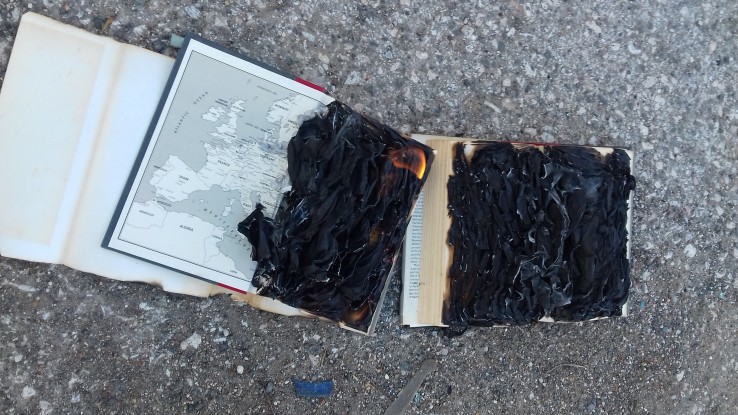
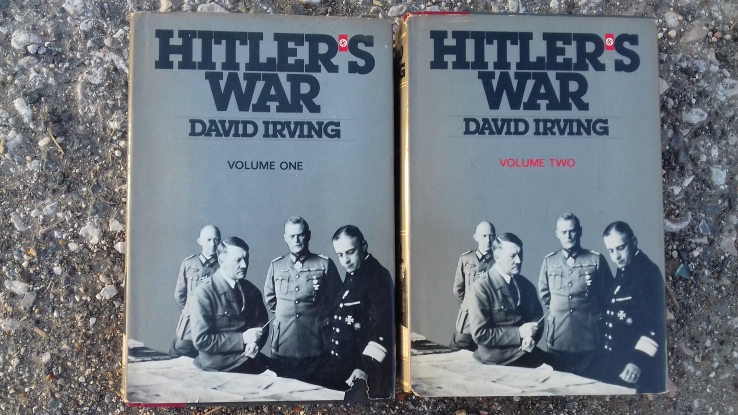
20170207_163216I miss the days before Kindles and iPods, when you could get to know someone better by browsing through their book and music collections. Our Dutch friend Merel, at whose house we spend New Year’s Eve, has a good variety of recent fiction and books on sustainable development and the like. I’m a little taken aback to see on her shelves quite a range of books on dictators and fascism, including two by the disgraced Hitler apologist David Irving. Thankfully it turns out they belong to her landlord.

Irving is a Nazi activist who used to get away with pretending to be a historian. He was the subject of a 2016 film starring Rachel Weisz and Timothy Spall, which depicted his failed attempt in 2000 to sue the historian Deborah Lipstadt for pointing out that he had systematically distorted details about the Holocaust in his books in order to let Hitler off the hook. The judge concluded that:

Irving has for his own ideological reasons persistently and deliberately misrepresented and manipulated historical evidence; that for the same reasons he has portrayed Hitler in an unwarrantedly favourable light, principally in relation to his attitude towards and responsibility for the treatment of the Jews; that he is an active Holocaust denier; that he is anti-Semitic and racist, and that he associates with right-wing extremists who promote neo-Nazism.

As it happens I’d come across a physical copy of one of his books before, about twenty years earlier in my local library in Dublin. I took it out and disposed of it, and then explained to the library what I’d done and why. They understood my point and once I’d agreed to pay the cost of the book they agreed not to replace it. The film about the trial of the book’s author is no classic but it sets out the main details, featuring real footage of Irving giving Nazi salutes to audiences of skinheads in Germany and Austria, where he once spent a year in prison for continuing to spread lies about the death camps. It also makes the link with other kinds of denial – one of the key lines spoken by the main character is ‘Elvis is dead. The icecaps are melting. And the Holocaust did take place’. The fact that Holocaust denial is booming online and that many of those espousing it also deny that the earth’s climate is changing is no coincidence. Hitler launched his campaign to conquer Europe in order to extend Germany’s ‘Lebensraum’, living space. In anderen Worten, he wanted to expand the Third Reich’s vegetable patch. Last week the right-wing British tabloid newspaper The Sun, owned by the climate-denying pro-Trump tycoon Rupert Murdoch, used its front page to blame Spanish people for depriving Britons of food. Inclement weather in Southern Europe has meant that there are fewer vegetables to export to British supermarkets, and The Sun wants its readers to blame foreigners rather than asking why global weather patterns are changing. As I have long argued that climate denial and racism are intimately linked, I can’t help but feel at the same time a little vindicated and also really rather scared for the future.
sin-titulo

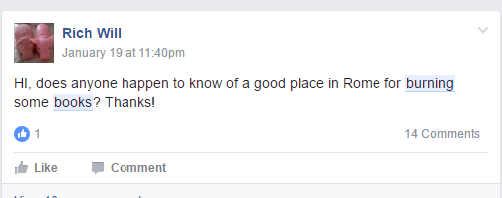
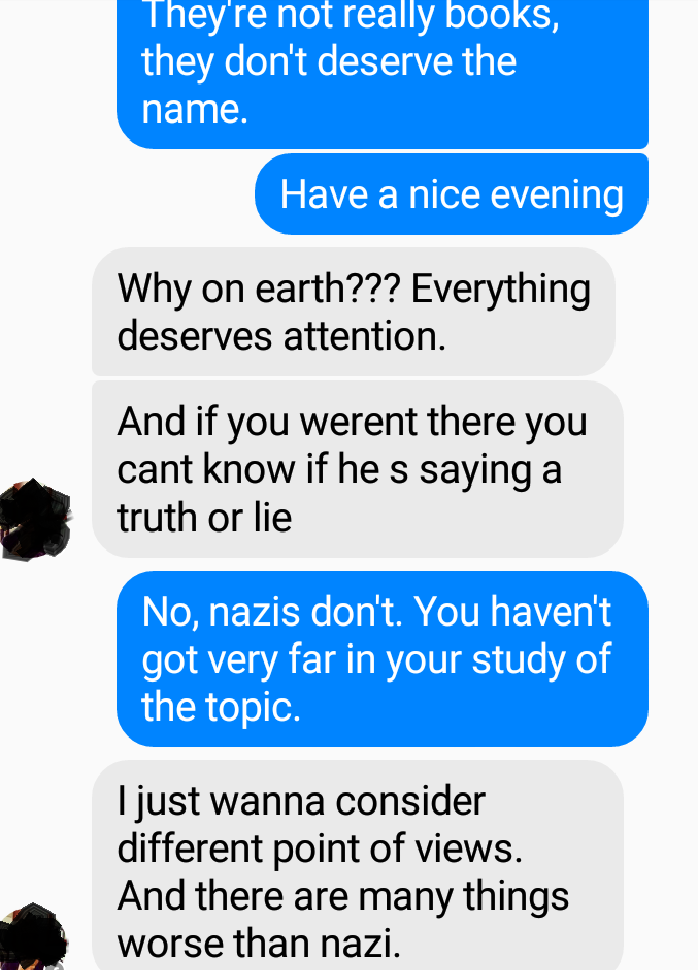
Once I’d explained the books’ provenance to Merel, she was more than happy for me to take them away and get rid of them. It was just a case of finding the time (my wife was heavily pregnant until last Monday :-)) and the place (we’ve only lived in Rome since last September). I decided to post a question in a friendly group for local foreigners on Facebook. Things I’ve posted there in the past on related topics have generally got a good reception, although I’d been surprised when, in response to a piece I’d written in which I called  the Italian fascist group Casapound ‘openly racist’, an Italian guy popped up and invited me to join them. My post about the books got a mixed response. Several people were consternated until I pointed out what kind of books they were, but some contributors continued to remonstrate, calling me a Nazi for wanting to burn books. Thankfully a sensible person pointed out that while the Nazis had indeed gone in for a bit of book-burning, it wasn’t by any means the worst thing they had done. A couple of people made witty but pointed reference to the fact that one of Rome’s (very best) bookshops is called ‘Fahrenheit 451’. I replied, arguing that the two items in question didn’t really deserve the hallowed status of ‘book’. I made the same point to a young Italian guy who promptly sent me a PM asking if he could have the books ‘for research’ because he was ‘interested in the topic’:
screenshot_2017-02-07-18-51-49

…which gives a new dimension to the phrase ‘you’d have to have been there’.

Although Irving has long been a discredited and bankrupt irrelevance in terms of serious history, both the Guardian and The Independent for some reason decided to give him a blast of publicity in the wake of the film. He claims that the election of a US President who openly consorts with Holocaust deniers (and, it should go without saying, climate liars) has revived interest in his ‘work’, with ‘thousands’ of young people contacting him to find out more about his ‘research’. He continues to use YouTube to propagate the lie that he’s a proper historian.
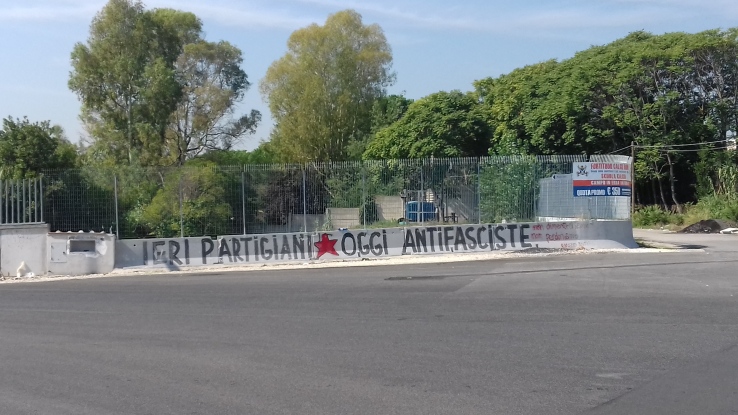
20160914_111306Someone in the Facebook group had suggested a far-off part of town crummy enough that few would be bothered by the sight of someone burning some books, but I didn’t really want to drag a one-week-old-baby across Rome and end up getting us both arrested for arson. Instead I thought of a largely abandoned area round the corner, next to the river, so I could get the whole thing out of the way in half an hour and not neglect my parental responsibilities. As it happens the area isn’t uninhabited; there’s a community of gypsies scattered along a stretch of the Tiber. Elsewhere on Facebook I read about the impending destruction of a similar settlement in Napoli, where my wife was born. The European Roma Rights Centre reports that:

The proposed forced eviction will render more than 340 Romani families homeless, including pregnant women, young children, and persons with disabilities. These Romani families, like most Roma in Naples, are a part of the city, having been resident there for a number of years. Despite this, the municipality of Naples has not provided them with any alternative housing.

I’m sure Irving himself would approve. Anti-gypsy racism seems particularly rife (indeed respectable) in Italy. The Telegraph reported in 2008 that a class of Italian schoolchildren had produced drawings supporting the burning of a local gypsy camp. As a novice arsonist myself I had to hope that the fire I was about to start wouldn’t burn out of control and have a similar impact. Whatever it was I wanted to achieve by burning the books, it certainly wasn’t that.

Thankfully there was a good omen. The place I settled upon also has some fitting graffiti (‘YESTERDAY PARTISANS, TODAY ANTI-FASCISTS’). As it happens, the only elected representative of the aforementioned fascist group Casapound recently dismissed the Italians who took up arms against their own fascist Government and the Nazi regime which stepped in to save it as ‘rapists’.

20170207_163458

It would be nice to see someone like Irving as a detail of history, a footnote: there were some Nazi sympathisers who denied the holocaust, but they were ignored. But that’s not the case. Next month the French may well elect a President whose biological and political father has repeatedly described the systematic murder of millions of people as exactly that: “a detail of history”.
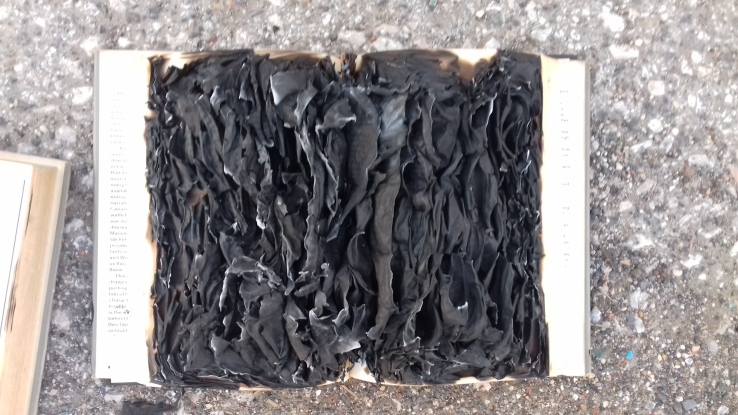
20170207_163750-1

The reasons that some things are beyond debate is that people often lie about their interests and their ideologies. David Irving knows the Holocaust happens, he just can’t admit publicly that he thinks it was a good thing and should be repeated.
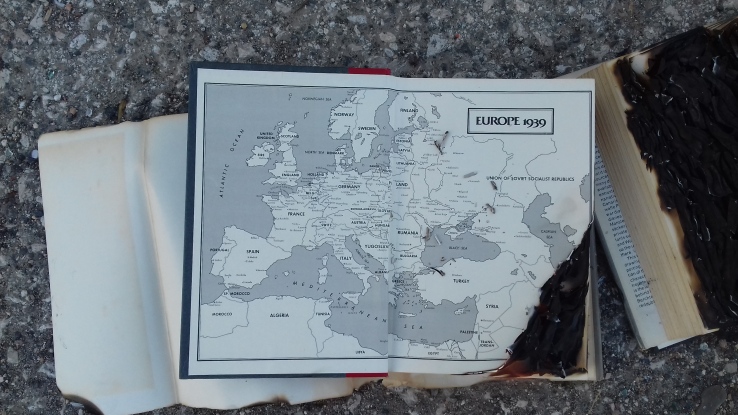
20170207_163924

As people like to say these days, this is why we can’t have nice things. It also explains why I wanted to burn these books.
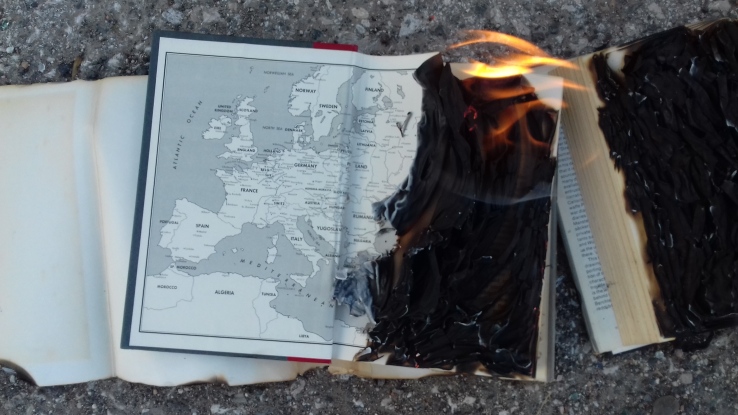
20170207_164009

Holocaust denial and climate denial have much more in common than has been so far acknowledged. Exxon executives knew several decades ago that the company’s activities were causing the planet to overheat and would make human life impossible, but they kept quiet because admitting it could hurt their profits. They and other such companies then invested billions of dollars in spreading lies about climate science, funding people to speak up for them who are no more proper climate scientists than David Irving is a proper historian. These are the kind of trolls who would take the last six words of the last sentence and remove them from their context. If I could I would burn all attempts to deny that the climate is changing. I would set fire to millions of web pages and happily watch them go up in smoke.
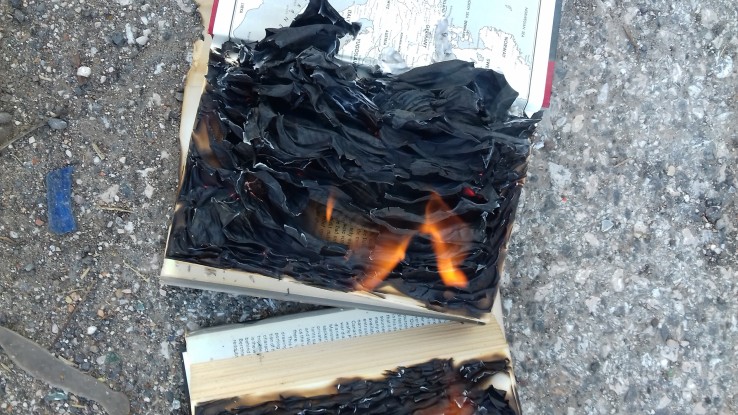
20170207_164104

By denying death, they deny life.

20170207_164117

Afterward the well-known events took place.

Our inventions were perfected. One thing led to another,
orders were given. There were those who murdered
in their own way,
grieved in their own way.
I won’t mention names
out of consideration for the reader,
since at first the details horrify
though finally they’re a bore.
(Dan Pagis)
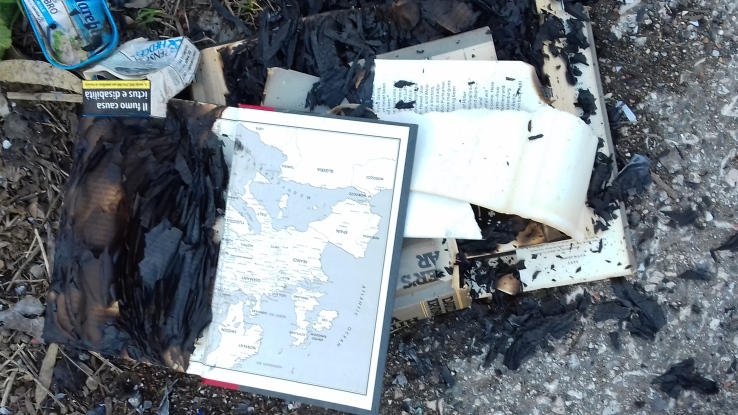
20170207_164638

and even though there are those
hidden behind platinum titles
who like to pretend
that we don’t exist
that the marshall islands
tuvalu
kiribati
maldives
and typhoon haiyan in the philippines
and floods of pakistan, algeria, and colombia
and all the hurricanes, earthquakes, and tidalwaves
didn’t exist

still
there are those
who see us

hands reaching out
fists raising up
banners unfurling
megaphones booming
and we are
canoes blocking coal ships
we are
the radiance of solar villages
we are
the rich clean soil of the farmer’s past
we are
petitions blooming from teenage fingertips
we are
families biking, recycling, reusing,
engineers dreaming, designing, building,
artists painting, dancing, writing
we are spreading the word

and there are thousands out on the street
marching with signs
hand in hand
chanting for change NOW

they’re marching for you, baby
they’re marching for us

because we deserve to do more than just
survive
we deserve
to thrive

dear matefele peinam,

you are eyes heavy
with drowsy weight
so just close those eyes, baby
and sleep in peace

because we won’t let you down

you’ll see

(Kathy Jetnil-Kijiner)

Lesson Plan: Features of a language (int upwards)

67dde25c2a569f6db126df3db3baa229

In celebration of my recently having welcomed my 850,000th visitor to this site, I decided to share one of my favourite ready-made lessons. It’s one I’ve done dozens of times and it’s always worked really well. It encourages students to think carefully about the grammatical features of English and how it compares to their own language(s). In the process they have in-depth and important discussions about what the function of a particular form (eg. continuous aspects) actually is.

It’s designed for multilingual classes but it could easily be adapted for monolingual groups by simply asking each group to discuss their opinions as to whether or not their main language has such features. It could end with the students presenting their ‘ideal’ language to the whole class, followed by further discussion of why plurals are necessary in English, what the function of countable nouns is, etc. They could then write a short essay for homework reflecting on what they like and don’t like about English and why.

Features of a language

1. Does your partner’s language have all these features? Find out!

Language feature

Partner 1

Partner 2

Subject-Verb-Object eg: I love you

Articles eg: The weather is terrible! I’d like a coffee

A perfect aspect eg: I have been to China

A continuous aspect eg: I am learning English

Cases: eg: He loves her; She loves him

Prepositions eg: We are at the airport; I am going to Swansea

Auxiliary verbs eg: Does he like coffee? I didn’t go out last night

Tenses eg: I speak Spanish; We spoke Spanish when we were on holiday

Verb conjugation eg: She likes cheese

The passive eg: My bag was stolen

Countable nouns eg: I am looking for some informations

Irregular verbs eg: I am, you are, she is

Modal verbs eg: must, should, can

Capital letters in nationalities and languages eg: Austria, Chinese

Plurals: eg: dogs; cats; people

Fixed word order eg: I like very much chocolate very much

Reversed order in questions eg: You are South American; are you Brazilian?

2. Now, imagine that we were going to invent an entirely new language which was easy to learn. Which features would you need to include and which could you do without?

Language feature

An ideal language (yes/no)

Subject-Verb-Object eg: I love you

Articles eg: The weather is terrible! I’d like a coffee

A perfect aspect eg: I have been to China

A continuous aspect eg: I am learning English

Cases: eg: He loves her; She loves him

Prepositions eg: We are at the airport; I am going to Swansea

Auxiliary verbs eg: Does he like coffee? I didn’t go out last night?

Tenses eg: I speak Spanish; We spoke Spanish when we were on holiday

Verb conjugation eg: She likes cheese

The passive eg: My bag was stolen

Countable nouns eg: I am looking for some informations

Irregular verbs eg: I am, you are, she is

Modal verbs eg: must, should, can

Capital letters in nationalities and languages eg: Austria, Chinese

Plurals: eg: dogs; cats; people

Fixed word order eg: I like very much chocolate very much

Reversed order in questions eg: You are South American; Are you Brazilian?

The ideological psychopaths behind Trump, Putin and Brexit

I’ve seen several headlines comparing Steve Bannon, Trump’s Chief Strategist, to the Mad Monk Rasputin, given the coincidence of their seemingly hypnotic influence over the country’s most powerful man and their apparent commitment to arcane forms of Evil. Rasputin also has a counterpart in contemporary Russian politics, in the form of Vladislav Surkov, ‘Putin’s grey cardinal’, a figure who, according to the Atlantic, “has directed Russian society like one great reality show”, often using bizarre means of discrediting anyone who stands up to the Government. A meeting between Bannon and Surkov would put Malcolm Tucker and Jamie from ‘The Thick of It’ in the shade.

Although Tony Blair’s Press Secretary Alistair Campbell was the model for Tucker, his bullying and lying could hardly be called psychopathic, and he seems to have been driven by loyalty and career progression rather than destructive zeal even as his dishonesty and cynicism destroyed the Middle East. The same could not be said for someone who, although he is no longer on the scene, has also had a decisive influence on world events: Dominic Cummings, former adviser to the failed Geek Emperor Michael Gove and, as head of the pro-Brexit camp in the Referendum, originator of the slogan ‘Take Back Control’. He has been described by David Cameron as a ‘career psychopath’ and by Rachel Johnson, sister of Boris, in similar terms. I urge you to read in full Pat Kane’s assessment, in which he calls Cummings an “intellectually committed chaos-merchant” and reports on his mission to subject all aspects of human behaviour (health, education, all public services) to the capricious and/or sadistic whims of the market. This may not suit everyone, but Cummings believes most of us to be a waste of education, as cognitive ability is primarily related to genes. This throwback to early 20th Century ideologies is currently off -stage, back to writing deranged screeds on his personal website, but the ideas he promotes are clearly of influence on a Government which has no better idea than rip-it-up-and-start-again.

Figures like Bannon, Surkov and Cummings may have different visions of a perfect society, but they share a commitment to elite rule and an idea of how to aggressively pursue it: by creating chaos, using what Rebecca Solnit (in one of the best assessments I’ve yet encountered of why Trump won) describes as ‘gaslighting’ to destabilise accepted values and undermine trust in established institutions. I found out about Surkov through Adam Curtis (a very skilled propagandist in this own right), who says that Surkov has “turned Russian politics into a bewildering, constantly changing piece of theater…(creating) a constant state of destabilized perception, in order to manage and control”*. This interest in disruption is something all ideological psychopaths share. An appropriate analogy might be that shaking a baby vigorously enough a) might somehow make it grow up quicker and b) will stop things getting boring. I don’t think it’s hyperbole to say that historical precedents to such projects lie in the Chinese Cultural Revolution and the Khmer Rouge. Figures like Bannon, Surkov and Cummings also have literary antecedents. Kane defines Cummings as “a mercurial figure who could easily stalk the pages of the Booker Prize longlist”. After all, part of the thrill and success of the Booker-winning ‘Wolf Hall’ lay in Thomas Cromwell’s machiavellian machinations. Much of what I’ve read about the three ideological psychopaths in question reminds me of a quote from H.G. Wells’ Doctor Moreau:“Each time I dip a living creature into the bath of burning pain, I say; this time I will burn out all the animal, this time I will make a rational creature of my own.”

They also put me in mind of a series of characters in the later J.G.Ballard novels: deranged scientists and psychologists relieving suburban boredom and stress and shaking up bourgeois lives with doses of ultraviolence. The messianic tennis coach Bobby Crawford in Cocaine Nights (1996) oversees a crime wave in an expat coastal resort while arguing that ‘great men’ should live outside the law and crime can be encouraged as ‘a means to an end.’ Wilder Penrose in Supercannes (2000) is a psychiatrist who promotes psychopathy as a means of relieving stress. Millennium People (2003) features a charismatic and possibly insane pediatrician called Richard Gould, who stirs up his followers to bomb Heathrow, the NFT and the Tate Modern in a “search for meaning”, while in Kingdom Come (2006) Dr Maxted counsels of the need for “elective insanity” and foments suburban revolt based on sporting and consumer loyalties, arguing that: the future is going to be a struggle between vast systems of competing psychopathologies, all of them willed and deliberate, part of a desperate attempt to escape from a rational world and the boredom of consumerism”.

There’s also been a lot of talk over the last few months about tricksters: Pied Pipers who lead the masses astray. Ideological psychopaths seem to make use of charismatic leaders, or at least to put themselves at their service. They are often not the figureheads themselves but the powers behind the throne. The Italian populist leader Beppe Grillo keeps himself out of direct political involvement and tries to get someone else to do the dirty work (he’s not very good at choosing). Then there’s the question of which ideology they adhere to. Bannon recently claimed to have once been a Leninist but has very clear fascist and possibly Nazi sympathies. Surkov’s inspiration apparently comes from contemporary art, and both he and Bannon have been associated with the fascist Russian ‘philosopher’ Alexander Dugin, who believes Russia should provoke an all-out world war. As for Cummings, despite his intellectual posturings, he may be stupid enough to be a fan of that ultimate Godhead of failed teenage bullies with megalomaniac pretensions, Ayn ‘Medicare’ Rand. He is an extreme Neoliberal and a reminder that the origins of Neoliberal thought lay partly in nazi belief in the purity and goodness of elite power.

Another common comparison for Bannon has been Goebbels. The Nazi propaganda leader was notoriously interested in and inspired by mystical beliefs and occult rituals. The Trump phenomenon has partly been explained in terms of a hypnotic effect, not least by (stranger and stranger…) Dilbert cartoonist Scott Adams. The (mock?) science of Neurolinguistic Programing may partly explain why, according to several reports, people went into Trump’s rallies curious and came out fuming. Conspiracy theorists find consolation in the belief that all world events, from Brexit to Trump to the war in Syria, are controlled by the CIA; it’s comforting to think that someone’s there behind the scenes watching and learning and will step in when things get out of hand. However, part of the immense value of Thomas Pynchon’s ‘Gravity’s Rainbow’ lies in its exposure and exploration of the chaos and vanity of attempts to control and learn from war, with its groups of scientists competing to use humans like lab rats.

One thing people like Surkov do is to learn from recent developments in marketing and apply them directly to politics. What’s happening politically in the UK, the US and elsewhere is by no means detached from what’s going on in the economy. We are subject to massive and increasing manipulation in the form of disruptive technologies, such as Airbnb and Uber, many of whose creators believe that disrupting settled industries and tearing up patterns of social behaviour is an end which justifies all means.

That ultimate agent of chaos Donald Trump certainly has a way with a crowd, but he’s also stupid and helpless when it comes to understanding world events. He watches the TV news and accepts the simplest and most misleading of explanations. He appears to have no-one to trust and doesn’t seem to have any idea what he’s doing beyond acting out his most sadistic impulses. It may be that he thinks Steve Bannon is his only friend. Bannon certainly appears to know how to manipulate his charge. The plot of this contemporary dystopian parable is starting to resemble Frankenstein, but in this version the Doctor doesn’t care about the consequences of what he’s created, and instead is urging the monster out of the castle to attack the village and take over the world.

Rasputin, of course, ended up being shot dead and thrown into a river, partly undone by his own drunken boasting. As for his contemporary counterparts, they may look and feel like protagonists making their own rules but in reality they are obeying deeper and darker forces which may well destroy them. All of them appear to be deeply narcissistic and probably enjoy being talked and written about, even though it’s public knowledge that Bannon is a wife-beating drunk, Surkov a failed novelist and pictures of Cummings show him posing like a pitiful pastiche of the Bullingdon crew. Maybe he was the one who cleaned up after their parties. Ultimately the three ideological psychopaths I’ve talked about here are not masters, but servants of (to quote Pynchon in ‘V’) a much more ominous logic.

* Curtis explores this in more depth in ‘Hypernormalisation’ (2016)

Saramago and the City – My Master’s dissertation

yellow-light

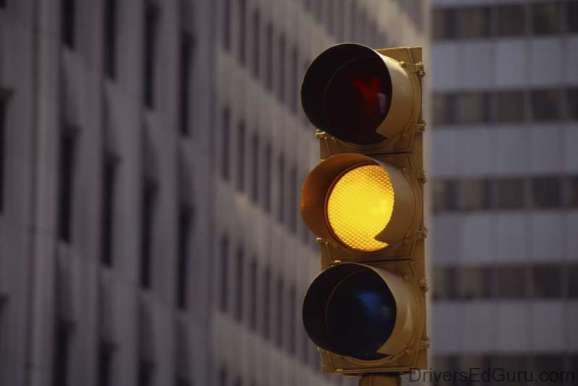
“O disco amarelo iluminou-se” is the first sentence of the first novel I read in Portuguese: ‘Blindness’, by José Saramago. It means “the yellow light came on”, and (although it took for a few seconds to work this out at the time) it refers to a traffic light. The first driver in a line of cars has suddenly been struck by a mysterious blindness which will go on to infect all but one of the inhabitants of an unnamed city, causing the authorities to panic and impose martial rule as society breaks down more or less overnight. One key to the novel lies in the fact that the Latin word for ‘city'(civitas) is also related to ‘civilisation’; when the basic signs and codes that regulate civilised behaviour lose their meaning, we may as well all be blind. ‘Blindness’ is probably the novel I’ve read more times than any other. I’m always slightly surprised to come across people who haven’t heard of it as it has always struck me as a fundamental insight into the times we are living through.

Both the city and the country in the novel are unnamed, and the film of the book was shot in Tokyo, Toronto and São Paulo. Three of Saramago’s subsequent novels are set in similarly anonymous urban environments: ‘Seeing’, ‘All the Names’, and ‘The Cave’*. When, in 2006, a particular set of circumstances led me to take a Master’s course in Portuguese Studies which entailed writing a 15,000-word dissertation, I decided to connect those novels with an area I was becoming increasingly interested in: Urban Geography. I read writers such as Henri Lefebvre, Mike Davis, Teresa Caldeira and learned about the notion of the right to the city in a world increasing divided between neoliberal dreamworlds on the one hand and nightmarish slums on the other. The thinker I learned most from, however, was the world’s leading urban geographer, David Harvey, who actually looks a bit like a cross between Karl Marx and God. There are passages of his books you could dance to, punching-the-air kind of dancing. This video is a great visualisation of how his lucid style makes it beautifully easy to understand complex subjects.

The Master’s course was, then, a pretext to learn about the world through the prism of a limited range of countries. Learning about Portugal’s history of empire and loss of empire helped me reflect on my own country’s shameful past. Going back to writing essays after a 13-year break also made me reassess my relationship to ‘my’ language. My dissertation supervisor, who was from Mozambique but had lived and worked in English for more years than I had, once corrected something I had written, changing ‘in doing so’ to ‘in so doing’. Given that my livelihood is based on claiming authority over the English language, it was quite a salutary moment. (The difference is actually one of formality, but I thankfully had the humility not to try to pull rank.) Writing such a long-form piece helped me reflect on my command of written English. My natural style is actually not that different from Saramago’s, one which some people find rambling and irritating. The original title of ‘Blindness’ was ‘Ensaio Sobre A Cegueira’ (an essay on blindness), after the style of Montaigne, and his novels read like extended reflections, conversational in tone and consisting of digressive explorations of ideas rather than compelling plots and detailed characterisation. Writing about his work in an academic setting forced me to employ a more direct approach than I’m naturally inclined to adopt.

Throughout the course modules and during my dissertation research I learned about the depth and contours of my ignorance of the world and tried to fill in some of the massive gaps. The experience helped me learn that not everyone knows everything, and that knowledge in an academic context is often very specialised**. In around 2008 I got talking to David Harvey himself at an annual summer conference in Central London, and over a couple of pints and a LOT of crisps he said that my topic sounded interesting but he’d never heard of Saramago. I meant to put this information in the essay, along with a footnote boasting that it was revealed in a personal conversation, but sadly I forgot.

For a while I planned to turn my dissertation into a PhD but, although I did discuss the possibility during trips to Coimbra and Rio, it didn’t happen. Maybe that’s a good thing – I could quite happily waste the rest of my life in a good university library. While a friend of mine took 14 years to finish his PhD thesis, I reckon I would be the first to take 1,400. I did, however, end up back at the same university (King’s College London) in a working capacity. Last summer I was preparing Chinese students to take postgraduate courses, so I thought it would be fun to show them the short essay I’d written exactly ten years earlier when I was applying to do a Master’s at the same institution. (The essay is here, but it’s a bit crap.) Towards the end of the course, as we were working on writing abstract-style summaries, I proudly showed them the one I’d written for my eventual Meisterwork and was simultaneously chastened and impressed when they pointed out that among its 150 words there was a blindingly obvious typo.

I was already thinking that it might be fun to write something here about Saramago when it struck me as weird that something that took me so long to write has been read by so few people. Therefore I’m posting it here for the ages. It’s never been published (for at least two very good reasons) so it may be that someone researching or just interested in the topic will find it useful. I’m sure there are bits of it I would now change, with some sections underdeveloped and some overreliance on and/or misrepresentation of other people’s ideas, but in any case here it is, verrugas e tudo.


*Not that those are necessarily the best Saramago novels to start with, I would recommend ‘The Double’ if you’re not familiar with his work as it’s much more of a philosophical pageturner.

** For example, geologists often know almost nothing about climate science, especially those who are being specifically and handsomely paid for their ignorance of the topic.

Continue reading “Saramago and the City – My Master’s dissertation”

If you really want to bring down Trump, snap at his Achilles heel

The science-fiction author Philip K. Dick once wrote that “sometimes the only rational response to reality is to go insane”. Some experiences and threats are just too traumatic to deal with. Hence we use a range of psychological mechanisms to protect our sense of who we are and what we are doing from breaking down. One of the main ones is denial: we simply pretend that that which troubles us doesn’t exist. However, denying what we are scared to face has consequences which may be worse than the thing itself. Repressed fears can return as outbursts of rage against undeserving targets, fetishised stand-ins for whatever it is that we are avoiding.

I believe that the core appeal of the new far-right of Trump, Le Pen, Farage and so on is that it denies on our behalf things that we can’t face, and identifies simple targets against whom our repressed fears can be expressed in the form of rage. The list of things that supporters of such individuals systematically deny includes racism, rape, historical events, news sources, slavery, the holocaust, science,  and accepted facts in relation to all of the above.

How can I state the above with such certainty? In the spirit of honesty and not denying one’s own past, I confess that for several years I was in the very bad habit of arguing with supporters of Ukip on Twitter. In a bid to use the medium as something other than an echo chamber, I sought out people with opinions different from mine and tried to engage them in debate. One thing I learned is that such a  platform is not designed for and can’t really be adapted to support meaningful political discussion. The other conclusion I was forced to accept is that denial is the central platform of parties like Ukip. It was like doing a Master’s degree in Puerility and Obtuseness Studies. Not only did I see their supporters regularly deny all the things I listed above: I was also regularly part of interactions in which the other party would deny what they had just said, refuse to acknowledge a logical fallacy in their argument, ask for evidence of my points and then refuse to engage with the evidence I provided, and turn to personal abuse when all else had failed. Part of the problem with discussing politics on the Internet in general and Twitter in particular is that the other party can just disappear: they’re not responsible for defending the statements they’ve made or the claims of the organisation they’re supporting. This exacerbated the problems I experienced in trying to reason with people whose worldview denies reason itself.

All that I’ve described is united in one specific issue, one that I think enables and then excuses all types of denial. That, of course, is the climate. If you can deny Climate Change, you can deny anything. It helps enormously (and is absolutely no coincidence) that the leaders of new far-right parties are funded directly by the Climate Denial Industry. But the ideology of denial runs deeper than mere economic self-interest. We are all to some extent if not climate deniers at least climate ignorers. As I’ve argued before, we are all complicit in the conspiracy to cover up the facts about the climate. However, as abstract facts become manifest in our daily lives, as changes to our habitat become more apparent and less deniable, the pathology of the serious climate trolls is deepening and spreading to infect all other areas of human knowledge and seriously threatening everything that we take for granted, all the rights and forms of social progress that underpin our freedom and stable way of life.

The links between, on the one hand, those in the political realm who ridicule and censor our attempts to protect our living systems and, on the other, the economic interests that jeopardise our species’ survival are also becoming more explicit and less deniable. Anyone curious about Trump’s connections to Russia and what interests lie behind them does not need to go trawling through Wikileaks documents or hope that some hitherto unseen videotape comes to light. The fact that Putin has regularly been seen in the company of the man who Trump appointed his Secretary of State is troubling in itself. That his company (ExxonMobbil) has rightly been called the greatest criminal corporation in history tells us most of what we need to know about what is going on in international politics right now. Trump’s direct financial involvement in the pipelines he himself has authorised fills in the rest of the dots.

The reason that climate change is the Achilles heel of the new far-right is that it is only possible to go on denying these things if you are part of a psychotic cult, one which is led by a psychopath and whose principle purpose, whose golden edict, is denial. If you are not part of such a cult, the available facts speak for themselves, or at least they would if they were more widely acknowledged. The reason that the things I’ve described are not more widely discussed is because they have revolutionary implications for how we live. That’s why companies like ExxonMobbil, Volkswagen, Koch Industries etc have devoted so much money and energy to making sure that ordinary people are confused by basic facts about the climate, believing that there is doubt and ambiguity where there is none. But our own experience of the world has now reached a point where it is only by direct censorship and repression that the truth and its implications can be contained.

If we truly want to address the cause of the rise of monsters like Trump and Le Pen, we all have to become climate campaigners. They are strong because we are silent about what most scares us. If we, collectively, can break that silence then we can expose them at their weakest point. That means we need to learn and share as widely as possible the true story of the climate crisis, one which starts with very basic science and develops into the deadliest and most dastardly conspiracy in human history. It also means that we have to be open with each other about something that truly terrifies us. Although activism is in itself a form of therapy in that it transforms our perspective on our own situation from a passive to a dynamic one, it isn’t enough in relation to this issue. We also need climate therapy groups, in which people can be honest about their fears. To paraphrase Thomas Pynchon, we need to keep sane, but care. And we also need to make sure that whenever anyone is worrying or ranting about the dangers that Trump, Le Pen and their ilk represent, climate change is absolutely central to the concerns being expressed.

The ideology of the emerging Trump/Putin/etc cult is based on psychotic and puerile denial of the causes and consequences of changes in our climate. The most effective way to stem its rise is to break our silence about that terrifying subject and accept our adult responsibility not to let the most evil forces on the planet destroy the lives of all of our children – including, as of three days ago, my own.

Corbyn has put Labour on the same side of history as Farage, Le Pen and Trump

screen-shot-2016-06-24-at-08-08-18-440x286I’ve always had a huge amount of affection for Jeremy Corbyn. I’ve heard him speak eloquently and forcefully on countless occasions in support of excellent but underpublicised causes. I supported him in the first Labour leader ballot and I urged everyone I knew to do the same. Like most people who care about such things I was furious that the other candidates hadn’t even had the integrity to oppose the Government’s Welfare Bill. When he says that Theresa May is on the wrong side of history in inviting Trump for a state visit, I’m in full agreement with him (although that particular phrase has been overused beyond repair).

However, I didn’t vote for him last November in the second ballot because there were signs that he and his team didn’t have the leadership and communication skills to face the challenge. They seemed unaware of how to research, design, test and transmit compelling slogans and images in order to influence political debate. (Here is an excellent example of what they could have done.) What’s more, there was abundant evidence from former shadow cabinet members who were by no stretch of the imagination Blairites of a lack of basic coordination, so that policies which did emerge were often contradicted or cancelled out by unplanned and haphazard leadership statements.

However, the main reason I didn’t vote for Corbyn against Smith wasn’t his incompetence or the weakness of the opposing candidate. It was his betrayal over Brexit. Although by no means everyone who voted for the UK to leave the EU was a supporter of the far-right, the EU referendum was a nationalist trap which the then PM Cameron, motivated by a mixture of short-term desperation and monumental complacency, fell right into. 

Corbyn’s efforts during the referendum campaign were lacklustre, even after one of his own MPs was shot dead by an activist of a terrorist group closely connected to Ukip. His immediate call for implementation of Article 50 was an indication of his lack of political judgment and a betrayal of those who elected him leader. That he should, in this week’s parliamentary vote, exploit the most important issue in recent British history in the attempt to establish himself as a firm leader shows that he and his team have no understanding of what’s at stake and seem to have taken seriously Tory press propaganda that the UK has a future outside the EU. All expert advice before and after the referendum makes it absolutely clear that it doesn’t.

By obliging Labour MPs to vote in favour of whatever Tory plans for Brexit turn out to be, we can only hope that Corbyn has placed himself on the losing side of history. Where he could and should have mobilised Labour’s extensive campaigning machinery and put his very strong core of dedicated supporters to work arguing that the whole Brexit project is a reactionary folly and that the referendum was a farce, he’s divested himself of moral authority and his leadership has ultimately come to serve the socially regressive, racist and climate-lying agenda of the international far-right. The future of parliamentary opposition now lies in a progressive coalition led by people like Caroline Lucas, Mhairi Black, Nicola Sturgeon and, why not (since Nick Clegg’s career is hopefully still dead and buried) Tim Farron. Anti-Brexit Labour MPs, i.e. those who had the integrity to vote against the Government and against their party leadership this week clearly have a role to play. They represented the majority of Labour voters. But as of now the leadership of the Labour Party is, for all Corbyn’s personal decency, at best irrelevant and at worst an obstruction in the way of building something better.

Some more thoughts on how we come to know ourselves

I’ve been thinking recently about consciousness, about how we come to be aware of ourselves and of the world. In a passage which I think can also be taken as a broader metaphor for how we develop our perceptions of reality, Karl Marx somewhere describes the workings of the economic system (capitalism) in the following terms: the enormous machine is housed inside a building which we can never enter. We can only look through a number of tiny windows – inevitably, only one at a time – to surmise how the whole apparatus might work.

(He might go on to say that we can also study what the machine produces, which is to say immense wealth on the one hand and immeasurable misery on the other. He might say that, but unfortunately I can’t track down the quote.)

The following, from the pediatrician and psychoanalyst Donald Winnicott, describes the view from the inside:

“At the very beginning, the infant is in a state of ‘primary unintegration’: unconnected feeling states and without even a rudimentary ego.”

In one of his most famous quotes, Winnicott also says that “there is no such thing as a baby” – there is only a collection of needs that must be met by the baby’s environment, which in the very early stages is its mother. It’s mainly through the relationship with her that the infant develops a sense of itself as a unified being.

In both cases, the first from outside and the second from within, we can’t perceive a unity. In developing our self-consciousness we rely on others’ reflections of ourselves to develop our sense of who we are. We learn about ourselves by looking at others, particularly when they’re looking at us. Where we feel a muddle of physical and mental sensations, they perceive a unity. For Lacan, the mirror stage is when (starting around twelve months) we start to recognise externally-generated images of ourselves. Some people get stuck in this phase, never surpassing their obsession with their own reflections.

It’s a staggering experience to witness the first flickerings of the awakening of consciousness. In the beginning our brand-new daughter was just a jumble of nerve endings united by a vague sense of need. Then she learned that she has a voice, two organs that let in light, a mouth and the opposite of a mouth. She still has little use for her hands; her favourite part of herself are her breasts, which she has no way of knowing aren’t part of ‘her’ body. She’s very much in the phase of not knowing she exists and (although her eyes are not yet able to focus) she looks to us for clues about what she is. We will tell her what and who she is, and she will tell us what and who we are.

In fits and starts I’ve been reading the novel ‘How to be both’ by Ali Smith, which describes the flowering of adult consciousness in a teenager in the midst of the brutalising world of social media. Our daughter is (hopefully) tens of thousands of days away from (whatever survives of) that, although our initial plan of keeping all connected devices out of her sight proved to be absurdly unrealistic. (I’ve tried to explore these issues here). The fact that nowadays so much of our notion of who we are and what we are worth is mediated by these black mirrors means that we obsessively try to control what we share of ourselves and what is shared of us in order to create a self-portrait we can live with, or at least one that doesn’t trouble or shame us too much.

It’s interesting, therefore, to consider what perceptions visitors to this website (the overwhelming majority of whom haven’t met me in person) receive of me as an individual, and how my perceptions of their (your) perceptions affect my perception of myself. (I’ve tried to articulate the relationship between self-consciousness and social-media-as-spectacle here.) It’s startling to realise that tens of thousands of people are simultaneously reading your thoughts. Most will just be fleeting visits but it’s gratifying to read the extremely thoughtful and often bewilderingly generous comments of those who say they’ll be back – after all, every creative act is an attempt to create unity in the form of the community of those who experience it. As for the experience of having an article go viral the week before my first child arrives, it’s thanks to my daughter that my head is still attached to my shoulders. Anything that can happen online is inevitably of secondary importance when compared to the birth of a new human being.

We also learn who we are through the mass media, which teach us morality tales about who we should and shouldn’t be and how we should and shouldn’t behave. A lot of those offered up for public approval and/or opprobrium are paranoid and/or sadistic caricatures, grotesquely insecure narcissists who seem to have got stuck in the mirror stage and who depend on media exposure to feed their bloated but poorly-nurtured and hence ultimately insatiable egos. I hope that what I write here isn’t perceived (that you don’t perceive it) as a manifestation of any burgeoning megalomania on my part, but rather as an honest (albeit from now on more occasional) attempt to usefully explore aspects of our shared reality and, in doing so, create a community of those who share those perceptions. As for any impulses I might harbour towards world domination, I confidently expect to take first prize in the World Nappy-Changing Championships to be held later this year. I just hope that I won’t fall asleep on the podium.