Rome: The Streets Where We Live

sin-tituloI was tickled to see that someone on Tripadvisor had described the restaurant immediately underneath our flat as being in an ‘absolutely insignificant quarter of the city’. The area may not have a name as such (we have to describe it using a series of awkward coordinates) or any singular identity but it is of significance to us for two reasons: one, there’s the fact that we live here, and two, that it embodies certain tendencies and pressures both global and local*.

Take, for instance, that restaurant. It’s become quite popular of late partly by virtue of its very good rating on Tripadvisor (and/or the other way round). It also attracts quite a few foreigners, a lot of whom may well be staying locally. There’s now something which calls itself a ‘guesthouse’ in our building, but no hotels nearby. I attribute the presence of those tourists to (and I presume the guesthouse is part of) Airbnb. Will Self once remarked that most inhabitants of London don’t actually live in London itself, but rather on the map of underground stations. In a similar way, nowadays most tourists visit a Google Maps version of a city: sleeping in Airbnb homestays, eating in Tripadvisor restaurants, getting driven round by Uber**. A recent report on the effects of Airbnb in Amsterdam mentioned established local businesses getting pushed out by new concerns catering to tourists such as bike rental shops, so it’s not by chance that one has just opened up right across the street from us. To be fair, those tourists do need some way of getting around, given that Uber barely exists in Italy and the public transport system appena funziona. Finding a normal taxi in Rome often feels like getting your hands on something to smoke in an unfamiliar city: you have to hang about in particular places and hope you get lucky, or try to get hold of the number of someone who might be able to supply you with one. At least our area is more or less within walking distance of Trastevere, a much more Woody Allen part of town altogether.

In terms of local changes, it’s noteworthy that the restaurant itself used to (until about two years ago) be a Jewish one. Although I don’t know its history, there’s certainly a community centred on our street, with two butchers and a bakery on the other side of the road. It reminds me of the few weeks in the summer that I spent staying near to the huge Orthodox Jewish colony of Stamford Hill. It struck me as curious that the Orthodox people and the other locals rarely acknowledged each other. Those few interactions I had – looking for directions, asking to get past people on the bus – felt kind of encouraging. Although rumours abound in London about what the Orthodox community gets up to behind closed doors, peaceful coexistence is based on letting other people get on with their lives rather than bashing down doors in case someone’s doing something you could enjoy getting annoyed about. Racism itself is becoming conditioned by the intrusive habits and prurient morés of online life. It seems so easy to resolve conflicts and differences on the internet: you just call people names and it instantly feels like the world’s a better place. In offline reality respectful distance is the basis of civilised accord.

It sometimes seems as if anti-semitism is bubbling away, just beneath the surface, everywhere you look. Just beneath our apartment is a shop run by a guy from Bangladesh. This also feels like home from home; I used to live in a bit of Bangladesh, in Whitechapel to be exact. However, while almost all Bangladeshis in East London come from a tiny part of the country called Sylhet, most here seem to be from Dhaka. The proprietor of the shop works extremely long hours, and is tired of it. He wants to go to London, and he wants to know if there is any way I can help him. He got 5.5 in IELTS ten years ago and he used to work as a pizzaiolo. It’s hard to see how he might get a visa. After ten years here he finds Italy ‘disgusting’. Why doesn’t he like the country any more? my wife asked him once. ‘Because there are too many Jews’, was his rather startling response. Not a great move. Now we choose to shop elsewhere.

Although they might not welcome his support, he may have something in common with the local fascists. A couple of years ago there was a sudden local spate of far-right graffiti and posters against ‘usury’. I recently came across some graffiti from the teenage fascist collective Casapound reading ‘respect the hero, not the refugee’. This seems to be something of a trope on the far-right. They worship violent sacrifice and martyrdom in much the same way as their jihadi counterparts in the Middle East. Both are puerile Valhalla-worshpping death cults. Last December, in one of my proudest moments, I tore down and disposed of a huge fascist poster stuck up next to our local bus stop spreading the standard lies about immigrants getting precedence over local people in housing and healthcare. Then we got on the bus and went to the Museum of Liberation, which focuses exclusively on the Nazi occupation of the city. In Italy there is a keen distinction made between nazis and fascists. In some circles calling oneself a fascist is almost respectable, or at least it doesn’t have the same stigma as nazifascista, which applies only to the German forces. I recently read a book by a prominent US historian of fascism who argued that the Italian version wasn’t nearly as bad and had more in common with Mao’s China than Hitler’s Germany. I find this dubious – such arguments are destined to give succour and credibility to the contemporary far-right.

‘Nationalism is an easy illusion’. That’s what’s written in huge letters on a nearby railway bridge, more or less where Garbatella begins. This area was built during Mussolini but it houses a radical tradition, with lots of squats putting on politically-inspired music events. Just to the south there is the vast district of EUR, also inaugurated by Mussolini as a showcase for fascist architecture; Bertolucci used it to very great effect in Il Conformista. It does have some remarkable and not at all unpleasant-to-look-at buildings, such as the Square Colosseum. Nevertheless, things seem to get poorer and grubbier as you follow the main arteries further south, and the new far-right is keen to take advantage of popular discontent. I recently saw a news report about a squatted social centre in EUR being turfed out by ‘local’ people repeating the usual lies about immigrants. Also beginning just around the corner from us is Via Magliana. This area of the city gave the city the Magliana gang, which appeared to be dormant until about two years ago when a huge scandal broke, centring on the figure of Massimo Carminati. He boasted that his mafia operation was making far more money from running refugee centres than it does from dealing drugs. The investigation revealed a level of murkiness in the distribution of public money that most hoped was a thing of the past. The whole affair reminds me, once again, of Mexico. The fact that the new Mayor, Virginia Raggi, seems to be feeling the unexpected strain of her job may be part of a deliberate design to teach her who really runs the city. Two months ago she lamented that Rome is ‘full’ and can take no more migrants, and then a week later made a laudable statement attacking a gang of racists in a deprived part of town for trying to exploit the housing crisis for their own ends. In the meantime, a series of transport strikes have combined with the ongoing garbage collection crisis to create a sense of impending municipal doom.

There is a vibrancy to this area which is partly attributable to the presence of immigrants. When I first visited in 2012 we popped into the haberdashers to get keys made and I found out that the guy I thought was Sicilian turned out to be from Egypt. I feel comfortable speaking Italian with other foreigners. The lingua franca is Imperfect Italian. There seems to be a sense of shared experience despite my evident privilege. One common sight on Italian streets is recent (and sometimes not so recent) immigrants selling books. There appears to be a whole publishing industry based on these street sales, and over the years the quality of the publications has improved considerably. They sell illustrated children’s stories (which will soon come in handy) along with recipe books and some excellent volumes of African poetry.

The Algerian-Italian writer Amara Lakhous used our district as the setting for one of his novels. His books are always pleasurable and easy to read despite the abundance of new and old Italian slang. He presents a laudable defence of multiculturalism without flinching from the difficulties, with terrorism and the suspicion it generates an ever-present background. The world he describes is one I catch glimpses of, one of overcrowded apartments and constant anxiety about renewing one’s permesso di soggiorno (residence permit). One of the largest groups of recent immigrants is from Bangladesh, and they tend to be the ones you see in tourist places selling selfie sticks, luminous flying things and mobile accessories. Like the goods sold on the Metro in Mexico city it’s hard to find out how the goods are distributed. I asked my Bangladeshi hairdresser but he didn’t know or didn’t want to tell me. Visiting his shop is a cheap if not always cheerful experience. The first time I was there I had my hair cut by an Afghan who spoke no Italian, the second time it was the owner, who has been here for three years. I soon felt guilty about favourably comparing my Italian to his. His first year or two years in Italy were spent working in agriculture in Apuglia, which is apparently not exactly a bucolic idyll.  Before that he had been stuck for months in Libya, before managing to escape with hundreds of others on a boat designed for dozens. It’s tempting to call him one of the lucky ones but I wouldn’t swap my luck for his.

In addition to a local Chinese shop selling useful plastic tat, on the corner of the street there is a coffee bar run by cheerful second-generation Chinese people who seem to speak better roman dialect than the locals (after all, they are locals). It’s a very popular place to hangout, read the paper and argue and also doubles up as a gambling emporium. Although betting shops are becoming more prevalent in Italy, they are more subtly woven into the urban fabric than they are in the UK, and are easily confused for normal cafés. There may well be a link between their increasing number and the amount of people begging on Viale Marconi, outside the hundreds of shops selling expensive baby accessories and the dozens of french fries outlets that have sprung up in a sign that globalisation and austerity may be doing permanent damage to the Italian diet. There are also signs of gentrification, such as the brand new and very swish birreria just around the corner and the artisan beer shop on our street. Given that I am, in theory at least, its perfect customer and I’ve never been in there or seen anyone buying anything, I don’t know how it survives. However, Mexico taught me that just because somewhere doesn’t have any customers doesn’t mean it’s not…solvent. So chi lo sa.

Some tourists come to our area to go to Saint Paolo’s Basilica, in whose café I’m sitting as I write this. Since December 2015 it has been under very heavy guard, with armoured vehicles and fully-armed and camouflaged soldiers outside. The church is of huge historical and religious significance as it houses the remains of St Paul. You could fit several ordinary-sized cathedrals inside it and still have room for one or two smaller basilicas. I used to use it as a soulful shortcut to get to the metro station, but the experience of passing through a metal detector with a machine gun pointed at your feet is guaranteed to shush any spiritual siren calls that were beckoning you in.

To get to the Basilica and the Metro station you have to cross the river. At some not-quite-conscious level I’m always contemplating bridges and rivers and the relationship between the two. Along the Tiber you can walk all the way into the centre. On the other side of the river, towards the working class district of Testaccio, with its former gasworks and warehouse clubbing scene, you see signs of gypsy encampments amidst the overgrown foliage.

Like most areas of Rome our district has its share of dog shit**, graffiti, broken glass and smashed-up pavements. This is not a part of Rome that Penélope Cruz or Jesse Eisenberg will be spotted in any time soon. I haven’t written about many of the delightful things that this area and Rome in general have to offer, its restaurants and gelaterias and galleries and bookshops. I didn’t want to (and I probably wouldn’t know how to) write an Eat-Pray-Love-style elegy in which I boast of the tiny pleasures of sipping on a perfectly-formed cappuccino and nibbling at a melt-in-your-mouth cornetto in a picturesque Roman piazza while reading Dante in the original language. But there is much of significance on any street and I hope I’ve given something of a sense of what it’s like for this individual (me) to be living in this part of Rome at this particular moment in its immensely complex history and some suggestion of what it must be like for those less blessed with good fortune than myself.


* I’ve only been living here since September 2016 but me and my wife had already been visiting regularly since 2012.

** I’m aware of the irony of writing about this on the internet.

*** Mind you if you really want to see some dog shit the place to go is Via Vaiano near La Magliana. Mamma mia.
DSC_1646.JPG

Mérida: Language learning, native speakers and red phone boxes

untitled-design-13-1170x611One of my roles in life involves testing the English language to make sure it’s working properly. It’s in this capacity that I get to fly down to Mérida for a few days, eat sopa de lima and cochinita pibil in nice restaurants, and pay a visit to an excellent language school. It’s easy to find because it has a red phone box outside. Everyone I meet there is friendly and seems competent. The owners (both English, in their thirties) greet and chat to the students as they arrive; they seem to know their names and both speak very good Spanish. As for the teachers, they are young, cheerful, and seem to be mostly English.

The school, which goes by the name of the London Academy and has been open for around two years, is “the only British language school in Mérida with 100% qualified British teachers that offers a true British cultural experience”. The images on the walls show cool young people enjoying themselves in London. It’s unlike a lot of  ‘British’ schools I’ve worked at in the past in that there’s a refreshing lack of photos of Beefeaters and the Royal Family and the atmosphere is by no means austere and reserved as it is in some anglophone learning environments. Entering the school I worked at for several years in Lisbon was like going to the dentists: staid, forbidding and snobbish. The school in Mérida is selling an updated version of the UK. It certainly needs to stand out, because there are a lot of schools in that particular suburb. When I walk round the block I count another four. Some seem to be part of chains and most are selling themselves on cost: low prices, discounts if you pay upfront for online classes and year-long courses.
img_4676Ultimately it’s a question of marketing. What the London Academy is selling is a tourist experience. For the students (or at least for their parents) the school is a corner of a foreign field. They will be immersed in the classroom in an English-only environment with a representative of the target culture. What the teachers get is a reasonably-paid job and an experience of living abroad, one which gives them the chance to learn some of the language and, if they’re lucky, become friends, or possibly very good friends*, with some of the locals. Nowadays in the world of English language teaching this is quite a retro model. It is based on the promotion of the assumption that the teacher is a monolingual native speaker with no or little knowledge of the host culture. Bringing a new cohort of teachers over every year is very expensive at a time when there is more competition from schools which use other images and associations to promote the learning of English.
There also seems to be a growing recognition that the language study trips abroad business is similarly a branch of tourism. The school I worked at for several years in London has just been bought up by a language travel organisation. It is true that there is no easier environment to learn and teach in. The students get some experience of interacting in an English-speaking setting and they also make English-language friendships with each other. This doesn’t mean that they start watching Eastenders and spend every night down the rub-a-dub. Rather they bond over their dislike of the food, the absurd rents they have to pay and the hangovers they picked up (and the fellow students they didn’t) in bars and clubs where most other customers (and the staff) are also there to improve their English. This is perfectly natural; after all, on holiday, you tend to make friends with other tourists rather than the locals. Some students do arrive with the impression that it’s all about becoming “English” (which is a useful marketing illusion), but they soon knuckle down to the more important and less confusing task of developing an English-speaking life. It’s far more important for Mehmet, who lives in Istanbul and deals with Chinese people on the phone, to understand Wei Wei from Shandong than it is for him to understand what Russell Brand says**. As for the teacher, their job largely involves creating a environment conducive to social and cultural exchange, with their role a mix of tour guide, cultural mediator, facilitator and occasional counsellor.
img_3197Sadly, thanks to a combination of international competition in the education market, arbitrary and ill-thought-out changes to visa rules and the global economic situation, the language school industry in the UK (and London in particular) has taken a hammering over the last few years, with very well-established places going to the wall and the survivors getting snapped up by international concerns. It is also possible that over the next few years the international marketing of British English by institutions such as the British Council will encounter difficulties in a world which no longer views Britain as vibrant, mobile and welcoming but rather as insular, hostile and closed. Whereas most marketing of English courses tends to sell an image of mobility – in the words of an advert I saw recently, ‘Where can you go if you don’t know English?’ – all this talk of shutting borders is designed and destined to do permanent damage to one of the very remaining industries which the UK still dominates.

Another major change in the world of English language teaching is a shift away from the notion that native speakers automatically make better language teachers. That’s not to say that the assumption is by any means dead. Browsing websites advertising teaching jobs in Mexico recently I was shocked by the number of ads looking for ‘native speakers’ and specifying ‘no experience necessary’. I’d imagine that most people learning a language would want a teacher with experience. But the rationale for this never was pedagogical. Again, it’s more to do with marketing, to the extent that one term commonly used in China for a foreign teacher is ‘dancing monkey’. Anyone ‘foreign’ will do as long as they don’t have a Chinese face or name. 
globalhelpswap-a-guide-to-merida-5There seems to be growing acceptance nowadays that the best attribute a teacher can have is the ability to teach, regardless of where they happen to have been born. The spread of English as a lingua franca has led to a growing recognition that it does not ‘belong’ to any one national group. Indeed, it helps to have consciously learnt the language you’re teaching. Having done so gives the teacher insights into the learning experience which allow them to give their students shortcuts and to identify potential pitfalls and misunderstandings. Non-native teachers also make more realistic role models, as the old joke about an English learner saying that when he grows up he wants to be a native speaker acknowledges. Plus it’s also true that a ‘native’ level of English is not a desirable goal. In international settings it is often British, American and Australians who have most difficulty making themselves understood, given their reliance on irony and idioms which may be lost on people who don’t share their cultural background. The trend is partly driven by economic changes – although native speakers are more profitable, non-native teachers are cheaper – but it has a positive effect as better teachers find it easier to get work.

The notion of ‘native speaker’ is problematic in any case. I’m one of them, yet there are lots of lots of ‘foreigners’ who use(d) ‘my’ language better than I do: Conrad, Nabokov, Zizek and Varoufakis all spring immediately to mind. My Italian wife writes things in her job that are much better than anything I could produce***. The idea that a ‘native speaker’ is an exemplary model has given way to a focus on proficient, competent or expert speakers. Similarly, the category of ‘mother tongue’ speaker does not take account of people who grew up speaking one language at home and another at school. Ultimately, nation state and language are just not a very good fit, especially in relation to English.
mexican-colorful-serapeI myself found out quickly in Portugal many years ago that in a monolingual EFL classroom it’s the monolingual teacher who has problems expressing what they want, especially when dealing with teenagers. Students know their own culture and can communicate perfectly well with each other. Hence they can run rings round a teacher who has little training and almost no experience of inspiring learning and imposing discipline. Such a relationship depends partly on the personality of the teacher and partly on their ability to assert their authority over the language on the basis of their national identity. Anyone who has taught in such a context will recognise the frustrations described by George Orwell in his story ‘Shooting an Elephant‘. It is all too common for fledgling (and sometimes veteran) EFL teachers to develop the attitude of a colonial policeman and to dismiss the ‘natives’ as lazy, stupid “evil-spirited little beasts” who are out to “make (your) job impossible”.

This doesn’t mean that teaching and learning is impossible in such a context but where it does take place it tends to be by accident. My own ‘teaching journey’ has taught me that any meaningful educational experience has to be based on cultural exchange. Every teacher who sticks at it works out eventually that if you’re not learning, you’re not teaching. The model I’ve been describing is about trying to impose one identity on another. What must take place instead is a recognition and validation of each others’ identities. This involves drawing on the students’ expert knowledge of their language, their experiences, expertise and social roles rather than dismissing all of the above and relying instead on a combination of communication games, bullying and luck.
2dd6318a70b4c4c1ae32371699eec48eI would like therefore to put forward five suggestions for roles that EFL teachers can usefully adopt in a monolingual teaching/learning environment:
1. The students’ knowledge of their own language is an essential classroom resource. This means that both the teacher and the students sometimes need to play the role of translators. It also implies a ceding of control and a certain amount of humility on the part of the teacher. My students know their own languages better than I do and sometime meanings have to be negotiated and dictionaries referred to. This has the advantage of reflecting real language use; in any given human interaction where more than one language is involved discussions over corresponding forms, functions and meanings are ever-present and sometimes other authorities have to be invoked. Clearly there are activities where this is not appropriate, and the teacher needs to establish when and why only the target language should be used. In a cooperative environment with purposeful activities students will be happy to go along with this.

2. Tip number 1. implies that the teacher should speak or be learning the language of their students. There are, bizarrely, language teachers who have no experience of learning another language or who have never done so successfully. Such teachers are not able to understand and relate to the frustrations and ritual humiliations their students are exposing themselves to. Several times in my teaching career I have been put on the spot by a student asking me to perform a task I have asked them to do. Such experiences have helped me to reflect on how useful and how ‘doable’ the activity I’m imposing is. Once, with a class of Italian teenagers who were traumatised by the prospect of their Trinity Exam, I did the task myself in very imperfect Italian, getting them to play the role of examiners. A light bulb went on. They realised that they didn’t need to be completely fluent and that it was fine to make mistakes as long as they basically made themselves understood. They all went on to pass the exam. In order to be a teacher you also need to be a learner. This is a role no teacher should ever stop playing; there are always new things to learn.

3. If you are teaching in another country you are also a model of someone immersed, out of their depth, occasionally thrown in at the deep end, experiencing anxiety, and sometimes losing face. Your ability to articulate these feelings and reflect on those experiences in English will be better than that of your students****. This involves drawing on your own experiences.  This paragraph itself could generate a very useful lesson for students struggling to articulate their own experiences with the language. It doesn’t mean that the teacher is an exemplary language learner but as someone who learns and also thinks about language a lot you do have insights to offer.

4. A teacher needs most of all to be a teacher, with a range of approaches and techniques to suit each particular class. Hence our role is not that of an oracle on our language and culture. Both students and teachers have gaps in their knowledge of the world. That is fine. A classroom can be a very useful place to identify things that we don’t know and to figure out how we can find out. It very often happens that I learn new things in English*****, and when that happens I point it out to my students. As a language teacher I know that some students fail to understand that one’s command of a language is never total. Pointing it out by using yourself as an example helps students to recognise that their English need not and can not ever be ‘perfect’. I am there in the classroom because of my teaching experience and ability, and not as a proxy for the Queen or for Cambridge University.

5. Teachers should also facilitate sharing of emotional experiences. We can help the students visualise their learning experience and identify specific examples of progress. One excellent way to do this is to explore learning metaphors: are they on a journey, climbing a mountain, working out in a gym, hanging out with some friends once a week? In tackling such themes the teacher is playing the role of a counsellor. In order for this to be effective the teacher needs to work constantly on creating an encouraging and forgiving environment based on an ethic of cooperation rather than on shaming people who make mistakes.

peninsula-de-yucatan-mexico-extreme-tourism-with-outdoor-diving-adventure-29These tips are written with the teaching of English in mind. Some of them also apply to other languages. For example, I can’t say that the list of characteristics of various French supermarkets I spent ninety minutes learning in an intermediate French class a few years ago has helped me a great deal when talking to recent Senegalese immigrants in Rome. The same applies to Spanish and to an extent Portuguese; there’s not much point learning to lithp or to use o senhor appropriately when you’re off to live in Mexico or Brazil. Some other-language courses I’ve encountered have confused language competence and grammatical knowledge, with little room for error and a very narrow definition of success. The teaching of English does have something to offer language teaching in general given that there is simply more practise and research taking place.
It’s different with, say, German, Italian, Japanese or Finnish, since almost all speakers of these languages are from those countries or have spent time there. Then learning things like the names of personalities and radio advertising jingles is important. At the moment I live in Italy, where what hinders my comprehension most is a lack of knowledge of the (admittedly very complex) culture. It is, however, only one of many possible experiences. In past I’ve tended to assume that my own learning experiences are the only or the ultimate model, which is clearly not the case.
590Several years ago in London there was a best-selling book/CD for English language learners called ‘Get Rid Of Your Accent‘. The cover featured a woman who looked like Agatha Christie and sounded like Lord Reith’s elocutionist. As David Crystal points out, learners do need a pronunciation role model but the notion there is one way of speaking is absurd. People certainly need to have a command of Standard English, but in a globalised world intelligibility is the main issue. The same goes for local varieties of grammar. A former colleague used to teach his newly-arrived elementary students to ask everyone they met “What do you do work-wise?”, a question guaranteed to draw a blank look from Akiko from Kyoto. It can be useful to teach students to understand local accents in questions like ‘wotjado?’ and ‘naamean?’, but it’s pointless and unfair to ask them to speak in that way. Sometimes over the years my lessons have been about making students talk just like me. That, to briefly use a particularly British English term, is bollocks.598434_10151531054831548_111665811_n

* In some cases, very many very close friends.

** Mind you, there’s a wonderful story about teaching TEFL from the man himself here.

*** This is not meant to suggest that I have a number of wives from different countries. Maybe I should ask her how to rephrase it to make it more clearer.

**** If it isn’t, you may have wandered into an INSET session by mistake.

***** Such as how to spell ‘bizarrely’.

Oaxaca: Tourism, Tlayudas and Terrorist Teachers

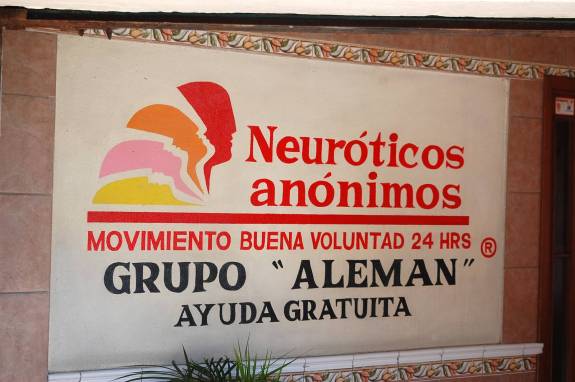
naI don’t know how many German-speaking branches of Neurotics Anonymous there are outside the Bundesrepublik. There’s probably a couple in Austria, and possibly a Geriaticneurotikenanonymous in Paraguay, but that’s beside the Punkt. We were surprised to find one in Oaxaca, Mexico. For a moment I was tempted to go entlag to one of their meetings, but I was visiting the city on holiday with my wife, herein known as Ch, who, despite my very best efforts, does not sprechen sie Deutsch, and in any case mein Volkabeln isn’t quite up to the Mark. Plus I’m not neurotic. Wirklich.dsc_0934Everybody loves Oaxaca. The first thing that Mexicans talk about whenever the place is mentioned is the food, which is indeed delicious and hard to find good versions of elsewhere. Mole is the most iconic dish – it’s actually a family of dishes of immense complexity. Coloradito, the one most associated with Oaxaca and also the most picante, is made with 36 ingredients, including chocolate, chillies, fruit, nuts, spices of various kinds, pumpkin seeds and about, er, 28 other things. Vanesa, a Oaxacan friend of Ch’s who we met up with in Mexico City shortly after we arrived, got very excited when telling us about all the eating we’d be able to do on our holiday, and then very angry when she moved on to tell us about los maestros – the teachers. Of whom more later.

Oaxaca (pronounced waHAca) is the name of both the city and the state. The latter is vast, and cut in half by mountains. After we leave the city it takes us 12 hours by bus to get to Puerto Escondido on the coast and it’s only 85 miles mientras el cuervo vuela. The rugged terrain isolates communities, which means that Oaxaca is the country’s most ethnically diverse state, with an indigenous population of 48% (mostly Zapotec and Mistec), the second highest in Mexico after the Mayan Peninsula, where most of the population are…Welsh (just testing). corbyn2A wander around the Museum of Culture testifies to this. ‘Oaxacan’ culture unifies all sorts of traditions with their own belief systems, cultural artifacts and artisan technologies. The many local markets and the makeshift stalls spread on the ground in the town’s squares by people from often distant villages show off handcrafted and painted wooden sculptures called alebrijes, and intricately woven and brightly dyed tapetes, huipiles, sarapes and the ubiquitous rebozos. Some of these artefacts we have seen elsewhere in Mexico, but we get something of a surprise on entering the adjacent church and former monastery of Santo Domingo de Guzmán when we see an image of someone we recognise from home (see photo). It’s by no means the only connection Jeremy Corbyn has with Mexico. His wife, Laura Álvarez, is a human rights lawyer who also runs a business importing chocolate made by indigenous communities. Little else is known about her (except, presumably, by him), so it’s not completely beyond the realms of possibility that she did some sort of deal over local produce and insisted that a stained-glass window image of her husband be installed as part of the agreement. Certainly there is no shortage of chocolate and chocolate products on sale in the UNESCO-approved colonial centre, along with hundreds of varieties of mezcal, of which I sadly only get to try about half.
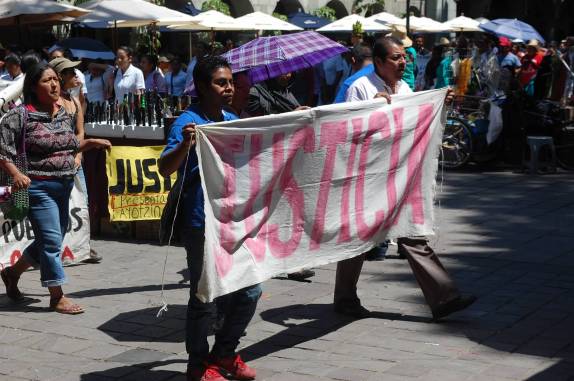
In the Zócalo (the main town square) most of the people selling things seem to be of indigenous origin, and so do most of the people protesting. The centre of the plaza has been turned into an Occupy-style camp. These are the famous teachers. I’m still trying to clarify what the situation is with them as their activities inspire a considerable amount of revulsion and rage amongst Mexicans I’ve met elsewhere. Reading their banners and the sheets they’ve hung up setting out their case and briefly chatting with some of them helps to make things clearer. Their movement, led by the dissident teachers’ union CNTE, has been fighting for decades for decent wages and proper schools and over the years their struggle has to some extent become instituionalised, particularly under the leadership of the phenomenally controversial Elba Esther Gordillo. One key date in the long history (detailed here) was May 2006, when police fired on striking teachers in Oaxaca. This led to a seven-month state of siege in the city. State forces unleashed massive repression, which to some extent continues – police vehicles armed with enormous machine guns are a regular sight around the city centre – and was stepped up in response to furious protests after 43 poor indigenous students from the neighbouring state of Guerrero were kidnapped, tortured and murdered by the army in September 2014. More recently teachers from Oaxaca, Michoacán and Chiapas have been striking and protesting against President Peña Nieto’s asinine education reforms, which seem partly designed to provoke and destroy the unions; they also attempt to sabotage the carrying-out of elections by attacking and burning polling stations, and very regularly sequester road-toll booths and block major highways. It is this kind of action which enrages locals like Vanesa, who are simply unable to go about their daily lives as a result. I sympathise with the frustration of people like her – I have never had to live with such massive and constant disruption. But I also grew up in a country with a decent school system where there were properly-remunerated teachers, plentiful materials and classrooms with roofs. Plus I’m aware that at least some of the opprobrium towards the teachers is at least related to racism; that certainly has been the case among members and supporters of successive national governments. This is one of those issues on which I have to bow to the greater wisdom of people who properly live in Mexico.justiceSo, Oaxaca is a complex place. Maybe a third eye would help make sense of things. In the market I buy a t-shirt featuring an image of Maria Sabina, the Queen of Mushrooms. She became an international celebity in the 1960s, attracting seekers of ancestral cosmic wisdom such as (it was rumoured) Dylan, Lennon, Jagger and Richards. She herself wasn’t impressed by the hordes of new arrivals. She was a curandera, for whom the point of taking psilocybins was not to find the divine but to heal sickness. Although we don’t visit her dsc_0616village, it is still on the tourist trail – every time I wear the t-shirt over the next few months, from Havana to Angkor Wat, I receive masonic nods and winks from those who share my apparent knowledge of arcane hallucinogenic rituals. We do, however, end up taking a trip: a bus excursion to Monte Albán to look at Some More Pyramids. We are lucky to be assigned a tourguide with some alternative theories to explain why some of the stone carvings depict people with deformed limbs, the upshot of which is that archeologists are all liars, historians are full of shit and we ourselves are a bit thick and should go to infowars.com if we can bear to learn the real Truth about the world. We also visit the jaw-dropping petrified waterfall and the hot springs at Hierve l’Água. Afterwards we share a collective taxi with some other tourists in order to rejoin the main bus. Halfway along an otherwise deserted track, the truck comes to an unexpected stop, and a representative of a small contingent of men requests that we all get out of the vehicle and into another one with no immediate explanation. Some of us start to suspect that something a bit kidnappy might be underway, but thankfully the new driver reassures us, explaining that the place where we got out marks the boundary between two taxi concessions, and that there have been ‘problems’ in the past when drivers from one village have encroached on the other’s territory. This makes me wonder if the preponderance of recovery groups in Mexico might be somehow related: perhaps one cartel controls all the Narcotics Anonymous groups in a given town and another armed gang rakes in the income from the meetings in the adjacent pueblo. I can’t imagine that such a situation would be particularly good for anyone’s sense of serenity.carvingAfter we’ve tromped up and down a fair few pyramids in the 40 degree heat, taken more photos than we will ever have time to look at and visited enough artisanal workshops to last the lifetimes of several Aztec gods, we are all keen to get back to Oaxaca, sink a couple of mechiladas and echar una siesta. So we’re delighted to hear we’ll be taking in one more attraction: we’re going to see some black pots being made. The black pots turn out to be useless, at least for their primary purpose of containing liquids. If you put water in them, it apparently goes all murky and you can’t drink it. They are nonetheless very pretty decorative objects, with their black sheen achieved by polishing them before firing them. Oh. It turns out that I am the only person in the world who finds pottery boring*. Everyone else wanders round the shop cooing at the crockery on display, or at least they do until the heavens intervene. Unfortunately the shop is open to the elements, which is a shame because the elements are in a very bad mood; like us, they’re probably a bit tired and just want to be driven back to the hotel. They descend on the place and smash bits of it to pieces while we cower in the corners and try to avoid getting lacerated by shards of falling pottery. In fact the weather gods have done us a major favour, because as soon as the torrent ceases we wade across the car park and get back in the van.

There’s a limit to what we can see in and around the city in three or so days. You could easily spend a month in Oaxaca State and not even get round to a third of the places you are recommended to visit. It is the fourth most visited state in the country, and also happens to be the second poorest, with 76% of the population living in extreme poverty. In my English language examining job I often pose this conundrum to candidates when the topic of tourism arises. It suggests to me that tourism is not a good or fair strategy for developing a region. Oaxaca does not suffer from a lack of promotion or even a shortage of visitors, and it’s rich in terms of both natural and cultural resources. It has a range of outstanding natural landscapes and no shortage of well-preserved ruins reflecting its historical complexity, the range of civilisations that have existed there. However, while most images of Oaxaca depict things of indigenous origin, whether archaeological sites or local products, in tourism-related jobs indigenous people themselves are rarely seen. This must be partly because of racism, but it is also clearly related to education. People whose schools do not have books and roofs are far less likely to acquire the skills necessary to obtain such jobs. Compared to a national average of 26%, only 5% of Oaxaca’s indigenous population reaches middle or higher education.cartoonThere is also the question of who has money to invest to take advantage of all the visitors. Most mid-range places we stay in happen to be owned by foreigners, and at the level of higher-end tourism, it’s international money that dominates – indeed it often physically displaces both local investment in addition to causing the eviction of local people and the destruction of natural environments. A recent and spectacular example of the latter were the mangroves in Cancun. Where tourism does create jobs for local people, they tend to be of poor quality – short-term, badly-paid and often very exploitative. Betting on tourism as a development strategy also has an opportunity cost. It replaces other forms of development and means that everything is valued in terms of its potential appeal to visitors. This is something I hear all the time in IELTS exams, regardless of the topic: parks are good because tourists like them. National cinema is useful because it promotes the country and might encourage tourists to visit. Museums and galleries are important because tourists seem to like them. The success of this ideology is demonstrated by the fact that to many people it seems to be a natural way of thinking, a common sense point of view. Drawing people’s attention to the fallacy of it (not exactly my job, but what the hey) is like the joke about one fish remarking to another on the temperature of the water. It’s an ideology which lends itself to exploitation by private interests. In ‘The Shock Doctrine’ Naomi Klein detailed how after the Asian tsunami of 2004 fishermen along the coasts of Sri Lanka and Thailand were displaced by hotel developments. In the case of Mexico, we learn of a similar situation towards the end of the film ‘Y Tu Mama También’: the young family who the three main characters have become friends with on the beach (filmed in Huatulco, Oaxaca) will soon be forced to leave their beachside home because of a new holiday resort. The same dynamic is in operation around the world, and not just along coastlines, but also in major cities, as the urban geographer (and my personal friend) David Harvey explores in some detail here. As he explains, tourism is a great product for capitalists to invest in because, unlike a vacuum cleaner or a mobile phone, it is instantly and infinitely consumable, with no product cycle. There is no limit to the amount that tourists can consume. Meanwhile local people are locked outside this endless festival of superfluous consumption, and in many situations are left with no other available means of survival but to sit on the pavement and try to sell whatever they have to the tourists. As for how people excluded in this way feel, Jean ‘Binta’ Breeze tries to put herself in their huaraches in her brilliant poem ‘Third World Girl‘:
Jean ‘Binta’ Breeze poem: ‘THIRD WORLD GIRL’ from Tilt Spoken Word on Vimeo.

The poem also addresses cultural appropriation. Oaxaca is important to Mexico in a similar way to how the Northeast is important to Brazil. In both cases the region provides symbols and icons which are central to national identity, and in both cases the people of the region are amongst the most deprived in the country. One such Mexican national emblem is the rebozo. In summer 2015 the Franz Mayer Museum held a special exhibition on Frida Kahlo’s use of the garment, titled, revealingly in English, Made in Mexico**. (The same exhibition had been held in London a year earlier). We learn from the information on display that this outfit is “one of the feminine Mexican garments par excellence … it has (much) meaning in the creation of the identity of women and the country.” The text that introduces the exhibition does not speak mainly of the rebozo, but of national identity:

‘Mexico is a rich tapestry in which multiple threads are interwoven. Its long and tumultuous history, from the ancient pre-Hispanic towns to the modernity of its urban culture, has brought many influences and ideas to the country, adapting to a cosmovision and way of life singularly Mexican. The decorative arts, an integral part of Mexican culture, reflect the intersection of traditional culture, colonial legacy and contemporary and political life. The rebozo has been – and continues to be – a resistant emblem of Mexican identity.’

In the words of Subcomandante Marcos of the Zapatista Army of National Liberation, what the Mexican state and its elite values is not its indigenous population, but an image of it. It then sells Mexico on the global market using images of indigenous people and indigenous products, but denies the people themselves the education that would give them the chance to exploit those things for themselves if they chose to do so. It’s comforting and flattering to think that our visit to Oaxaca helped develop the region in some small way. We certainly found it a deeply enriching experience. But I don’t believe that tourism is a equitable or sustainable way to develop a region or a city. Social and economic policies should focus on improving the living standards and human potential of the people who live in a particular place, and not the experience of those who are merely there on holiday. To which I suppose the only logical corollary is: if I ever go back to Oaxaca, I very much hope that I have a worse time than I did on my first visit.

* José Saramago’s novel ‘The Cave’ (which I also mentioned yesterday, oddly enough) is partly an essay In Praise of Pottery. Those bits of it are profoundly dull.

** I wrote a piece in Spanish about it in Spanish here (it’s in Spanish).

43

Guadalajara: Why I stopped using Uber

9ac31908-39b5-40d0-b67a-3e3433a6c47cAcross the doors of the lift in my hotel in Guadalajara there is a huge peel-and-stick painting of someone’s idea of a blue-sky palm-tree paradise, but where you might expect to see golden sands and sunlounges, what greets your eyes instead is a Burger King concession next to a huge line of cars. The good people of Guadalajara, it seems, enjoy their traffic jams. They are also fond of shopping centres, and of the car parks that must therefore surround and lie underneath them, which is why in search of an actual bar it takes me about half an hour of hard work to find one amidst the Walmarts and VIPs and Chili’s and VIPS and Chili’s and VIPs and drive-in Walmarts Walmarts Walmarts. The entire landscape in the area where I happen to be hotelled is composed of shopping centres, megamarts, car showrooms and names of stores in six-foot writing designed to be read by people speeding past or more realistically biding time in embotellamientos. It’s on another scale from where we live in Mexico City. The city is effectively unwalkable and the only places I can find to eat without giving up and joining the traffic are restaurants rated for their parking rather than their food. It doesn’t help that Guadalajara is immense and it takes 45 minutes to get anywhere fun even by car – it feels strangely much larger than DF. It’s the kind of hyperalienating environment which José Saramago deplores  in ‘The Cave’, a place which is, in the words of Frederick Jameson, ‘useless as a conduit of psychic energy’. It puts me in mind of Cabot Circus, that huge alien spaceship which has obliterated the centre of Bristol. There’s nothing new about such an environment and there is little to say about it that authors such as JG Ballard, William Gibson and Will Self haven’t already written. But my individual experience of it is inevitably physically and spiritually exhausting. 20th Century modernity became fixated on the private motor vehicle and the 21st Century shows no signs of moving on despite its own terminal obsession with the smartphone. Who cares about a three-hour bottleneck when you can sit in your car and text. It takes me three attempts to get to the centre using public transport and my feet; eventually I give up and take a taxi.screen shot 2016-09-28 at 3.32.27 pm.pngI always learn a lot from Mexican taxi-drivers, about politics and the ins-and-outs of gang wars. Asking about who controls the city (and which politicians they are in league with) starts to feel a bit like asking how the local football teams are faring. In Guadalajara there has recently been a low-level war between two mafia groups and now things are (ostensibly) relatively calm because one of the sides won. For taxi drivers in Guadalajara the theme of violence and politics is intimately connected to their jobs and to the increasing dominance of one particular cartel known as…Uber.
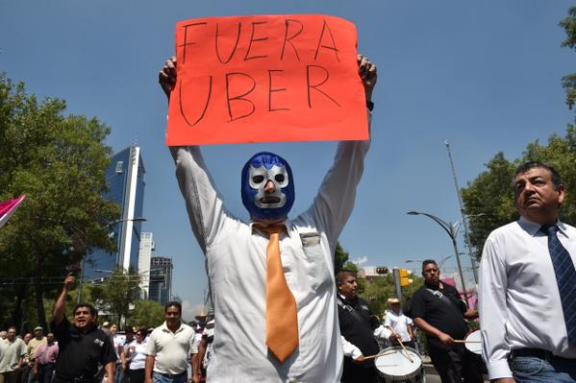
The transition to the post-human economic model is not proving to be smooth one anywhere you look, and in Mexico like so many social and economic changes it is mediated by violence. There have been physical attacks on and kidnappings of Uber drivers, and it is hard to tell whether this is inspired more by traditional drivers struggling to survive or by cartels not wanting to lose their share of the market. The situation is unsustainable both from the point of view of taxi drivers and from the perspective of those who drive for Uber. On the part of the normal taxi drivers there is outrage at the corruption involved. The governor of the city recently changed the terms of their licenses; he also introduced an unsustainable level of competition into the trade by buying dozens of cars and putting them to work for Uber. Hence, like in many other cities, many people working ‘for’ Uber are not the owners of the cars they drive. In any case the amount that drivers earn from Uber is not enough to maintain a car to the standard the company demands and certainly not enough to replace it after a few years. Over time, as competition intensifies, individual drivers don’t earn enough and they lose their ‘jobs’. In the meantime they have to cope with sudden increases in how much they (or their bosses) have to pay the company – in mid-2015 they were faced with an overnight 20% to 25% increase. The clients of course won’t notice when drivers drop out, because as the traditional taxi service disappears there will always be new ones, who will then in turn fade away – indeed, who will literally disappear given the amount that Uber is investing in the development of driverless cars. And although Uber is not yet profitable it has bottomless pools of capital to draw upon, given that companies such as Goldman Sachs are involved. The drivers are just place-holders, stand-ins for robots who haven’t quite made it out of the factory yet. I realise when talking to the driver on the way back to the hotel from work that this happens to resemble my own situation. I’m here to administer international English exams, speaking ones that are conducted in person and which take about 14 minutes each. The students also do written exams, which take considerably less time to grade (I currently hold the secret world record), and so are the much more lucrative part of the deal. However, it is rumoured that the written exams will soon be conducted online, and then it is safe to assume that the spoken exams will follow, as already happens with the competitor exam.uber-protestaIn addition to the damage it does to the livelihoods of working people, there are several reasons why using Uber makes me so uncomfortable despite its obvious advantages in terms of convenience and (ironically) comfort. It’s useful to take the name seriously. Uber provides a comforting and flattering sensation of belonging to the elite – in Pynchonian terms, to the elect rather than the preterite. In the case of any danger or discomfort we can be whisked away in and to safety. The fact that it is cash-free feeds the fantasy. The phrase “there will be a car waiting for us” is a very seductive one; silently, magically, someone turns up; there’s machinery behind the scenes taking care of our needs. The way Uber operates means that we are effectively being driven round on the internet; just like we can now choose to mentally absent ourselves from awkward social situations with less than a digital click of the fingers, Uber gives us the opportunity to slip away physically. Although Uber drivers I have encountered have been unfailingly courteous the system works to abstract relations and frees me from potentially perilous social obligations: I’m not forced to listen to obnoxious phone-ins on the radio, or (even worse) having to listen to Smooth FM; I obviously don’t have to stress about possibly not having enough cash. I also learn a lot less from drivers in Uber cars; interaction feels more stilted, more like I’m talking to a tourist guide than a taxi driver. The service serves to cushion us from daily frustrations and curtain us off from awkward personal engagement with the service provider; our relation with him or her is more remote, so he or she is interchangable. As such the whole experience puts me in mind of the scene in ‘Cloud Atlas’ which depicts a future in which only a tiny number of superconsumers have the right to shop and are served by a sub-race of interchangeable and immediately disposable replicants.CLOUD ATLASWhen we pay for special treatment what we are paying for is an enhanced image of ourselves. This is the ‘added value’ that companies are desperate to add to their products. This cultural tendency to fantasise ourselves as superconsumers partly explains the appeal of figures like Trump and the Kardashians. Trump in particular lives a fantasy life of a fantasy billionaire, and by taking Uber we also partake in this roleplay. This aspiration-as-pure-fantasy is what capitalism is increasingly betting on. An article in the Financial Times in 2013 urged its readers to shift their investments into luxury items, “many of which have been outperforming peddlers of more humdrum goods in recent years”.  Uber stitches privilege seamlessly into the fabric of our lives and helps us pretend that we are not paying for it. In the back of an Uber car I can stretch back and mentally flick through the latest edition of How to Spend It; I certainly find that I am much more likely to ignore the driver altogether and pretend I need to do stuff on my phone. I can be driven round like the billionaire in ‘Cosmopolis’, seemingly detached from the social and economic pressures exerted on the driver. Uber drivers rarely complain: about other customers, about their job, about the city they live in. They are after all more dependent on the person paying them, who can, if they are in any way displeased, jeopardise the driver’s future income at a safe distance with a tiny gesture of the thumb. They are our servants in a way that taxi drivers are not. Uber is all about strategy, about accomplishing total control over the field in which they operate. Normal cab drivers have tactics to evade total control and exploitation; this might consist in ripping off the customer, talking back, or taking detours. They know the cities in a way Uber drivers generally don’t, dependent as they are on GPS. Tl;dr: I think it’s wrong to use Uber.20161112_193715.jpgWhen I do at long last get to the centro histórico of Guadalajara its beauty and charm stupefy me; I’m glad that on this third and final visit I finally made the effort. The colonial heart of the city was designed, set out and built specifically in order to ridicule any humble attempts I might make at describing it. Jalisco es Mexico is the slogan used to promote the region and the symbols and bright colours you see emblazoned all around insist on this, as do the ubiquitous mariachi music and the incessant invitations to try out the local tequilas. In a tiny sundrenched plaza called Nueve Esquinas I gorge on birria, the ingredients of which are one entire dead goat boiled in its own blood, four different kinds of chilli, and about two litres of my own sweat, as the local beer and a shot of the regional moonshine sieve right through my hair back into the bowl and so I promptly grab some more tortillas, dive in and perform a perfectly executed Mexican version of La Scarpetta. Afterwards I walk around in a daze in the blistering heat and take a hypnogogic doze on a bench. It’s all too much to take in, and I don’t want to have to deal with the tedium of rush hour, so I take a taxi back to the hotel with a driver called Alberto who comes from Monterrey and whose girlfriend is scheduled to give birth to twins any day now. It’s a high-speed, bumpy but convivial experience soundtracked by norteño music a un volumen ensorcedor. Addled as I am with goodwill, goat and agave I offer to do a deal over the price so I will pay double the pittance I am charged and then claim it back from my employer. I try to explain the phrase stick it to the man, for which I’m sure Mexican Spanish must have range of equivalents, but only confusion results and I decide it’s probably about time for another siesta.

Guanajuato: What the Catholic Church has in common with Slayer

incredible-views-in-guanajuato-mexico-1Guanajuato is the kind of place where you spend most of your time hoping you can come back one day. The term Pueblo Mágico is somewhat overused in a Mexican context – you’d be hard pressed to find a reasonably attractive town of a certain size to which that classification hasn’t been applied – but the charms of this place are plentiful and immediately apparent: an undulating landscape of colourful roofs and baroque churches spread over several hills, from which a bird’s eye view swoops down to tight-knit labyinths of alleyways which put me in mind of Alfama in Lisbon or the Ribeiro in Porto, these twisting callejones opening suddenly upon laurel-lined colonial squares laid out in their own haphazard maze. Its effect was such that even though we have now left Mexico I still have the vague but somewhat vain hope that we will go back before we leave. Somehow.

We happen to be there during the Day of the Dead celebrations and there couldn’t really be a more appropriate place to visit. Many of the streets are carpeted in intricate tapestries in colours which surpass my vocabulary in any language, composed of various flora and foodstuffs depicting calaveras and other catrinas or commenting slyly but wittily on political events.
Although the notion that Death is more present or more acknowledged in everyday life in Mexico can be challenged on various fronts*, this is a city built on the sacrifice of hundreds of thousands of silver miners. We descend to one of those mines and learn about the horrendous conditions endured (or not) by countless generations of mostly indigenous workers, and then we climb back up into the baroque ornateness of a church resplendent in the produce of all that toil. The whole of Guanajuato, it seems, was developed because the owners of the mines had nothing better to do with their money than build shrines to themselves. In the words of Walter Benjamin, there is no document of civilization which is not at the same time a document of barbarism.

It wasn’t just indigenous workers who broke their backs digging up precious metals. A caption in the local museum alludes coyly to the ‘presence’ of African ‘workers’ who were brought in to complement the Nahuas, Michoacanos, Otomis, and Chichimecas commandeered from other parts of Mesoamerica. Nowadays there is a glut of workers for a far smaller pool of jobs in tourism and the culture industry, with something of an an oversupply of hotels. We are certainly well catered for. The owner of our rambling hillside guesthouse turns out to be a gringo, one who typifies a certain kind of voluble effusiveness particular to North Americans, a characteristic which I personally find very endearing. He is full of stories about how he and a small team of in-laws hewed the place out of raw rock. It is a genuinely staggering achievement, involving hauling hunks of stone up and down the hill and hacking out waterways where there were none. casa-zuniga-b-bTalking to him I am reminded of Fitzcarraldo, or any number of mad semi-mythical geniuses who headed south, grabbed machetes and gouged out their visions in the tropics. The sprawling establishment has a lot in common with the local churches in that there is silver and steel everywhere, but the decorations do not depict angels or edenic scenes, instead they consist of rather macabre, twisted metal sculptures. It looks like a workshop where the stage set for the new Iron Maiden world tour is being welded and hammered together.148216400712045Fittingly, my less-than-elaborate costume for the Day of the Dead itself is a Slayer t-shirt I buy for 100 pesos. Here you can see a photo of me in all my gothic grandeur.

Even more of a frightening sight are the mummies which have long been one of Guanajuato’s main tourist attrations. The corpses were perfectly preserved but a century or so of morbid gawping has worn them out a bit. It strikes me that so much of the histrionic shrieking and visceral iconography of heavy metal music are in part an unwitting parody of certain aspects of the Catholic Church. While most metal bands would probably describe themselves as nihilistic, they are actually for the most part deeply moralistic, albeit more id than superego, a celebration of all the sadistic and grisly elements that priests pretend not to enjoy. There are few passages as gothic and rich in potential death metal imagery as the description of the sermon on the eternal tortures that await the damned in hell in James Joyce’s ‘Portrait of an Artist as a Young Man’.

A clue to what lies behind all these representations of gore is on display throughout the city: many churches are covered with huge images of fetuses reminding anyone who needed reminding of the fervent desire of the medieval and neomedieval church to control women’s sexualities at all costs. The museum where the mummies are housed also houses a few preserved examples of desiccated embryos. It may be that the historic treatment of women by the church and the state has contributed to the development of a culture in which men feel free to seize and dispose of women’s bodies with impunity. After all, certain still-dominant elements of the church hierarchy do not regard women’s bodies as their own property, but rather as mere vessels for the next generation of male heirs and child-carriers. Just a few hundred miles south of here the Church is having women locked up for decades for the mortal sin of having a miscarriage.

It comes as something of a shock to discover several weeks after visiting Guanajuato that I had already, in a sense, visited the place before. Rewatching a documentary about Thomas Pynchon I learn that he fled here when running away from a journalist who had tracked him down in Mexico City after his first novel became an overnight success. Subsequently while rereading ‘About the Day’ I notice with a start that he even visited and described the mummies in some detail. It gives me an curious insight into how he composes his immensely complex and often encyclopedic novels, because while he was here in 1963, the novel didn’t emerge til 2006. He gives the impression that he writes down absolutely everything that he learns and experiences and it all goes into his books.

A far more bloodless place is only an hour away from Guanajuato on the bus: San Miguel de Allende. This is Mexicoland, the kind of place which someone like Bill Gates probably finds pleasant and safe to wander round in his polo shirt and chinos. It is awash with serious tourist money and the effect is somewhat bland, like a golf course whch just happens to be covered in colonial buildings. Nowadays the rich don’t build palaces, they acquire cultural capital instead. The streets are teeming with vapid art galleries selling tasteful but meaningless decoration. We are very glad that we reversed our original plan of staying here for five days and nipping over to Guanajuato for one. Está bien aburrido, guey! Guanajuato, por otro lado, es una maravilla macabra.


*On the last night in Guanajuato we met someone dressed as a ghoul, an American artist who has defeated death and now openly and joyously taunts it.

** All but three of the photos in this piece were taken by the author. Anyone who can guess which three stands to win an all-expenses-paid trip to the bathroom.

*** This is part of an ongoing occasional series of reflections inspired by cities I have been to recently. Other entries can be found tagged below under Cities.

México, DF: What links the murder of dogs in Condesa to the Corredor Chapultepec?

arquitectura-corredor-cultural-chapultepec-3

I’m trying to write a novel, one set in Condesa, a nice, quiet, leafy suburb of Mexico City, in mid-2015. A number of things make this difficult, not the least of which is that it’s now 2016 and not only are events quickly moving way ahead of me, they are also, conversely, getting closer to home. Last Saturday night two people were shot within around fifty metres from our front door. I know this because a journalist from Proceso magazine was brave enough to write about it several days later:

“Last weekend, in the middle of Calle Saltillo in Condesa, outside the bar Dussel, which only opens in the early morning and closes when the sun hits its peak, a man on a motorcycle killed two people. Approximately seven months ago, on the same street corner with Alfonso Reyes the owner of a bar known as LIFE was executed.

“The Roma-Condesa area is not just one of the trendy zones of Mexico city because of its bars, restaurants, galleries and parks and because it’s inhabited by middle-class hipsters or by the millennial generation. It’s also an area which has for some time been under the control of the first chilango (Mexico City) organised crime gang known as La Unión.

“The boom in restaurants, bars, pubs and nightclubs in Roma and Condesa, as well as the real estate boom that has attracted the capital’s young population, has attracted the attention of La Unión because it is a natural market for adulterated alcohol and all sorts of drugs.

“The authorities of Cuauhtemoc, the most economically and politically important district in the Federal-District, have detected people from La Unión operating in the fashionable colonies Roma-Condesa, carrying out the transfer and sale of drugs in the central streets of Tamaulipas, Michoacan, Alfonso Reyes, Saltillo, Alvaro Obregon, Orizaba, Colima and others where the bars and clubs that are being subject to extorsion but do not want to officially recognize it are concentrated.

“Violence has become increasingly present in these two colonies where there have been invasions of land and buildings, assaults on passers-by, armed robberies at some restaurants and executions outside of some clubs.”

…which reminds me that on Sunday morning we walked past the spot where the double murder must have happened, because the road right in front of the bar in question was closed off by police tape. At the time we dismissed it as not much, because there was no media in sight, but I understand better now that just because some people have been violently killed doesn’t mean that the mainstream media can or will report on it. Ironic, of course, that I only learnt about the details of what happened on our doorstep when a friend in London sent me the article via the internet. This part of the city is mostly populated by transient funseekers and youngish expats like ourselves, with few restaurants and cafes that don’t turn out to be chains, so there is less of a sense of community than I initially assumed. The murders fit into a pattern of recent events which we read about when we were thousands of miles away just before Christmas. Not just read about, in fact — a neighbour of ours filmed this video out of his window, a couple of hundred metres away. This was apparently followed by an incident where twenty armed men burst into an apartment building on Avenida Amsterdam, held up the residents at gunpoint and ransacked the place. Stories, not all apocryphal, of raids on bars and restaurants in Condesa and the adjoining barrio of Roma abound, as well as reports of extortion (‘derecho de piso’) of bar and restaurant owners in the neighbourhood.

Although we, as people entirely remote from the tit-for-tat battles between drug gangs, are little more likely to fall victim to violent crime than we were in Hackney, it’s made us nervous. All the time we’ve been here the fact that we live in a nice, safe part of town has been a major opening conversational gambit. So many people in Italy and the UK asked us ‘How’s Mexico?’ that some part of my brain started to assume it was a new greeting that had taken off in our absence, so after I while I found myself asking friends and family the same question. But the automatic answer we’d happily been trotting out over the previous few months no longer rang true. An uncomfortable aspect of this is that we had come to assume we had some sort of privileged immunity to the violence that simultaneously destablises and sustains this society. In my novel I’d like to explore the ways in which this is also true on a wider and deeper level, explore its myriad contradictions and try to come to terms with the manifold hypocrisies it entails. For the time being it means we need to watch our steps. After all, as the Proceso article mentions, the reason there are so many vibrant and pulsating bars in this district is drugs, and those who take them have obviously obtained them somewhere hereabouts. There is a huge nighttime economy, and violence is a powerful currency.

All this connects with the novel I’m trying to write in a way which if I attempted to pass it off as mere fiction would make anyone who read it dismiss as profoundly implausible. You would not get away with making this shit up. It is possible, for example, that recent events are somehow to do with the poisoning of several dogs in two nearby parks last summer. In my novel it will be 43 dogs, for fairly obvious, but hopefully not too trite, reasons. Certain aspects of the plot I stole from someone who shall remain anonymous, because I have no idea who connected the events in the first place. Try this on for size:

In about early December last year I popped into an internet cafe on Insurgentes in order to print something as part of my ongoing battle with the tax authorities. This involved cutting and pasting some details from my email, but when I clicked paste what appeared in the word doc was not what I expected. Instead what popped up was a closely-worded text in capital letters which must have been some sort of letter-to-the-editor. Although I was too slow and in too much of a hurry to understand more than the gist of it, in essence it set out a bad-tempered conspiracy theory arguing that the deaths of the dogs in Condesa was part of a political strategy by the authorities to manufacture a sense of paranoia which would somehow lead to a positive result in the referendum (to be held later that week) on the future of the Corredor Chapultepec. This is a huge scheme to turn a neglected thoroughfare in the centre of the city into a version of Dubai. The text alleged that the police and political authorities were engaged in a complex plot to destabilise an emblematically tranquil part of the city in order to achieve their political and commercial aims.

So far, so mindbendingly odd. Or possibly just mad. There’s little reason to believe it wasn’t written by a local nutcase, and I don’t want to assume that goings-on here are any more wacky than in, say, London. But then I did know from the US-born DF-based writer Francisco Goldman, and from various other informants, that in very much the same way as criminal gangs compete and kill over the drug trade in Condesa, the national ruling party (Peña Nieto’s PRI) do have a long-term plan to take over DF. Ever since the mayoral system was introduced nearly twenty years ago, it has been won by someone (at least nominally) on the left. Listen to the local radio here and you are sure to hear an advert from the PRI boasting of their ability to run the city. According to Goldman and his friend the former mayor Marcelo Ebrard, the PRI will stop at nothing to get their hands on the prize. The current mayor (Miguel Mancera) was elected in 2012 as an independent, but his brutally repressive/staggeringly incompetent actions since have led very many people to suspect that he is doing a job for the PRI. His claim that there is no organised crime in Mexico City is endlessly ridiculed as there is countless evidence that it is a straight-up lie, not least the hugely increased police presence in the more salubrious parts of the city over the last few months. What may well be happening on a city-wide scale is what the drug gangs are apparently offering to bar owners in Condesa — the PRI may be roughing things up so that it can then offer ‘protection’. When the left-wing former and future presidential candidate Lopez Obrador (‘the Pike’) talks about the ‘mafia of power’ it is more than just an attention-seeking metaphor.

Ultimately in my novel I might end up taking a leaf out of one of Martin Amis’s better novels and having a character with my own name drifting in and out of the action (but hopefully not getting shot dead on page 16). At least for all of my extremely limited understanding of the dynamics of life in this city, there’s no way on earth I would do DF as much of a disservice as Amis has done in every novel he’s written about London in the last thirty years. The more I pick up on what’s going on around us, I start to suspect that capturing even the vaguest sense of it all might just be beyond my powers. I think even Thomas Pynchon himself would balk at some of the outlandish plot twists devices that reality comes up with in Mexico, DF. At least one other novelist, Roberto Bolaño, had a term he used to classify the level of surrealism inherent to this place: infrarrealismo. If I now proceed to get arrested for researching how to poison dogs online, it will fall into that category.

Torreón: What Connects Isis and Mexican Drug Cartels?

1

I’m sitting in a plush hotel bar in the northern city of Torreón (like a smaller, grubbier and emptier version of Monterrey) trying to understand baseball. I’ve enlisted the help of some Texans at the next table who are ably fielding my persistent enquiries (or, as they would call them, inquiries) about what’s happening on the TV, questions along the lines of: why, when the pitcher throws the ball, does the batperson almost never make the slightest attempt to hit it? and why, when he does deign to make contact with it, why does he almost never actually run to first base, but instead stroll nonchalantly? Surely it would make more sense for him to run? Eventually I give up asking questions about the game and try to watch it, which is hard because it appears to me to be extremely fucking boring, and it seems that the players agree, as at one point a massive fight is staged and as far as I can tell the whole thing is abandoned.

The following night I try again with American football (or, as Americans call it for fairly obvious reasons, football). I feel compelled to do this because in a few weeks I’ll be off on what is effectively (apart from an interflight wander around a bit of Queens a couple of years back) my first trip to the States and I want to learn some of the language in preparation. I’ve long noticed that whenever, let’s say, Larry David says something like ‘Hey, did you see that Nicks game?!’, I genuinely don’t know what he’s talking about, which is a bit ridiculous, as my very livelihood is based on my claim to have a perfect grasp of the English language, even though I was unable to get through Underworld by Don Delillo, apparently one of the greatest novels published in my lifetime, because it was basically a big book about sport, and I don’t really know what a quarterback is.

The key thing about understanding any sport is knowing some very basic rules so as to be able to follow what is actually happening. In the case of football this is made difficult by the very many stops and starts and by my not knowing anything about the roles of the people on the pitch (I think they call it a pitch). Who is supposed to be passing the ball to whom, and to what end? Why don’t they just get on with it rather than stopping to piss around every ten or possibly twelve seconds? In theory I don’t really need to know any of this stuff, but I am apprehensive about trying to join in sports conversations in bars and making a massive anglofool of myself. Also I would like to be able to read that particular Don Delillo novel one day after I’ve finished reading everything by Thomas Pynchon six or seven more times.

There’s also the fact that there doesn’t seem to be a massive amount to do in Torreón once you’ve eaten your way through a big pile of dead pig and read all the information on the internet. It apparently was quite a lively place until about eight years ago when a particular bunch of evil bastards called Los Zetas turned up and started contesting the territory with the Cártel de Sinaloa by, in their inimitable fashion, torturing and murdering (and, let’s face it, probably eating) as many people as they could. Torreón is located at a midway point between Chihuahua, Sinaloa, Durango, Nuevo León and Tamaulipas, all places synonymous with drug trafficking. In 2010 it was listed as the seventh most dangerous city in the world, although things have calmed down a good bit since about 2013, as, like in other areas of Mexico, the authorities appear to have taken the side of the Sinaloa Cartel, sitting back and letting them get on with the job of eliminating the Zetas and restoring some sort of uneasy peace.

The dynamics of these situations are no easier to understand than the rules of American sports, and unlike baseball and football asking people to explain to you what exactly is going on isn’t always a good idea. At least on TV you can see the ball being passed around, moves being made and attack and defence strategies being adopted, even if the adverts do get really annoying. With the drug trade there are an enormous amount of goods being passed around — the global narcotics industry is said to be worth over $400 billion a year (and counting), and a huge proportion of the produce which generates that revenue comes from or passes through the north of Mexico.

The official story of what happened on the 26th September 2014 in the town of Iguala in Guerrero State is that the corrupt local mayor handed over dozens of radical students who were getting on his nerves to a drug gang he was in cahoots with who then tortured, shot and burnt them. It is generally agreed by anyone with half a brain and a quarter of a moral conscience that this story is an utter lie. What is far more likely to have happened is that the student protestors, who wanted to commandeer a number of buses to take them to a rally in Mexico City, took one which happened to be stuffed with a huge shipment of heroin belonging to the drug gangs ready to be transported to the US. The municipal police, the army and the drug gangs therefore attacked the students, torturing and killing them and then burning their bodies in the incinerators in the army barracks, to which the military have steadfastly refused access. The official story therefore is a transparent attempt to cover up an intimate network of relationships between drug traffickers and very high levels of the State and army.

Of course, unlike in a film by Oliver Stone, there are no secretly signed documents recording all of this information. No-one had sat down and written out a detailed plan of operations which, if it could be found, would incriminate all the politicians and military figures involved. The fact that we know all this is thanks to very dedicated journalists and investigators who have painstakingly and at very great personal risk pieced together evidence which disproves the States’s explanation and posits a far more plausible one. Whereas I could, if I was so inclined, simply google and learn all about the rules of any sport I choose, in the case of the relationship between crime and politics successions of events and their causes are much harder to ascertain.

So far, so self-evident. The mere fact that corruption of this sort exists in Mexico is no revelation and is not worthy of a blog post based on tortuous and tenuous analogies. Bear with me.

It has become a minor trope of journalists over the last few years to refer to groups like the Zetas and the Cártel de Sinaloa as the ‘Isis of Mexico’, given the seemingly out-of-control growth of such organisations through the imposition of terror. In the case of drug syndicates, there is a clear meaning and purpose to their violence — a share of that $400 billion a year. The Sinaloa Cartel is said to have annual revenues of around $3 billion a year and although estimates that it employs more people than Walmart are downright silly it certainly has a huge number of people working for it. Salon.com lists several similarities between the drug syndicates and Isis:

They behead people by the hundreds. They heap headless, handless bodies along roadsides as warnings to those who would resist their power. They have penetrated the local, state, and national governments and control entire sections of the country. They provide and services to an impoverished public, which distrusts their actual government with its bitter record of corruption, repression and torture.They seduce young people from several countries, including the United States, into their murderous activities.

However, there is something about this analogy which doesn’t work: the question of motivation. While drug gangs cause mayhem and kill thousands for money, Isis do so purely out of religious zeal. They have a barbaric interpretation of holy scripture and that is what inspires them to destroy entire societies of people they regard as ‘apostates’. In the declaration they released explaining their rationale for the horrendous attacks which took place in Paris last Friday they talked of killing ‘hundreds of idolaters…together in a party of perversity’. Clearly in the case of Isis the reasons for their acts of terrorism are ideological rather than mercenary.

Except…

In an article published over the weekend Oliver Tickell, editor of the Ecologist magazine, pointed to a revelatory FT report on how much money Isis earns from oil: something in the order of $1.5 million a day, or $500 million a year. If Isis was a Mexican cartel making that much money from drugs, it would be beheading probably about the same amount of people as it actually does in the Middle East. There is no quoted index of the value of a human head in dollar terms, but I would imagine the price in Northern Mexico and Northern Iraq must be comparable, and in the case of Isis, there is an additional holy premium to be earned.

So, as Oliver Tickell details, Isis has an interest in the price of oil. As we have recently discovered, oil producers will do anything to protect their profits. In the case of Exxon and the potential threat to their future income represented by climate change, they mounted a hugely successful decades-long campaign together with other fossil fuel corporations to cover up the facts — in the words of climate campaigning hero Bill McKibben, “no corporation has ever done anything this big or bad”. As for Shell, they attempted to go ahead with drilling in the Arctic even though their own scientists had specifically warned them that doing so would inevitably mean that any attempt to control carbon emissions and thereby limit global temperatures would be blown to pieces. It is simply impossible to imagine anything such companies would not do in order to protect their future incomes.

Next month in the French capital world leaders will come together and seek to reach a new agreement on carbon emissions. This is D-Day for fossil fuel companies. This could potentially have been be the point at which, after so many previous summits at which corrupt lobbying campaigns have successfully managed to stall any meaningful moves towards preventing a global ecoapocalypse, world leaders were forced by the pressure of millions of ordinary human beings to challenge the interests of some of the most powerful and dangerous corporations on the planet. The chance of that happening is almost certainly now reduced to zero. The very word ‘Paris’ now stands for something else entirely.

If I wanted to I could easily go online, find a list of rules governing the sports of baseball and American football and learn all about the different moves, strategies, and tactics, and then when I next watched a game I could look at the way the players try to move the ball around the pitch and score points while others try to obstruct them. In the case of financial interests and politics, most business takes place off the field and away from the cameras. I can only proceed by analogy, inference and interpretation, looking at results and surmising what the causes may have been. In the case of the climate talks in Paris, they have now been destabilised on two fronts by powerful forces which have specific interests in the continued production of fossil fuels. That is not remotely to suggest that there was a secret agreement between energy corporations and Islamic terrorists to murder people on the streets of Paris, but it is apparent that they share an interest in making sure that the talks are a failure.

This is not a conspiracy theory. It is the setting out of facts which seem to correspond in some way. Ironically, those people who instinctively shout ‘false flag!’ in response to any event of this nature are extremely unlikely to develop such theories about this particular topic. Those supposed radicals who pride themselves on consistently challenging the official version of events were long ago duped into thinking that the vested interests in the climate ‘debate’ were those scientists who patiently set out their reasons for grave concern rather than the corporations seeking to protect their profits at any cost.

The people who committed the atrocities in Paris are now dead. A certain kind of justice has been served. Whether the inhabitants of Raqqa, suffering under the brutal regime of Isis and now subjected to a massive retaliatory bombing campaign themselves deserve to be punished is highly debatable. In the case of Exxon, it is extremely unlikely that anyone will face justice in this lifetime. We saw a few months ago that the Mexican Government was unable (and, let’s face it, unwilling) to hold the CEO of the Sinaloa Corporation inside the justice system. As we sit and watch this game develop and try to figure out what is actually happening and why, what chains of events are triggered by particular moves, it seems to be the case that some players are simply too powerful to be punished. In the immortal words of Bodie, the teenage drug-dealer from The Wire, this game is rigged, man.

Does “Mexico City” live up to the hype?

485738354I’m walking down the street in a pleasant upmarket neighborhood and as I walk I have to tread carefully, as the ground beneath my feet is covered in often quite deep cracks as a result of a huge earthquake which is said to have taken place 30 years ago. Such is the level of detail you find everywhere you look in what must be by far the most ambitious and fully-realised piece of immersive theatre yet produced. While companies such as Punchdrunk, Secret Cinema and You Me Bum Bum Train may have awed us in the past with their transformations of abandoned post office sorting offices and the like into exquisite dream palaces of theatrical imagination, ‘Mexico City’ is on an entirely different scale.
Something that strikes one again and again throughout this experience (in truth, more of an installation than anything resembling a play) is the sheer number of actors and or/other visitors (it’s not always easy to tell who’s who). On both of my visits (one trip is certainly nowhere near enough) there seemed to be a cast of literally millions. Even someone entirely jaded with the by now often very standardised rituals and tricks of promenade or participative theatre could not be anything other than blown away by the astonishing artificial world that has been brought into being.

Despite the epic scale, this is no Wagner opera. Visitors are in no danger of losing the plot since the action, which erupts non-sequentially like any number of volcanoes of all shapes and sizes, means that there are an infinite amount of threads, so the spectator is left to wander around at leisure and weave his or her own narrative. Thus no two experiences could ever possibly be the same. The production is of such a vast size that any meaningful opportunity for the casual punter to work out what the hell is going on flies out of the window, but the great pleasure of the production — chasing round and attempting to fit the various pieces together — never feels like a chore, and everywhere you turn your senses are constantly assaulted by fresh stimuli, whether it be the sight of someone standing in the traffic juggling fire, the bursts of mariachi and norteño music assailing you as you stroll down the street, or the intoxicating smell of sliced chillis mixed with arrachera cooking on a neighbourhood grill.

Indeed the physical extent of the show is such that not just walking is involved. Being part of and struggling against the traffic is part of the frustration and therefore part of the fun. Anyone who has been to the Glastonbury Festival will know just what I mean — you set off in good time to reach a particular attraction, but along the way find so many unexpected and delightful things happening that whatever you intended to see quickly gets forgotten. My advice for first-time visitors is: forget about Uber and Google Maps — let yourself go with the flow instead. You will soon find yourself feeling like less of a spectator or even a voyeur, more of a flâneur. The sensation is rather like watching a blue whale glide by an inch from your face, simply too big to take in, but even this does not begin to do justice to the level of detail involved.

The audience is also encouraged to investigate and interact with their surroundings. A large part of the pleasure of the production lies in what you might discover if you have a root round amongst the almost insanely detailed sets: the markets, the parks, the squares and pretty much everything else that the human mind can conceive of and cities can provide. There is even a full-scale metro system, which also functions as a chaotic underground shopping centre, with all manner of goods on sale, often at ear-splitting volume. It is particularly by poking your nose into the hidden recesses of the installation that you will be able to make the most of your visit: a careful inspection of a mere one hundred square metres of the set will yield much more in the way of meaningful insights into modern urban existence than a whole lifetime of visits to the National Theatre or the White Cube.

For those who choose to investigate it there is a hugely complex and thrilling backstory written into the production, involving former civilisations, floating cities, and colonial invasions followed by bloody struggles for independence and violent revolutions — once again, the intricacy of these elements is mind-bending. There are even murky rumours about recent presidents murdering their wives and intriguing tales of high-level corruption involving government contracts and bloodthirsty drug gangs. You might even be able to ask some of the characters about such things — although the show is said to be largely improvised, the actors have been very well prepared in terms of their knowledge of the world they are depicting. Although other reviewers have expressed some disquiet about the occasionally menacing nature of their interactions with the characters I found them to be very cordial at all times. Strike up a conversation and you may find yourself being led to a part of the set that few get to see. 66 Minutes in Damascus it is certainly not!

For me, the best moments were often the smallest: reclining on a vast brightly-painted bench stretching my legs in the dappled sunshine as New Age music played around me, or chatting with a storytelling Cuban ice-cream salesman in the midst of the most vibrant and colourful market I have ever seen in or outside a theatre. The superb choreography and the extraordinary logistical flair of the staging mean that such moments are never far away.

Given the scale, the complexity and the level of detail involved, not everything about the production could be said to be perfect. Some miscasting is evident, with 70-year old men stacking shelves in supermarkets and a very high proportion of street stall workers clearly too young for the roles they are playing. Indeed there is a level of implausibility in the sheer number of people selling things to each other and to the visitors — it is unlikely that in a real city so many people could eke out their existence in such a way. There was also, despite the variety, a certain amount of repetition. I swear that over the course of my two visits I must have heard the recorded voices of the woman collecting old appliances and the one selling local snacks over a thousand times. There have also been concerns expressed about the ways in which the actors themselves are treated on and off set — certainly it seems that spectators are given VIP treatment in comparison with the conditions in which the participants work. In some places the set is starting to come apart, although in many cases it is hard to say whether that effect is deliberate or not.

What can be said to be the themes of such an ambitious production? Given the scale at which the producers of the piece are working, they resemble the same issues which we all struggle with every day, highlighted and exaggerated in subtle ways as is proper to such a complex and colossal work of art. Human survival in the face of great inequality is one, along with the subtle and less-subtle ways in which we work together equanimously to resolve and/or avoid conflict in the face of ubiquitous injustice. In the end the themes which emerge reflect the nature of the piece itself, the challenges inherent in putting such an endeavour together. If there is a single strain of thought informing the work, it must be that of the sociologist Erving Goffman, according to whom “All the world is not, of course, a stage, but the crucial ways in which it isn’t are not easy to specify”. Goffman would certainly have appreciated this stupendously varied and infinitely entertaining production.

Monterrey: Welcome to Amexica

monterrey_photoshop3There is a line in James Joyce’s Ulysses in which Steven Dedalus lists the central elements of the British empire: beer, beef, business, bibles, bulldogs, battleships, buggery and bishops. A similar list for the city of Monterrey, situated as it is within what Ed Vulliamy has called ‘Amexica’ — the badland borderzone encompassing Northern Mexico and Southern Texas — would certainly include the first two, along perhaps with business hotels, broad-brimmed hats, bullets, big cars and black gold.

Certain cities, particularly in this part of the world, are designed more for cars than for people. To get safely across the road from the hotel to the pharmacy to try to get hold of some wax earplugs in case I need to block out the sound of the traffic at night takes me about ten minutes of very hard work. It would be quicker to take a taxi. The highway is lined with the kind of restaurants in which the quality of the parking is valued much higher than that of the food — in Mexico, that means Chili’s, PF Chang’s, VIPs, El Portón, the ineptly named Italianni’s and other establishments which specialise in very generous quantities of meat (generous, that is, to the human diner, not to the animated being which provided the food). The whole thing would make for a refreshing antidote to anyone suffering from optimism about the ability of human societies to cut carbon emissions any time soon, or to adjust their diets to make them more sustainable and less cruel.

There seems to be a growing consensus on social media that the ‘environmental problems we are facing’ (this is starting to sound like a euphemism) are caused not by cars, but by cows — not fossil fuels, but farting. I suppose that becoming vegetarian is, although highly laudable, easier than addressing one’s over-reliance on motor transport and the products of petrochemical innovation. Many years ago I happened to be stepping out with a plastics engineer, and it occurred to me to ask her something which had never crossed my mind before: what is plastic? Plastic, she explained, evidently confused and embarrassed that someone with whom she was closely and publicly associated could be so very ignorant, is derived from petrol. The computer I am using now is made of petrol. This may not be news to you, but for me back in 1999 it triggered a traumatic memory of my total confusion as a child upon being told that glass is somehow made of sand. As it happens, between them petrol and cows account for a very high proportion of the increasingly limited natural resources we depend upon every day, and it wouldn’t entirely surprise me to find that the enormously successful documentary ‘Cowspiracy’ had been helped into existence by forces determined to protect one of these industries at the expense of the other.

I’m not sure how much methane gas deer produce but I do catch a glimpse of one or two (it is hard to tell the difference, unless you see them together) at the private university I visit for the afternoon. It’s a pleasant place to walk around, perhaps a bit too pleasant in fact. I feel a bit like I’m on a set where an advert for a private university is being filmed. Everyone is very shiny and extremely young, they all seem to be studying Finance, and unlike everywhere else in Mexico I can see no mention of the number 43. It’s the diametrical opposite of a escuela normal. Of the exam candidates I interview several have come up from Tampico, somewhere I hope never to visit, and may well not, given that the organisation I work for stopped doing exams there two years ago in case their examiners got shot (not necessarily by the candidates, but you never know). As he booked into his hotel on his last visit there a colleague of mine was advised to stay away from the windows por si acaso.

On the way back to the hotel the taxi driver warns me we’re in for a pretty wet evening (I don’t think he’s flirting). I always learn a lot from taxi drivers; in South Africa on honeymoon last year we basically covered the main points of a Master’s course on race, society and politics just by talking to the people transporting us around. Here in Monterrey taxi drivers are very used to gringos, especially ones that don’t speak a word of Spanish, which I presume is why several of them a) repeat the same things to me in slow Spanish and broken English while gesticulating wildly in order to indicate difficult words like ‘hotel’, and b) try very hard to rip the fuck out of me. In Mexican Spanish (and possibly in Venezuelan and Patagonian Spanish too, I don’t know) people use the phrase ‘ver la cara a alguién’, to see someone’s face, meaning to rip someone off*. There is of course little I can do to disguise my cara de gringo, which means one taxi driver tries hard to sell me some prostitutes, and then when I express a strong lack of interest in that, a trip to some waterfalls instead. So not just a taxi driver then, but a pimp tour guide taxi driver. Triple jobbing. This kind of abuse gets so ubiquitous and annoying that I end up sitting silently in the back and wondering whether I should give up, sell out and start using bloody Uber.

Thankfully, however, my faith in cab drivers is restored by Agustín, an enormous and enormously tattooed twenty-something whose car is adorned with disco lights and tiny skulls and soundtracked by some sort of surprisingly catchy death metal music. He tells me an entertaining tale about how one of his neighbours out in the suburbs was shot dead this very morning by another neighbour, who at the age of 14 is hooked on some sort of fairly unpleasant-sounding but certainly very more-ish glue/crack concoction**. Some people are desperate for money — as I leave for the airport one taxi driver drives in front of another, jumps out and grabs my bag, puts it in the trunk and drives me off at top speed. He then conducts a furious argument over the radio with the first taxi driver over the fact that he has just stolen a clearly lucrative customer. I can see how things can turn violent. Given the level of barbarity involved in the drug trade, it seems likely to me that the taxi business must have some cartel involvement, and it’s obviously not the only one. In August 2011 a group of comandos belonging to the particularly vicious Zetas gang raided a casino which wasn’t paying its dues***, in the process burning it down and killing 53 people****. This brings the death toll for this short series up to almost a hundred, and we haven’t even got to Torreón yet.

Nevertheless, most of that was a couple of years ago, and now Monterrey is officially much safer than it used to be. Hopes are high that things will continue to improve. A lot of those hopes have been invested in Jaime Rodrigues Calderon, aka El Bronco, the new State Governor of Nuevo León, who is the first ever to be elected without the support of a political party. His campaign is already being talked about as a masterpiece of political marketing strategy — on the way to the airport in DF I passed a billboard advert promoting the man credited with his success. It really is a remarkable achievement, given that Calderon has never been associated with any political party, neither the governing Partido Revolucionario Institucional, nor the opposition Partido Acción Nacional (in Mexico, rather like in Ireland, with whom its political system has rather a lot in common, the two main parties are even more corrupt and right-wing than each other). He has always stubbornly insisted on remaining outside the established political networks as a matter of moral principle, free from the influence of what former-and-future failed presidential candidate Antonio López Obrador has labelled the ‘mafia of power’. All, that is, except for one brief 31-year period in the PRI. Sorry? Yes, right, there is that. El Bronco was in the ruling PRI for 31 years, until September 2014.

Orale. That fact may help to explain why the newly-elected independent Governor has recently gone on the attack against that self-same Obrador, the left-wing candidate who just happens to be the PRI’s main bugbear. He has also distinguished himself not only by telling the families of people kidnapped by the State and by the State’s close friends in the drug gangs to shape up and face up to the fact that their kids are dead, while also blaming the mothers of the disappeared for not having done more to keep their kids in line, given that, as he puts it, they must have been got rid of for some reason. He’s started to sound a bit like one of his good friends, former President Carlos Salinas de Gotari, who is regarded in Mexico in much the same way as Fernando Collor de Mello is in Brazil or Charlie Haughey is in Ireland. All this has led some sage observers to the eminently reasonably conclusion that he is being maneuvered into position for a pop at the 2018 presidential race as a secret PRI candidate. He’s definitely got better intellectual credentials than the current office holder — when EPN was asked to name a book which had inspired him, he was famously unable to name a single one that he’s even read, whereas El Bronco says that this classic of national literature is his own personal favorite.

Speaking of books, at the airport bookshop I come across a newly-published book about the current state of Mexican politics — it’s called The Authoritarian Return of the PRI.

Nevertheless, the state of Nuevo León certainly has a lot of very attractive scenery, with some very oddly-shaped mountains dominating the skyline, containing some beautiful waterfalls, and probably more than a few prostitutes. One night I do manage to get out for a look around, ending up in Monterrey’s flagship restaurant, Rey de Cabrito, eating goats in a room decorated by goat heads next to a table on which two of my fellow diners are sporting goatees, which seems to me a bit risky under the circumstances (I subsequently discover you can buy Rey De Cabrito-branded whole dead goats, attractively packaged, at the airport). The next night my plans to go out and see a different side to the city with some actual local people I’ve been introduced to are scuppered by the fact that it is raining more than anything I have ever experienced before, with thousands of melted glaciers drowning the city, including quite a few cars and their occupants. Ultimately, if human beings used their cars less, it would rain less in some places, and more in others. In a not dissimilar way, flying around doing absurd exams while writing self-important rambly blogs criticising others for their bad habits don’t do no good neither, but qué se puede hacer?

*In Spain the word for rip-off is ‘timo’. Whether or not this has affected the fortunes of a certain major multinational mobile service provider I don’t know, but I suspect the Spanish have noticed the connection.

** I didn’t mention the issue of drugs in the introductory list because I couldn’t think of a synonym for narcotics beginning with ‘B’.

*** Subsequently the new Governor (see below)’s recently-estranged brother accused the newly-elected Governor of running a protection racket of his own, involving charging local casinos $40,000 a week to operate.

**** At the risk of being slightly controversial, I do think that it’s a shame that the new James Bond film wasn’t being filmed there at the time.

Veracruz: Shot dead in the pick n’ mix aisle

La transición mexicanaIt’s a shock to walk into a branch of WalMart to be greeted by the sight of three security guards brandishing the kind of major weaponry currently being used elsewhere to pulverise Isis and their victims to pieces. It’s simultaneously comforting and disconcerting to see that no-one else is paying the slightest attention to their presence, in fact the three Robocop clones are acting just like security guards might elsewhere, except for the fact that they are dressed for World War Three, or possibly Four. I don’t ask. They are strolling around, yawning and playing disconsolately with their Motorolas, eying up the Pick n’ Mix and looking ready to blast into space anyone who looks like they might try to smuggle a 48-inch flatscreen down their trousers. I only popped into the place to buy a tiny bottle of Mezcal to entertain myself with post-work while watching the IT Crowd on Netflix; not finding one, I contemplate the possible consequences of trying to leave empty handed. For the first time in my life I am genuinely apprehensive that someone might shoot me dead unless I purchase some alcohol.

Security (or, rather ‘security’) is generally pretty visible these days in Boca del Rio. This seaside suburb of Veracruz was the site of an incident remarkable even by the standards of Mexico’s mid-level civil war, when, on 20 September 2011, 35 corpses were dumped in the street outside a shopping centre by one of the rival gangs of narcos said to dominate the state. The Governor of the State of Veracruz, Javier Duarte de Ochoa, called the episode ‘abhorrent’. Duarte is doing his best to control the situation as he knows best, taking regular lessons from his idol and role model General Franco. He is particularly keen to control the media, particularly when it takes photos of him looking overweight, and he also keeps a keen eye and a heavy fist on the activities of groups of students who try to challenge his rule and hold him accountable. He also keeps himself busy violently refuting persistent and seemingly well-founded allegations that he is directly connected to the activities of narco cartels in his state.

So whenever I come here (it’s my third visit) I find that the word regime tends to play on my mind, partly because in this state, unlike in Mexico City, the ubiquitous state police tend to wear military camouflage uniforms and drive around with heavy armoury mounted on the back of their jeeps. Still, largely because the role of the repressive apparatus is partly to keep the city safe for tourists and business travellers, it feels safe enough, indeed extremely pleasant, to walk around in the sunshine. As I stroll along the malecón I come across a monument to a century of Lebanese immigration, possibly paid for by the country’s most famous Lebanese descendant, who is also one of the world’s richest (and quite possibly dodgiest) men. A hundred metres further on a similar monument, unveiled by the country’s President in 2012, commemorates Jewish immigrants, presumably many of whom fled what Benjamin Netanhayu apparently regards as the Palestinian-inspired Holocaust. Certain kinds of visitors and migrants are therefore welcomed by the regime, others not — in a stark contrast with the two monuments, right across the street above a hair salon is the Honduran consulate. According to Amnesty International (the organisation under whose auspices I myself am ultimately here in the country), Mexico has become a “death trap for migrants”, with tens of thousands of people who are fleeing violence and poverty in Central America and trying to reach the US facing a serious risk of mistreatment, kidnapping and murder along their tortuous route at the hands of both state authorities and drug gangs (in Mexico these are very often the same people). It’s hard to correlate this with my own direct experiences, which are better reflected in a separate report by something called Expat Insider magazine, which places Mexico in second position in terms of its ‘expat quality of life’, with “nine out of ten expats describ(ing) the attitude of the Mexican people toward foreign residents to be friendly”. My instinctive abreaction to this is to vomit; however, a moment’s honest refection exposes the fact that while I may abhor the status of ‘expat’, I enjoy the many protections and freedoms it affords me.

This profoundly simple contradiction sharpens my reflections on my experiences this very morning, when I spent a reasonably difficult hour or so buying tickets for my upcoming trip to Los Angeles (during which I discover that when I try to pay on Expedia using my Mexican card, the price automatically doubles). Nevertheless the level of frustration I experience confirming my passage to the land of the free is put into some perspective when I leave my room and head towards the rooftop pool. Leaving the lift one of the maids greets me, asks me if I speak Spanish and also where I’m from. She then asks to speak to me in private.

Yolanda’s Story

I haven’t seen my husband since eight years ago, when I left Miami and came back to Mexico to be with my children. Now he has contacted me and told me that he wants a divorce. He has met a woman, twenty years older than him who tells him she can get him papers if they get married. He says she doesn’t want any money, and that there is nothing going on between them; she says that after the marriage he will get his papers in three months. I don’t know what to do. He insists that the only reason he wants to do this is so that our children will be able to travel to and live in the US when they are older.

Do you think what he says is true? What do you think I should do?

The sociologist Zygmunt Bauman argues that nowadays power is measured in mobility. The benefits I enjoy in being able to live in and visit different countries at will constitute profoundly unfair privileges, but this incontrovertible fact is one I find very easy to forget when judging people and situations around me. The sacrifices necessary for Yolanda to guarantee some chance of a future for her family and maintain some some of connection with her husband (who, as I delicately suggest to her the following day when I’ve done a bit of research online, sounds a little bit ingenuo if not a total pendejo) are the result of injustices so absurd that it is hard for me to express to her how abject and awkward they make me feel. As many have commented in the past, one of the damaging and damnable things about privilege is how quickly and insidiously it generates a sense of automatic entitlement.

The exam candidates I interview in the few hours of actual work I do during my visit are mostly trainee sailors, who dream of seeing the world and being able to travel the world with impunity. From 2004–2005 I taught, as it happens, in a maritime university in China, where I tried my best to work my way through the separate, but connected, labyrinth of contradictions which my presence there implied. Over these few days it becomes clear that representatives of what I have gradually and grudgingly been forced to accept is my own government suffer no such moral qualms on their visit to the Middle Kingdom, having cut their way through the maze of ethical considerations and abandoned overnight any notion that the UK has a responsibility to at least pay lip service to a human-rights-and-democracy agenda. In Veracruz I am surprised to see the first Chinese English language school I have ever seen outside China. Media allies of the Cameron regime have themselves seemingly been taking lessons from their Chinese counterparts in how to deal with the opposition, launching a vicious campaign of slander against the Guardian journalist Seamus Milne, who Jeremy Corbyn has had the temerity to try to appoint as Director of Communications without first asking their permission, while also in another transparent attempt to impress their new best friends banning the artist Ai Wei Wei from working in the UK.

China is of course not the only repressive regime the UK Government has been working more closely with of late. In addition to its renewed deep personal friendship with the Democratic Republic of Saudi Arabia, this is also the strictly-not-political Year of Mexico UK; ironically, I’m here in Veracruz on behalf of the main organisations involved in promoting this. If it is fair, as I believe it is, to talk about a global neoliberal regime, I myself am working for it.

The day before I leave I pass through the lobby of my hotel and see another first — a banner advertising $10,000 executive trips by luxury yacht, complete with champagne buffet and shark fishing, which warns potential customers that such trips are ‘subject to climate change’. The following day I wake to a text from Ch. warning of a hurricane on the Pacific coast. Dozily, I look at the bright blue sky out of the window and check the weather for Veracruz online. Nothing — little wind, no hurricane. It is only when I browse twitter for all the latest outrage about Israel and Palestine, the global refugee crisis, Corbyn and Milne, George Osborne’s visit to China and all the rest that I see a post about the biggest hurricane ever, which is headed straight for the opposite coast, the part of the country I am due to fly into that very evening — it is scheduled to arrive in Guadalajara at exactly the same time as I am. On the BBC website there is a startling image making it clear that, while everyone on the coast will die and all the buildings will be destroyed, the bright orange section a little inland is probably the second worst place in the world to be flying to any time soon. Meanwhile on the TV news I hear Enrique Pena Nieto boasting that car sales in Mexico hit 900,000 in the first nine months of the year. Unprecedented hurricanes and record-breaking car sales. I am relieved, in a way, at such clear evidence that the immense contradictions to which I am subject do not only exist in my own head. Subsequently, I delay going to Guadalajara, the destruction caused by Hurricane Patrícia turns out to be a lot less than expected, and I am glad that it is not just me who is enormously lucky.