I once tried to watch a documentary about the political status of Puerto Ricans. With all its myriad details of unincorporation vs statehood vs self-determination, it was considerably less entertaining than ‘West Side Story’. Now, for more than three million people, such issues may be a matter of life and death.
Donald Trump doesn’t know much about Puerto Rico either. He’s been told that it’s an island, and sort-of foreign and sort-of not, but he also knows that the people there can’t vote. He’d really rather just tell people things are going great and go and play golf. It doesn’t matter to him what happens to the people there. It’s an island, for Christ’s sake. Trump wouldn’t have the capacity to help even if he wanted to. He just has no intrinsic motivation to care about people who can’t do anything for him in return. (EDIT: The US has brought back Trump’s five predecessors to coordinate the reconstruction, due to the fact that the current office-holder so obviously does not give a shit.)
Trump also has no impulse control. Since he became president, he’s spent more than two months on the golf course. Although (as I wrote shortly after the inauguration) he’s the kind of leader that the US has imposed on so many other countries, it’s not so much that (as some claim) he’s following an authoritarian playbook; he’s too stupid, arrogant and lazy to read. Instead he’s an instinctive tyrant, his instincts conditioned by the crudest imaginable form of Social Darwinism. The notion that life is all about competition is a suitable ideology for someone who’d already been awarded the gold medal before they’d even drawn their first breath. This is not story he tells himself, of course. He just knows he’s entitled to go and play golf whenever he feels like it. His ideology, then, is Neoliberalism at its most basic: the market works for me, so it must work for everyone else. More competition is always good, because I’m the guy who owns all the starting pistols and the finishing tape. Now kneel before me – or, rather, stay on your feet or I’ll use the starting pistol on you.
Now, such a person has an instinctive understanding of threat posed by climate change. To people like Trump, the idea that society might – indeed, must – become more cooperative is worse than the reality that our habitat is collapsing. As Naomi Klein has cogently argued over the last few years, capitalism (particularly in its turbocharged, scorched earth variety) is simply incompatible with the continued existence of our species.
Of course, it’s easy to blame our leaders for our plight. There’s also the question of our own responsibility. We, as a ‘civilisation’, long ago collectively decided to ignore the implications. That is, after all why Trump was elected: there’s nothing less real than reality TV, so one way to escape from a frightening reality was to elect a reality TV star, someone who plays the role of a tycoon for the cameras. Facebook, Twitter have happened along, not quite by chance, at just the right moment to enable us to screen out those aspects of reality that make us uncomfortable. It’s no accident that Trump once declared that “All I know is what’s on the internet“. While Obama was the first black president, Trump is the first internet one. (Not to mention the “first white president“.)
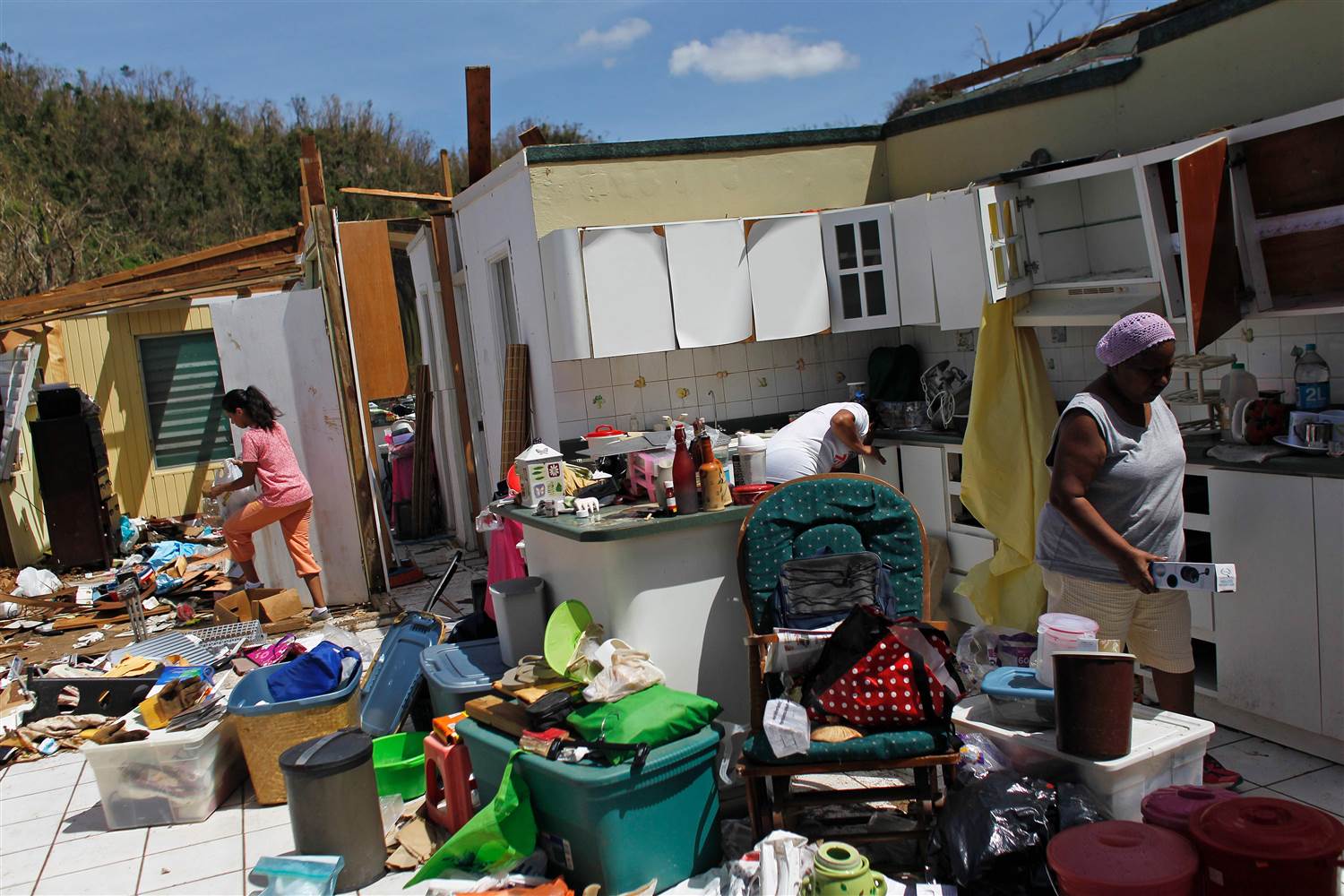
Puerto Rico is an instructive case. It’s not like parts of Bangladesh, Houston, or Miami, i.e. part of a larger territory into which our perception of its suffering can be subsumed. It’s isolated, so presents a very stark test case of whether or not we actually give a flying fuck about our future. If we don’t respond to calls like that of the Mayor of San Juan, and not just with donations but with political action, we are truly lost. Every city on earth will face similar existential crises,often part of bigger ones, like the coming wave of crop failures. The market – the rising price of food and energy, which some are lucky to be able to afford – will only protect us so far. Its not just that our current leaders will let us starve or drown, they will actively ignore our plight just as they denied the circumstances that made it inevitable. We have to recognise that what is happening in Puerto Rico is a climate catastrophe, part of a much larger and even deadlier global transformation, and act accordingly by making sacrifices on behalf of those already suffering and by getting rid of political leaders who refuse to even acknowledge the nature of the crisis. We must build local and international solidarity networks and demand that those we elect to govern our cities develop infrastructure to withstand the inevitable. If we don’t do these things, there will be no one left to speak up for us.
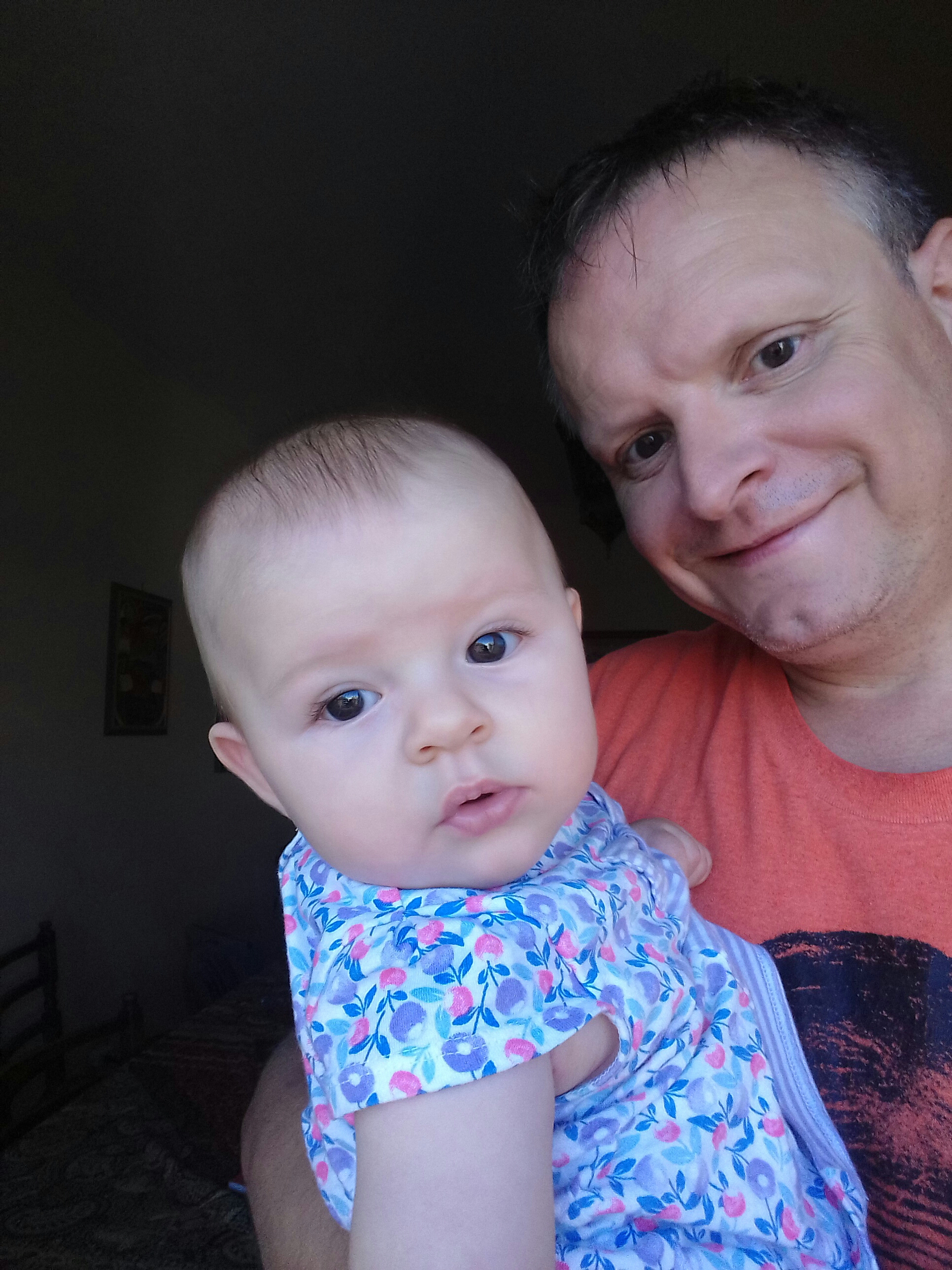
Human beings only really come into existence in the own right following nine months of total dependence on their mothers. Nine months is therefore a significant enough milestone to blow up balloons, eat cake with lots of sugar and ice-cream (us, not her) and make playlists. As it happens, our daughter was actually born eight months today, but this site has a tradition of celebrating anniversaries on the wrong date, and in any case I just had the idea for creating a playlist and I don’t have the patience to wait another month. Plus it turned out that I can only (just) think of eight birthday-related songs I like*.
The Beatles – Birthday
So far she’s tended to turn her tiny piggly-wiggly nose up at the “White Album”, but this is a lot jollier than ‘Happiness is a warm gun’, plus the beat is very uniform and she loves banging her arms up and down like a totally demented (if very young) Herbert von Karajan.
Altered Images – Happy Birthday
She’s not quite old enough to remember either Altered Images or ‘Gregory’s Girl’, but then neither is her mum. Actually, speaking of ‘Gregory’s Girl’, people did used to tell her dad (me) that he (me) was a dead ringer for the film’s star, and given that everyone who sees our daughter immediately exclaims that she looks just like me, we have the dubious honour of having a baby daughter who looks exactly like John Gordon Sinclair.
Stevie Wonder – Happy birthday
This would make a far better US national anthem than that godawful self-aggrandizing dirge, which, let’s be honest, is more likely to make you lie down and go to sleep than stand to attention. Plus the Stevie Wonder version expresses far more laudable sentiments, with which no sane person could reasonably disagree. Also, at eight months our daughter is just getting to the point where she can actually (like Stevie himself) #taketheknee.
The Sugarcubes – Birthday
At this point in the testing of the playlist, our daughter starts actually singing along with gusto. Or she could just be in need of milky-wilky. Either way, she seems to know all the words. Maybe she’s been speaking Icelandic for the last few months, and we haven’t noticed.
The Birthday Party – Release the bats
Again, slightly before her time, and not in any sense a birthday song, but you will notice the presence of the b-word in the name of the band, and her dad’s been listening to a lot of Nick Cave recently because there was a rave review of one of their gigs in The Guardian. Plus as she likes The Sugarcubes she might go for the screeching and the atonal elements in this one. Hard to tell, cos her mum took her off to her grandma’s place, muttering something about ‘torturando tua figlia con questa musica di merda’, which sounds bad.
Pedro Infante – Las Mañanitas
A change in tone from the previous one. My wife always gets embarrassed when I explain that the reason our daughter has a Mexican name is that she was conceived in Mexico. She prefers explanations which involve cicogne. If we were still living there our daughter would be hearing and singing this all the time, as it’s the Mexican version of ‘Happy Birthday’. I do know all the words, just not all in the right order.
Rafaelle Carrà – Tanti Auguri
This is the Italian birthday/wedding disco anthem of all time, to the extent we had it on our own wedding playlist. That of me and my wife, that is. Not me and my daughter. That would be…odd, even in the south of Italy.
Heaven 17 – (We don’t need this) fascist groove thang
You can probably tell that I really was running out of birthday-related favourites at this point, but then Spotify handily suggested including this, which is sort of appropriate, as she was born nine days after Tr*mp’s inauguration. On the one hand I’d hate it if his name was her first word, but at the same time I have been teaching her the word whenever she does one. Two more reasons to choose this song: 1) It is, like her dad (me) from Sheffield and 2) Current pedagogical theory suggests that it’s best to introduce the existence of (unnecessary) brackets to one’s child sometime between the eight and ninth months.
* ‘Birthday Girl’ by Stormzy was a candidate for inclusion, but on mature reflection I decided that its many references to ‘birthday sex’ were…inappropriate.
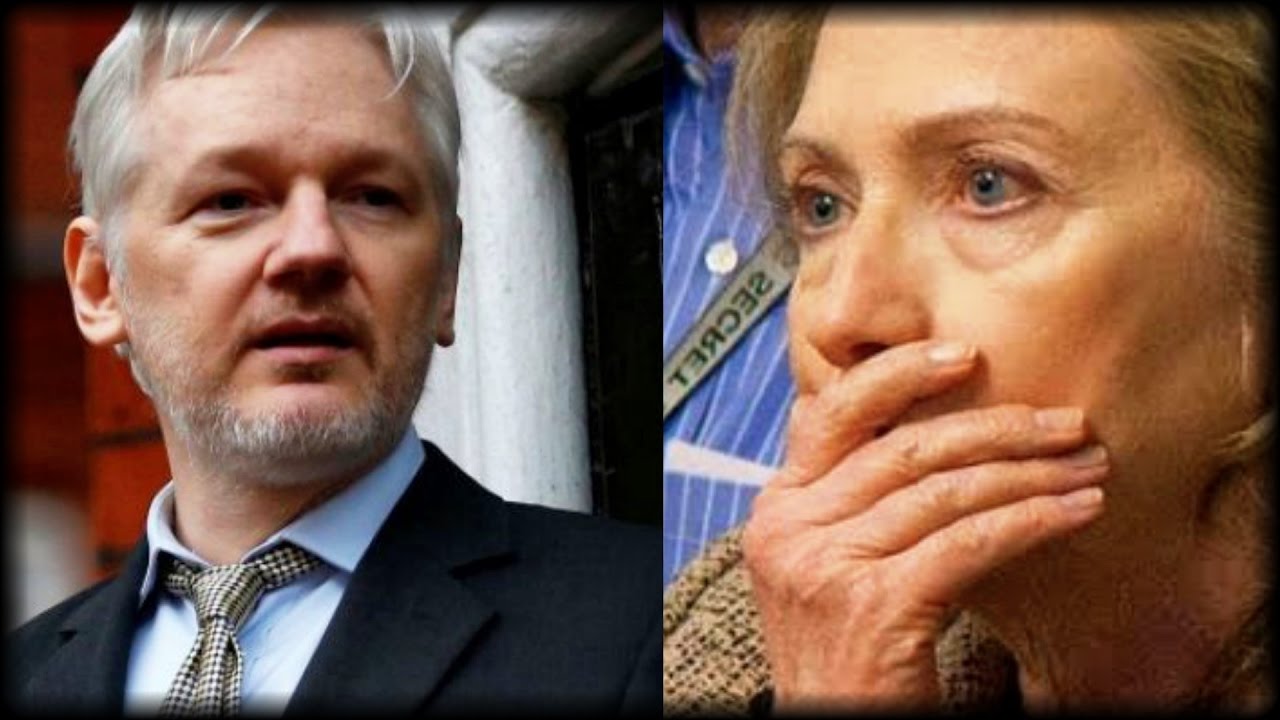
At a press conference Friday morning, Wikileaks founder Julian Assange revealed ‘astonishing’ details of how, in the run-up to last year’s election, prominent supporters of Democratic Party candidate Hillary Clinton exchanged emails with one another in which they discussed her chances of success and expressed hope that she would defeat Donald Trump.
He then went on to highlight a number of other aspects of the Clinton campaign which he said would ‘shock to the core’ anyone who thought that she was ever a suitable choice for President of the United States.
Amongst other allegations, Assange detailed the following:
Clinton ‘doesn’t have a winkle’, but rather ‘some sort of front bottom’.
She has, on at least one occasion in the past, ‘done it with a boy’ (at this point in the press conference Assange giggled uncontrollably behind his hand for several minutes while other representatives of Wikileaks looked at their shoes and appeared to be experiencing considerable embarrassment).
The former candidate, said Mr Assange once he had composed himself and been given a drink of Ribena, has, in the past, ‘done a big poo’. (At this point Mr Assange went bright red and fell off his chair, appearing to bang his head with some force on his playpen. He then began crying rather loudly and had to be comforted by a member of the Wikileaks team who, between sobs, he referred to as ‘Nanny’. He then made a final, whispered statement in which he explained that he had ‘done wee-wee’, and the assembled journalists were requested to vacate the playroom so that he could be cleaned up and, in the words of another member of the Wikileaks staff, allowed to spend some time ‘playing with his computer’.)
I’ve been living in Italy now for a year, and on the whole I’ve been made to feel very welcome. No one has put pressure me to go back to my own country or suggested that I’m exploiting essential services that should be reserved for locals, even though during that time my wife and I have smuggled into the country a basically infirm member of our family, one who has no concept whatsoever of hard work, has made no apparent progress in learning the language and appears to have who does nothing but use up vital resources. If it wasn’t for the amount of panolini our baby daughter gets through, Rome’s garbage disposal crisis could be solved at a stroke.
The kind treatment afforded to my family might be considered odd, given that Italy is currently undergoing a wave of xenophobic fervour, one that (for me) recalls the deeply unpleasant events in late 1990s Ireland. Within a few months from around late 1997 onwards, as a result of tabloid campaigns aimed at the small numbers of refugee claimants then starting to arrive (sample headline from The Irish Independent: ‘Asylum scroungers fake ‘torture’!’), black people were getting screamed at in supermarkets and bus queues. Thankfully, nearly a generation later, Ireland appears to have comprehensively pushed back such attempts to turn it into a famously unwelcoming country.
In neither Ireland nor Italy have I, as an immigrant, faced similar treatment. Did I happen to mention that I’m white? Of course, most Italians would not knowingly discriminate against people on the basis of their skin colour. Like Ireland, Italy has a long history of emigration, a history of ethnic diversity going back to the Roman Empire and also a more recent one of massive internal migration. But brutal discrimination against people of apparently different backgrounds does exist, and it is coming from somewhere.
That discrimination partly manifests itself in relation to housing. In my time here there have been at least two front-page stories from my adopted city (Rome) in which locals have (apparently) refused to let people with black skin live in their midst. A few months ago an Italian-Moroccan family, one which has been based in Italy for several years, was prevented from taking up public housing assigned to them. Today, Repubblica reports on the plight of an Italian-Ethiopian family, similarly stopped from moving into their new home by a mob of angry ‘locals’ and a certain number of increasingly familiar faces egging them on.
There is a context for these events, specifically in terms of the numbers of recent arrivals. Italy and Greece are being used as corridors by the EU, much like the ones overcrowded hospitals will stick patients in when there’s no more space in the wards. As it happens, there’s lots of space in Europe for newcomers, but, with the odd noble exception, there has been a lack of political will to point that fact out. The human cost of recent waves of migration is not actually borne by Italians, but by the migrants themselves, prevented by the authorities from settling down and by other EU countries from moving on. (A very detailed and moving account of this is given in the 2015 film ‘Mediterranea’.) Many newcomers would like to reach the UK, where, owing partly to the history of the British Empire, they have personal connections and/or can speak the language, which would make it easier for them to continue their lives. The refusal of the British to accept our historical and moral responsibility is utterly shameful. However, the fact that my own country has a history of racism doesn’t mean that I can’t condemn it wherever I happen to be living now.
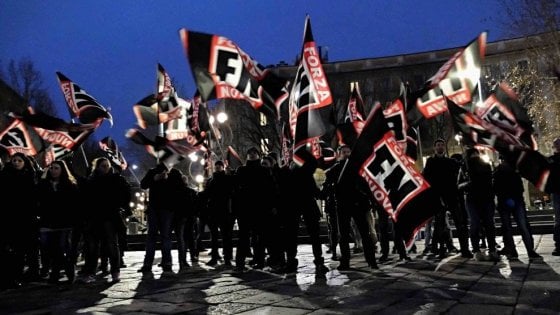
The conflicts increasingly taking place in Italy are not motivated by the newcomers themselves, but by political forces determined to misrepresent reality in order to provoke division so as to gain power. Racist politicians like Meloni and Salvini are never off the TV, spreading outright lies about the benefits paid to recent arrivals. The country’s leading opposition political figure, Beppe Grillo, makes common cause with the far-right, responding to criticism by claiming that ‘anti-fascism is not my concern‘. But its not those individuals who turn up wherever there’s an opportunity for aggro. Any visitor to Rome will notice the hateful posters of the openly nazi group Forza Nuova, whose thugs were behind yesterday’s racist protest in Rome. Another group which openly boasts of terrorising immigrants and their supporters occupies a substantial building in the centre of Rome. Above the entrance the name of the organisation is engraved in a pathetic pastiche of Mussolini-era iconography. Just like their counterparts in the US, the UK and Germany, such groups hate their ‘own’ country. One of their piccolo fuhrers is even on record as calling the anti-fascist partisans of the Second World War ‘rapists’. Their objective is the same as that of Isis: to divide people using violence and the threat of violence in order to gain power. It behoves all immigrants, regardless of our status or the colour of our skin, to speak out against them just as we condemn other forms of terrorism. Italy is, in the words of Cesare Balbo, “a multiracial community composed of successive waves of immigrants”, with “one of the most mixed bloodlines, one of the most eclectic civilisations and cultures which there has ever been”. For all the absurd pretensions of Forza Nuova and Casapound, it is not and never again will be a fascist country – alle fine, è il nostro paese, non il loro.
Having been a teacher for almost twenty years, I know that the classroom can be a frustrating place to teach and learn, and I’ve seen how easy it is to become bitter about the whole process and concept of education. Dealing with racist, lazy or wilfully ignorant students is a strain, and the staffroom can be a uniquely cynical place. There’s the constant cliché of teachers complaining about their students. All my students are so unmotivated, uninspired and hostile to the very idea of learning, teachers complain. All your students?, I think. What’s the common denominator? Then, the next day, I find myself moaning in much the same manner.
I’ve had little contact with the world of mainstream education, meaning I’ve avoided for the most part having to deal with both the classroom management of recalcitrant teenagers and the implementation of ever-innovative forms of bureaucracy designed to reduce education to the imparting and absorption of SOW-dictated lesson content. I’ve escaped all the immensely frustrating and tiring rigmarole of box-ticking and hoop-jumping of the Age of Ofsted (which now I come to think of it does sound like a character from The Handmaid’s Tale). Nevertheless, working mostly in the field of private language education, I have witnessed the way in which it is increasingly thought of and programmed as and like a business, with the teacher as mere service provider overseeing the delivery of the kind of content which can be easily converted into measurable and marketable spreadsheet data, with schools (and, increasingly, universities) desperate to guarantee students a specific level and speed of progress. Thomas Gradgrind would be delighted to see just how much the system is deigned to make students and teachers knuckle under; Paulo Freire, on the other hand, would turn in his beard.
Such system places immense pressure on the emotional, physical and social security of both students and teachers. While the mass abandonment of the teaching profession is a demonstration of just how hard it is for both teachers to maintain motivation, students find their own ways to drop out, either morally or physically, making the tasks of teaching and learning even more demanding. Secondary classrooms thus become environments where it takes immense emotional strength to even breathe. Who would willingly throw themselves into such a cauldron? As it happens, from next week I’ll be back to teaching secondary school teenagers for the first time in many years. On the one hand, the prospect terrifies me; on the other, I do kind of think what kind of teacher are you really if you can’t teach children?
I’ve long stuck by the adage that if you’re not learning, you’re not teaching. Education involves the building of a relationship, a mutual sharing of knowledge and experience rather than the mere handing-over of merchandise. Two preconditions for this to take place are respect and empathy, especially in mainstream education when dealing with kids from extremely challenging backgrounds. The teacher has to demonstrate a convincing interest in the lives and enthusiasms of the people they are teaching. Perhaps the video above (which was made in 2010 and very quickly went viral) shows us one example of how to achieve that. It’s certainly entertaining and enjoyable.
However, some things about the rap battle make me uncomfortable, starting with the way it’s framed: Teacher vs student. My reservations have been encapsulated in the form of a poem (part of a longer piece called (‘SOME VIOLENCE)’ by (ironically) my former poetry teacher, Wayne Holloway Smith, whose collection ‘Alarum‘ features class, masculinity, education and violence as central themes. His poem begins:
‘On YouTube an educated man is telling teenager that he is uneducated and will never amount to anything’.
In watching the video, it’s impossible to set aside this question of status. The confrontation is not, even for a second, a battle of equals. With immense wit and charm, the teacher patronises the student, divesting him of his self-definition as articulate, in control of language. He does so (argues the poem) on behalf of a State whose main function is to force him to value himself in its terms, to see himself through its eyes, to discipline and direct his energy, explicitly telling him:
‘Let me introduce you to the value inside the language of my particular group: I am better than you’.
The students is thus subjected to authority’s withering gaze and found wanting: ‘You’ll never amount to anything’. It is the teacher, not the student, who is ‘articulate, witty‘, who teaches him a lesson, which is that: ‘this language (that which the teacher, ‘wearing a suit and his hands casually in his pockets‘, commands) finds you ridiculous’.
Bourdieu’s notion of symbolic violence (itself an example of the kind of intellectual capital which the teacher has access to, and the student doesn’t) is brought to life in the following part of the poem, in which a bull is tormented by ‘a showground of people making it mean to them violence‘, forcing it to recognise itself through their eyes:
and the slow-breathing creature is thinking pulling this name Bull in and out of its nostrils
and the man understands the creature further with flailing arms helps it to understand itself with pit-sand thrown in its eyes
and OK suddenly it understands
the man: for a moment, a pulsing orgasm, lust hung in the air cue: screaming; cue: the world has realised it was right all along cue: the animal being taken to a place where they can correct its evil by sword
Mark Grist (like Kate Tempest, a poet who became a rapper) addresses some of these aspects in a comeback in which he expressed his frustration and anger at the way the video was presented online and in the media as a morality play. I understand his anger, but agree with Wayne Holloway Smith in that I think the form lent itself to that interpretation. There’s largely where its entertainment value (and certainly its online appeal) came from. Both combatants employ sexism and threats of violence, but Grist’s is knowing, informed by ironic distance in the form of jocular self-awareness, whereas (in the words of the poem) ‘when the teenager responds it is cliché‘. The teacher (and, by extension, the audience, drawn to the video by the promise of seeing foolish aspirations brought down to earth, ‘bound to agree‘ with its conclusion) provokes vile attitudes from the student, responses that confirm what we ‘know’ about such people, much like the treatment of the bull in the next part of the poem.
Despite my sense that the format of the rap battle between teacher and teenager was inherently problematic, Grist’s solo poems, which often draw and reflect on his experience as a teacher led onto, are often hugely compelling. I found this one deeply affecting:
It forced me to reflect on some of the more unpleasant episodes of my teaching career, those moments when my response didn’t match up to my ultimate responsibility for a student’s emotional well-being. The poem confronts both the classroom and the staffroom at their most bleak and difficult. Like many poems, it’s a novel condensed into two minutes, humanising its subjects in a way that reminded me of a passage from a recent George Saunders article about writing fiction:
When I write, “Bob was an asshole,” and then, feeling this perhaps somewhat lacking in specificity, revise it to read, “Bob snapped impatiently at the barista,” then ask myself, seeking yet more specificity, why Bob might have done that, and revise to, “Bob snapped impatiently at the young barista, who reminded him of his dead wife,” and then pause and add, “who he missed so much, especially now, at Christmas,” – I didn’t make that series of changes because I wanted the story to be more compassionate. I did it because I wanted it to be less lame.
But it is more compassionate. Bob has gone from “pure asshole” to “grieving widower, so overcome with grief that he has behaved ungraciously to a young person, to whom, normally, he would have been nice”. Bob has changed. He started out a cartoon, on which we could heap scorn, but now he is closer to “me, on a different day”.
How was this done? Via pursuit of specificity. I turned my attention to Bob and, under the pressure of trying not to suck, my prose moved in the direction of specificity, and in the process my gaze became more loving toward him (ie, more gentle, nuanced, complex), and you, dear reader, witnessing my gaze become more loving, might have found your own gaze becoming slightly more loving, and together (the two of us, assisted by that imaginary grouch) reminded ourselves that it is possible for one’s gaze to become more loving.
Or we could just stick with “Bob was an asshole,” and post it, and wait for the “likes”, and for the pro-Bob forces to rally, and the anti-barista trolls to anonymously weigh in – but, meanwhile, there’s poor Bob, grieving and misunderstood, and there’s our poor abused barista, feeling crappy and not exactly knowing why, incrementally more convinced that the world is irrationally cruel.
What should education do but make us into humans, i.e. people who are ready to grant each other the status of fully-realised characters with our own specific experiences, memories and complexities? Surely our job as teachers is to help our students see that the world need not be as ‘irrationally cruel’ as it appears to be. I hope that I’m up to the challenges of the next few months, and don’t fall back on the self-serving cliché that it’s the students, not their teacher, who lack energy, imagination and motivation.
Around 15 years ago it became commonplace for anyone who spoke up in defence of basic human rights to be posed the following hypothetical dilemma:
You say it’s always wrong to torture people. That’s fair enough. But what about terrorists? What if the authorities somehow knew that a captured suspect was planning to blow up an entire city? Wouldn’t it be morally right to put pressure on such a terrorist in order to save millions of lives?
Of course, such questions were a red herring. There never has been or could be such a textbook case. No authority could claim foreknowledge which allowed it to abandon universally agreed principles of respect for the judicial process and for human rights. That doesn’t mean they don’t try, and this ubiquitous theoretical challenge to the foundations of human rights – at every level of culture, from the front page of Newsweek to ten or so series of the TV show ’24’ – was accompanied by a very non-theoretical assault on those principles, most spectacularly in Abu Ghraib and Guantanamo Bay. This is how we arrived at the point where the most powerful political figure in the world can openly instruct police officers to exceed the bounds of legal conduct in the treatment of anyone they don’t like and/or suspect of (potentially) committing a crime.
As the previous paragraph made clear, I believe that human rights are inalienable. No authority has the right to exclude any individual from fair judicial processes or to negate their physical existence.
But there’s something about the current conjuncture which I find puzzling. The most powerful position in the world, one that grants immediate access to weapons that could annihilate human existence at the touch of a single button or at the posting of a single tweet, is in the hands of a man who is deeply psychologically, mentally and emotionally unstable, has no moral scruples which might serve to regulate his impulses, and no meaningful understanding or apparent sense of the consequences of his actions for either his morally hideous family or the entire human race. He has also repeatedly demonstrated that he has no respect whatsoever for the vast majority of that which his compatriots hold most dear, including – particularly if they happen to be black – their lives. This in a country which has huge numbers of very heavily-armed individuals who have been brought up by Hollywood movies to believe that it is right and good to use violence, up to and including self-sacrifice, to redress the moral balance of the universe, and that God has uniquely anointed the American people with this redemptive task.
As I say, I personally don’t believe in political violence, and I don’t believe that any institution or individual has the right to deprive anyone else of life. There are, however, many people who do believe such things, and who have the means and motivation to act on their beliefs, on our behalf.
(P.s. I’m well aware of the argument that those who focus on Trump as the exclusive source of the world’s problems and ignore the brutal history of American imperialism are guilty of naivety. As it happens, such notional individuals are not nearly as naive as those who, like Glenn Greenwald, argue that those who focus on Trump as the source of the world’s problems and ignore etc, etc, etc are patronising. Greenwald was, until recently, a fine and principled journalist; now, he’s working for the other side.)
Berlin: The newly-reelected German Chancellor Angela Merkel is facing increased pressure to revise her government’s stance on murder in the wake of the Bundestag election results. The formerly marginal AFM (Allianz für Mörder) party achieved almost 13% of the votes and will take seats in parliament for the very first time.
Mrs Merkel, who was reelected with a vastly reduced majority, will need to govern with the help of smaller parties. Germany’s second political force, the SPD, experienced a dramatic fall in its vote share and the Greens and left-wing Die Linke party were unable to match the performance of the AFM, particularly in the increasingly pro-murder east of the country.
Mainstream German political parties have maintained a solid consensus on the issue of murder throughout the post-war period. However, the success of the AFM, which believes that murder should be legal when the victims happen to have been born outside Germany and/or have different colour skin, will challenge this unanimity.
The Deputy Leader of the AFM, Beatrix von Storch, is granddaughter of the Finance Minister in the pro-murder government which ruled Germany from 1933 to 1945. She is a particular advocate of the murder of immigrant children, while party founder Bernd Lucke is said to be a close personal friend of the Anglo-German political figure Nigel Farage and a strong admirer of British murderers such as Dr Crippen and Fred West.
In response to the results, the BBC Radio 4 Today Programme has reported that it is now incumbent upon Mrs Merkel to respond to the concerns of AFM voters by relaxing what many see as excessively stringent regulations governing murder. It then broadcast a ten-minute interview in which someone who believes it should be legal for the government to murder people on the basis of their ethnic background was allowed to explain the reasoning behind her position.
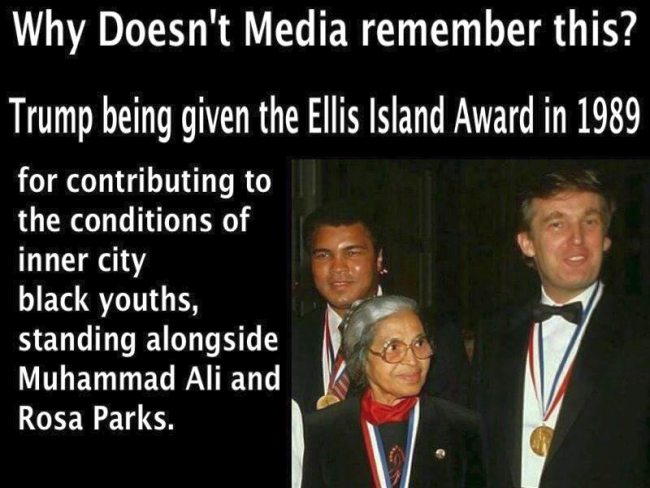
There are numerous photos in existence which show President Donald Trump in the presence of black people. Were he racist, he would have refused point-black to ever have his photo taken with any black people, punched them in the face and rapidly walked away from the camera. No racist on earth would ever think of not doing that, and it is absolutely inconceivable that Donald Trump could combine lifelong racist beliefs and behaviours with the occasional cynical photo opportunity for PR purposes. It’s also definitely the case that any black people who have been in shot whenever a photo of Donald Trump has been taken can be considered to have granted him unqualified support for anything he has ever said or done and will ever say or do. It’s like he owns them.
A huge number of notable black people have expressed enduring respect for President Trump. Muhammed Ali called him ‘the greatest anti-racist activist that the world has ever seen’ on at least seventy-seven separate occasions, while Rosa Parks requested that the words ‘I would never have had the courage to sit at the front of the bus if it hadn’t been for the brave and principled leadership provided by President Donald J. Trump, truly the first black president’ be chiselled on her gravestone. Rapper Chuck D even named his first three children Donald in tribute to President Trump. (N.B. Although there is no actual evidence of any of these things being true and it may well appear that we have made all of them up on the spot, we refer you to points 3, 4, 8, 9, 12, 13, 19 and 20. below.)
Barack Obama once said something negative about white people, or something.
Hillary Clinton allegedly used a private email server.
The notion that Donald Trump is racist is part of a witchhunt orchestrated by the Deep State. The fact that there is no evidence suggesting the existence of a ‘deep state’ (an expression imported from Turkey) is conclusive proof that the Deep State is so powerful it has covered up all signs of its existence, (c/f ‘The Usual Suspects’). The current secret leader of the Deep State just happens to be…Lebron James!!!
Racism doesn’t exist. Albert Einstein called the very concept ‘a patent absurdity, a transparent Frankfurt School fabrication and an attempt to disguise the natural superiority of the white race’. (N.B. This quote has also been attributed to Anders Breivik.)
Slavery existed before the so-called slave trade, etc etc etc (see stormfront.org for more background on this).
Barack Obama once said something negative about white people, or something.
Hillary Clinton allegedly used a private email server.
There is nothing ‘racist’ about believing that human beings can and should be divided on the basis of genetic differences which determine their innate abilities and characteristics, that white people occupy the highest position in the racial hierarchy and that their resultant socio-economic and juridical superiority may at times need to be enforced by violence.
Donald Trump is himself married to an illegal immigrant who barely speaks any English.
Barack Obama once said something negative about white people, or something.
Hillary Clinton allegedly used a private email server.
There were some crimes in Chicago, or something. (I can’t remember the details, it was on Breitbart.)
It is President Trump’s repeatedly stated belief that heavily-armed self-declared nazis and KKK supporters bearing burning torches and screaming about the innate superiority of white people over blacks and Jews is unproblematic, even healthy, and that those who oppose racism and fascism are terrorists who deserve to be met with extreme force. Those who connect these beliefs with his family history of KKK affiliation and a series of 1970s court cases which conclusively proved that his family business systematically discriminated against black tenants, add in the fact that he used to keep a copy of Adolf Hitler’s speeches by his bedside, and draw the conclusion that he is and always has been racist, are somehow, for reasons we prefer not to go into, missing the point.
Barack Obama once said something negative about white people, or something.
Hillary Clinton allegedly used a private email server.
Purported recordings of President Donald Trump repeatedly using the N-word while filming The Apprentice has been hidden by the series’ producer, a confirmed Trump supporter, so no one needs to worry about that. Phew.
Barack Obama once said something negative about white people, or something.
Hillary Clinton allegedly used a private email server.
President Donald Trump is clearly absolutely massively racist, but his supporters can’t admit this to others or themselves, so they run around in circles performing logical somersaults, making up bizarre lies on the basis of utterly implausible hearsay and humiliating themselves beyond repair.
I don’t just mean politically. Obviously he’s playing the wrong role, was swept into office on a frothing white tide, and is now a demented puppet of forces he couldn’t even begin to understand. I mean literally.
Clearly he had enough of a connection with his father to inherit his wealth and his hate-fuelled value system. But accounts of his life make clear just how insecure he is about his status in a range of fields. As President, he projects those insecurities onto others, tweeting and rabidly barking at his mirror-mirror-on-the-wall rallies about the illegitimacy of his political opponents. The force of his obsession with others’ illegitimacy was what took him to the White House. Of course, he focussed (and continues to focus) principally on Obama’s legitimacy as an American – maybe Trump, like many of his fellow racists, believes that all black people are literally bastards. As for Hillary, the fact that, as he flounders further and further out of his depth and the reality dawns even on him that he lacks even the most basic notion of what his rights and responsibilities as president are, his only consistent response is to whine about the illegitimacy of her defeat, is a clear sign that he knows that he is marooned in a role he is absolutely and uniquely ill-suited for.
I suspect that what lies underneath Trump’s almost crippling self-doubts about himself as a white heterosexual male is a fear that he is, in the deepest of senses, illegitimate. As he teeters on the edge of a full hysterical breakdown just at the moment when his emotional inadequacies may lead the world to an actual full-on nuclear fucking war, one way to send him gibbering away from the levers of power may be to state clearly to him what we all know: he is not only illegitimate as president, but also not the rightful heir to his father’s name and fortune. Not only is he pretending to be Commander-in-Chief; he is pretending to be the son of Fred Trump, and thus only pretending to be Donald J. Trump.
He tried to bring down Obama by casting down on his legitimacy, thus revealing his own Achilles’ (as he, less literate than any black high-school drop-out, would attempt to spell it) heal. Now’s the time we need to leave aside his tax returns just for a moment and ask: what are you hiding about your birth certificate, Donald? Could it be that the J actually stands for…Jamal?!
Maybe a good hashtag to use would be simply…#birther. Now, I wonder how we can go about getting Lebron James to tweet that?
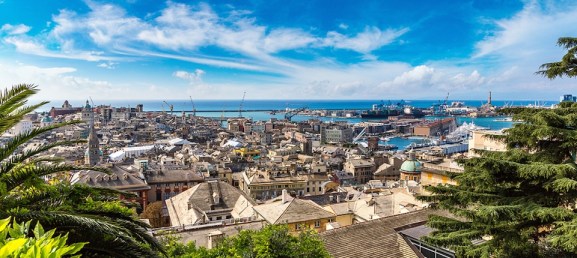
I’ve thought of Genoa as a Portuguese city ever since, in Dublin in summer 2000, I drunkenly butted into a late-night bus conversation in what I thought was some unusual variety of that language, only to find that the two people were speaking zenese, or genovese, which just happens to share some of the cadences and vocabulary of continental Portuguese. The latter may not be entirely a coincidence – history doesn’t record which languages were spoken on Columbus’s expeditions, but as he was born in or near Genoa, prepared his voyages in Lisbon and set off from Spain it must have been a mishmash. The cities thus share a history of maritime expansion, and now live in the shadow of those former glories. Genoa feels to me not so much a city I’ve never visited before as a city I’ve never got round to living in, because back in another Golden Age of Overseas Discovery, that of TEFL, when the mere accident of having been born into an English-speaking environment meant that you could, at the drop of a derisory month-long course, emigrate and earn a decent living pretending to teach English, it was spectacular images of Portugal’s second city, Porto, which drew me there. If the Guardian travel section had instead featured Genoa, I could just have easily ended up in north-east Italy. I might even have ended up marrying an Italian woman*.
Arriving in a new city involves, Marco Polo-style, recalibrating one’s impressions of all the other cities one has visited or might visit. Thus, in keeping with my assumptions, Genoa does indeed strike me as a version of Portugal’s two main cities, which are both port cities with hilltop palaces descending rapidly to medina-style alleyways. In Genoa those alleyways are called caruggi. They’re immediately reminiscent of the steep, twisting warrens of Lisbon’s Alfama or Porto’s Ribeira – and, funnily enough, they also resemble other parts of Italy, for example, the Barrio Spagnolo in Napoli, but without all the vespas which render that area so unpleasant to walk around. The fact that we arrive just before what looks like an incoming squall puts me in mind of when, in 2009, I got to Trieste, another city I’d long longed to visit. I found it to be windblown, sombre, and not all that welcoming, albeit in a way that was sort of interesting in terms of reflecting on its complex history and just what it was that James Joyce found so compelling about the place. In Genoa, after we leave the station, despite Google’s claiming that our accommodation is only 1.3 miles away, the taxi takes us on an apparently unavoidable detour through winding tunnels, and takes me back to that macabre Mexican masterpiece of Guanajuato. There is a connection, in that some of the silver adorning the palaces and cathedrals is sure to have been siphoned from the veins of the new world, as is also the case from Sevilla to Syracuse. Strolling around Genoa, it does feel a bit like a greatest hits of the best bits of large southern European cities. While some areas recall Sant Pere and Barrio Gótico, with their tiny shops that are also bars and tiny bars which are also shops, others are a little like Rome but without all the bloody tourists, with their segways, their Trump hats and their incessant f*cking pointing.
I’ve always been fond of the Spanish word accidentado (uneven, bumpy)**, which describes the layout of Genoa pretty well. Its endless hilly detours make it enjoyable to get lost in. Losing my bearings happens to be my preferred mode of getting to know a city; however, it turns out that things are different when you’re in charge of a pram. Sudden stunning vistas, cutaways though ginormous 18th century buildings right down to the sea are all very breathtaking, but the prospect of another flight of stairs is less enticing. With the skies still threatening to Do A Houston, I’m excited to see a poster advertising a showing of ‘Eraserhead’ serendipitously starting in just four minutes time; however, it proves impossible to find an impromptu babysitter among the passers-by. Later, when we find a nice, quiet place to eat, our daughter starts to behave like the proverbial drunken sailor on shore leave. She soon manages to cover herself in so much pesto genovese she’s almost indistinguishable from Kermit, but with the personality traits of a young Miss Piggy. When, about 20 minutes into this mortifyingly messy and noisy farce,another couple-with-baby arrive, the proprietor quietly sends them back out into the pouring rain, claiming that he’s all booked up for the next month and a half. Then he disappears, possibly to shoot himself in the head.
The following day we explore the Museum of Maritime History, which is so huge and detailed it’s like standing and reading a six-volume series of books, each with 800 pages for each year of the city’s existence. After two hours we’ve managed to cover two of the five floors and are too exhausted to tackle the part about immigration, which is the bit that drew us there in the first place. The captions employ a curious Verfremdungseffekt, in that they present PhD levels of historical analysis written in often purple prose presented in the kind of lighting more appropriate for sending a baby to sleep, which thankfully, eventually, it does. By the time we head off in search of gelati and fasciatoi we’re left in no doubt whatsoever that a) being a galley slave was really not very much fun at all and b) Christopher Columbus definitely did come from Genoa and not, as some have claimed, just outside Swansea.
One more recent person of global significance that doesn’t exactly cover the city in gloria isthe renowned comedian/trickster/drunk-driver Beppe Grillo, leader of the at-best-incoherent at-worst-openly-racist 5 Star Movement. His blog has been called Europe’s number one source of fake news stories, navigating us to a brave new world where nothing is true except for what’s published on certain implicitly trusted highly ideological websites. His influence helps explain why newspapers are full of stories about parents withdrawing their children from school so that they don’t get forcibly injected with chemtrails. Grillo emerged in the same decade as a more laudable local character: Fabrizio de André, whose classic album ‘Crêuza de mä‘ (roughly, ‘Crossing the sea’) gives the name to a beachside bar we visit in the picturesque beachside suburb of Boccadasse***. The album, with its genovese-dialect North African-influenced songs about lives lost at sea, resonates; as we walk around Genoa, we see graffiti in support of those who have more recently been forced by circumstances to seek a better life elsewhere.
Such solidarity recalls another famous episode in Genoa’s history: July 2001, when the city played host to massive anti-globalisation demonstrations focussed on the G8 summit. That spirit very much lives on in and around the carruggi. There is some remarkable anti-gentrification graffiti. One such slogan calls for the immediate expulsion of the ‘creative middle class’. There are posters for a Right to the City conference, slogans condemning the immigration authorities and opposing deportations, and graffiti referring to the recent alleged rape by carabinieri police of a young tourist. Genoa sees some cruise ships but not as many as Barcelona, where tourists themselves have been the focus of furious protests. The area (called, I think, Madalena) looks a lot like a busier version of Alfama, particularly because this week I’ve been following Momus’s escapades in Lisbon, a city which some are calling ‘the new Berlin’. It reminds me that in the fifteen years since I left Lisbon it has also changed, with the arrival of new waves of tourists and gentrifiers and the settling-in of new immigrant communities****.
It’s only a few steps away from the emblematic museum-like streets with their 18th-century palaces and ‘lifestyle stores’ that we happen upon some of the more vibrant side-streets. There seems to be more variety of immigrant groups than I’ve found in similar cities, for example Bilbao. Visa services are on offer to quite a range of language speakers: Arabic, Chinese, Vietnamese, Bengali and Welsh (possibly not Welsh); Latin American sex services are available to tutti quanti. There are some African tailors’ shops which seem to come straight from the streets of Kinshasa. We come across one lively bar where there seems to be a very energetic argument going on between Columbians and Venezuelans. It’s our last night, and I never could resist the lithesome rhythms of bachata, so we quickly load up on cheap rum, sell the baby to some passing zingari, and start to make the most of what’s left of our short holiday. Tl,dr: I’ve been to Genoa, it’s good, you should go there too, adesso scappo a cambiare la bimba.
* Piuttosto che una terrona :-P. **Apparently, unsurprisingly, the word also exists in Italian. *** I was first introduced to the music of both Fabrizio de André and (much to my wife’s chagrin) Franco Battiato by a visiting friend of a friend around ten years ago. I’m currently passing on the favour to our seven-month-old daughter, who seems to respond positively to the particular melange of melodies, instruments and rhythms of ‘Crêuza de mar’. Or it could just be that she secretly understands zenese. The fact that most Italians had to turn to the translations of the lyrics (included with the original album) in order to figure out what the songs were about suggests to me that genovese is, like a number of regional cosiddetti variations on Italian, not actually a dialect, but rather a language.
**** Dublin has also changed a great deal since I left.


 Infinite Coincidence